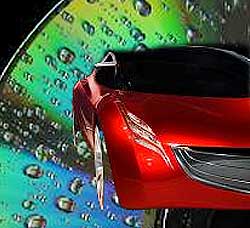
 Now, many people probably haven’t heard about laser hydride compact disc (CD) storage before. I know that I hadn’t before I stumbled across a company called Plasma Kinetics.
Sure, there are many ways to store hydrogen including metal hydride containers which can be quite heavy, compressed hydrogen tanks which are extremely insulated and built to withstand leakage and impact. Some of these tanks are built out of metal alloys and others out of more expensive carbon fiber.
But, Plasma Kinetics has come up with a novel way to store hydrogen for cars that can reduce the weight of the storage tanks by as much as 400 lbs as compared to a conventional automobile and 500 lbs as compared to a Tesla Roadster.
The novel approach is to use Laser hydride CD storage. What this means is that a hydrogen car owner will refuel their vehicle at a regular hydrogen fueling station. The compressed hydrogen fuel will flow into the car and microwaves will ionize the H2 onto CD, similar to what we would put into a CD player in which to listen to music.
And much like the process of listening to music, the device would use a laser to release the hydrogen on demand from the magnesium CD as the car needs it for fuel. The CD’s would be stacked in a series and could provide a range of over 300 miles for the average hydrogen fuel cell car.
Plasma Kinetics is currently displaying their laser hydride H2 storage device at the U. S. Department of Energy’s Arpa-e Summit, which was developed to showcase leading edge and breakthrough clean energy technology. Plasma Kinetics is currently looking for investors to bring their product to the next level of development.