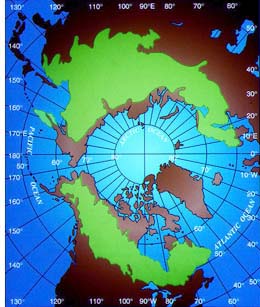
Also characteristic of the boreal forest are innumerable water bodies: bogs, fens, marshes, shallow lakes, rivers and wetlands, mixed in among the forest and holding a vast amount of water. The winters are long and severe while summers are short though often warm.
Forests cover approximately 19.2 million square miles (49.8 million square kilometres) – (33%) of the world’s land surface area. They are broken down as follows:
|
mil. sq. mi.
|
mil. sq. km.
|
|
|
|
||
|
Boreal Forests
|
6.4
|
16.6
|
|
Other Forests
|
12.8
|
33.2
|
|
|
||
|
Source: The World Bank 1996
|
||
|
|
||
|
|
||
|
Country
|
Total forest area (millions of ha.)
|
Percentage of global forested area
|
|
|
||
|
|
764
|
22
|
|
|
566
|
16
|
|
|
247
|
7
|
|
|
210
|
6
|
|
|
134
|
4
|
|
|
116
|
3
|
|
|
113
|
3
|
|
Nordic countries
|
53
|
2
|
|
All other
|
1239
|
36
|
|
|
||
Soils in this forest are called podzols, from the Russian word for ash (the colour of these soils) and their development podzolization. Podzolization occurs as a result of the acid soil solution produced under needleleaf trees. This means that iron and aluminum are leached from the A horizon, and deposited in the B horizon. Clays and other minerals migrate to lower layers, leaving the upper one sandy in texture.
Because of the low temperatures, decomposition is fairly slow, and soil microorganism activity limited. The highly lignified needles of the dominant trees decompose slowly, creating a mat over the soil. Tannins and other acids cause the upper soil layers to become very acidic, and the permanent shade from the evergreen trees keeps evaporation to a minimum, and the soils are often wet. In some cases they are waterlogged nearly all year. This tends to limit nutrient cycling, compared to more southerly forests.
Major plant species
By far the most dominant tree species are conifers which are well-adapted to the harsh climate, and thin, acidic soils. Black and white spruce are characteristic species of this region along with Tamarack, Jack Pine and Balsam Fir. Needleleaf, coniferous (gymnosperm) trees, the dominant plants of the boreal biome, are a very few species found in four main genera – the evergreen spruce (Picea), fir (Abies), and pine (Pinus), and the deciduous larch or tamarack (Larix).
In
Broadleaf deciduous trees and shrubs are members of early successional stages of both primary and secondary succession. Most common are alder (Alnus), birch (Betula), and aspen (Populus).
It is now recognized that so-called climax communities in the boreal undergo an approximately 200-year cycle between nitrogen-depleting spruce-fir forests and nitrogen-accumulating aspen forests.
The conical or spire-shaped needleleaf trees common to the boreal are adapted to the cold and the physiological drought of winter and to the short-growing season:
- Conical shape – promotes shedding of snow and prevents loss of branches.
- Needleleaf – narrowness reduces surface area through which water may be lost (transpired), especially during winter when the frozen ground prevents plants from replenishing their water supply. The needles of boreal conifers also have thick waxy coatings – a waterproof cuticle – in which stomata are sunken and protected from drying winds.
- Evergreen habit – retention of foliage allows plants to photosynthesize as soon as temperatures permit in spring, rather than having to waste time in the short growing season merely growing leaves. (Note: Deciduous larch are dominant in areas underlain by nearly continuous permafrost and having a climate even too dry and cold for the waxy needles of spruce and fir.)
The severe winters, and short growing season, favour evergreen species. These trees are also able to shed snow in the winter, which keeps them from breaking under the loads, and to begin photosynthesis early in the spring, when the weather becomes favourable.
Muskegs – low lying, water filled depressions or bogs – are common throughout the boreal forest, occurring in poorly drained, glacial depressions. Sphagnum moss forms a spongy mat over ponded water. Growing on this mat are species of the tundra such as cotton grass and shrubs of the heath family. Black spruce and larch ring the edge. Sphagnum moss may enhance the water logging – once established, it has the ability to hold up to 4000% of its dry weight in water. It often limits what species can establish once it gains a foothold. Some of the trees can reproduce by layering, since the probability of seeds germinating are low.
Larch forests claim the thin, waterlogged substrate in level areas underlain with permafrost. These forests are open with understories of shrubs, mosses and lichens. In
The North American boreal forest offers breeding grounds to over 200 bird species, as well as being home to species such as Caribou, Lynx, Black Bear, Moose, Coyote, Timber Wolf and recovering populations of Wood Bison.
Herbivores have to cope with highly lignified food, which is hard to digest. Moose are common large herbivores in the boreal. Caribou use the forest for shelter in the worst parts of the winter. Moose (Alces alces, known as elk in
The beaver (Castor canadensis), on which the early North American fur trade was based, is also a creature of early successional communities, indeed its dams along streams create such habitats.
Bear are abundant in the boreal, along with wolves (where they haven’t been exterminated). Snowshoe hares and lynx, which have unusually large feet to walk across snow, are common throughout the eco-region.
Fur-bearing predators like the lynx (Felis lynx) and various members of the weasel family (e.g., wolverine, fisher, pine martin, mink, ermine, and sable) are perhaps most characteristic of the boreal forest proper. The mammalian herbivores on which they feed include the snowshoe or varying hare, red squirrel, lemmings, and voles.
Among birds, insect-eaters like the wood warblers are migratory and leave after the breeding season. Seed-eaters (e.g., finches and sparrows) and omnivores (e.g., ravens) tend to be year-round residents. During poor cone years, normal residents like the evening grosbeak, pine siskin, and red crossbill leave the taiga in winter and may be seen at residential bird feeders.
Role of forest fire
Fire is a crucial disturbance factor in the boreal ecoregion. It facilitates the destruction of old, diseased trees along with the pests that are associated with those trees. Many animals are able to escape natural fires and some trees such as aspen and jack pine actually require fires to stimulate their reproductive cycles. Furthermore, the nutrient-rich ash left behind helps fuel plant growth. A patchy mosaic of plant communities left in the wake of fire action provides the variety required to sustain different species of wildlife.
Fire, which removes the lichen from the ground, can severely impact caribou but favours moose, which browse on the advance growth (new saplings) that emerges after the fire. As human populations encroach on this remote forest area, they increase the frequency of fires, and caribou populations decline.
Although the population in this ecozone is relatively sparse, there are many small communities which rely on various resource extraction industries such as forestry and mining. Unless they diversify, their existence is extremely tenuous, often relying on one mill or mine as their economic mainstay. For generations, the boreal forest has also been home to First Nations people including, in
The “high mineral potential” in this region is also very problematic. Specific concerns include the disposal of acidic effluent from tailings, containment of radioactivity and the effects of emissions from processing plants.
The construction of most hydroelectric facilities (dams) in
With these facts at hand, is the situation in the Boreal regions alarming? All in all there are problems, many of which could be ignored since the Boreal regions aren’t yet popular to fret over. Remember, at these extreme polar latitudes the forests, once cut down, take much longer to regenerate than forests that are logged in tropical regions of the planet. Some of the problems that the Boreal regions face are:
- air pollution from smelters and power plants
- radioactivity from atomic power and weapons testing
- water pollution & disruption of habitats if commercialization of a northern shipping routes become a reality
- adverse impact of new mineral and oil/gas extraction
- new threats to endangered species
Locked up in the Boreal forests are vast amounts of carbon, and their biomass is so huge and so vital that when they are in their maximum growth phase during the northern spring and summer, the worldwide levels of carbon dioxide fall and the worldwide levels of oxygen rise.
The Boreal Forests are just as important to the global ecosystem as the Tropical Forests and they should be given equal attention by all concerned with forestry and the environment. Global environmental changes, and the social, economic, and political processes of globalization that help drive the concerns, are now influencing local forest conditions and management practices.
At the same time political changes and alliances are facilitating the evolution of novel institutions and the interplay between institutions from different governmental levels. Some of these are clearly aimed at facilitating further exploitation of forest resources and promoting economic development, whereas others are aimed more at controlling or mitigating some of the environmental and social impacts of these transformations.
At the international level a number of environmental regimes, like the Kyoto Protocol and the Convention on Biological Diversity, are evolving in ways that could potentially have a major influence on forest land development strategies of nations. At more local levels, decentralization is facilitating what is in some a cases, a return to more community-based rather than state-centered forms of forest management.
However, scientific understanding of the boreal forest’s significance in the carbon cycle and its role in control of greenhouse gases and impact on global climate change is incomplete. Research efforts – few and far between prior to the last decade – are increasing, particularly the Canadian-based BOREAS Project.
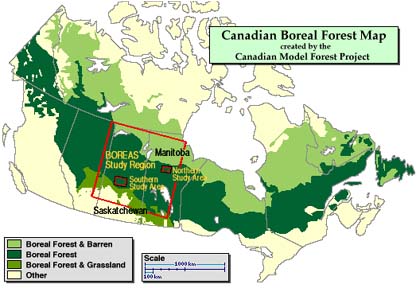

The BOREAS Project
Summary of Results
The first BOREAS field year was completed in 1993-1994. Surface flux data were collected throughout the growing season from the towers and other techniques . Over 350 research flights (remote sensing and airborne eddy correlation) were flown in support of the operation.
A surprising picture of the energy, water and carbon dynamics of the boreal ecosystem is emerging, even at this early stage in the experiment. In simple terms, the lowland forests of the boreal ecosystem in
Importantly, it has been reported that the moisture level in the moss/humus layer never gets low enough to induce moisture stress in the overlying vegetation. If this finding holds up under further analysis, it would imply that root zone moisture, a difficult variable to quantify over large spatial scales, does not exert significant control on the surface energy balance. Rather, the important variables controlling photosynthesis and evaporation appear to be soil temperature in the spring, and atmospheric relative humidity and air temperature in the summer and fall.
This new understanding of controls on regional evaporation rates is relevant to the issue of whether the boreal ecosystem is a sink or source of carbon, but until the analysis is further along this question will remain unresolved. We have learned that sequestration of carbon by conifers, the largest component of the boreal ecosystem, is limited in the spring by frozen or cold soils, and in the summer by hot temperatures and dry air. In the fall, the conifers were observed to have the largest carbon uptake of the season; presumably as soils are warm, the air temperatures are not so hot, and the air is not so dry. Leaf-level measurements suggest that the end of the growing season may be induced by frost. Measurements show that at temperatures below about -5 to -10°C, black spruce needles do not recover, and photosynthesis stops.
To summarize, the photosynthetic machinery of the boreal forest has considerably less capacity than the temperate forests to the south. This is reflected in low photosynthetic and carbon drawdown rates which are associated with low transpiration rates.
The low evapotranspiration rates coupled with a high available energy during the growing season (the albedos are among the lowest observed over vegetated regions) can lead to high sensible heat fluxes and the development of deep planetary boundary layers, particularly during the spring and early summer. These planetary boundary layers are often characterized by intense mechanical and sensible heat-driven turbulence.
As far as we know, all current climate and numerical weather prediction models grossly overestimate evapotranspiration from the region.
