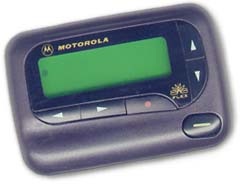
 I was going through security at the airport the other day, and tossed my beeper into one of those gray bins — along with the device that should make the beeper superfluous, a cell phone.
“I didn’t know anyone used beepers anymore,” said the 30-something guy behind me.
What could I say? That doctors also use typewriters, buggy whips, and ice boxes?
But those are really the wrong comparisons — better is something more early-90s, like this “mobile phone.” For a while back then, beepers were a quite the status symbol among the junior high school set — especially if they were made of clear, teal-colored plastic.

And while teenagers have long ago moved on, virtually every doctor I know still carries a beeper. One of my un-named colleagues (at and un-named hospital in an un-named city) became so frustrated by having to carry two devices that he hacked into his hospital’s paging system so that now he gets his pages on his cell phone as a text messages.
(He says texts over cell phones are sent via the same technology as pages. Who knew?)
This article discusses some reasons why beepers have some advantages over other wireless systems. But that was two years ago, and given advances in cell technology, I find it hard to believe those advantages wouldn’t be quickly be overshadowed by all the obvious benefits of a cell phone, particularly a modern smart device.
I, for one, would be happy to trade mine in. Just say the word.