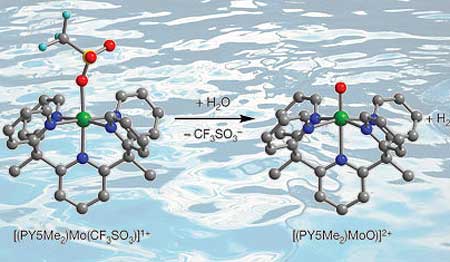
 Researcher Jeffrey Long and his colleagues at UC Berkeley have discovered a cost effective way to make hydrogen from seawater using a molybdenum-oxo catalyst and a mercury electrode. This is not Long’s first foray into H2 either as back in 2005, he was working on developing hydrogen storage materials for use in cars.
In September 2007, I had talked about using radio waves to burn seawater to produce hydrogen. Then in March 2009, I had talked about producing hydrogen from seawater with the use of magnets.
The key features of the UC Berkeley discovery includes, “Significantly, Long’s catalyst is also stable in the presence of impurities that can be found in the ocean, meaning that sea water can be used without pre-treatment. The team used a sample of California sea water in the system and found the results to be similar to the results obtained for water at neutral pH. In addition, no other electrolyte is necessary when using sea water, which helps reduce costs and removes any need for organic acids or solvents that could degrade the catalyst.”
Scientists have long been experimenting with different methods of using seawater to produce hydrogen (ocean buoys, deep sea underwater turbines and wind turbines have also been researched). Since most of the Earth’s surface is covered with saltwater, the prospect of using this vast resource is enticing.
Of course if Long’s technology does scale up into commercialization, then perhaps a mobile seawater-to-hydrogen station would be advisable especially in light of disasters such as the recent oil slick in the Gulf of Mexico which would most assuredly muck up the system. But, nonetheless, the UC Berkeley research is encouraging as a highly efficient and low cost method of producing hydrogen from the Earth’s most abundant resource which is water.