 There has been a press release circulating for the past couple of days by a company called GridShift Inc. that claims to have made an electrolysis breakthrough that will deliver compressed hydrogen fuel at around $2.51 per kilogram (equivalent to a gallon).
This press release has met with some skepticism from sources such as Bnet.com. But, I’m a little more optimistic after having a conversation with GridShift’s CEO Robert Dopp (pictured). According to Mr. Dopp, “My goal is to reach the 85-percent energy efficiency at 1 Amp/cm2 by this summer and then verification will begin. I am so far ahead of the field that comparative data will be hard to find.
“It is due to the coating technique I have developed which coats all surfaces of a 3D shape (like reticulate nickel foam) with nano catalysts in a way that is robust enough to withstand the rigors of electrolysis and still exposes the powders to the electrolyte’s boundary layer. None of the catalysts are Noble or expensive.”
Much of the technical details of how the new proprietary GridShift technology works in general can be found in a whitepaper on their website. According to the whitepaper, “We use no Noble metals in our work (i.e. no platinum). We then developed a novel way to adhere these powders to a metallic electrode surface … We have developed a unique method to attach nano catalysts to a metallic surface in a way that has very low impedance to the reaction sites, covers all surfaces of a porous structure and leaves the particles well exposed to the boundary layer.”
 According to the GridShift press release, “GridShift’s uses a new catalyst comprised of readily available nano-particles, reducing catalyst costs by up to 97 percent. Platinum is the most often used catalyst for electrolysis based hydrogen generation, but at a cost of over $1700 an ounce, it becomes prohibitive at scale. This newly developed catalyst costs just $58 an ounce.
“Overall, GridShift’s new method for hydrogen generation produces four times more hydrogen per electrode surface area than what is currently reported for commercial units today. This means that an electrolysis unit using the GridShift method would produce at least four times more fuel in the same sized machine, or require a unit four times smaller than normal to make the same amount of hydrogen. GridShift’s new electrolysis method finally breaks down the barriers that have kept a truly green hydrogen highway from extending across the country.”
One of the problems that Bnet had with the $2.51 per gallon figure is that it was based upon five cents a kilowatt-hour when the national average is 12-cents. This may partly be true if the electrolysis device is to be used in hydrogen fueling stations during peak hours. But, at night during off-peak hours, when most home hydrogen fueling stations would be used (and presumably hydrogen fueling stations would also use this time to compress and store hydrogen as well) the 5 cent mark is about right. And this figure also becomes less if wind, solar or other alternative energy is used to provide the electrolysis.
 In addition, Bnet states, “The average new car struggles to reach 25 mpg, but hydrogen cars averaged 47 mpg in 2008 …” I’m not sure where they got this figure, but it is low compared to the data I have gathered, putting hydrogen cars more in the 60 mpge to 80 mpge range. Remember, that most hydrogen cars today are also hybrid vehicles and some are even plug-in hybrids.
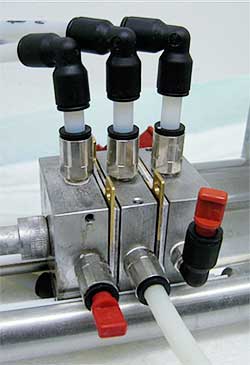
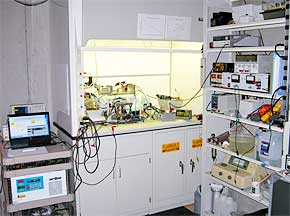
Also, remember that if the $2.51 per gallon figure is correct and hydrogen cars get double the mileage as the average gasoline-powered automobile this would be the equivalent to around $1.75 per gallon of gasoline, a price we can all live with. The GridShift dual electrolyzer is pictured along with the laboratory it was conceived and tested in.
I’m optimistic that GridShift will truly provide, as the name implies, a shift in the paradigm from fossil fuels and uncontrollable offshore oil spills to cleaner, home grown alternative fuels of the future in just a few short years.