
The audiobook reviewed here is ‘Language, Music and Laughter in Evolutionary Perspective’ by R Dunbar. This was contained in an earlier MIT book but has been republished in audibook format. The audiobook is relatively short at 42 minutes but within this space Dunbar details his theory of the evolution of language, laughter and music. The narrator Simon Vanoe speaks clearly, slowly and conveys the efficient rationalism of the author’s work. Dunbar’s writing is logical and reminded me somewhat of a Sherlock Holmes novel in which the reader is led inexorably to the conclusion. In this case, the conclusion is that language, music and laughter in humans have in combination taken the place of the grooming that is seen in other non-human primates. Dunbar firstly hypothesises that grooming is an affiliative social interaction resulting in the release of opioids and oxytocin which are responsible for the social bonding with which they are associated.
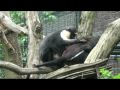
Grooming in Diana Monkeys
He then argues that as the group size increases, so does the percentage of time that spent in grooming. As humans typically have a group size of 150 people who are known well, he performs a calculation using data from primates and predicts that the time spent on maintaining such group sizes using grooming would significantly take away from other essential activities. Dunbar’s solution is elegant and simple. He suggests, citing the relevant evidence, that language originated not in the gradual development of gestures as some have suggested (see review here) but instead in the use of language to replace grooming with a more efficient activity for maintaining social bonds. He argues that this didn’t develop suddenly but was preceded by communal music which is interesting in relation to recent studies (see news articles here). However he then argues that the mechanism for inducing the release of oxytocin or opioids needs to be identified. Of the two candidates, smiling and laughter, he excludes smiling on the basis that in Chimpanzees this is associated with submission. Instead it is laughter that is associated with play in chimpanzees and he provides indirect evidence that in humans this is associated with the release of endogenous opioids. Here his observations are profound and he cites research in which it was found that time engaged in conversation in people is correlated with the number of laughs after taking into consideration the topic of discussion. He also notes that laughter is contagious. There are many more subtle steps in the arguments but Dunbar’s hypothesis is an important one and is testable.
In conclusion, although relatively short, this audiobook present a fascinating hypothesis for the origins of language, music and laughter which is both well argued and clearly presented.
References
Dunbar R. Language, Music and Laughter in Evolutionary Perspective. Narrated by Simon Vanoe. University Press Audiobooks. 2007.
You can follow ‘The Amazing World of Psychiatry’ Twitter by clicking on this link
Podcast
You can listen to this post on Odiogo by clicking on this link (there may be a small delay between publishing of the blog article and the availability of the podcast).
TAWOP Channel
You can follow the TAWOP Channel on YouTube by clicking on this link
Responses
If you have any comments, you can leave them below or alternatively e-mail [email protected]
Disclaimer
The comments made here represent the opinions of the author and do not represent the profession or any body/organisation. The comments made here are not meant as a source of medical advice and those seeking medical advice are advised to consult with their own doctor. The author is not responsible for the contents of any external sites that are linked to in this blog.


