

Foreword: (World Forums)
As it is very well known to most of the members of the International Community Here, Piraeus is the port of Athens (related in the same way as Tokyo and Yokohama).
It is also probably known to almost all that for a number of reasons (analyzed HERE, in the principal thread about Athens Skyscrapers and Highrises) Athens and Piraeus don’t have skyscrapers (with the exception of the Athens Tower which only marginally passes the lowest limit for a building to gain the title of a skyscraper with a height of 103m and 28 habitable floors.
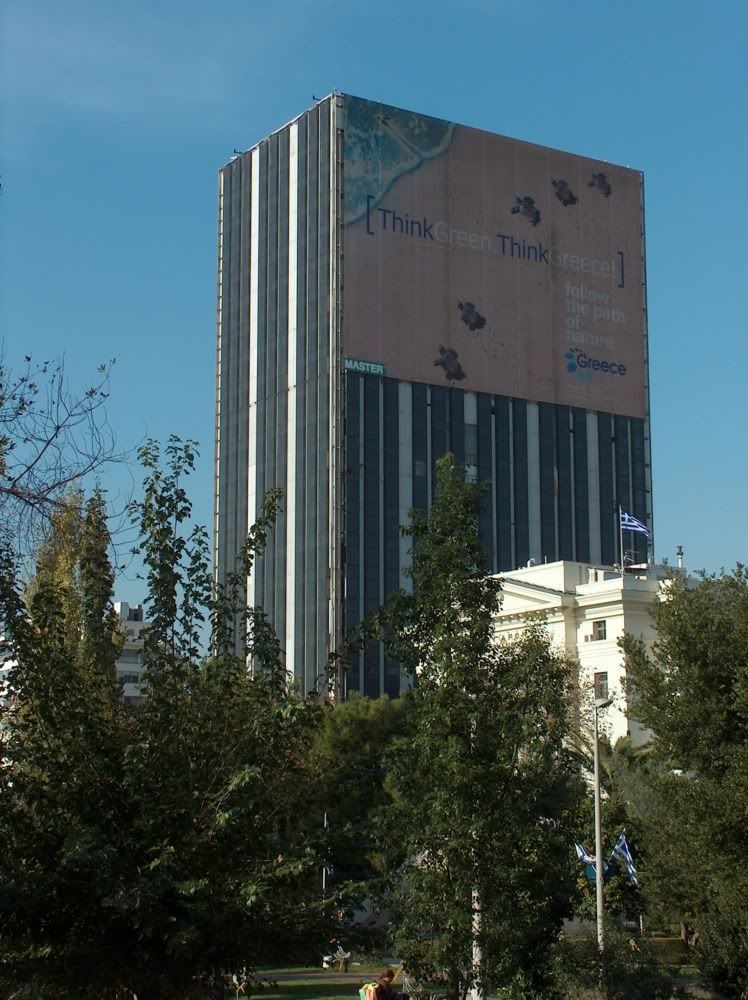
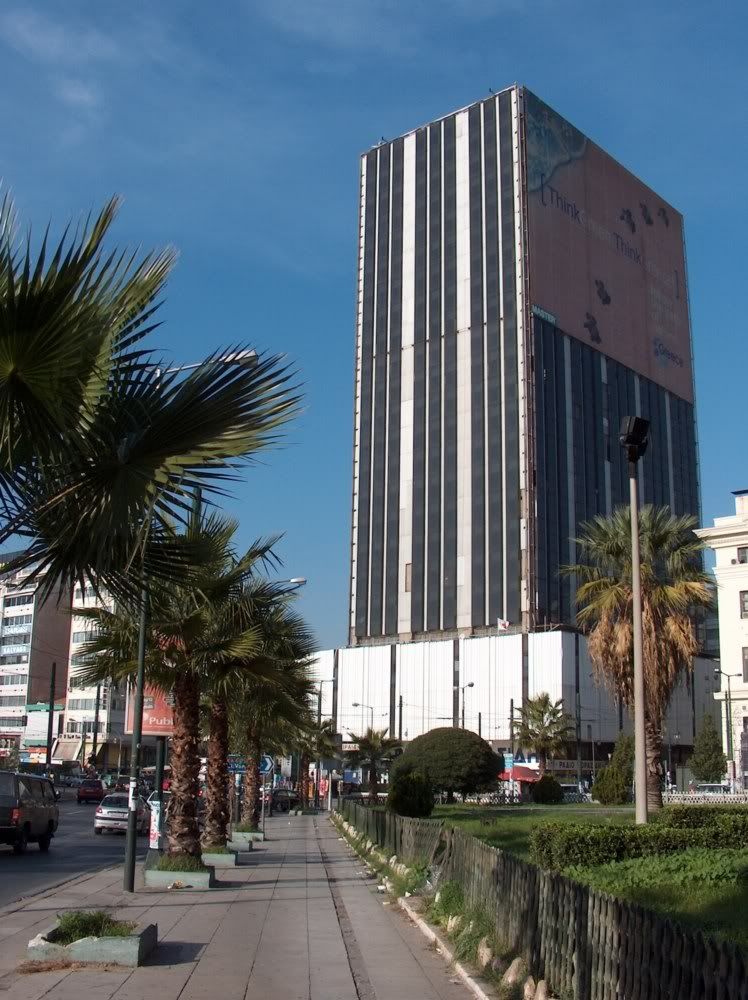
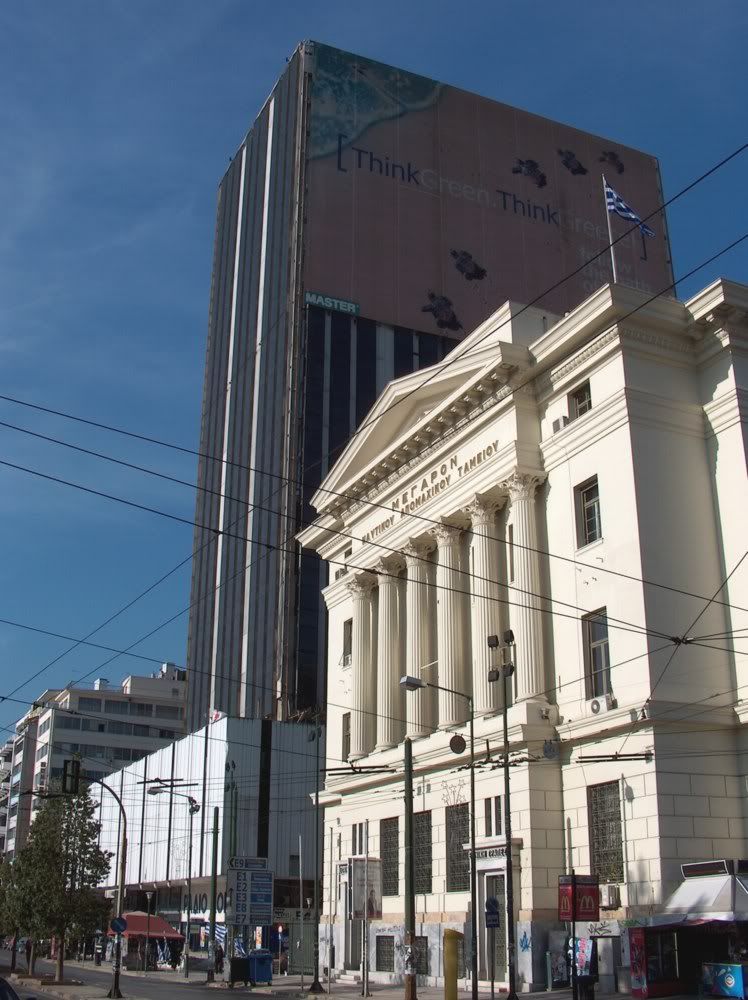
Few however know that the second tallest building in the Athens-Piraeus metro area, the infamous Piraeus Tower, remains incomplete for over 35 years. The reasons for this are unclear and there have been many reports and alleged reasons attributed to this, including engineering errors, or simply, bureaucracy and jurisdictional conflicts as to whom the authority for the completion of the tower belongs, including the owners of the first three of floors which are the only ones in use, the Piraeus Port Authority and the Municipality of Piraeus.
In his context, after several weeks of forced silence by the members of greekarchitects.gr not to disclose anything on the details until I received the go ahead, I am very happy to announce the opening of the architectural competition regarding the Tower of Piraeus.
As most of the Greek forumers already know, the particular building, is an empty 25-storey, 84m-tall shell overlooking for over three decades the main port of Piraeus. As said before, for quite some time, I was aware of the intentions of the organizers of the that is, the GreekArchitects.gr people to try to instigate some interest as to the fate of this gigantic empty shell that haunts the cityscape of Piraeus and occupies precious unusable real estate space that could otherwise have been used in a more efficient manner.
Furthermore, what may be to the interest of an international contender is the challenge to create a proposal for a new tall building which will be completed in an urban environment that does not have any serious experience in dealing with height or better put, the vertical dimension of architecture.
How can this new building type be introduced and to what extent, novelties in design and visual aesthetics be explored? What may be the input of an international contender who, without being immersed to the local prevailing normative circumstances as to what constitutes an appropriate measure for the size and dimensions of a building, will attempt to rejuvenate an empty urban shell and give it new form for a city in need for transition?
Below two texts are included, that is, the announcement for the architectural competition as well as the article on the main Greekarchitects.gr site regarding the characteristics of the building. This article was co-authored by myself and Alexios Vandoros who is a practicing architect and member of the architects.gr team who also did all substantial research at the Municipality of Piraeus, the Hellenic Techical Chamber (TEE), as well as many on-site inspections, and other contacts with public and private institutions directly or indirectly involved to the buildings construction, utilization and exploitation in the past or present time.
Overall though, I wish to publicly express my appreciation to the efforts of all involved in the project, in the hope that it will pave new directions in terms of the overall architectural discourse in Greece and that it will constitute the first step towards the completion of this tower and the long awaited introduction of the "third dimension" in the Modern Greek architecture.
Well done guys, and I am proud to have helped the little bit I did for you. Time to go higher.
Architecture that reaches for the skies is the product of visionary minds.
______________________________________________________
I. The Competition
Piraeus Tower 2010 Changing the Face/Façades Reformation
For further details and expression of Interest to participate:
-Please Click HERE to access the Competition’s main Website in English
-Please Click HERE to access the Competition’s main Website in Greek
ANNOUNCEMENT
GreekArchitects.gr and DuPont Hellas S.A have proudly launched an open architectural ideas competition entitled: Piraeus Tower 2010 Changing the Face/Façades Reformation
The initiative of our architectural ideas competitions is the localization of urban issues at vital points of Greek cities and the attempt to resolve them through Architecture, presenting to the citizens and State the real proportion of Architecture in the real urban space.
For all the above, a Tall Building at the port of Piraeus that is abandoned for more than 30 years was located. It is a 22-storey building, 84 m. tall and it is known as Piraeus Tower. The only tower of the area is sleeping in one of the bigger ports of the Mediterranean that presents a dynamic growth at the last decades.
The main issue of the competition is not the completion of another high rise building, whose completion is pending for years. The problematic exceeds the narrow limits of the dialectic regarding the construction or not of high rise buildings and skyscrapers in Greek cities and particularly in Athens.
The competition is focused only at the reconstruction of the external façade of the building in order to set off a synectic and clear position regarding the conversation of the Tower with the Piraeus urban landscape and how this new facade takes part in and partially forms the relation between the Port, as an important entrance and exit point of the capital, and the urban complex of Athens.
There is no material restriction in each proposal- any material can be used. The only requirement is the use of at least one material of DuPont Company.
The objective pursued through the competition Piraeus Tower 2010: Changing the face. Façades reformation is to include the building in the urban landscape through the design proposal and to highlight it as the landmark for the wider area.
GreekArchitects.gr and DuPont Hellas S.A. would like to welcome all the participants and wish you good luck.
Organization: GreekArchitects.gr
Director:
Vassilis Mistriotis, Architect
The competition Steering Committee:
Alexios Vandoros, Architect, Chief Editor & Press Representative of the competition;
Manolis Anastasakis, Architect, Organisation Head of the Competition;
Santra Kalliagra, Architect, Assistant Chief Editor;
Maria Papadimitriou, Architect, Assistant Editing Director;
Simos Gerasimidis, Civil Engineer.
II. Piraeus Tower – The Sleeping Giant
by Alexios Vandoros (SSC Username: VandoTeam) and Gregory Maloukos (SSC Username: gm2263) – 2009-12-16
First Published in Greek Architects.gr Tall Buildings Section
Click HERE to access the article in English in greekarchitects.gr
Click HERE to access the same article in Greek in greekarchitects.gr
Standing on the Acropolis, once upon a time an architect is rumored to have said, looking towards the sea of concrete, which is the trademark of modern Athens:
This city always struck me as a continuous work-in-project, meaning that the city seems to be nearing the completion of a stage in its development and being close to a leap to the next level, something which never comes, always being postponed.
Very few buildings epitomize the essence of this statement with such intense symbolism more than the incomplete Tower of Piraeus also known as Piraeus Tower, or Piraeus Trade Center. The latter was a name tagged to it in a stunning analogy to its role, which was envisioned at the time of construction to be the same for the port of Piraeus with the role of its twin, ill-fated, much larger counterparts that were destroyed on the port of New York in the events of September 11, 2001

Far view of the Tower as seen from the Profitis Ilias Hill
(C) gm2263 -2002
As fate would have it, many decades after groundbreaking, the 25-storey tower (84meters height) still remains a grandiose urban carcass that haunts the skyline of the port of Piraeus. There, in the bustling port, thousands and thousands of commercial ships come and go in a clockwork fashion under the silent presence of the incomplete giant, an image which truly justifies the title of an unfinished work in progress. An image that clicks in the mind as a silent invitation to (re-)act against the prospect of such a gigantic perpetuated degradation.
Event Chronology
The reasons for what seems to be the perfect urban stagnation tale, which is stunning even for those familiar with the so-called Greek reality starts during the years of the military dictatorship (1967-1974). At that time (1968), and under a new law, namely the Development Law Α.Ν. 395/68 on the Heights of Buildings and Free Construction", construction permits for a few dozens of tall buildings were given (12-28 habitable floors), something that for the lovers of the Attica Landscape was and still is an act of sacrilege and utter disrespect for the monument of the Acropolis which dominates the historic landscape of the city of Athens.
On the other hand, the construction of the Tower of Piraeus was the result of a political decision that was taken during the same period and after Athens had already built its first (and to many, the only real) skyscraper, the Athens Tower (28 fl, height 103m). The rationale for its construction was related to the desire of the then political regime to provide Piraeus with a landmark icon of economic and urban development and enhance its image as a shipping business and commercial center, as well as to solidify the status of the officers of the then regime as reformers of the Greek political and economic system.
In addition to all the above, the Piraeus Tower may have been perceived as the opposite pole to the Athens Tower, reflecting the relationship between Athens and Piraeus, a fact that may be corroborated by the similar morphology and architectural style of both buildings (International Style).
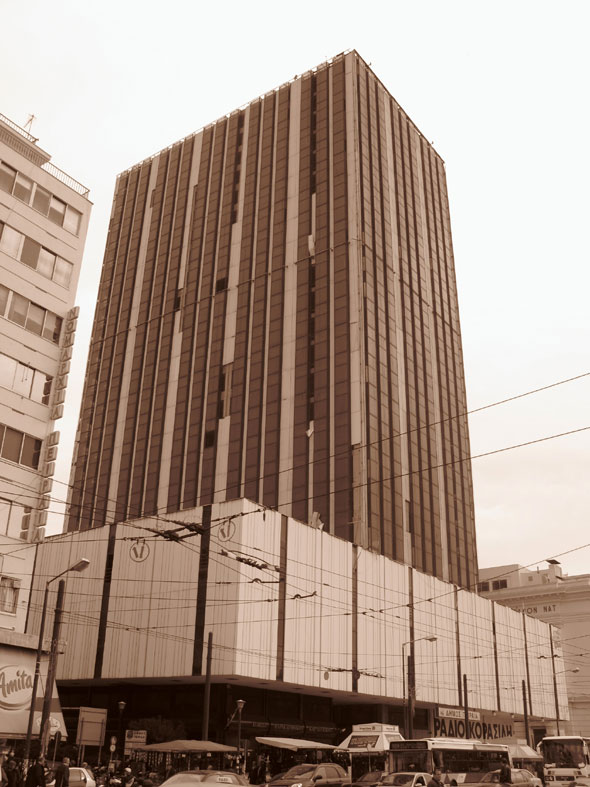
The "Sleeping Giant"
(C) Alexios Vandoros and GreekArchitects.gr
Project Team:
Architects: I. Vikelas, G. Molfesis, A. Loizos
Civil Engineer: A. Oikonomou
In short, the timeline of the most significant events in the life of this building up to the time of this writing are as follows:
-1972 to 1974: Preliminary works and topping out of the frame of the building (Mayor: Mr Skylitsis). During those works, a historic landmark building in the area with a clock on its top is demolished as part of the renovation planning. When the frame is completed, it has 25 floors above the ground level, stands 84m tall and is clearly visible from all parts of the port.
-1983: Cladding of the external surfaces of the building with glass (Mayor: Mr Papaspyrou)
-Late 1980s to present: The three first floors of the building accommodate various uses including a high school, an electronics superstore and public and state authorities. No floors above that level were ever occupied. Various rumors about the static capacity and stability of the building appear in the press and become the object of concern of mainly the citys society despite the denials coming from the technical world and other official bodies and public authorities.
-1997-1998: Competition for the design and construction with a contractor by the municipality of Piraeus which did was not completed (Mayor: Mr. Logothetis)
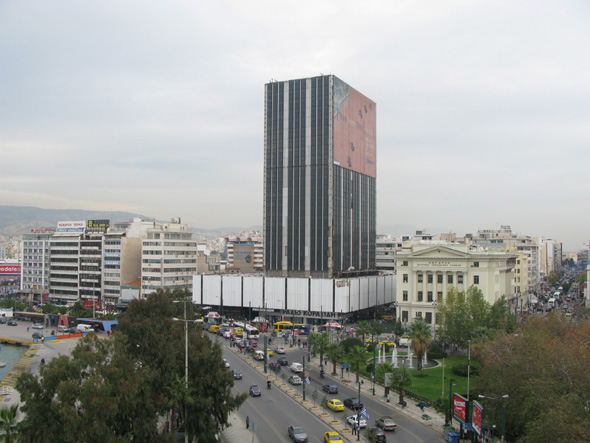
General view of the Tower
(C) Alexions Vandoros and Greek Architects.gr
– 2001-2: International public allocation to the lowest bidder competition by the municipality of Peiraius (Planning construction completion of the Peiraus Tower with the system that includes exchange / operational compromise).
The competition was won by the company AVAX, but was never completed. (Mayor Agrapidis)
Today: The structural body of the building is completed. The ground floor stores and the first two floors have been constructed and are in function. The claddings of the external surfaces of the building and the insulation of the seconds floor rooftop have been completed. The separate stores that are in use have their own EMP installations.
Since then, the status of the building has not changed despite the good wishes of various parties to assist in its completion. What is surprising is that even the 2004 Summer Olympic games have not been a sufficient cause to mobilize the completion of the building, despite the fact that the port of Piraeus was filled with docked cruise ships, many used as floating hotel facilities at the time.
Note: Some of the basic problems of the building, which were spotted by the municipality of Peiraius and were set at the prescriptions of the past competitions, are the approach to the Tower and the car parking. Initially the building provided very narrow parking area. This fact is aversive for its utilization, since the offered office spaces cannot be served and terrible problems will be generated at this already overloaded area. The adjacency with the terminal train and subway station is a positive element at this direction.
At this point, the direct connection of the possible placement of high rise buildings at the urban habitat with the essence of sufficient public transportation and general access to the buildings, must be underlined. The high rise buildings must not be faced as autonomous building units, rather than as a part of the wider urban habitat. This way high rise buildings can give a solution to the enhancing impasses of the urbanization, rather than making them worse.
Proprietary: According to the proclamation of the competition by the municipality of Peiraius the building is a property of the municipality of Peiraius, except from a ground floor store (334,80 s.m.).
Plot: the plot where the building has been constructed is 3840,30 s.m. at the roads Akti Poseidonos, Dimosthenous, Tsamadou, Ippokratous, Makras Stoas, Anonymos.
Coordinates: 37°56’41"N 23°38’38"E
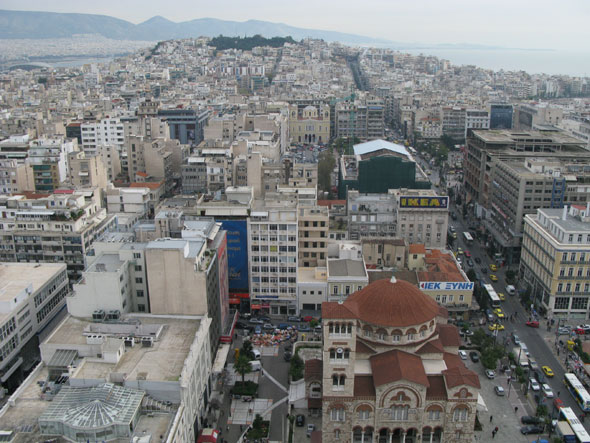
View from the top of the Tower looking towards the Aghia Triada Church and the Profitis Ilias Hill
(C) Alexios Vandoros and greekarchitects.gr
Technical characteristics of the building
Building plan:
a. Two basements.
b. The narrow volume ground floor shops, Α’ and Β’ floor.
c. The high volume 3rd to 22nd floor
d. The terrace
The areas of the surfaces mentioned above are:
Α. Existing Building
Basement B: 1386 m²
Basement A: 2125 m²
Ground Floor: 2125 m²
Α’ and Β’ floor: 3147 m² each one
Typical Floor: (3rd 22nd): 1034 m² (besides the 20th)
20th floor: 648 m²
Terrace: 154 m²
The volume of the building is 91,942 m³
The initial uses of the building were:
1. Basement B: Engine Room
2. Basement A: Garage for the property owners
3. Ground Floor: Stores – Shops
4. Α’ and Β’ floor: Stores – Shops
5. 3rd floor: Coffee Shop
6. 19th and part of the 20th: Lecture Hall
7. 20th and 21st floor: Restaurant
8. 22nd: EMP facilities
9. Rest of the floors: public services and private offices
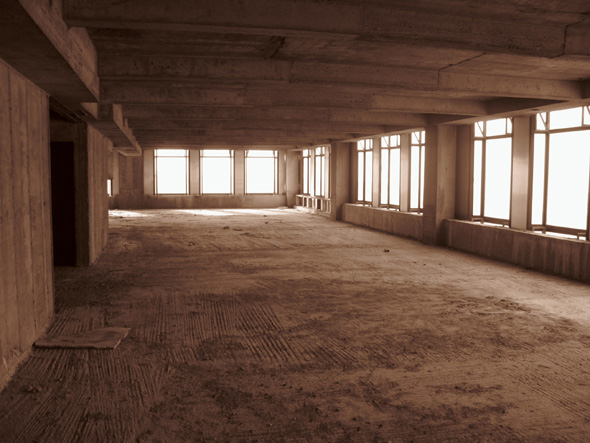
View of the inside of the Tower
(C) Alexios Vandoros and greekarchitects.gr
Geometrical Characteristics of the building:
1.1.1. Characteristics of the building.
1.1.2. Building Dimensions
2.1. Maximum exterior dimensions (including 58 χ 54 m of sidewalks)
2.2. Exterior dimensions (a’ and b’ floors), plot area: 3.147 m²
2.3. Typical floor plan: 1.034 m²
2.4. Typical height: 85.02m
2.5. Building height: 84.00m
2.6. Building height without terrace: 80.20 m
1.1.3. Typical Floor characteristics
3.1. Typical Floor dimensions, plot area: 25 χ 40 = 1.034 m²
3.2. Height of typical floor: 3,26 m.
1.1.4. A and B floor characteristics
4.1. Α’ and Β’ floor: 3.147 m²
4.2. A, Β’and C height: 4.10 m
1.1.5. Basements characteristics
5.1. Basement B plot area: 1.386.14 m²
5.2. Basement A plot area: 2.124.94 m²
5.3. Basement A Height: 3.00 m
5.4. Basement B Height: 4.30 m
5.5. Basement C Height:: 5.50 m
1.1.6. Other Characteristics
6.1. Terrace Dimensions: 11.5 χ 36 m
6.2. Mezzanine Height: 3.50 m., plot area.: 2.125 m²
6.3. Ground Floor height: 3.50 m
In Conclusion
To many, the prolonged existence of the incomplete tower is yet another proof of the embarrassment from various parties, including the Greek state, the Greek technical construction and architecture community and the public opinion, as to what will be done with this issue. For it is now a common secret that the traditionalists within the Greek architecture and wider general academic community still view tall buildings as negative icons reminiscent of the hatred years of military junta, as well as symbolizing the destruction of the Athenian landscape after the Second World War.
The issue is far beyond the dialectic for the construction (or not) of tall buildings at the Greek Cities and especially in Athens. At the relevant column in GreekArchitects (http://www.greekarchitects.gr/index.php?maincat=22) there are many writings (at the Greek language) for the specific issue. The paradox is not the acceptance of constructing high rises and building tall in Greece, but rather the complete absence of any dialog for this possibility altogether.
In view of the above, it becomes apparent that the main problem here is not the completion of yet another big building whose construction remained on hold for years, as in the case of the new Athens Museum of Modern Art, but it extends well beyond that, and into the acceptance of the re-entry of tall buildings and even skyscrapers into the architectural vocabulary of Piraeus, Athens, and potentially a couple more big cities too.
This prospect of the construction of new tall buildings or even imminently, of world-class skyscrapers (that is, buildings of well above 100m height) still fuels a never-ending controversy and should be seen as one of the most deterring factors in re-opening the discussion about the ages-old 25-floor empty shell still overlooking the port in its seemingly timeless and unending idleness.
Alexios Vandoros, chief editor of GreekArchitects.gr / CTBUH Country Leader for Greece
Grigoris Μaloukos, BSc, MBA / Emporis.com, Editor for Athens and Greece
__________________________________________________________________________________
My latest pictures: