


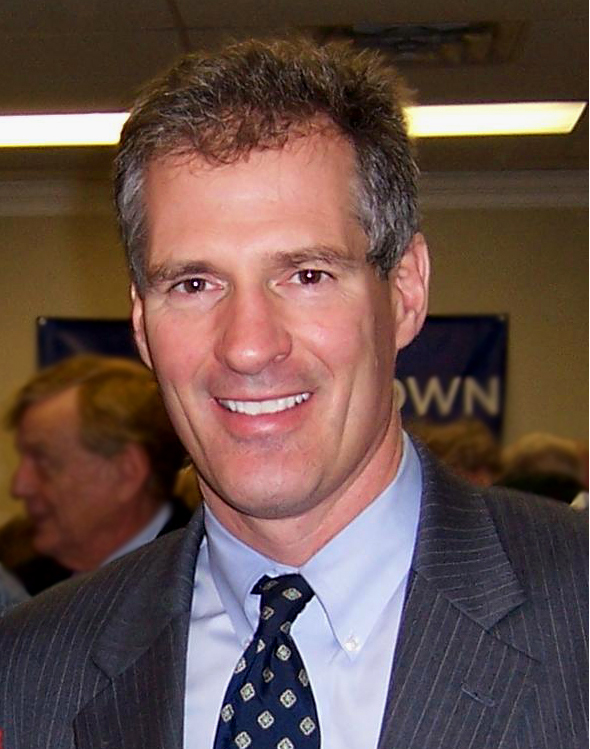
Will Sen.-elect Scott Brown (R-Mass.) vote "aye" on climate change? That's the big unknown.
Senator-elect Scott Brown’s (R-Mass.) stunning victory in Massachusetts over Martha Coakley was a shot heard across the country. Although the impact this victory will have on climate change legislation remains hard to assess, most agree that when it comes to issues like climate change (or healthcare…), Tuesday’s surprise win is not a positive. “It’s going to be an uphill climb,” one Democrat Hill staffer told GER earlier this week.
Even before Brown’s election, the prognosis on President Obama signing a climate change bill into law by the end of this year was not good. But the reality is that the Senator-elect Brown’s climate change position is hazy. As ClimateWire reports, when it comes to climate change (and green issues in general), little is actually known on his stance.
On another cornerstone issue for the Obama administration – healthcare reform – Senator-elect Brown has pointed out that he could be the 41st senator that Republicans need to block Democratic initiatives. Brown’s not divulging how he would vote on that issue, but as ClimateWire points out, his stance on health care could offer some indication on what his intentions are in regards to climate change and cap-and-trade.
What’s also true is that the little bipartisanship we’ve seen in the 111th Congress has benefited climate change. Case in point: Senator Lindsey Graham (R-S.C.) has attached his name to the Kerry-Boxer legislation, which is one of the two climate change bills with some form of cap-and-trade provision now making its way through the Senate. Senator John Kerry (D-Mass.), in a statement emailed Thursday to GER, says he’s confident an issue like global warming will convince key Republicans to cross the aisle in support of his bill.
Kerry told us:
It doesn’t have to be polarized. Just listen to a conservative like Senator Graham or business leaders from across the ideological spectrum. This is the single best opportunity to create jobs, reduce pollution, and stop sending billions overseas for foreign oil from countries that would do us harm.
While U.S. politicians continue to debate the validity of human-made climate change, and in doing so paralyze any chance of passing meaningful legislation, the rest of the world is forging ahead. Just this week, Ontario, Canada’s most populous province, saw a massive C$7 billion ($6.65 billion) investment announced in wind and solar power from a South Korean consortium made up of Samsung C and T and Korea Electric Power. The 2,500-megawatt power project is set to create 16,000 new jobs over six years and is one of the largest announced to date in North America. What clinched the deal? The Korean consortium says it was the province’s Green Energy Act, passed last spring, and its generous feed-in tariff, as well as a package of generous tax subsidies, that have engendered some controversy.
Not all feed-in tariffs are equal. In Ontario, they are helping attract large investments, but in Europe, pressed by stagnating growth, key markets are cutting these generous subsidy programs. Last week, France said it would slash its solar subsidies by 24 percent and this week Germany, the world’s largest solar market, announced a 15 percent cut in its feed-in tariff. The move by Chancellor Angela Merkel’s conservative government had been widely expected and the cut was actually less than the 25 percent to 30 percent Germany’s leading Christian Democratic party had been pushing for.
The slower market in Germany, France, and across Europe could spell trouble for companies like thin-film PV maker First Solar which generates a majority of its revenues in Germany, although growing markets like the U.S. and China could actually offset that.
To conclude, let’s look offshore and in particular to a scientific study released this week that shows that fish and crabs actually thrive around offshore wind turbines. The U.S. lags behind Europe in developing its offshore potential and the news that offshore wind turbines (along with used New York City subway cars) make for good reefs could be a game changer for an industry that’s (ironically) struggling with its eco-image.
——————————————-
GER’s Weekly VC Radar:

Data released Friday by the PricewaterhouseCoopers, the National Venture Capital Association and Thomson Reuters show venture capitalists invested $17.7 billion into 2,795 deals for U.S.-based companies in 2009, a 37 percent decrease from 2008, and the lowest volume since 1997.
Double-digit declines in investments were spread across almost every industry including clean technology, life sciences and software.
Venture capital investment in clean technology experienced a significant decline in 2009 with $1.9 billion invested in 185 deals, a 52 percent dollar decrease from 2008 when $4.0 billion was invested and a 31 percent decrease in deal volume from the previous year. Clean Technology investing accounted for 11 percent of all venture capital dollars in 2009 compared to 14 percent in 2008.
Specifically, this week saw a steady flow of VC investments supporting smart grid and wind turbine companies. One of this week’s largest was FloDesign Wind Turbine, a manufacturer of high efficiency wind turbines which closed a $34.5 million Series B funding round led by Kleiner, Perkins, Caufield and Byers. In Toronto, Ecobee, a smart grid technology company, raised $6.73 million. Backers included Ontario Emerging Technologies Fund (OETF), JLA Ventures, and Tech Capital Partners. Ambata Capital, founded by former Credit Suisse investment banker Michael Philipp, announced an (undisclosed) equity investment for “a significant” minority stake in geothermal developer Reykjavik Geothermal.