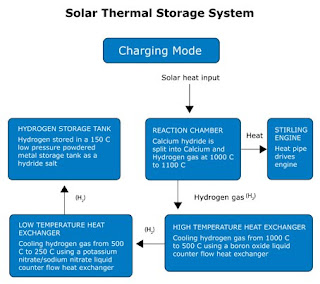
This is another incremental improvement on the business of operating thermal heat systems driven by solar sources in particular. We have identified a superior storage medium that is well known and readily available at low cost. All solar systems need a working fluid to grab the heat energy even it the intent is to shove it immediately into an engine. Having a working fluid that nicely enters into a chemical reaction giving off a mobile gas avoids reaction reversal and truly stores the energy in a safe form for later convenient consumption. It can all get cold even.
In fact it means that a solar thermal plant can be engineered to be a standby energy source that sells its energy during peak demand and will fit nicely into a photovoltaic system were no such storage may be practical.
This is a major advance for solar thermal power and likely makes the high temperature designs presently been deployed economically feasible. It will possibly work best in the extremes of the desert plants such as the tower system built in Spain
EMC Solar Claims Calcium Hydride Has Ten times the density of conventional molten salt solar storage
http://nextbigfuture.com/2010/01/emc-solar-claims-calcium-hydride-has.html
http://4.bp.blogspot.com/_VyTCyizqrHs/S1i-tR-oQ4I/AAAAAAAAGVs/SVKsCO2mu8s/s1600/100-kw-system.jpg
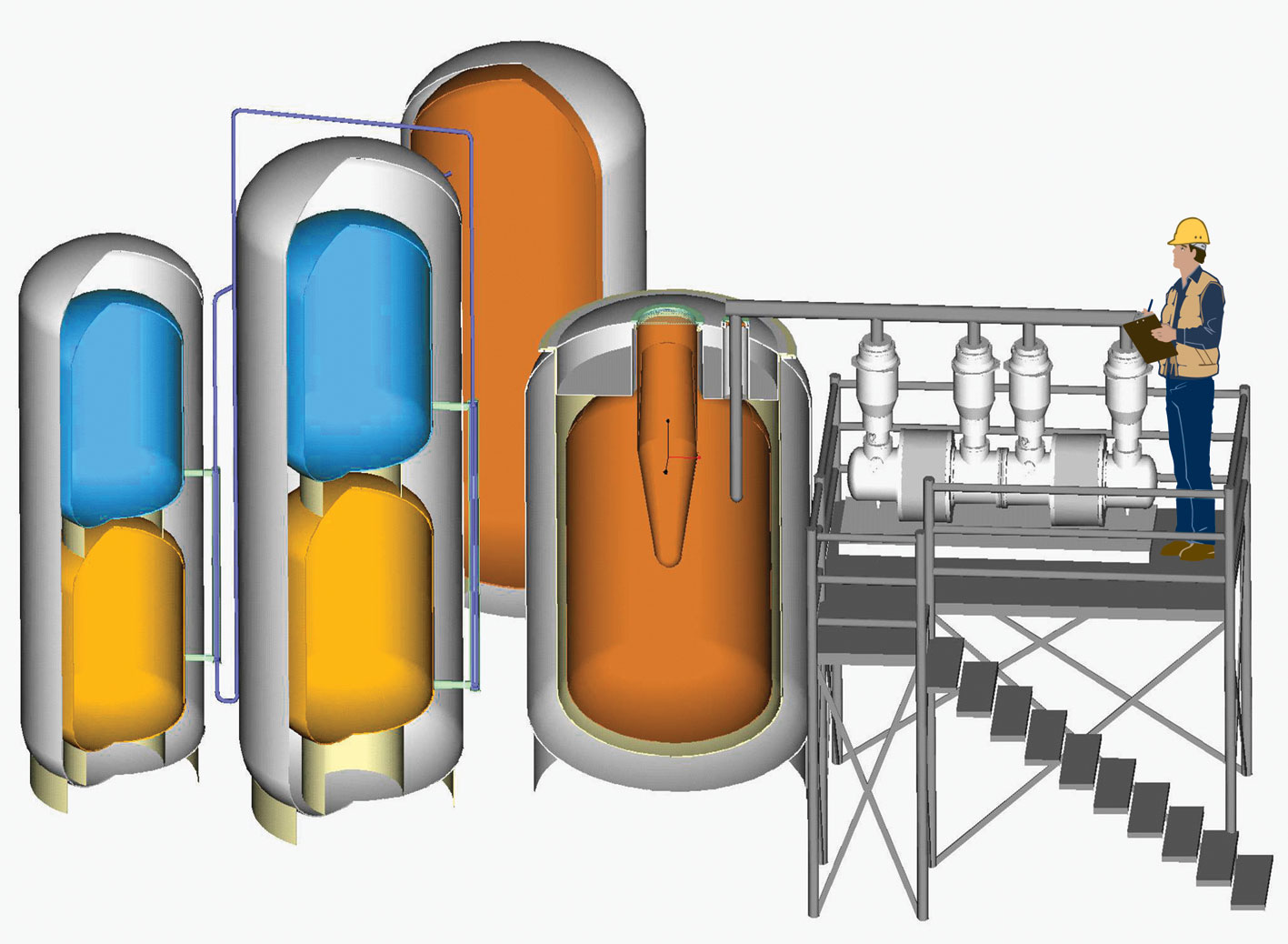
Hydrogen is stored in a separate low temperature hydride tank. Two heat exchangers are used to extract the thermal energy from the hydrogen before storage in the low temperature hydride. The heat exchangers are required to extract the remaining 20% of the total system energy still in the 1100 C hydrogen before it is cooled to near room temperature.
A central triple walled reaction chamber holds both Calcium and Calcium hydride as liquids between 1000 C and 1100 C. Heat is extracted from the reaction chamber to drive one or multiple 100 kW high temperature Dual Shell Stirling engines operating at 50% conversion efficiency.
The thermal storage costs are substantially lower than a nitrate salt system and reflect both the simplicity of the calcium hydride system and the significant increase in power density. In the calcium hydride system the two liquids, calcium and calcium hydride, remain in the central reaction chamber. Only hydrogen is pumped between tanks
* Store 18 hours of thermal energy
Sunlight is focused through a quartz window, into the reaction chamber, onto an inverted molybdenum cone submerged in the liquid calcium which absorbs the solar energy. Major cost reductions occur due to the use of a down mirror system which allows the power head to be immersed within the reaction chamber inside the liquid calcium. This allows a significant increase in heat transfer capability. An insulated cover is placed between the quartz window and power head at night minimizing thermal losses.
The advantage of this system is that it is a completely reversible closed cycle. The intermittent sunlight can be chemically stored and released at a controlled rate for electric power production. The system uses materials which are low cost and provide a competitive electrical production facility for very large scale application.