As was leaked earlier this week, a study paid for by the International Chamber of Commerce has come out with ridiculously misleading and misguided report about how “piracy” is killing jobs all through Europe. The tagline is that it’s “costing” 1.2 million jobs and about $330 million. And, of course, that sort of report is the kind that the press loves, and so we get a series of headlines:
- Net piracy puts 1.2m EU jobs in peril, study shows
- Internet piracy taking big toll on jobs
- Illegal-file sharing could ‘cost billions’ by 2015
- Piracy threatens Europe’s creative industries
- EU must take ‘urgent’ action on piracy, report warns
And on and on and on and on. Of course, it’s not even close to true. The real story is that for certain companies who refuse to adapt and refuse to embrace what consumers want and what technology allows, modern technology will cause them to fail. However, at the same time, it has already opened up new opportunities and created new jobs while making it easier and more efficient to create, promote, distribute and consume content. Somehow, however, none of that seems to show up in these studies.
Honestly, the claims by this research firm, TERA, read like “automobiles costing buggy makers jobs and money, something must be done!” It’s based on a fundamental misunderstanding of basic economics and the nature of dynamic markets (and, frankly, calls into question anything put out by this particular firm). The only thing “costing” companies money are their own actions. If they are failing to adapt to a changing market, that’s their fault. Don’t try to pin the blame on new technologies and consumers getting better access to content.
Even worse, when you start to dig into the report you find all sorts of highly questionable or downright incorrect assumptions. TorrentFreak put together a starter list of problems (feel free to add more in the comments):
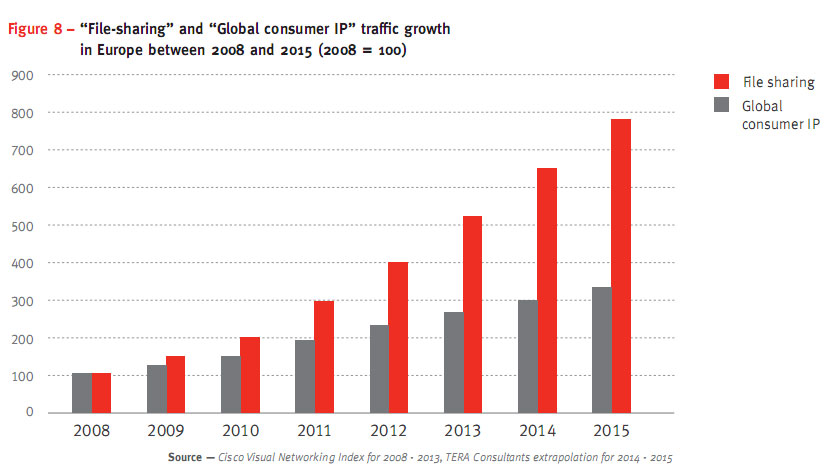
- The report suggests that there’s a direct correlation between Internet traffic growth and lost jobs. That is, the more traffic that is generated on the Internet, the more money will be lost. This correlation is 1 according to the report, which assumes that all growth in Internet traffic will increase piracy at the same rate.
- The report makes another bogus assumption by stating that more traffic will mean more piracy and thus more lost revenue. It does not account for the fact that people might consume higher quality files which are greater in file-size. All projections are based on bandwidth and not the number of pirated goods.
- The report cites some academic literature which suggests that piracy leads to a decrease in sales. Studies that reported the opposite or a null-effect were carefully left out. This bias defines the entire outcome of the report. If they used studies that found a positive effect they would have found that piracy would create hundreds of thousands of jobs in the years to come.
- The report uses fixed substitution rates. They assume that 10 downloaded albums results in one lost sale and this figure is not adjusted for the projected increase in piracy. One would think that the public’s budget for entertainment is limited and that the substitution rate would go down as piracy goes up.
- Related to the previous point, if the industry did indeed lose over €240 billion in revenue by 2015, consumers would have a lot of extra cash to spend. Depending on where this money was spent it might create more jobs than the entertainment industry claims it is losing. As a report commissioned by the Dutch Government showed last year, the overall effect of piracy on the economy might actually be positive.
- It gets even more ridiculous when we take a closer look at the claims. In the UK consumers spent €6.3 on audiovisual products. If the projected trends continued, the ‘lost’ revenue because of piracy would exceed the actual revenue, meaning that the music and movie industries would end up having to pay people for pirating their products.
- Lastly, the researchers seem to have trouble putting a decent report together as they messed up the legend of one of the critical figures. In this figure the bars for “file-sharing” and “global Internet traffic” are switched around. This makes us skeptical about the other statistics that are published in the report.
In other words, it looks like a typical study where the folks who created the study had the answer before they did the study, and then just needed to fill in the blanks carefully to make sure they got the results they wanted. It’s basically a blatant lie. The unwillingness to look at studies that suggest job increases or that look at the positive impacts from greater and easier distribution and promotion is clearly a joke.
Permalink | Comments | Email This Story