The five books included to directly foster student learning of basic geometry are:
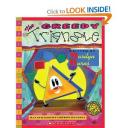
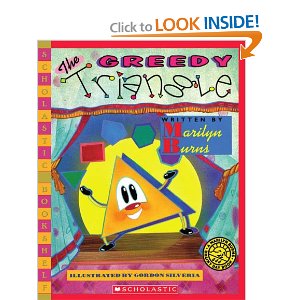
- “The Greedy Triangle” by Marilyn Burns and illustrated by Gordon Silveria
- A great tool for guiding class discussions on attributes of shapes and enhancing geometry vocabulary, to say the least. Also, the book is good for captivating students’ interest. The silly story is full of excitement and colorful fun illustrations. It’s an even greater resource knowing that Marilyn Burns is the author. She provides ideas for extending student’s learning at the end of the book.
- AMAZON link: http://www.amazon.com/Greedy-Triangle-Scholastic-Bookshelf-Marilyn/dp/0545042208/ref=sr_1_1?ie=UTF8&s=books&qid=1272265647&sr=1-1
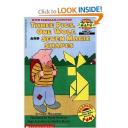
- “Three Pigs, One Wolf, and Seven Magic Shapes” by Grace Maccarone and illustrated by David Neuhaus
- This book is of a modern day tale of the three little pigs and the big bad wolf. Students will be pleasantly surprised as the story unveils an interestingly happy ending! The book is a great resource for exploring geometric shapes, transformations, and understanding that shapes can be made from other shapes. Interactive tangram ideas are provided in the back of the book.
- AMAZON link: http://www.amazon.com/Three-Seven-Shapes-Scholastic-Reade r/dp/0590308572
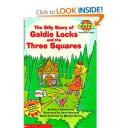
- “The Silly Story of Goldie Locks and the Three Squares” by Grace Maccarone and illustrated by Anne Kennedy
- In this story, Goldie Locks is the great-great-granddaughter of the fairy-tale Goldilocks. Throughout her journey, which is very similar to her great-great-grandmother’s, she explores all kinds of shapes and even talks about the “attributes of the shapes”. These attributes can be reviewed and formalized after story time to ensure students understand the concepts as it relates to geometric shapes.
- AMAZON link: http://www.amazon.com/Silly-Story-Goldie-Squares-Reader/dp/059054344X/ref=sr_1_1?ie=UTF8&s=books&qid=1272265413&sr=1-1
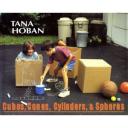
- “Cubes, Cones, Cylinders, & Spheres” by Tana Hoban
- Throughout this book, photographs of familiar objects found in our everyday lives depict a variety of shapes. The picture book is great for guiding a class discussion on solid shapes and their attributes. Vocabulary terms will be reinforced by students through discussion and exploration of other objects found in our environment. This book is great for all students and especially for LEP students or for those who require additional support.
- AMAZON link: http://www.amazon.com/Cubes-Cones-Cylinders-Spheres-Hoban/dp/0688153259
- “Discovering Shapes, Circles” by Sandy Riggs and art by Richard Maccabe
- This resource book provides activities and fun facts that reinforce various concepts of circles in past and present times. The hands on activities engage students in that the natural learning process is encouraged. The teacher can evaluate student understanding through observations and interactions during activities and through class discussions exploring various concepts such as congruency, circumference, and using the circle to draw shapes. Activities include Compass Creations, Drawing Circles, Are Circles Important, and more. Answers and a glossary are provided.
- AMAZON link: http://www.amazon.com/Circles-Discovering-Shapes-Sandy-Riggs/dp/0761404589/ref=sr_1_1?ie=UTF8&s=books&qid=1272266226&sr=1-1