Author: Serkadis

  • Force India Also to Launch Car Online, on February 9

    Launching one’s 2010 single-seater via an online presentation has become a habit in today’s Formula One. And really, no one could blame the teams for that, as saving money and cutting down costs has become a true religion in the series in recent years. And we have the economic recession to blame for that.

    Force India Mercedes has therefore become the latest team to take on that habit, as they today announced that their presentation of the VJM03 on February 9 will happen online. So instead of … (read more)

  • With HipHop, Facebook Merges PHP Flexibility and C++ Raw Speed

    As one of the biggest websites in the world and certainly one of the most complex, Facebook is looking at any trick in the book to squeeze some more performance out of its infrastructure. One of the most ambitious undertakings, one it kept quiet about until now, HipHop for PHP is a project designed to speed up the popular programming … (read more)

  • Another Googler Joins the Obama Administration–Now We’ve Got a Foursome! [BoomTown]

    Please see this disclosure related to me and Google.

    It will be like they never left the Googleplex in Silicon Valley if this Washington, D.C. invasion of execs from the search giant keeps up.

    The fourth new geek in town is Sumit Agarwal (pictured here), who was head of Google’s mobile product management, to become the deputy assistant secretary of defense for outreach and social media in the Office of the Assistant Secretary of Defense.

    Phew! But what’s that? Poking with M-16s? The Berlin Wall? Tweeting troop movements?

    In any case, it’s interesting to see so many key appointments in the tech arena going to one company, especially one so immersed now in national and international policy issues.

    And especially since Google (GOOG) is also spending so much money in D.C. on lobbying recently.

    As I reported recently:

    According to the most recent public reports filed by Google with the Senate on its lobbying spending there, the search giant has significantly increased its outlay in 2009 from the previous two years.

    In 2007, Google spent a total of $1.52 million, which rose to $2.84 million in 2008.

    And the 2009 total? Just over $4 million, according to the Lobbying Disclosure Act Database.

    That’s probably no surprise given the ever-growing range of issues of concern to U.S. regulators due to Google’s increasing number of deals and because of many new and often controversial initiatives the company is forging forward with.

    From pushing for approval of its DoubleClick acquisition in 2007 to its failed attempt to strike a search and online partnership with Yahoo (YHOO) in 2008 to last year’s wrangling with book publishers to 2010’s expected tussle over its $750 million purchase of mobile advertising start-up AdMob, Google’s presence in D.C. is only going to rise as its ambitions expand.

    That’s still $2.7 million less than archrival Microsoft (MSFT) spent in 2009, but Google has been gaining on the software giant in a very short time.

    In any case, these are still former Googlers, who might or might not return to the mother ship at the end of their tenure.

    But, for those keeping track, Agarwal will join:

    * Former business development and also product exec Katie Jacobs Stanton, who was the Obama administration’s director of citizen participation and now works in the State Department.

    * Google’s top policy wonk Andrew McLaughlin, who serves as deputy chief technology officer.

    * And Sonal Shah, who worked at Google.org, who is director of the White House’s new Office of Social Innovation and Civic Participation.

    Buy This Item: [Click here to buy this item]

    Read Original Article

  • Windows 7 Sales Also Boot Faster Than Vista [Digital Daily]

    It took about a year for Windows Vista to claim 10 percent market share, something it’s successor Windows 7 has managed in just three months. New data from Net Applications shows Microsoft’s (MSFT) latest operating system accounting for 1 in 10 computers accessing the Web as of the end of January.

    Not much of a surprise, really since Microsoft said during last week’s earnings report that it shipped a record number of copies of Windows during the December quarter. The company has sold some 60 million Windows 7 licenses since launching the operating system on Oct. 22, with returning consumer demand driving a healthy 35 percent year-on-year increase in Windows licensing revenue for the quarter. Clearly, Windows 7 is on a nice hot streak right now — something that, I think it’s safe to say — never happened with Vista. But is that streak driven by the broader PC market rebound that began prior to the operating system’s launch or by Windows 7 itself?

    Buy This Item: [Click here to buy this item]

    Read Original Article

  • Pre-market Roundup: Equity Futures Now Down, Commodities Weak

    After a decent rally over the past two days, equities may have run out of steam.

    Futures for the three major indices point downward slightly, with the S&P 500 down 3.25 points to 1095.

    Metals across the board are also falling – from gold to palladium.

    Oil is slightly down by two cents a barrel to $77.21. Natural gas futures are up 1.8 at $5.533.

    Softs are down, save for cotton and lumber, which are up 3.25% and 2.15%, respectively. Aside from corn, all grains and pork belly futures are up currently.

    In the earnings and upgrades arena, Walmart (WMT) was upgraded to Buy from Hold at Stifel Nicolaus.

    Ryder ®, the rental truck company, saw their Q409 EPS fall by 63% YoY due to reduced performance and sales both domestically and globally.

    Finally, Goldman added McDonald’s (MCD)  and NASDAQ (NDAQ) to its Conviction Buy list.

    FUTURES_AM feb3

    Join the conversation about this story »

    See Also:

  • Questionable Timing: Goodwood to host a motor show?

    Filed under: ,


    Automotive sculptures on the Goodwood grounds – Click above for high-res image gallery

    With manufacturer attendance dwindling at expos worldwide, now might seem to be just about the worst time to launch a new motor show. But that’s exactly what the Earl of March and his team at Goodwood are planning. That is, if the latest reports from England prove accurate.

    According to the report, the 2010 Goodwood Festival of Speed – a longstanding fixture of the automotive calendar – could be preceded by a car show featuring displays from manufacturers and even a 3.5-mile track on which prospective buyers would be able to take the new cars for test drives.

    Word has it that Alfa Romeo – this year’s “featured marque” in commemoration of the Italian automaker’s centenary – will use the event to debut the new Giulietta. And with the future of the official British International Motor Show still up in the air, Goodwood could step in to fill in.

    [Source: PistonHeads]

    Questionable Timing: Goodwood to host a motor show? originally appeared on Autoblog on Wed, 03 Feb 2010 08:32:00 EST. Please see our terms for use of feeds.

    Read | Permalink | Email this | Comments

  • HAPPINESS TIP: Be aware that the EGO can be an ESTOP – stopping you from paying attention to what brings the truest happiness!

    ego

    Lately I’ve been waking up listening to Wayne Dyer – and today he said something I really found interesting. He talked about how dangerous the ego is in our lives – and if only we could give ourselves an “egoectomy.”  Then Wayne Dyer listed the following as the six components of the ego:

    1. I am what I have. My possessions define me.
    2. I am what I do. My achievements define me.
    3. I am what others think of me. My reputation defines me.
    4. I am separate from everyone. My body defines me alone.
    5. I am separate from all that is missing in my life. My life space is disconnected from my desires.
    6. I am separate from God. My life depends on God’s assessment of my worthiness.

    MY ASSIGNMENT TO YOU:

    Today as you go about your day, become aware of how much your ego is chattering at you – distracting you from what really brings the truest happiness in life!

    For more happiness tips, check out my big best seller, HOW TO BE HAPPY DAMMIT, by clicking this line you’re reading right here, right NOW!

    del.icio.us · Slashdot · Digg · Facebook · Technorati · Google · StumbleUpon · Yahoo

  • Europe To Greece: You’re All Good, Except For These 1,224 Issues

    The European Commission ostensibly gave the green light to Greece’s financial plan today, but according to Deutsche Bank the commission included an overabundance of red flags in their full assessment of the country judging by the 1,224 word count of their report, as shown below.

    Not all votes of confidence are the same:

    Chart

    (Via Alphaville) Check out the official EU 1,224 word report here >

    Join the conversation about this story »

    See Also:

  • CAREER TIP: Keep making sure your ladder is against the right wall.

    career ladder

    To succeed at your career and be a happy human, you gotta stay up-to-date — NOT ONLY on the outside world — but on the inside story on who you really are.

    Have you changed in the last few years?

    Are you married?

    A parent?

    Divorced?

    Fatter?

    Fitter?

    Did you go through any life-altering change?

    What interests you now?

    ARE YOUR PRESENT CAREER INTERESTS AND GOALS IN SYNC WITH YOUR PRESENT LIFE INTERESTS AND GOALS?

    If you’re ready to rise up higher on the right career ladder, and no longer willing to settle on staying on the wrong rungs, check out my book ENOUGH DAMMIT by clicking this line right here, right now!

    del.icio.us · Slashdot · Digg · Facebook · Technorati · Google · StumbleUpon · Yahoo

  • NNSA’s Big Budget, START and CTBT [14]

    The Administration has proposed a massive increase in funding for the nuclear weapons complex, increasing the budget for NNSA by 13.4 percent (over what the FY2010 appropriation.)

    John Fleck has an excellent write-up of the announcement in the Albuquerque Journal.

    The purpose of announcing the massive increases in funding for the nuclear weapons enterprise — stockpile support (25 percent increase), infrastructure (5 percent) and other categories is political — is presented as the right thing to do, which it may be, but it is also intended to find votes in the Senate for ratification of the START Follow-on Treaty and, at a later date, the Comprehensive Nuclear Test Ban Treaty. The budget release follows a major op-ed by Vice President Biden in the Wall Street Journal that makes explicit the link between funding the complex and achieving the agenda laid out in Prague:

    Our budget request is just one of several closely related and equally important initiatives giving life to the president’s Prague agenda. Others include completing the New START agreement with Russia, releasing the Nuclear Posture Review on March 1, holding the Nuclear Security Summit in April, and pursuing ratification and entry into force of the Comprehensive Test Ban Treaty.

    Some of my friends are complaining that by funding the complex first and asking for START (and CTBT) ratification second, the Administration is spending is squandering its only leverage.

    I worry about that, too. But I think this is the right approach, given the structure of the Senate and the President’s temperament.

    Let’s hold aside, for the moment, the argument that the complex is deteriorating and people are leaving. I suspect that lack of funding isn’t the primary challenge facing the labs nor is more money a sufficient remedy for their woes. But more money is probably a necessary element of a comprehensive strategy to fix the labs. This is, all things considered, probably the correct policy decision.

    The Politics of Treaty Ratification

    But is it good politics? Barack Obama said he preferred to be a great one term president, rather than a mediocre two-term President. No one believe him of course, because the two are often correlated — the ability to achieve policy successes depends in large part on the same political acumen that aids reelection.

    There are basically two approaches to getting to 67 votes in the United States Senate to ratify an arms control treaty. One option is to peel off just enough Republican Senators, convincing them to break ranks with their party in exchange for specific benefits or out of fear of losing reelection. The other is to secure the support of both the Senate Majority and Minority Leaders, so that the issue does not become partisan at all.

    I hate to point this out, but only one of these two strategies has ever worked for an arms control treaty (at least as far as I can tell.) Securing the support of the opposition leadership is essential to avoiding a straight party-line vote that is more about partisanship than the national interest. This is why Michael Krepon, who edited the wonderful Politics of Treaty Ratification, blogged that “ratification usually happens by comfortable majorities or not at all.” John Isaacs made this point, as well.

    This is the context in which to understand Senator Jon Kyl’s opposition to the various arms control treaties: He is Minority Whip and aspires to be the leading Republican voice on security issues. Perhaps, like another aspiring whip, he imagines even greater offices are within his grasp. His strategy to achieve these things is to make votes on arms control treaties a test of Senator’s Republican bona fides.

    To worry that Senator Kyl might “pocket” this concession and ask for ever more rather misses the point. Of course, he’s going to do that (and more)! He’s not an idiot, after all. But nor is Senator Kyl the proper object of a ratification strategy — or at least he shouldn’t be.

    The practical reality is that the Administration has to bring a majority of the Republican caucus along to support START and CTBT — even if fewer votes are technically required. If you look at the dozen of so candidates the Administration might hope to “peel off” — such as John McCain or Richard Lugar — few of them will be eager about the prospect of crossing over on a party line vote. The key to ratification has always been Mitch McConnell — and will be as long as he is Senate Minority Leader.

    Depoliticizing START and CTBT

    Which brings us to the budget roll-out. I don’t have any special insight into how Vice President Biden — who is spear-heading ratification process for START and CTBT — is going about cutting a deal. But I seem to recall he is familiar with the Senate.

    If the strategy is to avoid, to the greatest extent possible, politicizing either treaty, starving the nuclear weapons complex probably won’t create leverage with the Senate Minority Leader and might, in fact, backfire. If you give Republicans a choice between a well-funded nuclear weapons complex and a talking point to conflate the Prague agenda with unilateral disarmament — which is a favorite claim by Senator Kyl — most will understandably choose the latter. “Unilateral disarmament” is the “death panel” of the nuclear weapons debate. The goal, then, is to take away Kyl’s talking points, rather than to horse-trade with Senators. (That comes later.)

    Frankly, this is probably the only strategy an Obama Administration would undertake. It is difficult to imagine this President taking the bare-knuckled approach that we might have gotten from, say, Lyndon Johnson. However much juice his presidency has left — and that is the popular parlor question of the moment, for people in Georgetown who can afford parlors — for better or for worse, Barack Obama has his own style.

    I cannot, for example, imagine Obama, as LBJ did, holding a meeting in the buff at the White House swimming pool or dictating to poor Doris Kearns from the commode. For better, or for worse.

    So, we are left with the strategy of attempting to depoliticize the treaties, recognizing that there will be some additional horse-trading at a later date. It might not always succeed, but it is probably the only strategy that will.

  • All-New 2011 Infiniti M Sedan starts at $46,250

    Filed under: , , ,

    2011 Infiniti M – Click above for high-res image gallery

    Sales of the all-new 2011 Infiniti M are still a few weeks away, but Nissan’s luxury arm has released pricing details on both the 2011 M37 and it’s V8-powered brother, the M56.

    In standard, rear-wheel drive guise, the M37 starts at $46,250 – just $450 more than the outgoing model – and comes packing the 330-horsepower 3.7-liter V6, with considerably more grunt than the last generation’s 3.5-liter V6 and better fuel economy to boot. The all-wheel drive variant starts at $48,400, and both models come equipped with Infiniti’s Drive Mode Selector, Active Noise Control, RearView Monitor and Enhanced Intelligent Key memory.

    Option up for the 2011 M56 and in addition to the 420-hp, direct injected 5.6-liter V8, the Premium Package comes standard, including the eight-inch VGA touch screen with navigation, Bose 10-speaker audio system, 9.3-gig Music Box hard drive, streaming Bluetooth audio, heated and cooled front seats and heated steering wheel. All told, the M56 comes in at $57,550 for the rear-wheel drive model and $60,050 for the M56x with all-wheel drive. That’s a sizable bump over the outgoing M45, but considering all the additional kit that comes with the new V8 model, it’s a justifiable increase and certainly in line with the competition. Make the jump for the full break down, including options pricing and detailed descriptions.

    Gallery: 2011 Infiniti M

    Continue reading All-New 2011 Infiniti M Sedan starts at $46,250

    All-New 2011 Infiniti M Sedan starts at $46,250 originally appeared on Autoblog on Wed, 03 Feb 2010 08:00:00 EST. Please see our terms for use of feeds.

    Permalink | Email this | Comments


    Buy This Item: [Click here to buy this item]

    Read Original Article

  • Market Volume Screams Oversold

    Bespoke Investment Group says the market is screaming oversold, based on multiple indicators they track. In particular, 10-day average trading volume for NYSE listed stocks as a percentage of total market volume has hit 35%. This is higher than any reading since November 2009 and is two standard deviations away from a standard reading.

    According to Bespoke, this is significant:

    Bespoke: In the charts below, we show the S&P 500 and the 10-day average upside volume on the NYSE. On the chart of the S&P 500, we have also included red dots to show each time upside volume was at least two standard deviations below average. As shown, most (although not all) of these readings have occurred near short-term lows. In fact, in the week following these instances, the S&P 500 has averaged a gain of 0.89%. Over the next month, the S&P 500 has averaged an even greater gain of 4.3%.

    Chart

    (Via Abnormal Returns)

    Join the conversation about this story »

    See Also:

  • Hyundai Reports January Sales Increase in the US

    It’s not a secret that Hyundai had a great year in the US. The Korean manufacturer managed to top its 2008 sales and continue growing, thanks to its new line up and affordable prices. Though 2009 was great, it seems that 2010 started even better for the auto manufacturer.

    Just today, Hyundai Motor America announced it sold 30,503 vehicles in January, up 24 percent compared to January 2009. This report announces Hyundai’s thirteenth consecutive month of market share gains.

    "While we we… (read more)

  • Electricity – Paying Three Times For The Same Thing, And Some Unintended Consequences (PART 1)

    PART ONE OF TWO PARTS

    Don’t you just love the way Politicians find new ways to gouge you. They don’t call it a tax, and won’t hear of anyone who does, in fact, roundly vilifying anyone who does dare call it a tax. Then they find a way to give it a name that makes it seem acceptable, a name that IF anyone does criticise it, gives them ammunition to attack that person with labels signifying they are destroyers of, in this case, the environment that we all have to live in. Then, without offering a truthful explanation, and with the media in their back pocket, they introduce these new measures, and the only real thing that we actually CAN do is to pay ….. and pay ….. and pay.

    The same applies with the electrical power we all use, something that has now become a staple of life, something we cannot do without, and something we all have to use.

    To correctly understand just how we do use it, you need an understanding of its production, and the way we use it. Those large scale plants that produce the huge amounts of electrical power, in the main coal fired power plants and nuclear power plants work precisely as they are designed. Their size is the reason that they hum along at the same rate all day every day, because that is how they work at their most efficient. They are immensely heavy generators, around 250 to 400 tons in weight, and they rotate at 3600 RPM. To do this, they require an immense amount of steam to drive the turbine that drives the generator. They cannot be run up and down in speed easily or in a short space of time, and in fact they are not designed to do this. They provide vast amounts of power to the grids in their area, and we as consumers then draw that power down from what is there.

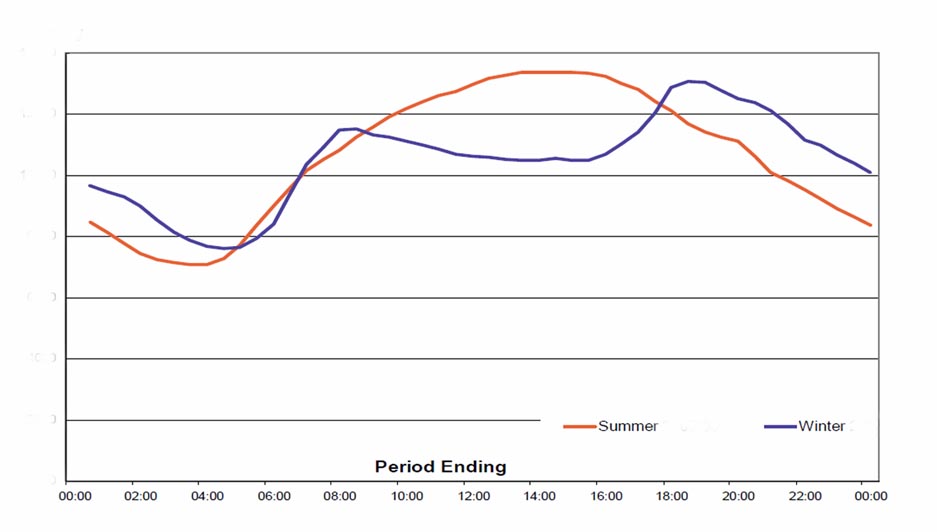
    Now look closely at this simple graph, probably the most misunderstood diagram in the whole electrical power area. It is the Load Curve for power consumption.

    Load Curves for actual electrical power consumption.

    If you click on the image it will open in a new and larger window. As simple as the diagram looks, it requires some explanation as to what it shows and what it means.

    This graph has no real need for  labels to be annotated to the X and Y axes, where in the Country or even the World that this graph applies, or even who it might apply to. That X axis indicates time on a 24 hour basis, and  the Y axis indicates total power consumption on a percentage basis. This graph applies almost the same in New York as it is in Miami, as it is in Los Angeles, as it is in Seattle, as it is in St. Louis, as it would be in all the smaller cities and towns in between. It is the same in London, Rome, Sydney, Tokyo, and for every city and town in every Western World Country. It also applies right down to the single household application to every residential application in every one of those Western Countries. The power consumption for Summer is indicated by the orange line and the blue line indicates power consumption for Winter. The other seasons apply as for the warmer periods of Spring and Autumn as for Summer, and the cooler times as for Winter.

    As you can easily see from the graph, there is a dip in the early AM hours when we are all in bed. In Summer, power gradually rises during the morning, and then gradually decreases until around 10PM. In Winter, there is a short spike early in the morning when we all rise, turn on the lights, turn on the heat, shower, cook breakfast, you know, everyday life at home. Then there is another, and this time significant spike in the late afternoon around 3.30PM peaking around 5.30 to 7PM and then gradually decreasing till around midnight. This is the time we all get home from school and work, the time when we turn on the heat, shower, most importantly, cook dinner, relax with music and the TV, you know, normal everyday life at home.

    Now, look again at the graph where the dip is. The line directly above that goes across the whole page. That is around the 60% mark. That line drops below that line for barely a couple of hours in Summer, and an hour in the Winter. So, everything below that line is power that is still being consumed, and that is for the whole 24 hours of every day. Because that dip is so small, then nearly two thirds of all the power (everywhere) is still being consumed. That counts for nearly all the coal fired and nuclear power in the Country. Those plants supply all that power that is required ABSOLUTELY, all day every day.

    During the day as consumption rises, then other plants come on line to add the top to what is being already supplied by those plants, and then we as consumers draw down from that overall total. These plants that add that extra are plants that can easily run up and down in speed, and in the main are Natural gas fired turbines that drive the generators. These plants are specifically designed to run for those shorter periods of time when that extra is needed, and after that peak passes then they can be sequentially shut down until it is back to just the power provide by the large plants that lumber along flat out all the time.

    Those plants from the renewable sector cannot be relied upon to supply power during the Peak periods, and in fact are probably not taken into account when planning for power that has to be available during those specific times. Solar power only supplies its power during daylight hours, so in Winter those peaks are not during daylight hours, and Solar Power only supplies 0.02% of all U.S. power anyway, so even that minute amount of power is of no consequence. Wind Power also cannot be effectively relied upon because those Peak power times are specific, and wind towers power availability is variable relying on the wind, which may or may not be lowing during those specific times, and even so, it supplies barely 1.6% of the total consumed power anyway, so that small amount would make very little impact if any, so it is not considered.

    That power below the line is what is termed Base Load Power, and the other periods of time are what is termed Peaking Power.

    Now, keep in mind that those Natural Gas fired plants still emit Carbon Dioxide (CO2) and in fact KWH/KWH, they emit 55 to 60% that of those coal fired plants, so they in fact are also quite substantial emitters themselves. In fact, all those Natural Gas Plants emit around 420 Million tons of CO2 each year and they only run on average 4 to 6 hours a day.

    So you are already paying for the electrical power you use. That cost covers the cost of construction for all those plants, the cost of the fuel, the cost of the wages for all the people working in the power production industry, the cost of maintenance, the cost of the transmission infrastructure and a small percentage on top of that.

    You consume the electrical power you have always consumed. It changes very little, and if you think about it long and hard, there are very few savings you can make in the way you already consume that electricity, and any changes that you do make are only minor in nature, and would amount to only small monetary savings.

    CARBON CAP AND TRADE (THE BIG NEW TAX)

    Considering what you already do consume, now think of adding an extra cost (for the amount you already pay) on top of that again, this time for the proposed Carbon Cap And Trade Bill.

    This new tax (and there’s no other name for it) will take one of two forms. An outright tax on the CO2 being emitted by all those plants, or a cap being introduced and then anything above that being levied on those emitters. If one or the other, that extra cost will be passed directly down to you as the consumer of the electricity. That amount has been quoted around $50 per ton, and overall, just in the U.S. alone nearly 3.5 Billion tons of CO2 is being emitted just from the production of electrical power. So, even though you already pay for your electricity, there will be an added cost if this piece of legislation is approved. Those proposing this Bill will tell you it will ultimately lead to a drop in emissions. However, any changes you make will be minute compared to the overall picture, and even if every single consumer did in fact find reductions, that amount of 3.5 Billion tons will not be affected by an amount that will actually make a difference. So you will still be paying a considerable amount more for the electrical power you already consume,, and any changes at that personal level will not mean much in the way of any major savings for you, so it will just result in a net raise in the cost of electrical power for you. The fallacy that it will reduce emissions by a substantial amount is something that will never eventuate.

    In PART 2, I will detail how you will further be charged extra again, for the same amount of electricity you already consume. That PART 2 is directly below this on the same home page, or if you are visiting externally, then take this link.

    Filed under: 111th Congress, America (USA), Blundering Bureaucrats, Climate Alarmists, Climate Change, Conniving Politicians, Democrats, Environment, Environmental activists, Fanatics, Fear-mongering, Fraud/Waste, Global Warming, Liberals, Lily-Livered Liberals, Limp-Wrist Liberals, Political Prostitutes, Politics, Power Hungry, Propaganda, Public Opinion, Spine Donor Politicians Tagged: Base Load power, Carbon Cap And Trade Tax, Carbon Dioxide (CO2) Emissions, Climate Change Legislation, Climate Change Religion, Coal Fired Power Generation, Electrical Power Load Curve, Global Warming Alarmism, Global Warming Hype, Household Electrical Economies, Household Electrical Power Usage, Natural Gas Power Plants, Peak Power, Peaking Power

  • Electricity – Paying Three Times For The Same Thing, And Some Unintended Consequences (PART 2)

    PART TWO OF TWO PARTS

    In PART 1, I detailed how you, as a residential consumer, use electricity, and how you will be slugged further for using it. If you have not read PART 1, it is directly above this on the Home page, or for those of you who are visiting externally, then take this link.

    This diagram for Load Curve for actual consumption of electrical power was also in PART 1, but I refer to it again further down, so I have also included it here. If you click on the image, it will open in a new and larger window.

    Load Curves for actual electrical power consumption.

    SMART METERS

    These have already started rolling out in some States, and they have even started to roll out here in Australia, with two States already legislating for their introduction.

    Now go back to the above graph at your second window. See those periods of time when the peaks are. That is where these Smart Meters are aimed squarely at. You are told they will be installed at every residential electricity metering point. You are told that they will monitor your consumption of electrical power. You are told that this will be an effective measure to help you reduce your consumption. You are told that during the Peak Power times, they will be used to either reduce that Peak Consumption, or in some cases to remove selected components in your house from access to electrical power so that Peak Power can be reduced. You are told that these are a boon for residential areas, because you, the consumer, can then use your electrical power more efficiently. In the small type however is shown that at times of Peak power, then the power you use during that time will cost you more. When asked to further explain this, it is mentioned that you can then change your consumption from these high cost times to times when the power is cheaper. This makes it sound really wonderful for you the consumer, so the intent is to have it sound like it’s a good thing.

    However, go back to the graph. Look at those Peak power times. The big hump in Summer from 8AM until 10PM, and in Winter that time in the morning when you cook your breakfast, and that time from late afternoon/early evening till midnight. The time when you get home, and turn on the lights and the heat, almost an essential in the cold Winters, and, most importantly, the time when we all cook and eat dinner, you things you do in a normal lifestyle.

    These smart meters are aimed squarely at the residential sector. We all have homes to go to. We all come home from work. We all cook and eat dinner. We all like the comfort of our own home.

    So, they are actually going to charge you more again for the same electrical power you already use during those times. They tell us we can alter our usage to times outside those peak hours. So, one answer is to move the dinner time out until after midnight. Don’t turn on the heat. Don’t shower after work. Fine. We can all do that. However, if we all do that, does it not just extend that Peak Power period when those CO2 emitting plants are already running, and they will just have to be running for longer.

    This is only aimed directly at the Residential sector which consumes 38% of all the power produced, and any increase, no matter how (seemingly) small at that residential cost level will still amount in huge amounts of money for Governments, not the provider, but a levy passed directly from them back to the Government, in the same manner as for the Carbon Cap and Trade Tax.

    UNINTENDED CONSEQUENCES

    Last week I posted on the subject of Household Solar with the post at this link and I showed exactly how this is not all it is made out to be by those who trumpet its effectiveness. I specifically detailed how it is not effective as a supplier of electrical energy for the household application, as it cannot supply power outside of daylight times. After hours, you are still drawing down all your electrical power from the usual grid in your area, so you are still consuming power from those plants that run up during those times. You cannot justify that it is still the same as what you are producing, because, theoretically, the power you generate during the day that is supplied back to the grid is supposedly being consumed by those others connected to the grid. You are still a net consumer of power FROM the grid. The only thing that this form of power actually IS, is revenue neutral. To do this Governments have to provide subsidies at the front end in the amount od 20 to 25% of the total installation cost, and then to pay you a feed in tariff of two to three times the cost of what you pay for the grid electricity you consume. This is the only way that this form of power can be made to pay for itself, and in actuality takes you up to 25 years to recover that cost, incidentally just about the same time as for the life expectancy of those panels. If the Authority said they were raising the cost of your electricity three times, you would squeal like a stuck pig, and yet it;s okay for you to aske them to pay you that three times for what you produce extra that is fed back to the grid.

    Now consider the introduction of these smart meters if you do have a roof full of solar panels. They produce power during daylight. You come home after work and consume what you always have during that evening period, that Peak Power period. Now you have to pay the extra for that consumption. So, it now stands to reason that the extra cost for the power you consume from the grid during Peak power times will negate almost completely the feed in tariff you were relying on to recover your original outlay, especially when taken into account with the now added cost of the Carbon Cap and Trade Tax.

    So, effectively, Carbon Cap and Trade and Smart Meters will kill off completely the household solar panel ‘theory’ of saving power.

    Think again how many realistic ways you can save power during those Peak Power times. Do we all eat our meals after midnight, skip breakfast, shower at 2 in the morning, go without heat in Winter, or air conditioning in those States where it is hot in the Summer?

    WHY HAS IT COME TO THIS?

    Governments everywhere are desperately trying to find measures to cut back on the consumption of electrical power. They introduce measures like this to make vast sums of money, in the distorted thinking that if they price electricity so high, then people will cut back on their consumption of it. Whichever way you look at it, it’s a false economy. (for you the consumer, that is) You can’t cut back in the significant amounts that is hoped for.

    This has come about specifically because those Governments have steadfastly neglected to construct new power plants, and in fact have actually refused to even think about constructing new plants, because of what they ‘perceive’ as an electoral backlash by those green hued ‘friends of the dirt’ who will come out and vote against someone who does propose it, while the vast bulk of the rest of us only want that power to always just be there, so voting against it is something they don’t really take into consideration when the bigger picture is considered.

    Now it has got to the stage where those already existing power plants have reached the age where they are approaching time expiry. An average large sized coal fired power plant has a life expectancy of 50 years, which can be extended out to 60 and 75 years, but the average is around 50. The whole inventory of U.S. coal fired plants is now 48 years. They are all getting old, and with no new ones being constructed, for political reasons alone, then they are closing down. These are all old technology plants, whereas new, efficient coal fired plants, similar to those being constructed in China at the rate of one new plant every 7 days, and those plants are considerably smaller for a greater power production, and emit less CO2, more efficient all round.

    NO, this is definitely not a way to save on the consumption of electrical power, and consequently less emissions of CO2, because people will always consume roughly the same amount of power that they always have consumed.

    The only thing that will be happening is that Governments will now be making vast amounts of money from charging you three times for the electricity you consume. The will couch it terms that sound warm and fuzzy, almost like ‘well how can you argue against something that is such a responsible thing to do?’

    All that money will just flow in like rivers of gold, and not one penny of it will be spent constructing new power plants that actually will be able to provide the electricity we all need, and when we actually need it, electrical power that has now become a staple of life as we know it, and if that electrical power is no longer there, there will chaos in the streets. Pity help those politicians then.

    So then, what can we do?

    Nothing. All we can do now is pay ….. and pay ….. and pay.

    These power plants do not just appear out of thin air. A lot of forward planning needs to go into them. It’s almost got to the point now where it is too late, so really, all we can do is pay. Euphemistically speaking, they’ve got us by the (insert suitable noun here). All they need to do is squeeze. All we can do is squeal in pain, oh, and pay.

    Filed under: 111th Congress, America (USA), Blundering Bureaucrats, Climate Alarmists, Climate Change, Conniving Politicians, Democrats, Environment, Environmental activists, Fanatics, Fear-mongering, Fraud/Waste, Global Warming, Infrastructure Problems, Liberals, Lily-Livered Liberals, Limp-Wrist Liberals, Political Prostitutes, Politics, Power Hungry, Propaganda, Public Opinion, Spine Donor Politicians Tagged: Carbon Cap And Trade Tax, Carbon Dioxide (CO2) Emissions, Climate Change Religion, Climate Change Scaremongering, Coal Fired Power Generation, Electrical Power Load Curve, Global Warming Alarmism, Global Warming Hype, Household Electrical Power Usage, Household Solar Power Generation, Smart Meters, U.S. Electrical Power Consumption

  • Gateway’s FX6831: Core i7 Gaming Power For a Mere $1300 [Gateway]

    Gateway’s introducing two new Core i7 gaming desktops today, and you’d be forgiven for not being able to tell them apart at first glance. The lower-end model is essentially the same rig—but $400 less than its $1700 counterpart.

    Let’s go to the tape: both run on Core i7-860 processors. Both house ATI Radeon HD5850 graphics. Both come with a 1.5TB SATA hard drive, a DVD drive, and WIndows Home 7 Premium. Both have the same impressive array of ports and 7.1 channel audio support. All of that, plus 8GB DDR3 RAM, is pretty terrific for the FX6831-01’s $1300 price tag.

    The higher-end FX6831-03, though, costs $1700 for the exact same set-up plus a Blu-ray drive and 16GB DDR3. And hey, that’s still not too shabby! But not quite the steal that the $1300 version looks like, especially given the similarities.

    Full PRrrrrrriffic details ahoy!

    GATEWAY BRINGS ENHANCED DESIGN, BLU-RAY DRIVES, USER FRIENDLY FEATURES AND FASTER PERFORMANCE TO ITS FX, DX AND SX DESKTOP PCs

    IRVINE, Calif., Feb. 3, 2010 – Gateway today announced the addition of new models and features across its line of gaming, multimedia and small form factor PCs.

    The FX Series of affordable gaming PCs gets a redesign that includes a modernized chassis and new lighting accents. The DX line of multimedia PCs and SX small form factor PCs both now include eco-friendly 1TB drives and powerful Intel Core i5 and i3 Processors, respectively. In addition, the FX and DX now include models with Blu-ray drives.

    FX Series Desktops – Continuing to Redefine the Mainstream Gaming PC

    With a newly designed chassis, Gateway’s value line of gaming PCs continues to break all the rules, managing to pack more performance and features than ever before into a powerful PC that blows the doors off competitively priced systems. The new design maximizes usability and includes numerous additions that enhance the computing experience.

    “When it comes to online entertainment, PC gaming and value, Gateway’s FX Series can’t be beat,” said Steve Smith, Gateway desktop product marketing. “While maintaining our price/performance leadership position, the new FX models boast a race car-like design with red accents and lighting, and include several new features that enhance the convenience and use of the PC.”

    The new FX design makes it easy to access and use key features, providing simple and quick access to ports and peripherals. The top front of the PC includes high-def headphone and microphone jacks, while an angled media card reader makes it easy to insert, remove and transfer data from cameras and other devices. This can be especially helpful when the PC is placed under a desk.

    A handy recessed storage tray on the top of the chassis makes it easy to place cameras, smartphones and MP3 players when downloading files. At the back of this tray, users will find two additional USB ports, which provide convenient connectivity for miscellaneous peripherals. Just behind this recessed area is an enclosed rear compartment which provides a place to store and hide the excess cables from any peripherals placed on the tray.

    The control dial for the system’s adjustable lighting effects can also be found on the top front of the unit, as well as the Photo Frame, stand by and backup buttons.

    Boasting a 1.5TB drive, FX users will have plenty of room for photos, movies, music libraries and more. Tool-less expansion bays provide additional storage room for growth and backup. A convenient access door on the front of the PC conceals two external hard drive bays, and glides down effortlessly with a slight push on the front latch. Eject buttons for the optical disk drives are also conveniently and seamlessly integrated into the front sides of the PC.

    Not to be outdone by its user friendly features, both new models in the FX line feature ATI Radeon HD5850 graphics and the Intel® Core™ i7-860 processor with Turbo Boost Technology for killer performance. The FX6831-03 also boasts a Blu-ray drive and 16GB of DDR3 memory, making it a true gaming solution.

    Gateway® FX6831-03

    * MSRP: $1,699.99
    * Intel® Core i7™ 860, 2.8GHz w/Turbo Boost Technology up to 3.46GHz
    * ATI Radeon HD5850 w/1GB discrete video memory
    * 16GB memory (DDR3 dual channel 1333MHz)
    * 1.5TB SATA hard drive (1) (7200RPM)
    * 16X DVD+/-R/RW SuperMulti
    * Blu-ray disc 4X BD-ROM / DVD-SuperMulti Drive
    * Windows® 7 Home Premium 64-bit

    Gateway® FX6831-01

    * MSRP: $1,299.99
    * Intel® Core i7™ 860, 2.8GHz w/Turbo Boost Technology up to 3.46GHz
    * ATI Radeon HD5850 w/1GB discrete video memory
    * 8GB memory (DDR3 dual channel 1333MHz)
    * 1.5TB SATA hard drive (1) (7200RPM)
    * 16X DVD+/-R/RW SuperMulti Drive
    * Windows® 7 Home Premium 64-bit


  • Leaked Mitsubishi ASX / RVR brochure reveals interior

    Next month at the 2010 Geneva Motor Show, Mitsubishi will unveil its new ASX compact crossover, otherwise known as the RVR in Japan. While we know that the ASX / RVR will definitely make it to the United States, we’re not sure what Mitsubishi will call it once it gets here

    Either way, a leaked brochure of the Mitsubishi ASX / RVR gives us our first look at the interior of the new compact crossover.

    2011 Mitsubishi ASX:

    2011 Mitsubishi RVR (Renderings):
    Mitsubishi RVR Mitsubishi RVR Mitsubishi RVR

    – By: Kap Shah

    Source: CarScoop


  • Saab 9-5, precios disponibles para Bélgica

    Tras las últimas buenas noticias que esta teniendo Saab hoy les tenemos que sumar la llegada a Bélgica de su berlina más apreciada, el Saab 9-5. La marca acaba de hacer pública la lista de precios oficiales para dicho país.

    Saab 9-5 SportCombi

    Cabe destacar que los precios son realmente competitivos (al menos para el mercado belga). Por otra parte, recordemos que la gama esta compuesta por dos motores gasolina, el 2.0T de 220 CV y el 2.8T de 300 CV, en cuanto a diesel, sólo hay una opción disponible, un 2.0 TID de 160 CV.

    A continuación os dejo con la lista de precios oficiales:

    • 2.0T 220 CV Vector 39.950€.
    • 2.0T 220 CV Vector Aut. 41.950€.
    • 2.0T 220 CV Aero 44.850€.
    • 2.0T 220 CV Aero Aut. 46.850€.
    • 2.0T 220 CV AWD Aero 47.650€.
    • 2.0T 220 CV AWD Aero Aut. 49.650€.
    • 2.8T 300 CV AWD Aero Aut. 5.600€.
    • 2.0 TiD 160 CV Linear 35.950€.
    • 2.0 TiD 160 CV Linear Aut. 37.950€.
    • 2.0 TiD 160 CV Vector 37.950€.
    • 2.0 TiD 160 CV Vector Aut. 39.950€.

    Related posts:

    1. Disponible el Saab 9-3 1.9 ECO TTiD
    2. Saab 9-3X, precios confirmados
    3. Kia Venga 2010, precios disponibles
  • “Teen Mom” Renewed For Season 2

    MTV has greenlit Teen Mom for a second season, Tony DiSanto, President of Programming for the network said last Friday.

    The first season of reality spinoff followed the post-delivery lives of Maci, Amber, Farrah and Catelynn, whose pregnancies were documented on the docu-soap 16 and Pregnant. Last Tuesday night’s finale drew more than 3.6 million viewers.

    “Season one moms give viewers a deeper look inside the lives of teenage parents. Told by each girl first hand, the series will depict the varied challenges young mothers face. From relationships to education to financial hardships, these young parents are learning to navigate life with adult responsibilities,” says MTV.

    Teen Mom will return with eight all-new episodes in the Summer of 2010. The second season of 16 and Pregnant debuts Feb. 16 @ 10/9c on MTV.

  • Sanaullahs illegal plaza: CM merges probing bodies

    areview.co.cc: Chief Minister Punjab has merged the committee formed regarding Law Minister Rana Sanaullah’s illegal plaza into the body earlier established by the House. Addressing the Punjab Assembly session, CM said that as many as 19 plazas have been demolished so far under the Kiani Commission Report, saying that a wrong precedent would be set if action was not taken in this regard. He maintained that a unanimous NFC Award was a sore point for the enemies of democracy and Pakistan, adding that efforts were made to address the grievances of Balochis in the accord.He, however, added that unless the Balochis were given their due political rights, they would not think good for the country.Terming the President as a symbol of federation, the CM said that it was obligatory for all the provincial governments to accord warm welcome to him on his arrival.He noted that he was abroad at the time when the President arrived in Lahore, and added that he would warmly receive him if he come to the metropolis in future.

    Share/Bookmark