Author: Serkadis

  • Context is King: How Videos Are Found And Consumed Online

    Editor’s note: This is the third in a series of posts by guest writer Ashkan Karbasfrooshan. Previously, he wrote about the State of Online Video, and 12 Surprising Things Holding Back Online Video Advertising.  In part 3 today, he examines how videos are found and consumed online. Karbasfrooshan is the founder and CEO of WatchMojo , a producer of premium, informative and entertaining video content. The company’s catalog of 5,000 videos has generated over 110 million streams since 2006.

    To try to understand—let alone guess—the future of video advertising, one needs to start by looking at the biggest trend in media over the past few decades.  In November 2006, Bear Stearns Cable and Satellite analyst Spencer Wang published a study called “Why Aggregation & Context and Not (Necessarily) Content are King in Entertainment”.  While Bear Stearns has since been acquired by JP Morgan and is now a mere footnote in business books, the study’s findings are more relevant than ever.  Let’s examine 8 key factors behind online video consumption

    Factor 1: Media is Fragmenting

    According to a recent NY Times article, in the 1952-53 season, more than 30% of American households watched NBC during prime time, according to Nielsen.  In fact, up until twenty years ago, you could buy a 30-second spot on CBS, NBC or ABC and reach “everyone.”  Today, NBC’s prime time reach is 5%.  Sure, NBC is lagging CBS and ABC, but neither the Tiffany network nor Disney’s counterpart is faring much better.  The secret’s out: fewer people watch TV and teenagers spend every waking minute connected to the Internet, increasingly through the mobile web.

    Factor 2: Deportalization is Here to Stay

    As the media world becomes fragmented and consumers move online, the Web is following a similar path, known as deportalization: the move away from the dominant portals of old, as social networks gain huge followings and vertical niche sites gain smaller, but more loyal, followings.

    Ten years ago, you could buy a banner on MSN, AOL or Yahoo and reach “everyone” on the Web.  Five years ago, you could get the same result by buying a text link through AdWords and reach consumers who were either searching directly on Google.com, or surfing on the countless number of websites that were part of Google’s publisher network through AdSense.
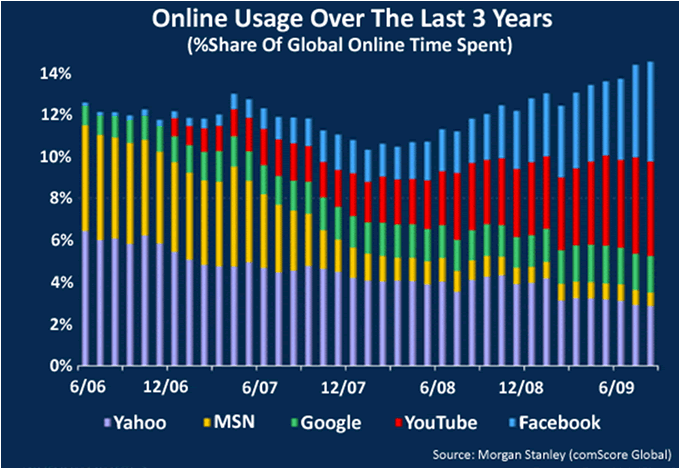
    Suffice to say, times have changed.  In fact, less and less often do consumers even seek out content  by actually going to a given site.  To paraphrase Jeff Jarvis, if something is important, it will find me, be it via newsletter, Facebook, Twitter or a shared link in an email.  In fact, Facebook might very well be the last giant Web property and when it launched Facebook Connect, it too began to extend its tentacles across the Web.  Twitter’s growth has maintained thanks to its off-site (API) growth, while YouTube exploded due to its open embeddable nature from the get-go.

    However, after YouTube sold to Google for $1.65 billion and the site’s aggregate traffic soared, some video producers tried to find a way to generate an audience—and revenues—outside of YouTube in order to build a legitimate business.  In other words, media is becoming fragmented, the Web is becoming deportalized, and the front line of it all is online video.

    Factor 3: Content is Not a Zero-Sum Game

    If we return for a second to television, it’s worth noting that with the advent of cable television, as the number of channels rose, so did overall content consumption.

    Analogously, as the number of content producers and distribution points increases online, consumption increases exponentially.  For proof, look no further than the recent comScore figures touting over 31 billion videos were viewed in November 2009.

    Factor 4: Content is King?

    Indeed, to paraphrase Viacom’s Chairman Sumner Redstone: content becomes more important than distribution mechanisms; as new channels of distribution creep up, it is the content that is always going to be necessary, hence the adage “content is king”.  If you fast forward to 2010, it’s true that with all of these social media aggregation and distribution tools, you are seeing media rise to the surface.  No one, after all, cares about the pipes; it’s what flows through the pipes that matters.  The context—Facebook, Twitter, email—in which people are introduced to media and consume it is becoming more important than the content itself.  Content is no longer king, context is.

    Factor 5: Demand for Content is Elastic, Supply of Funds is Not

    The problem, as you can imagine, is that while it’s perfectly plausible for global advertising to grow, it will not grow fast enough to feed all of the mouths at the creative table.  As “consumer touch points” increase, the number of people that each piece of content reaches becomes smaller at the time of publishing/broadcast but can grow over time.  That’s the theory, anyway.

    This is a double-whammy trend.  It is negative because the audience for something (and corresponding revenue) will be less than what the most popular event on television will be, which partially explains the cachet television still has over its online brethren.

    But it is also a positive trend in that as a content owner you will be able to derive more revenue over the course of the content’s shelf life.  Don’t get me wrong, syndication on television is an enormous revenue stream, but that is not an option for all programming, whereas online, technically, anything has both a shot at building an audience and having some kind of residual revenue stream.  The problem is that there is no vetting process per se online so the lowest common denominator can be zero.

    Factor 6: Chasing Hits Has Proven Futile

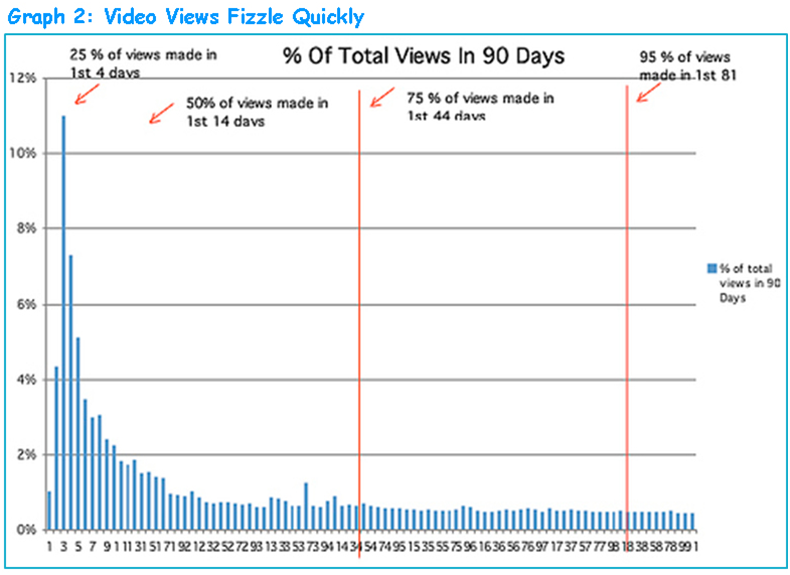
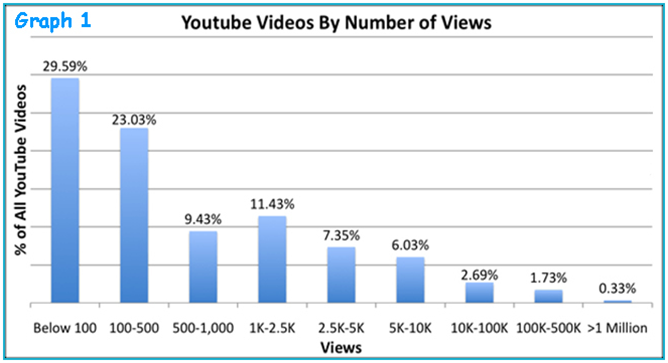
    Ultimately, overall consumption of media will increase but hits become less frequent and each hit will become more niche.  The stats support this hypothesis, despite YouTube’s aggregate size and macro-level success, each clip’s average viewership shows that regardless of whether the video is user-generated, premium or super-premium (for a definition of the differences click here), on average:

    • It will garner 500 views over time
    • 25% of those views will come in the first four days and
    • by and large, only the first 30 to 60 seconds will be watched.

    How can you build a business on that?
    Factor 7: Discovery vs. Recovery

    Exasperating matters is how content is actually unearthed.  To borrow from John Battelle’s breakdown of search: videos are found via recovery and discovery.

    Statistics show that:

    • 45% of views come from direct navigation where a user goes to YouTube and searches to “recover” something they have already seen or are actively looking for.  Of course, YouTube is the world’s second largest search engine and most of those searches are now conducted on YouTube.com, which reinforces the argument that YouTube is now the best Internet M&A of all time.
    • The other 55% of the time, users stumble upon a video and “discover” it.  That is right, over half of the time, users land on something randomly.
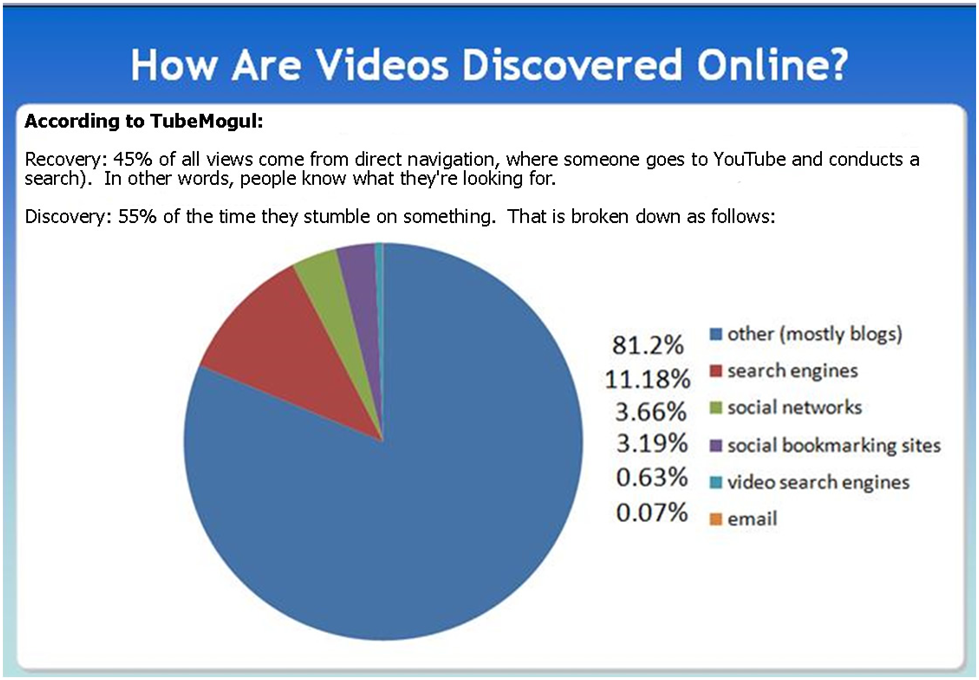
    In other words, while traditional media views the web as a place where pirates turn to to rip off their copyright, the truth is, only half of all of the content consumed is actually searched for, the other half is stumbled upon, meaning you actually have to distribute it widely enough to increase the likelihood that people even notice it, let alone give a damn!

    This is why you need both lots of content and a diversity of it.  Indeed, Time.com former Managing Editor Josh Tyrangiel admitted that “long form journalism, a staple of magazines like Time, is not working” online.  The same applies to long form video online, and by extension, on mobile.

    Factor 8: Size Matters

    So what works?  To gain more insight into that (and to avoid an overly biased outlook), I reached out to Dina Kaplan, who is the COO of blip.tv.  (We use blip.tv’s video player on our web property).  According to Kaplan, a Pyramid of Content is emerging on the Web.

    I tend to agree.  Back in February 2007, I wrote an article called “The Commoditization of Distribution and the Scalability of Content”.  In it, I alluded to a rudimentary pyramid with super premium on top, premium in the middle and UGC at the bottom:
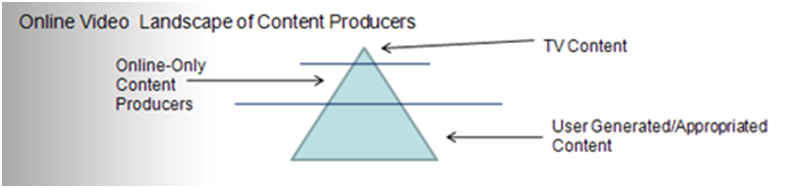
    It’s certainly not rocket science, and Kaplan and I are not alone in having that view.  She continues: “Hulu is the best-known platform sitting at the top of the pyramid, in terms of hosting and distributing network content.  YouTube, which has long been known for hosting great viral and one-off videos, has owned the bottom of the pyramid.”

    The question remains: who will own the middle.  A couple of years ago, YouTube made a move towards “torso content”.  Kaplan’s blip.tv is obviously making a play for the middle, “blip.tv [wants to own] the middle of the content pyramid: the best original shows produced for the Web.  These shows are produced by talented individuals and production companies who are building up loyal audiences for their shows, just as the producers of a traditional TV show would.”

    With things like Apple launching the iPad and IPTV gathering steam, Kaplan is confident that “shows will move around from screen to screen and you’ll choose to watch content on whatever screen is most convenient for you at that moment.”

    Of course, with Boxee’s struggles to get traditional media on-board, one wonders if new media producers have a golden opportunity to win traditional ad dollars, which dwarf new media dollars by a wide margin.  For all the talk and excitement about online advertising and online video advertising, TV advertising in the US remains a $75 billion industry.
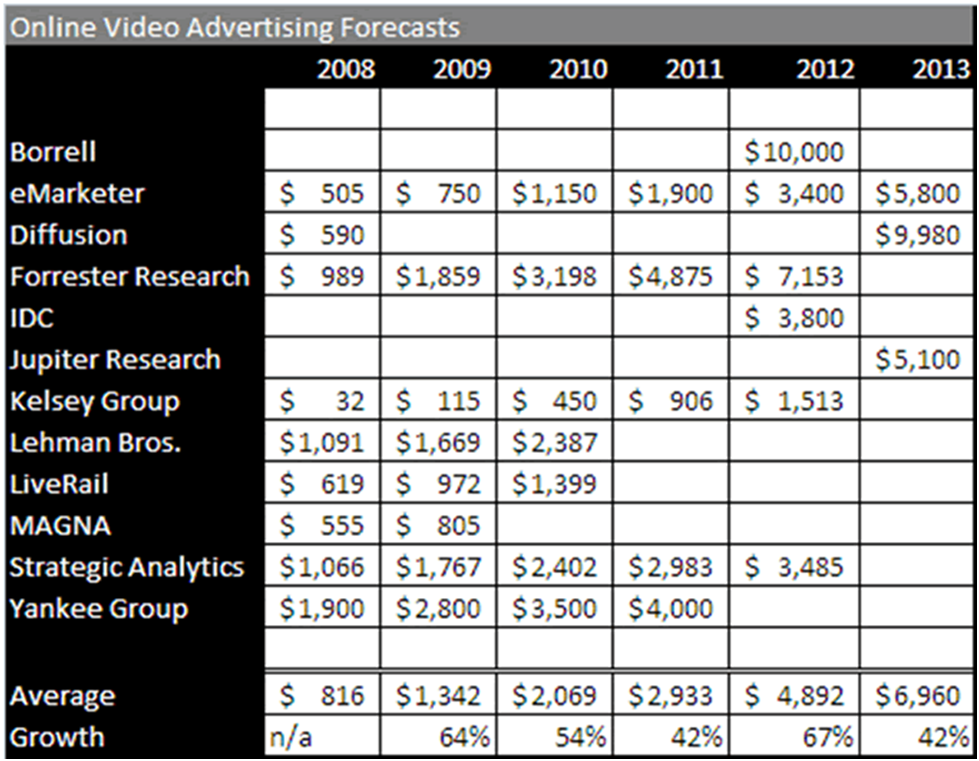
    When you realize the dichotomy between the existing business that is Television and the potential that might be Online Video, you realize why the stakes are so high.  Come back next week when we update our Pyramid of Content to reflect the reality of 2010 and look at how videos will be monetized online.  Also read:

    Part 1: State of Online Video

    Part 2: 12 Surprising Things Holding Back Online Video Advertising

    Next Week – Part 4: How Will Videos Be Monetized


    Buy This Item: [Click here to buy this item]

    Read Original Article

  • Google Apps Script Now Available to All Users

    Google Apps Standard Edition users got a bit of a treat yesterday as Google has introduced Apps Script to the free edition after the feature had been made available to Premier and Education Edition users a few months ago. The tool enables users to automate any task in Google Apps, from updating spreadsheets to sending emails. Apps Script can be quit… (read more)

  • DTNA Engines Get EPA 2010 Certification

    The diesel engines featuring BlueTec technology have been certified by the US Environmental Protection Agency (EPA) as EPA 2010 compliant. The engines in question are DD13, DD15, and DD16 with SCR technology and the certification means the units have been cleared for market launch.

    We are delighted that the EPA recognized the performance of our engines and certified them for 2010, Martin Daum, head of DTNA said in a release. "DTNA decided at an early stage in favor of the SCR technology … (read more)

  • DutchTab 1.3 reviewed

    Dining out with friends is one of life’s little pleasures nothing stimulates decent conversation better than a delicious meal served with refreshing beverages. The last thing you want to do with a belly full of food is indulge in advanced mathematics to split the bill ….

    Read more at BestWindowsMobileApps here.

    Share/Bookmark

  • Weekend Update 01.30.10- The Padophile Edition [Digital Daily]

    Ok, so maybe that headline was a bad joke, but plenty have been made at the expense of the name of Apple’s (AAPL) newest wunder-device. Maybe people are jealous. Maybe it’s too sexy. Maybe it’s too useful. And maybe they needed more women on the branding team.

    Whats not to love? By weight it should be exactly five times as awesome as the iPhone.

    What Weekend Update is certain about though is that the most amazing feature of the new iPad has not even been covered by the media. Based on careful study, Weekend Update’s scientists have concluded that the iPad has nearly infinite “media mass”. When tech journalists and bloggers reached the Apple “event horizon”, which was mysteriously located at the doors of the Yerba Buena Center, their blogs and media outlets were unable to escape the iPad’s gravity and the internet seemed doomed to receive post after post from inside the Apple singularity, forever. I mean, this post is no exception. So today’s Weekend Update will be filed from inside the Apple black hole. It’s soft, dark and welcoming here—like living inside a fresh new turtleneck. At least we’ve got wifi.

    Kara was the woman to watch at the iPadapalooza this week, as she tested the waters at her first Apple unveiling. Oh, and one more thing… she brought the Flip cam. Kara conveniently cut together all the highlights of the exchange between Steve Jobs and out very own magical Mr. Mossberg. prior to releasing the full, “just hot enough for Boomtown” version of her video, she filed a post warning Dell (DELL), HP (HP) and Lenovo that at $499, the iPad is coming for them. Kara also used her awesome editor power to issue a cautionary Memo to Apple execs by dispatching yours truly, the trusty AllThingsD intern, to take the pulse of the academic heart of Silicon Valley—Stanford U. You get to watch me bounce from disappointment, to existential dilemma to ultimate triumph when we locate some future iPad owners. There’s a moral in there for Mr. Jobs though. See if you can tease it out.

    Walt was in his element, and took his position as high priest of the geek-hood at the iPad launch. Always fastidious, Walt un-crated a Mossblog post so all could download his first impressions. While Walt was generally upbeat on the sleek new device, he drove home an important point. Jobs is out on a limb here. For the first time he is trying to find success in popularizing a totally new type of device, not just raising the bar on an existing one. Walt’s question will definitely be one that leads the media discussion moving forward.

    Every team needs a clutch player; the go-to guy when news is happening fast and it all has to get out there. John was our man, and brought his A-game to the Apple event, and dutifully live-blogged while our mediamaster Adam beamed back live pictures. From there, John made special posts about how the Apple stuck with AT&T as its carrier of choice, and also how they’ve upped the ante on gestures for the multi-touch interface. John rounded out his furious week of posts with a showcase of AllThingsD’s very own event photos. You’ll see Jobs, the iPad, and even some exclusive shots from inside the experience area, where the media minds got to fondle the iPad first hand.

    Peter made the trip out west too, and his perspective couldn’t have been more important. If there was any takeaway from the event, it was that this device is all about the content that will run on it… even if all of that isn’t ironed out yet. Peter was the voice of reason, or rather, channeled the voice of Wall Street, which seemed to reserve judgment on the device until we all know more, like what it can actually do. peter rounded out his iPad coverage with an interesting little nugget about AT&T’s (T) win-win-win situation. The oft-scorned wireless carrier already provides the data connections for Sony (SNE) and Amazon’s (AMZN) e-readers, so win or lose for Apple, good ‘ol AT&T is sitting pretty.

    This whole iPad thing is a new phenomenon to physics, so there’s really no telling if we will ever get out of the iPad media black hole. Weekend Update is hoping that if all the techie journalist band together we can find out way back into the light. Who knows, maybe if we wait long enough, there will be an app for that too.

    Buy This Item: [Click here to buy this item]

    Read Original Article

  • Tesla Roadster to bid adieu in 2011, successor coming in 2013

    Much like the replicants of Philip K Dick’s fertile imagination, it seems like Tesla’s Roadster will live a famous, but short life. In its pre-IPO filings to the SEC, the company has cited “tooling changes at a supplier” as the reason it will stop selling its current gen Roadster and Roadster Sport EVs after 2011. Given that all Roadsters are built at the Lotus factory in England, this probably suggests new Elise or Exige models are on the way and the manufacturing facilities are being updated accordingly. It also means Tesla will be left without any product to sell until the planned 2012 launch of the Model S sedan, while its next generation of two-door sporty supercars won’t be arriving until 2013. Sigh.

    Tesla Roadster to bid adieu in 2011, successor coming in 2013 originally appeared on Engadget on Sat, 30 Jan 2010 06:35:00 EST. Please see our terms for use of feeds.

    Permalink Autoblog  |  sourceAutopia  | Email this | Comments

    Buy This Item: [Click here to buy this item]

    Article

  • Best Herbal Remedies For You | Health Tips @Aqualus

    Areview: Best Herbal Remedies For You. Filed under: Health — admin @ 11:48 am. As medical science has delved and abstraction into atomic biology, and the means these compounds and agents assignment has been explored and broadly researched, …

    Share/Bookmark

  • Madrid Gets the 3D Treatment in Google Earth

    Google has plenty of reasons not to be satisfied with this world, the recent issues in China, all the people criticizing Google Books, Street View, the increasing government scrutiny, you name it. Maybe that’s why it’s working on creating a new one, or at least recreating this one on its own terms, in Google Earth. Google’s mapping services are constantly evolving and with the influx of new, high-quality photography coming from the one of the most advanced imaging satellite in the world, the … (read more)

  • Jaguar Land Rover working on Jet Powered EV

    Wow: Will Jaguar Have the First Hybrid Born From Jet Turbines? – Green Car Reports

    That’s the kind of electric vehicle I want. A Jet engine is smooth and much better suited to working in tandem with electric vehicles. It would also be capable of turning out energy much more efficiently than a traditional piston motor. That would mean you could turn the power up on the electric motor and let it use more electricity to power the wheels. New Jaguar XJ220 anyone?

    Looks like Rover’s 100 + years of history are counting for something against the big boys. Where’s Toyota’s Jet engined EV and why didn’t GM think of that in their Chevrolet Volt?

  • Owen Van Natta Talks About His First 8 Months Running MySpace (video)

    I sat down with MySpace CEO Owen Van Natta at the World Economic Forum in Davos, Switzerland earlier this week to talk about his first eight months on the job. This is one of Owen’s first video interviews since taking the job last April.

    We talk about Van Natta’s vision for the once-mighty MySpace. The site was at one time the worlds largest social network and had more page views than any other U.S. website. But in the last couple of years it has been eclipsed by Facebook’s stunning growth.

    Still, Van Natta and team have a plan. The MySpace of the future will be all about the social experience around content, and the company’s strong offerings in music and music videos through MySpace Music will be the cornerstone of that effort. From the interview:

    I think we have a unique value proposition for consumers that is about being the place where people socialize around content, and by socialize, I mean the tag line of, you know, discover and share and showcase content. It’s where you learn about content both through your friends and, you know, sometimes it’s more important that the people that you don’t have any connections to in the real world. And one of the big differentiators for MySpace is the fact that we have an open social graph. People expect to connect to people they don’t have connection to in the real world but has similar interests with. And so, it’s a great way to do discovery. It’s a lot of the way discovery happens in the real world. And now the social web is just simply enabling that to happen more increasingly online.

    Van Natta has made two acquisitions since joining, iLike and iMeem, both in the music space. And that iLike deal got MySpace Music onto Google search, driving a lot of traffic and attention to the service.

    We discuss both acquisitions in the interview.

    Van Natta also talks about MySpace revenue, particularly the soon to terminate Google search deal.

    The full transcript is below. You can also watch Van Natta’s presentation at the event here.

    Michael Arrington: I’m here with Owen Van Natta, the CEO of MySpace. Owen, you’ve been CEO for eight months now?.

    Mr. OWEN VAN NATTA (CEO, MySpace): Eight months. About eight months now.

    Michael Arrington: We’re sitting down at the luxurious Club Hotel in Davos, Switzerland. You’re at the World Economic Forum. This has become a bit of a tradition for me to interview CEOs here. This is the internet ghetto. This is where they put all the internet CEOs. It’s not like the best hotel in the world. As you found out, there’s no shampoo.

    Mr. VAN NATTA: (laughs) No shampoo. And they’ve got beds in the closets.

    Michael Arrington: Murphy beds. Yes.

    Mr. VAN NATTA: But they also have a great sound track here, so you could hear it matches the decor. It’s very ’70s, very (unintelligible).

    Michael Arrington: So, I have a few minutes with you. What I want to start with is, tell me what MySpace is today.

    Mr. VAN NATTA: MySpace is a place to share and it’s a place to discover, share and showcase content. That’s what people are doing on MySpace today and that’s what we’re focused on, continuing to provide to people.

    Michael Arrington: So, over the last eight months, what have you fixed, what have you pushed forward on, what have you cut? What is your job there?

    Mr. VAN NATTA: Well, we’ve – I’m very focused on being a user center’s company. And that means starting with the product, making sure that we have a product plan that matches the mission statement of discover, share and showcase content. We’re focused on the music category. We’re focused on film and television. We’re focused on games. That’s what people are engaged with today on the site. Once we – you start a product strategy, you need to make sure you have the right team. We’ve built a entirely new management team of MySpace. I’m really excited about some of the talent that we’ve brought on board. Now, it’s all starting to be built throughout the entire company, and obviously, you have to have a great technical platform in order to be able to compete in the internet space. And we’ve been doing a lot of work to position ourselves to deliver on the promise of our type of platform. You know, we’re doing a lot of things to improve the experience like decrease page download times and we’re starting to realize some of those games already. I’m excited about our progress so far.

    Michael Arrington: Your engineers are mostly in L.A. and San Francisco, right? Or entirely in L.A. and San Francisco?

    Mr. VAN NATTA: We actually have a large engineering group in – well, reasonably large engineering group in Seattle.

    Michael Arrington: OK. And have you hired a lot of engineers since you’ve come on board? Or has it been mostly keeping the ones that you like or how – what has that been like?

    Mr. VAN NATTA: No, we’re constantly bringing new engineering talent at all levels of the organization. We have a new CTO, got an Alex Maghen who has a great background dealing with large scale systems. And I think we have a lot of great news to come in terms of tech (unintelligible) coming in. It’s a big area of focus for us.

    Michael Arrington: Before you came on board – in fact, I talked to DeWolfe, your predecessor, here a year ago, and there was a lot of focus on the past before you and your team joined about competition, and particularly Facebook, and how you stacked up against Facebook at different times. I haven’t heard a lot of that from the team, not a lot of focus on the competition, more about what you are and what you’re doing to push forward. In fact, you’ve integrated with, I think, Twitter in some ways, right?

    Mr. VAN NATTA: Yes.

    Michael Arrington: You’ve done a small integration with Facebook Connect. Are we going to see more of that? How can you use some of the companies out there to make your product better?

    Mr. VAN NATTA: Well, a big part of our strategy is to be – is to really embrace openness and let people engage with content where it is that they want to engage with it. So, you know, one of the things that we did early on was we acquired a company called I Like That. I know you’re aware of. It has a…

    Michael Arrington: Yeah, just a month before they were integrated with Google Search.

    Mr. VAN NATTA: That’s right.

    Michael Arrington: Did you know about that when you bought them? Did you know that that deal is going to happen?

    Mr. VAN NATTA: You know, those things are always in the works but it wasn’t a done deal. But you know…

    Michael Arrington: The timing sort of worked out well, looked like you got a really good deal on that company as well.

    Mr. VAN NATTA: Well, I think, you know, the timing of the Google partnership is one that we’re excited about. You know, we’ve even extended, so since then, we announced that we’re going to be part of their real time search initiative and, you know, we’re excited to see what type of collaboration that brings as well.

    Michael Arrington: Well, since we’re on the topic of Google, I’ll jump ahead. You have a search deal with them that signed a couple of years ago before you joined, and in, I think, June of next year – middle of next year, the end of your fiscal year next year, it ends, at least the last for a public statement on that. Are you renegotiating that or you think you’re working with another partner? It’s nearly $900 million deal over three years. It’s a substantial amount of revenue. Where do you stand with that?
    Mr. VAN NATTA: All those types of partnerships always need to evolve. You know, we’ve continued to evolve the business and building that in a way where we just – we don’t have any dependency on – we don’t have dependency on any one revenue stream. We’re always open to new partnership. We’ll continue to extend our partnership with Google in the areas of music search as well as real time search(ph). So, you know, that continues to be a great relationship that we’re excited about. And we’re going to be looking at lots of different options as we go forward. We’re really pushing on innovation. You know, we’re really in the midst of remaking MySpace into the place where you discover, share and showcase content and partnerships are going to be a big part of that.

    Michael Arrington: If you talk about content, and this has been something you and your team is – have talked about almost since day one. Obviously, you have the music property with is great. It’s been around since over a year now. You guys do a lot with trailers. I see trailers all the time. You have lots of video content on the site. Is that what we should be thinking of? Or you’re thinking of more of like a Hulu type of thing or are you actually pulling an actual TV content, like what do you mean by content? And there are games as well. Are these games that you’ll publish? Will you acquire companies? Will you pull in more third party Flash games? Is there a way we should – as a press, should be thinking about what you mean by content?

    Mr. VAN NATTA: On the Music Space, having the relationships that we do and the joint venture we do with the major record labels, the publisher, all the independent record labels, give us the ability to have a music experience that really is unparalleled.

    Michael Arrington: Music videos, music streaming…

    Mr. VAN NATTA: All of it in one location and very, very social which we think is really the foundation for discovering (unintelligible).

    Michael Arrington: What about mobile? We see a mobile music initiative at some point?

    Mr. VAN NATTA: We continue to look at mobile. It’s a big part of the way that people are interacting with the site today. We got a tonic(ph) growth in mobile, and it’s a big area of focus for us, and I’m really hopeful that we’re going to continue to evolve and innovate and that’s (unintelligible)…

    Michael Arrington: And maybe see streaming music and that kind of thing in the future.

    Mr. VAN NATTA: I think all those things are the things that users are increasingly wanting and we want to serve those user needs, especially as it relates to discovery around music because that’s one of the underserved areas in the market that we’re uniquely positioned to deliver for consumers.

    Michael Arrington: What about TV and films? I mean, actual films and things like that. Is that something that you think YouTube and Hulu will dominate or is that a place that you’ll play or do you know yet?

    Mr. VAN NATTA: We consider YouTube and Hulu to be partners today and we have their content integrated all throughout the site. We have over 400 partnerships with different content producers and content creators. That’s going to continue to be an area of focus for us. We host our own music videos, that was something we launched, as you know, last year. So, those models will continue to evolve but it’s really going to be about partnership. We’re building a platform where we want users to come and engage with that content in a highly social environment and that’s going to continue to be our focus in terms of providing great user experience.

    Michael Arrington: OK. Do you think – and I know this is a question you’ve been asked many times. But, do you think we’ll see a for Facebook Connect integration? Is it something you’re still considering, something you’re deciding on?

    Mr. VAN NATTA: We did a very small Facebook Connect…

    Michael Arrington: The European site.

    Mr. VAN NATTA: Out of our UK office. Again, I think embracing openness means looking at it everywhere. And, you know, we’re certainly looking at different ways that users want to be able to engage with the content and we’re pretty much open to figuring out the right way to make that available for users, where it is that they want it. 7.45

    Michael Arrington: OK. MySpace has always been a bit behind maybe on design and technology. And not your team’s fault, but what are your plans to remedy that? Or do you disagree with this statement?

    Mr. VAN NATTA: You know, I think usability and user experience and design are critical areas if you’re going to be a player in the consumer web. One of the first hires that we made was someone that had a user experience for (unintelligible) extensive experience, building great user experiences from some of the top sites out there. It’s something that…

    Michael Arrington: Who was that?

    Mr. VAN NATTA: That really focused on – she’s a woman named Katie Geminder.

    Michael Arrington: OK.

    Mr. VAN NATTA: She’s got experience at Amazon and Apple and Facebook.

    Michael Arrington: Does she report to Jason?

    Mr. VAN NATTA: She does.

    Michael Arrington: OK.

    Mr. VAN NATTA: She – and so, it’s an area – it’s a big area focused for us. It’s something that we’ve actually been staffing up quite a bit. We’re starting to build a really solid team there. We need to have a technical platform that really enables us to have a great user experience and we’re focused on building that out too.

    Michael Arrington: How far away are you from that do you think?

    Mr. VAN NATTA: You know, it’s an interactive(ph) process. It’s not something that you can do a big atomic launch around. We have a very large site with a large number of users and we really want to bring them along and have them show us through exactly how it is that they’re responding, give us a feedback exactly what the best user experience is. So, you’re going to see that continue to evolve. We’ve done a number of things in that space already where we (unintelligible) set a number of categories and number of areas on the site that we just didn’t think we’re adding value for users, that usually we’re showing through their actions weren’t the things that they were coming to MySpace to do, things like weather and jobs and classifieds, horoscopes. I know you found out that horoscopes are gone.

    Michael Arrington: I was – that was a sad day.

    Mr. VAN NATTA: But, you know, that’s something that we’re continuing to focus on and we want to be excellent in usability and design. We were building a really strong competence(ph) there.

    Michael Arrington: You know, Facebook talks a lot about how they’re the pipes around social. You guys talk a lot about you’re the content. It seems to be that the one word you use a lot is content and social experience around content. Is that the right way to think about MySpace?

    Mr. VAN NATTA: I think we have a unique value proposition for consumers that is about being the place where people socialize around content, and by socialize, I mean the tag line of, you know, discover and share and showcase content. It’s where you learn about content both through your friends and, you know, sometimes it’s more important that the people that you don’t have any connections to in the real world. And one of the big differentiators for MySpace is the fact that we have an open social graph. People expect to connect to people they don’t have connection to in the real world but has similar interests with. And so, it’s a great way to do discovery. It’s a lot of the way discovery happens in the real world. And now the social web is just simply enabling that to happen more increasingly online.

    Michael Arrington: So, you were always a startup guy. I mean, even in Amazon, you broke out and started a line for them. You were with Facebook when they were a very small playlist. You’re now at a big company within a big company. Looking back over the last eight months, is the job what you thought it would be when you took it? Was it different than you thought it would be?

    Mr. VAN NATTA: I think this is a unique situation. I certainly came in expecting that this is going to be a lot of work but what I am excited about everyday and what gets me fired up and my team fired up everyday is that we have an incredible asset base and we have a really strong user value proposition. It’s something that users are telling us every single day with their time that they really value highly. And as we continue to make improvements, we’re seeing increased engagement around the areas that we are focused on, the content areas that we just talked about. So, you know, look, building these companies is a huge challenge, but I love building teams, I love being part of a team, and I’m really excited about what we have in front of us and really also pleased with the progress we’ve made so far.

    Michael Arrington: All right. Thanks very much. Oh, one other thing. You just hired a new chief revenue officer.

    Mr. VAN NATTA: We did. Nada Stirratt.

    Michael Arrington: Any shifts on your revenue strategy now based on that?

    Mr. VAN NATTA: Well, one of the things that we’re seeing in terms of the market is, you know, the economic downturn, as I’ve talked with a lot of CEOs and marketers, you know, brand managers, I think the economic downturn caused a lot of these companies to really reevaluate their advertising strategy and what you increasingly see is more people’s time spent online but fewer brand always being able to be spent online. And one of the areas where I think we’ve been super innovative and where I think we have a strong competency is in the integrated marketing area, some of the things that we do with movie studios or on movie launches or record releases. You know, we released over 200 records in the last 12 months for bands, and really to promote those heavily to millions and millions of people in a very integrated way is super unique. When we talk to users about it, we look at users’ behavior, what we’re finding is they really view that content as valuable as they would view professionally produced content or content that isn’t necessarily advertising content. And, you know, that is what we think is the big opportunity that could bring a lot more brand always on to the web and that’s what we’re working on with our advertising partners on today. So, I’m excited about that. I think it is new in that as more brand always go online, people are going to want those types of experiences and I think we’re really continuing to lead the market in terms of that type of integrated marketing.

    Michael Arrington: OK. Thanks very much for your time.

    Mr. VAN NATTA: Yeah. Thanks a lot.


    Buy This Item: [Click here to buy this item]

    Read Original Article

  • iPad v. A Rock

    This speaks for itself. Thanks to Phil Santoro for creating it and sending it us (a play on the iphone v. rock joke).


    Buy This Item: [Click here to buy this item]

    Read Original Article

  • iPad UI gets ported to the iPhone and iPod touch

    At this particular point, 50-something days away from the earliest iPad deliveries, we doubt too many people are up in arms about the iPad’s ability to act as a jumbo iPhone. On the other hand, if we told you you can take pretty much the entire iPad experience and distill it down to your iPhone OS device, well you’d probably care a lot more, wouldn’t you? To get that extra 3D flavor to your UI, including the fetching iBooks shelf and other iPad-specific touches, you’ll need a jailbroken iPhone or iPod touch, access to the Cydia app store, and the manpower to click past the break for the full instructional video. Come on, you know you want to.

    [Thanks, Taimur]

    Continue reading iPad UI gets ported to the iPhone and iPod touch

    iPad UI gets ported to the iPhone and iPod touch originally appeared on Engadget on Sat, 30 Jan 2010 04:54:00 EST. Please see our terms for use of feeds.

    Permalink   |  sourceRedmond Pie  | Email this | Comments

    Buy This Item: [Click here to buy this item]

    Article

  • Blown ECM

    hey guys..!!

    i drive a chevy aveo 1.4.
    im running an FFE and a filter.

    off late my car started stalling everytime i put on the ac or redlined it..
    got everything checked and scanned a zillion times nothing showed..
    finally i got an ecm from another aveo and the car was fine..!

    ok few questions..
    can the aveo/optra ecm be repaired?
    can the aveo 1.4 run on an aveo 1.6 ecm?..all the internals are the same.from what ive got from an international forum the 1.6 is a stroked 1.4.

    ok guys Help!!!
    i need to do it asap…as in today itself!!

  • Triple Strength Resveratrol – ( 225mg, 60 Vcap )

    Triple Strength Resveratrol - ( 225mg, 60 Vcap ) Resveratrol is an antioxidant that is intended to provide nutritive support for cardiovascular health.
  • Goat’s Rue Alcohol Free ( 120 Caps )

    Goat's Rue Alcohol Free ( 120 Caps ) An alcohol free liquid concentrate in vegetarian capsules. Goat’s rue is one of the most potent herbs known to increase breast milk and also helps stimulate the development of mammary tissue. This formula helps adoptive mothers to successfully breastfeed.
  • BIOSIL ( 30ML, 30 ML )

    BIOSIL ( 30ML, 30 ML ) Nourish Your Body’s “Health and Beauty Proteins” – Naturally! The condition of skin, hair, nails, and bones depends on three essential structural proteins: Collagen, Keratin and Elastin. They are known as your “Health and Beauty” proteins. Collagen “plumps” the skin removing wrinkles and may avoid their formation. In addition, collagen enhances to continuously hydrate your skin – from the inside out. Keratin is the protein that’s packed into your hair shaft providing hair with thickness, strength, and elasticity. Plus, Keratin gives your nails strength and clarity. Elastin gives your skin its ability to “bounce back,” may take away fine lines and wrinkles. For bones, collagen provides the “binding sites” for calcium. With age, these three structural proteins decline. BioSil is specifically formulated to nourish all three health and beauty proteins may provides favorable effects to restore them to more youthful levels. Clinically Proven Reduces Fine Lines and Wrinkles by 19%. Thickens and Strengthens Hair. Creates Stronger More Break Resistant Nails. Increases Bone Mineral Density 200% over TCR. Safe – Effective – Natural.