Author: Serkadis

  • Mercedes SLS AMG Enters Fashion World

    Mercedes-Benz recently commissioned fashion designer Gareth Pugh and photographer Nick Knight to create a visual campaign for the Mercedes-Benz Fashion Week in Berlin, which also features the German carmaker’s new Gullwing. The SLS AMG was, in fact, Julia Stegner’s partner during the photoshoot.

    The German model was wearing a futuristic outfit designed by Pug, which was in perfect symbiosis with the design of the Mercedes-Benz SLS AMG. Julia is not at her first collaboration with the three-p… (read more)

  • GM to Sell Saab to Spyker This Week?

    Although General Motors is in the process of winding down Saab, negotiations for the sale of the Swedish brand continue and, according to the latest rumors on the matter, Spyker is favorite to buy it. According to Bloomberg News, the Dutch carmaker wants to offer a combnation of cash and preferred shares in Saab worth $500 million, a proposal that complies with GM’s requirements.

    As a result, an agreement is expected to be reached this week, although officials involved in the matter are keepi… (read more)

  • Disappointed with RE CL500

    Hello all,

    Sometime back, I got a chance to ride my uncle’s RE Standard 350 for couple of months. After riding this bike, I had decided that my next bike would be an RE one and Standard in particular.

    Recently when I planned to buy this bike (after pestering my parents) I realised that the production of Standard has been stopped and sales have stopped in Karnataka. But the Classic 500 caught my eye. Thought the bike was not available for TD at the showroom when I went, the sales guy explained me with all the features of this bike. It sounded very interesting. I came back home and did a bit of research on this bike. The reviews were great, everyone complimenting the looks and UCE engine.

    I had the photo of this bike as my wallpaper and everytime I saw the pic I wanted to own one asap.

    I wanted to take a TD of the bike before booking. I went to my friend who owns this bike, to take a TD. I was full joshed up to ride this new machine from RE.

    I sat on the bike thinking the feel would be similar to Standard. But it wasn’t. This bike is low. I took the bike for a small ride. It didnt impress me much. The riding position disappointed me, the RE thump was missing (very obvious because of new engine), and I couldnt feel I was riding an RE bike. It didnt give the majestic feel of riding as compared to Standard. I understand that the technology used in CL is far superior than the one used in Standard, but still CL let me down.

  • IE and Firefox Users Aren't Invited to the HTML5 Video Party

    Last week, there were a couple of big developments for HTML5, both YouTube and Vimeo implemented HTML5-based video players on their sites. This is a huge step forward for the proposed standard, but most users won’t be able to take advantage of it. Right now, the players only work on recent builds of either Google Chrome or Safari leav… (read more)

  • Pope Proclaims: Go Forth and Blog

    What I find most remarkable about this decision is how fast it has come and that is opens to door for thousands of professional voices to be heard on the Blogosphere.  Imagine, if you like, the Chinese communist party telling its cadres to do this, or perhaps the US officer corps, or perhaps the managers of Microsoft been given this license. 
    Amazingly, the Catholic Church is leading on this.  The Pope has chosen to trust his priesthood, obviously a good bet, but it still blows the door open for a public debate and real public participation.  I suspect that it will work out just fine.
    The press loves to take cheap shots at the Church over its famously slow response to change, though that has waned in resent years as more are coming to respect the nature of the Church not just as another institution, but as almost the only institution that must make definitive moral decisions and those policies are always the standard for others.  Other churches and religions have dabbled in this and have typically been found wanting.
    In fact, the modern age has seen the disappearance of some of the most egregious anti Catholic propaganda commonly deployed by a lot of other Christian faiths, or perhaps I simply am too successful at avoiding such people.
    For the nonce, the Church has decided that its thousands of priests can and will blog and compete with each other for attention and ultimately reach their own audience of believers.
    This is very powerful.  No longer does a believer have to accept whoever is at the alter to provide their spiritual instruction.  They can choose a priest who speaks successfully to them personally.
    There are presently 400,000 priests worldwide, each typically providing service to an average of 3,000 believers.  I can from my own experience, can say that without the use of a blog, it is impossible to properly reach out to that many people.  The truth is that you reach ten percent and rely on family and the rest to maintain the rest.
    With a blog, a gifted writer can communicate with and even develop a much larger effective audience than otherwise possible.
    Pope To Priests: go Forth and Blog
    By Associated Press

    Saturday, January 23, 2010
    VATICAN CITY — Pope Benedict XVI has a new commandment for priests struggling to get their message across: Go forth and blog.

    The pope, whose own presence on the Web has heavily grown in recent years, urged priests on Saturday to use all multimedia tools at their disposal to preach the Gospel and engage in dialogue with people of other religions and cultures.

    And just using e-mail or surfing the Web is often not enough: Priests should use cutting-edge technologies to express themselves and lead their communities, Benedict said in a message released by the Vatican.

    “The spread of multimedia communications and its rich ’menu of options’ might make us think it sufficient simply to be present on the Web,” but priests are “challenged to proclaim the Gospel by employing the latest generation of audiovisual resources,” he said.

    The message, prepared for the World Day of Communications, suggests such possibilities as images, videos, animated features, blogs, and Web sites.

    Benedict said young priests should become familiar with new media while still in seminary, though he stressed that the use of new technologies must reflect theological and spiritual principles.
    “Priests present in the world of digital communications should be less notable for their media savvy than for their priestly heart, their closeness to Christ,” he said.

    The 82-year-old pope has often been wary of new media, warning about what he has called the tendency of entertainment media, in particular, to trivialize sex and promote violence, while lamenting that the endless stream of news can make people insensitive to tragedies.

    But Benedict has also praised new ways of communicating as a “gift to humanity” when used to foster friendship and understanding.

    The Vatican has tried hard to keep up to speed with the rapidly changing field.

    Last year it opened a YouTube channel as well as a portal dedicated to the pope. The Pope2You site gives news on the pontiff’s trips and speeches and features a Facebook application that allows users to send postcards with photos of Benedict and excerpts from his messages to their friends.

    Many priests and top prelates already interact with the faithful online. One of Benedict’s advisers, Cardinal Crescenzio Sepe, the archbishop of Naples, has his own Facebook profile and so does Cardinal Roger Mahony, archbishop of Los Angeles.

    In Saturday’s message — titled “The priest and pastoral ministry in a digital world: new media at the service of the Word” — Benedict urged special care in contacts with other cultures and beliefs.

    A presence on the Web, “precisely because it brings us into contact with the followers of other religions, nonbelievers and people of every culture, requires sensitivity to those who do not believe, the disheartened and those who have a deep, unarticulated desire for enduring truth and the absolute,” he said.

    Monsignor Claudio Maria Celli, who heads the Vatican’s social communications office, said that Benedict’s words aimed to encourage reflection in the church on the positive uses of new media.

    “That doesn’t mean that (every priest) must open a blog or a Web site. It means that the church and the faithful must engage in this ministry in a digital world,” Celli told reporters. “At some point, a balance will be found.”

    Celli, 68, said that young priests would have no trouble following the pope’s message, but, he joked, “those who have a certain age will struggle a bit more
  • B’Lore – Dharmastala Road Condition

    Hi, I’ve tom visit Dharma & Kukke this week end with my family in my Swift.

    Did any one travelled thru’ Shiradi ghats recently & how’s the condition? Or Is it advisable to take Charmudi ghats …Hassan- Belur-Mudigere-Kottigehara-Charmudi [is it necessary to touch Chickmagalur?]

    Pl let me know which route is better Or is it better to avoid driving self & hire a cab? I like self driving in ghats, as long as they are in drivable condition.

    Thanks

  • Mahindra & Mahindra Pondering US Launch

    Rumors regarding a possible US launch of Indian manufacturer Mahindra & Mahindra appeared in the online media a long time ago but until now, there was no confirmation on the matter. Well, Mahindra boss Pawan Goenka said in a statement that such a scenario is indeed possible and the first models to hit the United States will probably be a re-worked version of the Scorpio SUV.

    There are no official release date for the time being but Goeka hints that Mahindra’s plans could become reality as soo… (read more)

  • Honda “Living with Robots” Documentary, Video Included

    Honda finally debuted the sixth short-film documentary from the Dream the Impossible Documentary Series at the 2010 Sundance Film Festival, last Friday. As we previously reported, the short documentary film called Living with Robots highlights Honda’s ASIMO (Advanced Step in Innovative Mobility), a humanoid robot which is designed to someday assist people in their homes.

    "The Sundance Film Festival is the ideal place to explore new and diverse ideas at the intersection of art, technology… (read more)

  • Raw Milk

    The consumer has been brainwashed for fifty years to avoid raw milk or alternately to trust only pasteurized milk.  I grew up with this even though I drank fresh milk my entire childhood.  The truth is that every farmer is fastidious over healthy cows and clean milking equipment.  The consumer would be astonished to see the care maintained as a matter of course.


    The problem begins with the need to blend product in tankage and to transport it to a processing facility.  Obviously a blended product hugely increases risk and pasteurization is designed to remove the risk.  One cannot disagree with that protocol.  In fact I personally want nothing to do with milk that must be days old at least by the time it arrives in my home, if it is not pasteurized.   Recall that it is stored at the producer at least a couple of days even before shipping.


    Fresh milk directly from the producer will be from a known healthy herd with the personal guarantee of the owner and likely hours old simply because that will be the easiest way to sell it.


    The quality of the product will be hugely superior to anything you can imagine.  In fact the best thing commercial milk has going for it is no one has ever tasted fresh milk.


    Fresh milk delivery has to be a same day proposition and the blending needs to be avoided.  The customer can order directly from the herd.  There is likely a viable business here with modern refrigeration.


    However, it is also time to rethink the whole process of milk handling and pasteurization.  There are better ways that can surely be now perfected and plausibly applied at farm level.


    Using EM waves to knock out foreign bacteria is possible on small processing systems.  So it may be possible to satisfy the health department with a neat technological fix.


    By the bye, If you have never drank raw milk, you are in for a treat. The difference is night and day.


    Ont. farmer toasts victory in raw milk trial with glass of the contentious drink

    Thu Jan 21, 6:55 PM
    By Ciara Byrne, The Canadian Press
    NEWMARKET, Ont. – Clutching a glass of raw milk, an emotional Michael Schmidt toasted what he called a victory for the local food movement Thursday after the Ontario dairy farmer was found not guilty of 19 charges related to selling unpasteurized milk.
    “People need to learn how to stand up even when it seems it’s impossible to achieve change in our interpretation of the law,” said Schmidt, who was often depicted by supporters as the small farmer fighting for consumer food rights against an established milk industry.
    In a legal battle that played out over three years, Schmidt fought to continue the operation of his 150-member raw milk co-operative in Durham, Ont., and defended himself against the charges for dispensing milk straight from the cow.
    Schmidt was charged under the Health Protection and Promotion Act and the Milk Act after an armed raid by about two dozen officers and government officials at his farm in 2006.
    While raw milk is legal to drink, it’s illegal to sell in Canada. Officials consider it a health hazard.
    Under Schmidt’s cow-share program each member of his co-operative owns a part of the cow. By owning the cow members were drinking milk from their own animal, he says.
    On Thursday, justice of the peace Paul Kowarsky ruled that Schmidt’s method of distribution made the group exempt from the legislation. He also found the operation did not violate the province’s milk-marketing or public-health regulations.
    Kowarsky said the Crown could not prove that Schmidt had tried to market the milk. It was made clear on signs at the farm and at the blue bus where Schmidt set up shop at a Vaughan, Ont., market that only members could purchase products made from raw milk, he added.
    “The undisputed evidence of the defendant is that there is no advertising or selling,” said Kowarsky.
    The legislation was originally created to protect the vulnerable, but the cow-share members were not vulnerable and were cognizant of all concerns associated with drinking unpasteurized milk, he added.
    “They consume the milk at their own risk,” said Kowarsky, adding the product had been thoroughly tested and was shown not to be contaminated.
    At trial, food scientists and health experts testified that mandatory pasteurization laws are needed to protect public health.
    Schmidt argued that government officials and food scientists could not guarantee the safety of any food, and suggested informed consumers should be able to buy raw milk if they want.
    At the culmination of the detailed verdict, Kowarsky said the cow-share program was a “legitimate and lawful” enterprise and called the case part of a “search for contemporary justice.”
    A Ministry of Agriculture spokesman was not able to say if the ministry would be reviewing the Milk Act.
    “We’re disappointed in the court’s ruling,” said Brent Ross. “The government will review the court’s decision and determine next steps.”
    Thrilled supporters, some wearing sweaters emblazoned on the back with “Team Raw Dairy,” gasped and clapped as the justice of the peace handed down his verdict. The courtroom, packed with so many supporters that dozens were left standing, flocked to a teary-eyed Schmidt, as they flung their arms around him.
    “He’s giving us all a chance for the small farmer to enter into private contracts such as cow-share or farm-share agreements where we can decide what we buy, eat and how we behave,” said a jubilant Judith McGill, a cow-share member who has helped rally support for Schmidt.
    Outside of the court, two women poured and passed around creamy glasses of raw milk to people as children perched on signs reading “protect our food.”
    During the verdict, Kowarsky also acknowledged the growing trend towards the local food movement, and said he found many cow-share programs existed around the world.
    This was a message not lost on Schmidt, who said the verdict had opened the door to new kind of conversation.
    “It was never a war. It was a Shakespearean drama,” Schmidt said coyly. “We tried to get into a dialogue.”
    Schmidt has not ruled out entering the political scene so he can push for the full legalization of raw milk.
    “Like (former prime minister Pierre Elliot) Trudeau said, the government has no business in the bedroom of the people, and here I say the government has no business in the stomach of the people either.”
    For Allyson McMullen, Schmidt’s win is also a win for consumer choice.
    “It’s so much more about milk. It’s about food. It’s about us having the choice to put what we want in our bodies and I think that this is incredible,” she said.
  • Hyundai Sonata Gets Listed in ACEEE’s “Green Choices 2010”

    Nowadays, any car manufacturer who wants to get one of its models recognized as an environmentally friendly car has to think about hybrid technology. Though batteries become more and more popular, most of us drive a gasoline powered car and will probably buy a gasoline powered car next time we’re in the market for a new vehicle. So the American Council for an Energy-Efficient Economy decided to list the Hyundai Sonata as the greenest gasoline powered car available in 2010.

    ACEEE’s Green Choi… (read more)

  • On Shelves This Week: January 24 – January 30, 2010

    It’s one heck of a week, alright! After the ho-hum releases that’s been coming our way since 2010 started, we’re finally getting some serious action. MAG, the ambitiously massive multiplayer game from Sony, is finally coming out

  • “Jersey Shore’s” Pauly D & Angelina Dating?

    Jersey Shore’s Paul “Pauly D” DelVecchio has sparked rumors that he’s “hooking up” with former castmate Angelina Pivarnick after the twentysomethings were seen canoodling at the Vida launch party at Voyeur in Los Angeles Jan. 13.

    “They were very cute together and seemed totally into each other, They couldn’t keep their hands off of one another.”


    The lovesick Pivarnick — who left the smash MTV reality show early after she was fired from the Seaside Heights t-shirt shop where the cast was employed — is reportedly single now and being romantically-linked to the heavily-gelled mixmaster.

    A spywitness spills in the Feb. 1 issue of In Touch Weekly: “She was making out with him for most of the night and they weren’t trying to hide it at all. This season Pauly D was infamous for hanging out with Mike ‘The Situation’ and trying to sleep with as many girls that they could… guess he’s changed his ways.”


  • O’Reilly Drops Ebook DRM, Sees 104 Percent Increase In Sales [Voices]

    By Cory Doctorow, Co-Editor, BoingBoing.net

    It’s been 18 months since O’Reilly, the world’s largest publisher of tech books, stopped using DRM on its ebooks. In the intervening time, O’Reilly’s ebook sales have increased by 104 percent. Now, when you talk about ebooks and DRM, there’s always someone who’ll say, “But what about [textbooks|technical books|RPG manuals]?

    Read the rest of this post on the original site

    Buy This Item: [Click here to buy this item]

    Read Original Article

  • Fred Wilson and the Venture Capital (Non-)Cartel [Voices]

    By Paul Kedrosky, Blogger, Infectious Greed

    When a capitalist says that he is pleased to see profits increase as his competitors disappear and the remainder hold the line on price is that a cartel? How is it different from the CEO of, say, Honda, gloating about the elimination of other auto companies, and then asking the remaining companies to hold car prices?

    All these questions came to mind in reading some of the more entertainingly outraged comments to venture capitalist Fred Wilson’s post today about the venture capital diet.

    Read the rest of this post on the original site

    Buy This Item: [Click here to buy this item]

    Read Original Article

  • Fail to the Chief [Voices]

    By Farhad Manjoo, Technology Columnist, Slate.com

    Shortly after Barack Obama won the White House, I called up Joe Trippi, Howard Dean’s Web-savvy onetime campaign manager, to talk about why he thought Obama would be a “different kind” of president. Back then—long before AIG bonuses, “death panels,” the underpants bomber, and Martha Coakley—many supporters argued that Obama’s brilliant, tech-savvy campaign suggested a new model for governing. The president-elect and many on his staff promised that when they took office, the Web would be at the center of their efforts to reach out to the public.

    Read the rest of this post on the original site

    Buy This Item: [Click here to buy this item]

    Read Original Article

  • Update on the Evolution of comScore Media Metrix 360 [Voices]

    By Linda Abraham, comScore Voices

    It’s been nearly seven months since comScore first announced the introduction of Media Metrix 360, our new panel-centric Unified Measurement of digital audiences.

    Our stated premise behind this initiative was to bring the digital media industry a solution which integrates server-side web analytics which do a good job of measuring total page views (if properly filtered for non user-requested traffic and counted correctly as one beacon per page) and panel-based audience measurement which provides insights into the behavior of individual people, as opposed to cookies or machines.

    The response to this initiative has been overwhelmingly positive, as evidenced by the high level of participation among top publishers – approximately 75% of the top 50 publishers in the U.S. are either fully reportable under this new methodology or in the process of doing so – as well as the reaction we’ve gotten from agencies and other industry stakeholders.

    Read the rest of this post on the original site

    Buy This Item: [Click here to buy this item]

    Read Original Article

  • Why We Should Boycott ComScore (and *Perhaps* Why Traders Should Short Their Stock) [Voices]

    By Jason Calacanis, Founder and CEO, Mahalo.com

    Comscore (SCOR) is the technology industry’s biggest bully, and today I’m calling for an industry-wide boycott of their services.

    I’m asking journalist and bloggers to stop covering their stats, I’m asking advertisers to not use their services, and finally, I’m asking startup companies to not support their new and widely reported on “$10,000 to get your stats correct” extortion ring.

    If I was a stock trader I would short the stock–but I’m not–so I won’t (I keep my money in bonds and angel investments for the record).

    Read the rest of this post on the original site

    Buy This Item: [Click here to buy this item]

    Read Original Article

  • Haitian Fault

    One thing about major active faults is that there are not too many of them. In fact they are rather uncommon and easily detected if you have your eyes open.  If faults are active, the ground bends and warps forming a scarred landscape.  It is easily recognized around LA or San Francisco.
    There are also better hidden ones out in flat country that way more tricky to spot or well eroded old ones that sometimes come back to life.
    However, the majority of quakes come from the same well known faults as we have just seen in Haiti.
    The first problem is that people build along them.  This can not be properly avoided because a decent exclusion zone would be fifty miles to either side of the fault.  Yet San Francisco has shown that building codes can sharply curtail damage and death rates.
    Their last quake was the same magnitude as the Haitian quake and their death toll was 68.  That starts been within an acceptable range for that level of disturbance.
    The absolute key to it all are building codes that minimize the collapse threat.  That is what has killed possibly 200,000 in Haiti.  We see pictures of piles of concrete and almost no rebar.  Those buildings actually crumbled.
    The first rule is to stop building unreinforced concrete structures at all.  Even better, adopt wood frame construction for housing up to three stories.  A quake will still tear them apart but they are fighting it all the way.  In Kyoto a few western build structure were noticeably still standing.
    I can go further than that.  I can produce stress skinned panels that have perhaps half the weight and twice the strength for about the same end cost after construction.  It has not been made to happen yet, but it is feasible and is the future of global housing for that and superior energy retention and ease of construction.
    Nothing is ever bullet proof but Haiti’s quake was survivable.  There was little ground damage suggesting foundations could survive.  Once the building is able to avoid collapse, the remaining threat is land movement and that is local and rare enough to ignore.
    Haiti would be well served to switch totally to termite treated wood frame housing even if stress skin is not available. 
    My point remains.  It is possible to build out a completely new Haiti using stress skin panel construction presently unavailable, at similar cost to other options, able to withstand a magnitude 7 quake and withstand a level 4 hurricane and possibly much more with negligible loss to human life.  A friend put several years of his life into perfecting the necessary art and I spent many months confirming and analyzing the economic model to an optimum solution.
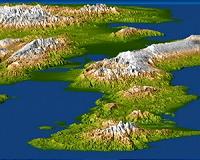
    Fault Responsible For Haiti Quake Slices Island‘s Topography
    by Staff Writers  Washington DC (SPX) Jan 18, 2010
    The sharp diagonal line exactly at the image center is the Enriquillo fault. Port-au-Prince is immediately to the left (north) at the mountain front and shoreline.

    A magnitude 7.0 earthquake occurred on January 12, 2010, at Port-au-Prince, Haiti, with major impact to the region and its citizens. This perspective view of the pre-quake topography of the area clearly shows the fault that is apparently responsible for the earthquake as a prominent linear landform immediately adjacent to the city.

    Elevation is color coded from dark green at low elevations to white at high elevations, and the topography is shaded with illumination from the left. The topography in this image is exaggerated by a factor of two.

    The sharp diagonal line exactly at the image center is the Enriquillo fault. Port-au-Prince is immediately to the left (north) at the mountain front and shoreline.

    The Enriquillo fault generally moves left-laterally (horizontally, with features across the fault shifting to the left when the fault breaks in an earthquake), but vertical movements occur along the fault where irregularities in the fault line cause local compression or extension of the earth.

    Meanwhile, movements of the topography at the Earth’s surface can falsely appear to be vertical where mountain slopes are cut and misaligned by horizontal shifts of the fault.

    Additionally, differing erosion rates on the two sides of the fault, due to the juxtapositioning of differing rock types by the fault, can give the appearance of vertical offsets of the current topographic surface. All of these real and apparent horizontal and vertical offsets of the topographic surface may (and likely do) occur here, making the fault easily observed in the topographic data.

    The elevation data used in this image were produced by the Shuttle RadarTopography Mission (SRTM), flown aboard Space Shuttle Endeavour in February 2000. SRTM acquired elevation measurements for nearly all of Earth’s landmass between 60 degrees North and 56 degrees South latitudes.

    For many areas of the world, SRTM data provide the first detailed three dimensional observation of landforms at regional scales.

    The mission was a cooperative project between the National Aeronautics and Space Administration (NASA), the National Geospatial-Intelligence Agency (NGA) of the U.S. Department of Defense (DOD), and the German and Italian space agencies. It was managed by NASA’s Jet Propulsion Laboratory, Pasadena, Calif., for NASA’sScience Mission Directorate, Washington, D.C.

    View Width: One degree latitude (111 kilometers, or 69 miles)
    View Distance: Five degrees longitude (525 kilometers, or 325 miles)
    Location: 18 to 19 degrees North latitude, 70 to 75 degrees West longitude
    Orientation: View east, 5 degrees below horizontal
    SRTM Data Acquired: February 2000

    Haiti Quake Occurred In Complex Active Seismic Region
    by Staff Writers
    Woods Hole MA (SPX) Jan 21, 2010

    The magnitude 7.0 earthquake that triggered disastrous destruction and mounting death tolls in Haiti this week occurred in a highly complex tangle of tectonic faults near the intersection of the Caribbean and North American crustal plates, according to a quake expert at the Woods Hole Oceanographic Institution (WHOI) who has studied faults in the region and throughout the world.

    Jian Lin, a WHOI senior scientist in geology and geophysics, said that even though the quake was “large but not huge,” there were three factors that made it particularly devastating: First, it was centered just 10 miles southwest of the capital city, Port au Prince; second, the quake was shallow-only about 10-15 kilometers below the land’s surface; third, and more importantly, many homes and buildings in the economically poor country were not built to withstand such a force and collapsed or crumbled.

    All of these circumstances made the Jan. 12 earthquake a “worst-case scenario,” Lin said. Preliminary estimates of the death toll ranged from thousands to hundreds of thousands. “It should be a wake-up call for the entire Caribbean,” Lin said.

    The quake struck on a 50-60-km stretch of the more than 500-km-long Enriquillo-Plantain Garden Fault, which runs generally east-west through Haiti, to the Dominican Republic to the east and Jamaica to the west.

    It is a “strike-slip” fault, according to the U.S. Geological Survey, meaning the plates on either side of the fault line were sliding in opposite directions. In this case, the Caribbean Plate south of the fault line was sliding east and the smaller Gonvave Platelet north of the fault was sliding west.

    But most of the time, the earth’s plates do not slide smoothly past one another. They stick in one spot for perhaps years or hundreds of years, until enough pressure builds along the fault and the landmasses suddenly jerk forward to relieve the pressure, releasing massive amounts of energy throughout the surrounding area. A similar, more familiar, scenario exists along California‘s San Andreas Fault.

    Such seismic areas “accumulate stresses all the time,” says Lin, who has extensively studied a nearby, major fault , the Septentrional Fault, which runs east-west at the northern side of the Hispaniola island that makes up Haiti and Dominican Republic. In 1946, an 8.1 magnitude quake, more than 30 times more powerful than this week’s quake, struck near the northeastern corner of the Hispaniola.

    Compounding the problem, he says, is that in addition to the Caribbean and North American plates, , a wide zone between the two plates is made up of a patchwork of smaller “block” plates, or “platelets”-such as the Gonvave Platelet-that make it difficult to assess the forces in the region and how they interact with one another. “If you live in adjacent areas, such as the Dominican Republic, Jamaica and Puerto Rico, you are surrounded by faults.”

    Residents of such areas, Lin says, should focus on ways to save their lives and the lives of their families in the event of an earthquake. “The answer lies in basic earthquake education,” he says.

    Those who can afford it should strengthen the construction and stability of their houses and buildings, he says. But in a place like Haiti, where even the Presidential Palace suffered severe damage, there may be more realistic solutions.

    Some residents of earthquake zones know that after the quake’s faster, but smaller, primary, or “p” wave hits, there is usually a few-second-to-one-minute wait until a larger, more powerful surface, or “s” wave strikes, Lin says. P waves come first but have smaller amplitudes and are less destructive; S waves, though slower, are larger in amplitude and, hence, more destructive.

    “At least make sure you build a strong table somewhere in your house and school,” said Lin. When a quake comes, “duck quickly under that table.”

    Lin said the Haiti quake did not trigger an extreme ocean wave such as a Tsunami, partly because it was large but not huge and was centered under land rather than the sea.

    The geologist says that aftershocks, some of them significant, can be expected in the coming days, weeks, months, years, “even tens of years.” But now that the stress has been relieved along that 50-60-km portion of the Enriquillo-Plantain Garden Fault, Lin says this particular fault patch should not experience another quake of equal or greater magnitude for perhaps 100 years.

    However, the other nine-tenths of that fault and the myriad networks of faults throughout the Caribbean are, definitely, “active.”

    “A lot of people,” Lin says, “forget [earthquakes] quickly and do not take the words of geologists seriously. But if your house is close to an active fault, it is best that you do not forget where you live.”

    The Woods Hole Oceanographic Institution is a private, independent organization in Falmouth, Mass., dedicated to marine research, engineering, and higher education. Established in 1930 on a recommendation from the National Academy of Sciences, its primary mission is to understand the oceans and their interaction with the Earth as a whole, and to communicate a basic understanding of the oceans’ role in the 
  • El New York Times de pago en 2011 para lectores habituales

    Times Reader

    Lo peor de los intentos de la prensa de encontrar un modelo con mayores ingresos a través del pago por contenidos es no saber siquiera si existe alguno que pueda funcionar tras los fracasos de hace años. Se barruntaba que el NYT volvería a liderar al sector, y esa parece su intención dado que en el anuncio oficial aseveran que el periódico será de pago en la web en 2011 y, como se esperaba, para los lectores habituales. La primera lectura es que postergan el paso un año para esperar mayor recuperación económica y para sembrar adhesiones a su modelo.

    Pero lo que más me interesa es cómo diseñan su modelo de pago para salvar el tráfico y los ingresos por publicidad:

    • Abierto para usuarios poco habituales, con esto consiguen que sus contenidos sigan siendo indexables y enlazables, aspectos imprescindibles para mantener vivo el tráfico de la web.
    • ¿Impactará en pérdida de páginas vistas? Un dato relevante en este caso es determinar qué porcentaje de usuarios consumen muchas y, de ellos, cuántos estarán dispuestos a pagar. A corto plazo esa es la cuenta importante, no el porcentaje sobre el total de lectores porque, si los planes del New York Times se cumplen, de los ocasionales no se perdería tráfico. Para que el movimiento sea rentable en primera instancia necesitarían que los ingresos por suscripción fuesen mayores que los costes de montar el sistema + ingresos por publicidad de las páginas vistas perdidas de estos usuarios habituales. Eso para ser rentable la acción, otra cuenta distinta es para hacer rentable el medio en su totalidad.
    • La parte que podrían estar minusvalorando desde el NYT es el debilitamiento de la comunidad alrededor del medio. El planteamiento económico podría tener sentido sobre el papel – otra cosa es que en la práctica llegue más o menos lejos, sobre todo si el resto de medios no les sigue – pero perderán activos tan valiosos para un medio online como son la participación de calidad y las recomendaciones de sus artículos que hacen, sobre todo, los lectores más fieles.

    Al menos ya sabemos la fecha en que empezará el baile. Lo que todavía no está claro es cuantos medios se animarán a acudir y de qué forma, pero si el NYT sigue con su apuesta, no dudaría de que muchos de ellos irán detrás.


  • Prof. Segura testifies in Prop. 8 trial

    In S.F., federal court hears arguments for legality of California ban on same-sex marriage

    Plaintiffs called Prof. Gary Segura to the stand last Wednesday and Thursday for the trial of same-sex marriage case Kristin M. Perry v. Arnold Schwarzenegger to speak on the political vulnerability of the gay and lesbian community. (Courtesy of Stanford News Service)

    Plaintiffs called Prof. Gary Segura to the stand last Wednesday and Thursday for the trial of same-sex marriage case Kristin M. Perry v. Arnold Schwarzenegger to speak on the political vulnerability of the gay and lesbian community. (Courtesy of Stanford News Service)

    The question of same-sex marriage has entered the federal courtroom, and LGBT activists and marriage protection advocates alike have prepared their factual ammunition for the battle ahead. Caught in the controversy’s whirlwind, political science Prof. Gary Segura testified for a total of nine hours Wednesday and Thursday as an expert witness on political representation.

    Both sides of the marriage debate will have the chance to present their evidence in the federal trial Kristin M. Perry v. Arnold Schwarzenegger, which began Jan. 11 and is expected to end this week. Plaintiffs are challenging the constitutional validity of the California ballot measure Proposition 8, which passed by a 52 percent margin in November 2008, banning same-sex marriage in the state.

    The trial is the first to bring same-sex marriage to federal courts, and plaintiffs hope to use Segura’s testimony to invoke the federal equal protection clause in favor of marriage equality.

    The Rational Basis Test

    According to law school Prof. Jane Schacter, this trial is particularly significant because it questions whether the gay and lesbian community is “a suspect class.” If the gay and lesbian community is declared a suspect class, the courts may apply a more stringent test to the validity of the ban.

    States are allowed to disadvantage a group as long as there is a “rational basis,” and Prop. 8 was originally justified by this test.

    Once a group is declared a suspect class, however, the courts must apply a higher level of scrutiny and prove that states have a right to apply the law due to compelling state interest. Plaintiffs hope to increase the level of scrutiny in order to throw out Prop. 8.

    According to Schacter, in order to be declared a suspect class, the gay and lesbian community must prove three conditions: a history of discrimination, a lack of sufficient political power through the normal political process, and a victimization due to irrelevant traits.

    “A fourth condition may be applied, too: immutability,” she added. “In colloquial terms, do people have a choice of being gay, or are they born gay?”

    Historically, racial discrimination has been a subject of strict scrutiny, while gender has fallen into the category of intermediate scrutiny.

    Segura’s evidence is intended to support the second condition, which law emeritus Prof. Michael Wald said had evidence in its favor.

    “I do think that gays and lesbians are politically vulnerable,” Wald said. “Just because voters pass something doesn’t mean it’s constitutional.”

    Schacter acknowledged that there are compelling arguments on both sides. While California extends domestic partnership rights and has no ban on sodomy, the gay and lesbian community has also been subjected to discriminatory ballot initiatives.

    ‘Scare Tactics’

    In addition to reviewing the concept of scrutiny, the courts are also trying to determine if the marriage protection advocates are driven by animosity.

    “The Court wants to say that if the animosity is the only factor backing Prop. 8, then the judge would strike it down,” Schacter said. “[Judge Vaughn Walker] would invalidate it if that’s the only thing backing it.

    “Judge Walker is conducting a full-blown trial with lots of witnesses and cross-examinations,” she added. “The trials before were based on dry legal arguments conducted on briefs. [Walker] is really looking at the factual basis behind Prop 8.”

    Sarah Masimore ’11 commented that the case will force same-sex marriage opponents to give factual support to their arguments. “I think it’s really great that it’s in the court system right now because [Prop. 8 supporters] can’t use scare tactics anymore,” she said. “They have to give actual evidence of what they said during the campaign.”

    Segura on the Stand

    Segura said he initially declined to participate because of the time commitment but, after thinking about it further, decided it would be a worthy undertaking.

    “It seemed like an important thing to be associated with,” he said. “When they called the second time, I just said, ‘Alright.’”

    Segura’s argument for the political vulnerability of the lesbian and gay community rests on his claim of the group’s subjection to widespread public disapproval and condemnation. “Gays and lesbians are more likely than any other American to be targeted with rape and murder and hate crimes.” he said.

    Through his research, Segura found that gays and lesbians do not have basic employment discrimination prevention rights in 29 states, are underrepresented in public office and are targeted by more political initiatives than any other group.

    According to Segura, the gay and lesbian community has lost 70 percent of the time on issues not concerning marriage, and 100 percent on issues concerning marriage.

    “Now, three-fifths of the states have constitutionally established a group of people as not fully equal,” Segura said. “It’s wrong to view all of these things and conclude that a group is still sufficient to protect their basic rights through the normal political process.”

    Segura, whose academic background is in minority rights, said his role in the trial was professional. “I was not testifying as an advocate,” he said. “I am a social scientist. My work is a fair assessment of the strategic political circumstances of gays and lesbians.

    “I’m part of the trial to provide expertise to the court but there are competing experts,” he added. “My views are not consistent with the person that the defendants are bringing.”

    The defendants will bring in Claremont McKenna government Prof. Kenneth Miller to testify more about political power, speaking in opposition to Segura’s arguments.

    End of the Road?

    Schacter and Segura both agreed that the San Francisco case will not be the end of the road. According to both, whoever loses the decision will probably appeal to the Ninth Circuit. From there, the Supreme Court may decide to hear the case.

    “The bringing of this case was so controversial,” Schacter said. “Some gay rights groups didn’t think it was the right time since there may be a five-member majority [of conservative values] in the Supreme Court.”

    According to Schacter, Supreme Court Justice Anthony Kennedy ’58 would be the swing vote if the decision made it to his court. Kennedy ruled on behalf of striking down the ban on consensual sodomy in the 2003 case Lawrence v. Texas, but Schacter said it was unclear whether he would go so far as to support same-sex marriage.

    “You read between the lines and you can see that he made the distinction clear that he wasn’t deciding anything about the marriage issue,” she said. “At the level of legal argument, you can use the sodomy decision to support marriage equality, but whether [Kennedy’s] willing to do that is a separate question.”

    Schacter also said that if Prop. 8 is upheld, the Supreme Court may not review the case – a possibility with complex implications for the political struggle over gay marriage.

    “It won’t really change the status quo,” she said. “It will not threaten the many anti-marriage equality measures that are already placed around the country, so the Supreme Court might just wait before reviewing it.”

    Schacter made the comparison between the previous ban on interracial marriage and the current ban on gay and lesbian marriages.

    “It took almost 20 years before the ban on interracial marriage was struck down,” she said. “The gay rights battle began in 1993, approximately.

    “There are astonishing parallels,” she added. “Marriage has been a changing, evolving institution. At the time that there were bans on interracial marriage, there was tremendous public support for banning it since it violated religious barriers.”

    According to Schacter, there was probably 90 percent disapproval for interracial marriage around the country before the Supreme Court finally overturned the ban.

    “If voters voted that there cannot be interracial couples, then that wouldn’t be constitutional,” Wald added. “It’s a restriction of choice to marry. Whether you restrict a choice on race or gender or other factors, that is generally unconstitutional in terms of policy.”

    Schacter added that strict scrutiny was applied to the 1967 case of Loving v. Virginia, which struck down the ban on interracial marriage.

    “The heart of this case is whether this issue is comparable to Loving v. Virginia,” she said. “Whether it will carry over to the same-sex controversy is not settled. It may be an uphill battle for gay rights activists.”