Author: Serkadis

  • Santander Confirms Pedro de la Rosa Backing

    Although Giancarlo Fisichella was one step ahead of Spanish driver Pedro de la Rosa in signing a racing deal with Sauber F1 Team, it was the latter who eventually won that fight. The former McLaren Mercedes tester was confirmed a few days ago as official driver of the Swiss outfit, and we now know the reasoning behind Peter Sauber’s decision.

    With BMW no longer backing the team and major sponsor Petronas already signed by another team, it wasn’t rocket science to figure out that Sauber will s… (read more)

  • Aston Martin Inaugurates First South American Dealership

    The Brits at Aston Martin have now made officially their way into South America: the company has inaugurated its first dealership there, Aston Martin Santiago, as lefthandnews reports.

    The showroom is located in Santiago, Chile. The company expects in the present year to sell 15 cars in that market.

    According to the aforementioned source, Aston Martin has decided not to create a sales and marketing office for the Santiago dealer. The company’s U.S. head office, located in Irvine, Californ… (read more)

  • AAA Announces State Legislative Priorities for 2010

    The American Automobile Association (AAA) yesterday revealed that it is planning to build on the campaign of traffic safety law improvements that started last year and its is currently working with legislators and other safety advocates in statehouses across the country to draft and pass legislation in 2010 that will make roads safer.

    "Traffic safety improvements should generate special interest in states facing budget challenges.  These laws reduce governments’ medical and emergency res… (read more)

  • Workers Block Access in GM Antwerp Plant

    And here’s how it begins… After hearing that General Motors might shut down the Antwerp production facility, workers at the Belgium plant blocked access to a part of the factory. Obviously, they are disappointed by GM’s intentions and are calling for another decision that would avoid the 2,300 job cut that could occur when shutting down the plant.

    According to a report by Autonews citing an official of the ACV union, Antwerp’s work council will meet today to discuss the matter.

    Basically… (read more)

  • El Dorado Located


    As I have posted on extensively, the creation of terra preta soils permitted dense urbanized Stone Age populations.  Present day clearing activity is now exposing their presence for the archeological record.


    It is noteworthy that these cities show dates only as early as 200 AD.  This is likely a result of limited sampling.  The tool set necessary was already a couple of thousand years old.  This is common though for such dating because most samples come from areas representing the maximization of the culture and likely miss the long early development.


    The late dates support the idea that the whole society was extent when the new world was discovered.  Once again Europeans did not so much as miss these antique civilizations so much as their pathogens got there first and threw these societies down.  The nastiest pathogen was the slave trade of course.


    With out question, these were states and they certainly fit the story of El Dorado.  They most likely decorated buildings with gold and this enhanced the story.  We are not seeing stone structures but we did not see them in Mesopotamia either.  We have mounds and these were certain to hold wood frame structures of the leaders.


    Terra preta made possible an Amazonian population in the tens of millions.  The culture itself most likely prevented it from happening except for locales like this.


    Amazon explorers uncover signs of a real El Dorado


    Satellite technology detects giant mounds over 155 miles, pointing to sophisticated pre-Columbian culture
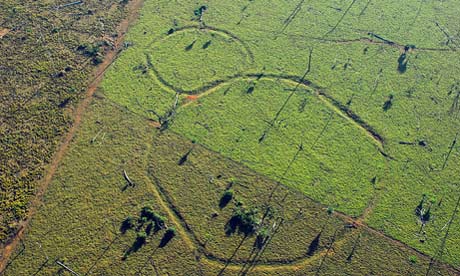
    An aerial picture of traces of earthworks built by a lost Amazonian civilisation dating to 200AD. Photograph: National Geographic
    It is the legend that drew legions of explorers and adventurers to their deaths: an ancient empire of citadels and treasure hidden deep in theAmazon jungle.
    Spanish conquistadores ventured into the rainforest seeking fortune, followed over the centuries by others convinced they would find a lost civilisation to rival the Aztecs and Incas.
    Some seekers called it El Dorado, others the City of Z. But the jungle swallowed them and nothing was found, prompting the rest of the world to call it a myth. The Amazon was too inhospitable, said 20th century scholars, to permit large human settlements.
    Now, however, the doomed dreamers have been proved right: there was a great civilisation. New satellite imagery and fly-overs have revealed more than 200 huge geometric earthworks carved in the upper Amazon basin near Brazil‘s border with Bolivia.
    Spanning 155 miles, the circles, squares and other geometric shapes form a network of avenues, ditches and enclosures built long before Christopher Columbus set foot in the new world. Some date to as early as 200 AD, others to 1283.
    Scientists who have mapped the earthworks believe there may be another 2,000 structures beneath the jungle canopy, vestiges of vanished societies.
    The structures, many of which have been revealed by the clearance of forest for agriculture, point to a “sophisticated pre-Columbian monument-building society”, says the journal Antiquity, which has published the research.
    The article adds: “This hitherto unknown people constructed earthworks of precise geometric plan connected by straight orthogonal roads. The ‘geoglyph culture’ stretches over a region more than 250km across, and exploits both the floodplains and the uplands … we have so far seen no more than a tenth of it.”
    The structures were created by a network of trenches about 36ft (nearly 11 metres) wide and several feet deep, lined by banks up to 3ft high. Some were ringed by low mounds containing ceramics, charcoal and stone tools. It is thought they were used for fortifications, homes and ceremonies, and could have maintained a population of 60,000 – more people than in many medieval European cities.
    The discoveries have demolished ideas that soils in the upper Amazon were too poor to support extensive agriculture, says Denise Schaan, a co-author of the study and anthropologist at the Federal University of Pará, in Belém, Brazil. She told National Geographic: “We found this picture is wrong. And there is a lot more to discover in these places, it’s never-ending. Every week we find new structures.”
    Many of the mounds were symmetrical and slanted to the north, prompting theories that they had astronomical significance.
    Researchers were especially surprised that earthworks in floodplains and uplands were of a similar style, suggesting they were all built by the same culture.
    “In Amazonian archaeology you always have this idea that you find different peoples in different ecosystems,” said Schaan. “So it was odd to have a culture that would take advantage of different ecosystems and expand over such a large region.” The first geometric shapes were spotted in 1999 but it is only now, as satellite imagery and felling reveal sites, that the scale of the settlements is becoming clear. Some anthropologists say the feat, requiring sophisticated engineering, canals and roads, rivals Egypt‘s pyramids.
    The findings follow separate discoveries further south, in the Xingu region, of interconnected villages known as “garden cities”. Dating between 800 and 1600, they included houses, moats and palisades.
    “These revelations are exploding our perceptions of what the Americas really looked liked before the arrival of Christopher Columbus,” said David Grann, author of The Lost City of Z, a book about an attempt in the 1920s to find signs of Amazonian civilizations. “The discoveries are challenging long-held assumptions about the Amazon as a Hobbesian place where only small primitive tribes could ever have existed, and about the limits the environment placed on the rise of early civilisations.”
    They are also vindicating, said Grann, Percy Fawcett, the explorer who partly inspired Conan Doyle’s book The Lost World. Fawcett led an expedition to find the City of Z but the party vanished, bequeathing a mystery.
    Many scientists saw the jungle as too harsh to sustain anything but small nomadic tribes. Now it seems the conquistadores who spoke of “cities that glistened in white” were telling the truth. They, however, probably also introduced the diseases that wiped out the native people, leaving the jungle to claim – and hide – all trace of their civilisation.
    • This article was amended on Wednesday 6 January 2010. Percy Fawcett’s experiences in the Amazon were said to have partly inspired Arthur Conan Doyle’s book The Lost World, but Fawcett’s disappearance did not, contrary to a suggestion in the original article – he vanished after the book was published. This has been corrected.


  • Fish Memory

    So the take home lesson here is that if fish have a memory, they may learn to associate disturbance with danger.  That possibly gives another reason why one can drop a baited hook near a visible school of fish and be ignored.


    This is of course common sense, disturbed fish certainly do not bite and that surely suggests memories a lot better that three seconds.


    I always had though that I was facing a battle of wits with fish once the river water cleared in the spring.  Perhaps we now know why.  This was really one of those idle questions that had never been deemed worth the trouble of answering along with the idea that earth worms do not feel pain which is also rubbish.


    Fish can remember things for months: Scientists

    LONDON: Australian scientists have claimed that fish can remember things for months, dismissing the myth that the aquatic animal have 
    three-second memory. 

    According to the researchers at the Charles Sturt University, the traditional view that fish lack the brain power to retain memories is “absolute rubbish”. 

    “Fish can remember prey types for months. They can learn to avoid predators after being attacked once and they retain this memory for several months. And carp that have been caught by fishers avoid hooks for at least a year,” lead author Kevin Warburton said. 

    “That fish have only a three second memory is just rubbish but nobody knows where the three-second myth comes from,” Warburton was quoted as saying by The Telegraph. 

    Ashley Ward, a fish biologist at Sydney University, said: “It seems to come from an advert many years ago, but nobody is sure what it was for.” 

    Fish can also learn to improve how to catch food, said Warburton, carry out acts of deception and modify their behaviour, for example, in reef environments cleaner fish who eat parasites off ‘client’ fish act on best behaviour when they spot a larger patron. 

    Warburton said: “What’s fascinating is that they co-operate more with clients when they are being observed by other potential clients. This improves their ‘image’ and their chances of attracting clients”. 

    The team came to this conclusion after studying the behaviour of Australian freshwater fish. 

  • Coulomb ChargePoint Available in Washington

    Washington received its first Coulomb ChargePoint Networked Charging Stations for electric vehicles, after the supplier installed a station at one of The Markets supermarket. The Markets has 21 selling points in Washington state and in the future all will benefit from a charging station.

    "We decided to offer the charging station because of the greater Bellingham community’s interest in green technology and the large number of people who already drive hybrids, Kevin Weatherill, president… (read more)

  • 2010 Ford Taurus Featured in ‘Chasing the Shadow’ Game

    American carmaker Ford recently revealed that its 2010 Taurus is starring in a new online interactive game, White Collar: Chasing the Shadow, which  is the online extension to the USA NETWORK hit TV drama White Collar. The game follows a con artist and FBI agent who team up to catch bad guys.

    The Taurus is featured in both the television series and in the new game that allows players – acting as FBI trainees – to drive the Taurus and use its features to catch a notorious villain dubbed The Wh… (read more)

  • Golden Mean and Cognition

    Some thoughts here about the golden mean.  I suspect that his suggested linkage is actually a bit of a stretch but then why not?  The golden mean falls out of simple geometric manipulation rather too easily to take very seriously.  It is sort of like been overly excited about the circle without a background in geometry.


    Any way it is easily constructed and thus a convenient way to pleasingly shape rectangular image frames from a chosen dimensionality.  It is thus no surprise it is commonly used.


    For that reason it is suspect to read more into it than totally necessary.


    The headline is a touch too ambitious, but the speculations are of some interest.


    Researcher explains mystery of golden ratio

    December 21, 2009
    This is Adrian Bejan of Duke University. Credit: Duke University
    The Egyptians supposedly used it to guide the construction the Pyramids. The architecture of ancient Athens is thought to have been based on it. Fictional Harvard symbologist Robert Langdon tried to unravel its mysteries in the novel The Da Vinci Code.
    “It” is the golden ratio, a geometric proportion that has been theorized to be the most aesthetically pleasing to the eye and has been the root of countless mysteries over the centuries. Now, a Duke University engineer has found it to be a compelling springboard to unify vision, thought and movement under a single law of nature’s design.
    Also know the divine proportion, the golden ratio describes a rectangle with a length roughly one and a half times its width. Many artists and architects have fashioned their works around this proportion. For example, the Parthenon in Athens and Leonardo da Vinci’s painting Mona Lisa are commonly cited examples of the ratio.
    Adrian Bejan, professor of mechanical engineering at Duke’s Pratt School of Engineering, thinks he knows why the golden ratio pops up everywhere: the eyes scan an image the fastest when it is shaped as a golden-ratio rectangle.
    The natural design that connects vision and cognition is a theory that flowing systems — from airways in the lungs to the formation of river deltas — evolve in time so that they flow more and more easily. Bejan termed this the constructal law in 1996, and its latest application appears early online in the International Journal of Design & Nature and Ecodynamics.
    “When you look at what so many people have been drawing and building, you see these proportions everywhere,” Bejan said. “It is well known that the eyes take in information more efficiently when they scan side-to-side, as opposed to up and down.”
    Bejan argues that the world – whether it is a human looking at a painting or a gazelle on the open plain scanning the horizon – is basically oriented on the horizontal. For the gazelle, danger primarily comes from the sides or from behind, not from above or below, so their scope of vision evolved to go side-to-side. As vision developed, he argues, the animals got “smarter” by seeing better and moving faster and more safely.
    “As animals developed organs for vision, they minimized the danger from ahead and the sides,” Bejan said. “This has made the overall flow of animals on earth safer and more efficient. The flow of animal mass develops for itself flow channels that are efficient and conducive to survival – straighter, with fewer obstacles and predators.”
    For Bejan, vision and cognition evolved together and are one and the same design as locomotion.The increased efficiency of information flowing from the world through the eyes to the brain corresponds with the transmission of this information through the branching architecture of nerves and the brain.
    “Cognition is the name of the constructal evolution of the brain’s architecture, every minute and every moment,” Bejan said. “This is the phenomenon of thinking, knowing, and then thinking again more efficiently. Getting smarter is the constructal law in action.”
    While the golden ratio provided a conceptual entryway into this view of nature’s design, Bejan sees something even broader.
    “It is the oneness of vision, cognition and locomotion as the design of the movement of all animals on earth,” he said. “The phenomenon of the golden ratio contributes to this understanding the idea that pattern and diversity coexist as integral and necessary features of the evolutionary design of nature.”
    In numerous papers and books over past decade, Bejan has demonstrated that the constructal law (www.constructal.org) predicts a wide range of flow system designs seen in nature, from biology and geophysics to social dynamics and technology evolution.
    Provided by Duke University (news : web)
  • Alonso Drives Santander-Livery Ferrari F60 at Paul Ricard

    Fernando Alonso may have to wait until February 1st to drive Ferrari’s 2010 challenger in the testing session at Valencia’s Ricardo Tormo Circuit, but that isn’t to mean the Spaniard will step at the wheel of a Ferrari for the first time.

    According to the latest press photos released by Ferrari’s new sponsor Grupo Santander, the 2-time world champion drove the team’s 2009 car with the new livery for 2010 on the Paul Ricard circuit in France. Commonly used by the teams in the GP2 Series for te… (read more)

  • Sony Reader Limited Edition Valentine’s Day Bundle is the Book of Love

    Sonyereader1 300x191 Sony Reader Limited Edition Valentines Day Bundle is the Book of LoveSony is at it again making new limited edition Sony Reader bundles. Now this time it’s for Valentine’s day. The latest one is being called the Reader Valentine’s Special Bundle or maybe it should have been called the book of love… This love bundle includes a red leather cover with light, a free eBook download, and the ebook “The Heart Speaks by Mimi Guarneri”. This special bundle is retailing for $329.99 and even if you don’t have a Valentine, you can buy it for yourself, read an eBook and feel loved.


  • Controversial special fees bill approved

    Regulation changes dominated Wednesday’s Graduate Student Council (GSC) meeting, with a heated debate prior to passage of a special fees bill — recently passed by the Undergraduate Senate — and a discussion about amending campaign rules.

    Special Fees Stalemate

    On Tuesday, the ASSU Senate approved a bill to end the practice that allowed student groups to automatically receive a 10 percent increase to their inflation-adjusted special fees funding.

    The ongoing dispute over the legislation resulted in several students’ proposing an amendment to revise the bill. The amendment was rejected and the special fees bill was subsequently passed by the GSC by an overwhelming margin.

    Still, the bill resulted in heated debate.

    GSC members entertained ideas of changing the bylaw to include an annually adjusted amount, maintaining the automatic 10 percent increase, or voting down the proposals entirely.

    Doctoral candidate in computer science Adam Beberg proposed an amendment that the automatic increase amount be determined each year by relevant legislative bodies. The bill in question proposed cutting automatic increases completely.

    Chief Financial Officer and graduate student in chemical engineering Ryan Peacock emphasized the overall importance of accountability for student groups. “We need to keep in mind that it’s a privilege for groups to do special fees,” he said.

    “I think we’re being too sympathetic to them, and I think that’s the problem,” Peacock added.

    But Beberg commented that the extended process of petitions for any increase beyond inflation would cause groups to be discouraged to petition, thereby reducing programming.

    GSC members decided to vote after examining pros and cons. Twelve members opposed and one abstained on Beberg’s proposed amendment.

    The original bill, which strikes the 10 percent automatic increase clause completely, was approved with 10 members in favor, one opposed and two abstaining.

    “The Undergraduate Senate needs to start saying no [to special fees increases],” said GSC Programming Coordinator and third-year student in electrical engineering Addy Satija. “This change will just keep them accountable.”

    Campaign Fairness

    Elections commissioner Quinn Slack ‘11 proposed two changes to election regulations. The first change concerned campaign flyers: Slack proposed to remove the stickers-regulated flyer limit and hand over the issue to environmental groups.

    “Green student groups can make this into an environmental issue,” Slack said, “rather than a mundane enforcement issue.”

    Co-chair Eric Osborne, a third-year law student, responded to the idea: “The green student groups can’t enforce like 50 students from going crazy with flyers,” he said.

    Adamant about not allowing a change in the current sticker policy, ASSU President David Gobaud brought up issues of sustainability and equality. According to Gobaud, a co-terminal student in computer science, lifting the regulation will result in too many flyers and an unfair advantage for students with more money to spare.

    “We need to level the playing field for those who don’t have a lot of money to spend on the election,” Gobaud said. “The election should not be determined by the ones who have the most money. Anyone should be able to enter the race and have a fair chance of winning regardless of their socioeconomic background.”

    The second change concerned campaigning time limits. Currently, students are not allowed to continue campaigning while students are voting. The proposed change would lift the buffer time.

    Secrecy and privacy also were brought up in the discussion. Determined not to allow this second change to happen, Gobaud insisted that capping campaigning during elections allows people to have a clearer mind.

    “If you have someone going around campaigning during the election, then you’ll have certain situations that are going to be very uncomfortable,” he said. “There’s peer pressure. We should not open the elections to be controlled by peer pressure.”

    Because of the controversy surrounding the issue, Osborne decided to hold a straw poll. The flyer enforcement change was determined to be unpopular, while the vote on letting candidates campaign until the day of voting split evenly.

    Revision will not be made until further discussion.

    Fundraising and Fund Approvals

    Before discussion of special fees and campaigns, the meeting began with ASSU updates. After announcing that there will be a joint legislative meeting on Feb. 17 at 6 p.m., the executives went on to talk about their fundraising efforts in Haiti.

    According to Gobaud, the campaign has generated $24,000 from the Stanford community in less than 72 hours and $150,000 from 17 partner schools in less than four days.

    “It’s very powerful,” Gobaud said of the campus response. “All donations will be going to Partners in Health to help the earthquake victims.”

    The upbeat sentiment contrasted with concerns raised Tuesday at the meeting of the Undergraduate Senate, where the focus was on increasing student donations believed to be anemic compared to other participating institutions.

    The meeting continued with funding requests from five student groups. The GSC approved $1,974 for the Beyond Borders Beyond Identity event held by Southeast Asian student groups, $1,330 for the Chinese Women Collective, $820 for the Stanford India Association, $700 for the Coastal Society and $250 for the French Stanford Students Association.

    Programming and operations followed funding requests. The masquerade ball ticket sales have steadily increased, with 898 people projected to come. Attendance for the ball will be capped at 1,100 people.

    Members went on to discuss what to do with a ping-pong table purchased by the GSC approximately three years ago. After brief discussion, they voted to sell the table and direct the money back into the GSC programming funds account.

    Elicia Blackford M.A. ‘10, a Stanford Teacher Education Program (STEP) student, was confirmed as the executive director of the student services division.

  • Garmin-Asus M10 with Windows Mobile 6.5.3 coming at Mobile World Congress

    garmin-asus-logo Pre-announcing things a bit, Garmin-Asus has told ZDNET that they expect to release 2-3 Windows Mobile handsets this year, including their first Windows Mobile 6.5.3 device, the Garmin Asus M10.

    The M10 will feature a 3.5 inch WVGA resistive screen, 600 Mhz MSM7224 processor and 5 megapixel camera for around $400. Garmin-Asus will also be releasing Android units, but notes Windows Mobile still has a high acceptance factor, and that the latest iterations of Windows Mobile greatly improves finger friendliness.

    Pictures are not yet available, but all should be revealed in less than 4 weeks at Mobile World Congress.

    Read more at ZDNET here.

    Via Engadget.com

    Share/Bookmark

  • Alfa Romeo Giulietta video

    The Alfa Giulietta could be the car that saves Alfa Romeo in the eyes of CEO Sergio Marchionne, unimpressed by the performance of the brand. And it’s nothing less than we’d expect from sensual Alfa design, and this fast cut video shows it from all angles. Try to ignore the subtitles, or you’ll miss the look of the car (fabulous in white).

    Debuting at the 2010 Geneva Motor Show, the Alfa Giulietta will have a turbocharged 1.4-litre petrol engine with 120 hp, though the more exciting 1.4 Multiair will also be available from the launch date, with 170 hp. There will be a 1.6-litre JTDM with 105 hp and a 2.0 JDTM with 170 hp. For those wanting the full Alfa power job, a Quadrifoglio Verde version should also be produced, with 235 hp.

    Alfa Romeo Giulietta new pics from site Alfa Romeo Giulietta new pics from site Alfa Romeo Giulietta new pics from site Alfa Romeo Giulietta new pics from site

    Alfa Romeo Giulietta new pics from site Alfa Romeo Giulietta new pics from site Alfa Romeo Giulietta new pics from site Alfa Romeo Giulietta new pics from site

    Source | World Car Fans


  • Unofficial: GM to Shut Down Antwerp Plant

    Although both Opel and Saab are belonging to General Motors and are involved in significant restructuring processes, the Swedish company is making the headlines more often as everybody is curious to find out what’s going to happen with the brand. However, Opel makes the headlines once again as sources familiar with the matter are claiming that General Motors will close the over-debated Antwerp plant and eliminate around 2,300 jobs.

    According to a report by Reuters, the Flemish government was … (read more)

  • Toyota Sienna Enters Production

    Japanese carmaker Toyota announced yesterday the production debut of the US styled, developed and assembled Sienna, at the carmaker’s TMMI plant in Pricenton, Indiana. This marks an important event in TMMI’s evolution, as the facility struggled last year to survive the ongoing crisis.

    "Without a doubt, our team members were worried," Wil James, senior vice president of TMMI said. "Layoffs were happening all over the auto industry. It would be many months before Highlander prod… (read more)

  • Updated Photoshop Magnet Kit Still Won’t Crop Your Fridge

    pS MagnetsLooking for some fun new magnets that also display your geeky side? The newly  updated Photoshop Magnet Kit from Meninos includes new versions of all the menus, palettes, brushes, layers and more. There are 13 Magnets in all and each one will easily hold up that note about picking up milk on your fridge.  The PS Magnet Kit retails for $25.


  • The Residences at Greenbelt – Laguna Tower | Makati City | 48 f |170.75 m |

    The Residences at Greenbelt – Laguna Tower

    Antonio Arnaiz Avenue, Makati City, Philippines


    Laguna tower is at the left

    Height:170.75 m (560.2 ft)
    Floor:48 aboveground, 3 belowground
    Completion:2008
    Architect:Architecture International, in cooperation with GF & Partners Architects
    Use:Residential
    Owner:Ayala Land, Inc.
    Elevator:4

    The Residences at Greenbelt – Laguna Tower is a residential condominium skyscraper in Makati City, Philippines. It is the first of three buildings being constructed as part of The Residences at Greenbelt (TRAG) complex, and is the basis of the now being constructed The Residences at Greenbelt – Manila Tower. It is expected to be one of the tallest skyscraper in the Philippines with a height of 170.75 metres from the ground to its architectural top[4].

    The building has 48 floors above ground, which includes a 4-level podium with commercial establishments, and 3 basement levels for parking. It is considered to be one of the most prestigious residential building in the Philippines.

    Location

    The Residences at Greenbelt complex is located along Antonio Arnaiz Avenue (formerly known as Pasay Road), and the entire complex block is bounded by Paseo de Roxas Avenue, Greenbelt Drive and Esperanza Street. The complex was formerly the site of the old Coronado Lanes bowling center and parking lot. Being inside the Makati Central Business District, it is strategically located near malls, hotels, offices, schools, and entertainment areas. As with its name, it is part of the Greenbelt Complex which includes the Greenbelt Mall. Just right across Greenbelt Drive is the Rennaissance Makati City Hotel.

  • Mercedes Confirms Schumacher Will Have No 3 Race Number

    Even if the testing session with a GP2 development car has raised some concerns regarding Michael Schumacher’s neck problems, the German now confirmed that he feels great and can’t wait to start testing his team’s car for the 2010 season.

    During the second day of testing at the Jerez circuit earlier this month, the German driver admitted that he felt some slight neck pain when driving the GP2 car, but added that these things are supposed to be normal after a long period of inactivity. Today h… (read more)

  • Verari Restarts After Asset Sale

    Bruce V. Bigelow wrote:

    San Diego’s Verari Systems, which ceased business in mid-December and laid off more than 200 employees, says it is restarting its blade computer business after an investment group acquired Verari’s assets at auction. An investment group led by the company’s original founder, David Driggers, purchased Verari’s inventory, equipment and technologies, and will support past Verari customers. The restructured company, renamed as Verari Technologies, will resume operations this week with less than a third of its previous workforce.