Author: Serkadis

  • Mitsubishi ASX to Lack Start-Stop in Australia

    Yesterday, Mitsubishi confirmed the European-spec compact crossover model that will be showcased at the 2010 Geneva Motor Show in March. Codenamed ASX, the new model will go on sale across Europe in spring this year, with other markets to receive it during the course of 2010.

    Although in Europe the ASX will be offered with start-stop technology, the car won’t feature fuel-saving systems in Australia, a separate market likely to receive the model by year end.

    "There are a few issues th… (read more)

  • PetroBank Ramps up THAI


    It is rare that technological development advances smoothly.  I have been following this project for over two and a half years and this has been exceptional.  In fact the only issue anyone has had to whine about was the sand situation which was already well known but not engineered out of the equation until the original theory was shown to work.  All very reasonable.
    Some writers have woken up to the actual importance of this technology.  It is correct to say that this can postpone peak oil for decades.  Observe that its first production development is set to produce 100,000 barrels per day.  It has effectively converted heavy oil into conventional oil for all intents and purposes.  Perhaps a bit strongly stated but close enough that it does not matter.  It makes oil sand mining almost obsolete but that will continue to be used to clean off the surface deposits.  All the rest will be exploited with THAI and not SAGD which is clearly obsolete.
    We can expect Canada’s commercial oil reserves to now exceed one trillion barrels, or equal to all the oil produced to date worldwide.  Significant reserves throughout the USA will also become exploitable and all formerly productive fields will be subject to a good second look.  After all, at least half the oil was left behind.
    In the meantime the US has zoomed back to been the lead global producer of natural gas thanks to success with shale gas. 
    The bottom line is that the USA and Canada are about to be totally self sufficient in gas and oil even without any help from other energy technology. 
    I remember an article in Scientific America back perhaps thirty years ago in which it was observed that including Canada’s tarsands gave the country a quarter of the global resource.  Since then a lot of oil has been discovered elsewhere so the ratio has hardly stood up.
    We have burned one trillion barrels.  Another trillion is in place in conventional reserves and Canada has a spare trillion in reserve that is now readily produced just like conventional oil in terms of overall impact.
    Some may want to quibble over my bandying about the trillion word, but the fact we gave up counting a long time ago when we hit two thirds of that value.  It cost money to properly show these values and it has to be worth while. 
    Petrobank Ramps Up THAI  Operations
    2010-01-06 19:38:00
    CALGARY, ALBERTA–(eMediaWorld – Jan. 6, 2010) – Petrobank Energy and Resources Ltd. (“Petrobank” or the “Company”) (TSX:PBG) is pleased to provide an update on our THAITM projects.

    Kerrobert Project

    The Kerrobert THAITM project is a 50/50 joint venture with Baytex Energy Trust. This joint venture project highlights the global applicability of THAITM technology in conventional heavy oil resources. We believe that a significant portion of the estimated 20 billion of barrels of unrecovered conventional heavy oil resource in Saskatchewan can be commercialized using THAITM.

    At Kerrobert, we have been on continuous air injection and the wells have been on production since late October. Since this project involves mobile oil, our original plan was to utilize temporary hydraulic pumps on each well to create a drawdown pressure across the horizontal well and, as combustion gas production increased, we would cease pumping and flow the wells by produced gas lift. As previously reported, the initial fluid production volumes were tested at 180 to 300 barrels per day per well, with oil cuts ranging from zero to 40%. However, during the transition phase to gas lift we learned that liquid inflow to the production wells exceeded the pump’s capacity, which limited our ability to draw down the wells and also caused frequent pump failures. On December 21, 2009 we re-configured the pump in KP1 to improve its pumping capacity and we are currently re-configuring KP2.

    Since the re-configuration, fluid production rates from KP1 have ranged from 250 to 420 barrels per day with oil cuts averaging 36% and reaching as high as 65%. We have also increased the air injection rate to 50,000 m3/day and the produced gas rate has increased to 8,000 m3/day. Well bore temperatures are rising with toe temperatures consistently in the 120 to 140 degrees Celsius range. Produced gas composition confirms high temperature combustion and we have recently measured an improvement in the API and viscosity of the produced oil. We expect to have the KP2 pump reconfigured and producing at similar rates to KP1 within the next few days.

    Surface facilities have been operating smoothly with only minor cold weather and early start-up related issues. We have not had any solids or produced sand. The next expansion of our air compression capacity will be installed at the beginning of April. Due to the current pump limitations, we intend to replace them in the near future with a higher capacity design, targeting 500 barrels of oil per day (“bopd”) per well. We are also finalizing our plans for the development of the initial earned lands which would encompass up to 20 additional production wells in this portion of the pool. We plan to commence this expansion in the third quarter of this year.

    Conklin (Whitesands Project)

    At Conklin, we effectively shut-in the majority of our production from August to November to facilitate the re-drilling of the P1 and P2 wells. The P1B and P2B replacement wells were then placed on production at the end of November as planned, and air injection rates have been increased to close to design capacity. In a re-start situation such as this, early production consists of bitumen and condensed steam from the pre-heating period. We are now seeing the expected increase in combustion gas and improving oil quality and oil production rates. P3B has been choked back during the start up of the new wells to manage the gas balance between all three wells.

    Total oil production has reached 350 bopd and, although overall facility efficiency has been impacted by severe cold weather, we target increasing total Conklin production to 900 bopd by the end of the first quarter. We have now revised our maximum target production for the Conklin pilot to 1500 bopd and we anticipate reaching this production level in mid 2010.

    May River Project

    The May River Project is our first large-scale commercial THAITM application on Petrobank’s oil sands leases west of Conklin, Alberta. The May River design builds on the experience gained from the Conklin facility, and incorporates many of the simplifications that have been successfully implemented in Kerrobert. The project will be built in phases, with initial production capacity of 10,000 bopd and an ultimate capacity of up to 100,000 bopd.

    The regulatory application for May River‘s first phase was filed with the Energy Resources and Conservation Board (“ERCB”) and Alberta Environment in December 2008. The application has been deemed complete and is now moving through the regulatory process. We have received the supplemental information requests (“SIRs”) from Alberta Environment on March 31st and from the ERCB on July 17th. The responses to both the SIRs were filed mid-December and we anticipate approval in early 2010. To provide investors with more insight into the Alberta regulatory process, our application with the SIRs and all related documents are available on the ERCB website at www.ercb.ca.

    Front-end engineering and design for the May River Project was completed at the end of the fourth quarter of 2009. The design incorporates self sufficient power generation utilizing low-BTU produced gas, produced gas sweetening, and future add-on capability for carbon dioxide capture. Unlike other existing oil sands projects, our project will be a net water producer, rather than a water consumer. These design elements combine to make the May River Project an environmentally sustainable process for oil sands and heavy oil development. The project is also designed to utilize a modular approach with direct and immediate applicability to heavy oil projects world-wide.

    Dawson Project

    The Dawson Project is located near Peace River, Alberta and will be developed in the Bluesky formation. The regulatory application for the project was filed on April 2, 2009. We received Alberta Environment’s conditional approval on June 26th and ERCB’s SIRs were received at the end of November. We expect to file our response in the next two weeks. This project will incorporate our learnings from the Kerrobert project and will demonstrate the THAITM technology in a mobile Peace River oil sands reservoir.

    Petrobank Energy and Resources Ltd. is a Calgary-based oil and natural gas exploration and production company with operations in western Canada and Latin America. The Company operates high-impact projects through three business units and a technology subsidiary. The Canadian Business Unit, operated by Petrobank’s 64% owned TSX-listed subsidiary, PetroBakken Energy Ltd. (TSX:PBN), is a premier light oil production company combining high growth, long-life Bakken reserves and production with legacy conventional light oil assets, delivering industry leading operating netbacks, strong cash flows and production growth. The Latin American Business Unit, operated by Petrobank’s 67% owned TSX listed subsidiary, Petrominerales Ltd. (TSX:PMG), is a Latin American-based exploration and production company producing oil in Colombia with 16 exploration blocks covering a total of 1.9 million acres in the Llanos and Putumayo Basins of Colombia and 2.6 million acres in the Ucayali Basin of Peru. Whitesands Insitu Partnership, a partnership between Petrobank and its wholly-owned subsidiary Whitesands Insitu Inc., owns 75 net sections of oil sands leases in Alberta, 36 sections of oil sands licenses in Saskatchewan and operates the Whitesands project which is field-demonstrating Petrobank’s patented THAITM heavy oil recovery process. THAITM is an evolutionary in-situ combustion technology for the recovery of bitumen and heavy oil that integrates existing proven technologies and provides the opportunity to create a step change in the development of heavy oil resources globally. THAITM and CAPRITM are registered trademarks of Archon Technologies Ltd., a wholly-owned subsidiary of Petrobank.

    Forward Looking Statements. Certain information provided in this press release constitutes forward-looking statements. The words “anticipate”, “expect”, “project”, “estimate”, “forecast” and similar expressions are intended to identify such forward-looking statements. Specifically, this press release contains forward-looking statements relating to results of operations, future well performance reserves, and the timing of certain projects. The reader is cautioned that assumptions used in the preparation of such information, although considered reasonable at the time of preparation, may prove to be incorrect. Actual results achieved during the forecast period will vary from the information provided herein as a result of numerous known and unknown risks and uncertainties and other factors. You can find a discussion of those risks and uncertainties in our Canadian securities filings. Such factors include, but are not limited to: general economic, market and business conditions; fluctuations in oil prices; the results of exploration and development drilling, recompletions and related activities; timing and rig availability, outcome of exploration contract negotiations; fluctuation in foreign currency exchange rates; the uncertainty of reserve estimates; changes in environmental and other regulations; risks associated with oil and gas operations; and other factors, many of which are beyond the control of the Company. There is no representation by Petrobank that actual results achieved during the forecast period will be the same in whole or in part as those forecast. Except as may be required by applicable securities laws, Petrobank assumes no obligation to publicly update or revise any forward-looking statements made herein or otherwise, whether as a result of new information, future events or otherwise.

    Resources and Contingent Resources. In this press release, Petrobank has disclosed estimated volumes of “contingent resources” or “resource” estimates. “Resources” are oil and gas volumes that are estimated to have originally existed in the earth’s crust as naturally occurring accumulations but are not capable of being classified as “reserves”. The following are excerpts from the definition of “contingent resources” as contained in Section 5 of the COGE Handbook, which is referenced by the Canadian Securities Administrators in “National Instrument 51-101 Standards of Disclosure for Oil and Gas Activities”. “Contingent resources” are those quantities of petroleum estimated, as of a given date, to be potentially recoverable from known accumulations using established technology or technology under development, but which are not currently considered to be commercially recoverable due to one or more contingencies. Contingencies may include factors such as economic, legal, environmental, political, and regulatory matters, or a lack of markets. It is also appropriate to classify as “contingent resources” the estimated discovered recoverable quantities associated with a project in the early evaluation stage. “Contingent resources” are further classified in accordance with the level of certainty associated with the estimates and may be subclassified based on project maturity and/or characterized by their economic status. “Resources” and “contingent resources” do not constitute, and should not be confused with, reserves.

  • Climate Comedy


    This bit must be classed almost as high comedy.  The IPCC’s reputation is descending into the abyss as a direct result of the recent revelations.  This item merely adds fuel and has come to light because of the revelations of climate gate.  It appears that I have vastly more related qualifications than ‘the world’s top climate scientist’.  After all, economic theory attracts folks whose mathematical skills are at best minimal. 


    Now it turns out that our genius has been collecting endorsements like a sportsman from those most benefiting from his regime.  This whole scene would shame a practiced con man, who I would expect to be far more subtle.


    The trail of this reported finding is even more unbelievable. The New Scientist is certainly a reliable science magazine and typically does an excellent job of confirming sources.  Yet it is still journalism and is certainly able to get things wrong.  That is why I always note the source of a given story and try to maintain a strong element of skepticism.   Over time though, everyone can get caught.


    The most famous gold salting scandal of all time caught out and destroyed men with solid careers and decades of experience checking for exactly the type of fraud pulled.  The weight of success eventually warded of all newcomers with the sheer weight of manufactured evidence and the weight of known authorities who had claimed to have reviewed the data and had.  In short, the snowball kept gathering mass until no one could stand against it.


    In the end, you had to know it was fraud in order to see what was in front of you.


    The same situation has occurred with IPCC.


    THE NEW CLIMATE CHANGE SCANDAL

    Glacier melt claims were ‘speculation’
    Monday January 18,2010

    By Anil Dawar


    FRESH doubts were cast over controversial global warming theories yesterday after a major climate change argument was discredited.
    The International Panel on Climate Change was forced to admit its key claim that Himalayan glaciers would melt by 2035 was lifted from a 1999 magazine article. The report was based on an interview with a little-known Indian scientist who has since said his views were “speculation” and not backed up by research.
    It was also revealed that the IPCC’s controversial chairman, Dr Rajendra Pachauri, described as “the world’s top climate scientist”, is a former railway engineer with a PhD in economics and no formal climate science qualifications.
    Dr Pachauri was yesterday accused of a conflict of interest after it emerged he has a network of business interests that attract millions of pounds in funding thanks to IPCC policies. One of them, The Energy Research Institute, has a London office and is set to receive up to £10million from British taxpayers over the next five years in the form of grants from the Department for International Development.
    Dr Pachauri denies any conflict of interest arising from his various roles.
    Yesterday, critics accused the IPCC of boosting the man-made global warming theory to protect a multi-million pound industry.
    Climate scientist Peter Taylor said: “I am not surprised by this news. A vast bureaucracy and industry has been built up around this theory. There is too much money in it for the IPCC to let it wither.”
    Professor Julian Dowdeswell, a glacier specialist at Cambridge University, said: “The average glacier is 1,000ft thick so to melt one even at 15ft a year would take 60 years. That is a lot faster than anything we are seeing now so the idea of losing it all by 2035 is unrealistically high.”
    The IPCC was set up by the UN to ensure world leaders had the best possible scientific advice on climate change. It issued the glacier warning in a benchmark report in 2007 that was allegedly based on the latest research into global warming.
    The scientists behind the report now admit they relied on a news story published in the New Scientist journal in 1999. The article was based on a short telephone interview with scientist Syed Hasnain, then based in Delhi, who has since said his views were “speculation”.
    The New Scientist report was picked up by the WWF and included in a 2005 paper.
    It then became a key source for the IPCC which went further in suggesting the melting of the glaciers was “very likely”.
    Yesterday, Professor Murari Lal who oversaw the chapter on glaciers in the IPCC report, said: “If Hasnain says officially that he never asserted this, or that it is a wrong presumption, then I will recommend that the assertion about Himalayan glaciers be removed from future IPCC assessments.”
    Last year the Indian government issued its own scientific research rejecting the notion that glaciers were melting so rapidly.
    Before the weakness in the IPCC’s research was exposed, Dr Pachauri dismissed the Indian government report as “voodoo science”.
    The revelations are the latest crack to appear in the scientific consensus on climate change.
    It follows the so-called climate-gate scandal in November last year when leaked emails from the University of East Anglia’s Climatic Research Unit appeared to show scientists fiddling the figures to strengthen the case for man-made climate change.
    The scandal prompted critics to suggest that many scientists had a vested interest in promoting climate change because it helped secure more funding for research.
    Last month, the Daily Express published a dossier listing 100 reasons why global warming was part of a natural cycle and not man made.
  • Samsung unveils SyncMasters with the ‘world’s highest’ contrast ratio

    We’ve harped about manufacturers constantly pushing nearly useless dynamic contrast numbers on us for so long that we half-expected this announcement to be about some phantom billion to one number. Well done Samsung, then, for focusing on the static (or real) contrast ratio of 3,000:1 on its sparkling new F2370H and F2380MX 23-inchers. These are certainly not the first panels to reach that plateau (check the Prad link below showing the Eizo EV2333 achieving 5,000:1 in testing), but let’s not argue over PR semantics. They do boast higher contrast than most and both come with 1920 x 1080 resolution and HDMI inputs, whereas the more professionally oriented 2380 model (see our hands-on here) also boasts height and swivel adjustments along with an extra DVI port. Priced at 397,000 KRW ($350) and 417,000 KRW ($370), the two new SyncMasters are coming to Korea soon and the rest of the world seems an inevitability as well.

    Samsung unveils SyncMasters with the ‘world’s highest’ contrast ratio originally appeared on Engadget on Wed, 20 Jan 2010 03:01:00 EST. Please see our terms for use of feeds.

    Permalink Akihabara News  |  sourceSamsung  | Email this | Comments

    Buy This Item: [Click here to buy this item]

    Article

  • Sony’s PS3 Motion Controller Delayed to Fall

    PS3 Motion Controller

    In a press release that never actually uses the word delay, Sony announced that they’ve delayed the launch of their PlayStation 3 Motion Controller from its original spring release to fall of this year.

    Although a specific reason for the delay wasn’t explicitly given, it looks like it probably amounted to Sony needing more time to launch the device with a strong line-up of compatible games. “We have decided to release the Motion Controller in fall 2010 when we will be able to offer an exciting and varied line-up of software titles that will deliver the new entertainment experience to PS3 users,” explained SCE president and group CEO Kaz Hirai. “We will continue to work to have a comprehensive portfolio of attractive and innovative games for the Motion Controller, not only from SCE Worldwide Studios but also from the third party developers and publishers, whom we have been working closely with.”

    And in a separate but related PS3 motion controller rumor floating around the net, VG247 reports that an official name for the device has been chosen: According to an anonymous but “concrete source,” the name is Arc. Yes, Arc. No explanation for this supposed name was given (all weird controller names need an equally weird and strained explanation, don’t they?), but Sony gave VG247 a standard “we don’t comment on rumor or speculation” response.

    Buy This Item: [Click here to buy this item]

    Read Original Article

  • One Corporate Centre | Pasig City | 181m | 45 Fl |

    One Corporate Centre
    Ortigas Center, Pasig City, Philippines

    Height:181m / 606.96 ft (roof)
    Floor:45 floors
    Completion:2009
    Architect:Philip H. Recto Architects
    Owner:Amberland Corporation

    One Corporate Centre is an office skyscraper in Pasig City, Metro Manila, Philippines. It is one of the tallest skyscraper in the Philippines with a height of 202 metres (662.73 feet) [3] from ground to tip of architectural antenna. The building has 45 floors above ground including 7 floors for commercial purposes, and 9 basement levels for parking [4].

    One Corporate Centre was designed by Philip H. Recto Architects, and is developed and owned by Amberland Corporation.

    Location

    The building is located at the corner of Meralco Avenue and Doña Julia Vargas Avenue in Pasig City, and is strategically positioned within the Ortigas Center, the second largest Central Business District (CBD) of the country. One Corporate Centre is located near the Philippine Stock Exchange at Tektite Towers, and a few blocks away from the headquarters of San Miguel Corporation. There are also a number of residential condominiums and high end villages like Valle Verde at the vicinity of the building’s location, as well as a major shopping malls like the SM Megamall, Robinson’s Galleria, and Shangri-la Plaza.

    Features and amenities

    The building will have a gross leasable office space of 62,670 m2 (674,574.27 sq ft).[5]

    Amenities inside the building include a Food Court, Executive Dining/Restaurants, Function Rooms with audio-visual facilities, Gallery overlooking Ground Floor lobby for art and other exhibits, Coffee shops, and a Fitness Center.

    There will also be a 9 basement levels for parking with paging system, and a helipad at roofdeck.

    14 high-speed elevators and 2 service elevators will service the entire building to the office floors and to the parking basements, respectively. There will also be 1 service elevator that will service all floors for other purposes

  • Motus Motorcycles Introduces World’s First Direct Injected V4 Engine

    Motus Motorcycles, which are intensively working on developing the first V4-powered American sport touring motorcycle, partnered with Katech Engines to complete the world’s first direct-injected V4 engine. Dubbed KMV4, the engine is destined to be used in Motus MST motorcycles, including the MST-01 and MST-R machines.

    "To create the ultimate sport tourer, we had to either work around the shortcomings of available engines or develop a purpose built engine for our application," Brian … (read more)

  • Peugeot Cuts 5,700 Jobs in France

    Europe’s second biggest carmaker, PSA Peugeot Citroen, has cut 5,700 French Jobs, surpassing the 3,500 voluntary departure target set in 2009, Bloomberg wrote.

    One thousand seven hundred people no longer work in Peugeot’s factory in Rennes, France, for which the carmaker targeted 850 buyouts as it shut down an assembly line last year, company spokesman Pierre-Olivier Salmon told the aforementioned source.

    Peugeot is reducing costs as it is trying to obtain a similar profit margin to that … (read more)

  • Milka Duno to Make Stock Car Debut at Daytona ARCA Event

    The two women that caught the eyes of all racing enthusiasts in the North American IndyCar Series – one way or the other, with more or less success – Danica Patrick and Milka Duno are set to conquer the world of stock racing also. And, since there has to be a start for everything, both have announced racing debuts in the upcoming few weeks.

    If the reports about Patrick’s debut in the Nationwide Series somewhere this season have already surfaced in the media in recent weeks, her Venezuelan riv… (read more)

  • MINI Countryman Official Images Leaked

    Only a day after MINI posted on its Youtube channel the first teaser video hinting to the new Countryman, the first official images showing the Beachcomber concept in its production guise. The Cuntryman will be a MINI unlike any other, as it will ride on a different platform than the rest of the MINI family.

    The need for adopting a new platform is explained by the fact that the new vehicle will use an all-wheel drive system, as well as a higer ride height. According to Leftlanenews, the Coun… (read more)

  • Aid takes center stage in annual education report

    Student groups aren’t the only ones writing Stanford Fund letters to generous alumni — Vice Provost John Bravman and the Office of Development do it every year in the form of the Annual Report on Undergraduate Education.

    The report — separate from the University’s Annual Report, which is created out of the University communications department — tells donors where their money went when they cut a check to the University and provides an opportunity to highlight areas where Stanford would like to invest more money into the undergraduate experience.

    Despite a year of financial belt-tightening, everything about the 2008-2009 Annual Report on Undergraduate Education centers around the new, from the hire of an Earth Systems field program coordinator, to a profile of Stanford’s Arts Intensive summer program, to the just-renovated student residences at Crothers. Even the format of the Annual Report itself — now a “green” 30-page interactive online viewbook — is a departure from past years of a paper-based publication.

    The yearly report — a joint effort by the Vice Provost for Undergraduate Education (VPUE) and the Office of Development — provides donors with a snapshot of key undergraduate programs — crucially, through the lens of donations to The Stanford Fund. It reads like a brochure for prospective students — underscoring a myriad of must-have undergraduate offerings — but with one caveat: If you like these programs, you (the donors) must pay for them.

    Rebecca Smith Vogel, senior director of marketing and communications at the Office of Development, said the Undergraduate Education report is not so much a fundraising strategy as it is a donor update, but the University does highlight some major initiatives and priorities in the report’s pages.

    “In determining which programs to feature in the annual report, we look at allocations that received the most money, and we also try to vary the programs we feature so that donors who are receiving the annual report year after year are getting an opportunity to read about different aspects of the undergraduate experience,” wrote Vogel in an e-mail to The Daily.

    Whereas one year we might focus on the arts, another year we might have more stories that feature work in the sciences or engineering,” Vogel said. “We do try to have something that would interest everyone, so we are aiming to showcase a variety of programs and students in any given report.”

    In mid-December 2009, the Office of Development sent an e-mail to 82,000 undergrad alumni, parents of current students and past donors to inform them about the 2008-2009 Annual Report on Undergraduate Education.

    The 2008-2009 report highlighted three main areas where the University wanted to direct its alumni donations: need-based financial aid, the academic experience and student life. Eighty-two percent of The Stanford Fund dollars were allocated to undergraduate financial aid, 11 percent went to academic experience and seven percent went to student life.

    Financial Aid

    Financial aid, one of President John Hennessy’s highest priorities, moved to the forefront of the outreach message.

    “We have stood by our Financial Aid commitment by using other institutional sources of funding such as The Stanford Fund (annual gift funds) more heavily than we would have if the endowment funds were available,” Karen Cooper, director of financial aid, told The Daily in November.

    After a 27 percent decline in the University’s endowment, 82 percent of the Stanford Fund was earmarked for Financial Aid in 2008-2009 to fill the widening gap. In typical years, about half of The Stanford Fund goes toward financial aid. For 2009-2010, the University projects that 75 percent of The Stanford Fund — 15 million — will go toward Financial Aid. Currently, 49 percent of undergraduates receive need-based financial aid.

    The 2008-2009 Annual Report on Undergraduate Education aimed to personalize the financial aid message by profiling videos of first-time college students like Justin Heermann ’12, who rely heavily on The Stanford Fund.

    “I remember driving down Palm Drive with my dad and seeing the campus open up in front of me, and it got even better when I realized that through Financial Aid, I could actually come here,” Heermann said in a video embedded within the report.

    In the past, the University seemed hesitant to put too much weight on the importance of financial aid. The 2007-2008 Undergraduate Education report stressed that money allocated to increasing access to the University was “more than just financial aid” — and Stanford seemed to follow an approach of actually showing what financial aid does for a student rather than spending time telling donors it was important for its own sake.

    Student Life

    This year’s report also showcased recently completed building plans. The report emphasized that alumni dollars ensured that Stanford students were no longer “stuffed like sardines in a can” due to implementation of The Housing Master Plan, which aimed to create more living space for students. In 2009, Crothers Hall and Crothers Memorial Hall were converted into undergraduate housing units.

    In past years, the University took the approach of profiling a specific student group in the Undergraduate Education report. This year, however, the approach appeared to be a renaissance strategy, showing that the University has it all. The report features an embedded video montage of students saying thank-you from Stanford’s 100-plus registered student groups, from “a cappella to wushu.”

    Academic Experience

    In the academic realm, the new field program coordinator within the Earth Sciences School, Introductory Seminars (Intro-sems) and the Arts Intensive program topped the list for expansions to the undergraduate academic experience.

    The Stanford Fund provides money straight into the coffers of the University’s three undergraduate degree-granting schools: the School of Humanities and Sciences, the School of Engineering and the School of Earth Sciences. The schools then individually determine which department projects to fund with the TSF money.

    The School of Earth Sciences used its 2008-2009 Stanford Fund donations to hire a field program coordinator, Max Borella, to lead outings to Death Valley and Owens Valley and to work with faculty to tailor the undergraduate experience for earth sciences students.

    Intro-sems were also big on the University’s fundraising priority-list. As in past years, they continue to shore up support for the small student programs that were launched under Stanford President Gerhard Casper.

    The report also highlighted the Arts Intensive Program, a three-week immersive experience similar to Sophomore College where juniors and seniors study the arts in the weeks before fall quarter. VPUE launched the Arts Intensive in 2009 with grants from The Stanford Fund and the Hume Endowment for the Arts.

    “Considering the economic times, I am very fortunate to be a part of a community that believes in its youth and in supporting each other,” said Nikesh Patel ’10, a recipient of The Stanford Fund scholarship. “Thank you.”

    VPUE and the Office of Development are hoping donors feel the same way — and write a check to Stanford to show their gratitude.

    In fiscal year 2009, $18.4 million was raised in The Stanford Fund, down from the $19.8 million raised in 2008. The Stanford Fund hit a fundraising peak in 2006 and 2007 at $19.9 million.

  • Students teaching students

    Ever wonder what the deal was with that one-unit class on Disney films being taught by the guy down the hall last spring? Were those fliers a joke or could students actually get academic credit for learning something fun, yet interesting, from a peer? This is just one example of a Student Initiated Course (SIC), a laid-back, discussion-based class option worthy of consideration.

    SICs take advantage of one of Stanford’s most valuable resources–the student body itself. Students have the opportunity to design a curriculum and instruct their peers on a specific topic of interest.

    These one- to two-unit weekly classes taught for credit/no credit cover an eclectic range of unusual–and often under-represented–subjects. This quarter, students had the opportunity to enroll in SICs ranging from “Development and Diversity in Papua New Guinea” to “Discoveries and Debates in Neuroscience Research” to an “Intro to North American Taiko.”

    Jenna Gunderson ’11, an avid sports fan, co-taught a course called “Introduction to American Sports in American Society” last quarter.

    “We thought that some Stanford students might be interested in learning more about sports,” she said. “We thought maybe it would get them pumped for going to different sporting events.”

    Dan Bohm ’10 taught the class with her. Unsurprisingly, he’s also a big sports fan–he writes for The Daily’s sports section and has played and coached different sports throughout his life. In coming up with the idea for the class, both Bohm and Gunderson felt that providing students with greater exposure to sports and their rules, histories and roles in our society might make students more excited about attending Stanford games.

    “We wanted to spread the wealth about sports to a group on campus that we thought wasn’t necessarily as interested as we were,” he said.

    Janani Balasubramanian ‘12 and Matthew Miller ‘12, who are teaching a class called “The Color of Ecoliteracy” this quarter, also wanted to expose fellow students to their combined intellectual passions of racial studies and the environment. They felt that these particular passions were lacking adequate coverage in the available professor-led courses here.

    “We have a lot of really great environmental studies classes and a lot of great classes on race,” Balasubramanian said. “But there aren’t that many classes that deal with both.”

    Miller agreed that SICs like theirs have the potential to provide a more interdisciplinary angle to topics than the typical department offerings might.

    “We feel that a lot of times classes make you fraction off your academic passions and not really deal with the whole equation,” he said.

    One of Miller and Balasubramanian’s students, Rachel Dowling ’10, signed up for the class because of its efforts to synthesize two previously isolated issues.

    “I decided to take this class because there aren’t any other classes that deal with this specific issue,” she said. “It addresses a unique feature of environmentalism.”

    To lead a SIC, teachers-to-be are required to attend training sessions, secure a faculty advisor, fill out an application and prepare for a quarter’s worth of instruction by assembling materials, PowerPoints and discussion ideas.

    According to students who have taken SICs before, their shortcomings are minimal and understandable due to the logistics of these classes; they simply don’t meet that often in any given quarter.

    “For a one-unit class that meets only one hour a week, I thought that most of the drawbacks–lack of coverage of certain topics, for instance–were manageable and understandable,” said Chris Seck ‘10 who took Gunderson and Bohm’s class on sports in the fall.

    Helen Kwan ’11, who took a SIC on Harry Potter her freshman year, had little to say in complaint about her SIC either.

    “Maybe the biggest drawback would be a lack of potential resources that professors have access to,” she stated.

    In addition to providing students with exposure to under-explored areas of interest, SICs also foster a different, more comfortable format of idea exchange within the classroom setting.

    “In most regular classes, the information tends to flow one way–the professor enlightens the student with lectures and stories,” Seck noted. “In student-led classes, the experience tends to be more interactive because the age gap–and experience gap–is not so great.”

  • Mini Countryman leaked pics

    Mini Countryman leaked pics

    Official leaked pics of the Mini Countryman have appeared, only one day after a teaser video of the Mini crossover vehicle. The version of the Mini Countryman seen in these pics is an all-wheel-drive Cooper S, with a new grille and front bumper. It’s similar to the Mini Beachcomber concept seen at the 2010 Detroit auto show, although appears to be slightly more compact, and with a hatch shape closer to the Mini Cooper.

    This particular colour is Pepper White, contrasted with a black roof and blacked out wheels. The mini Countryman keeps the dual exhaust pipes, and has an interior design in classic Mini style, incorporating a speedometer in a centrally mounted position in the dash. It has black seats and white overhead, although the turquoise coloured door and centre trim is a bit bizarre.

    The Mini Countryman won’t officially debut until the 2010 Geneva Motor Show in March, and will be available on the market by the end of the year. It will cost about 25,000 euros, while you can expect to pay about 4,000 euros more for the Cooper S version. Expect to see more details soon, after these leaked pics, and check out the psychedelic teaser video after the jump.

    Mini Countryman leaked pics

    Mini Countryman leaked pics Mini Countryman leaked pics Mini Countryman leaked pics

    Source | World Car Fans


  • 2011 Mustang GT Is the Daytona 500 Official Pace Car

    For the first time in 40 years, a Ford vehicle has been named official pace car for one of the most famed races in the US, the Daytona 500. The Ford in question is a 2011 Mustang GT, a vehicle which, prior to the race, will be auctioned at the 39th Annual Barrett-Jackson Scottsdale Collector Car Auction on Jan. 23, for the benefit of the Juvenile Diabetes Research Foundation (JDRF).

    The Mustang is a preview of the production car which will become available in dealerships later this spring. It… (read more)

  • Goomeo allows local P2P file sharing via WIFI on your smartphone

    goomeo Here is a pretty interesting application that does away with the speed issues associated with Bluetooth file transfer.

    Goomeo lets you share your files with other people using wifi (direct phone to phone) so you can share contacts, MP3’s, playlists, podcasts, videos, pics and other files. It also has a chat feature that lets you text message or voice message (like a walkie talkie) also using wifi over WIFI, which has a 100 m range in free air.  Through Goomeo you can also update your facebook status or tweet and you can provide your location and a meeting point.

    The app is cross platform, but there is an alpha release out for Windows Mobile at present.

    Try the app here and let us know how well it works.

    Via FuzeMobility.com

    Share/Bookmark

  • Convert MKV to other video formats like MP4, FLV, AVI, WMV, 3GP, etc.

    Convert MKV to other video formats like MP4, FLV, AVI, WMV, 3GP, etc.

    About MKV files:

    Wikipedia gives an explanation of it as: "The Matroska Multimedia Container is an open standard free container format, a file format that can hold an unlimited number of video, audio, picture or subtitle tracks inside a single file. It is intended to serve as a universal format for storing common multimedia content, like movies or TV shows. Matroska is similar in conception to other containers like AVI, MP4 or ASF, but is entirely open in specification, with implementations consisting mostly of open source software. Matroska file types are .MKV for video (with subtitles and audio), .MKA for audio-only files and .MKS for subtitles only. The most common use of .MKV files is to store HD video files."

    Although MKV files have been one of the most popular video formats, most portable devices, video players, video editors, etc. do not give native supports to them. Therefore, it’s necessary for us to convert this format to many other media formats, so as to play or edit them without trouble.

    How to convert MKV to other video formats like MP4, FLV, AVI, WMV, 3GP, etc.?

    Software you need:

    Pavtube MKV Converter

    Step 1: Click "Add" button to load MKV files.

    Step 2: Click the drop-down list of "Format" to select an output format, which format to select depending on your end use of the generated files. Meanwhile, click the folder icon at the end of "Output" to specify a destination folder.

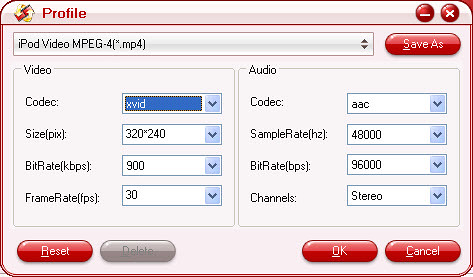
    Step 3: Click "Settings" button to adjust video and audio parameters like aspect ratio, bit rate, frame rate, sample rate, etc.

    Step 4: Click "Convert" button to start conversion.

    Tips:

    1. If you want to combine multiple MKV files to be as one file, please tick the checkbox "Merge into one file".

    2. Click the camera icon, and then you can take screenshot of the playing MKV file, after that, click the folder icon on the right side of this icon to get the screenshots.

    3. Click "Edit" button, then you will be led to the editor interface as below:

    The "Crop" function allows you cutting off black edges and the unwanted areas of the original MKV files.

    The "Trim" function enables you to set the exact duration of the video clip. You can set the "Start" time and "End" time, or you can directly drag the slide bar to the time points as you like.

    Through using "Text Watermark" and "Image/Video Watermark" function, you are able to add your preferred texts, pictures, even GIF animations and videos to be as your watermark, in that way, the "Picture-in-picture" effect will be realized beautifully.

    The "Effect" function permits you adjusting the effects of your MKV files, including "Brightness", "Contrast", "Saturation", and adding special effects like "simple gauss blur", "Simple laplasian sharpen", flip color", etc. to your videos.

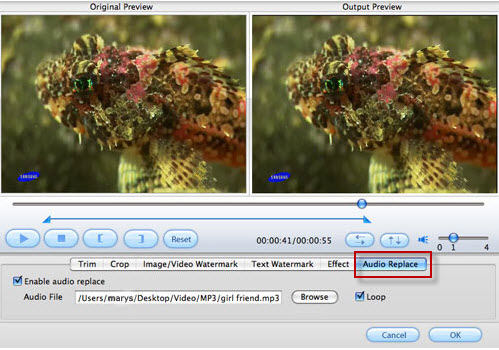
    "Audio Replace" function makes it possible for you to take place of the original audio with your specified audio source.

  • Convert MOD and TOD files generated by JVC camcorders on Windows and Mac

    Convert MOD and TOD files generated by JVC camcorders on Windows and Mac

    JVC camcorder users are usually troubled by MOD and TOD files that generated by their JVC camcorders, because the two formats generally can not be accepted directly by most video players or editors. If you want to enjoy these video files on your computer or portable devices, or even do some further editing with video editing software, you have to convert them to some other common formats previously. This article here will introduce you how to convert MOD and TOD files generated by JVC camcorders on Windows and Mac?If you are in need, please go ahead with it.

    Part 1: About MOD and TOD:

    Both MOD and TOD are the informal tapeless video formats produced by certain digital camcorders. And both of them have never been given to any meaning explanations or official names by their creators JVC or Panasonic. The differences between them lie in: MOD are used by JVC, Panasonic, and Canon in some models of camcorders, such as JVC GZ-MG130, GZ-MS100U, GZ-MG255, Panasonic SDR-SW20, SDR-SW21, SDR-S26, Canon FS100, FS200, FS21 and so on, while TOD is only used by JVC camcorders, like JVC GZ-HD7, GZ-HD5, GZ-HD6, GZ-HD30, and GZ-HD40; Moreover, MOD is only used for standard definition video files, while TOD is exclusively used for high definition video files.

    Part 2: How to convert MOD and TOD files on Windows?

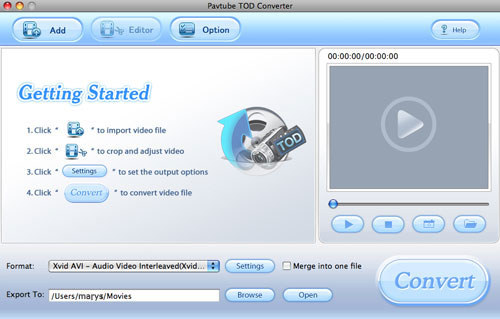
    Step 1: Download, install and run Pavtube TOD Converter

    Step 2: Import video files, select output format and specify store path

    Add your recorded MOD or TOD files to this program, and select whatever formats you need from the drop-down list of “Format”. If you want to play on your cell phone, you can select 3GP; to play on iPod or iPhone, you can select MP4; to share online, you can select FLV. Meanwhile, press output folder to specify where to locate the output files, or you can use the store path set by default. Further more, suppose you need to join several files to be one, you can check “Merge into one file” to realize it.

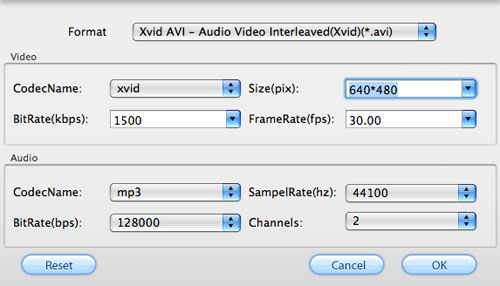
    Step 3: Set advanced settings:

    You are allowed to do some advanced settings according to your own requirements. In this section, you are able to set parameters for output video, the bigger value, the better quality, but the larger size.

    Step 4: Convert

    Pavtube provides you a friendly interface while converting, and all the conversion info can be found out in the following window, like total progress, the time have spent, the file size have been generated, as well as the possible left time and the entire size probably produced during the conversion.

    Tips:

    1. The converting speed of this software is 1-2 times faster than the similar converters. Batch conversion can be done in a few minutes. Merge multiple files into one file is also available.

    2. It does not have the audio-video sync issues.

    3. With exception of adding text as watermark, images, GIF animations, and videos can also be added as watermarks to realize the picture-in-picture effect.

    4. You can use the “Trim” function to select certain video clips to convert. And you can also take advantage of the “Crop” function to remove black edges or change the screen size.

    Part 3: How to convert MOD and TOD files on Mac?

    Step 1: Download, install and run Pavtube TOD Converter for Mac.

    Step 2: Select formats and do advanced settings

    Add your recorded MOD or TOD files to it, and select whatever formats you need from the drop-down list of “Format”. If you want to edit with iMovie, you can select MOV or MP4; to play on your cell phone, you can select 3GP; to play on iPod or iPhone, you can select MP4; to share online, you can select FLV.

    Meanwhile, you are allowed to do some advanced settings according to your own requirements. For instance, you can reset the screen size or change the bit rate. Increase the bit rate, video quality will be improved, while file size will be enlarged. Decrease the bit rate, file size will be reduced, while quality is inferior to the original.

    Step 3: Export To

    Set which destination folder the output files will be exported to. You can export them to the default path or specify a path to locate them by clicking “Browse”.

    Step 4: Convert

    Tips: Introduce you two more special functions to optimize your conversion.

    Suppose to add logos or images on your videos to show your personalized settings or to reserve your own copyright? The following step will show you the methods of adding watermarks.

    1. Add watermarks to your video

    There are four ways to add watermarks, including adding text, adding images, adding GIF animations, and especially adding videos. Don’t you think a picture-in-picture function is really wonderful?

    2. Audio Replace
    If you want to add some soft music or some other audio resources to match your recorded videos, you can have a try about the function of “Audio Replace” to replace the original audio in your videos. You can click “Browse” to select which audio resources will be used to take place of the original audio.

    Hope this article could definitely relieve your format troubles while handling MOD or TOD video files no matter you are a Windows user or a Mac user. v

  • Kubica Makes Rally Monte Carlo Exit with Engine Failure

    Robert Kubica’s intrusion in the world of rallying lasted only 4 kilometers, as the Polish driver’s Renault Clio R3 suffered an engine failure during the prologue of this week’s Rally Monte Carlo. The round in the Principality counts for the season opener in the International Rally Challenge and was supposed to be Kubica’s first real rally event.

    France’s publication Auto Hebdo reported that Kubica’s miss-happening took place in the icy prologue on Tuesday night, and that the Renault mechanic… (read more)

  • Automotive Education Day at NAIAS

    Whereas back in December 2008 the Pasadena Art Center College of Design hosted a design show with car company recruiters almost missing from the event, things seem to have changed during the past year. On January 20, the 2010 North American International Auto Show (NAIAS), backed by State Farm Insurance, will host the sixth edition of the Automotive Education Day.

    Unlike in 2008, everyone of the automotive companies attending hopes students will play a crucial role in the industry’s future a… (read more)

  • Genii Capital Optimistic Saab Will Be Sold

    Although General Motors has already started winding down Saab, both Spyker and Genii Capital, a.k.a. the two interested bidders that are still in the race for buying the Swedish unit, are confident that a deal could be reached soon. After Spyker’s CEO expressed his confidence that a final decision is to be made in the near future, Genii Capital is sure that Saab will be after all sold.

    On the other hand, the Luxembourg-based financing firm is quite reticent when it comes to its chances to sec… (read more)