Author: Serkadis

  • Kia Soul Used as Scammer Bait

    South Korean manufacturer Kia launched yesterday a warning on the company’s kia-buzz.com blog regarding the use of the Kia and Kia Soul names to lure people into well organized scams.

    The warning was issued after Kia got a tip from a blogger, who received an email asking him to contact an express delivery company in the UK and claim a prize. According to Kia, some of the messages you may receive on your email or even on your phone may promise a Kia Soul, along with a cash prize, if you follo… (read more)

  • GSC discusses Special Fees, constitutional revision

    Potential constitutional revision dominated Wednesday’s GSC meeting, with a proposed bill to reduce special fees spending and talk of clarifying the ASSU staff confirmation process with members still upset over the rejection of Farah Abuzeid ’10 to the position of co-chief of staff.

    The meeting began with funding requests from two student groups. The GSC approved $250 for the Pakistanis of Stanford and $4,221 for the Stanford Africa Business Forum. After approval of these requests, GSC funding committee chair Ping Li raised a concern about fund use.

    According to Li, some student groups may be lying about funding an event for the well-being of the student body when instead they are simply buying food for their officers. Li proposed a transfer of $500 from the food account to the internal account. The money would be used to hire an auditor to keep student groups in check.

    “If we find they did anything to abuse the funds, then they can’t access funds for the rest of that fiscal year,” Li said. The pilot project will be implemented immediately and will be continued in following years.

    “We’ve been doing it by honor so far,” said Justin Brown, deputy chair of the funding committee, “but people have been screwing with the system.”

    In an attempt to curb special fees spending, the GSC also discussed a possible Special Fees bylaw change to prevent groups from increasing their budgets by ten percent without oversight. The bill, entitled “A Bill to Reduce Growth in Special Fees Spending,” was also discussed during Tuesday’s ASSU meeting.

    Currently, student groups requiring special fees get an automatic budget increase of ten percent each year, plus inflation.

    “If you want to increase your special fees budget, then you have to do it the way everyone else does it — which is to petition,” Brown said.

    According to co-chair Eric Osborne, existence of the student groups will not be affected, but their funding may be decreased due to GSC oversight.

    “They shouldn’t be able to add ten percent willy-nilly to their budgets every year,” Osborne said.

    School of Education representative Eric Shed agreed with Osborne on the special fees bill.

    “This strikes me as a fair, practical, and effective solution, and that is an irregularity in legislature,” Shed said. “I just want to acknowledge that.”

    Voting will be delayed until next week in order for GSC members to familiarize themselves with the proposal.

    ASSU Announcements

    Following the discussion on special fees reduction, undergraduate outreach chairs Adrienne Pon ’12 and Britt Kovachevich ’09 were unanimously confirmed as legislative liaisons for the ASSU.

    The next announcement was an introduction to a new initiative that aims to help student groups by offering free technology consulting services for maintaining their websites. Basic website techniques will be taught at Old Union on Jan. 15 and Jan. 22 from 4-6 p.m.

    Other ASSU announcements included a salary/benefit negotiation workshop called “MAANuary: MAAN Mustache Challenge” and the “Hack-a-thon” for coders as an alternative to the Dance Marathon.

    The Mustache Challenge involves Stanford men growing out their facial hair and then accepting bids to shave them, in order to raise money to prevent violence against Stanford women. The “Hack-a-thon” allows for students not keen on dancing to still participate in the marathon.

    “If you have computer science or software development skills, you can code for 24 hours instead of dancing for 24 hours,” said ASSU President David Gobaud ’08 M.S. ’10.

    Constitutional policy revisited

    The confirmation of Abuzeid to the co-chief of staff issue was revisited as Osborne asked Parker for an update of the pending positions. According to Parker, there will be no case to clarify the issue. GSC members were not satisfied with the statement.

    “We want to get this issue cleared up,” Osborne said.

    The GSC debated the possibility of claiming that harm is done by not confirming Abuzeid. According to parliamentarian Robert Hennessy, harm needs to be done in order for the GSC to bring the issue up to the constitutional council.

    “I can honestly say that the GSC is harmed because Andy [Parker] is overworked,” Osborne said in reference to Parker taking up both positions of vice president and co-chief of staff in the meantime.

    “Arguably, every student at Stanford can bring up a case,” he added, “because they are all affected by Andy being overworked.”

    Members proposed the idea of draft to clarify the voting procedure regarding ASSU confirmations in the bylaws.

    According to Adam Beberg, doctoral candidate in computer science and former GSC member, the Senate may be acting against their constitutional power in attempting to prevent Abuzeid from being confirmed.

    “It’s a staff position, not [an] employee,” Beberg said. “It’s not something we should be voting on.”

  • Swinging for Vegas victories

    The ever-talented Stanford women’s tennis program kicks off its 2010 program this Friday at the Freeman Invitational in Las Vegas. Led by head coach Lele Forood, the team will seek a return to the top of the national rankings and to recapture the Pacific-10 title.

    The Stanford Daily File Photo

    The Stanford Daily File Photo

    Forood is heading into her 10th year coaching the Cardinal. She has had an accomplished career, including being named the 2003 National Coach of the Year and the three-time Pac-10 Coach of the Year (2004, 2005, 2007). The team’s record is an astounding 233-15 under her leadership and she was the first female head coach to win the NCAA team title when she went 30-0, 8-0 Pac-10 in 2001, her maiden season.

    “We’ve set this year up schedule-wise to put our primary focus on winning the Pac-10 title again,” Forood said. “Last year was our first year in over 20 years that we didn’t win the conference title and it’s a big goal of ours again this year. When you win the conference title, it means you’re one of the top three teams in the country because our conference is so strong.”

    As for the team, they’re pretty impressive in their own right. Stanford women’s tennis has a record-shattering 151 home-match winning streak, the longest active home streak of any intercollegiate sport in NCAA Division I history; the streak dates back to the 1999 season. They have fully dominated at home for the past decade. They have made 28 consecutive NCAA tournament appearances and reached the round of 16 for the 24th straight season last year, finishing with a final record of 19-5.

    Unfortunately for the 2010 team, it will face a little extra scrutiny this year despite its national No. 13 ranking. The Cardinal has seen a progressive slide in postseason victories since 2006, the last year they won the championship. A semifinal in 2007, a quarterfinal in 2008 and an appearance in the round of 16 last year all suggest that the program may be entering a lull. Last season’s finish of third in the Pac-10, snapping a streak of 21 consecutive Pac-10 titles, doesn’t help their defense either.

    “It is definitely possible [to win the Pac-10 again], otherwise we wouldn’t put it out there as a goal. It’s not going to be easy,” Farood said. “Cal’s team got to the final, UCLA is always top 10 and Washington has two top players, so it’ll be a huge challenge for us, but even in years that we won it, they had been that good too.”

    Stanford does have the players it needs to dominate nationally again though. Senior Lindsay Burdette finished the 2008-09 season with a 21-10 record, including 27-8 in doubles with her partner junior Hilary Barte. The pair reached the national championship match, but lost to California’s Mari Andersson and Jana Juricova 6-3, 6-4. The two have appeared in good form in the fall indoor season. They captured the doubles title at the ITA National Indoor Championships as the tournament’s No. 2 seed after defeating Tennessee’s Natalie Pluskota and Caitlin Whoriskey 6-4, 3-6, 7-6 (4).

    Barte is one of the star singles players for the team as well. She was named Pac-10 Player of the Year last year, earning All-American honors in singles and doubles and finishing the year with a national singles ranking of No. 9. She led the team with a 35-6 record while playing at the No. 1 spot.

    “We have a really interesting mix of players this year,” Farood said. “We have a really good blend of very experienced players and very talented freshmen and sophomores who know what it takes to win. We have a really nice balance for the team.”

    Mallory Burdette, Lindsay’s sister, is just a freshman and already big things are expected. Her performance in the Saint Mary’s Invitational in October propelled her to be crowned singles champion of the Red Division, defeating the No. 2-seed, Pacific’s Jenifer Widjaja, 6-4, 6-1 in the championship while knocking off the No. 1-seed Alexandra Poorta on the way. Mallory also combined with fellow freshman Stacy Tan during the ITA Northwest Regional Championships, making a run to the semifinals before losing to Cal’s Andersson and Juricova 8-1.

    When asked about Mallory, Farood responded, “I think she is already one of the top players in college tennis. Winning that tournament – that was a pretty strong tournament – and the fact that she’s ranked in the top 20 immediately are very important.”

    Another rising freshman star is Stacy Tan. With a record of 5-3 for the year, Tan’s best result was a semifinal performance at the Saint Mary’s Invitational, which she followed up with a Round of 16 appearance at the ITA Northwest Regionals.

    “Stacy’s results were very close to the top,” Farood said. “She had match point on the number 10 team in the region. She’s right there as well and we just have to get this team started.”

    The women’s team played an exhibition against Hawai’i, prevailing 5-2 in their final fall action before spring Pac-10 play. Barte/Burdette won their No. 1 doubles action 8-4 as the Cardinal swept the doubles 3-0. In singles, the two won their respective singles matches in straight sets. Stacy Tan and Natalie Dillon were both edged in tough three-setters, but Stanford left the court with the win.

    Following the Freeman Invitational, the team will travel to Indian Wells to compete in the NCTC Classic before returning to Stanford for a two-game home stand against Hawai’i (1/27) and UC Davis (2/02). Pac-10 team play starts against UCLA and USC at their courts in late February.

  • Track and field: Indoor season opener

    Following over a quarter of preparation, the Stanford track and field team finds itself facing the first meet of year, as well as the first meet of the indoor season. As they head to Seattle for the University of Washington Indoor Preview, the Cardinal men and women will immediately be thrust into tough competition. The team is prepared to start the season with strong runs and personal bests.

    Stanford Daily File Photo

    Stanford Daily File Photo

    With a recruiting class of over thirty, the Cardinal faces the exciting prospect of new talent that could both surprise and overwhelm opponents. This depth will prove particularly useful in the distance events, which require mental strength in addition to physical prowess. The Stanford runners should be able to utilize their large numbers to create a strong running pack that will overpower the competition.

    The freshmen will play a key role in maximizing the team’s scoring and in increasing the team’s potential to win a championship title.

    “The freshmen this year are just great,” said junior Maddie Duhon. “There’s a huge amount of enthusiasm and talent in this class across all event groups, so it will be exciting to see how they contribute to the team’s success this year and beyond.”

    Indeed, a strong recruiting class such as this one not only indicates a favorable season, but also promises a bright future for the program.

    “The attitude that the freshman adopt will affect the program for years to come,” agreed sophomore Chris Derrick. “If, as a collective group, they dedicate themselves to Stanford track and field, we could see some really great results in the years to come; the first few weeks leave me optimistic that that will happen.”

    With such a large class size, the coaching staff must make sure to channel the talent in the proper direction, so that the sheer number of runners does not become overwhelming. The advantage of such a wide selection pool, however, is that the Cardinal can now be represented in events that previously went neglected, bringing more potential points to the team. Men’s high jump, for example, has frequently gone without Stanford participation, but freshman Jules Sharpe now seems to be a promising talent in the event.

    Other freshmen that will make their mark on the men’s side will be Spencer Chase in sprints and Tyler Stutzman and Andrew Berberick in distance.

    As the freshmen look forward to competing for Stanford for the first time this weekend, they hope for a memorable experience that will give them an introduction to the collegiate level of competition.

    “This weekend will be a good chance for us to get reacquainted with indoor track,” said senior Kate Niehaus. “I am especially excited for these freshmen who haven’t raced yet in the Stanford uniform; doing that for the first time is such a thrill!”

    The indoor season presents itself as the first competitive arena for most collegiate track teams, just a few months before the much-anticipated outdoor season. But indoor races are not just a warm-up – the competition remains just as stiff, giving the athletes a chance to establish themselves in the track and field community.

    “Although indoor is sometimes considered as just a stepping stone for outdoor track, no one really holds back when it comes to race day,” Duhon confirmed. “We still compete against many of the same athletes and our goals are the same: to be our best and win.”

    Indeed, both the men’s and women’s teams hold season goals of victory in the Mountain Pacific Sports Federation and qualification of as many athletes as possible for the NCAA Indoor Championships.

    So does a day in the life of one of these track and field athletes really look like? In addition to the incessantly stressful academic life of The Farm, these student-athletes also spend hours practicing and traveling, especially during the indoor season when all meets take place in other locations.

    “Life as a student-athlete is almost always busy,” Niehaus agreed, “but I really love running, the team and competing – I could imagine my time in college no other way!”

    Indeed, the joy of being a part of the team, as well as the pride of running for Stanford, keeps these athletes motivated and focused.

    “Running for Stanford is something that I take pride in,” Derrick affirmed. “At the end of the day I enjoy both the end result of athletic success as well as the process of working toward it – rewards are more fulfilling when they are earned through hard work – and in that sense, there is nothing more rewarding for me than track and field.”

  • Next-Gen Nissan Titan Due in 2014?

    In the current economic environment, pickup trucks and large cars are surely the most affected models of the whole auto industry so parent companies are trying a different approach over this particular sector. Take Nissan for example. Sales of its Titan light-duty pickup dropped in 2009 by around 44 percent as compared to 2008 so investing in a new version that would come with last-gen technology could prove to be a waste of money.

    That’s why the guys over at Nissan are considering 2014 as th… (read more)

  • Two Korean Tire Makers Interested in F1 Programme

    With Bridgestone announcing their exit from Formula One at the end of the 2010 season, Bernie Ecclestone must be going crazy looking for tire suppliers to replace the Japanese maker. In recent months, the biggest players on the tire manufacturer market – Michelin, Pirelli and Goodyear – have all declined offers to return (or debut) in the Great Circus.

    However, according to German publication Auto Motor und Sport, there is still hope for Formula One. It seems two Korean tire manufacturers are… (read more)

  • GM Could Reopen Plants to Satisfy Demand

    After General Motors closed several US plants as parts of its global reorganization, the American automaker might bring some of them back to life in a move supposed to help the company meet higher demand for several vehicles. Mark Reuss, GM’s North American president, said in a statement at the 2010 North American International Auto Show that plants currently in charge of Chevrolet Equinox, GMC Terrain, Cadillac SRX and Buick LaCrosse production can’t satisfy demand.

    Both the Terrain and Equi… (read more)

  • Google Offers Satellite Images of Haiti, Post-Earthquake

    In the immediate aftermath of a 7.0 earthquake that caused an unbelievable amount of destruction to Haiti’s capital, Google has been asked by relief organizations and users to show images of what’s actually happening on the ground.

    In partnership with geospatial imagery company GeoEye, Google has just released a new layer for Google Earth showing post-earthquake devastation. Haiti was first added to Google Map Maker in response to hurricanes that wreaked havoc on the country more than a year ago. Read on for before-after pictures and details.

    Sponsor

    The Red Cross has stated that as many as 3 million Haitians have been affected by the earthquake, with as many as 100,000 deaths likely, according to Haiti’s prime minister. Since the quake’s epicenter was right off the capital city, Port-au-Prince, most of the official buildings, from government officials’ residences to jails and hospitals, have been significantly damaged or completely leveled. Google’s imagery shows exactly that:

    You’ll have to install the Google Earth plugin if you haven’t already to see this layer.

    In a post just published by Googlers Dylan Lorimer and Jessica Pfund, they write, “We hope that Google Map Maker can also play a role in disaster relief efforts…Today, we have made this Map Maker data for Haiti available to the UN in its raw form for the earthquake relief efforts. If you have any local knowledge to share, please help us continue to build a better map of Haiti with Google Map Maker.”

    For a list of ways you can donate money to help suffering Haitians and stay informed on Haiti-related breaking news, check out this post we published earlier today on resources, charitable organizations and news outlets.

    Discuss


    Buy This Item: [Click here to buy this item]

    Read Original Article

  • GM Chips In for Shattered Haiti

    American manufacturer GM announced yesterday the approval of an immediate $100,000 contribution to the American Red Cross relief fund to be send in the aid of Haiti, devastated after the 7.0 quake which struck on January 12. GM also announced it has set up a special web-link to be used by employees who want to make their own contribution.

    "As one of the world’s largest car companies, doing our part to contribute aid to Haiti is not about business but our obligation to our fellow man,&quo… (read more)

  • MINI One MINIMALISM Line

    German carmaker BMW announced a revised range of petrol engines for the MINI, MINI Clubman and MINI Convertible which will meet the EU5 exhaust emissions standard in Europe and the ULEV II standard in the USA from spring 2010.

    New to the model range is the MINI One Convertible, powered by a low-fuel consumption and low-emissions four-cylinder engine producing 72 kW/98 hp.

    According to the manufacturer, the new MINI One MINIMALISM Line, available with two engine variants, has the lowest e… (read more)

  • El fin de la privacidad en la era de los blogs y las redes sociales

    Api social Google

    Controvertidas declaraciones del fundador de Facebook Mark Zuckerberg, recogidas por RWW con el impactante titular “la era de la privacidad se ha terminado“. Básicamente Zuckerberg hace una lectura de cómo ha evolucionado la tendencia de la gente a compartir de forma abierta en internet, partiendo de los blogs, reflexionando sobre el éxito de Facebook y, sin mencionarlo, reflejando su obsesión por el crecimiento de Twitter. Refrenda los últimos movimientos en Facebook, como los cambios en este servicio de red social para empujar a compartir de forma más abierta que introdujeron el pasado mes de Diciembre.

    Hay un punto de partida en el que creo que Zuckerberg tiene razón, si algo han avalado los usuarios de internet en los últimos años es que han percibido valor en compartir en internet: conocimiento, temas personales, gustos, preferencias, contenidos. Ya sea en facetas profesionales o en personales, el resultado es que “lo 2.0” se construye sobre el retorno que reciben los usuarios – visibilidad profesional, prestigio, sentimiento de pertenencia, percepción de influencia, contacto humano con gente que le interesa – cuando participan y comparten en la web. También creo que tiene razón al subrayar que “la norma social sobre la privacidad se transforma”, y que lo está haciendo rápidamente. No en el sentido de que “ha llegado el fin de la privacidad“, pero sí que las nuevas generaciones tienen una preocupación muy diferente que los que hemos crecido en la era pre-internet. Ejemplo de ello son la asunción de que las fotos de las reuniones de jóvenes se asume que van a ser compartidas en Tuenti, mientras que en grupos de mi edad lo esperado es que primero pidamos permiso.

    Donde creo que Zuckerberg no ha estado tan fino es cuando hace la lectura del reflejo en los blogs y las redes sociales de esta evolución de la privacidad. Los blogs tienden a ser un fenómeno minoritario en el lado de la creación porque en ellos van quedando quienes quieren tener una publicación, para compartir lo personal los blogs han sido sustituidos por Facebook, Tuenti y compañía ¿por qué? Porque hay cierto control de con quien se comparte, porque tienen gestión de la privacidad. Por eso Facebook llegó a varios cientos de millones de usuarios y los blogs no han escalado, no sólo por una cuestión de usabilidad sino porque las redes sociales ofrecen un entorno más propicio para lo que es más relevante para el usuario – lo personal, lo afectivo – frente a sistemas de publicación en abierto. (más desarrollado esto en http://www.error500.net/articulo/fin-blogs-era-redes-sociales).

    En la tesis de Zuckerberg tengo la impresión que se trasluce la obsesión que tienen desde hace tiempo con Twitter. Ser abierto permite al sistema de “microblogging” entrar en el negocio de las búsquedas y cosechar visibilidad (enlaces, integraciones de terceros, menciones en blogs y medios) que está vedada para todo lo que queda tras el jardín vallado de Facebook. Por un lado entiendo que Facebook ha ido creciendo porque son una compañía muy abierta a cambiar lo que sea necesario para seguir evolucionando, pero con la privacidad y el “todo abierto” podrían darse con un canto en los dientes, hasta los adolescentes aprenden a configurar su preferencias para conseguir que quienes ellos no desean – típicamente, los padres – no se enteren de las fotos que subieron de la última fiesta.


  • HARELBEKE : Diverse projecten

    Naast de werken in Kortrijk zijn er ook (weliswaar minder) werken in Harelbeke. En aangezien Harelbeke niet officieel bij Kortrijk behoort, maar er wel volledig in vergroeid is, maak ik hier een thread over de projecten die aan de gang zijn in Harelbeke…
  • Nokia N900 gets its second firmware update this week

    Don’t get us wrong, enabling the Ovi Store was a pretty sweet add-on in the last update — but the second N900 push in just a single week features a list of fixes and changes that should put smiles on a few owners’ faces, too (and a few devs’ faces, for that matter, while they wait for this payment bug to get patched up). This time around we’ve got full support for Swiss keyboard layouts, better compatibility with 3-branded SIM cards, support for Microsoft Exchange Server 2003 in the handset’s Mail for Exchange service, and a handful of performance and usability tweaks for Ovi Maps. It’ll be available both over-the-air and via PC download in a phased global rollout over the next day, so keep checking; no need to get all crazy about it if you’ve already installed the first update, though — you’ll be automatically alerted when this one’s ready for you.

    Nokia N900 gets its second firmware update this week originally appeared on Engadget on Thu, 14 Jan 2010 01:35:00 EST. Please see our terms for use of feeds.

    Permalink   |  sourceNokia Conversations  | Email this | Comments

    Buy This Item: [Click here to buy this item]

    Article

  • USTR Will Listen To The Public On Creating Its ‘IP Axis Of Evil’ List?

    Among copyright experts and copyright policy folks, it seems widely recognized that the US Trade Rep’s “Special 301” review process has been a massive joke. Last year, at an event discussing copyright, even folks from the US Copyright Office laughed off the Special 301 report. Historically, what it’s been is the entertainment industry putting together a list of countries that don’t have draconian enough copyright laws, and it gets the USTR to complain about them and put them on a “watch list” of sorts. Pretty much everyone who understands these issues knows it’s a complete joke, but unfortunately there are lots of people who don’t understand these issues, and it lets diplomats and politicians make laughable claims like saying that Canada is a hub for piracy — and the press almost never questions where that information came from because it sounds all official.

    So it’s nice to hear that apparently the USTR is opening up the Special 301 review process to the public (slightly) in not just asking for written input, but also holding a public hearing for the first time ever (via Michael Geist). That said, I’m not convinced this will really make a huge difference. Since this is a discussion about what foreign countries are doing with their copyright laws that doesn’t directly affect most of the American public directly (though we can be concerned about the fallout). So who’s going to take part? The usual suspects form the industry will, asking for increased protectionism designed entirely to prop up their business models, rather than actually looking at a country’s copyright laws. But will others really have enough to say? KEI plans to submit something, and does a good job cautiously praising the slightly more open process, but worrying about whether it will actually make a difference.

    Permalink | Comments | Email This Story


  • Lotus Evora Cup Race Car Unveiled Ahead of Geneva

    British manufacturer Lotus released yesterday the details of the car which will enter the 2010 Evora Cup. The car will make its first appearance at Birmingham, on Thursday the 14th, 2010. Designed by Lotus Motorsport, the car is eligible to compete in a number of different national and international series, including endurance and sprint racing.
    The Evora Cup car comes equipped with a new 4l V6, which develops 400 hp. The engine, mid-mounted, is paired with a Cima six speed sequential paddle… (read more)

  • Windows and Mac Users: What You Can Get in A DVD Ripping Program

    Nowadays rip DVDs is becoming a common activity performed by many software programs. But many portable multimedia players only play video in the MPEG-4 format. Now, when getting a DVD ripping program is a must, the question on what to look for will be one of the first questions that you will likely ask.
    If you own a portable gadget that plays video and you want to watch your DVD videos on it, you most likely need a DVD ripper program. This includes devices like the iPod Touch, iPod Nano, iPod Video, iPhone, Zune, PSP and others. If you want to store your DVD movies on your computer or a hard drive, you too need DVD ripping software.
    This guide will show you how to use 4videosoft DVD Ripper platinum (for windows users) and DVD
    Ripper for Mac
    (for mac users)
    in an easiest way and explain how to merge/ subtitle/ crop/ trim/ effect the video files while conversion.

    Part 1: How to rip DVD files into versatile video/audio formats for playback on iPhone/iPod/PSP/Zune/Apple TV/Phone/Xbox/Zen…

    Step 0: Download and install 4Videosoft DVD
    Ripper
    Platinum
    Step 1:Load your files
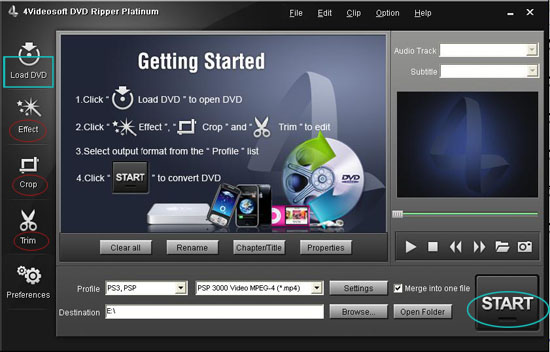
    Click “Load DVD” button to load your DVD.
    This professional DVD Ripper can load three DVD source, you can load your DVD from DVD drive, DVD folder in your PC and also IFO file.

    Step 2:Choose your settings
    Select the output video format you want from the “Profile” drop-down list.
    Some powerful functions such as “Trim”, “Effect”, “Crop” “Preference” are all available.
    Step 3:Start conversion.
    If you want to convert DVD by default settings, just click “START” button to convert. It is the easiest and common way to convert with only three steps.
    You can have a coffee or have a walk now! In a short while the conversion will be finished.

    Part 2: how to rip a DVD to AVI, MPEG, MPEG4, WMV, MOV, DivX, ASF video or WMV, MP3 audio on your Mac computer

    Step 0: Free Download and install 4Videosoft DVD Ripper for Mac
    When you finished the download process, run the .exe file to install it.

    Step 1: Click “Load DVD ” or “Add DVD” button to import DVDs.

    Step 2: Select one or more files in the list, click "Profile" drop-down button, select an output format for selected files in the drop down list that opens.

    Step 3: Click "Browse" or “Open Folder” button on the right of "Destination", select a destination folder in the dialog box that opens, and click it.

    Tips: If you want to do more operation with your DVD, the following functions will satisfy you.
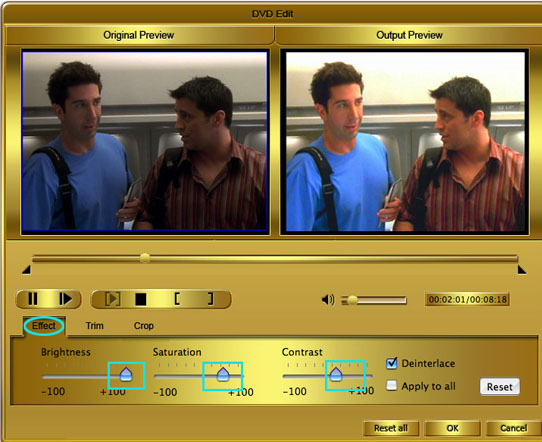
    1. Effect.
    If you want to adjust the effect of your movie, please click the “Effect” button and a pop-up effect window will appear. It allows you to edit your movie’s effect including “Brightness, Contrast, Saturation and Volume”.

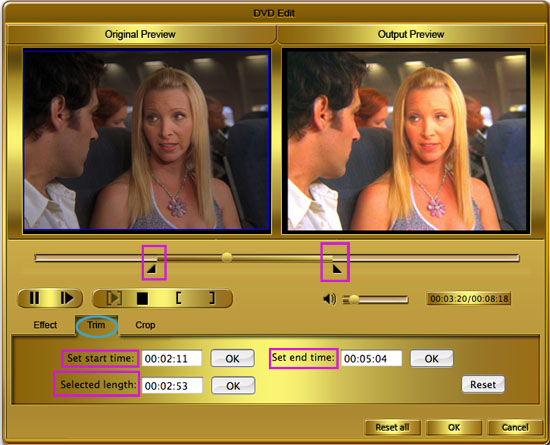
    2. Trim.
    The "Trim" function also servers as a video splitter for you to get any time-length video episode. You can set the "Start Time" and "End Time" to set the exact time-length of the clip or you can directly drag the slide bar to the position you want.

    3.Crop.
    By using the "Crop" function you can crop off the black edge of your video and you can also drag the line around the video image to adjust the video play region to fit for your mobile devices

    Step 4: After all the settings, click the “START” button to start ripping DVD to destination format.

    Keep these tips in mind while shopping to find the best DVD ripping software for your needs.
    Video Converter
    Video Converter for Mac
    So just go to have a try now.

  • Twitter for Teams: Teambox Launches Web-Based Collaboration Tool

    Since Google Wave’s launch, we’ve seen a slew of real-time, short-form collaboration tools.

    From massively multiplayer Q&A app Quora to invite-only, group-scrapbooking tool TwitAlbums to developer-centric, code-coaching resource Squad, the web is rife with sites focused on making groups more communicative and more efficient. Teambox has popped up on our radar as “a Twitter-like project collaboration tool,” and it fits right in with this trend.

    Sponsor

    This app allows users to share text, tasks and files. Much like topics in Quora, activities in Teambox can be followed by users who need to stay updated, publish updates to their team or view the related stream of information. Projects are invite-only, and users can choose who the collaborators will be and determine permissions for each person.

    Communications occur through threaded topics. Participants in a conversation are notified via email when their topic is updated. Tasks are updated in series of comments and act as to-dos that can be assigned, modified and completed.

    The app further allows for sharing files of any size, and profile pages allow supervisors or others to see what a particular user has been working on lately.

    The Twitter-like UX is familiar and fast, and the interface seems simultaneously lightweight and robust. For project management and team collaboration – including distributed teams – we can see this application going over very well.

    Best of all, Teambox is a free and open source project. The app is built using Ruby on Rails, and while the web version of the app is perfect for small- or medium-size teams, larger companies can host Teambox on their own servers – which might also be good news for users and admins concerned with data security.

    These distinctions set Teambox apart from Basecamp, a popular product from 37signals that also provides web-based project management tools.

    Although the web app is completely free, Teambox also offers paid features, such as server installation for self-hosting, customer support and white-label versions.

    What do you think? Is Teambox’s Twitter/Basecamp mashup something you could use at your company or for a group side project? Let us know what you think of the application in the comments.

    Or, for a bonus round of backstory, check out the ReadWriteWeb Spain interview with founder Pablo Villalba.

    Discuss


    Buy This Item: [Click here to buy this item]

    Read Original Article

  • New startup Joincube joins social software fray — targets small businesses

    JoinCubeSocial software — software that gives companies and individuals ways to interact and share information — has quickly been winning the interest of companies looking to track progress and share knowledge better among their employees. A number of software offerings already cater to large enterprise customers. But Joincube, a new startup from Argentina, is now targeting smaller companies.

    Since its October launch, the company has signed 100 such customers mainly in the US and Europe.

    It’s easy to be (justifiably) skeptical of yet another player entering an increasingly crowded space. A few days ago, social software company Jive Software announced that it increased revenues by 85% in 2009 (reportedly to $30M) and added marquee customers such as SAP, Qualcomm and Kaiser Permanente. And another player in the space, Socialtext, recently announced a record quarter.

    But a newcomer specifically targeting smaller businesses may still be able to carve out a niche for itself. For example, Zoho, a bootstrapped company with most of its employees in India and China, has more than 2 million users of its applications primarily within small businesses. Given the fact that it sometimes competes head-to-head with the likes of Google and Salesforce.com, the company was able to surmount some formidable obstacles.

    According to Joincube’s CEO, Mariano Rodriguez, the company’s focus on ease of use and customer service will be key in differentiating it within the small-business market. Mariano says that a typical customer purchases a 50-user subscription package ($39 per month) and is up and running quickly thanks to the software-as-a-service (SaaS) model. As an example of the type customer the company is targeting, he cited a law firm that was able to quickly integrate the software into their work processes in order to collaborate on creating legal documents for clients without a lot of effort expended on training and IT support.

    According to Mariano, the company is currently working on pre-integrating some third party applications — such as VoIP conferencing –as a prelude to releasing a public application programming interface (API). Also, since customer acceptance has progressed faster than the company anticipated, it is exploring new, more aggressive sales strategies in order to take advantage of a window of opportunity it sees in the small enterprise space.

    Though the company faces many challenges, not the least of which is the growing interest in the social software market from the likes of Microsoft, Google and Salesforce, its focused strategy could continue to bear fruit. One thing the company should consider is integrating its offering into one or more of the SaaS ecosystems — Intuit, Netsuite, or Salesforce.com, for example — in order to leverage their captive user bases. Either way, Joincube offers one more option for small companies to take advantage of the benefits of social software: greater productivity and collaboration.

    Joincube is based in Buenos Aires. It was founded two years ago by eight engineers who bootstrapped the project with $100k of their own funds.


    Buy This Item: [Click here to buy this item]

    Read Original Article