 MARKETING — VALUE-ADDED — AGRITOURISM: If you’re already involved in backyard or small scale farming, be sure not to take your veggie gardens, flower fields or farm animals for granted. Rural and nature scenes are often highly desirable products. If you have good photos of your micro farming scenes, you can turn them into art prints or “oil paintings” to hang on the walls of your farm store or farmers’ market, to have on display during agritourism events, or print small versions in your farm newsletters. Images of your small scale farming operation go a long way to brand your farm, attract customers and instill a faithful following amidst current customers. Sites such as PhotoFiddle (one of our affiliates which we really love — but there are others, so shop around) can turn your digital photos into art prints or even what look like oil paintings on stretched canvas. You can even offer to sell copies of your displayed farm art by creating a price that gives you a profit (Example, Photofiddle charges $15 for an 8×10 art print, you charge $23. Photofiddle charges $35 for an unframed canvas painting, you charge $45), and only order a new copy when a customer prepays for one. Be sure to put a copyright notice on each piece of art sold. — www.MicroEcoFarming.com
Author: Serkadis
-
Small Scale Farming: Using farm photography for farm marketing and creating a small value-added product
-
Tron: Evolution announced and dated
Following the announcement made during the 2009 Spike Video Game Awards, Disney Interactive Studios today let slip an official announcement for Tron: Evolution, the companion game for the new Tron movie.
-
Kepler Motors Motion supercar to debut at Dubai Motor Show
Filed under: Coupe, Performance, Misc. Auto Shows

Kepler Motors Motion – Click above for high-res image galleryIt’s hard not to be skeptical when a company that no one has ever heard of announces a brand-new supercar. A few have managed to last more than a few years, like Koenigsegg and Pagani, but most seem to disappear just as quickly as they appear. Russ Wicks, founder and CEO of Kepler Motors, is evidently undaunted by the statistics and is launching his new supercar, the Motion, this week at the Dubai International Motor Show.
To their credit, Kepler Motors seems to have all right pieces to the puzzle. The Motion features all the makings of a 21st century supercar like a carbon fiber composite monocoque chassis and body, active suspension and aerodynamics, and a seven-speed sequential transaxle. The all-important horsepower rating is an impressive 800 thanks to the combination of a modified Ford 3.5-liter twin-turbo EcoBoost V6 that drives the rear wheels and a 250 hp electric motor that sends power to the front. Yes, it’s a hybrid.
While we remain skeptical, we wish Kepler Motors the best of luck. They will surely have their hands full filling their proposed production limit of 50 cars that are set to be delivered to customers at the start of 2011. We will be sure to bring you any updates regarding the supercar startup, but until then check out the gallery below or read more about the Motion in the press release after the jump.
Gallery: Kepler Motors MOTION Supercar


[Source: Kepler Motors]
Continue reading Kepler Motors Motion supercar to debut at Dubai Motor Show
Kepler Motors Motion supercar to debut at Dubai Motor Show originally appeared on Autoblog on Mon, 14 Dec 2009 14:29:00 EST. Please see our terms for use of feeds.
-
New X-Box Live client for Windows Mobile

 WM Live is a new X-box Live client for Windows Mobile that lets you sync your Xbox Live friends career / status / gaming history on your device so you can look it up while online OR offline.
The application is currently on version 0.8 and in my testing seem to be a bit buggy, but did sync my profile quite nicely.
Read more about the app at Zaamit.com here, and download using our Microsoft tag (gettag.mobi).
Via FuzeMobility.com

-
DX vs. Control
Hi, everyone! I’m new here since yesterday — and so happy to find such useful information. 🙂I have a question re how and when to intervene.
Background: I don’t have a T2 dx but my A1C is a little high. T2 runs in my family, and I have recently developed what may be a few classic symptoms. So I tested my BG during the last 24 hours — everything looked great fasting and at bedtime. After meals, BG was 122, 140, 147.
My question is how to resolve this contradiction:
— I don’t meet the dx criteria for T2. (Fasting BG normal; no yet-discovered random BG above 200.)
— People who have T2 should not permit their BG to rise above 140 after meals, in order to prevent neuropathy, etc.
— My after-meal BG is above 140, and I feel -very- fatigued and weak after meals.Hmm. What should I do? Are there preventive measures / interventions I should ask my doctor about?
Also, how do you find a good endocrinologist? What to look for / avoid?
Thanks so much!
— J. -
Kitum Cave
Kenya, Africa | Geological Oddities
When the Kitum cave was first discovered the many marks, scratches and furrows along its walls were assumed to have been the work of picks wielded by ancient Egyptians searching for gold or diamonds. In fact, the excavated sections of the cave are the result of something altogether much stranger.
The Kitum cave is found on Mount Elgon, an extinct shield volcano and the cave itself developed as the result of cooling volcanic rock. The cave which extends some 600 feet into the mountain has walls covered in salt, and it is here that the mysterious cave diggers reveal themselves.
Each night for hundreds (possibly thousands) of years animals have traveled into the cave in the dead of night to use it as a giant salt lick. Buffaloes, antelope, leopards, hyenas, and most of all elephants bumble blindly through the cave (the elephants often bump their heads in the process) making their way to the salty walls of the cave. It is the elephants that have done the digging.
Using their massive tusks they scrape the the salt, the elephants pull off chunks of the walls to crush and lick up the salt. Over the centuries this has resulted in a noticeable increase in the size of the cave and walls covered in tusk marks. The trip to the cave is not without dangers and there is a deep crevasse into which many younger, more inexperienced elephants have fallen leaving behind an elephant graveyard.
The Kitum cave is more recently famous for a very different sort of lifeform, a deadly virus. In 1980 and again in 1987 visitors to the cave contracted Marburg virus, a deadly virus very similar to Ebola. The cave and Marburg virus rose to notoriety when it was featured in bestseller “The Hot Zone.” It is believed that the bats in the cave may carry the virus and that their powered guano may act as the disease vector.

-
REPORT: Honda finally approves a second act for the Element
 2010 dog-friendly Honda Element – click above for high-res image gallery
In spite of being functionally outstanding, Honda‘s odd looking Element crossover has never lived up to sales expectations. The funky box never approached the initial sales target of 75,000 units a year, and this year it’s on track for barely more than 15,000 sales. Despite its relative commercial failure, Honda has reportedly given the green light to a second generation model. Despite a couple of modest freshenings, the Element is already seven years into its life cycle – considerably longer than typical for a Japanese branded model.
Given the slow sales, why would Honda bother with a new iteration? Honda’s executive vice-president, John Mendel, has informed Automotive News that virtually all Element sales are incremental. The Element shares its platform with the much higher volume CR-V, but apparently almost no buyers cross-shop the two vehicles – Element buyers have no interest in the CR-V and vice-versa. If Honda does proceed with a new model, perhaps unique features like the recently introduced dog friendly package will be the key to increased differentiation and success.
[Source: Automotive News – sub req’d]
REPORT: Honda finally approves a second act for the Element originally appeared on Autoblog on Mon, 14 Dec 2009 14:01:00 EST. Please see our terms for use of feeds.
-
Sony starts talking about PSN fees again
This isn’t the first time Sony folks have talked about possible PlayStation Network fees. Last time, Kaz Hirai was quick to reassure PS3 owners that current PSN services
-
The Turtle Trader Cashes In On America’s Financial Angst
The Turtle Trader Micheal Covel appears to have joined the financial angst gold rush.
In addition to his blog shown to the right, which always appeared to us like nothing but a giant sales pitch for his Turtle Trader book, he has now also come out with a movie for sale.
It’s about the crisis, and the trailer doesn’t say much except that we should be confused and outraged.
We suspect that the secret to turtle trading involves developing additional cash flows around one’s trading activity.
Join the conversation about this story »
See Also:
- Fears Mount Over Japan’s $100 Billion Treasury Sell Off
- CHART OF THE DAY: Small Business Cash Crunch Fears Getting Worse And Worse
- Fear Of Bank Writedowns Sends Asian Markets Plunging
-
C&K Develops Comprehensive Range of Smart Card Connectors
Compact smart card connectors designed for full size ID1 and SIM/SAM ID000 cards…
C&K Components has developed a comprehensive range of smart card connectors. Featuring high temperature thermoplastics and compatibility with automatic pick-and-place equipment, the CCM01 and CCM02 Series smart card connectors are designed for full size ID1 cards, while the CCM03 Series connectors are designed for SIM/SAM ID000 cards. The CCM04 Series devices are compatible with both ID1 and SIM/SAM ID000 cards.
“As a long established supplier of smart card connectors, we have extensive experience matching performance with the need to remain cost sensitive, which is particularly important in consumer electronics applications,” said Jerome Smolinski, senior product manager for C&K Components. “We consider the true cost of the interconnect to be a function not just of price, but also the ease with which the device can be integrated into the customer’s production process and its performance in the field.”
The smart card connectors are ideal for use in transaction, identification and PoS (point-of-sale) applications, as well as handheld devices and GPS units.
The CCM01 and CCM02 Series devices feature a sealed, normally open card detection switch and a chamfered opening in the card entry slot to improve the card guidance. Maximum card insertion force is 10N and contact force ranges from 0.25N to 0.5N. Minimum mechanical life for the 8-contact CCM01 Series connector is 100,000 cycles. The 8-contact CCM02 Series connector also features an anti-piracy system and has a minimum mechanical life of 500,000 cycles.
The compact CCM03 and CCM04 Series smart card connectors are available with 6 or 8 contacts and feature hinged, fixed or auto-locked covers. The CCM03 Series devices exhibit a minimum mechanical life of 10,000 cycles for the hinged cover and 50,000 cycles for the fixed cover. Card insertion force is 1N for the hinged cover and 3N for the fixed cover, while contact force ranges from 0.25N to 0.5N. The CCM04 Series connectors feature a minimum mechanical life of 100,000 cycles. Maximum card insertion force is 10N, and contact force ranges from 0.25N to 0.5N.
-
Desperate White House Tells Harry Reid To Cut Healthcare Deal With Holdout Lieberman
Barack Obama is not going to let pesky Joe Lieberman get in the way of its healthcare reforming dreams. In fact, it’s going to acquiesce to him.
If Joe Lieberman had his own idea for how to fix healthcare, he could probably get it passed, because it sounds like Obama is telling Senator Majority Leader Harry Reid to cut any deal it can with the former Democrat VP candidate.
POLITICO: The White House is encouraging Senate Majority Leader Harry Reid (D-Nev.) to cut a deal with Sen. Joe Lieberman (I-Conn.) and eliminate the proposed Medicare expansion in the health reform bill, according to an official close to the negotiations.
But Reid is described as so frustrated with Lieberman that he is not ready to sacrifice a key element of the health care bill, and first wants to see the Congressional Budget Office cost analysis of the Medicare buy-in. The analysis is expected early this week.
“There is a weariness and a lot of frustration that one person is holding up the will of 59 others,” the official said. “There is still too much anger and confusion at one particular senator’s reversal.”
Basically, they all have humongous egos, and Barack Obama would like them to try setting them aside.
Join the conversation about this story »
See Also:
- Lieberman Stuns Democrats, Now Says He’s Voting Against Healthcare Reform
- Democrats Cave On Public Option And Agree To Something Much Worse
- The Healthcare Polling Data That Has Democrats So Freaked Out
-
Toyota to Sell Plug-In Hybrid with Lithium-ion battery in 2011 TNR.v, CZX.v, WLC.v, LI.v, RM.v, CLQ.v, SQM, FMC, ROC, AVL.to, RES.v, CCE.v, QUC.v, F
 Now we have Toyota in our Lithium camp and it is very important for our Macro View on Micro Caps:“It is a very important news for our Lithium Demand model. Plug-In Hybrid above is promised in 2010 with Lithium-ion battery, now Toyota announces that new bigger Prius will be with lithium-ion battery in late 2010. Our discussions at Frankfurt Motor Show 2009 now officially confirmed: that all advanced Hybrids and all BEV are using lithium batteries. Salman Partners have recently put an investment Metals Morning Note where they pronounced “Lithium comeback”
 The New York Times:
By HIROKO TABUCHI
Published: December 14, 2009
Toyota Motor said Monday that it planned a widespread release of its plug-in hybrid car in 2011 as the company scrambled to gain the upper hand in an increasingly crowded battle over next-generation “green” technology.
Kimimasa Mayama/Bloomberg News
Takeshi Uchiyamada, vice president of Toyota, demonstrated how to charge the battery of the Prius plug-in hybrid in Tokyo on Monday.
Toyota, the world’s largest automaker, dominates the current generation of gas-electric hybrid vehicles, but it has refrained from rushing lower-emission cars like the plug-in hybrid to market. Instead, Toyota has focused on plans to introduce regular hybrid technology to all its models by 2020.
But Toyota’s rivals are surging ahead. General Motors plans to build as many as 60,000 Chevrolet Volt plug-in hybrids a year, starting in late 2010. Other automakers, including Ford and Volkswagen, have announced their own plug-in models, and Nissan plans to mass-produce a fully electric car in 2010.
Toyota is now increasing its pace. “Several tens of thousands” of the plug-in version of its Prius hybrid will go on sale in 2011, the automaker said Monday. A small number of the plug-in models will be available for lease later this month as planned, but those will be limited to government and corporate clients in the United States, Europe and Japan.
Takeshi Uchiyamada, Toyota’s executive vice president, said in Tokyo that the company was waiting until 2011 to begin sales so it could hear feedback from users during the leasing period. The plug-ins would carry an “affordable” price tag, he said, without giving an estimate. Prices for a regular Prius hybrid with no plug-in function start at $22,400 in the United States.
The plug-in Prius would be the first from Toyota to use the powerful lithium-ion battery already used by many of its rivals. The car travels 23.4 kilometers, or 14.5 miles, as an electric vehicle on a single charge before a regular gas-electric hybrid system kicks in. It gets an overall mileage of 57 kilometers a liter, or 134 miles per gallon — exceeding the Prius’s 38 kilometers a liter, according to Toyota.
The plug-in Prius would charge in about 100 minutes and halve the running cost of traveling 30 kilometers in comparison with a regular Prius if recharged at night, when electricity costs are often lower, Toyota said.
The automaker says it also plans to sell a pure electric “urban commuter” vehicle in 2012 that would run on lithium-ion batteries.
But Toyota is not a vocal advocate of cars powered primarily by batteries — partly because it first wants to reap the full benefits of its heavy investment in its hybrid technology. Regular hybrid systems are still the company’s main green technology, Toyota executives stress.
Executives point to a number of constraints for electric vehicles: short range and feeble horsepower, lack of infrastructure like recharging stations, long charging times and the burden the cars could place on the electric grid. All-electric vehicles, in particular, are suitable only for short city runs, they say.
“We have been working on developing efficient powertrains to be able to use oil as efficiently as possible,” Mr. Uchiyamada told the Associated Press on Monday. “Many hurdles remain for alternative fuels.”
Industry experts are split on just how quickly the auto industry will shift to regular hybrids and plug-ins — and ultimately to zero-emissions vehicles like pure electric or even fuel cell-powered cars. Much will depend on the price of oil, as well as emissions standards set by governments, they say.
The uncertainty over the future mix of technologies is forcing carmakers to hedge their bets with various kinds of technology. That means that, for the time being, manufacturers could “struggle to achieve the required scale economies to cover high up-front investment costs,” Clive Wiggins, an auto analyst for Macquarie Bank based in Tokyo, said in a recent note.
Heavy development costs could weigh on the bottom line of automakers already dealing with the fallout of the global economic crisis. Toyota predicts a loss of ¥200 billion, or $2.26 billion, for the fiscal year ending in March, following a record ¥437 billion loss last year.
Mr. Wiggins said he was “cautious on the infrastructure constraints and costs involved” with plug-ins and electric vehicles. Eco-friendly vehicles could log sales of 11.2 million units in 2020, or 12 percent of total auto sales, from 0.8 million in 2009, with the majority of those sales coming from regular hybrids, he predicted.
Others predict that plug-ins and electric vehicles will be “game-changers” that will allow rivals or even newcomers to leapfrog the industry leaders like Toyota.
The Nissan chief executives, Carlos Ghosn, has said that pure electric cars will make up at least 10 percent of global demand by 2020, assuming oil costs more than $70 a barrel.
To address some constraints on its electric vehicle, the company is readying a lithium-ion battery that will power a car for 300 kilometers on a single charge, about twice the distance currently possible, Japan’s largest business daily, The Nikkei, reported last month, without identifying its source.
With a technological leap of that magnitude, and with rising concerns over global warming, consumers could rapidly shift from gasoline cars and hybrids to zero-emissions technology, said Hiroshi Shimizu, an environmental studies professor at Keio University in Tokyo and an electric car advocate.
’“When the market decides on what technology will be dominant,” Mr. Shimizu said, “carmakers better be ready, or ready to fall out of the race.” -
Hussman: Stocks Are “Decidedly” Speculative At These Levels
Interesting comments from John Hussman, who remains very skeptical of the rally:
The S&P 500 is currently priced to deliver total returns averaging about 6.1% annually over the coming decade, even assuming that the future trajectory of S&P 500 earnings continues to obey the long-term peak-to-peak growth channel that has characterized earnings for most of the past century. Notably, that 6.1% annual projected return was equaled at the market peaks of the 1960’s, early 1970’s and at the 1987 peak. Lower prospective 10-year returns were only observed during the late 1990’s, which have been followed, not surprisingly, by 10-year returns lower than 6.1% annually. When stocks are overvalued, one does not get to have his cake and eat it too, without getting indigestion later.
We generally present valuations from the standpoint of earnings, applying a wide range of historically consistent terminal P/E multiples to mid-channel earnings 10 years hence, projected using the very well behaved historical growth channel for S&P 500 earnings across economic cycles. Of course, we can also analyze valuations from the standpoint of the discounted cash flows that are likely to be delivered to investors over time. These include our variant of the Barsky-DeLong model (presented in Don’t Discount Discounted Dividends, and the realized payout model that I presented in The S&P 500 as a Stream of Payments.
The following charts update where valuations stand from a discounted payout perspective.
The Barsky-DeLong model is the most charitable and optimistic. That approach assumes that stocks have gradually become less risky as the economy has developed, and therefore deserve higher valuations over time. Thus, although stocks were priced to deliver a real, after-inflation return of 7% annually early in the century, the Barsky-DeLong model would currently be happy with long-term real returns of just 4.2% annually. Of course, lower required returns imply higher equilibrium valuations. On the basis of that 4.2% annual real return target, the appropriate index level for the S&P 500 would currently be about 810. Again, this is the most charitable model. The red line below tracks the actual S&P 500 index. The blue line is our version of Barsky-DeLong. Given that current index levels are well above those implied by the model, the conclusion is not that stocks must decline immediately, but rather, that long-term total returns for the S&P 500 are likely to be less than 4.2% after inflation.
Join the conversation about this story »
See Also:
- 80% Chance Of A Market Crash In The Next Year
- Hussman: I Was Wrong, And Didn’t Realize How Stupid Investors Were
- Hussman: Beware The Oncoming Tanks
-
More Charts The Record Labels Don’t Want You To See: Swedish Musicians Making More Money
We’ve already discussed the research on the UK music industry that shows both that live revenue is more than making up the decline in recorded revenue and that musicians themselves are making more revenue than ever before. Some people have suggested that this is a UK-only phenomenon, but a worldwide study found the same thing as well. And, now it looks like the same is being found in Sweden as well — home of The Pirate Bay, which we keep being told is destroying the industry. Swedish indie record label owner Martin sends in the news on data from the Swedish music industry, which looks quite similar to the UK data. First, it shows that while there was a tiny dip in overall revenue, it’s back up to being close to it’s high, mostly because of a big growth in live music:
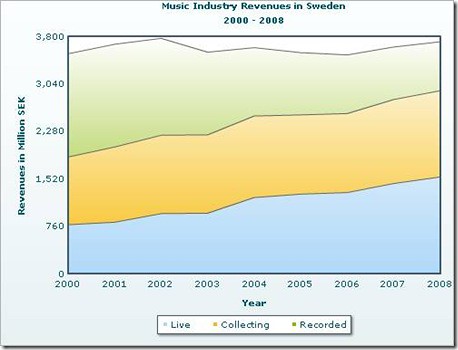
Chart by Daniel Johansson
Basically, recorded revenues dropped. Collections stayed about the same, but live grew. More importantly, though, is the second chart, which shows the revenue for actual musicians. And that’s going in one direction: up.

Chart by Daniel Johansson
And yet, The Pirate Bay is destroying the ability to make music, right? Funny that the numbers don’t seem to support that at all. Basically, these charts are showing the same thing that those other studies have shown. More music is being created. There is greater “discovery” of new music. There are greater revenue opportunities for musicians, and the only part of the business that appears to be suffering is the part that involves selling plastic discs. Yes, that sucks if your business was based on selling plastic discs, but for those who can adapt and adjust, there is more money than ever before to be made. That sorta goes against the claims that “piracy” is somehow destroying the industry, doesn’t it?Permalink | Comments | Email This Story
-
Ask Dr. Richard K. Bernstein Free Live Webcast – Author of Diabetes Solution
Richard K. Bernstein, MD, Author of the best selling books-Diabetes Solution and Diabetes Diet has monthly free webcasts and teleconference calls every month. You can listen via the web or phone and ask your questions to Dr. Bernstein.
If you are interested there is a call and live webcast Tuesday December 22nd at 7PM CST.
Dr. Bernstein’s philosophy is every patient with diabetes is entitled to the same blood sugars as a person without diabetes.
If you would like to read more about him or register for the free webcast or call, or just ask a question just go to and click on Ask Dr. Bernstein.This month he will also be giving out information on Aspirin and Diabetes.
The calls are very informative with Dr. Bernstein answering 35-45 questions on each webcast. The calls and webcasts are not commericals and Dr. Bernstein does not have anything to sell, except educating people with diabetes on how to normalize their blood sugars and prevent the complications.
-
National Scholarship Providers Association
The National Scholarship Providers Association (NSPA) is the only national organization dedicated solely to supporting the needs of professionals administering scholarships in colleges and universities, financial aid offices, non-profit organizations, community foundations, and large corporate foundations.Their Mission: to advance the collective impact of scholarship providers, and the scholarships they award, through exchanging best practices, offering professional development opportunities, and promoting student access and success in higher education. The National Scholarship Providers Association (NSPA) is the only national organization dedicated solely to supporting the needs of professionals administering scholarships in colleges and universities, financial aid offices, nonprofit organizations, community foundations, and large corporate foundations.
Their Mission: to advance the collective impact of scholarship providers, and the scholarships they award, through exchanging best practices, offering professional development opportunities, and promoting student access and success in higher education.
-
ANDERSON’s NOTEBOOK: Optimistic as Second Week of Climate Talks Begin
Fred Anderson has been asked by The Bureau of National Affairs (BNA) World Climate Change Report to write a daily column titled "Anderson’s Notebook" during the second week of the Copenhagen conference of the parties (COP-15 ). The column will provide perspectives on issues central to the negotiations. "Anderson’s Notebook" will be featured as part of BNA’s special expanded coverage at http://climate.bna.com/Copenhagen, which is being made free to site visitors worldwide.
Today, Anderson’s first notebook entry, Optimistic as Second Week of Climate Talks Begin, reviews the first week of COP-15 and discusses the state of the talks and the prospects for a successful outcome.
Anderson is attending the Copenhagen conference as a member of the California Action Reserve Delegation, which includes US private sector and government officials.To read the full entry, please click here. -
Victor Niederhoffer: Tiger Woods’ Downfall Is Bad News For The Stock Market
Whenever Victor Neiderhoffer speaks there are only two scenarios possible — either you don’t get it, or he doesn’t.
Yet it’s hard to ever know for sure which one it is, thus his genius.
Victor Neiderhoffer: Isn’t the quitting of golf by Tiger symptomatic of the redistribution scheme to the cronies that puts individual achievement and property rights on the lowest rung of the totem pole, and doesn’t this have predictive value for the market the next year?
Does it?
He then dives into quantitative finance.
The average standard deviation of the market the last several years is 20 and the average mean absolute deviation is 14, and the average range is 19. The relation between the mean absolute deviation and standard deviation is consistent with the expected proportion of √(2/π) or about 4/5 for a normal distribution.
Join the conversation about this story »
See Also:
- Please Explain How Victor Neiderhoffer Makes Any Sense At All
- Tiger Should Tell Rachel Uchitel To Take Her Sexts And Shove Them
- Tiger’s Lawyers Negotiating Huge Hush-Money Payment To Rachel Uchitel
-
Complete Guide to Cleaning and Disinfecting Your Mac

Computers get dirty, especially their human interface surfaces — keyboards and pointing devices.
In some instances, dirt can even affect input device performance as well as appearance. Some time ago the faithful SlimType gave me a scare when the F and W keys stopped responding properly. A keystroke would register only when the key was pressed more firmly than usual, and the subtle over-center click of the SlimType’s scissors keyswitch mechanism was missing — the malfunctioning keys feeling “numb” and offering higher than normal resistance.
The medicine that time proved to be blowing out the accumulated crud beneath the key console with compressed air. I successfully used an automotive shop compressor with a blow gun. For more cautious folks, or those without convenient access to a compressor, one of those little aerosol cans of compressed air used for cleaning photography equipment could do the trick.
But sometimes a bit of compressed air isn’t enough. So, here is our guide to cleaning everything from mice to laptops.
Getting Started: Apple’s Cleaning Recommendations
Apple has posted a Knowledge Base article covering recommendations and guidelines for cleaning Apple computers, displays, or input/ peripheral devices. Much of its advice should be common sense, such as before you start cleaning:
- Turn off your Mac.
- Unplug the power cord from the wall or power strip.
- Remove the battery (from products with removable batteries such as some Apple portables or from wireless devices such as mice and keyboards).
- Disconnect all external devices from the computer.
Other warnings some users might be less likely to think of are:
- Don’t use window sprays or cleaning products containing ammonia, chlorine, or abrasive ingredients.
- Don’t use rough towels or cloths to dry the plastic.
- Don’t spray cleaner directly onto your computer. Liquid could drip inside the case and cause an electrical shock or malfunction.
- Don’t use excessively damp cleaning wipes.
If more than dusting is needed, use a lint-free cloth slightly dampened to wipe away dirt or grime. Don’t over-wet the cloth. If you can squeeze drips of water out by wringing, it’s too wet.
Solvents and Cleaners
Plain water may not be effective on oils or grease residues, in which case a stronger agent will be needed. Try iKlear or mild detergent first.
Cleaning Laptops
Instructions specific to Apple laptops include not using isopropyl alcohol on bare LCD panels (or any type of alcohol or ammonia-based glass or window cleaner, I hasten to add). Use only a damp, soft, lint-free cloth or purpose-made, Apple-approved LCD cleaning product like iKlear.
Aluminum portables are best tackled with a damp, soft, lint-free cloth. Apple says it’s safe to use 70 percent isopropyl alcohol on them (I personally wouldn’t) or iKlear. Remove surface dust or loose dirt gently with your bare hand before proceeding with cleaner and cloth. After cleaning, dry the aluminum with a soft, lint-free cloth.
For plastic portables, the same applies as aluminum, but I would recommend a gentler, damp-cloth approach first and reserve the heavier-duty agents for stubborn stuff. As with the metal machines, remove any loose surface dirt gently with your bare hand before proceeding with cleaner and cloth. After cleaning, dry the plastic with a soft, lint-free cloth.
For the new unibody MacBook’s non-slip plastic coated aluminum bottom case, Apple recommends using a 3M Gray Microfiber or soft dye-free, lint-free cloth for cleaning, once again giving its blessing to 70 percent isopropyl alcohol or iKlear on the bottom case.
Mouse Cleaning
Mice get dirty. When your mouse becomes covered in fingerprints or its surface is soiled, you can gently wipe it with a clean, lint-free cloth. If necessary, moisten the cloth using plain water, making sure not to over-saturate it, and be mindful that the mouse’s internal electronic components may be damaged if water seeps or drips inside.
With Apple’s Mighty Mouse, the scroll ball can be cleaned using a lint-free cloth lightly moistened with water, making sure to rotate the ball itself to ensure complete coverage or you can use something like Wet One.
Drowned Keyboard First Aid
Moisture is potential death to electronics, as anyone who’s ever spilled liquids on a computer keyboard or laptop can ruefully tell you. Apple also warns against using solvents like acetone, alcohol, or alcohol-based cleaners on your computer, admonishing to never spray cleaner directly onto the machine, since liquid could drip inside the keyboard or case and cause an electrical shock (or more likely a component-frying short-circuit and/or residual corrosion).
Should you spill liquid on your keyboard, if it’s thin and clear fluid, immediately shut the computer down, unplug the keyboard, turn it upside down, and drain the liquid out, let it dry (inverted or on edge is best) for 24 hours at room temperature, after which it may or may not recover. If the liquid is greasy, sweet, sticky, or acidic, you’re likely out of luck. I ruined a MacAlly iceKey scissors-action keyboard a while back by sloshing diluted Grapefruit Seed Extract (extremely acidic) on it twice in a week — the only times I’ve drowned a keyboard in two decades of computer use. We disassembled the keyboard and cleaned the circuits, but corrosion had set in.
Computer Disinfection
With the H1N1 flu pandemic, computer contact surface disinfection has moved to the front burner, especially for machines accessed by multiple users. Apple support also has a Knowledge Base article entitled How To Disinfect The Apple Internal Or External Keyboard, Trackpad, And Mouse. The article recommends, in addition to regular cleaning of your computer and input devices, that disinfecting them may be desirable, noting that,”Multiple people using the same computer, people using the computer when they were ill, and the particular environment where the computer is used, are a few reasons you may wish to disinfect areas of the computer that people come into contact with the most.”
Using a mild soap with antibacterial properties will help, but Apple suggests properly disinfecting contact areas with products like Lysol Wipes, Clorox Disinfecting wipes, or Clorox Kitchen Disinfecting Wipes. I would be cautious about using them on the screen however (except for glass-covered aluminum laptop and iMac displays), and would stick with water or iKlear for that. Otherwise, follow the general rules outlined in the regular cleaning instructions above, with a special caveat to not use disinfectant wipes containing bleach, or disinfectant sprays in general.
What are some techniques you’ve used to clean those hard to reach and sensitive areas of your gadgets?


-
iPhone “air interface” poor, makes AT&T look bad


The New York Times recently ran an interesting article where they put the blame for AT&T’s much ballyhooed network problems squarely in the court of Apple, not not due to handset growth and usage, but simply due to poor radio design.
According to Roger Entner, senior vice president for telecommunications research at Nielsen, the iPhone’s “air interface,” the electronics in the phone that connect it to the cell towers, had shortcomings that “affect both voice and data.”
Despite this AT&T has done little to speak out, choosing to be the public whipping boy for Apple’s poor work.
Entner says that in the eyes of the consumer, “the iPhone has the nimbus of infallibility, ergo, it’s AT&T’s fault.” AT&T does not publicly defend itself because it will not criticize Apple under any circumstances.
Several independent tests, run on devices that are not iPhones, actually show AT&T’s network to be superior to Verizon’s.
Paul Carter, the president of Global Wireless Solutions, a third-party services that run network tests for the major carriers, who have covered more than three million miles of roads this year, while running almost two million wireless data sessions and placing more than three million voice calls, said:
“AT&T’s data throughput is 40 to 50 percent higher than the competition, including Verizon,”
Root Wireless, who 4.7 million tests on smartphones for each of the four major carriers, spread across seven metropolitan areas: Chicago, Dallas, Los Angeles/Orange County, New York, Seattle/Tacoma, the San Francisco Bay Area, and Washington found in every market, AT&T had faster average download speeds and had signal strength of 75 percent or better more frequently than did Verizon.
Asked how this could be reconciled with AT&T’s bad reputation, Ron Dicklin, chief technology officer at Root Wireless, noted the tests were done with handsets other than the iPhone, which does not allow non-Apple programs like his to run in the background.
Ever since the iPhone’s release there has been similar claims, which Apple appears to have neatly deflected, but as the iPhone’s problems on AT&T becomes more obvious, it is clear if you want the best service on USA’s best network, whichever network you feel that is, you are better off not choosing an iPhone at all.
What is our Windows Mobile user’s experience of AT&T and Verizon? Is AT&T really that bad and Verizon really that good? Let us know in the comments.
Via FuzeMobility.com


