Author: Serkadis

  • That Was Fast: New Detroit Newspaper Lasted An Entire Week Before Shutting Down

    A few weeks ago, some publishing industry veterans announced plans to start a new daily newspaper in Detroit, a city that has seen its daily newspapers significantly scale back the production of the paper product. This resulted in some reasonable confusion over how the plan could possibly make sense. There was little indication of a plan to do anything different to try to offer a better product. Instead, it looked like just an attempt to jump in with a product not particularly different than the ones that had already stumbled in the same market — but without the brand recognition or built up loyalty. So, it should come as little surprise that the new paper appears to have folded after just a single week of operation, though the publishers insist it’s just a temporary “bump” due to (merely) a lack of advertising, distribution or timely printing operations. Seems like there are some kinks to work out.

    Permalink | Comments | Email This Story


  • Goldman: Air Travel Roaring Back To Life

    This could be great news for the air travel industry.

    Goldman’s proprietary ‘GS Investment Banking Travel Index’ has rebounded substantially as of late, implying that corproate travel is likely to rebound as companies become more comfortable with travel spending for employees.

    In Asia, the firm favors Chinese carriers due to their exposure to the high potential Chinese domestic travel market.

    gs

    While the Asian airlines sector has rallied and re-rated in terms of total enterprise value to fair value (EV/FV), it remains well below where it has been. Thus there’s potentially more room for Asian carriers to run should Goldman’s index prove useful.

    gs

    (Via Goldman Sachs, Asia Pacific: Transportation: Airlines, Hino Lam, 1 December 2010)

    Join the conversation about this story »

    See Also:

  • Sony sells 440,000 PS3 units during Thanksgiving week, PSP sales increase

      Sony has revealed that the Playstation 3 has sold more than 440,000 units during the Thankgiving week with the PSP also seeing a significant sa…

  • Japanese Deflation Forces Emergency Central Bank Meeting

    Japan declared a surprise central bank meeting today, in response to crushing deflation and a strengthening Yen.

    Japanese exporters rallied on the news, hoping for action against a strong Yen. Check out the dollar/yen move in response to the emergency meeting news:

    yen

    Basically, expect Japan to throw more money at its banks and prod them to blow it on something.

    WSJ: With its key policy rate already at a rock-bottom level of 0.1%, the BOJ has few options to consider.

    One is to implement a quantitative easing plan to inject additional liquidity into the financial system, possibly through the purchase of Japanese government bonds. But members have been reluctant to take that step, because it reduces the bank’s options if the economy weakens further, and such steps are believed to have contributed to the global financial crisis.

    It’s a sad story, Japan. Rather than focusing on effective allocation of capital, fanatical support for exporters has created perverse economic policies and massive debt.

    Japan should just let deflation happen and learn to be less dependent on exports, instead focusing on efficient use of capital. Ride market forces, don’t fight them. For example, a strong yen means that foreign assets are suddenly cheaper for Japan to own or use, which means higher potential domestic returns from cheaper foreign inputs into production. Imports aren’t bad if you earn more value off of them and a strong currency doesn’t have to be feared.

    Join the conversation about this story »

    See Also:

  • Local UK Newspaper Chain Tries A Paywall

    Slowly, but surely, we’re seeing some regional newspapers try out a paywall. We’ve already seen Newsday, on Long Island, put up a paywall, but it’s more about reducing churn than actually getting people to pay (and early reports are that not many are paying). Now, as a bunch of readers sent in, Johnston Press, in the UK has announced a paywall as well, asking £5 for three months of access (which certainly beats Newsday’s ridiculous $5/week plan. I’m glad that some newspapers are actually trying this out, as it was getting a bit tiresome hearing them all threaten to do so without any actual action. Now we can actually see what happens. Of course, my opinion on the matter has been clear. I think it will be a lot more difficult to get people to pay than these publishers believe, and it will be a lot more expensive to manage than they believe. Also, the writers for the papers behind paywalls might not like the fact that no one knows who they are any more. At the same time, it will only serve to open up the competitive market for others to come in at a better price point (i.e., “free”) and scoop up a significant percentage of the advertisers who are seeking to reach a larger audience.

    Permalink | Comments | Email This Story


  • Aussie Dollar Fired Up With A Rate Hike To 3.75%

    The Aussie dollar has bounced back from the Dubai Debacle (whereby the U.S. dollar strengthened on financial crisis fears) last Friday.

    It’ll no doubt be further helped by news that Australia has hiked interest rates yet again, to 3.75%. This marks the third hike in Australia’s latest rising interest rate cycle.

    This third interest rate hike stands in stark contrast to most developed nations who are too scared to tighten ultra-loose monetary policy. Why is the economy so much better down under? See it here.

    Australia’s latest move is the right thing to do given the relatively strong economy, and it appears to have been expected.

    Bloomberg: Investors bet there was a 76 percent chance that Stevens would increase the benchmark rate by a quarter-point today, according to Bloomberg calculations based on interbank futures on the Sydney Futures Exchange at 11:51 a.m.

    AUD

    Join the conversation about this story »

    See Also:

  • Sony To Release FVA-U1 USB-Based Mofiria Finger Vein Authentication Device


    PIA0001001344

    Sony Japan has announced they are bringing a device based on Mofiria technology to the market on December 18th. The USB-based FVA-U1 is a tamper resistant authentication device, similar to a fingerprint scanner, except it scans the veins in your fingers. Compared to the other biometric authentication techniques, vein authentication technology achieves higher accuracy on personal identification and forgery resistance because it uses the veins inside the human body. Finger vein patterns differ from person to person, each finger to finger, and it is said that they do not change over the years. Mofiria technology uses a unique method where a CMOS sensor diagonally captures scattered light inside the finger veins. The vein pattern is quickly and accurately extracted from the captured finger vein image without a fixed finger position – ensuring it will be very easy to scan your finger vein pattern. Sony will also be providing a SDK for Mofiria technology, and has stated this is network compatible.

    qfhh7c00000lzdst

    Sony hopes to attract businesses where security is key, hospitals, universities and information security specialists with this new product offering. The Y30,000 FVA-U1 will come with a special case, USB cable, guide, instruction manual, and warranty. Sony has also launched a new Mofiria website.

    PIA0001001343

  • The Uselessness Of Amazon’s Announcement That Kindle Is Its Best Selling Product

    A few folks have sent over some version of the story that the Kindle is outselling every other product on Amazon. Of course, that’s somewhat meaningless, as the folks at Gizmodo smartly point out. Because you can only get the Kindle via Amazon, and that makes the number completely different than other products:


    When Amazon tells you that the Kindle is the highest-selling product on Amazon, you’re supposed to think of it as you’d think of anything else: as a strong, reliable metric in gauging how well a product is doing in general. The thing is, there is no “in general” for the Kindle. There is only Amazon. Anyone who wants a Kindle and doesn’t normally shop at Amazon has to make an exception. Anyone who wants a Kindle and doesn’t normally shop online has to make an exception. The Kindle didn’t outsell the iPod Touch–not even close.

    Permalink | Comments | Email This Story


  • Call of Duty: Classic coming to PSN and XBL this week

    Activision has finally announced that Infinity Ward’s re-release of the original Call of Duty, titled Call of Duty: Classic, is finally heading to PSN…

  • WHO HIV Treatment Guidelines Updated

    This just in:

    WHO is now recommending that ART be initiated at a higher CD4 threshold of 350 cells/mm3 for all HIV-positive patients, including pregnant women, regardless of symptoms.

    Which makes eminent sense, of course.  Because if starting HIV therapy might prolong survival in developed countries, why shouldn’t it do the same in the developing world?

    In fact, when you consider the higher incidence of TB and invasive bacterial infections in such settings, it could easily be argued — and has been argued — that starting early would net greater survival gains in resource-poor settings than it would here.

    Plus, there’s the CIPRAHT001 Study, which proves it.

    But there’s more — the new WHO guidelines also urge that countries  “phase out” the use of stavudine in favor of less-toxic NRTIs, and that women continue breastfeeding so long as they are also on ART.

    Good news all around.

  • 2011 Audi A8 revealed amidst the stars at Design Miami 2009

    Filed under: , , , ,

    2011 Audi A8 – Click above for high-res image gallery

    We’ve just returned from the Audi A8 world premiere here at Miami’s star-studded Design Week, and we’ve got a slew of images of the new range-topping sedan. More evolutionary than revolutionary in style, the new wundersedan is nevertheless an impressive looking piece with the visual charisma to go toe-to-toe with the celebrities that filed in to fawn over its broad shoulders.

    Despite the clear heritage link to the outgoing model, there are a number of new technologies under the skin that represent firsts for the brand, including full LED headlamps that adjust their direction and throw based on the navigation system, a new development of MMI that includes a handwriting recognition feature, and an updated 4.2-liter FSI V8 engine with more power (372 horses) and an eight-speed Tiptronic gearbox. Despite being more powerful, the A8 is also more fuel efficient, with a claimed improvement of 15 percent with the aforementioned gas V8.

    The slippery new shell once again rests on the brand’s Aluminum Space Frame (ASF), and Audi says the car is longer and wider than its competitors, yet it sits lower. The sleek new bodywork is good for a .26 coefficient of drag. When it comes to America late next year, the new A8 will arrive in both standard and extended-wheelbase models, and we have it on good authority that both TDI and hybrid variants will also come to the States – although the alternative fuel powertrains aren’t likely to happen right away. While you’re waiting, check out our high-res galleries below as well as the official press release. We’re working on uploading video of the new A8 as well, so check back soon.

    Gallery: 2011 Audi A8

    Live photos copyright (C)2009 Chris Paukert / Weblogs, Inc.

    [Source: Audi]

    Continue reading 2011 Audi A8 revealed amidst the stars at Design Miami 2009

    2011 Audi A8 revealed amidst the stars at Design Miami 2009 originally appeared on Autoblog on Mon, 30 Nov 2009 21:34:00 EST. Please see our terms for use of feeds.

    Permalink | Email this | Comments

  • Watch: Bayonetta’s “witch time” gameplay

    With the scheduled demo release right around the corner, Sega and Platinum Games has decided to show off a brand new gameplay video of their upcoming …

  • Facebook Photos Coming Back To Haunt Users In Surprising Ways

    There have been a bunch of stories lately about how pictures that people put up on Facebook are coming back to haunt them in unexpected ways. First, we have the case of Adam Bauer, a University of Wisconsin-La Crosse student who had been careful about who he friended, but chose to accept a friend request from an unknown user, because “she was a good-looking girl.” Turns out that the “good-looking girl” was actually the La Crosse police, who ticketed him for underage drinking because of a photo on Facebook of Bauer holding a drink. This reminds me of a case we wrote about six years ago, involving a woman who posted some naked photos of herself at some locations around Lincoln, Nebraska — leading the police to charge her with violating local no-nudity laws.

    The other story that a bunch of folks have submitted was the case of a woman who who lost her disability insurance benefits because of photos on Facebook. She was on sick-leave due to a diagnosis of depression. Yet, somehow the insurance company got access to her Facebook photos that showed her out having fun — at a birthday party, on vacation and the beach and at a Chippendale’s show. Now it’s entirely possible that there was insurance fraud going on. Or, it’s also possible that someone who had been diagnosed with depression was trying to put her life back together. It’s a bit difficult to think that an insurance agent looking at photos online is better at diagnosing the situation than a trained doctor.

    In both of these cases, the issue is that photos might not tell the whole story. Making major decisions based just on some photos uploaded to social networks seems fraught with potential problems. I could certainly see using them as part of a larger investigation, but it doesn’t seem like that was the case in either situation. But, in the meantime, it’s a reminder that your privacy is increasingly disappearing — and you may be surprised about decisions that others make about you based on what you assumed was perfectly innocent activities.

    Permalink | Comments | Email This Story


  • Perfect Pod: Cat Capsule by Christian Ghion

    Cat Capsule

    Just came across this ultra-mod cat bed by French designer Christian Ghion. I don’t think it’s available for sale anywhere, but it sure is cool! Very Austin Powers.

    Thanks to Peter for the find.

  • 90% of Existing Solar Panels Last for 30 Years, Instead of Predicted 20 Years 2009

    800px-Bisley_Green_Shop_roof_3

    2009Nov30: 90% of existing solar panels last for 30 years, instead of the predicted 20 years, according to the independent EU Energy Institute (BBC).

    Reference: BBC http://news.bbc.co.uk/2/hi/science/nature/8386460.stm

    Image Description: Green roof with Sedum plants and solar panels at The Green Shop, Bisley, Gloucestershire, UK. Photo by thingermejig, 2007Aug2. Image Location: Wikimedia Commons http://commons.wikimedia.org/wiki/File:Bisley_Green_Shop_roof_3.jpg Image Permission: This file is licensed under the Creative Commons Attribution ShareAlike 2.0 License.

  • 52″ Sony BRAVIA XBR10 Series HDTV Bows Out Of USA


    xbr10

    I’m surprised to announce that only after a few months of being on the market, the super thin 52″ Sony BRAVIA XBR10 (aka in Japan as the Sony BRAVIA ZX5) with wireless HD capability is no longer for general availability in the USA. While a few models are left at various brick and mortar SonyStyle stores, the official SonyStyle USA website states, “No longer available for purchase at Sony Style.” We tapped our contacts at SonyStyle who confirmed this information and stated that it was a “limited production model.” Limited production? We’re surprised at that statement, since the TV was not announced as such.

    Fortunately, the 46″ XBR10 is still for sale at SonyStyle and will probably continue to be available through the holidays. But for how long? This sure seems like Sony is clearing the slate for some new BRAVIAs (e.g. XBR11, XBR12), which Sony has stated before they will bring to the market by February.

    I’m not surprised that the 52″ model is being phased out, though. Sony has been slipping hard in the USA with their TV sales, falling victim to extraordinary prices, too varied of a lineup (XBR7, XBR8, XBR9, XBR10 are all for sale simultaneously), and consumers being manipulated by the phrase “LED TV.” Last time I looked Sony were tied in a distant fourth place with Toshiba, which placed them far behind Samsung, Vizio, and LG. Consumers may also be confused with the XBR9 and XBR10 line (LCD with edge-lit LCD), which many online have found inferior to the XBR8, which is a LCD with RGB backlit LED.

    vizio3q2009

    I still think the XBR10/ZX5 was a true marvel in Sony technology; perhaps ahead of its time (or just simply misplaced for sale in a struggling economy) with its high price, incredible design and wireless 1080P capability.

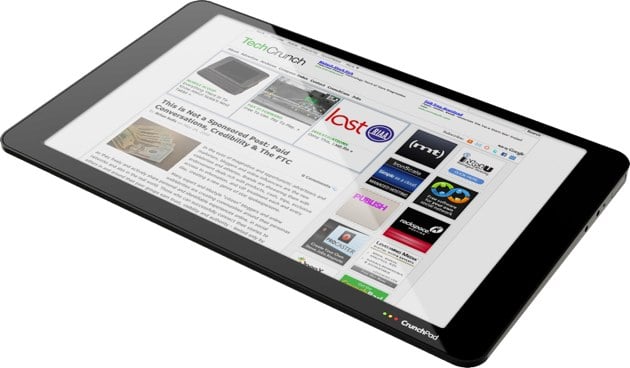
  • The CrunchPad is no more

    CrunchPad

    Anytime over the past year-and-a-half or so, whenever someone asked me what I thought about the , my answer was pretty much always the same: you’ll never get your hands on one. Call me a cynic, but I just found it difficult to believe that Mike Arrington would be able to pull off what no other major consumer electronics manufacturer has been unable to do as of yet. Today, Mike announced that the CrunchPad is dead. No more. Kaput. I’m not surprised.

    Let me make myself clear, though. My thoughts had nothing to do with the capabilities of Arrington, FusionGarage, or anyone else involved in the project. I simply felt that there would be an outside influence that would knock the project off-track. Conspiracy theory or not, if a major manufacturer that had a lot of pull in the area where these devices are manufactured (like China) truly wanted to play hardball to make sure a small start-up couldn’t release a device like the CrunchPad because they were going to be releasing something similar, at a much higher price, I bet they could pull that off.

    Not to say that this is what happened, I’m just thinking aloud. However, when you read Mike’s post on the matter, you quickly realize that something went on, and it was something strange and sudden. Either way, the CrunchPad is dead. No worries, though, 2010 will be the year that the tablet hits the mainstream.


    Tags:
    ,
    ,
    ,
    ,
    ,
    ,

    The CrunchPad is no more originally appeared on Gear Live on Mon, November 30, 2009 – 5:11:45


  • Hussman: 80% Chance Of A Market Crash Over The Next Year

    johnhussmanportrait.jpg

    Fund manager John Hussman says he under-estimated how little investors have learned in the market crashes of recent years and thus has missed much of the market upside this year.

    But he’s not changing his tune.

    And the market’s current altitude, combined with crappy economic fundamentals, make Hussman put the odds of a crash and economic downturn over the next year at a startling 80%.

    We face two possible states of the world. One is a world in which our economic problems are largely solved, profits are on the mend, and things will soon be back to normal, except for a lot of unemployed people whose fate is, let’s face it, of no concern to Wall Street. The other is a world that has enjoyed a brief intermission prior to a terrific second act in which an even larger share of credit losses will be taken, and in which the range of policy choices will be more restricted because we’ve already issued more government liabilities than a banana republic, and will steeply debase our currency if we do it again. It is not at all clear that the recent data have removed any uncertainty as to which world we are in…

    In my estimation, there is still close to an 80% probability (Bayes’ Rule) that a second market plunge and economic downturn will unfold during the coming year. This is not certainty, but the evidence that we’ve observed in the equity market, labor market, and credit markets to-date is simply much more consistent with the recent advance being a component of a more drawn-out and painful deleveraging cycle. Meanwhile, valuations are clearly unfavorable here, and even under the “typical post-war recovery” scenario, we are observing an increasing number of internal divergences and non-confirmations in market action.

    As Gluskin Sheff chief economist David Rosenberg noted last week, “Even if the recession is over, the historical record shows that downturns induced by asset deflation and credit contraction are different than a garden-variety recession induced by Fed tightening and excessive manufacturing inventories since the former typically induce a secular shift in behavior and attitudes towards debt, asset allocation, savings, discretionary spending and homeownership. The latter fades more quickly.

    “This is why people didn’t figure out that it was the Great Depression until two years after the worst point in the crisis in the 1930s; and why it took decades, not months, quarters or even years, for the complete transition to the next sustainable economic expansion and bull market.

    “Mortgage applications for new home purchases hit a 12-year low in the middle of November (down 22% in the past month!), fully two weeks after the Administration said it was going to not only extend but expand the program to include higher-income trade-up buyers. Once again, there is minimal demand for autos and housing, and that is partly because the market is still saturated with both of these credit-sensitive big-ticket items after an unprecedented credit and consumer bubble that went absolutely parabolic in the seven years prior to the collapse in the financial markets an asset values. We are probably not even one-third of the way through this deleveraging cycle. Tread carefully.”

    See Also: John Hussman: I Was Wrong–I Didn’t Realize How Stupid People Were

    Join the conversation about this story »

    See Also:

  • Molli Steam Tram

    Mecklenburg-Vorpommern, Germany | Inspired Inventions

    One of the few remaining steam trains in regular use, the Molli is unique in that while within city limits it runs on city streets like a tram.

    Molli is the nickname of the Mecklenburgische Bäderbahn Molli train which runs on 900 mm gauge from Bad Doberan to Heiligendamm, the oldest narrow gauge railway on the Baltic coast.

    Molli started life 1886, and runs right through towns on its 15.4 kilometer route on tram-like tracks.

    Molli runs between Heiligendamm and Kühlungsborn, near the beach, and between Heiligendamm and Bad Doberan parallel to an alley.

    The most interesting section is in Bad Doberan, where its rails lay in Goethestrasse like the rails of a tramway on a road. The route is very picturesque, making it a local tourist attraction.

    There is a Molli Museum at the railway terminal at Kühlingsborn West.

    The trip from Heiligendamm to Bad Doberan (or in the opposite direction) takes 40 minutes.

  • French Courts Continue To Penalize eBay For Actions Of Users

    While more and more courts seem to be understanding that eBay shouldn’t be responsible for what users are selling on its site, it appears that French courts are a bit confused. Last year, a French court fined eBay $63 million because counterfeit LVMH products were being sold on the site. Of course, eBay has no way of knowing what’s legit and what’s not, but the French court didn’t seem to care. A similar case, also involving LVMH, but concerning Google ads, was also ruled in LVMH’s favor, but it was appealed to the European Court of Justice, and a judge there has already indicated that it makes little sense to blame the company. But that isn’t stopping the French courts. eBay has now been fined yet again, because of a French ban on selling even legally purchased brands of LVMH perfumes if you’re not an authorized distributor. eBay is appealing the ruling, saying that banning the resale of legally purchased goods doesn’t make sense and harms consumers. However, a much bigger question is why eBay should be liable at all. It’s not eBay doing the selling, but users on the site.

    Permalink | Comments | Email This Story