Author: Serkadis

  • Poll: Will you be shopping on Black Friday?

    Okay, we need to hear from you guys, our peeps. We’ve told you about a bunch of deals, some of which are downright fantastic, like that $78 Blu-ray player at Walmart. So we want to know, do you plan on braving the crowds on Friday morning to take advantage of any of this years Black Friday sales? Will you be doing your shopping from home? Or do you just not care?

    Give us a glimpse into your world, will ya?


    Tags:
    ,
    ,
    ,
    ,
    ,
    ,
    ,
    ,

    Poll: Will you be shopping on Black Friday? originally appeared on Gear Live on Wed, November 25, 2009 – 9:21:18


  • Get your black Wiimote, nunchuk, and MotionPlus at Costco

    Black Wii Remote Costco

    Hey, are you looking to add to your Remote collection this holiday season, or are you maybe picking up a Wii for the first time? If so, be sure to hit up Costco. As you can see in the image above, they’ve got stacks of black Wii Remotes that are bundled with both a black Nunchuck, and a black Wii MotionPlus add-on, all for $59.99. Yeah, you won’t find that price anywhere else.


    Tags:
    ,
    ,
    ,
    ,
    ,
    ,
    ,
    ,
    ,
    ,
    ,
    ,

    Get your black Wiimote, nunchuk, and MotionPlus at Costco originally appeared on Playfeed on Wed, November 25, 2009 – 9:12:30


  • Review: 2009 Audi A8L a requiem for a heavyweight

    Filed under: , , ,

    2009 Audi A8L – Click above for high-res gallery

    We come not to bury the A8L, but to praise it. Next week the newest generation of Audi’s aluminum spaceframe panzer will greet the world in Miami, and we expect it to be a leap through a wormhole compared to today’s car. After a week with the current model at the end of its six-year run, we walked away from a saloon that still has us smitten. What we didn’t expect was that, even though we didn’t come to bury the thing, we would end up throwing quite a bit of dirt on it.

    That might make the Audi A8 the Megan Fox of automobiles.

    A funny thing happened on the way to reviewing the 2009 Audi A8L: we discovered ourselves writing compromising things about the four-ringed flagship. This is a sedan that we adore mightily, and having thought it over, we might even say unreasonably. It became the girl you’re dating that you first describe as “She’s great!” just before divulging a list of mildly unseemly behaviors that you’d never considered all at once, ending with, “Wow… I really do like her, but come to think of it… she’s a little kooky.” That might make the Audi A8 the Megan Fox of automobiles.

    We drove the A8L W12 a couple of years ago, and it was possessed of so much battleship-gray girth we wanted to call it the Bismarck and park it in a Norwegian fjord for safety. Yet and still, it was glorious: an exterior awash in pulchritude, an interior so beautiful we wish we had gotten its autograph, and it gulped miles, and gas, like cognac. Since we didn’t write about it, we didn’t give it the philosopher’s thought, and we walked away from it with only roses, no thorns. But now…

    Photos copyright (C)2009 Jonathon Ramsey / Weblogs, Inc.

    Continue reading Review: 2009 Audi A8L a requiem for a heavyweight

    Review: 2009 Audi A8L a requiem for a heavyweight originally appeared on Autoblog on Wed, 25 Nov 2009 12:10:00 EST. Please see our terms for use of feeds.

    Permalink | Email this | Comments

  • More Nirvana, Night Ranger in Rock Band next week

    Next week’s Rock Band Store update is gonna be a treat for grunge fans as a Nirvana three-pack is on the way. For those whose musical tastes run ever …

  • Multitasking Is Our Main Activity

    Earlier this year, I wrote a post questioning whether the “inefficiency” found in multitasking was a bug or a feature. It was in response to studies pointing out that people who multitask tend to be less efficient at specific tasks. Folks like Nick Carr like to hold up things like that as examples of how modern technology makes us dumber, but more and more people are questioning that concept. While this is from a few months ago, Kevin Donovan points us an excellent piece by economist Tyler Cowen that challenges the concept that internet multitasking is a problem. In it, he makes a key point:


    Multitasking is not a distraction from our main activity, it is our main activity.

    That’s a nicer way of saying what we said a few months ago. The “inefficiencies” from multitasking aren’t a bug. They’re a feature. Cowen goes on to explain it using the analogy of a long distance relationship compared to a stable marriage:


    A long-distance relationship is, in emotional terms, a bit like culture in the time of Cervantes or Mozart. The costs of travel and access were high, at least compared to modern times. When you did arrive, the performance was often very exciting and indeed monumental. Sadly, the rest of the time you didn’t have that much culture at all. Even books were expensive and hard to get. Compared to what is possible in modern life, you couldn’t be as happy overall but your peak experiences could be extremely memorable, just as in the long-distance relationship.

    Now let’s consider how living together and marriage differ from a long-distance relationship. When you share a home, the costs of seeing each other are very low. Your partner is usually right there. Most days include no grand events, but you have lots of regular and predictable interactions, along with a kind of grittiness or even ugliness rarely seen in a long-distance relationship. There are dirty dishes in the sink, hedges to be trimmed, maybe diapers to be changed.

    If you are happily married, or even somewhat happily married, your internal life will be very rich. You will take all those small events and, in your mind and in the mind of your spouse, weave them together in the form of a deeply satisfying narrative, dirty diapers and all. It won’t always look glorious on the outside, but the internal experience of such a marriage is better than what’s normally possible in a long-distance relationship.

    The same logic applies to culture. The Internet and other technologies mean that our favorite creators, or at least their creations, are literally part of our daily lives. It is no longer a long-distance relationship. It is no longer hard to get books and other written material. Pictures, music, and video appear on command. Culture is there all the time, and you can receive more of it, pretty much whenever you want.

    In short, our relationship to culture has become more like marriage in the sense that it now enters our lives in an established flow, creating a better and more regular daily state of mind. True, culture has in some ways become uglier, or at least it would appear so to the outside observer. But when it comes to how we actually live and feel, contemporary culture is more satisfying and contributes to the happiness of far more people. That is why the public devours new technologies that offer extreme and immediate access to information.

    Many critics of contemporary life want our culture to remain like a long-distance relationship at a time when most of us are growing into something more mature. We assemble culture for ourselves, creating and committing ourselves to a fascinating brocade. Very often the paper-and-ink book is less central to this new endeavor; it’s just another cultural bit we consume along with many others. But we are better off for this change, a change that is filling our daily lives with beauty, suspense, and learning.

    The full piece is much longer, but beautifully written and quite convincing.

    Permalink | Comments | Email This Story


  • Mahtab’s Story by Libby Gleeson

    When 12-year-old Mahtab’s father returns home with obvious signs of torture, and her grandfather is forever lost, her family knows it can no longer live in Taliban-controlled Herat, Afghanistan. Her best friend has already left without saying goodbye, hoping to find refuge somewhere in Iran. Now Mahtab and her family must leave her beloved grandmother and the rest of the extended family in search of survival and freedom.

    Mahtab, her mother, and her two younger siblings begin their frightening journey hidden in the back of a truck, while her father rides in the front, bribing officials when necessary to get the family safely to Pakistan. There the father must leave his family behind, traveling alone to Australia where he hopes he will be able to prepare a secure new life for his wife and children. They must patiently wait, hidden, desperate, and unsure of their tenuous future. Days and weeks become many, many months … the younger children begin to wonder if they can remember their father’s face … and even Mahtab begins to doubt that the family will ever be safely reunited again.

    Mahtab’s Story is inspired by a true story, the book’s cover reveals. In the afterword, award-winning Australian author Libby Gleeson recalls that she was introduced to a group of refugee girls in a Sydney high school in 2004: “Their stories of persecution and fear in their own countries and their escape to Australia were so compelling that I felt I had to write about that experience.” She stresses, however, that this is a novel, not a biography. And yet, this is also sadly a very familiar tale in our contemporary world of questionable wars and the countless innocent victims who must risk everything for survival. In the end, Mahtab’s is undoubtedly one of the lucky stories …

    Readers: Middle Grade, Young Adult

    Published: 2008, 2009 (United States)

  • Rock Band and Old Navy join up for Thanksgiving

    You’ve probably seen the ads on the malls and stores, but just in case you didn’t want to take a closer look then, you can do so here. MTV Games and…

  • The Vegetarian Myth

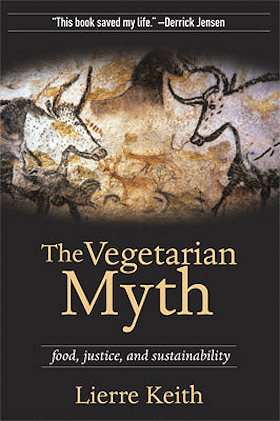
    the vegetarian myth cvr The Vegetarian MythWow.

    It isn’t often that I write book reviews (have I ever? – serious question), but it isn’t often that a truly important book like Lierre Keith’s The Vegetarian Myth pops up on my radar just begging for one.

    You may remember it from a brief mention I gave back in September, or maybe from Dr. Eades’ endorsement of it. You may have even already read the book yourself. If you haven’t, read it. And if you have? Read it again or get one for a friend.

    That goes double for vegans, vegetarians, or anyone on the cusp of adopting that lifestyle. If you fit the bill, especially if you’re considering veganism/vegetarianism for moral reasons, drop what you’re doing and run to the nearest bookstore to buy this book. It’s incredibly well-written, and the author has a real knack for engaging prose, but that’s not the main reason for my endorsement. The real draw is the dual (not dueling) narratives: the transformation of a physically broken moral vegetarian into a healthier moral meat eater; and the destructive force of industrial agriculture. The “Myth” in question is the widely-held notion that vegetarianism is the best thing for our health and for our planet. On the contrary, Keith asserts that a global shift toward vegetarianism would be the absolute worst move possible. It’s vitally important. It’s definitive. It’s somewhat depressing, and it’s brutally honest. It also might be the book that changes your life.

    Lierre Keith is a former vegan/vegetarian who bowed out after twenty long years of poor health and paralyzing moral paradoxes. Her original goal was to explore the question, “Life or death?” as it pertained to food. She, like most vegetarians, assumed she had a choice between the two, that it was an either/or thing. Eating tofu and beans was life, while a burger represented death. Life didn’t have to involve death – that was the weak way out, and the honorable (and difficult, and therefore meaningful) way to live was by avoiding animal products of all kinds. No blood on your hands or on your plate meant a clean moral slate.

    Or so she thought. See, Keith began as a moral vegetarian. She never espoused the idea that meat was inherently unhealthy or physically damaging; she was simply a young kid who “cried for Iron Eyes Cody, longed… for an unmolested continent of rivers and marshes, birds and fish.” We’ve all heard of kids who “turn vegetarian” when they find out their chicken nuggets once walked, clucked, and pecked. Well, Keith was that five year old who bemoaned the “asphalt inferno of suburban sprawl” as a harbinger of “the destruction of [her] planet.” Hers was a deep-seated commitment to the preservation of all living things, not just the cute and fuzzy ones.

    That expansive scope meant she looked at the big picture, and suffered for it. She never got to enjoy that oh-so-common smug vegetarian elitism, because she was too aware. Seeds were living things, too. They may not have had faces or doting mothers, but they were alive, and that meant they could die. Killing slugs in her garden was impossible, and deciding whether to supplement the soil with actual bone meal was excruciating. Unlike most of her peers, she knew that avoiding direct animal products didn’t mean her hands were clean. They might not be dripping red, but living organisms died to make that head of lettuce possible. Fields were tilled and billions of microorganisms were destroyed, not to mention the mice, rabbits, and other wild animals whose environments are leveled to make way for industrial farming. And so whichever direction she went – home gardening, local produce, or grocery store goods – Keith was contributing directly and indirectly to death.

    What’s a moral vegetarian to do?

    She briefly entertains studying with a mystic breatharian, hoping to (tongue-in-cheekily) learn to subsist purely on oxygen. She spends hours picking slugs from her garden and goes to relocate them. Nothing works. She keeps coming back to death.

    “Let me live without harm to others. Let my life be possible without death.” Keith realizes this vegetarian plea (which “borders on a prayer”) is impossible to fulfill. She can’t live and eat without something dying, and that’s the whole point of it all. Death is necessary and natural. Circle of life, you know? Without death of some sort, life would get a whole lot worse.

    Keith ultimately sets her sights on one of our favorite human “advancements” at the Apple: agriculture! Readers of MDA already know how agriculture altered our trajectory forever, but maybe not in such vivid detail. We focus on the lowered life expectancy, reduced bone density, compromised dental health, and the stooped, shrunken skeletons of our Neolithic ancestors, but Keith shows how grain agriculture actually destroys the land it touches. The Fertile Crescent, ground zero for grain development, used to be, well, fertile. It was verdant, lush, and teeming with life – including nomadic hunter gatherers. Paradise, you might even say. Animals grazed on perennial grasses, pooped out nutrients, and gradually those nutrients would work themselves back into the soil. It was a beautiful, natural life cycle that worked great for millennia. But once grains were grown and the land was irrigated, everything changed. Perennial renewable grasses became annual grains. Animals no longer grazed and replenished the soil. The top soil was robbed of nutrients and faded away. Irrigation meant crucial annual floods were disrupted or even halted. A massive monkey wrench was thrown into the system, and rather than coexisting as a complementary aspect of nature, man thus commenced the conflict with the natural world that rages to this very day.

    And that’s the crux of her argument – that modern industrial agriculture is wanton destruction. Grain-based, vegetarian agriculture is even worse, because it attempts to eliminate a crucial player in the normal life cycle of the planet. Animals, which provide manure, calcium, and other nutrients for the soil, have to be part of the equation. Whenever a culture turns to a grain-based agricultural system, these same problems arise. Annual grain crops killed the American prairie and, for the vegans out there, they kill the millions of animals, bugs, and birds that rely on specific ecosystems to survive. The vegan’s soy burger has nary an animal part, but the machines that worked the soybean fields were greased with the blood of a thousand organisms. The vegetarian’s wheat crops feed millions, but robs the land of nutrients and destroys the top soil necessary for life.

    Primal readers won’t be surprised by what they read. They may be horrified at the extent of the environmental damage caused by industrial agriculture, but they won’t be surprised (given agriculture’s poor track record with our health). Keith lays out an effective case against grains (and for a Primal-ish, low-carb, high-fat diet, believe it or not) on nutritive, moral, and economical grounds that’s tough to refute. The nutritional information will come as second nature, but the sources are sound and the references are powerful.

    There’s more, far more, but I’d rather not spoil the entire thing. Just read it and rest assured that it’s worth your time. The book is a must-read, and a great ally for anyone interested in promoting a healthy, sustainable, omnivorous future. Read this book and distribute it to your vegan friends.

    Primal approved!

    Check out excerpts on Google Books, read the first chapter here, or purchase the book here or here.

    Get Free Health Tips, Recipes and Workouts Delivered to Your Inbox

    No related posts.

  • CHART OF THE DAY: U.S. Weekly Jobless Claims The Lowest Since September 2008

    button more charts
    button chart prev button chart next

    The Department of Labor reported today that initial jobless claims for the week ending November 21st fell 35,000 on a seasonally-adjusted basis from the previous week.

    They rose 68,080 on an not-seasonally-adjusted basis, but this basically means that jobless claims rose less than normal for this time of year. Seasonal adjustments are widely used to spot overall unemployment trends since the employment market is indeed seasonal.

    As shown below, at 466,000, this most recent seasonally-adjusted claims number represents the best data point we’ve had since the week of September 13, 2008.

    Regardless of the potential for static in the weekly numbers, or errors due to seasonal adjustments, it’s now pretty clear that the overall rate of new jobless claims has indeed slowed substantially.

    u.s. jobless claims, COTD


    Get This Delivered To Your Inbox

    You can get this dropped in your inbox every afternoon as The Chart Of The Day. It’s simple. It’s convenient. It’s free. All we need is your email address (though we’d love your name and state, too, if you’re willing to share it).  Sign up below!

    Join the conversation about this story »

    See Also:

  • (Shazam)RED Makes the App Store a Slightly Kinder Place

    The (RED) movement allows companies to give a little back while also selling their products, by branding versions of their goods with the (RED) logo, name, and color. In exchange, a portion of the price of said products is donated to the fight against HIV and AIDS in Africa. Apple is on board with the program, with (RED) iPods, and now one of its iPhone developers, Shazam, has thrown its weight behind the cause, too.

    Shazam is the first mobile app to endorse the program. (Shazam)RED is available on the App Store now for $4.99, which is the same price that Shazam Encore retails for.

    The only difference between the two is that when you purchase (Shazam)RED, 20 percent of the purchase price of the app, or a little less than $1, will be “contributed to the Global Fund to fight AIDS, Tuberculosis and Malaria,” with (RED) funds specifically going towards the fight against HIV and AIDS. Also, in addition to the features included in Shazam Encore, you get access to (RED) news and content via an icon on the bottom menu bar that loads (BLOG) RED in a built-in browser.

    In an interview with TMCnet.com, Shazam CEO Andrew Fisher highlighted the success of the (RED) program, and the potential reach of (Shazam)RED given the iPhone’s massive user base. With over 10 million people owning either an iPhone or an iPod touch worldwide, the potential boon for projects like (RED) is astronomical. And the relationship is mutually beneficial, since developers get access to the marketing value inherent in the (RED) brand.

    In case you aren’t familiar with the new features of Shazam Encore, which is the paid version of the wildly popular music identification app Shazam, it allows you to find recommendations for your music tags, search for songs, albums, and artists, and see charts of the most-tagged music. You can also sync your tags with the web-based Shazam interface and share them via Facebook and Twitter. Finally, you can use car mode to identify playing on the radio while you’re driving.

    If you were planning on paying for Shazam Encore anyway, there’s no real reason not to opt for (Shazam)RED (iTunes link) instead, unless you’re worried about future updates. I’m sure that Shazam will update this product for at least as long as they do Encore, though, because I can’t imagine much additional effort or expense would be required, if any, to do so.


  • 2010 National Conference on Volunteering and Service

    Request for Proposals

    Be a part of the 2010 National Conference on Volunteering and Service.
    Please join us by sharing innovative ideas to stimulate participant learning through the use of new skills, practical tools, creative solutions, best practices and cutting-edge technology. We are looking for skilled presenters to offer a wide range of thought-provoking sessions for our specific conference audiences in one or more of the following topic and skill areas:
    • Business
    • College and University
    • Cultural Institutions and Arts Programs
    • Economic Recovery
    • Education
    • Effective Volunteer Management
    • Environment
    • Disaster
    • Faith and Neighborhood Groups
    • Health
    • Leadership for Social Change
    • Nonprofit Capacity Building
    • People with Disabilities
    • Philanthropy
    • Program Impact
    • Social Innovation
    • Technology and Social Media
    • Veteran
    • Youth
  • Warren Buffett’s Secrets To Success


    Alice Schroeder, former Wall Street analyst and author, The Snowball: Warren Buffett and the Business of Life

    • Warren Buffett’s secrets to success:
    • Pattern recognition: The man has 50 years of experience.  He’s seen it all.
    • Focus and intensity: 18 hours a day for decades
    • Geography: He’s not located in the middle of the herd (NYC/Boston/CA)
    • Time horizon: He’s not playing in the quarterly rat race; he can let markets play out
    • Conservative enough that errors don’t kill him: Don’t lose money is rule #1
    • Read excerpts of The Snowball here >

    Produced By: Kamelia Angelova & William Wei

    Join the conversation about this story »

    See Also:

  • Rates great but agents working twice as hard for half the business; Where is the economy going?

    pipeline-press

    rob-chrisman-daily

    Earlier this week, the country’s first marijuana cafe opened up, which not only sells medical marijuana, but also has a restaurant where customers can eat. In a related story, the recession is over!

    Whoever wants a 4.50% 30-yr fixed rate conforming loan with a point back to cover closing costs, raise your hand! Well, we’re just about there. Fannie 4% securities are shuffling around 99 or 100, and when you throw some servicing-released premiums on the price, you’re easily above par. And who wouldn’t want to own this servicing? Even I am thinking about refinancing, and I don’t even own a place! Seriously, heck, I have a 7-yr ARM that closed in 2003 at 4.75% (so it starts adjusting next year) that I am thinking about refinancing. Given the 30% LTV maybe I can even find an investor!

    So if rates are so great, why are applications dropping and agents continuing to work twice as hard for half as much business?For last week, the MBAA’s weekly application index dropped 4.5% with applications to buy a home up 9.6% and refi’s down 9.5%. (“The MBA revised the indices for the prior week.) Does this data support what many in the business already are feeling: That most people who can refinance already have, that the economy would have to go further into the tank for mortgage rates to drop much more, and we’d better get used to a purchase market in the coming months and next year?

    How long does it take the MBAA to compile multifamily statistics? I guess eleven months, since Monday’s headline read, “MBA Reports Multifamily Lending 40 Percent Lower in 2008 Than 2007; Market Remained Broad and Diverse”. Their report stated that “2,877 different multifamily lenders provided a total of more than $88 billion in new financing for apartment buildings with five or more units, which is a 40% decline from 2007 levels, and the top five were PNC Real Estate, Wachovia, Wells Fargo Bank, N.A, Capmark Financial Group Inc, and Deutsche Bank Commercial Real Estate. The report also mentioned that 26% of lenders who made multifamily loans in 2008 made just one, and two-thirds made five or fewer!

    more news on FOMC Statement, HAMP and FNMA, bond market, and joke of the day ,,,  <<< CLICK HERE

    (There will be no commentary on Friday – I’ll be in Best Buy looking for bargains.)

    Rob

  • REPORT: Toyota may pull people out of CA, relocate to KY and MI [UPDATE]

    Filed under: ,

    While the majority of Toyota‘s jobs are still in Japan, the auto juggernaut has also accumulated a 34,000-employee empire here in the U.S. as well. Those jobs are scattered among ten manufacturing facilities and three main office complexes in Michigan, Kentucky and at the company’s North American headquarters in Torrence, California. But the downtrodden auto industry and Toyota’s recent losses have prompted the Japanese automaker to find ways to cut costs, and the company’s California headquarters may lose some workers as a result.

    The Detroit News is reporting that Toyota is relocating product planning, accounting, travel and data services jobs from California to its engineering and manufacturing headquarters in Kentucky and its technical center in Michigan. Toyota is neither confirming or denying the report, but the company did say it isn’t going to exit California like Nissan did earlier in the decade, adding “Emphasis has been placed on finding new efficiencies, shared services and enhanced collaboration to address the changing economic conditions and prepare Toyota for the future automotive market environment.” Toyota currently employs 10,700 workers in California, a number that will drop if this report proves true.

    UPDATE: Toyota has released a statement that it isn’t planning any “significant geographic relocation of personnel” at this time. Hit the jump to view the short release.

    [Source: The Detroit News]

    Continue reading REPORT: Toyota may pull people out of CA, relocate to KY and MI [UPDATE]

    REPORT: Toyota may pull people out of CA, relocate to KY and MI [UPDATE] originally appeared on Autoblog on Wed, 25 Nov 2009 11:29:00 EST. Please see our terms for use of feeds.

    Read | Permalink | Email this | Comments

  • Default Windows Mobile keyboard finally updated

    mskeyboard

    We have seen a lot of changed to the Windows Mobile UI since Windows Mobile 6.5.1, but the small stylus-centric keyboard has always remained. 

    It seems no longer, with the latest build of Windows Mobile, WM 6.5.3, revealing a new keyboard skin directly from Microsoft.  So far it is not known if the keyboard will come with additional intelligence, such as keypress prediction which improves accurate typing, even the new, larger, finger-friendly keys is a massive improvement.

    Read more at XDA-Dev here.

    Via Pocketnow.com.

    Share/Bookmark

  • Some HD2 Questions

    Because there have been so many reviews around the HD2, we’ve decided to do things a little differently… :)

    I’ve been trudging through the pile of questions people wanted and so here are some answers (there’ll be a bunch more soon, though I’ll post them so they don’t appear on the front page, but you can find them on the Leo section here, or on the RSS feeds/Twitter feeds).

    i’m interested in the screen material and how flexible the device is if you try and bend it. Also general durability of the micro USB connector. screen visibility when in direct sunlight would be interesting too. could also be good if you got one of those capacitive styli and used it for a few days to see how practical it is.

    Screen is glass, and judging by some of the videos on YouTube it’s pretty scratch resistant. It’s very very responsive (sometimes a little too responsive) and the lack of precision isn’t obvious. The device is very solid, bending it doesn’t really do anything at all. The microUSB connecter seems fairly robust, and I’m using it less than I used the connector on my Diamond due to the 3.5mm headphone jack. In direct sunlight it’s by no means the best device, but it’s not too bad. Will try and get some pictures when it stops raining in Bristol. Haven’t managed to get my hands on a capacitive stylus, though I don’t think it’s entirely necessary. It seems pretty slick as is, and I’ve not been left wanting.

    Also how effective is the LED flash in the dark?

    The LED flash is rather bright in “normal” mode and in “bright mode” it’s blinding. It’s great for finding my way up stairs in the dark, or avoiding the obstacle course that is my floor when I try and get anywhere.

    I already have the Leo software on my HD so know what its like, so the only thing i really want to know is at what point does the HD2 start to fail to play movies smoothly. What sort of bit rate and file types will cause stuttering. Id like someone to try an HD .mkv file and see what happens.

    MKV isn’t natively supported, and I’ve yet to find one small enough that it won’t destroy the 2GB microSD card whilst I wait for my 16GB one to arrive. It’s fine one 800×480 1MB/s MP4s, and could probably go higher though I can’t see the point. Films look utterly gorgeous, and with CorePlayer I’m playing 700mb DVD rips with no stuttering at all.

    On which apps you can pinch to zoom in and if you find an ability to make more apps pinch-zoom-enabled (e.g. something in the registry).

    I must admit I haven’t looked in too much detail at the pinch-zooming, though it’s now on my todo list. The only place lacking the magnifier (that actually needs it) is the Tasks UI, why it couldn’t be a part of Manila I don’t know.

    I´m especially interested in the usability of the new capacitive touchscreen:
    What are the advantages, what are the disadvantages in all-day-use. Is it difficult to get used to it coming from a resistive touchscreen and being accustomed to using your fingernails?
    Then, having the huge screen in mind, is it possible to use the device one-handed (guess that might be hard).

    One handed is okay, though reaching the start button if you’re left handed is a bit of a stretch (the hardware button is much easier to hit). You do get used to the size though, and my Diamond now feels really small with my Prophet seeming “normal sized”. The screen is both fantastic and annoying. It’s very very sensitive, and you quickly get used to not being able to use your fingernails, but in some situations it’s a little to sensitive. If you have your thumb resting near the edge of the screen it quite often interferes, though generally, the sensitivity is just right.

    Keep the questions coming in if you have them, and I’ll answer them as soon as I can!

    Share/Bookmark

  • Coca-Cola Zero Emissions Nissan X-Trail FCV Leasing in California

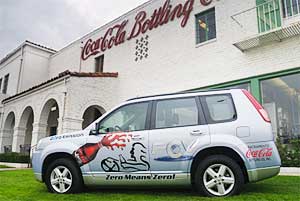
    Coke Zero Nissan X-Trail FCVThe Coke zero emissions Nissan X-Trail FCV was announced as a lease vehicle for the world’s largest carbonated beverage company at their Sacramento, California plant. This happens to be the first time that Nissan has leases a hydrogen fuel cell vehicle in the U. S. although they’ve already done so in Japan.

    Nissan has also shown their X-Trail FCV at the California Fuel Cell Partnership (CaFCP) in Sacramento and at various car shows and events throughout the U. S. at ride n drives plus other events. I was fortunate to drive one a few years back.

    Coca-Cola, which already uses various green cars in their fleet including improved internal combustion engines, EVs and hybrids will be using the Nissan X-Trail SUV to promote their Coca-Cola Zero product. According to Nissan Vice President Eric Noziere, “Any 5th grade math student can tell you that 0+0+0=0, yet in this case zero (carbs) plus zero (calories) plus zero (emissions) adds up to a great partnership and a great way to promote both the Nissan and Coca-Cola Zero brands.”

    Sacramento already has two operational hydrogen fueling stations in the area including one at the CaFCP. There is also an additional H2 fueling station that is being planned for operation at the Sacramento airport.

    Now, being the day before Thanksgiving it’s time for me to be a little silly. I was brainstorming some ideas on how to promote both the Nissan FCV and Coke with catchy slogans. So, I decided that I will now substitute some of the Nissan words in the old and new Coca-Cola slogans to see how they fit. Let’s star with:

    1. I’d like to buy the world an FCV and keep it company
    2. Have an X-Trail and a smile
    3. Nissan – it’s the real thing
    4. Things go better with X-Trail
    5. Nissan X-Trail FCV – the pause that refreshes

    Of course I’m sure that you can come up with a few of your own co-branded catchy slogans for the partnership between Nissan and Coca-Cola and if you do, please keep them to yourself. Yes, please.

  • Ex-Enron Trader Built Giant Caverns To Hoard Natural Gas

    John Arnold

    Natural gas prices remain depressed due to the fact that there is simply too much supply and no where to store it.

    While natural gas futures indicate that prices will rise in 2010, it’s hard to take advantage of this directly via the futures market if you can’t store your gas in the meantime.

    This has made John Arnold, an ex-Enron billionaire natural gas trader, look amazingly prescient these days.

    Apparently he’s already built his own underground gas storage caves. Thus he can buy gas today, store it, and then sell it in the future once natural gas prices are higher as the market indicates they will be. He could even likely lock-in profits for this arbitrage by shorting long-dated gas futures to hedge the whole trade. Or he could just charge others to store gas. Either way, our guess is that he’s sitting pretty right now.

    CNN: Most significant, Arnold has become an energy market middleman by investing in valuable natural-gas storage facilities. A huge glut in supply, plus a dropoff in demand from mild seasons and reduced industrial need, has resulted in rock-bottom gas prices. So players are rushing to store gas in hopes of selling it when prices are higher.

    In 2006 Arnold formed NGS Energy, which has carved a series of battleship-size storage caverns inside underground salt domes. “This is the opposite of a speculative play — it’s a bet on the future needs of the marketplace,” says Laura Luce, a former Enron colleague of Arnold’s who runs the venture.

    Natural gas’s storage and transportability as a fossil fuel, she says, also make it a key cog in the renewable-energy economy: “When there’s no wind or sun, you fill in with the cleanest energy available, and that’s gas. That’s why gas storage is going to be a great business.”

    Of course, Luce is the one who makes the public pronouncement. Arnold, by contrast, is hardly in danger of becoming the sort of gas evangelist who appears in TV commercials, like his energy-trading colleague and fellow Texan T. Boone Pickens does for wind and natural gas. In trademark fashion, Arnold is staying behind the scenes and working on how to profit from the next disaster.

    Read more here to get background on Mr. Arnold.

    Join the conversation about this story »

    See Also:

  • EA announces new Mercenaries game from EALA

    Pandemic may have closed down but the Mercenaries franchise will still be going strong. Staying true to their earlier statements that Pandemic’s key f…

  • Apple Seeks to Shut Down Psystar for Good With Permanent Injunction

    It’s been a long, drawn out legal battle, but Apple is clearly winning by almost all accounts, and it just filed for a motion that could end Psystar’s party permanently. On Monday, the company filed a claim for a permanent judgment against Psystar that would stop the clone maker from selling any products at all, under the U.S. Copyright Act and the DCMA (Digital Millennium Copyright Act).

    In other words, if you desperately want that Open(7), you’d better place an order ASAP, because you might never get a chance again once the decision comes down. The complaint, is based on the premise that Psystar is now “trafficking in circumvention devices,” which is causing “unquantifiable” harm to Apple’s image.

    The new motion specifically targets Psystar’s recently released software product, Rebel EFI, which bypasses the built-in prevention measures that limit the installation of OS X 10.6 to Apple-built hardware only. Using Rebel EFI, customers can supposedly install OS X on any Intel-based system, although the compatibility of individual components will vary widely.

    Up till now, Apple has succeeded in dealing serious blows to Psystar, including winning a summary judgment, but it hasn’t managed to get a ruling that would shut down the company’s operation for good. The clone maker can continue doing business even if it keeps having to pay damages, since it can declare bankruptcy and reform as long as it can raise enough operating capital to stay afloat…hence the attempt by Apple to put an end to the expensive cycle.

    Apple SVP of Worldwide Product Marketing Phil Schiller puts it succinctly in an affidavit for the latest claim:

    So long as Psystar continues these practices, the harm to Apple and its brand will continue.  I believe Apple should not be required to file a new lawsuit to stop Psystar from infringing Apple’s intellectual property each time Apple releases a new version of Mac OS X. Requiring Apple to file multiple lawsuits to stop the same infringing conduct would be unfair, expensive, and a waste of the Court’s and the parties’ resources.

    Apple also recently tried to shut down Atom support in OS X, which would seriously derail the efforts of at-home netbook hacking, so it looks like Cupertino is just generally trying to shut down any and all efforts to wrestle control of the operating system from its iron grip.

    The next hearing is scheduled for December 14, and the official trial will start in January 2010. Psystar doesn’t look to be in good shape as it is, but if Apple manages to get this permanent injunction, all hope is lost for the hackintosh purveyor.