Author: Serkadis

  • Republicans Assail ‘Freight Train of More Mandates’ In House Health Bill

    Republicans criticized the House health overhaul bill, released by Speaker Nancy Pelosi, for its size, scope and cost.

    ABC News reports: “Republicans, as expected, assailed the Pelosi bill, saying its 1,990 pages don’t reflect any change. House Minority Leader John Boehner, R-Ohio, billed it as a ‘government takeover of the health care system.’ The Democrats’ legislation has ‘over 50 new mandates, bureaucracies, tax hikes, commissions — All of this is going to require tens of thousands of new federal employees, which is fairly designed for a government takeover of our health care system,’ Boehner, with a printout of the entire bill in front of him, told reporters. ‘How are we going to fix out health care system with 1,990 pages of bureaucracy?’” (Khan and Karl, 10/29). 

    The National Review Online reports that Boehner said that “the House bill is no different than the Senate’s in terms of it’s expansiveness. … Rep. Eric Cantor asks, ‘Do the American people really believe that this nearly 2000 page bill won’t explode the Federal deficit?’ Rep. Mike Pence observes that the Pelosi legislation is ‘a freight train of more mandates, more bureaucracy and more taxes.’ … House GOP whip Roy Blunt hammered Speaker Pelosi for procedural chicanery and shutting Republicans out of process crafting legislation. Blunt noted that even as they scramble to figure out what’s in the 1,990 page bill it’s ‘highly likely’ that an ‘800 page amendment will be offered the moment it hits the floor. … Nobody will know what’s in this bill 72 hours from now’” (Hemingway, 10/29).

    The National Journal Blog reports that Republicans are seeking more transparency in Congress, especially on the health care legislation, with a bill introduced Wednesday by Rep. Dave Reichert, D-Wash., “that would require each of the 21 standing committees in the House to record votes on their Web sites within 48 hours. Rep. Charlie Dent, R-Pa., sponsored a resolution last week calling for cameras to be installed in the House Rules Committee hearing room and freshman Rep. Lynn Jenkins, R-Kan., recently sponsored a measure to require committees to post the text of adopted bills and amendments online within 24 hours.”

    In a press release, Reichert said, “When we’re debating a trillion-dollar health overhaul, constituents deserve to know how legislation takes shape — throughout the entire process”  (Noyes, 10/29).

    Insurers immediately reacted to the House bill, saying that it will cause costs to skyrocket. The New York Times reports: “Karen Ignagni, president and chief executive of America’s Health Insurance Plans,… painted a dire picture of the consequences of a government-run insurance plan, or public option, which is designed to compete with private insurers. She said it would ‘bankrupt hospitals, dismantle employer coverage, exacerbate cost-shifting from Medicare and Medicaid, and ultimately increase the federal deficit.’”

    The Times includes a full statement from AHIP, which states: “While this legislation recognizes the key linkage of market reforms and a personal coverage requirement, more needs to be done to ensure coverage is affordable and our health care system is sustainable. As the process progresses, health plans will continue to work to advance bipartisan legislation this year that will cover all Americans, make coverage more affordable, and improve quality” (Seelye, 10/29).

  • AppleTV firmware 3.0 just launched

    500x_appletvui
    The new Apple TV firmware just dropped with Genius Mixes, iTunes LP data, and iTunes Extras. As you see this is a quite a departure from the original firmware. I’ll stick it on and report back how it feels.

    Interestingly, since I hacked 2.x, I don’t really want to do this update. If you guys try it, let me know. I may give it a go this afternoon.

    Apple Introduces Apple TV 3.0 Software With Redesigned User Interface

    Enjoy iTunes Extras, iTunes LP & Genius Mixes on Your HD TV

    CUPERTINO, Calif., Oct. 29 /PRNewswire-FirstCall/ — Apple® today introduced new Apple TV® 3.0 software featuring a redesigned main menu that makes navigating your favorite content simpler and faster, and makes enjoying the largest selection of on-demand HD movie rentals and purchases, HD TV shows, music and podcasts from the iTunes® Store even better on your TV. You can now enjoy iTunes Extras and iTunes LP in stunning fullscreen with your Apple TV, as well as listen to Genius Mixes and Internet radio through your home theater system. The new Apple TV software is available immediately free of charge to existing Apple TV owners, and Apple TV with 160GB capacity is available for just $229.

    “The new software for Apple TV features a simpler and faster interface that gives you instant access to your favorite content,” said Eddy Cue, Apple’s vice president of Internet Services. “HD movies and HD TV shows from iTunes have been a huge hit with Apple TV customers, and with Apple TV 3.0 they get great new features including iTunes Extras, Genius Mixes and Internet radio.”

    The redesigned main menu on Apple TV gives you instant access to your favorite content. Recently rented or purchased movies, as well as other content including TV shows, music, podcasts, photos and YouTube, are accessible directly from the new main menu. The new software also allows Apple TV users to enjoy stunning fullscreen iTunes Extras and iTunes LP, including great new movie titles such as “Star Trek” or classics like “The Wizard of Oz” and albums such as Taylor Swift’s “Fearless (Platinum Edition)” and Jack Johnson’s “En Concert.” iTunes Extras gives movie fans great additional content such as deleted scenes, interviews and interactive galleries. iTunes LP is the next evolution of the music album, delivering a rich, immersive experience for select albums on the iTunes Store by combining beautiful design with expanded visual features like live performance videos, lyrics, artwork, liner notes, interviews, photos, album credits and more.

    Now Apple TV users can enjoy Genius Mixes through their home theater system and listen to up to 12 endless mixes of songs that go great together, automatically generated from their iTunes library. Customers can also enjoy Internet radio, allowing them to browse and listen to thousands of Internet radio stations, as well as tag favorite stations to listen to later. Apple TV’s support of HD photos is enhanced with iPhoto Events, which simplifies finding your favorite photos on Apple TV, as well as iPhoto® Faces, which gives access to photos organized by people identified in iPhoto.

    Apple TV users have direct access to a catalog of over 8,000 Hollywood films on iTunes including over 2,000 in stunning HD video available for rent or purchase. Users can also choose from a selection of 11 million songs, 10,000 music videos and over 50,000 TV episodes to purchase directly from their Apple TV or browse and enjoy the iTunes Store podcast directory of over 175,000 free video and audio podcasts. Purchases downloaded to Apple TV are automatically synced back to iTunes on the user’s computer for enjoyment on their Mac® or PC or all current generation iPods or iPhones.* iPod touch® or iPhone® users can download the free Remote app from the App Store to control their Apple TV with a simple tap or flick of the finger.

    via Giz


  • StumbleUpon Goes Search with New Incarnation

    Update: Starting today, all StumbleUpon users can access the new interface, according to the company.

    Original Article:
    StubmleUpon launched a big redesign today. The new version of the site comes with a variety of new features, which the company says are designed to make it simpler, searchable, and more social.

    "Our vision for StumbleUpon was simple–create a site where you could click a button and discover interesting, personalized and highly relevant websites," said Garrett Camp, StumbleUpon CEO. "We are now combining the power of discovery with search–and offering another way for people to access over 35 million user-endorsed websites."

    With the new version of StumbleUpon, anyone can receive personalized recommendations directly from the StumbleUpon homepage, from any computer, without any registration or installation. The company says the new design makes it easier for new users to discover interesting content.

    StumbleUpon Screenshot

    The  company says the personal preferences and collaborative human opinions that go into making "stumbles" personalized applies to search as well.. The result is personalized and relevant search results, according to StumbleUpon. Search is available from every StumbleUpon page, so users can search through their favorites, others’ favorites, or just through friends’ favorites.

    There is also a new and improved friend search feature, making it easier for users to find people they know and meet others with similar interests. In addition, users can see recommendations from people they know highlighted in search results, and easily stumble or search within their favorite sites.

    "It’s great to see the original founders’ vision reflected in this release, StumbleUpon’s first major product release since its independence from eBay," said Ram Shriram, StumbleUpon investor and board member.

    StumbleUpon can provide a tremendous source of traffic. Read this for information on how to get that.

    Related Articles: 

    > StumbleUpon Makes Big Improvements to Toolbar

    > StumbleUpon Can Get You Big Traffic and Lots of Links

    > StumbleUpon Jumps on the URL-Shortener Bandwagon


  • IngBoo Gets Seeded

    IngBoo, a Sunnyvale, Calif.-based online marketplace for information updates, has raised $800,000 in seed funding. Backers include Elis Nemes and Saeed Amidi of Amidzad Partners, Doug Tsui of Horizon Ventures and Allen Miner of Sunbridge Partners.

    PRESS RELEASE

    IngBoo (www.ingboo.com), the best free online service for consumers to organize their Web activities in one place, today announced that it has raised $800,000 in seed funding led by Elis Nemes and Saeed Amidi of Amidzad Partners, Doug Tsui of Horizon Ventures and Allen Miner of Sunbridge Partners.

    The company also announced the official launch of R3, its online publisher program. R3, which stands for Reach, Revisits and Revenue, offers a new revenue generating opportunity for all online content publishers. It is the only program of its kind to offer advertising revenue to publishers for content previews. To date, more than 50 publishers and advertisers have signed on.

    “Over the last several years, we have had the opportunity to evaluate hundreds of innovative startups from around the World,” said Saeed Amidi, founder and CEO of Amidzad Partners. “We believe that IngBoo is a category-defining startup, perfectly positioned to facilitate and accelerate the growth in users who organize their Web activities by subscribing to content previews.”

    “IngBoo’s R3 program has enabled us to deepen the relationship with our audience,” said Randa Clay, owner of freestuff4kids.net. “The one-click subscription model with content preview increases visitation to our site and has created incremental revenue opportunity for us.”

    “That we were able to raise this amount of seed capital in today’s challenging economic times and secure more than 50 publishers speaks volumes about our technology and business model,” said Rikard Kjellberg, CEO and co-founder of IngBoo. “And even more than giving publishers a new and free way to earn money from their content, IngBoo helps end users save time and money by giving them a free resource to organize all of their Web activities from a single page.”

    About IngBoo, Inc.
    Headquartered in Sunnyvale, California, IngBoo launched its service in April, 2009. An online marketplace for information updates, the “IngBoo list” delivers users the most relevant and timely information from any source on the Internet; organizing it in a clutter-free user experience. IngBoo returns control of Web-based information to the consumer, separating relevant information from spam and organizing content in a relevant fashion (patents pending).

    ShareThis


  • November Issue of Teaching Music Offers Bountiful Harvest of Tips, Inspiration

    With the school year well under way, the November ’09 issue of Teaching Music gives music educators a cornucopia of useful tips for the classroom and beyond. The features include:

    • Six Things They May Not Have Taught You in College
    • Making a Small Band Sound Big
    • Climbing the National Board Certifcation Ladder
    • A New View of String Instruction

    In UpBeat, the news pages include need-to-know stories about MENC projects and events. Among them:


    Roz Fehr, October 29, 2009. © MENC: The National Association for Music Education

  • CrunchGear meetup in Columbus, OH: Monday, November 9

    V for Vendetta

    Remember, remember, the 9th of November!
    Gadgets, technology, and beer.
    I see no reason why gadgets and tech
    should ever bring little cheer.

    Last year’s Columbus meetup was a huge success, and folks have been asking me when we’ll do it again. Well mark your calendars for Monday, November 9, and join us for a friendly evening of networking and libations at the Surly Girl Saloon, my favorite cowgirl/pirate themed bar! We’ll be in the party room in the back around 6:30 PM. The Surly Girl has a terrific menu, and a great selection of beers, so tastes of all types can be satisfied. John Biggs will be there, so you can ask him in person all those burning questions you have about Japanese sex jars!


  • Data Robotics Raises $10 Million

    Data Robotics Inc., a Santa Clara, Calif.-based developer of automated data storage products, has raised $9.97 million in new VC funding, according to a regulatory filing.  It had previously raised $43 million since 2005. www.drobo.com

    ShareThis


  • F. Scott Fitzgerald Made $8,397 On Great Gatsby; His Daughter Gets $500,000 Per Year From It

    There have been an increasing number of questions raised about both the length of copyright and the fact that it passes on to heirs after the original creator passes on. The original purpose of copyright had nothing to do with creating a welfare system for the children of content creators, no matter how much some content creators would like it to work that way. Economist Greg Mankiw points out a “factoid” that drives home the oddity that comes from such long copyrights:


    Royalties from The Great Gatsby totaled only $8,397 during Fitzgerald’s lifetime. Today Gatsby is read in nearly every high school and college and regularly produces $500,000 a year in [F. Scott Fitzgerald’s daughter] Scottie’s trust for her children.

    The article this comes from goes into great detail into F. Scott Fitzgelald’s earnings over his lifetime, and what’s striking is that with a different sort of copyright system in place, he barely seems to rely on copyright royalties at all to make money. Instead — like most jobs — he recognizes he needs to keep producing new works to earn money, selling stories to various publications, along with working for Hollywood studios in addition to his novels. How much things have changed.

    Permalink | Comments | Email This Story


  • Bayonetta’s US and Euro release dates confirmed

    Action game fans now have another thing to look forward to for the New Year. Sega has penciled in an early January release for Bayonetta (PS3, Xbox 36…

  • Can Speech Recognition Find Its Voice in Computing?

    Microsoft once again is touting its speech-recognition technology, predicting on its site this week that “talking to a computer may soon be as natural as using a mouse.” But while voice is a natural fit for mobile phones and some other platforms, when it comes to traditional computing — using a laptop, desktop or even a netbook — the use-case scenarios for speech recognition are more limited. It will take quite an effort to convince users to talk to their laptops instead of typing on them.

    The mouse has nearly become an extra appendage for many of us; touchpads and touchscreens are simple and intuitive; and larger screens minimize the need to drill down through menus. The use of voice as a navigational tool will increase as smartphone usage continues to ramp up, and it will likely be used in specific situations on smaller devices like netbooks — when a user’s hands are otherwise occupied, for instance, or in rare on-the-go scenarios. For traditional computers and laptops, though, I don’t see it gaining much traction among mainstream consumers.

    Don’t get me wrong: Speech-recognition software has come a long way in the last few years. Once prohibitively error-prone and inconsistent, the technology now is the foundation of impressive offerings from players such as MacSpeech, Nuance and Vlingo. Microsoft seems especially well-positioned in the space. The company picked up startup Tellme in a 2007 deal reportedly worth more than $800 million, and it is wisely using cloud-based technology to build a system that leverages an enormous amount of data to determine what users are saying.

    Picture 3

    For $79, get this report and more from GigaOM Pro. Subscribe today!

    The Redmond gang has helped push speech recognition into the mainstream with Ford Sync, the in-dash recognition and search system it powers. And Microsoft is aggressively rolling out voice functionality across its offerings including Bing for Mobile, Exchange Server 2010, Windows 7 and Windows Mobile.

    Voice is a natural fit for drivers whose hands are busy and whose eyes are on the road. It also will be absolutely crucial in mobile (GigaOM Pro, sub. required), where small keypads and screens make touch navigation difficult — or, if you’re behind the wheel, dangerous. And consumers are likely to love features like Microsoft’s Voice Mail Preview, which uses speech-to-text to deliver voicemail information to a user’s inbox.

    Use of speech-recognition offerings should ramp up in the next few years as phones continue to grow more sophisticated. When it comes to usage on desktops and laptops, though, any real uptake is a long way off — if it happens at all.


  • Nintendo makes DSi screens bigger than competitors

    By Tim Conneally, Betanews

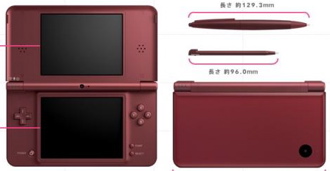
    Nintendo DSi LLThis morning, Nintendo announced the third upgrade to the DS family, the DSi LL (or DSi XL), will be released in Japan on November 21, one year after the DSi debuted, for ¥20,000 (approx. $220). The LL’s main improvement is the size of its screens, which have been increased from 3.25″ to 4.2″ with a moderate increase to the size of the chassis. The device also includes a much bigger stylus, which looks to be the size of a ballpoint pen, and battery life has reportedly been increased to five hours at maximum screen brightness.

    Handheld gaming has been a strong suit for Nintendo since the early ’80s, and it has consistently led the category despite the constant string of capable competitors touting higher quality or more innovative portable gaming platforms. Of Atari, Sega, NEC, Tiger, Bandai, SNK, and a handful of other notables, few video game and toy companies have been able to engage the handheld market for more than a single generation.

    Nintendo, meanwhile, has managed to work its way through seven consecutive generations of handhelds. It has done this by working on an extremely predictable and regimented upgrade path, incrementally refreshing its handhelds and slowly phasing out prior generations while retaining backward compatibility. This means each generation is made up of families of systems rather than single units.

    The seventh generation Nintendo DS (dual screen) family of consoles debuted in 2004 and has since been upgraded twice: from DS to DS Lite in 2006, and then to DSi in late 2008.

    Despite the availability of the new DSi, Nintendo’s handheld sales dropped nearly 20% in 2009. This, paired with unfavorable exchange rates, brought Nintendo’s profits down 61% in mid-summer. Today, the company reported a 52% decrease in quarterly profit and cut its annual forecast by about 25%. Things are looking pretty stale six years into the DS series, but bigger screens address a couple of potential audiences and use-cases.

    The improved visibility and more comfortable stylus could appeal to older gamers or those who simply don’t care for small screen gaming. The 4.2″ screen is respectably larger than the new PSP Go’s (3.8″), the iPhone 3G S’ (3.5″) and even those of smaller-form MIDs like the now-delayed Nokia N900 (also 3.5″).

    As Apple is wont to remind us, the public has embraced downloadable touch-based gaming, and the iPhone/iPod Touch platform has more than 21,000 games available. Nintendo DS and Sony PSP have barely 5,000 combined. However, iPhone screen visibility remains a major issue. The iPhone’s lack of buttons forces developers to integrate touch or motion control into their games, and the execution is oftentimes poor. Touching the screen always interrupts the gamer’s field of vision, and it proves to be detrimental in games where the developer hasn’t fully taken this into account. Furthermore, tilting, shaking, or waving the iPhone as some games demand is simply “counter-immersive” — if such an adjective exists.

    Though the DS family still lacks motion sensors, it has plenty of interfaces that developers can tap into to let the user’s view of on-screen action remain continuous. The touch screen’s view may be interrupted, but the upper screen’s view remains. And failing that, there is always the option to rely on the D-pad, buttons, microphone, and in the DSi’s case, two cameras.

    The point of this upgrade is that it falls in line with Nintendo’s past handheld upgrades, where displays get upgraded as the technology becomes affordable and energy efficient. With improved screens typically comes an improved user experience and a more engaged audience.

    Copyright Betanews, Inc. 2009


    Add to digg
    Add to Google
    Add to Slashdot
    Add to Twitter
    Add to del.icio.us
    Add to Facebook
    Add to Technorati


  • Sports Ratings Records and what it tells us about the internet

    have you seen sports ratings lately ? Just this week:

    The NBA on TNT had its highest ratings in TWENTY SIX YEARS .  Versus had its highest rated regular season NHL game EVER.  The first game of the World Series was the highest rated in 5 years.  The NFL was setting records on cable and achieving viewing levels not seen in TWENTY YEARS !. College Football ratings are killing it as well.

    But wait there is more.  TV viewing is up considerably in each of the last several years. We can even look at the box office for movies and the fact that the industry is seeing a theatrical revival.

    The question is simple. Whats going on ?

    The answer is simple as well.

    The internet has trained us.

    It has trained us to assign two distinct values to content that is available to us, regardless of media.    The 1st variable is participation value. The 2nd variable is shelf life.  The two variables go hand in hand.

    Every type of content has some quotient of participation value. At the bottom of the spectrum are games/shows/movies/events that you watch or attend by yourself, and you have no interest in telling anyone about.  Those shows have zero participation value.  They could be Perry Mason reruns (happened to catch one while I was working out on the road) or shows you watch when you have nothing better to do.

    At the top of the scale are games/shows/movies/events that potential viewers have predicted to have high participation value.  These are events that we look forward to not only watching or attending, but that we plan in advance how we are going to extend our participation.  We may plan on tweeting about it or posting a facebook update because we know our friends are there and we are bragging to each other, while at the same time showing off to friends who cant be there. Think going to the opening of Cowboys stadium, or going to a concert or opening night of a movie, or watching the big game.

    Or we may plan on going online and participating in discussion forums or chats. Or we may be planning on posting comments on our favorite websites where others have shared interests.  For others it may be some version of gaming, ala fantasy sports.

    Sports of course have high affinity engagement, and because of the internet, they have increasing participation opportunities.  You may watch a Magic game just to be able to tweet to Dwight Howard what you saw while watching the game.  You may watch the Giants Eagles game because your fantasy teams are stacked with players from those teams and your league allows first come changes. Or you may just want to see how your guys did so you can text your friends in the league and give them a hard time, or take a hard time. Its very, very common for fans of MMA (mixed martial arts) to stay up to the wee hours to watch our Dream Fights from Japan on HDNet , all the while online discussing the fight and then arguing over the outcome with others doing the exact same thing.

    The higher the participation value, the shorter the shelf life.  The role of the internet for high participation games/shows/events is not to show them, its to enable the participation. The explosion of Social Networking and social networking enabled games and applications has strengthened this as the internet’s role. Its improving TV ratings of shows with high participation value.

    While some may think that combining the presentation of events/shows/etc and the participation into a single webpage makes sense. It doesn’t.  The internet has also trained us that if it can be shown on the internet, its probably not going to have a high participation value. Why ? Because the expectation is that if its on the internet, you can get to it any time you want it.  Its out there waiting for you to stream or download at your pleasure. There is a long perceived shelf life.  So there is no rush.

    The latest U2 concert on Youtube is a perfect example.  I thought that when I went to Akamai’s status page the number of concurrent users would be in the millions. As you can see from this link, it was about 1.15mm. Nothing to sneeze at, but that is for ALL of the streaming Akamai was doing at the time and its not dramatically more than a normal night for Akamai (as I write this, the total on the akamai visualization page is 1.3mm, more than during the concert) .  I shouldn’t have been surprised.  There was no reason to rush to watch it. Its available now and probably forever more on the net.

    Compare this to live, competitive reality tv.  THe opportunity to watch a train wreck or to catch a spectacular performance, live , can easily trigger a high participation event.  Think watching me on Dancing with the Stars hoping or expecting me to wipe out.  You go in knowing and hoping and ready to let all your friends who werent watching know about it, and to talk about it with all your friends who are watching.  So while the ratings may have fallen off some for these shows, one episode comparable to Marie Osmond fainting, which led to a huge surge in viewing on my DWTS season, or a Brett Favre last second touchdown or interception return, or even a movie that is a hugely positive surprise like Paranormal Activity, all have short shelf lives while creating the expectation among viewers that they are or could be high participation events.

    Which brings us to our conclusion. THe longer the shelf life, the more likely that there is a lower perceived participation value. Sure you may want to talk about your favorite TV show with others, but there is no rush.  You can get to it when you get to it. More importantly, networks and production companies should work a lot harder at creating realtime  participation around their content. If you can increase the value of participation, you increase the value of the show and the desire to watch the show at the same time as others.  Which is exactly what is happening with sports in record numbers.

    You cant stop people from recording shows on their DVRs, and you shouldnt try. But you should try to give them as many reasons as possible to take advantage of the increased entertainment value of participating  with others. High participation  equals high viewership. That is exactly what record ratings for sports are telling us.


  • Google Ranked World’s Most Attractive Employer

    It’s a good bet that mailmen (and/or mail servers) are still delivering huge numbers of applications and resumes to Google.  A very large survey has confirmed that university students regard the search giant as the world’s most attractive employer.

    Universum contacted almost 120,000 students from Canada, China, France, Germany, India, Italy, Japan, Russia, Spain, the UK, and the US regarding which companies they’d most like to work for.  The result: Google won in both the business and engineering categories.

    Not many of the other corporations we usually cover made either list; you’ll find PricewaterhouseCoopers, Goldman Sachs, and Ernst & Young on the one side, and IBM, BMW, and Intel on the other.  But Microsoft scored quite well, at least, coming in at number three on the business side of things and number two in terms of the engineering rankings.

    So both Google and Microsoft will probably continue to employ people of the highest caliber for the foreseeable future.  It just looks like Google might maintain a bit of an edge, perhaps getting kids who are in the top 0.5 percent of their class instead of the more pedestrian top 1.0 percent or so.

    Hat tip goes to Barry Schwartz.

    Matt Cutts Extends Offer To Yahoo Engineers

    > Google Aims To Make Finding Music Easier

    > Google Launches Social Search Experiment

  • You No Longer Need the Google Toolbar to Use Sidewiki

    Last month, Google introduced Sidewiki, a feature of the Google Toolbar that allows users to comment on any page on the web. The comments could only be viewed by others who have the toolbar and the feature installed. That was until now.

    Google has now introduced a Sidewiki bookmarklet that can be used to read and write Sidewiki entries with Google Chrome, Safari, and other browsers. The bookmarklet is just a shortcut that goes in the bookmarks bar of you browser, and when you click it, it opens up a window showing Sidewiki entries for whatever page you’re on.

    When using Sidewiki, an expandable window can be viewed on the left-hand side of the webpage. When expanded, you can see the comments that have been written or contribute your own.

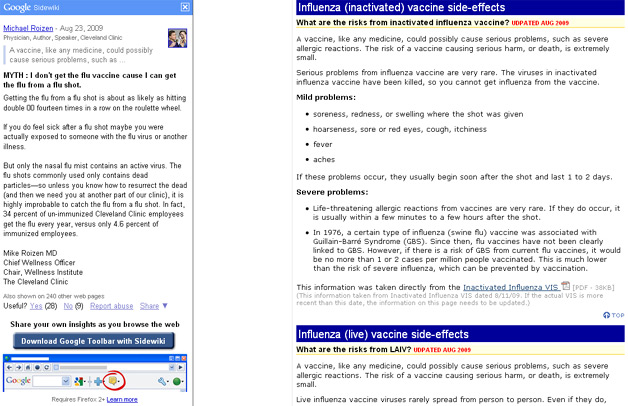
    Google Sidewiki

    Upon introducing Sidewiki, Google said it uses "multiple signals" based on the "quality of the entry," what they know about the author, and other user-contributed signals like voting and flagging. They say they want to only keep the most relevant entries appearing in the sidebar. Search Engine Land’s Danny Sullivan says Google gave him a few other factors like:

    – Use of sophisticated language
    – User’s reputation
    – User’s history

    Users’ Google Profiles are said to play a direct role in whether or not comments appear. Google ranks profiles in a PageRank-like manor, so the higher you profile is ranked, the more likely your comments are able to appear.

    Related Articles:

    Google Turning the Web Into an Exclusive Social Network?

    Integration – The Key to Google as a Social Network

    Want to Get Your Google Profile Verified?

  • Sprint Q3 results still reflect hard times for number three provider

    sprint-logo1Sprint seems to keep bleeding, keep, keep, bleeding subscribers. After losing 801,000 post-paid subscribers, which is slightly better than the 870,000 that analysts expected, Sprint might need to really change its game to do more than just stay afloat. Consequently, Sprint’s losses for the quarter are a whopping $478 million compared to $326 million YoY. Revenue dropped about nine percent to $8.04 billion. Interestingly enough, Sprint’s prepaid service, Boost, added over 600,000 subscribers thanks to Boost’s $50 unlimited plan. But with its Simply Everything packages including Any Mobile, Any Time, and hardware like the Palm Pre and HTC Hero, Sprint could be looking to shrink its quarterly losses in the future and maybe even see some positive gain.

    Read

  • Robots taking over role of backseat driver

    AIDA-01
    Meet AIDA, the Affective Intelligent Driving Assistant. This is a prototype robot that utilizes sensors inside and outside the car to create “a platform comprising of a personal robot and an intelligent navigation system that aims to bring an innovative driving experience.” I don’t own an automobile, so practically every driving experience is innovative to me right now! Rather than traditional destination-oriented GPS navigation, AIDA posits “a navigation system that mimics the friendly expertise of a driving companion who is familiar with both the driver and the city.” Hopefully AIDA won’t complain about my driving the way all my friends do.


    “Instead of focusing solely on determining routes to a specified waypoint, our system utilizes analysis of driver behavior in order to identify the set of goals the driver would like to achieve.” That is innovative, and as the video above indicates, AIDA can work to help you efficiently navigate your home city. It still looks suspiciously destination-oriented, and I wonder how much our continued reliance on navigation products is going to make us miss out of serendipitous discoveries, like the mom-and-pop movie theater nearby is showing your favorite B movie, or a big multi-family yard sale is taking place this Saturday. The more we rely on technology to get us where we’re going, the less likely we are to see what’s going on nearby.

    AIDA is a product of the MIT SENSElab, the MIT Media Lab’s Personal Robots Group, and the Volkswagen Group of America’s Electronics Research Lab. The full press release is available.


  • Socket Pocket: Inexpensive wall outlet cover with built-in gadget holder

    socket-pocket-gfci In the cutthroat (?) world of wall outlet covers that feature built-in gadget holders, this $6 option might just be a contender.

    The big draw, aside from low price, is the hinged base that keeps your device’s power cord in place. There’s also a side opening “for easy access to side charging devices.”

    Thoughtfully, the outlet covers are available in a standard version and also in a “GFCI” version for use with those special square outlets like you’d find in your bathroom.

    According to the product description:

    “Featuring a hinged and slotted ‘floor’ for threading cable into the pocket as well as an opening for accommodating side charging devices, the Socket Pocket can handle nearly any cellphone. Additionally, you can use the Socket Pocket to store pens, glasses, and scissors. Available for standard and GFCI outlets.”


    socket-pocket-diagram 


    Socket Pocket- Organize your cell phone while charging [Vat19.com]

    Also available at ThinkGeek.


  • Original Body HTC Heros with US 3G coming soon – but you’ll have to import

    If your pockets are just beggin’ to be filled with an HTC Hero, your options thus far (assuming you’re in the US) have been limited. You could get one through Sprint or wait for Verizon’s Hero-esque Droid Eris – but either of those options means you’re on a modified, round-bodied Hero rather than the angled, chin-tastic Hero that nearly 70% of our readers prefer. You could import one of the original bodied Heros from the UK – but then you wouldn’t be able to get 3G on any US Carrier.

    If you wanted US 3G and an original Hero, you were out of luck – until now.


  • Connectify Is Early Evidence of Why Win7’s “Virtual Wi-Fi” Matters

    4055433795_5fd5045e79_oMicrosoft’s Windows 7 operating system, as we noted when it rolled out last week, contains a highly interesting software layer — invented and developed at the company’s in-house research division — that enables “virtual Wi-Fi.” Essentially, it allows a user to group multiple Wi-Fi connections together to boost coverage and speeds. It stands to have an immediate impact on Wi-Fi users, but could also impact various broadband access technologies over time.

    Kevin over at jkOnTheRun today discusses new beta software called Connectify that takes advantage of the feature to “turn your Windows 7 laptop into a Wi-Fi hotspot.” Here’s why this technology is significant, and where it’s headed.

    The day before Windows 7 was launched, I sat down in our offices with a team of three people from Microsoft to discuss the new operating system, only to learn that none of them were aware of the virtual Wi-Fi software layer that it has. This really surprised me given that previous versions of Windows have bundled connectivity and networking technologies in such a way as to cause sweeping usage changes.

    There are multiple ways to share wireless connections; many people do so with the MiFi device. Connectify, though, takes direct advantage of the virtual Wi-Fi features in Windows 7 to create a software-based wireless router for Wi-Fi sharing. Just imagine the range and coverage possibilities that can come of turning your laptop into a router. (You can read more about how virtual Wi-Fi works here.)

    As Kevin notes:

    “With Connectify, you have a software solution to share the data connection of your PC — a secure hotspot with WPA2-Personal (AES) encryption is created via a virtual Wi-Fi interface, so any other Wi-Fi device you have can take advantage of your mobile broadband connection. And this differs from tethering options we’ve covered in the past because tethering generally only allows one other device to leverage the connection. By creating a Wi-Fi hotspot, multiple devices can join in.”

    That’s pretty slick, and has sold me on trying out Connectify. It’s likely that we’ll see other interesting extensions of the virtual Wi-Fi software layer in Windows 7 as well, including applications with broadband technologies other than Wi-Fi.


  • SVASE Main Event

    The Silicon Valley Association of Startup Entrepreneurs will be hosting the Main Event on Thursday, Nov. 5, 2009, from 6 p.m. to 8:30 p.m. entitled “Leveraging Corporate, Strategic Partnerships and Investments.” Learn about the key fundamentals of successful corporate investing programs, alliances and commercialization process from some of Silicon Valley’s leading corporate partnerships and venture funds. GigaOM readers who pre-register will receive the discounted affiliate rate of $29 to attend. For walk-ins on the day of the event, please add $10 to the affiliate rate.