Author: Serkadis

  • The Droid Has Landed…Unboxed! Plus a Few Facts

    Droid_by_Motorola_Front_Open_VZW_EyeSo the Droid from Verizon just landed and we have an unboxing video. Despite all the hype, I have this to say to the makers of the iPhone: You’ve got nothing to worry about. Go out, have fun and get into the hands of a few more millions. As for the BlackBerry, its makers better be worried. Watch the unboxing video below the fold.

    I’m not sure how you guys will feel about the Droid in a few days, but I can safely say that like so many so-called iPhone killers in the past, this isn’t one. That’s not a judgment as to the robustness or usability of the device — I need more time for that — it’s just that Verizon seriously overhyped it.

    The New York Times’ Saul Hansell has the whole story on Motorola, Sanjay Jha and how the Droid came to be. It’s an interesting read, and one which reveals that the design choices (or lack there off) are courtesy of Verizon. As Hansell writes:

    They found a way to fit a slide-out keyboard into a phone that was only 1.5 millimeters thicker than the iPhone. And they used a 3.7-inch touchscreen, noticeably bigger than the 3.5-inch screen on the iPhone. To take advantage of the higher resolution of that screen, Motorola, working with Google, developed new software that would support high-definition video and 3-D graphics.

    Here are some facts about Droid collected by our team.

    • Doesn’t appear to be full Microsoft Exchange support — includes Calendar, Mail and Contacts, but not Tasks or Notes, on which some corporate users rely.
    • Placing the Droid in the optional car dock immediately opens up the “Car Dock” interface, and turn-by-turn GPS directions are available.
    • Placing the Droid in the optional media dock places the Droid into an alarm clock and media player mode.
    • The interface is a stock Google Android 2.0 design, so no extra home screens like some other recent devices.
    • Unlike some HTC Android devices, Droid offers a standard 3.5 mm headset jack.
    • Like webOS Synergy, Droid unifies contacts from Gmail, Facebook and Exchange.
    • Dedicated hardware keys offer haptic feedback.
    • Verizon includes a 16GB SD card with the Droid, it supports 32GB.
    • Droid’s 5MP camera with flash trumps most other current phones with 720×480 (DVD Quality) recording at 24 fps
    • The camera also supports Image Stabilization, real-time color effects, scene modes and location tagging.
    • Droid does have an accelerometer and landscape keyboard, so it’s not necessary to slide out the QWERTY keyboard for landscape entry.
    • There’s no MotoBLUR, but there is a Facebook widget.
    • Back of the device is soft touch.
    • The 854×480 display offers a higher resolution than the first ASUS Eee PC netbook, which was 800×480.
    • Droid runs the same SnapdragonTI OMAP chip as the iPhone.


  • Grab a Piece of the $86B TV Market

    Are there new opportunities in television for entrepreneurs, producers and technologists? We think so, and we hope you can join us in two weeks at our third annual NewTeeVee Live conference to uncover these opportunities. Check out our speakers and schedule here. The last two years have seen a huge increase in the uptake of viewing video online, and on Nov. 12 in San Francisco, NewTeeVee will bring together an audience of the most forward-thinking media executives and investors. Standard tickets cost $595, but we’re offering a saver rate of $425. Hurry to lock in your savings. Please register here using the “GIGAOM75″ discount code.


  • Quo vadis, Forza Motorsport 3?

    fm32

    How much you enjoy Forza Motorsport 3 entirely depends on the time you have to invest in it. If you’re able to put in the man-hours you’ll find a racing sim that’s a deep as you want it to be, and just as rewarding. If you’re only able to play a few minutes here and there, well, it’s not really the same thing.

    The game presents itself as a driving simulator, but one that won’t punish you for not knowing the difference between a carburetor and a CD changer. And, incidentally, you’ll be changing the game disc as soon as you turn it on, for the game’s developer’s, Turn 10, couldn’t fit it all on just one; an optional content install prompts as soon as the game loads. You’ll need approximately 2GB of free space on your hard drive to get the entire FM3 experience.

    fm31

    From there a cheery British announcer guides you through the game—it’s as if you’re playing Top Gear. The standard modes are there, but it’s career mode that shows the game in its best light. You’re granted a low-level car—something that you yourself may well own in real life—then race from event to event, earning credits and plaudits from other car manufacturers along the way. The credits are used to buy upgrades, while after the occasional successful race you’ll get a message along the lines of: “Fiat thinks you’re a good driver, so they’re giving you this brand new car for free!”

    fm33

    Lather, rinse, repeat. You’ll go from Class Z clunker to Class A holy-cow-this-is-fast as you plug along in career mode, which will take some time. Better skip out on Heroes this week if you want to make the most of this game.

    The game looks good, yes, but I’m hesitant to call it the best-looking racing game I’ve ever played: that title belongs to Racer Driver: Grid. (Note: I never bought Dirt 2 because rally racing doesn’t appeal to me.) I don’t know, things just look too shiny to me. The best way I can describe it is, remember the first few FIFA games for the PS3/360, and how “shiny” the player models looked? I get the same feeling here.

    fm34

    Not that we’re graphics whores ’round these parts, but I’d be remiss to not mention how the game looks.

    To make another comparison to Race Driver: Grid, I do feel that the menus in the game, and just the way the game is presented, is less interesting than Codemasters’ hit. In Grid, menus fly by and spin in circles, you can see people walking about your garage while selecting a new paint scheme, your earned credits fill up in dramatic fashion, slowing down as you approach an upgrade point… It just seems more “next-gen,” more “hmm, now this is different” than FM3, which is very much “well, this isn’t anything special.”

    So is the game good? Yes, of course; I dare you not to enjoy it. You will, however, have a much better time if you can sit there for several hours rather than treating it as a quick “hey let me kill 10 minutes” fix.

    fm35

    That’s it.


  • Mercedes 2010 E-Class: video walkthrough

    mbvideo

    A lot of people loved our tech-focused segment on the all-new 2010 Mercedes E-Class and we’re following up with a nice video overview of the vehicle. We were lucky enough to meet with Bart Herring who is product manager for the E-Class series, and in addition to giving us a great presentation on the car, took some time to help put this video together.

  • The Bearable Lightness of Droid: How the iPhone aesthetic has finally hit the majors

    scaled.Droid by Motorola Front VZW HomeOne thing that that struck me when I first slid open the Motorola Droid is that the software must have been a non-shipping copy. Historically, when Verizon ships a phone, the stuff in the VCast Music Center, VCast Video, VCast Navigation, and VCast Electo Pet Shop – essentially bloatware that masquerades as value added software. Swiping through the Droid menus I found none of that. No widgets offering NFL sports scores, no Apps offering downloadable videos from Lady GaGa, just a clean, clear interface. I know most Android phones don’t ship with much extraneous software (MyTouch, for example) but for Verizon this is a real first.

    What does this mean? It means carriers are finally resisting the urge to bling out their phones like NASCAR racers. Without massive branding you get a cleaner experience and although I love the Hero’s Sense UI, the Droid in this pristine state shows us that carriers, and Verizon in particular, has grown up.

    VCast_big
    None of this, please. Thank you.

    If you’ll recall, the first iPhone had little, if any, AT&T branding. It was a phone with a few apps – a calculator, a stock app – and that was it. All of the extraneous junk was taken out.

    This gives the buyer a sense that they are buying a standalone experience, not just another feature phone. The Android Market is front and center if you want to improve things, but Verizon clearly thinks this phone can stand on its own without polluting the deck with their dreck.

    Other phones that did this include the Sidekick, another popular phone. I think Droid is, interestingly enough, Motorola’s savior. Whether they meant to make it as clean and attractive as they did is unclear but I’m glad they took a stand against mobile bloatware.


  • How-to: Create Services for Quick Search Box

    QSB_icon

    I’ve been playing around with Google Quick Search Box lately and am especially enjoying this services plugin from Martin Kuhl which lets you activate and pass input to OS X services right from within QSB.

    One snag though has been that services created through the new Automator template included in Snow Leopard leave out some vital bits that limit integration. Luckily, a handy application from Waffle Software called ThisService makes creating proper services that integrate seamlessly with QSB a lot easier than you might think.

    Being able to extend the functionality of QSB with OS X services really opens up a lot of possibilities. Grab text or files in QSB and pass them on to your services to do whatever you want with them, like creating a new To Do item in iCal. I’ve been focused recently on replicating functionality that I lost when I made the switch over from Quicksilver and I think that this improved service integration will get me about 90 percent of the way there.

    The bad news is that this means I need to whip up a bunch of custom services for myself. The good news is that ThisService makes that task very easy. Just give it a script (AppleScript will do, but if you’re more comfortable with other scripting languages you can use those), define the type and name of your service and click Create Service. ThisService handles all the fiddly Cocoa bits and spits out a completed service into your ~/Library/Services directory where QSB will see it and serve it up as an available action when appropriate.
    ThisService
    Actually writing your AppleScript will likely be the most complicated part, which is why ThisServices comes bundled with some handy starter scripts to put you on the right path. They also make a number of example scripts and services available for download from their site. The scripts don’t need to be complicated. For example, here is the one I use for adding To Do items in iCal:

    on process(input)
    tell application "iCal"
    tell calendar "work"
    make new todo at end with properties {summary:input}
    end tell
    end tell
    end process
    

    If you wanted to get fancy you could pass additional properties like the due date, priority, etc., but just getting a new item into the list is all I need.

    Once you have your service setup accessing them through Quick Search Box is as easy as can be. Because showing seems to be more useful than describing, below is a quick little video clip of the To Do service in action. What kind of services would you like to have? Share your thoughts in the comments.


  • Shirt features playable guitar, flames

    c498_electronic_rock_guitar_shirt_closeup

    The future, ladies and gentlemen. ThinkGeek has invented a tee shirt with a built-in playable guitar that uses a magnetic pick and included miniature amp to belt out any and all major cords. There’s a drum shirt, too, in case you’re more into rhythm.

    So it’s up to you: a $30 tee shirt with a built-in guitar or this $95 tee shirt from J.Crew that looks like it was made by a glue-huffing toddler. Seems like a pretty easy choice.

    Here’s a video just in case you’re still not convinced:

    Electronic Rock Guitar Shirt [ThinkGeek]


  • Greenhill To Exit Merchant Banking Biz

    (Reuters) – Greenhill & Co Inc (GHL.N) said it agreed to sell the right to launch successor funds to its three merchant banking funds for about $25 million, to focus entirely on its advisory business.

    The sale price is payable principally in Greenhill common stock, which will be retired, it said.

    The company, which expects to complete the deal in the current quarter, said the purchaser will be an entity formed by Robert Niehaus, chairman of Greenhill Capital Partners.

    Greenhill said it will retain its portfolio of Principal Investments, which had a fair market value of $178.5 million as of Sept. 30.

    It intends to use the proceeds of the portfolio, as and when realized, to fund share repurchases and dividends as well as to reduce its modest outstanding debt.

    The scale of the opportunity in the advisory business merits its undivided attention, it said in a statement.

    Greenhill said capital needs and other differences between the two businesses inevitably become more pronounced as they each grow and it is easier to run them under separate ownership. (Reporting by Abhinav Sharma in Bangalore; Editing by Gopakumar Warrier)

    ShareThis


  • Blackstone COO Sees Capital Shift Away From the U.S.

    NEW YORK (Reuters) – Blackstone Group’s COO Tony James said on Wednesday he foresees a gradual shift in the coming years of capital pools away from the United States to Asia, the Middle East and other areas of the globe.

    Speaking at a Financial Times conference in New York, he noted the dollar’s decline and said the United States may have to deal with a “much more level playing field where the dollar’s supremacy … is not taken for granted.”

    “I think we’re on a verge of a shift, which will be gradual — not overnight or two years from now — where the big capital pools shift away from America, to Asia, the Middle East, Australia and even Latin America,” James said.

    He is also concerned that the U.S. response to the financial crisis could harm America’s competitiveness and limit business.

    “I personally think we’re on track to do a lot of things which won’t stop a recurrence any more than Sarbanes-Oxley stopped this crisis; but will impose a lot of cost and limitations on our global competitiveness,” he said.

    Blackstone, one of the world’s most powerful private equity firms, has about $29 billion to invest, according to second-quarter figures it gave in August. It has investments in companies across the globe, including Hilton hotels and casino firm Harrah’s Entertainment.

    “America has had its issues in the last 18 months — but it also has had one hell of a ten-year run in productivity,” said James. “We’re a little bit in danger of throwing the baby out with the bathwater and damaging our long-term competitiveness in reaction to a short-term crisis.”

    The Obama administration and congressional Democrats are cracking down on the banks and Wall Street, aiming to prevent a repeat of the 2008-2009 financial crisis.

    James defended the role of private equity during the financial crisis, saying “no one can point to it as a cause” of the meltdown.

    He added that he thinks asset prices are too high, but still sees a lot of investment opportunities for Blackstone.

    Speaking at the same conference, Laurence Fink, chief executive officer of BlackRock, one of the world’s largest publicly traded investment management firms, said U.S. financial markets are still healing.

    “We’re not seeing any increase in leverage,” said Fink. He added that asset prices like equities and fixed-income securities are rising on factors other than the use of leverage.

    Fink was alluding to the stimulus packages of the Treasury Department and Federal Reserve aimed at jump-starting financial markets and economic growth.
    By Megan Davies and Jennifer Ablan
    (Additional reporting by Kevin Drawbaugh in D.C.; Editing by Gary Hill)

    ShareThis


  • Miyamoto loves Star Fox, disappointed in series’ declining sales

    Shigeru Miyamoto has an impressive record when it comes to successful games. The Mario franchise alone is as big a cash cow as a game franchise can ge…

  • In Health Debate, Both Sides Vie For Seniors’ Support

    Nearly all seniors already have health insurance through the Medicare program, but they are among the most sought-after groups in the political struggle to pass or kill a health overhaul bill.

    Democrats have stuffed their bills with sweeteners intended to woo the over-65 crowd. “The House health insurance reform bill will strengthen and improve Medicare and its benefits for older Americans, and help eliminate waste, fraud and inefficiency from Medicare,” said Rep. James Clyburn of South Carolina, the House’s No. 3 Democrat.

    Related Audio

    Morning Edition

    Among those sweeteners is a gradual closing of the “doughnut hole,” the quirk in the Medicare drug benefit that requires patients to continue to pay premiums even while paying the full cost of their medicines. The bills would also eliminate copayments on preventive care. And the Senate Finance bill would pay for annual “wellness” checkups for every Medicare patient. Currently, the program only pays for a single physical when a senior first enrolls in the program.

    Republicans, however, have been hammering for months the fact that much of the bill would be financed by cutting future Medicare spending.

    “It will slash Medicare for seniors by about a half a trillion dollars over the next 10 years,” Senate Minority Leader Mitch McConnell (R-KY) said last week on the Senate floor. “These are major cuts with serious consequences.”

    Targeting The Senior Vote

    It’s no secret why both sides are so actively aiming their messages at seniors, says Robert Blendon, a public opinion and health expert at the Harvard School of Public Health. “Seniors are incredibly important politically,” he says.

    In fact, in off-year elections, like the one coming up next year, says Blendon, seniors “tend to turn out at much higher proportions than other age groups, and when it comes to voting, it turns out that health care is incredibly important to their vote, much more so than younger voters.”

    So far, says Blendon, seniors are more negative toward the health overhaul effort than most other age groups. He says that’s in part because of Republican efforts to paint the Medicare cuts as potentially damaging to benefits, even though Democrats say the reductions will only target waste and inefficient spending.

    “I think what has been going on is that seniors have read about large-scale cuts, and that’s the way you’ve seen it in the newspapers or on talk radio shows. And they perceive that their care could deteriorate as a result of this,” he says.

    Selling The Bill

    But Blendon also says Democrats simply haven’t done a very good job letting seniors know that there are benefits aimed at them in the bills: “They’re not at all seeing the potential benefits that the Congress has tried to provide in this legislation for them.”

    That helps explain why in recent weeks Democrats have held a series of events to publicize the new benefits — and even improved some of them. For example, the drug benefit doughnut hole will now be closed faster — over 10 years, rather than the original 15.

    “The first bill was good. This is much better,” said House Speaker Nancy Pelosi about the change.

    But whether it will be good enough to change seniors’ so-far negative view of the bills remains an open question.

  • JVC drops the ball, releases a $200 BD Profile 1.1 Blu-ray player

    jvc-xv-bp11Last year I made a habit of calling out manufacturers that released Blu-ray players that didn’t have the latest Profile 2.0 spec. That was last year. But for some odd reason, JVC has introduced a brand new Blu-ray player that confirms to the old Profile 1.1 spec and therefore doesn’t have an Ethernet port or can playback any of the BD-Live features. Oh and this player has an MSRP of $200.

    Besides that little failure, the XV-BP11 seems like a fine player with HDMI x.v.Color/Deep Color, Dobly TrueHD and DTS-HD decoding. But that really doesn’t matter though. You can snag countless Profile 2.0 players for less than the starting price of the new JVC. Move along.

    JVC Announces Popularly-Priced Blu-ray Player

    New XV-BP11 player offers AVCHD file playback.

    WAYNE, NJ, October 28, 2009 – JVC today announced the availability of a new entry-level Blu-ray player. The new JVC XV-BP11 is a truly versatile high definition player, offering playback of high definition Blu-ray discs, plus playback of the AVCHD format, the high definition format widely used for HD camcorders, including the JVC HD Everio line.

    JVC XV-BP11 Features
    Playable Discs: BD-Rom, BD-R/RE, DVD-Video, DVD-R/RW, DVD+R/RW, Audio CD, CD-R/RW
    Playable Formats: AVCHD, WMV, JPEG, MP3, WMA, Dolby Digital, Dolby Digital plus, Dolby True HD, DTS, DTS HD Master Audio/Essential
    Connections:
    o Video: HDMI V1.3, composite
    o Audio: Analog L/R, coaxial, HDMI V1.3
    o USB Host (front panel)
    Convenience Features: Quick loading, cinema zoom (x16), parental lock, slim design

    The new JVC XV-BP11 Blu-ray player is available immediately for $199.95.


  • What Startups Need to Know About the VC Upheaval

    iStock_000003690791SmallTwo gloomy reports were released yesterday that may have some startups questioning their fundraising chances over the near term. The National Venture Capital Association issued returns data showing lousy results and said the industry should expect more of the same over the next few quarters due to a crummy exit environment and a shrinking pool of funds. Topping it all off was the news that angel investing was down for the first half of the year. Angels put $9.1 billion into companies, a decrease of 27 percent from the same period year before, but invested in the same number of deals, meaning that the same number of financing occurred, but they were for smaller amounts.

    Over at GigaOM Pro (sub. required), I’ve taken a look at what the overall capital trends might be in the venture market and laid out how that may affect startups as they seek funds. I discuss everything from the fact that less capital is going into startups to how the increasing emergence of small funds might affect them, using information taken from a paper by Industry Ventures, a secondary firm (Disclosure: Industry Ventures is an investor in True Ventures, which backs our parent company, Giga Omni Media. Om Malik, founder of Giga Omni Media, is also a venture partner at True.).

    Some other key takeaways for dealing with the new environment include how startups need to be realistic about their exit opportunities and seek appropriate amounts of funding for them. Another suggestion is to aim at a market that can be reached using limited funds. Big money will still be there, but it won’t be as readily available. But rather than end on a down note, here instead are some words of encouragement from the report:

    First, it’s going to be harder to get funding, but as Paul Kedrosky said via email, “All of this is conspiring to make venture capital harder to come by, which will likely only mean it’s as hard to come by as it was in the mid-1990s, when it wasn’t really that hard to come by at all, historically speaking.”

    See, for companies that are realistic about their prospects, have a clear plan and don’t need too much capital, it won’t be so bad. A revenue model may not even be necessary.


  • Hitwise Weighs Potential Impact Of Google Music

    Rumor has it that a new Google Music service will launch today, and the excitement is almost palpable as the announcement window provided by normal business hours narrows.  Or not.  Anyway, Hitwise took a look at Google’s relationship with music sites.

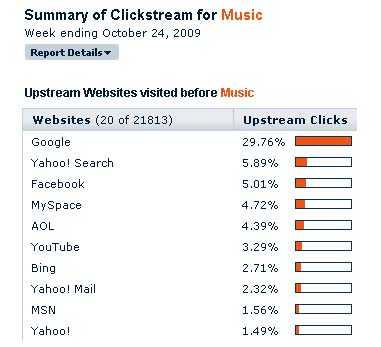
    As you might expect, Google’s a significant provider of traffic to music sites.  Heather Dougherty wrote, "Google was the top referral website to the Music category accounting for nearly 30% of the total traffic to the category last week, 5x more than 2nd ranked Yahoo! Search and 6.3x more than MySpace."


    If Google tries to take away what it’s given, things could get interesting, then.  A number of sites stand to lose a lot of traffic, chief among them Wikipedia, Yahoo Music, and MySpace.  Facebook and MTV Music make Hitwise’s top ten list, too.

    Still, in the grand scheme of things, Google’s music service may not mean a ton to the search giant.  Dougherty found, "Last week, Google sent 1.48% of their total visits to the Music category and of those visits," so it’s not like half or more of Google users are dying to hear more about bands.

    We’ll see what happens if/when the launch occurs.

    Related Articles:

    > Google Phone And Music Service Both On The Way?

    > Facebook, MySpace May Share Content

    > MySpace Introduces New Music Features

  • Are Kids Not Going Into Computer Science Because Their Parents Want Them To Be Sports Stars?

    There’s been some talk lately about how come not as many students are taking computer science in school, and someone over at Information Management online is suggesting that it’s all your parents fault for encouraging you to be a baseball star or a CEO or the next American Idol. This seems to be based on nothing more than a hunch, and the whole thing makes no sense to me. My guess is that most people who don’t go into computer science don’t do it because they’re not interested in it. I don’t think the answer is to tell your little slugger to put down the baseball bat and spend more time learning BASIC.

    Permalink | Comments | Email This Story


  • Customer Satisfaction With ISPs Rises

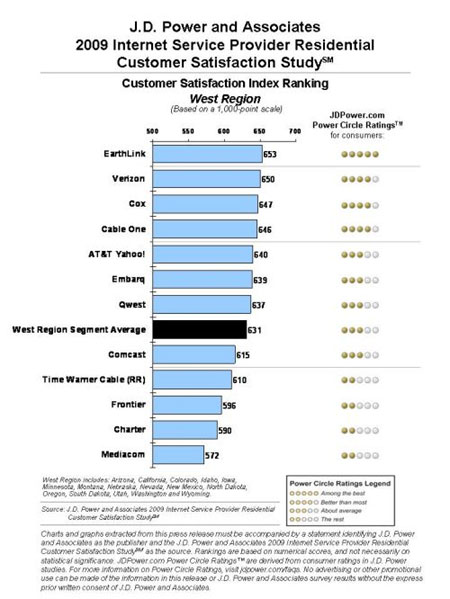
    Overall consumer satisfaction with high-speed Internet service providers (ISPs) has increased from 2008, mainly due to improvements in performance and reliability, according to a new report by J.D. Power and Associates.

    The study measures customer satisfaction with high-speed Internet service based on five factors: performance and reliability; cost of service; customer service; billing; and offerings and promotions.

    The study found that overall satisfaction with high-speed Internet service is 639 on a 1,000-point scale-an increase of 22 index points compared with 2008.

    "In many instances a household’s Internet connection acts as the backbone of its voice, video and information services, making the provider’s ability to provide a fast, reliable connection particularly critical," said Frank Perazzini, director of telecommunications at J.D. Power and Associates.

    ISP-Satisfaction
    ISP-Satisfaction

    "As households become more dependent on services provided via the Internet, eliminating outages and providing consistent connection speeds will become necessities in Internet service providers’ business models."

    Among customers who bundle services from their ISP, the most popular option is a combination of video and Internet services, selected by one-third of customers. The percentage of customers who bundle voice, video and data services has increased from 16 percent in 2008 to 19 percent in 2009.

    In addition, the proportion of customers who indicate they "probably will" or "definitely will" bundle their Internet service with other voice or video services in the next year has increased to 52 percent in 2009 from 43 percent in 2008.

    Other highlights from the report include:


    •     The proportion of high-speed Internet service customers who indicate they are loyal to their provider has increased by two percentage points from 2008, to 32 percent in 2009. Additionally, 66 percent of customers state they "definitely will" or "probably will" recommend their provider to others in 2009-an increase of four percentage points, compared with 2008.
    •  Among customers who contacted their service provider to resolve a problem or question, average hold times have decreased by nearly 30 seconds in 2009, compared with 2008.

    "Internet service may be considered the lynchpin of the bundled offering, serving to drive both customer loyalty and incremental sales opportunities," said Perazzini.
     

    "As competition for new customers increases among Internet service providers, retaining the existing customer base while promoting additional voice and video will continue to be critical."

    > Internet’s Possible Future In The US Gets Ready To Be Decided

    >ICANN Becomes More Independent

    > Domain Registrars Lose Accreditation


  • Google Voice

    Google launched Google Voice n March 2009 to help Internet users better manage their voice communications.  Initially, Google Voice was available to existing users of GrandCentral, a service Google acquired in July, 2007.  So, I have been waiting patiently for the past few months and was finally invited to try out the Google Voice Beta a month ago.

    Google Voice can be a useful service to simplify your phone communications. You can set various preferences–for example, calls from your colleagues get a custom answering message; calls from your parents don’t ring your work number; and calls from your spouse are answered directly when you pick up the phone rather than run through the Google Voice options such as answering the call, sending it to voice mail, or listening in on the voice mail.  Also, Google Voice allows you to get a single phone number that rings all your phones; screen callers before picking your phone; join several people for a conference call; record phone calls and store them online; read voicemail messages via email or SMS; forward, embed, or download voicemails; receive transcripts of your voicemail; send, receive and store SMS messages online; customize voicemail greetings for different callers; and block unwanted callers.  Furthermore, you can use the Google Voice to make international calls (paid service but quite inexpensive) and access Goog-411 directory assistance.  Specifically, I like to access my voicemail online and read the voicemail messages via email or SMS. I think it is easy to check e-mail for voice messages than traditional voicemail particularly when I am out of town.

    Until few days ago, you were required to select a new Google phone number when you first created a Google Voice account. But starting this week, you can get Google Voice with a Google number or with your existing mobile phone number. However, you will not get some features (like call screening, call recording, and call blocking) if you choose to use Google Voice with your existing number.

    If you want to try out Google Voice, you can request an invitation from Google or ask someone with a Google Voice account to invite you.  Also, you may check out the following videos before making the decision.


    Overall, I found Google Voice to be potentially useful even though the text-to-speech conversion is imperfect.  It would be great if Google allows forwarding Google Voice calls to an international phone number.  This is my wishful thinking.

    Posted in Telecommunications Tagged: communication, Google, phone, voice

  • Google to Give People More AdSense Filtering Options

    Back in August, Google gave AdSense publishers more control over what ads appear on their sites by launching an upgrading the category fitlering feature and extending the feature’s beta to the US and the UK.

    So in essence, if you don’t want certain kinds of sites showing up in ads on your site, you could block them. Google shows how the different ad categories contribute to your income, so you can take that into consideration.

    Today Google announced that it will be providing users with more ad filtering options. Soon, the option for 3 more filter categories will be added for a total of 8 different categories. These will be coming in the next few weeks.

    "To get started with category filtering, sign in to AdSense and visit the Ad Review Center, located under the AdSense Setup tab," says Google’s Arlene Lee. "You can choose from the listed categories, which include religion, politics, and dating, and your selections will be applied to ads in English no matter how they’re targeted."

    Ad Review Center

    "Please keep in mind that filtering ad categories may affect your AdSense revenue — we recommend first reviewing the percentages displayed in your account to understand the amount of revenue you may be blocking," she reminds users.

    Google says its continuing to work on additional filtering capabilities as well, but does not get into specifics. They are of course encouraging feedback.

  • Attention: Plex for Mac now plays well with Snow Leopard

    plexplex

    It’s been some time since I’ve written about Plex, the Mac-specific fork of XBMC that, well, is fantastic. It seems Snow Leopard somewhat borked the application, but the latest release is all fixed up. Have a peach.

    So the latest version, 0.8.3, fixes an issue that plagued the Apple remote control. Apparently the driver was such that it didn’t totally disable the OS X hooks. Like, you hit play on the remote from within Plex and then iTunes would start playing. That’s a giant pain, yes. But it’s fixed so there.

    There was also some sort of issue with non-5.1 audio sounding like garbage. Fixed, too.

    Hello exactly!

    via Lifehacker


  • Technology, Policy, Law, and Ethics Regarding U.S. Acquisition and Use of Cyberattack Capabilities

    Cover imageThe United States is increasingly dependent on information and information technology for both civilian and military purposes, as are many other nations. Although there is a substantial literature on the potential impact of a cyberattack on the societal infrastructure of the United States, little has been written about the use of cyberattack as an instrument of U.S. policy.
    Cyberattacks–actions intended to damage adversary computer systems or networks–can be used for a variety of military purposes. But they also have application to certain missions of the intelligence community, such as covert action. They may be useful for certain domestic law enforcement purposes, and some analysts believe that they might be useful for certain private sector entities who are themselves under cyberattack. This report considers all of these applications from an integrated perspective that ties together technology, policy, legal, and ethical issues.
    Focusing on the use of cyberattack as an instrument of U.S. national policy, Technology, Policy, Law and Ethics Regarding U.S. Acquisition and Use of Cyberattack Capabilities explores important characteristics of cyberattack. It describes the current international and domestic legal structure as it might apply to cyberattack, and considers analogies to other domains of conflict to develop relevant insights. Of special interest to the military, intelligence, law enforcement, and homeland security communities, this report is also an essential point of departure for nongovernmental researchers interested in this rarely discussed topic.