Author: Serkadis

  • Internet Hating Sony Pictures CEO Insists Piracy Is Killing Movie Business; But Facts Show Otherwise

    Ah, remember Michael Lynton? The Sony Pictures CEO who earlier this year insisted that nothing good had come from the internet at all. When everyone started mocking him for this statement, rather than back off, he doubled down and insisted it was true, using examples that were easily debunked. Apparently, he hasn’t learned his lesson. He’s back at it, pushing for the UK (and others) to pass laws kicking people off the internet (so-called “three strikes” laws) while insisting that due to piracy there’s less money to make movies and fewer movies being made. Of course, those are things that can be fact checked, and the folks over at TorrentFreak did exactly that, pointing out that more movies are coming out each year and more money is being made. Oops.

    The way Lynton tries to get around this is by not actually talking about how many movies are coming out, but just counting the number of movies that came out of “the leading studios.” I find this quite amusing, because in the podcast we discussed last week involving Paramount’s Scott Martin, part of his argument was that while the big studios were fine, the independents were all suffering and fewer movies were coming out because of it — and, as a “fan” of independent movies, he found that sad. I didn’t bother to check the numbers, but it appears that Martin was simply wrong. More movies are being made, and it looks like an increasing percentage of them are coming from smaller independent shops.

    The problem, again, seems to be that the folks at the movie studios (just like those at the record labels) only like to count the big hits as successes — rather than the smaller projects that actually make money and make up the majority of the actual market. It’s the same sort of thinking that makes movie studio people insist that we need to explain to them how they can keep making $200 million movies. That’s the wrong question. The question is how do you make profitable movies. The technology has advanced such that it’s cheaper and cheaper to make movies (which is why we have more of them). But notice that the studios never focus on ways to make movies in a more economical way, but how can they keep spending. Perhaps that’s a bigger problem than “online piracy.”

    Permalink | Comments | Email This Story


  • China: The Looming Giant

    While China’s Gross Domestic Product is currently less than half of the United States, China’s economy is expected to exceed the U.S.’s in just 15 years. Unlike the United States, China’s is working to dramatically increase its access to energy, both domestically and abroad. While the Obama Administration pulls back oil and gas leases,[1] halts a program to allow commercial oil shale leasing,[2] keeps new offshore energy exploration under lock and key,[3] and pushes for an energy tax under the name of cap-and-trade,[4] China is securing and expanding its energy resources around the world and at home.

    China’s Coal Consumption

    China already consumes more than twice the amount of coal as the U.S., but by 2025, its coal consumption is expected to be 3.7 times larger than ours[I1] . Reports suggest that China is building two coal-fired electric generating plants a week,[5] while the U.S.’s coal-based generating construction program is stymied by EPA reviews, re-reviews and legal delays. Forecasters have shown that under the climate change legislation currently working its way through Congress, U.S. coal consumption will be severely reduced and replaced by nuclear and renewable generating technologies, which are more costly forms of energy. And while China has professed that it will meet renewable generation goals, it will not partake in meeting targets for greenhouse gas reductions that will hurt its projected economic growth and its future status as a major world power.[6] Instead, China is willing to make reductions in greenhouse gas intensity (greenhouse gas emissions per unit of GDP), a measure proposed by the U.S. almost a decade ago, that allows for both economic growth and lower emissions per unit of GDP from improved efficiency and technology.[7]

    clip_image002

    Let’s compare energy consumption in China and the U.S. today to each country’s projected consumption in 2025. Data for 2006 is taken from the Energy Information Administration’s (EIA) International Energy Annual (IEA)[8] and the forecasts are taken from EIA’s International Energy Outlook (IEO)[9] for 2009. [10]clip_image004
    China’s Renewable Energy Production

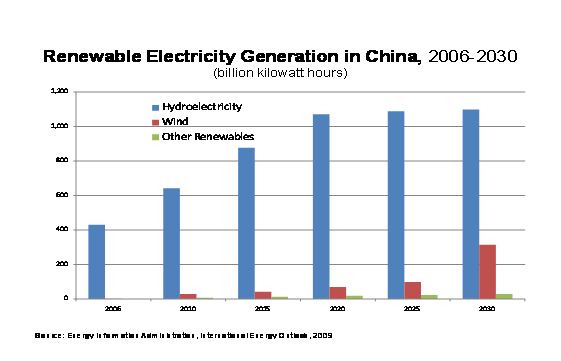
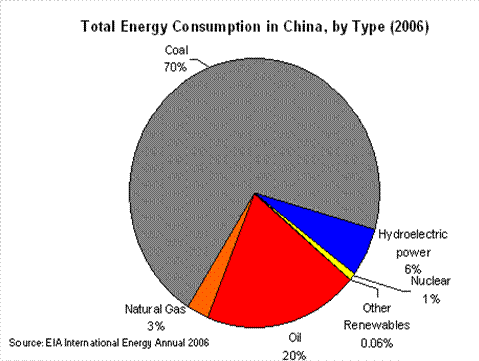
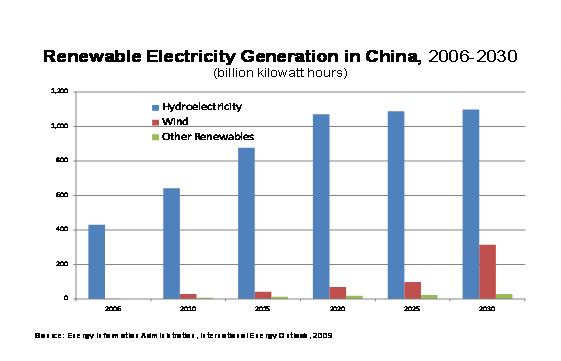
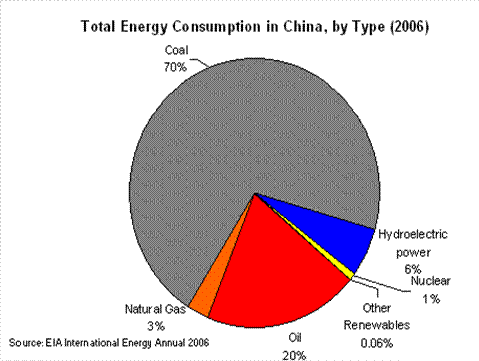
    China’s energy consumption today is dominated by coal, which supplies 70 percent of its demand, followed by oil, which supplies 20 percent. Renewable energy in China is largely hydroelectric power, particularly from the 18,200-megawatt Three Gorges Dam project, whose final generator went on line in October 2008. This project is the largest hydroelectric undertaking in the world. China has other hydroelectric projects planned, totaling an additional 57,720 megawatts of new capacity that will come on line in 2009. China has established a 30,000-megawatt target for installed wind capacity by 2020 (15 percent of its energy needs), and is currently installing wind power at a rate of at least 3,000 megawatts a year.

    However, wind growth in China isn’t without its problems. The Wall Street Journal reports that China’s transmission network currently can’t absorb such high rates of growth in renewable energy. Last year, as much as 30 percent of China’s wind power capacity wasn’t connected to the grid.[11] As a result, more coal is being burned in existing plants and new coal plants are being built as backup to wind energy. Wind resources do not conform to the normal hours of peak demand and require flexibility in the transmission and distribution system to take down other generators when the wind blows. Unfortunately, coal-fired capacity was not designed to be quickly taken on and offline as the electricity from wind fluctuates. clip_image006
    China’s electric generating sector today relies on coal for 79 percent of its generation and EIA only expects that figure to drop to 75 percent by 2030. China’s generating sector is also investing in nuclear power. Generation from nuclear power is expected to increase by 570 percent by 2025, according to the EIA. That increase is equivalent to an additional 40 gigawatts of new nuclear generating capacity—a lower forecast than some, who are reporting 60 gigawatts of nuclear power in China by 2020.[12]

    China’s Liquid Fuels Consumption

    China’s liquid fuel consumption is currently 7.2 million barrels per day, a rate of about a third of the United States. However, its projected growth far exceeds the U.S.; China is expected to increase its liquid consumption by 6.6 million barrels per day by 2025 (the largest growth of any country). At that time, China will consume about two-thirds of the U.S. level of liquids consumption. Unlike its vast coal reserves, China is not endowed with a lot of oil resources. Its oil reserves totaled 16 billion barrels in January 2009.[13] As a result, China has actively worked with other oil-producing countries (e.g. Venezuela, Angola). China has widely exchanged financial incentives for future access to oil supplies [14] including in U.S. waters in Gulf of Mexico.[15] China became the world’s second largest vehicle market in 2006, when sales exceeded those of Japan. In 2007, China produced nearly 8.9 million motor vehicles, an increase of 22 percent in production over 2006. China is the world’s third largest vehicle producer after the U.S. and Japan. The economic downturn reduced the growth in China’s vehicle sales to less than seven percent in 2008 and a lower rate is expected for 2009. Part of China’s economic stimulus package is expected to be used for infrastructure improvements in the transportation and electric power sectors.

    clip_image008

    China’s Natural Gas Consumption

    While China’s use of natural gas today is only at three percent, it is expected to triple its usage by 2025. Since China is not home to much of the World’s natural gas reserves (only 1.3 percent)[16], it will rely on imports to meet much of its natural gas demand. In 2030, EIA expects imports to make up more than one-third of China’s total natural gas consumption. To meet this growing need, China opened its first liquefied natural gas facility in 2006 and is expected to have a natural gas pipeline built by 2011 from Turkmenistan via Kazakhstan. Recently, Qatar has decided to divert around 10 percent of its liquefied natural gas exports to China from the United States because China is willing to pay more for the product.[17] It is a good thing that hydraulic fracturing has helped immensely to increase domestic U.S. supplies of natural gas, although the technology is currently being threatened by federal politicians, who are looking to restrict its use.[18]

    China’s Carbon Dioxide Emissions

    As fossil fuels represent 93 percent of China’s current energy demand, it is not surprising that China ranks first in carbon dioxide emissions in the world, with 6,018 million metric tons released in 2006. By 2025, that number is expected to increase to 10, 707 metric tons, an increase of 78 percent from its 2006 value and 75 percent higher than expected carbon dioxide emissions in the U.S. in 2025.

    clip_image010

    Bottom Line

    China wants to become the world’s largest economic power, and China’s leaders understand the fundamental reality that abundant supplies of affordable, reliable energy are essential to economic growth. This is in stark contrast to the U.S. government’s actions to severely limit access to our domestic energy resources and the current proposals to tax carbon dioxide emissions from about 85 percent of our energy (oil, coal, and natural gas) through cap-and-trade. Unlike the United States, China is ambitiously pursuing energy policies to make sure its people have enough energy to grow their economy and make their lives better.


    [1] Paul Foy, Interior Secretary Sued for Revoking Utah Leases, ABC News, http://abcnews.go.com/Business/wireStory?id=7592093.

    [2] Daniel Whitten, Salazar to rewrite Bush oil-shale plan, Bloomberg News, http://www.chron.com/disp/story.mpl/headline/biz/6280852.html.

    [3] Jim Tankersley, Salazar puts expanded offshore drilling on hold, L.A. Times, http://articles.latimes.com/2009/feb/11/nation/na-offshore-drilling11.

    [4] Institute for Energy Research, President Obama’s Budget includes $1.6 trillion in new taxes—the largest tax increase in history, http://www.instituteforenergyresearch.org/2009/02/26/president-obama-budget-includes-16-trillion-in-new-taxesthe-largest-tax-increase-in-history/.

    [5] Roger Harrabin, China building more power plants, BBC News, http://news.bbc.co.uk/2/hi/6769743.stm.

    [6] Institute for Energy Research, Lost in Translation, http://www.instituteforenergyresearch.org/2009/07/28/lost-in-translation/.

    [7]http://online.wsj.com/article/SB125409730711245037.html

    [8] http://www.eia.doe.gov/iea/

    [9] http://www.eia.doe.gov/oiaf/ieo/index.html

    [10] EIA is an independent statistical agency within the U.S. Department of Energy that forecasts future energy outlooks for the U.S. and the world.

    [11]http://online.wsj.com/article/SB125409730711245037.html

    [12] http://www.eenews.net/Greenwire/2008/12/23/

    [13] “Worldwide Look at reserves and Production,” Oil and Gas Journal, Vol. 106, No. 48 (December 22, 2008), pp23-24.

    [14]Venezuela signed a $16 billion investment deal with China over three years. The deal could raise oil output by several hundred thousand barrels a day. http://www.eenews.net/Greenwire/2009/09/18/

    China National Petroleum Corp. received a $30 billion low-interest loan from a state-run bank to finance overseas acquisitions, Beijing’s latest bid to secure mineral resources to fuel the country’s burgeoning economy. http://www.eenews.net/Greenwire/2009/09/09/

    CNOOC and Sinopec have agreed to buy a 20 percent stake in an oil field off the coast of Angola for $1.3 billion, the latest in a series of Chinese acquisitions of overseas energy and mining assets. http://www.eenews.net/Greenwire/2009/07/20/

    [15] David Pierson, China’s push for oil in the Gulf of Mexico puts U.S. in awkward spot, L.A. Times, http://www.latimes.com/business/la-fi-china-oil22-2009oct22,0,2776603.story?track=rss.

    [16] “Worldwide look at Reserves and Production,” Oil and Gas Journal, Vol. 106, No. 48 (December 22, 2008), pp. 22-23.

    [17] Reuters, “Qatar diverts LNG to higher-paying China from U.S.”{, October 27, 2009, www.reuters.com/article/companyNews AndPR/idUSLR15622520091027

    [18] “States to U.S. Congress: Hands Off Hydraulic Fracturing”, May 19, 2009, www.energyindepth.org/2009/05/1005/


  • RIM and Apple top U.S. Smartphone market share

    Apple_RIM_Marketshare

    Who’s ready for some statistics? This September ChangeWave Research conducted a poll of smartphone users in an attempt to gauge the market share impact (if any) of new and announced devices from Apple, Palm, and RIM. We’ve combed over the article and picked out some juicy tidbits for your reading pleasure. According to ChangeWave, 39% of people polled currently own a smartphone. Of that sample, 77% own either an Apple, Palm, or RIM branded device (I know, we’re curious about the other 23% as well). RIM polled the largest portion of U.S. market share with 40% followed by Apple at 30% and Palm with a measly 7%. Apple did top the customer satisfaction poll as 74% of iPhone users described themselves as “very satisfied” with their purchase; compare that with RIM at 48% and Palm at 33%. The iPhone also ranked first in future purchases plans of those polled who did not currently own a smartphone, but plan to purchase one in the next 90 days. Also 36% indicated a preference towards the iPhone, 27% towards the BlackBerry, and 8% towards Palm. Any BGR peeps out there with plans to upgrade to a smartphone in the near future? What are you leaning towards? D-D-D-DROID?

    [Via The iPhone Blog]

    Read


  • Quick Look: Creating and Using Site Specific Browsers

    ssb-intro

    The advent of the cloud over the past few years has meant that a lot of the tasks that we were used to doing on our Mac have now moved to the web. This brings with it a host of issues, from data ownership to reliability of services (see recent Sidekick fiasco) and whether the web can deliver a Mac-like experience.

    Putting all that aside, however, a more mundane problem is managing all of those sites and getting to them quickly and easily. Individual apps conveniently come with their own icon on your dock, web apps do not, forcing you to dig through the myriad of open tabs in your browser to find the app you need.If you’ve truly made the jump to cloud computing there is, thankfully, a better way: site specific browsers (SSBs). The basic idea is simple: Create a separate web browser, complete with its own icon on the dock, to browse to a single site. We’ve covered an excellent example of a site specific browser here on TAB in the past, Mailplane, which is used to access Gmail’s online interface.

    The beauty of an SSB is not only do you get the bonus of neatly having your own icon for a single web application, but it also allows that site to integrate with OS X more completely. For example you can have things like address book access and dock badges, all things that Mailplane does for Gmail.

    That’s great if you use Gmail, but what about all the other great web-based applications out there? Although there are not specific SSBs for things like Twitter, Google Calendar, Remember The Milk and other web services, there are two different programs that will let you take any web site and turn it into a site specific browser: Fluid and Prism. The major difference between the two is that Fluid uses Webkit to power its SSBs, while Prism uses the Gecko browser base that runs Firefox.

    fluid_screen

    Aside from these underlying technologies, the two programs offer remarkably similar functionality. Simply enter a web address, choose an icon (or just use the site favicon), and voila, a new program based on that site will be created for you. What’s more, each browser can accept various scripts to add functionality like a dock icon and even Growl notifications. You can even make an SSB your default email or RSS program.

    In many ways SSBs may represent the future of computing. Just look at Google’s upcoming Chrome OS, where the browser is the operating system. In such a situation it makes no sense to continue using the outdated system of web pages and browser bookmarks. When a website is a program unto itself you can argue that it deserves to be treated as one at the operating system level.


  • Spooky sounds from your Telecaster

    Do not adjust your computer because Bill Ruppert has put together a nice set of sound effects using only EHX pedals and some creativity. I love how he makes a clock sound with just the pick-up switch and then adds in some bells for spooky effect.

    You can see all of Bill’s gear here but I doubt we’ll be able to recreate his sweet tones without years of practice and fifty full listens to the Chilling, Thrilling Sounds of the Haunted House, an album that I used to own.


  • Hands on with the Motorola Droid: Sexy

    scaled.IMG_0140

    Here you are, friends and Romans, the Motorola Droid from Verizon, the phone you’ve been salivating over for the past few months. It’s now sitting quietly on the desk next to me, wondering where you are. The Droid wants you.

    After working with the Motorola Cliq and MotoBlur, Motorola’s own operating system, I had high to middling hopes for this phone. Looking at it now I’m happy to report that Verizon finally has an Android phone worth a second look.

    I need a little more time with the phone to offer my full level of adulation/excoriation, but so far I’ve noticed a few things:

  • Google Nagivation is an incredible addition to the Android family and looks great. The standalone Nav app guys need to worry.
  • The hardware is quite nice. The keyboard is spacious and easy to slide open.
  • There are none of the widgets that MotoBlur featured prominently including the Twitter widget that threatened to crash the phone.
  • The phone is very polished but the base of installed applications seems very sparse. After working with the Hero and the Cliq, you sort of expect all sorts of silly clocks and social networking apps. This has none of that.
  • It has the best start-up sound in the whole world.


  • More pics and facts about the new DROID by Motorola

    DROID by Motorola Dyn L Horiz

    Today is the International Day of the DROID. Well, not really, but Verizon did follow through and officially announced its new flagship Motorola Android device – DROID.

    Along with the official presser, Motorola was also kind enough to provide some glistening press shots of the DROID, “A no-compromise supergenius” as they like to call it, along with an official DROID by Motorola Fact Sheet (all after the jump).


  • Bad Vista-to-Windows 7 upgrade experiences #1: ‘Hosed’ Intel SSDs

    By Scott M. Fulton, III, Betanews

    Although we had good reason to expect that most folks’ experiences with Windows 7 upgrades this past week would be, as we put it, “without the crap,” the exceptions are starting to show up. One of the more serious cases involves Intel, which has withdrawn its latest solid-state drive firmware update after multiple reports from disgruntled users of complete storage system failure following their Windows 7 upgrades.

    The new firmware, along with Windows 7, was supposed to support a new internal file management methodology called TRIM. Its purpose was to compensate for a problem typical of memory-based storage, as opposed to traditional magnetic disks: Since memory systems must keep track of their contents even some of those contents aren’t really in use, over time, SSDs’ performance can lag. While traditional disks don’t have to retain a memory of the contents of sectors pointing to “deleted” files, SSDs do…and they can’t wipe the contents of those sectors individually. Instead, they have to wait until entire blocks become disused — which happens less and less often as drives become more and more fragmented. TRIM was supposed to overcome that deficiency with a kind of self-optimizing mechanism, letting SSDs wipe blocks more often, thus overcoming lags and keeping performance levels high over time.

    The trouble appears to be that something in the Windows 7 RTM distribution wasn’t ready for TRIM after all. Though Windows 7 appeared to work fine just after installation, soon afterwards, Intel SSD owners were finding they couldn’t sustain a reboot.

    “I removed the drive and put it in an external case and went to the desktop. Guess what, the partition was raw!” reported one contributor to Intel’s support forum early this morning. “Deleted the partitions and reinstalled Windows, and that seemed to do the trick. After an hour or two, a message came up and said that my drive was about to fail and S.M.A.R.T. reported it bad!”

    That contributor was joined by a flood of similar reports all over the major hardware forums. On HardForum Monday, there was this: “I’ve scared myself off of SSDs for a few years and would probably never touch an Intel SSD again. I’ll gladly take a 5% real-world performance hit for a drive that doesn’t have a history of bricking itself when a firmware update is applied.”

    The firmware update was part of a comprehensive SSD Toolkit from Intel released just last Monday, which had promised to boost write speeds by as much as 40%. As company marketing director Pete Hazen said at the time, “We are encouraging our 34nm customers to download the new firmware update today. Not only will Windows 7 users receive the performance enhancements of the Trim command, but so will our Windows XP and Vista users.”

    Reviewers of the TRIM firmware appeared to confirm that figure and did not report problems. One of those positive reviewers was Anandtech, which was also first to update its TRIM review with Intel’s comment that it was pulling the firmware update due to problems. Up to that point, commenters’ complaints had focused on Intel’s lack of willingness to extend TRIM support to owners of older SSD models, which cost much more in the early going than they do now. As one contributor noted, “I don’t think that you should lose the wiper and TRIM support for being an early adapter, it does not make sense.”

    PC Perspective’s Allyn Malventano believes the drive-hosing issue must not be widespread, noting it did not happen to him during his review, which involved an Asus P6T motherboard with an Intel Core i7 920 CPU.

    Copyright Betanews, Inc. 2009


    Add to digg
    Add to Google
    Add to Slashdot
    Add to Twitter
    Add to del.icio.us
    Add to Facebook
    Add to Technorati


  • Monomoy-Backed Fortis Plastics Adds On

    Monomoy Capital Partners has acquired the assets and operations of Nypro Chihuahua, a 100,000 square foot plastic molding facility located in the largest industrial corridor near the border between the United States and Mexico. No financial terms were disclosed. Nypro Chihuahua will operate as part of Fortis Plastics LLC, an acquisition platform formed by Monomoy in 2007, via acquisitions from Leggett & Platt and Atlantis Plastics.

    PRESS RELEASE
    Monomoy Capital Partners, L.P., a New York private equity fund that makes controlling investments in middle market companies, announced today that it has acquired the assets and operations of Nypro Chihuahua, S. De R. L. De C.V. from Nypro, Inc. Terms of the transaction were not disclosed.

    The Chihuahua acquisition was completed under Monomoy’s Fortis Plastics, LLC platform, a leading plastic injection and extrusion business that Monomoy formed in late 2008 through acquisitions from Leggett & Platt, Inc. and Atlantis Plastics, Inc. Fortis currently operates a resin compounder and eight regional molding facilities, including a large and growing operation in Ramos, Mexico.

    Nypro Chihuahua operates a state-of-the-art, 100,000 square foot plastic molding facility located in the largest industrial corridor near the border between the United States and Mexico. Fortis will focus on expanding the Chihuahua operation by extending its products and capabilities to Fortis’ current customer base of appliance, medical device, building products and furniture makers. The Chihuahua acquisition also provides Fortis with high-quality painting, decorating and clean room capabilities.

    “We are extremely excited about this transaction,” said Joseph Mallak, the Chief Executive Officer of Fortis. “The Chihuahua operation will increase the size of our growing Mexican platform, provide us with a great facility located in an important Mexican manufacturing zone and further differentiate Fortis in the marketplace. The acquisition will help current and future customers consolidate their supply chains and allow Fortis to continue its growth in the southern United States, Mexico and Latin America.”

    The Chihuahua transaction marks the third Monomoy acquisition for its Fortis platform over the past twelve months. “Fortis has grown its Mexico operation substantially over the past year despite a difficult economic environment for all manufacturers. The Chihuahua acquisition will allow Fortis to capitalize on this success and provide its customers with stronger options as the plastic molding industry consolidates,” said Mayank Singh, a Monomoy Vice President.

    About Monomoy Capital Partners, L.P.

    Monomoy Capital Partners, L.P. is a $280 million private equity fund that makes controlling investments in middle market companies. The Fund has completed 25 transactions in four years in the smaller end of the middle market and currently owns 10 business that collectively employ more than 5,000 people. Monomoy implements customized business improvement programs in all portfolio companies that reduce operating expenses, increase profitability and encourage meaningful growth. For additional information on Monomoy and its portfolio companies, please visit www.mcpfunds.com.

    About Fortis Plastics, LLC

    Fortis Plastics, LLC is a leading manufacturer of injection molded and extruded plastic parts for a variety of industries, ranging from appliances and power tools to furniture and medical devices. Fortis currently employs 950 team members at facilities located in Fort Smith, Arkansas, Carlyle, Illinois, Poplar Bluff, Missouri, Henderson, Kentucky, Jackson, Tennessee, South Bend, Indiana, Houston, Texas, Ramos, Mexico and Chihuahua, Mexico. Fortis provides its customers with a single solution for tooling, molding and material compounding. For additional information on Fortis, please visit www.fortisplasticsgroup.com.

    ShareThis


  • Motorola and Verizon unveil the Droid, Google Maps navigation

    By Tim Conneally, Betanews

    Verizon Droid by Motorola, open

    After a long period of rumors, leaks and teaser marketing campaigns, Verizon and Motorola have officially announced Droid, Verizon’s first Android smartphone, and the first Android device running Eclair. It will be available on Friday, November 6, for $199 with a two year contract and mail-in rebate.

    Motorola’s Contribution:

    In addition to pricing and availability, the complete list of specs that was leaked a bit early (and subsequently yanked) has been published by Motorola. It can now officially be said that Droid is nearly identical in size to the iPhone 3G S, with a screen 0.2″ larger, and a body only 0.02″ thicker despite having a full QWERTY keyboard.

    The slim Droid has a 3.7″ (480×854) WVGA capacitive touchscreen, and includes a 16 GB memory card which can be replaced by microSD cards up to 32 GB. Today’s announcement unfortunately does not include processor speed (listed as 550 MHz in leaks) or clarify whether it includes a discrete graphics chip as many had speculated.

    Verizon Droid by MotorolaWhat it does include is EV-DO rev. A 3G, 802.11 b/g Wi-Fi, Bluetooth 2.1 +EDR, a 5 megapixel autofocus camera with dual LED Flash and digital image stabilization and DVD-quality video recording, aGPS and standalone GPS, a 3-axis accelerometer, and 6.4 hours of talk time or 11.25 days of standby.

    Google’s Contribution:

    With yesterday’s launch of Eclair in the Android SDK, we got to see a number of the new APIs made available to developers in addition to some interface and support improvements that Droid will offer, such as HTML5 and Flash 10.

    But we kept seeing “navigation by Google Maps” in early Droid announcements, with little information as to what this represented. Today we’ve found out that Droid will launch with free navigation from the new Google Maps for Android 2.0 beta. It combines “plain English” voice command, turn-by-turn directions and its unique Street View perspective which is unlike any other GPS device currently available.

    Verizon’s Conribution

    In addition to providing the 3G Network infrastructure that Google CEO Eric Schmidt is so fond of, Verizon is equipping the Droid with Verizon Visual Voice Mail. When T-Mobile launched the G1, visual voicemail was not an option until third parties such as YouMail and Phonefusion made apps providing the functionality. It was not until considerably later that T-Mobile Visual Voicemail was an option presented to Android early adopters.

    Droid will be available exclusively at Verizon Wireless stores and through Verizon’s Web store on Friday, November 6.

    Copyright Betanews, Inc. 2009


    Add to digg
    Add to Google
    Add to Slashdot
    Add to Twitter
    Add to del.icio.us
    Add to Facebook
    Add to Technorati


  • It’s a desk! It’s a tricycle! It’s $500!

    sdesk

    I’m a simple man. I don’t ask for much, I try to do the right thing. So why must everything I want be priced at $500? Take this mobile desk, for example: part tricycle, part desk, all awesome (except the price tag, of course).

    Andrew Liszewski of OhGizmo! says that he wants this thing for his next trade show. I know exactly how he feels. I’d trade a little bike seat chaffing for swollen, blister-ridden feet at CES this January. And there’d be the added bonus of impromptu desk races every time the two of us bumped into each other on the show floor.

    There’s a two-person version available for $1000 as well, which offers a savings of zero dollars over the single version yet takes up more space. And if you have a big person and a small person trying to maneuver it around, it’d probably just keep spinning in circles due to the variation in available leg thrusting power.

    Mobile Desk [OpulentItems.com via OhGizmo!]


  • Google Delivers GPS for Android 2.0 Devices

    Google has launched Google Maps Navigation for Android 2.0 devices in beta. This acts as a GPS navigation system with 3D views, turn-by-turn voice guidance, and automatic rerouting.

    "But unlike most navigation systems, Google Maps Navigation was built from the ground up to take advantage of your phone’s Internet connection," says Google Software Engineer Keith Ito.

    Because of that Internet connection, Google provides seven features that are available:

    1. The most recent map and business data
    2. Ability to search in plain English
    3. Ability to search by voice
    4. Traffic View
    5. Ability to search along a route
    6. Satellite View
    7. Street View

    The following video demonstrates how Google Maps Navigation functions:

    GPS users may find the "search along route" feature to be particularly helpful. It is designed to let you search along your route to give you results that will keep you near your path. You can search for specific businesses by name or type and turn on popular layers such as gas stations, restaurants or parking. Since Google will provide the most recent map and business data, this is likely to be a more efficient tool than similar options from other GPS systems.

    Verizon’s Droid is the first phone to have the Google Maps Navigation and Android 2.0. Google Maps Navigation is only available in the U.S. currently. More information on the feature can be found here.

    Related Articles

    > Google Makes Biggest Design Changes to Maps Yet

    > Google Updates Maps with New Dataset

    > Google Revamps Mobile Local Search Experience

  • Celtic Therapeutics Raises $100 Million from PPD

    Celtic Therapeutics, a private equity firm formed to acquire and invest in a diversified portfolio of 10 to 15 novel therapeutic product candidates, has received a $100 million investment commitment from PPD Inc. (Nasdaq: PPDI).

    PRESS RELEASE

    PPD, Inc. (Nasdaq: PPDI) today announced it has signed an agreement to invest $100 million in Celtic Therapeutics Holdings L.P., an investment partnership organized for the purpose of identifying, acquiring and investing in a diversified portfolio of 10 to 15 novel therapeutic product candidates. Celtic Therapeutics will focus on mid-stage drug development candidates that have progressed through human proof-of-concept studies and are targeted to address unmet medical needs, seeking to advance development of these candidates to the next key product milestone, usually the beginning or end of Phase III.

    This investment in Celtic Therapeutics is intended to set the stage for a strategic alliance between Celtic Therapeutics and PPD. Both organizations are committed to forging a new framework for timely, cost-efficient drug development. As a result, PPD believes these efficiencies will lead to higher quality data and overall markedly reduced timelines. The goal of the alliance is to bring the best products to market more quickly to meet unmet needs of patients. PPD believes it will benefit Celtic Therapeutics’ mid-to-late stage pipeline across the board.

    “Built upon the leadership and track records of Stephen Evans-Freke and Peter B. Corr, Celtic Therapeutics has a team of seasoned drug development professionals we believe is capable of building one of the most highly valued late-stage portfolios in the global biomedical industry,” said Fred Eshelman, executive chairman of PPD. “As pharmaceutical companies continue to face extraordinary regulatory and market-related challenges in creating and expanding their drug development pipelines, Celtic has developed an innovative, product-focused investment model to address these challenges.” 

    Stephen Evans-Freke, Celtic Therapeutics’ co-founder and general partner, said, “It is our great pleasure to welcome PPD as a partner. In particular, we are delighted one of the most forward-thinking clinical research organizations has chosen to join forces with us.”

    Peter B. Corr, Celtic Therapeutics’ co-founder and general partner, added, “The present approach to drug development has become too expensive and time consuming. We look forward to working innovatively with PPD on new approaches for rapid planning, decision-making and execution of our drug development programs worldwide. We are delighted Fred Eshelman and his team will be working with us in this endeavor.”

    PPD anticipates it will account for this investment under the equity method of accounting.
     
    PPD is a leading global contract research organization providing discovery, development and post-approval services as well as compound partnering programs. Our clients and partners include pharmaceutical, biotechnology, medical device, academic and government organizations. With offices in 38 countries and more than 10,000 professionals worldwide, PPD applies innovative technologies, therapeutic expertise and a commitment to quality to help its clients and partners maximize returns on their R&D investments and accelerate the delivery of safe and effective therapeutics to patients. For more information, visit our Web site at http://www.ppdi.com.

    ShareThis


  • Vitamin Shoppe Jumps In IPO Debut

    NEW YORK (Reuters) – Vitamin Shoppe Inc (VSI.N) shares soared in their first trading session after the health supplement retailer’s IPO priced above expectations and became the first U.S. retailer to go public in two years.

    Its shares were up 16 percent to $19.67 on the New York Stock Exchange, after rising as much as 19 percent shortly after the opening bell.

    Vitamin Shoppe sold 9.1 million shares for $17, more than the expected range of $14 to $16. The chain will get net proceeds of $121 million from the IPO which it will use for the redemption of preferred shares and paying down some of its debt.

    Vitamin Shoppe, a North Bergen, New Jersey-based operator of 434 health supplement stores in the United States, became the first brick-and-mortar retailer to go public since the Oct. 2007 IPO by beauty products chain Ulta Salon, Cosmetics & Fragrance Inc (ULTA.O).

    Vitamin Shoppe’s sales rose at an annual clip of 11.3 percent between 2005 and 2008, when they reached $601.5 million. During that time, it opened 171 new stores, according to its prospectus. The company has been profitable since 2006.

    In its prospectus, Vitamin Shoppe estimated it could eventually reach 900 stores in the United States.

    The Vitamin Shoppe IPO is being managed by JP Morgan, Bank of America Merrill Lynch and Barclays Capital. The underwriters will have the option of buying another 1.4 million shares from Vitamin Shoppe’s selling shareholders. (Reporting by Phil Wahba; Editing by Derek Caney)

    ShareThis


  • Strato Auction Down to Three, Bridgepoint In Lead

    (Reuters) – Three bidders remain in the auction of German web hosting firm Strato, which has been put up for sale by German phone company freenet AG (FNTGn.DE), two banking sources said on Wednesday.

    Freenet said in June it hopes to raise between 300 million euros ($445.1 million) and 400 million from the disposal.

    Private equity firm Bridgepoint Capital is still in the frame along with two trade buyers, the bankers said.

    German daily Financial Times Deutschland earlier reported without citing sources that Deutsche Telekom AG (DTEGn.DE), freenet shareholder United Internet AG (UTDI.DE) and Bridgepoint were among those bidding.

    A bank meeting was held earlier in October about a possible club loan financing to back a deal.

    Strato is a well known company in Germany and banks are willing to provide financing, one of the sources said.

    Freenet wants to conclude the sale this year and is aiming to sign the deal by the end of November, Freenet’s CEO Christoph Vilanek told Reuters in an interview. [ID:nLR448795]

    Strato’s earnings before interest, tax, depreciation and amortisation (EBITDA) are able to support leverage of around three times, a banking source said previously.

    Freenet became Germany’s third-largest mobile phone operator after taking over Debitel for 1.63 billion euros in April 2008, in line with a strategic focus on its mobile business. (Reporting by Alasdair Reilly & Zaida Espana; Editing by David Holmes) ($1=.6740 Euro)

    ShareThis


  • Buyout Firms Jostle for Discount Retailer Matalan

    LONDON (Reuters) – Private equity firms are vying to get on a shortlist of potential buyers for discount retailer Matalan, which could fetch up to 1.5 billion pounds ($2.46 billion), sources familiar with the matter said.

    European buyout house CVC kicked off interest in the retail empire majority-owned by founder John Hargreaves and has since been followed by other private equity suitors, including TPG and Cinven, sources said.

    Advent International, whose investments include British budget store chain Poundland and German fashion retailer Takko, is also hoping to make it on the shortlist, another source said.

    The buyout firms and Matalan declined to comment.

    Matalan has not kicked off a formal process but has asked long-term adviser PWC to investigate a possible sale, which could see a short field of potential buyers assembled.

    “(PWC) wants to invite people into quite a tight process,” said a source, adding he expected a sale to kick off this quarter.

    Despite the flurry of interest from buyout houses, some were sceptical the business could achieve the 1.5 billion pound valuation. A source close to one of the potential bidders said the figure was too high.

    Bankers expect Blackstone (BX.N) and KKR will be interested in the business. Both firms declined to comment.

    PWC confirmed it was working on a possible sale but declined to comment on the process. (Additional reporting Victoria Howley; editing by Jon Loades-Carter) ($1=.6107 Pound)

    ShareThis


  • Picking Your Online Reputation Battles

    Part of managing your online reputation involves your strategy for handling the negative commentary that you acquire. If you write articles on the Internet, use Facebook, Twitter, or other social media outlets, or simply have a prodcut that people talk about, there is a very good chance you will encounter comments somewhere on the web that are less than favorable.

    That’s just the nature of the game. Some people choose to go on the defensive and immediately get caught up in a so-called "flame war." Others just ignore them. You may do a mixture of the two. The right call really depends on the nature of the comment and its potential impact on your brand or product.

    Negative commentary has been discussed throughout the industry a lot lately. It was a common theme at the recent BlogWorld Expo. Rebecca Kelley, Director of Social Media for 10e20, has written a humorous post on the subject for Jeremy Schoemaker’s ShoeMoney blog.

    "The fact of the matter is that the Internet is like a great big public bathroom stall," she says.  "Sometimes it’s clean, unassuming and well-stocked with supplies, but most of the time there’s piss on the floor, a deuce in the toilet, no toilet paper, and various atrocities scrawled onto the walls."

    "Some people avoid them at all costs, electing to hold it until they get home," she adds. "Others put up with them, going in and out to do their business and not letting it affect their day-to-day lives."

    Clearly Kelley looks upon the subject with a good deal of amusement. She’s not alone. Have you heard of The Bloggess? She’s a popular blogger and shares this sentiment:

    I think it’s safe to say that both of these women have been pretty successful on the Internet, so it may be worth paying attention to the fact that they do not take negative commentary too seriously.

    There’s no question that online reputation management is an important aspect of online marketing and keeping a favorable reputation to facilitate future business. That said, it’s generally not worth getting too worked up over somebody’s name calling or differing points of view. Sometimes you just have to choose your battles. Worry about the ones that have the greatest chance of damaging your brand.

    Related Articles: 

    > Baby Food Recall Shows Reputation Management Done Right

    > Killing Bad Search Results with Reputation Management

    > Fighting a Bad Online Reputation & Keeping a Good One

  • That’s Rich: China Accuses Google Of Censorship

    China, of course, is famous for massive censorship of the internet. Google, on the other hand, is well known for fighting censorship in many cases. Even in China, where it was required to block some searches, Google tried to take as permissive an approach as possible, even letting users know when a site was being blocked (yes, this was quite controversial, but the company did more than many other search engines). So, it does seem a bit surprising to see a headline claiming that China is accusing Google of censorship. Isn’t that backwards?

    It isn’t “China” so much as it’s the Chinese Communist Party’s main newspaper (so, basically, the paper of record from the government) claiming that Google is not finding a report it put out suggesting that Google’s book searching project might violate Chinese authors’ copyrights. Of course, that claim is a bit amusing as well, given China’s general attitude towards copyright over the last couple of decades… but that’s another story.

    Google claims that it did no censorship at all, and that there was an automated block put on the site via its StopBadware service, which makes sense. Google has long used StopBadware to try to protect users from malware sites, and the service does sometimes make errors. While it seems unlikely that Google would purposely block the report, that doesn’t make it any less strange for a Chinese government publication to accuse Google of censorship. Given the government’s happy embrace of censorship, how does it have any sort of moral claim here?

    Permalink | Comments | Email This Story


  • FCC considering taking some TV spectrum, auctioning it off for wireless broadband

    fccbb

    More FCC news for you, this Wednesday morning (and before Droid news consumes us all). The agency is considering taking some of the bandwidth that is currently allocated to digital television, and auctioning it off so that broadband companies can bid on it. The point, of course, is to increase the availability of wireless broadband.

    There’s a few sides here, each with some valid points. You’ve got the current TV station owners who, as you might expect, don’t want to lose any spectrum, even if you compensate them with giant bags of money. Then there’s the broadband companies who are all, “Please oh please let us have the spectrum, so we can create some new broadband service, and sit back and watch the money roll in.” You’ve got people who are against the move because it might put in jeopardy the spectrum that the federal government spent billions of dollars convincing people to switch to (the switch to digital TV). And then you’ve got people who just hate the FCC, and think that regulating the Internet isn’t even part of its charge.

    It’s important to keep in mind that, by definition, the spectrum belongs to all of us, as citizens. It should be used in such a way that is beneficial to the most citizens and not just a handful of TV station owners, for example.

    Now, will this even happen, auctioning off some spectrum so that broadband companies will bid? It might happen, but no rules will be put in place till February at the next big FCC meeting.

    A strong argument in favor of this: broadband access is simply more useful than traditional TV. You can only watch TV, which is fine. With broadband, you can watch, sure, but you can also participate (in debates relevant to you: PS3 vs. Xbox, the public option vs. something else, etc.), which is vital to having a fully informed citizenry.

    But don’t freak out: the FCC can say, come February, “Yeah, we can’t do that broadband spectrum auction thing. Sorry. Next question.”


  • The Digital Media Hot List Is Missing Some Heat

    image001Adweek today released its annual list of the hottest 10 digital media companies, some of which stretch the definition of digital media (iPhone, anyone?). The list shows some interesting bias, dumping Google to the No. 4 slot from last year’s No. 1 position primarily because its search algorithms aren’t people-powered like Facebook (No. 1) or real-time like Twitter (No. 3). The ranking also seems focused on what’s been hot for the last year, but it’s missing some big innovations that are getting hotter, like Google’s Android mobile OS or a company that’s pushing the envelope on offering location. I’d suggest Skyhook.  The complete list, below the fold:

    1. Facebook
    2. Hulu
    3. Twitter
    4. Google
    5. iPhone
    6. Huffington Post
    7. Bing
    8. WSJ
    9. Federated Media
    10. Viacom’s AddictingGames.com