Author: Serkadis

  • Toyota’s rating drops in Moody’s and Forbes’ world leading companies

    Toyota

    International rating agency Moody downgraded Toyota and its subsidiaries by one notch Thursday over the company’s recall woes and its trouble with the U.S. government. The prior rating of Toyota was Aa1, which has now been dropped to Aa2.

    “We do not take this rating change lightly,” said Toyota spokesman Paul Nolasco. “We plan to aim for an improved rating by making the best management decisions we can with customer trust as our top priority.”

    The rating is still relatively strong but the change shows the agency’s concern over the 8 million vehicles Toyota recalled worldwide.

    Toyota’s rating also fell on the annual Forbes Magazine list of the world’s leading companies. It was number 3 last year and this year it fell to 360.

    – By: Omar Rana

    Source: CNNMoney


  • Deep Silver, Techland announce nail’d

    Deep Silver has announced a new arcade racing game called nail’d for PS3, PC, and Xbox 360. Hit the jump for details and a video.

  • Jaguar launches 5-year/50,000 free scheduled maintenance for 2011 models

    2011 Jaguar XJ

    Going along with the launch of the new 2011 XJ sedan, Jaguar announced today that it is launching a free scheduled maintenance program for all 2011 models. Known as the “Jaguar Platinum Coverage” customer care, the coverage will give all 2011 Jaguar U.S. and Canada owners increased vehicle warranty and a strong maintenance plan.

    The new Jaguar Platinum Coverage features a five year/50,000 mile new vehicle limited warranty and complimentary scheduled maintenance for the duration of the warranty period, including no-cost replacement of select wear and tear components, and 24/7 roadside assistance.

    Click here to get prices on the 2011 Jaguar XJ.

    The no-cost coverage includes oil changes, filters, brake pads, brake discs, brake fluids and wiper blade inserts. The four programs combined offer customers class-leading coverage.

    “Jaguars have always been known as beautiful, fast cars, and now, with our modern lineup supported by Jaguar Platinum Coverage, they will be known as beautiful, fast cars with exceptional customer care and dealership service,” said Jaguar North America Vice President of Marketing and Sales, Richard Beattie. “We are delighted to now provide our customers the class-leading warranty and maintenance package in the luxury segment; we hope to turn our customers’ affair with Jaguar into a long term relationship. We are firm on our mission to continue to provide an extraordinary level of customer satisfaction.”

    2011 Jaguar XJ:

    2010 Jaguar XJ 2010 Jaguar XJ 2010 Jaguar XJ

    – By: Kap Shah


  • Ferrari lançará seis novos modelos até 2013

    Segundo revelação da Fiat feita essa semana, a companhia pretende apresentar mais seis novas Ferraris no mercado nos próximos três anos, como parte dos planos de negócios da companhia até 201a. Os novos modelos da Ferrari começarão a aparecer a partir de 2011, com a Ferrari 458 Spider e novos modelos Enzo e 458 que estão em desenvolvimento.

    Depois de lançarem a 458 Spider em 2011, também será apresentado a nova versão do 612 Scaglietti. Esse projeto tem o codinome F151 e terá um motor V12 e provavelmente será o primeiro carro híbrido da Ferrari a ser apresetado no salão de Genebra.

    Para 2012, além dos anúncios de fim do mundo modelos citados anteriormente, um sucessor da Ferrari Enzo vai ser mostrada, e também um sucessor da 599 GTB Fiorano. A sequência de apresentações terminará em 2013, se o mundo ainda existir até lá com a apresentação da versão Scuderia da 458 Itália, que por sinal foi lançada no Brasil recentemente.

    Via | Piston Heads


  • Audit Quality and Auditor Reputation: Evidence from Japan

    Published: April 22, 2010
    Paper Released: March 2010
    Authors: Douglas J. Skinner and Suraj Srinivasan

    Executive Summary:

    High-quality external auditing is a central component of sound corporate governance, yet what determines audit quality? Douglas J. Skinner, of the University of Chicago Booth School of Business, and Suraj Srinivasan, of Harvard Business School, study the Japanese audit market, where recent events provide a powerful setting for investigating the effect of auditor reputation on audit quality absent litigation effects. Specifically, Skinner and Srinivasan analyze events surrounding the collapse of ChuoAoyama, the PricewaterhouseCoopers affiliate in Japan that was implicated in a massive accounting fraud at Kanebo, a large Japanese cosmetics company. Taken as a whole, the researchers’ evidence provides support for the view that auditor reputation is important in an economy where the legal system does not provide incentives for auditors to deliver quality. Key concepts include:

    • Auditors’ reputation for delivering quality is extremely important. A substantial number of clients dropped ChuoAoyama as the extent of its audit quality problems became apparent, but before it became clear that the firm would be forced out of business.
    • The events at ChuoAoyama and particularly the decision by the Japanese Financial Services Agency (FSA) to suspend the firm’s operations can be seen as a watershed event in Japanese audit practice. The FSA used these events to send a message to the Japanese auditing community that the old ways of doing business would no longer be tolerated, and that it was serious about reforming audit practice.

    Abstract

    We study events surrounding ChuoAoyama’s failed audit of Kanebo, a large Japanese cosmetics company whose management engaged in a massive accounting fraud. ChuoAoyama was PwC’s Japanese affiliate and one of Japan’s “Big Four” audit firms. In May 2006, the Japanese Financial Services Agency (FSA) suspended ChuoAoyama’s operations for two months as punishment for its role in the accounting fraud at Kanebo. This action was unprecedented, and followed a sequence of events that seriously damaged ChuoAoyama’s reputation for audit quality. We use these events to provide evidence on the importance of auditors’ reputation for audit quality in a setting where litigation plays essentially no role. We find that ChuoAoyama’s audit clients switched away from the firm as questions about its audit quality became more pronounced but before it was clear that the firm would be wound up, consistent with the importance of auditors’ reputation for delivering quality.
    58 pages.

    Paper Information

  • Video: Dateline describes Detroit as Sarajevo from the air

    Filed under:

    Click above to watch the video after the jump

    There’s a reason Detroit is called the Motor City. The U.S. Auto industry was born there in a swath of southeast Michigan no larger than the state of Vermont. And when the industry was booming, the area was the epicenter for all things automotive. But times have changed for the domestic auto industry, and no region of the United States has felt the pain more than Detroit.

    Dateline traveled to Detroit to show just how far the Motor City has fallen, and the moving pictures shows an urban area that looks more like a war zone than a sprawling metropolis. The city of about 800,000 residents has only eight budget grocery stores, yet there are 400 liquor stores. Some 40 square miles of property is either vacant or abandoned – roughly the same land mass as the city of Buffalo. Detroit Mayor Dave Bing has even gone as far as to suggest that the city shrinks its boarders in an effort to survive. Hit the jump to see video that is sure to depress.

    [Source: Gawker TV]

    Continue reading Video: Dateline describes Detroit as Sarajevo from the air

    Video: Dateline describes Detroit as Sarajevo from the air originally appeared on Autoblog on Thu, 22 Apr 2010 08:58:00 EST. Please see our terms for use of feeds.

    Permalink | Email this | Comments

  • iSight: What’s Happening?

    In June 2003 at WWDC, Apple released the FireWire iSight webcam. Steve Jobs and Phil Schiller took the stage to show off the new iSight which everyone applauded and subsequently purchased. The $129 webcam allowed you to broadcast video to friends via iChat AV (in beta at the time) at 640×480 resolution. iChat AV received full 1.0 status that year with the release of Mac OS X Panther.

    Soon, the iSight made its way into Apple’s entire line-up of notebooks and iMacs; even the 24” LED display Apple sells has a built-in webcam. Now, the only Apple computers that don’t have an iSight are the Mac Pro and Mac mini, for obvious reasons.

    In Apple’s press release for the iMac G5, which was the first machine to have an iSight built-in, Steve Jobs was quoted, “Plus, the built-in iSight video camera delivers out-of-the-box video conferencing with friends and family, as well as hours of fun with our new Photo Booth application.”

    So, what happened to the iSight? It certainly wasn’t Apple’s fault that iSight didn’t get the adoption that it needed. These days, iSight has gone the way of MySpace-using teens that upload Photo Booth snaps while at the Apple Store and Skype conversations between grandparents. iSight is accessible via Apple’s Development APIs so developing for it is a cinch. There may be hope for iSight and the long-forgotten “AV” features of iChat. With the rumors of a forward facing camera in Apple’s next generation iPhone, we may see Apple’s seven-year investment into tiny cameras and easy to use chat software make its way to those away from their desk, without ever having to open a notebook and find a Wi-Fi network. But first, let’s discuss my thoughts behind where iSight has failed so far.

    Where iSight Has Failed

    I think it’s a philosophical reason that the iSight use never picked up, and maybe Apple will prove us wrong by making video conversations as easy as grabbing our cell phone. Technically, Apple was able to fit a video camera into the ultra-thin MacBook Air but I think Apple knew that video conversations on the go just wasn’t going to be used by consumers if it wasn’t easy.

    I’d argue that Apple did it best. Sure, this is an Apple-centric blog but after years of working in IT, I’ve used video solutions from Microsoft, Logitech and Cisco and each of these had their own quirks, device compatibility and performance issues. Any Mac sold has iChat AV built-in along with its camera. The video icon appears if someone has the same functionality, click and you see them within seconds. The problem is that it doesn’t travel. Apple’s notebooks don’t have built-in 3G and Wi-Fi isn’t always available. The iPad was my bet for truly making video conferencing mobile but that didn’t happen, at least in the first generation device. The holy grail for bringing video chat to everyone is to make it fit in your pocket, with the basic requirement being a data connection.

    How it Could Work

    Didn’t other handsets have video chatting software built-in? Sure. Nokia included these front facing cameras in many of its smartphones. The issue was compatibility where two handsets have the video camera and software and they frequently had to be on the same carrier, plus this was only being used in Europe and Asia. Yes, those are huge markets but it wasn’t “universal” across devices and carriers. From what I hear, the connections were too slow and the software too buggy to take over voice or texting as a preferred method of communicating with peers on the go. If the next iPhone gets this functionality, there are huge advantages that Apple has.

    • iPhones are available globally
    • Data speeds to mobile phones is much faster in 2010 compared to 2006
    • iChat on Mac OS X

    I could sit at home and video chat with someone on the go in Chicago, London or Tokyo. This is what it will take for video conferencing to truly take off and receive mass adoption.

    Then Again…

    Then again, there are cultural and behavioral observations that show video as a direct communications tool just doesn’t sync up with how we engage these days. In theory, video seems like a great way to go. Instead of a long email that takes 15 minutes to type, we’d rather phone a friend or video chat with them, but it just doesn’t happen. The video chat isn’t distributable to the team. The video chat can’t be searched or indexed and storage is still pricey if you’re doing a lot of video conversations. Not to mention, multitasking goes out the window; instead of plowing through 25 emails, I’m getting 25 iChat or Skype video calls every 10 minutes. It’s just not going to scale very well.

    So what does the future hold for iSight? That’s a tough one. The video camera is cheap for Apple to include, but is it useful to use R&D resources to include iSight in future devices? Will iSight appear in more consumer Apple devices? Will Apple take more risks by pushing this on us only to realize that we still won’t video chat despite having instant access to the service on our iPhones, laptops and desktops? If the new iPhone does get iChat AV w/ a forward-facing camera, we’ll see if the population uses it as much as we would hope…or maybe video conferencing goes the way of ExpressCard slots on Apple notebooks only used by a small percentage of the user base. Would you use iChat more if your iPhone or iPod touch had it built-in?

  • Los Altos Academy of Engineering HS Students Create HICE Vehicle

    It’s Earth Day … Again. Sometimes I feel like Bill Murray in the movie “Groundhog Dog”  (since the other Earth Day was celebrated on March 20 this year). Well, get up all you woodchuck chuckers and celebrate the environment and take one small step today in making this world a greener place.

    This week I had the pleasure of communicating with John Weng, the project manager for a California student-run high school project led by the Los Altos Academy of Engineering (LAAE).

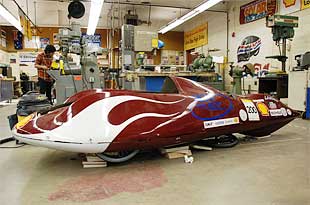
    Students in Hacienda Heights, CA have created a hydrogen-powered internal combustion engine car they are calling HICE. The term HICE (and sometimes H2ICE on this website) is an acronym for Hydrogen Internal Combustion Engine.

    The students have decided to forgo the popular hydrogen fuel cell car in favor of a high mileage vehicle using a four-stroke engine that will compete in next year’s U. S. Shell Eco Marathon.

    According to Mr. Weng, “Mike Keirns was the instructor who started the idea back in the 2007-2008 school year. From there, it became our flagship vehicle. We originally planned on competing in the Shell Eco-marathon and we were actually the first high school to create a hydrogen fuel cell vehicle as well back in 2007, winning first place. We intend to enter HICE next year for the Shell Eco-marathon. HICE is different from your published vehicle in that it does not require any gasoline whatsoever and runs on a student modified engine.”

    LAAE will be showing off their HICE vehicle (pictured) at their open house, May 8, 2010. Several political figures (such as Congresswoman Grace Napolitano) and other  VIP attendees are expected to join in the festivities.

    It’s important for the scientists, researchers and engineers of tomorrow to get a head start today in hydrogen fuel technology. LAAE continues to be a leader in such technology preparing students for high tech job markets that will pay good wages for years to come.

    And with any luck, they will not be forced to listen to repeated choruses of  “Babe, I got you Babe”. Happy Earth Day everyone … again!

  • New Money

    Boy, the money just keeps getting uglier, doesn’t it?  Our new $100 bill is now the official ugly stepchild of our currency family.

    And yet, that’s a good thing.  Ugly money–busy, jarringly colored, divided by grimly utilitarian security strips–is hard to copy.  The treasury is in a continual arms race with counterfeiters, who are a minor nuisance right now, but would be printing a lot more product.  I expect that by 2040, we’ll be using currency so ugly that it will have a known visual disorder associated with it, and people will be forced to use blindfolds when they’re checking out at the grocery store.
    On the other hand, we don’t use that much currency, so I’m not sure what all the fuss is about.  In theory, currency counterfeiting causes mild inflation.  In practice, the amount of currency that gets used in the United States is too small for counterfeiting to have any realistic impact on prices; these days, money is created not with the printing press, but in the electronic accounts of banks and the Federal Reserve.
    But fraud! you will say.  Well, sort of.  If the stuff isn’t distinguishable from real money, then who’s defrauded?  The people who get the money will be perfectly able to exchange it for real goods and services.
    What it actually does is transfer a small amount of seignorage revenues from the federal government to the counterfeiters.  An anarchocapitalist might argue that this is as it should be–that the federal government’s monopoly on currency is illegal.  I won’t go that far; the counterfeiters are, after all, free-riding on the full faith and trust of the US government.  What I will suggest is that the trivial damage done by counterfeiters might not be worth making our national currency a laughingstock.


    Email this Article
    Add to digg
    Add to Reddit
    Add to Twitter
    Add to del.icio.us
    Add to StumbleUpon
    Add to Facebook


  • This is the ModNation Racers Trophy Set

    You have useless new Trophy-organizing features thanks to FW 3.30, might as well put them to use. Here’s another game to give you more shiny badges to sort out.


  • Shell signs multi-series sponsorship deal with Penske Racing

    Filed under: ,

    For years Marlboro has been nearly synonymous with Penske, its racing cars (in open-wheels especially) adorned with the tobacco company’s red-and-white color scheme for decades, even if their name hasn’t appeared on the cars since 2005. But after 19 years in racing together, Marlboro parent company Phillip Morris ended its sponsorship of the motor racing dynasty earlier this year. Now it appears that Shell Oil could be taking its place.

    The deal, which comes into effect next season, encompasses Penske Racing teams in several series, including the Indy Racing League and both the Sprint Cup and Nationwide Series in NASCAR, but does not appear to extend to Penske’s American Le Mans Series team.

    In the Sprint Cup, the Shell deal comes at the expense of Richard Childress Racing (pictured above), which brought in Shell to replace Jack Daniels sponsorship which it lost last year. The Shell and Pennzoil logos will instead adorn the #22 car of Penske’s former champion Kurt Busch, while teammate Brad Keselowski’s #2 Dodge will continue with Miller Lite sponsorship. In Indy, meanwhile, the sponsorship replaces Penske’s longstanding deal with ExxonMobil.

    [Source: Autosport]

    Shell signs multi-series sponsorship deal with Penske Racing originally appeared on Autoblog on Thu, 22 Apr 2010 08:29:00 EST. Please see our terms for use of feeds.

    Read | Permalink | Email this | Comments

  • Novos detalhes do Maybach 62 2011 em vídeo e fotos

    Enquanto não é apresentado no Salão do Automóvel de Pequim 2010, o sedã superluxuoso Maybach 62 2011 pode ser mais apreciado nesses vídeos e na galeria de fotos logo abaixo, no qual podemos comprovar que em matéria de conforto e espaço o novo modelo não fica devendo pra nenhum outro do mercado.

    E não é pra menos pois se por fora o que chama a atenção no Maybach 62 2011 são suas dimensões avantajadas, seu interior impressiona pelo espaço, nível de conforto e acabamento oferecidos principalmente pelos passageiros traseiros, que recebem um tratamento digno de um interior de jatinho particular. Em breve teremos novas informações do modelo, direto do Salão do Automóvel de Pequim 2010.

    Maybach 62 2011
    Maybach 62 2011Maybach 62 2011Maybach 62 2011Maybach 62 2011


    Maybach 62 2011

    Maybach 62 2011Maybach 62 2011Maybach 62 2011Maybach 62 2011Maybach 62 2011

    Fonte: EMercedesBenz


  • No Federal Assistance For Derivatives?

    Senate Agriculture Committee Chair Blanche Lincoln’s (D-AR) aggressive derivatives bill passed committee yesterday and now awaits its merger with the chamber’s broader financial reform bill. It contains a controversial measure which would forbid the use of federal funds to assist any financial institution on the brink of collapse due to derivatives gone bad. While this will probably have a great deal of populist appeal, it appears to be in direct conflict with both versions of financial reform floating around Congress and general market stabilization efforts.

    Ties Regulators Hands in Some Financial Crises

    Both the House and Senate bills call for resolution funds that regulators would use to wind down large financial firms. Those funds would cover the costs incurred during that process, so that taxpayers wouldn’t be on the hook for another bail out. The FDIC would be in charge of that fund, yet the derivatives bill specifically forbids the FDIC from using its power to go towards the obligations of institutions that run into trouble due to derivatives. Isn’t it conceivable, however, that money due to derivative counterparties is precisely the kind of cost these funds might need to be used for? If the end is to stabilize a financial panic, then calming the market could depend on alleviating the fear of a catastrophic domino of swap dealer failures.

    The bill also forbids the Federal Reserve from using its emergency lending authority to provide a loan to a firm that might be in trouble due to derivatives. Again, this means that the Fed won’t be able to exercise its authority to stabilize the financial markets if a derivatives-related disturbance causes instability.

    Think AIG

    Perhaps the prototypical example of a big systemically intertwined firm that ran into trouble due to derivatives is AIG. A large portion of its bailout funds were famously used to cover some of its derivatives (swaps) obligations to big investment banks like Goldman Sachs and Societe Generale. This new legislation would make that bail out impossible.

    While that might sound great to populists everywhere, how would the U.S. government have stabilized the financial system if this legislation were in place prior to the financial crisis? Remember, even to wind down AIG, costs would have surfaced that needed to be addressed in order to prevent the market’s collapse. The proposed resolution fund created by assessments on big financial institutions might have covered such costs instead of taxpayers, but it wouldn’t be able to be used according to this legislation.

    (Nav Image Credit: Justin Ruckman/flickr)


    Email this Article
    Add to digg
    Add to Reddit
    Add to Twitter
    Add to del.icio.us
    Add to StumbleUpon
    Add to Facebook


  • Goldman Sachs: The Defense Case Starts to Firm Up

    Professor Bainbridge suggests that the timing of the Goldman suit may be suspicious, but not in the way that Republicans have claimed. From the Wall Street Journal:

    Last Friday, the same day that the government unexpectedly announced its Goldman lawsuit, the SEC’s inspector general released his exhaustive, 151-page report on the agency’s failure to investigate alleged fraudster R. Allen Stanford. Mr. Stanford was indicted last June for operating a Ponzi scheme that bilked investors out of $8 billion. He has pleaded not guilty. 

    Guess which of these two stories was pushed to the back pages? The SEC did its part by publishing the Stanford report so deep in its Web site that more than a few of our readers had trouble finding it. Yesterday, the SEC management’s response to the report was available on the agency’s homepage, yet it provided no links to the report itself.

    Little wonder. The report is damning for an SEC that wants the public to believe it has turned the corner after the Bernie Madoff disaster. The commission has made young Fabrice Tourre of Goldman Sachs a household name for his debatable disclosures to institutional investors. But many individual investors will be more interested in learning the story of Spencer Barasch. He’s the SEC enforcement official who sat on various referrals to investigate Allen Stanford and then, after leaving the SEC, performed legal work for . . . Allen Stanford.

    So not political maneuvering, but agency butt-covering.  This sounds suspiciously plausible.  And even if the SEC didn’t plan this, reporters would do well to counter this unfortunate accident of timing by resurrecting the story.
    Meanwhile, the counter-leaks have begun, and as I thought they might, they make the SEC’s case sound a bit weaker. 

    In one part of Pellegrini’s testimony, a government official asked him: “Did you tell (Schwartz) that you were interested in taking a short position in Abacus?”

    “Yes, that was the purpose of the meeting,” Pellegrini responded.

    “How did you explain that to her?” the government official said.

    “That we wanted to buy protection on traunches of a synthetic RMBS portfolio.” Pellegrini said.

    As Felix Salmon says, “if Pellegrini’s testimony turns out to be reliable, it surely constitutes a simple disproof of the SEC statement”–yet it somehow didn’t make it into the complaint.  But as he also notes, this is a selective quote, not the full testimony.  I’d love to know who leaked it–Republican appointees on the SEC who are pissed at getting slimed for their votes, or someone on the defense side?  Either way, this is shaping up to be one hell of a PR battle.
     
    (Nav Image Credit: Wikimedia Commons)


    Email this Article
    Add to digg
    Add to Reddit
    Add to Twitter
    Add to del.icio.us
    Add to StumbleUpon
    Add to Facebook


  • Vídeo: Aprenda como “não” estacionar

    Olha, sempre ouvi brincadeiras a respeito das mulheres no volante, uma frase super manjada como “mulher no volante, perigo constante“, e por ai vai. Eu particularmente nunca fui muito fã de brincadeiras assim, até mesmo porque o maior número de acidentes de carro envolvem motoristas do sexo masculino. Mas dessa vez, garotas, me desculpem pois essa aqui fez jus à frase que ouço há tantos anos.

    Como mostra a câmera de vigilância de um estacionamento, uma senhora de 62 anos chamada Tripta Kaushal foi condenada na última semana em Richmond Hill, Canadá, por não ter tanta prudência assim ao volante enquanto manobrava a sua BMW X5 em uma vaga.

    Após verem o vídeo, podem achar que na verdade ela estava pilotando um tanque de guerra, pois com muita facilidade ela consegue fazer o inimaginável, que é “escalar propriedades alheias”. Após o acidente, ela mostrou ser uma senhora muito “ligeira” e fugiu da cena, o que lhe custou uma multa de $500 e o direito de dirigir apenas das 7hs às 19hs. E também demonstrou que a BMW X5 é um belo carro para “terrenos acidentados”. Fica a dica!

    Via | Top Speed


  • PayPal Processes $21.3 Billion in Q1 2010

    eBay has seen a very solid first quarter, with both revenue and income increasing. PayPal has proven one of the company’s strong points, as always, but the Marketplaces division is also seeing a solid growth. The results were slightly above market expectations, but lowered estimates for the second quarter brought down the share price after the anno… (read more)

  • McLaren announces comprehensive restructuring, management changes

    Filed under: ,

    Fiat and Ferrari aren’t the only ones undergoing a comprehensive restructuring as longtime rival (both on and off the track) McLaren has announced a major reorganization of its operations and several management changes.

    The biggest shift for McLaren is the split between McLaren Automotive (which will produce the new MP4-12C supercar) and the McLaren Group (which operates the racing team). The roadcar unit is being split off into its own operation, based out of the McLaren Production Centre, which shares its grounds with the McLaren Technology Centre next door.

    The two companies will now report to two separate boards, which will in turn be accountable to separate shareholders. But to keep things sufficiently confusing for the rest of us, most of the key players – including executive chairman Ron Dennis, team principal Martin Whitmarsh, CFO Andy Myers, incoming legal counsel Tim Mumane and shareholders Mansour Ojjeh and Sheikh Mohammed Bin Essa al-Khalifa – will continue to serve on the boards for both companies. Richard Lapthorne, who was until now serving as non-executive chairman of the single unit before the split, will be leaving the company. Details in the press release after the jump.

    [Source: McLaren]

    Continue reading McLaren announces comprehensive restructuring, management changes

    McLaren announces comprehensive restructuring, management changes originally appeared on Autoblog on Thu, 22 Apr 2010 07:58:00 EST. Please see our terms for use of feeds.

    Permalink | Email this | Comments

  • Should Transmission of HIV be a Crime?

    legal scalesNot according to Journal Watch editor and New York Times writer Abigail Zuger, writing here in the Times.  She’s referring to the recent Darren Chiacchia case, where his former partner has filed a legal complaint that Chiacchia did not disclose having HIV — potentially a first-degree felony in Florida.

    Were it a matter of science alone, all those AIDS statutes could be rescinded tomorrow. But the science was only a small part of the panic that created them. And effective treatment has not altered the rest of that potent emotional brew: the virus still sows terror, uncertainty, shame and endless complications, whether the infection is concealed or revealed…

    Now we think we know better, but do we really? We blame that coughing woman in the subway for our cold, the giant meat company for our food poisoning, all manner of chemicals and electromagnetic radiation for our cancers, and fast-food outlets for ourdiabetes and heart disease. We cannot experience illness without casting around for blame.

    Yet at the same time we believe deeply in prevention. Surely if we watch our diets and get our mammograms and colonoscopies, wash our hands, take whatever vitamin is foremost in the news and eat our burgers well done, we can avert bad things. Whole generations have now grown up knowing that sensible people “play safe,” with the overriding implication that if you catch a sexually transmitted disease, you have no one to blame but yourself.

    Then the key point:

    And so whose fault is a new H.I.V. infection, really? Is it mine, for giving it to you, or is it yours, for being stupid and cavalier enough to get it?

    (Sorry for the lengthy quotes, she’s such a great writer it was irresistible.)

    I mostly agree with Abbie that effective treatment of HIV has changed the risk equation profoundly, and that what what originally motivated these laws — transmission of HIV was murder!  — no longer holds.  But remember that some (most?) might think that transmission of any infection — herpes, syphilis, MRSA, salmonella from peanut butter, hepatitis A from spinach — is potentially a crime.

    And people holding this view will continue to see these HIV statutes as completely justified.  As a result, don’t expect them to be removed from the books anytime soon.

  • Novas imagens do Volkswagen Phaeton 2011

    Imagens do novo sedan de luxo

    Foi apresentado pela Volks no Salão do Automóvel de Pequim 2010 a versão 2011 do Phaeton, o sedan de luxo alemão. Com uma parte frontal totalmente nova, faróis reestilizados com lâmpadas Bi-Xenon e um novo capô. A parte traseira do novo Phaeton também sofreu mudanças com lanternas novas, menores indicadores nos espelhos retrovisores e rodas de liga leve de 18 polegadas.

    O novo Phaeton 2011 terá duas opções de eixo à disposição, sendo duas versões na parte traseira e quatro motores (a diesel e gasolina). Entre os motores, os modelos à gasolina serão V6, com 280 cv, um V8 com 335cv e um W12 com 450 cv. O motor a diesel vai ser um V6 TDI com 240 cv.

    Outro recurso interessante é o sistema de navegação do carro, que pode integrar as informações online do Google Maps caso o motorista desejar.

    Imagens do novo sedan de luxo
    Imagens do novo sedan de luxoImagens do novo sedan de luxoImagens do novo sedan de luxoImagens do novo sedan de luxoImagens do novo sedan de luxoImagens do novo sedan de luxoImagens do novo sedan de luxoImagens do novo sedan de luxo

    Via | Top Speed


  • Planetary Mono Mill PULVERISETTE 6 classic line

    for fine-grinding of laboratory samples down to < 1 µm as well as for mixing, homogenising, emulsifying and alloying. With this universal mill the sample preparation and the sample analysis have again equal rights on the laboratory bench. Typical fields of application: geology, mineralogy, metallurgy, soil research, electrical industry, chemistry, ceramics industry, glass industry, nuclear research, pharmacy research. The PULVERISETTE 6 classic line is a planetary ball mill with one grinding station and an internal unbalance compensation. Because of the high ball acceleration a significantly higher comminution rate is achieved compared with centrifugal ball mills. The comminution in closed vessels guarantees loss-free milling (including suspensions). All grinding parameters, like grinding time, interval-, break times and rotational speed are adjustable via membrane keyboard. Grinding bowls and balls for the PULVERISETTE 6 classic line are offered in 9 different materials and 3 different sizes. Therefore the instrument can be used universally and enables contamination-free grinding as well as optimum quantitative adaption. Technical data: PULVERISETTE 6 classic line maximum feed particle size: 10 mm Useful capacity: up to 225 ml final fineness: < 1 µm