Author: Serkadis

  • Statement: Met Office response to CAA announcement

    Article Tags: Met Office, Statement

    article image

    Click source to read FULL Statement from the Met Office

    Source: metoffice.gov.uk
    Read in full with comments »   


  • Roubini Explains The Simple Reason That Aid To The PIIGS Is Doomed To Failure

    Nouriel Roubini

    Why are markets not convinced by the endless promises of aid to Greece?

    Maybe because the aid can’t possibly work.

    CNBC quotes a new Roubini note which really seems to get at the crux of the issue.

    “These issues within the euro zone stem primarily from a loss of competitiveness, high wage growth and labor costs which outstripped productivity, undisciplined fiscal policies and, crucially, the appreciation of the euro between 2002 and 2008.”

    He goes on to note that since nothing the EU or IMF is doing actually addresses these issues, there’s really very little hope that the problem is being solved.

    That being said, the EU/IMF can probably kick the can down the road a little bit.

    Join the conversation about this story »

  • Greek CDS Spreads Hit Brand New Record, As EU And IMF Begin 10 Days Of Tense Negotiations To Avert Catastrophe

    Amazingly, Europe can’t convince markets that it has the Greek problem under control.

    Greek CDS spreads have hit another record of 480 basis points, according to CMAnews.

    ForexLive notes that that the bond market concurs with Greek-German bond spreads hitting a 12-year high.

    10 days of talks between the EU and IMF began today, so expect LOTS of mixed headlines over the coming days.

    If things aren’t hammered out, a Greek default could happen as soon as May.

    Join the conversation about this story »

  • Newsletter: NZCLIMATE TRUTH NO 244 by Vincent Gray

    Article Tags: Headline Story, Vincent Gray

    THE FLAT EARTH

    All of the computer models of the climate have adopted the flat earth theory of the earth’s energy, as portrayed in Kiehl J. T. and K. E. Trenberth 1997. Earth’s Annual Global Mean Energy Budget. Bull. Am. Met. Soc. 78 197-208.

    Image Attachment

    The attached graph is in all of the Reports of the Intergovernmental Panel on Climate change, and it is fundamental to all their activities.

    It assumes that the earth can be considered to be flat, that the sun shines all day and all night with equal intensity, and that the temperature of the earth’s surface is constant.

    Read in full with comments »   


  • Credit Suisse: Next Stop, S&P 1270

    (This guest post previously appeared at the author’s blog)

    Credit Suisse recently upgraded their full year outlook on the back of stronger economic conditions.  They no longer see risks of a second half double dip (see here) and now believe the S&P 500 will reach 1,270 by year-end.  Their mid-year target is still S&P 1,220.   Their upgraded outlook is based on 5 factors:

    1)  We still expect GDP growth to surprise positively (41/2% global GDP growth this year)

    2) Corporates are under-invested (if corporate FCF normalises investment could rise by 32%)

    3)  Aggregate labour income looks set to surprise positively (as corporates have over-shed labour)

    4) China should have a soft landing (economic overheating is limited

    5) Fiscal/monetary policy is still loose and the impact of a property-price decline looks manageable).

    In addition, they say equities are still attractive compared to other asset classes and most investors are caught underweight equities:

    “Equities still offer value relative to other asset classes. The equity risk premium is 5%. Our long-standing target (based on ISM and credit spreads) has been 4.5% (implying a 9% return), but if credit spreads stay unchanged, the ERP could fall to 4.1%. Equities also hedge investors against the two risks that we are most concerned about longer term: inflation and sovereign credit risk.

    Mis-positioning: Pension funds and insurance companies still have abnormally low equity weightings. Since March 2009, retail investors have sold $82bn of equity and bought $93bn of bonds, and have just started to buy.”

    The disconnect between credit and equity has widened as the economy has improved.  Credit markets are back to levels where equities were at 1,335:

    “The major macro and credit variables are back to levels when the S&P 500 was last at 1,335.”

    Most importantly, CS says the new bear market is unlikely to begin in 2010.  They now expect the bear market to begin in mid-2011:

    “We postpone our expectation for the start of a new bear market to mid-2011E from end-2010E. We still believe that the big problem is $6.5trn of excess leverage, but this becomes an issue, in our opinion, only when we get a rebound in demand for private credit. This is unlikely to occur until mid-2011E as tighter bank regulations postpone a rebound in lending.”

    Source: CS

    Read more market commentary at The Pragmatic Capitalist >

    Join the conversation about this story »

  • North African Solar Projects

    It is pleasant to see the North Africans supporting an expansive program for solar energy production.  It is obvious and it is also a natural job producer.  The technology must also be up to the challenge or we would not be getting these brave pronouncements.
    What makes it so wonderfully attractive is that if one can show that a facility will pay out and keep its banker’s happy, then it is easy to replicate over and over again.
    We can expect hundreds of square miles of solar energy projects employing an awful lot of folks.
    It is a bright shining story and we can hope it lasts a while.  Costs are certainly dropping in solar energy as is the cost of energy transmission. 
    The only real treat is the sudden advent of cheap fusion energy which is certainly been seriously advanced for the first time in decades.  (this is no cheer for Tokamak)
    Solar projects shine in North Africa
    by Staff Writers

    Rabat, Morocco (UPI) Mar 24, 2009 

    North Africa is taking a shine to solar power in a big way, with plants slated for Morocco and Tunisia as a German-led consortium pushes ahead with the world’s most ambitious solar project in the Sahara Desert.

    The $555.3 billion Desertec project is designed to turn the Sahara’s endless sunlight into carbon-free electricity that will supply 15 percent of energy-hungry Europe’s power and lessen its dependence on natural gas from Russia.

    Separately, the Moroccan government hopes to invest $9 billion in a solar energy program over the next decade.

    This means big-ticket contracts could be up for grabs from major European, mainly French energy concerns, such as GDF Suez; oil giant Total; Areva, which specializes in building nuclear plants, and St. Gobain which manufactures mirrors and photovoltaic panels.

    Paris’s Maghreb Confidential online newsletter says the French were lining up to join the program when Moroccan Energy Minister Amina Benkhadra presented her investment program to her French counterpart, Jean-Louis Borloo, March 8-9 in Paris.

    The centerpiece of the Moroccan plan is a Franco-Moroccan solar power plant generating 20-40 megawatts and exporting up to 4 MW to France.

    That’s a relatively modest project. But the Moroccans are hoping that it will lay the groundwork for more ambitious projects that will boost solar power exports to Europe and beyond.

    One project being mooted for Morocca’s Solar Plan is a 500MW solar power station and at least nine international companies are bidding. They include Nexant of California and Fichtner Solar of Stuttgart, Germany, which has won contracts to design power plants at Ain beni Mather in Morocco, Hassi R’Mei in Algeria and Kuraymat in Egypt.

    In neighboring Tunisia, the government unveiled a solar plan in late 2009 that includes some 40 renewable energy projects, such as thermo-solar photovoltaic power plants, with a cost of $2.67 billion.

    Desertec is by far the most complex of all the solar projects currently under way. It is still in the planning stage and construction isn’t expected to begin for another 2-3 years.

    It has big-name partners, such as Deutsche Bank and Siemens, and is still attracting new companies, such as First Solar, a U.S. photovoltaic company that has constructed utility-scale solar plants in the deserts of the United States and the United Arab Emirates.

    Using a method known as concentrated solar power it would generate inexhaustible and affordable quantities of energy across the Mediterranean — and even on a global scale if necessary.

    One of its big attractions is that it would emit no carbon dioxide, making it the world’s biggest green-energy project. If Desertec does get off the ground, it would be the largest green-energy project on the planet.

    In theory, a global system of solar thermal power would also eliminate the prospect of resource wars erupting in the years ahead as the planet’s natural resources that currently produce energy — oil, gas, coal, timber and water — disappear.

    The idea for this massive project to harness the sun’s energy on a gigantic scale originated with a group of European scientists and politicians called the Trans-Mediterranean Renewable Energy Cooperation.

    The concept of large-scale solar power has been around for some time but was never able to make the breakthrough because of cheap oil.

    Desertec’s backers believe it will open the door to a new era of environmentally friendly generated power on a massive scale.

    That would keep Europe at the forefront of the struggle against climate change and help North African and European economies to expand within the limits of greenhouse gas emissions.

    Its critics caution that there are numerous pitfalls, among them the vagaries of North African politics and the perception that European projects like Desertec is just another form of economic plundering by the old colonial powers.

    According to Nature magazine, the solar-cell market has been growing by an average by 31 percent a year for the last decade, and enthusiasts predict a 20-25 percent growth rate in the next few years.

    Every year, the sun produces 630,000 terawatt hours — a terawatt equals 1 trillion volts — of energy in North Africa that is untapped. Europe consumes 4,000 terawatt hours of energy a year. That’s only 0.6 percent of the unused energy that falls on the North African desert.
  • Long Term Climate Pattern


    I do not think this will be terribly informative vis a vis the Holocene or the past ten thousand years in which we have had a significant break that is still poorly described and likely unclear.

    On this time scale a thousand years is too fine a resolution.

    The argument for linking the cycles of the glacial age to minute variations in the solar orbit was well made in the past century.  This provides better and stronger empirical support through much better resolution.

    Unfortunately, the acceptance of the idea that the ice cap expands into lower latitudes caused by the failure to recognize crustal shift continues.  If that proposition were to be slightly true then the Greenland cap would be covering the arctic isles at least.  As it is it is all very constrained easily by the nearness of the ocean.  Yet we are to suppose that sea level glaciation was possible thirty degrees further south during the Ice Age. 

    These solar variations are so small that while they are able to produce a signal they are not going to drop the heat input by the massive percentage needed to create lower latitude conditions.

    Besides, it is impossible to have an ice age unless lots of energy is passing through the hydraulic cycle to fill the atmosphere with moisture.  All the surplus moisture in the Southern Hemisphere cycles into the Antarctic and is dumped.  The Gulf Stream prevents that happening in the Arctic!
    So you cannot have it both ways.

    Therefore if the one is impossible, then the impossibility of crustal shift must be revisited.  I posted on that back in July of 2007 when I introduced the article Pleistocene nonconformity. All the difficulties disappear and all the evidence also lines up nicely.


    UCSB geologist discovers pattern in Earth’s long-term climate record
    Contact: Gail Gallessich

    805-893-7220

     (Santa Barbara, Calif.) –– In an analysis of the past 1.2 million years, UC Santa Barbara geologist Lorraine Lisiecki discovered a pattern that connects the regular changes of the Earth’s orbital cycle to changes in the Earth’s climate. The finding is reported in this week’s issue of the scientific journal Nature Geoscience.

    Lisiecki performed her analysis of climate by examining ocean sediment cores. These cores come from 57 locations around the world. By analyzing sediments, scientists are able to chart the Earth’s climate for millions of years in the past. Lisiecki’s contribution is the linking of the climate record to the history of the Earth’s orbit.

    It is known that the Earth’s orbit around the sun changes shape every 100,000 years. The orbit becomes either more round or more elliptical at these intervals. The shape of the orbit is known as its “eccentricity.” A related aspect is the 41,000-year cycle in the tilt of the Earth’s axis.

    Glaciation of the Earth also occurs every 100,000 years. Lisiecki found that the timing of changes in climate and eccentricity coincided. “The clear correlation between the timing of the change in orbit and the change in the Earth’s climate is strong evidence of a link between the two,” said Lisiecki. “It is unlikely that these events would not be related to one another.”

    Besides finding a link between change in the shape of the orbit and the onset of glaciation, Lisiecki found a surprising correlation. She discovered that the largest glacial cycles occurred during the weakest changes in the eccentricity of Earth’s orbit –– and vice versa. She found that the stronger changes in the Earth’s orbit correlated to weaker changes in climate. “This may mean that the Earth’s climate has internal instability in addition to sensitivity to changes in the orbit,” said Lisiecki.

    She concludes that the pattern of climate change over the past million years likely involves complicated interactions between different parts of the climate system, as well as three different orbital systems. The first two orbital systems are the orbit’s eccentricity, and tilt. The third is “precession,” or a change in the orientation of the rotation axis.

    Letter abstract

    Nature Geoscience 
    Published online: 4 April 2010 | doi:10.1038/ngeo828

    Links between eccentricity forcing and the 100,000-year glacial cycle

    Lorraine E. Lisiecki1


    Variations in the eccentricity (100,000yr), obliquity (41,000yr) and precession (23,000yr) of Earth’s orbit have been linked to glacial–interglacial climate cycles. It is generally thought that the 100,000-yr glacial cycles of the past 800,000yr are a result of orbital eccentricity1, 2, 3, 4. However, the eccentricity cycle produces negligible 100-kyr power in seasonal or mean annual insolation, although it does modulate the amplitude of the precession cycle. Alternatively, it has been suggested that the recent glacial cycles are driven purely by the obliquity cycle5, 6, 7. Here I use statistical analyses of insolation and the climate of the past five million years to characterize the link between eccentricity and the 100,000-yr glacial cycles. Using cross-wavelet phase analysis, I show that the relative phase of eccentricity and glacial cycles has been stable since 1.2Myr ago, supporting the hypothesis that 100,000-yr glacial cycles are paced8, 9, 10 by eccentricity4, 11. However, I find that the time-dependent 100,000-yr power of eccentricity has been anticorrelated with that of climate since 5Myr ago, with strong eccentricity forcing associated with weaker power in the 100,000-yr glacial cycle. I propose that the anticorrelation arises from the strong precession forcing associated with strong eccentricity forcing, which disrupts the internal climate feedbacks that drive the 100,000-yr glacial cycle. This supports the hypothesis that internally driven climate feedbacks are the source of the 100,000-yr climate variations12.

    1. Department of Earth Science, University of California, Santa Barbara, California 93106, USA
    Correspondence to: Lorraine E. Lisiecki1 e-mail: [email protected]
  • Water Splitting Virus


    The approach is novel and an imitation of nature with much more stable components.  They report that they have half of the problem demonstrated.  The objective here is to harvest light to produce hydrogen efficiently.  I am not sure that it is the most economic pathway, but it is a new promising pathway and other well researched paths have not so far been overly successful in bringing costs down.
    In fact the issue of hydrogen production cost has been the monster in the closet in the whole hydrogen economy promotion for the past decade and the main reason I have dismissed fuel cell technologies for thirty years.  So far I have not been wrong.
    This at least promises to provide a cost effective method of producing hydrogen and pure oxygen perhaps or some other valuable product.
    In my dreams we can find a method to collect most of the available solar energy that is available and leave the surrounding area well chilled.  We have to get the infrared also!
    Researchers harness viruses to split water: Crucial step toward turning water into hydrogen fuel
    April 11, 2010
    (PhysOrg.com) — A team of MIT researchers has found a novel way to mimic the process by which plants use the power of sunlight to split water and make chemical fuel to power their growth. In this case, the team used a modified virus as a kind of biological scaffold that can assemble the nanoscale components needed to split a water molecule into hydrogen and oxygen atoms.
    Splitting water is one way to solve the basic problem of solar energy: It’s only available when the sun shines. By using sunlight to make hydrogen from water, the hydrogen can then be stored and used at any time to generate electricity using a fuel cell, or to make liquid fuels (or be used directly) for cars and trucks.
    Other researchers have made systems that use electricity, which can be provided by solar panels, to split water molecules, but the new biologically based system skips the intermediate steps and uses sunlight to power the reaction directly. The advance is described in a paper published on April 11 inNature Nanotechnology.
    The team, led by Angela Belcher, the Germeshausen Professor of Materials Science and Engineering and Biological Engineering, engineered a common, harmless bacterial virus called M13 so that it would attract and bind with molecules of a catalyst (the team used iridium oxide) and a biological pigment (zinc porphyrins). The viruses became wire-like devices that could very efficiently split the oxygen from water molecules.
    Over time, however, the virus-wires would clump together and lose their effectiveness, so the researchers added an extra step: encapsulating them in a microgel matrix, so they maintained their uniform arrangement and kept their stability and efficiency.
    While hydrogen obtained from water is the gas that would be used as a fuel, the splitting of oxygen from water is the more technically challenging “half-reaction” in the process, Belcher explains, so her team focused on this part. Plants and cyanobacteria (also called blue-green algae), she says, “have evolved highly organized photosynthetic systems for the efficient oxidation of water.” Other researchers have tried to use the photosynthetic parts of plants directly for harnessing sunlight, but these materials can have structural stability issues.
     
    Belcher decided that instead of borrowing plants’ components, she would borrow their methods. In plant cells, natural pigments are used to absorb sunlight, while catalysts then promote the water-splitting reaction. That’s the process Belcher and her team, including doctoral student Yoon Sung Nam, the lead author of the new paper, decided to imitate.
    In the team’s system, the viruses simply act as a kind of scaffolding, causing the pigments and catalysts to line up with the right kind of spacing to trigger the water-splitting reaction. The role of the pigments is “to act as an antenna to capture the light,” Belcher explains, “and then transfer the energy down the length of the virus, like a wire.
    The virus is a very efficient harvester of light, with these porphyrins attached.
    “We use components people have used before,” she adds, “but we use biology to organize them for us, so you get better efficiency.”
    Using the virus to make the system assemble itself improves the efficiency of the oxygen production fourfold, Nam says. The researchers hope to find a similar biologically based system to perform the other half of the process, the production of hydrogen. Currently, the hydrogen atoms from the water get split into their component protons and electrons; a second part of the system, now being developed, would combine these back into hydrogen atoms and molecules. The team is also working to find a more commonplace, less-expensive material for the catalyst, to replace the relatively rare and costly iridium used in this proof-of-concept study.
    Thomas Mallouk, the DuPont Professor of Materials Chemistry and Physics at Pennsylvania State University, who was not involved in this work, says, “This is an extremely clever piece of work that addresses one of the most difficult problems in artificial photosynthesis, namely, the nanoscale organization of the components in order to control electron transfer rates.”
    He adds: “There is a daunting combination of problems to be solved before this or any other artificial photosynthetic system could actually be useful for energy conversion.” To be cost-competitive with other approaches to solar power, he says, the system would need to be at least 10 times more efficient than natural photosynthesis, be able to repeat the reaction a billion times, and use less expensive materials. “This is unlikely to happen in the near future,” he says. “Nevertheless, the design idea illustrated in this paper could ultimately help with an important piece of the puzzle.”
    Belcher will not even speculate about how long it might take to develop this into a commercial product, but she says that within two years she expects to have a prototype device that can carry out the whole process of splitting water into oxygen and hydrogen, using a self-sustaining and durable system.
    More information: “Biologically templated photocatalytic nanostructures for sustained light-driven water oxidation” Yoon Sung Nam, Andrew P. Magyar, Daeyeon Lee, Jin-Woong Kim, Dong Soo Yun, Heechul Park, Thomas S. Pollom Jr, David A. Weitz and Angela M. Belcher. Nature Nanotechnology, April 11, 2010

    Provided by Massachusetts Institute of Technology
  • Graphene Films Clear Fabrication Hurdle


    In this item we are learning to deposit a single layer of graphite on a dielectric substrate, rather important for actual commercial applications.  At this point they have effectively a proof of concept but no real control yet but are close enough to get useful results.
    Again this field has blossomed over the past few months and the rate of news flow is accelerating.
    It is an exciting time to be a physicist.
    Graphene Films Clear Major Fabrication Hurdle
    by Staff Writers

    Berkeley CA (SPX) Apr 13, 2010

    Graphene, the two-dimensional crystalline form of carbon, is a potential superstar for the electronics industry. With freakishly mobile electrons that can blaze through the material at nearly the speed of light – 100 times faster than electrons can move through silicon – graphene could be used to make superfast transistors or computer memory chips.

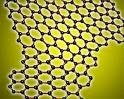
    Graphene’s unique “chicken wire” atomic structure exhibits incredible flexibility and mechanical strength, as well as unusual optical properties that could open a number of promising doors in both the electronics and the photonics industries. However, among the hurdles preventing graphite from joining the pantheon of star high-tech materials, perhaps none looms larger than just learning to make the stuff in high quality and usable quantities.

    “Before we can fully utilize the superior electronic properties of graphene in devices, we must first develop a method of forming uniform single-layer graphene films on nonconducting substrates on a large scale,” says Yuegang Zhang, a materials scientist with the Lawrence Berkeley National Laboratory (Berkeley Lab).

    Current fabrication methods based on mechanical cleavage or ultrahigh vacuum annealing, he says, are ill-suited for commercial-scale production. Graphene films made via solution-based deposition and chemical reduction have suffered from poor or uneven quality.

    Zhang and colleagues at Berkeley Lab’s Molecular Foundry, a U.S. Department ofEnergy (DOE) center for nanoscience, have taken a significant step at clearing this major hurdle. They have successfully used direct chemical vapor deposition (CVD) to synthesize single-layer films of graphene on a dielectric substrate.

    Zhang and his colleagues made their graphene films by catalytically decomposing hydrocarbon precursors over thin films of copper that had been pre-deposited on the dielectric substrate. The copper films subsequently dewetted (separated into puddles or droplets) and were evaporated. The final product was a single-layer graphene film on a bare dielectric.

    “This is exciting news for electronic applications because chemical vapor deposition is a technique already widely used in the semiconductor industry,” Zhang says.

    “Also, we can learn more about the growth of graphene on metal catalyst surfaces by observing the evolution of the films after the evaporation of the copper. This should lay an important foundation for further control of the process and enable us to tailor the properties of these films or produce desired morphologies, such as graphene nanoribbons.”

    Zhang and his colleagues have reported their findings in the journal Nano Letters in a paper titled, “Direct Chemical Vapor Deposition of Graphene on Dielectric Surfaces.” Other co-authors of this paper were Ariel Ismach, Clara Druzgalski, Samuel Penwell, Maxwell Zheng, Ali Javey and Jeffrey Bokor, all with Berkeley Lab.
    In their study, Zhang and his colleagues used electron-beam evaporation to deposit copper films ranging in thickness from 100 to 450 nanometers. Copper was chosen because as a low carbon solubility metal catalyst it was expected to allow better control over the number of graphene layers produced.

    Several different dielectric substrates were evaluated including single-crystal quartz, sapphire, fused silica and silicon oxide wafers. CVD of the graphene was carried out at 1,000 degrees Celsius in durations that ranged from 15 minutes up to seven hours.

    “This was done to allow us to study the effect of film thickness, substrate type and CVD growth time on the graphene formation,” Zhang says.

    A combination of scanning Raman mapping and spectroscopy, plus scanning electron and atomic force microscopy confirmed the presence of continuous single-layer graphene films coating metal-free areas of dielectric substrate measuring tens of square micrometers.

    “Further improvement on the control of the dewetting and evaporation process could lead to the direct deposition of patterned graphene for large-scale electronic device fabrication, Zhang says. “This method could also be generalized and used to deposit other two-dimensional materials, such as boron-nitride.”

    Even the appearance of wrinkles in the graphene films that followed along the lines of the dewetting shape of the copper could prove to be beneficial in the long-run. Although previous studies have indicated that wrinkles in a graphene film have a negative impact on electronic properties by introducing strains that reduce electron mobility, Zhang believes the wrinkles can be turned to an advantage.

    “If we can learn to control the formation of wrinkles in our films, we should be able to modulate the resulting strain and thereby tailor electronic properties,” he says.

    “Further study of the wrinkle formation could also give us important new clues for the formation of graphene nanoribbons.”

    This work was primarily supported by the DOE Office of Science.

    The Molecular Foundry is one of the five DOE Nanoscale Science Research Centers (NSRCs), premier national user facilities for interdisciplinary research at the nanoscale.

    Together the NSRCs comprise a suite of complementary facilities that provide researchers with state-of-the-art capabilities to fabricate, process, characterize and model nanoscale materials, and constitute the largest infrastructure investment of the National Nanotechnology Initiative. The NSRCs are located at DOE’s Argonne, Brookhaven, Lawrence Berkeley, Oak Ridge and Sandia and Los Alamos National Laboratories.
  • DS homebrew – fb4nds v1.3

    Homebrew coder Lino has recently released a new version of fb4nds, a simple Facebook client application for the Nintendo DS. Notable features of the latest update of the homebrew includes the addition of search friend function and

  • Hide The Decline II

    Article Tags: YouTube

    I’m no lawyer, but believe that for a libel or slander lawsuit to be successful, the plaintiff must prove that the defendants knew what they said was false, and that truth is an absolute defense. Thus, if Michael Mann is foolish enough to proceed in his threatened lawsuit against Minnesotans 4 Global Warming for their Hide the Decline parody video, he will:

    1. Need to prove that Phil Jones email to Mann about Mike [Mann’s] Nature Trick to “hide the decline” doesn’t really refer to Mann “hiding the decline” in the tree ring data, which show decreasing temperatures after 1960.

    2. Need to prove that Mann’s email to Phil Jones on June 4, 2003, stating “it would be nice to try to “contain” the putative “MWP” [Medieval Warming Period], even if we don’t yet have a hemispheric mean reconstruction available that far back” does not show scientific malfeasance.

    3. Need to prove that Mann’s hockey stick isn’t one of the most thoroughly debunked scientific papers of the 20th century

    Source: hockeyschtick.blogspot.com

    Read in full with comments »   


  • Met Office blasted for ‘unnecessarily’ triggering six-day British airspace closure by Paul Bentley and Claire Bates, Daily Mail

    Article Tags: Met Office

    The Met Office unnecessarily triggered the six-day closure of British airspace which has cost passengers, airlines and the economy more than £1.5billion, according to senior officials.
    A scientific model based on ‘probability’ rather than fact was used by the government agency to forecast the spread of the volcanic ash cloud, according to critics.

    Matthias Ruete, the European Commission’s director general of transport, said air traffic authorities should not have imposed a widespread ban.

    He suggested the ban should have been restricted to a 20 to 30 mile limit around the volcano in Iceland.

    He said: ‘The science behind the model we are running at the moment is based on certain assumptions where we do not have scientific evidence. It is a black box in certain areas.’

    Results of 40 or so European test flights over the weekend, including a British Airways flight on Sunday, suggested the risks were not as high as computer models predicted

    None found evidence of any ash in engines, windows or lubrication systems.

    Source: dailymail.co.uk

    Read in full with comments »   


  • Ken Block’s Gymkhana Three Ford Fiesta revealed

    Filed under: , , ,

    Ken Block’s Gymkhana 3 Ford Fiesta – Click above for high-res image gallery

    When Ken Block switched alliances earlier this year – ditching his Subaru Impreza WRX STI for a a rallified 2011 Ford Fiesta – there was no doubt in anyone’s mind that an all-new Gymkhana variant was right around the corner. Tonight in San Francisco, we finally got an eyeful of Block’s new ride, and as you’d suspect, it’s meaner, wider and ridiculously more powerful than its predecessor.

    The Gymkhana Three Fiesta was built by the same team that produced his Monster World Rally Team hatch, and includes a boosted 2.0-liter four-pot capable of 850 horsepower (de-tuned with a restrictor plate to output 650 hp in the name of tractability) and 660 pound-feet of torque. Partnered with a Olsbergs Motorsport-developed MSE Maktrak six-speed sequential transmission and powering all four wheels, the new Gymkhana contender will hit 60 mph in two seconds flat and according to Block, can “handle loose, while still providing complete control.”

    We plan to grill Block about his plans this evening, but in the meantime, make the jump for the official details and check out the teaser from earlier today.

    Continue reading Ken Block’s Gymkhana Three Ford Fiesta revealed

    Ken Block’s Gymkhana Three Ford Fiesta revealed originally appeared on Autoblog on Wed, 21 Apr 2010 01:01:00 EST. Please see our terms for use of feeds.

    Permalink | Email this | Comments

  • Yahoo to Launch Improved Advertising Campaign

    It is already a common fact that companies need to reinvent themselves and to attract more segments of the market as time goes by, in order to maintain their revenues. The Sunnyvale-based company attempted to regain its popularity during the fall of 2009, with several events all over the U.S. Apparently, they have decided to resume their effort hopi… (read more)

  • Climate sceptics force Queen’s University to hand over data by Hannah Devlin, The Times

    Article Tags: ClimateGate

    The university has until April 26 to appeal against the decision

    Scientists at Queen’s University in Belfast have been ordered to hand over 40 years of research data on tree rings after a three-year battle with climate sceptics. The ruling by the Information Commissioner sets a precedent for scientists having to comply with the strictest interpretation of the Freedom of Information (FoI) Act.

    It suggests that in future academics will not be able to avoid handing over data by claiming that the task would be too onerous or that it would breach intellectual property rights.

    Douglas Keenan, an independent researcher from London, who is a well-known climate sceptic, first requested the data in 2007. Queen’s refused his request, saying that it was too expensive.

    Now the commissioner has ruled that the university will be in contempt of FoI laws if it refuses to address the request.

    Click souce to read FULL report from Hannah Devlin

    Source: timesonline.co.uk

    Read in full with comments »   


  • Climate sceptics smell victory in parliament

    Article Tags: Opinion

    article image

    Click source to read FULL report

    Source: dutchnews.nl

    Read in full with comments »   


  • Can Virtual Conferences Replace Real World Boondoggles?

    A recent report by Market Research Media predicts that virtual conferences are poised to take over the conference market, growing to $18.6 billion (from nearly nothing today) in the next five years. Though it’s possible that virtual conferences could cannibalize the attendance of the real world conferences, there is more opportunity to increase the size of the market here. After all, attending a virtual version of a conference provides an intermediate tier for those who could not afford the exorbitant time and expense of traveling to a real-world conference. This is similar to what classical orchestras have been doing — using technology to provide a cheaper alternative to people interested, but unable, to attend their events.

    As the wildly popular TED Talks have shown, if done well, it is already possible to share engaging conference talks with a wider audience online. That said, viewing TED videos does not come close to the real-world experience of being at a conference. For most conferences, the presentations are only a small part of the appeal — networking is a large part of draw. In an attempt to address this, Second Life and ON24 both offer virtual conference programs that are designed to replicate the real-world conference experience online, complete with avatars, virtual meetings and even virtual “goodie bags.” Even as someone who spends the bulk of their day online, I am a little skeptical that this will work out well. In order for this to work, the focus has to be on how best to connect people in the virtual world, and less about avatars and goodie bags — and even then, the additional value of meeting someone through a “virtual conference” seems marginal to the other online social networking options that already exist.

    Having attended some great (and admittedly, very fun) conferences this year, I can see why conferences are sometimes considered boondoggles. After all, it is why Vegas has positioned itself as the king of all conference destinations. Though some argue that business relationships initiated in meetings during the day are solidified during the typical sponsored parties thrown at night, in lean times, being a known boondoggle is good a reason to be cut out of the budget. In the virtual world, perhaps Second Life is well positioned for this part of the conference “experience,” though maybe it should not have shut down all of its casinos.

    Permalink | Comments | Email This Story


  • What Seems to be An HD Mini Gets FCC “All Good”

    Summer is almost here and the list of FCC clearances is starting to get crowded with smart phones, and in that crowdimage, we see the HTC HD Mini. The HD Mini had been leaked quite a while ago, and we have seen reviews of this device, well now it seems the FCC has had time for a review of their own.

    They are suspected by Engadget to have approved HTC’s most recent Windows Mobile device, which from what they say, they think the label is what we see to the right. They are saying the color match and timing is perfect for the HTC HD Mini to be what we see, and I agree with them. HTC has yet to tell us of anything new, and so we have to believe this is the HD Mini.

    I do not care much for the Mini, it is a nice device and all, but being me, I would brake it. I have broken the HD1, Touch Pro2, Palm Pixi Plus, and other devices that many cannot say they have had the chance to break… well I have done it, and with this device I am sure it would be as easy to break as my LG Prada 2(RIPieces). The device comes with a very small form factor that I am not use to, a screen that looks like I could break with a day in my pocket, and what seems to not be a metal back.

    I am sure not everyone sees things from my POV, but I do not really like the device, and I am sure I will not like the next HTC device until the HD3 or some cool WP7S device breaks grown, but until then, I will enjoy my HD2… when I get it.

    If you feel differently, comment below and tell us.


  • Battlefield: Bad Company 2 gets soldier kit DLC

    A new set of downloadable kit will be hitting the Xbox 360 version of Battlefield: Bad Company 2 tomorrow, developer DICE has announced. details fater the jump.