Author: Serkadis

  • The Cooling of Greenland over the past 8000 Years, Hockeyschtick.blogspot.com

    Article Tags: World Temperatures

    Image Attachment

    A 2009 paper¹ plots GISP2 paleoclimate icecore data from central Greenland over the past 8000 years, finding at least 6 periods of warming exceeding that of the 20th century. In addition, the rate of warming 900-1000 AD leading up to the Medieval Warming Period exceeds the rate of warming in the 20th century.

    The authors find close agreement between two analysis methods of the temperature proxies for GISP2 data, stable isotope analysis² and Oxygen 18/16 variability³. The Medieval, Roman, and Minoan warming periods are all found to be hotter than the 20th century, in addition to other unnamed periods of warming over the past 8000 years.

    Click source to read FULL report

    Source: hockeyschtick.blogspot.com

    Read in full with comments »   


  • Starbucks says bring your own cup, please

    From Green Right Now Reports

    It’s official: Running around with that Starbucks paper cup is no longer cool.

    StarbucksThe Seattle-based coffee chain today announced that it would reward customers who use their own mug or tumbler with a complimentary cup of joe on April 15.

    The promotion is to show that BYOC (Bring Your Own Cup) is really better.

    “While our cup has become an integral part of the coffeehouse experience over the years, it has also become an environmental concern,” said  Ben Packard, Starbucks vice president of Global Responsibility.

    The company has “set aggressive goals to minimize cup waste” by developing cups that are recyclable, and aims to have 100 percent of its coffee cups either reusable or recyclable by 2015.

    Progress is being made. In 2009, Starbucks served 26 million beverages in reusable cups in the U.S., Canada and the United Kingdom (a 4.4 million cup increase over 2008), keeping an estimated 1.2 million pounds of paper from landfills, the company reported.

    Spurning disposable cups can also save forests. Starbucks encourages the curious to visit its Impact Calculator, powered by the Environmental Defense Fund, to see how many trees can be saved by using reusable cups. (Guess: A lot.)

    “In addition to working with cup manufacturers, municipalities and recyclers to make our cups more broadly recyclable, we’re encouraging customers to think about reusable cups the way they think about reusable grocery bags,” Packard said.

    Another way to help ensure that you and Starbucks on collaborating on a more eco-path: Ask for Fair Trade coffee, which is grown sustainably in conditions favorable for workers and the environment. Here are Starbucks notes on its Fair Trade coffee.

  • Video: Race-spec Mini E laps Nürburgring

    Filed under: , , , , ,

    Mini E Race – Click above for high-res image gallery

    The 13-mile long Nürburgring Nordschleife is one of the most treacherous race tracks in the world, even on the best of days. Taking it on in the fog seems like a recipe for disaster. Nonetheless, that’s exactly what a BMW engineering team did recently with a very special edition of the Mini E. The team took one of the battery-powered Mini models and applies some weight reduction measures to the body and then installed the usual array of racing bits. The latter included new tires, brakes and a roll-cage.

    The electric powertrain underwent some recalibration, likely to tone down the overly aggressive regenerative braking before ex-DTM race driver Thomas Jäger took to the ‘Ring. Jäger managed to set a reasonably respectable lap time of 9 minutes, 51.45 seconds with a maximum speed of 116.2 miles per hour. No word from BMW on how much juice remained in the battery at the end of the lap. Check out a highlight real of the lap after the jump.

    Gallery: Mini E Race

    [Source: BMW]

    Continue reading Video: Race-spec Mini E laps Nürburgring

    Video: Race-spec Mini E laps Nürburgring originally appeared on Autoblog on Tue, 13 Apr 2010 11:21:00 EST. Please see our terms for use of feeds.

    Permalink | Email this | Comments

  • Tetsuya Nomura has even more Kingdom Hearts planned

    In a Birth by Sleep Ultimania in Japan, Tetsuya Nomura already revealed that there are three Kingdom Hearts games already in development (qjnet/news/three-new-kingdom-hearts-game-already-in-the-works.html). In a 358/2 Days fanservice for North America this time, the

  • Our Quixotic President And Reckless Endangerment.

    04.13.10 04:14 AM posted by Skip MacLure

    It seems like events are rushing to greet some sort of an event horizon. There are just too many disparate potential flash points not to be completely realistic. The Middle East region is a sizzling hot spot that could have a region wide conflict start from any of a half-dozen different sources.

    North Korea is the next most obvious subject, with a very unstable government and internal power issues. They have been increasingly bellicose and tensions are sky-high between the two Koreas, since rumors still persist that the South Korean naval corvette ‘Cheonan’ may have been sunk by a north Korean torpedo.


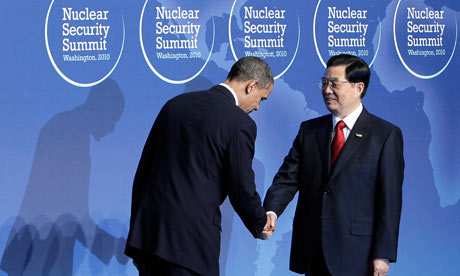
    Obama bows to China’s Hu Jintao.

    China is another factor, they have already taken the measure of Barack Hussein Obama and found him to be foolish and naive. They will use his indecisiveness to initiate some ‘incident’ over the island republic of China called Taiwan. China has been drooling over Taiwan for a very long time. China has also increased the number of missiles and artillery facing Taiwan from the mainland. With a timid Barack Obama at the helm, the Chinese may feel the time has come for a little adventurism.

    Obama has a miserable record of insulting one ally after another and, as in the case of Israel, withdrawing arms, munitions and spare parts, in the face of increasing threats and a potential regional war. It doesn’t take these folks very long to realize that this President, this government, not only cannot be trusted but will actively work for the benefit of their enemies while feigning friendship to them. read more »

    http://www.conservativeoutpost.com/o…s_endangerment

  • Greenspan calls out Congress on sub-prime crisis

    04.13.10 06:20 AM posted by Drew McKissick

    So what caused the collapse of financial institutions and the economic crisis / recession? Well, conservatives have maintained since the beginning that it was pretty much the logical outcome of lending money to people that can’t pay it back. Which leads to the institutions those people are supposed to pay back losing money…which led us to bailouts, etc.., etc..

    But the real question is what caused the bad lending in the first place? Well, a few days ago, former Fed Chairman Alan Greenspan went before Congress and pretty much laid the blame exactly where it belongs. Which means it wasn’t appreciated and won’t be paid attention to, but…

    "While the roots of the crisis were global, it was securitized U.S. subprime mortgages that served as the crisis’ immediate trigger," Mr. Greenspan explained. "The surge in demand for mortgage-backed securities was heavily driven by Fannie Mae and Freddie Mac, which were pressed by the Department of Housing and Urban Development and the Congress to expand affordable housing commitments." Unfortunately, Fannie Mae and Freddie Mac weren’t the only government agencies to feel the pressure. Mr. Greenspan also noted, "I sat through meeting after meeting in which the pressures on the Federal Reserve – and on, I might add, all of the other regulatory agencies – to enhance lending were remarkable."

    In other words, cheap housing policies. Don’t expect to hear too much about this in the "mainstream media" outlets. Especially since we’re almost at the point where housing is to be declared a "right"…right along with health care. read more »

    http://www.conservativeoutpost.com/g…ubprime_crisis

  • Summer time: Consumer Reports ranks the top convertibles for 2010

    Consumer Reports gave the Infiniti G37 Convertible, Lexus IS 250C and the Audi A5 Cabriolet convertibles an overall score of “Very Good,” topping Consumer Reports tests’ of three four-seat convertibles for the May 2010 issue. The publication also tested two less expensive convertibles including the Mazda MX-5 Miata and the Mini Cooper S Convertible.

    The Infiniti G37 Convertible and IS 250C earned “Very Good” overall road-test scores of 77, slightly beating the Audi A5 convertible, which earned a test score of 74. All three convertibles beat other competitors including the previously tested Volkswagen Eos (78) and BMW 328i (76) .

    Click here to get prices on the Infiniti G37 Convertible.

    “The G37 has many of the qualities CR’s testers like in the sedan configuration. The IS 250 should satisfy those looking for a refined and easygoing convertible, making both of them good choices,” said David Champion, senior director of Consumer Reports’ Auto Test Center in East Haddam, Connecticut.

    Click here to read our review on the 2009 Infiniti G37 S Convertible.

    In the convertibles tested, Consumer Reports only gave the Miata a “Recommended” rating since it said it doesn’t have sufficient reliability data on the IS 250C, A5, G37 Convertible, and Cooper S Convertible.

    Review: 2009 Infiniti G37 Convertible:

    Review: 2009 Infiniti G37 Convertible Review: 2009 Infiniti G37 Convertible Review: 2009 Infiniti G37 Convertible Review: 2009 Infiniti G37 Convertible

    All Photos Copyright © 2009 Omar Rana – egmCarTech.

    – By: Omar Rana


  • Wait! Maybe Retail Deflation Isn’t So Clear (WMT, WFMI)

    wal-mart walmart

    Charles Grom at JPMorgan has some excellent insights into food retail pricing. These are some interesting observations that you can check out.

    ————

    • &#9679  Take 1: Whole Paycheck? Not Anymore. Based on our checks, it appears that Whole Foods continues to stick to the course, with select price cuts throughout the store as opposed to a broad promotional strategy. While the company’s prices are still higher than KR/SWY/HT by roughly 14%, on average, this is down from last December (~19%). Of note, we did observe two important trends in the store: (1) the company has launched a special “One Day Deal,” promotion that highlights new savings every Friday and (2) traffic has improved with customers purchasing both discretionary and non-discretionary products – see our FC note out 3/30/10, Whole Foods: Trends Firming to the Upside, Overweight” for additional color on Overweight-rated WFMI.
     
    • &#9679  Take 2: Wal-Mart’s New Rollback Strategy Appears More Strategic: On April 1st, Wal-Mart launched a new wave of price rollbacks across its entire chain to help solidify its price leadership position. During our field work, we observed (1) enhanced signage used to identify new price cuts (Rollbacks) and bring attention to already low prices (Unbelievable Buys, Save More), (2) the use of end caps to highlight new rollback merchandise, and (3) the return of Action Alley. However, in spite of all the visual signs of price investment throughout the store, the average price in our 31-item basket (entirely food/consumables) actually increased 2.3% sequentially from February. This increase comes on top of a 1.9% uptick from January to February. Importantly, we found it difficult to determine which price cuts in food/consumables were incremental and which were a result of standard promotions the retailer typically puts in place. When it’s all said and done, however, Wal-Mart is still priced ~12.0% lower than the traditional grocers, on average (vs. 15.6% lower in February).
     
    • &#9679  Take 3: Kroger Slowly Pumps the Brakes: In April, we saw ongoing signs that Kroger has begun to tap the brakes on its heavy price investment (as CEO David Dillon indicated on the company’s 4Q call) and shifted its focus to more targeted promotions. For example, this was the first month in 2010 that the grocer hasn’t run its 10 items for $10 promotion – instead opting to focus price cuts on Passover and Easter products. As a result, average prices at the grocer increased 1.4% in April, which follows a 2.9% increase from January to February. On observations, traffic looked relatively in-line with February levels, but the number of items in the basket was noticeably higher than in our previous visit.

    Join the conversation about this story »

  • Seasonality, Climate and Diet

    AfricanSavannahEvolution and seasonality are inextricably intertwined. This isn’t a negotiable, controversial statement, because evolution describes an organism’s response to environmental pressures, and the seasons are part of the environment. Another uncontroversial statement is that the study of human evolution can give us insight into what constitutes a healthy lifestyle for modern humans. I think it’s reasonable, then, to suggest that understanding how seasonality affected human evolution might give even more insight into best practices.

    Most examinations of prehistoric climate change deal with average global temperatures, which can explain overall worldwide trends in climate, but when we’re talking about human evolution – that is, on the changes in the human organism that resulted from immediate, localized environmental pressures – knowing the mean global average doesn’t tell us much. To understand how seasonality affected our development, we need to look beyond the global trends. We need to look at specific climate conditions.

    The seasons change in many ways. There’s the obvious one – winter to spring to summer to fall – but how that inter-seasonal transition plays out depends on the overall climatic conditions of the environment. That is, winter has meant different things in different regions and at different times in history. Some places, winter is cold and dry, others warm and wet. Seasonality depends heavily on climate.

    Okay, so let’s take a look at our data. We’ve got a glacial period lasting 111,000 years, or half the time modern humans have been around (the last half). Throughout this glacial period, common geological features in the north included glaciers, huge sheets of continental ice, changing warm/cold seasons, and arid conditions, all of which make vegetation seasonal and life fairly difficult.

    Man grew up in the tropics. Yeah, there are subtropics and neotropics and whatever other distinctions you want to make, but the bulk of our evolution took place in tropical Eastern Africa, where and when it was warm. We also came of age during a glacial period that only just (11,000 years ago) ended. That glacial period was part of a larger ice age that began around 2 to 3 million years ago. We’re still in an ice age, technically, though popular parlance gets “ice age” and “glaciation” mixed up. An ice age is composed of glacial and interglacial periods. Today, we’re in the middle of an interglacial period.

    That last glacial period (what we generally refer to as “the ice age,” incorrectly so) began around 111,000 years ago and lasted 100,000 more. Modern humans (Homo sapiens sapiens) have been around for 200,000 years – that’s us. So, about half our time on Earth has been spent dealing with a glacial period. What’s involved in a glacial period, you might be wondering? Well, popular notions of glacial periods include barren tundra, steadily encroaching ice sheets, unstoppable glaciers (hence “glaciation”), hairy men (and women, I suppose) in animal pelts, seasonal vegetation, and wild game with massive stores of saturated back fat. For the northern latitudes, this is pretty accurate imagery. Canada and the northern United States were completely covered by ice. The Scandinavian ice sheet spanned the British Isles, Germany, Poland, Russia, and western Siberia. The Himalayas, Caucasus, and Alps experienced considerable glaciation. Glaciers reached Taiwan, the Japanese Alps, as well as the mountains of Morocco, Algeria, and Ethiopia. The hominids living in the affected areas, then, probably embodied the classic “caveman” lifestyle (the ones who survived, that is).

    Sixty thousand years ago, when Europe was icy and forbidding, modern humans weren’t there. Neanderthals were, though, and they were undoubtedly made for the region. Bulky, robust, heavy set, muscular, with pronounced brow ridges – these guys were your archetypal cavemen. But they were not modern humans. When we finally did head northward out of Africa into Europe, around 40,000 years ago, we actually displaced the extant Neanderthals. We mingled and interacted with them along the way, and we may have even interbred with them, but we are not Neanderthals. Those early Europeans were still Africans, genetically, as the famous Hofmeyr Skull showed.

    So, what does seasonal, evolutionary eating actually mean? To whom do we look for ultimate guidance?

    In the Primal community, there’s a tendency to hone in on the European hunter-gatherer experience for guidance in all things dietary. The big-game hunting, cave-painting Cro-Magnon is the first thing that comes to mind for most of us. That’s fine, to a point, but not when it means excluding from consideration of other hunter-gatherer populations living in completely different climates. We have to take it all in. It’s all relevant. They’re all humans.

    If it’s human, it’s relevant, and we have to pay attention.

    East Africa, the predominant site of human evolution, experienced the seasons as wet and dry, rather than hot and cold. It was always warm. There wasn’t widespread glaciation, except in the mountains. There were no African ice sheets. Glacial periods affected African climate, sure, but not by creating a winter wonderland. Glacial periods manifested as droughts and in the development of arid deserts and grasslands. Vegetation and game were available. Now, drought and desert undoubtedly altered the scope of human evolution by heavily impacting the humans (our ancestors) living there; it’s just a mistake to assume glacial periods meant fur coats and holing up in caves for the winter for everyone worldwide.

    Put another way, when eating seasonally, do we eat according to the seasonal patterns experienced by our East African ancestors or our European/North American/Australian/Asian ancestors? Do we look to the past as a road map, or do we merely eat what’s in season at local farmers’ markets?

    I’m not sure, but I’ll venture the safest guess I can muster.

    All of the above. Everything matters. One thing is for certain, though: we’ve all got that African Homo sapiens sapiens blood running through our veins. Each of us – irrespective of nationality, ethnicity, or recent ancestry – has several hundred thousand years of tropical evolution to account for. That’s when we developed our taste for animal flesh and our big beautiful brains. But we’re adaptable creatures, us humans. We can thrive on different diets with different macronutrient ratios.

    As long as you stick with the basics and avoid those foods that weren’t available, regardless of season, stuff like refined sugar, vegetable oils, grains, and legumes, everything else is just fudging with the margins. Keep one eye on the tropics and another on the Paleolithic climatic region of your choice. Could a descendent of Northern Europeans, a regular Norseman, thrive on a tropical diet of fish, coconuts, pork, and yams? I bet he could. Could a Native American grow old and strong on the modern Primal hybrid eating plan of Big Ass Salads, omelets, and crock pot recipes? Sure, why not.

    Seasonality shouldn’t be limiting. The fact that our ancestors evolved with perennial warmth and were still able to thrive in regions with actual seasons means we can handle just about anything. It means we can eat according to any season as long as we remember the basic nutritional laws that bind us all together, rules that were initially written in the tropics and then expanded upon in myriad other climates, seasons, and regions.

    Thank you for reading this series of posts in which I explored the role seasonality plays in the human diet and health. If you missed any you can catch up here:

    The Question of Seasonality in Human Health and Nutrition

    The Question of Seasonality in Fructose Availability

    Seasonality for the Birds

    Get Free Health Tips, Recipes and Workouts Delivered to Your Inbox

    Related posts:

    1. The Question of Seasonality in Human Health and Nutrition
    2. The Question of Seasonality in Fructose Availability
    3. Seasonality for the Birds

  • Fórmula 1: GP da Coréia pode ser cancelado da temporada


    Uma das etapas da Fórmula 1 2010 está ameaçada de ser cancelada no dia 24 de outubro. Falo do Grande Prêmio da Coréia do Sul, que estaria pela primeira vez participando do calendário da temporada de F1. A razão do possível cancelamento é o atraso nas obras que pode criar um atraso de 4 semanas entre os GPs do Japão e Brasil.

    O chefão da F1, Bernie Ecclestone, foi pessoalmente para a Coréia para avaliar as condições do circuito, e definir se a primeira corrida a ser realizada em Yeongam irá realmente acontecer, ou será retirada da temporada.

    Até mesmo o conhecido arquiteto criador de circuitos Hermann Tilke se mostra apreensivo com a conclusão dentro do tempo determinado dessa pista. Ele confessa que: “Pela primeira vez eu estou preocupado com o fato de um circuito não ficar pronto a tempo”.

    Via | Motorpasion


  • Chrysler, NASA team up to share knowledge and technologies

    While General Motors and NASA are teaming up on a new humanoid robot called Robonaut 2 or R2, Chrysler announced today that it is forming a three year alliance with NASA to share information related to advanced technologies in several areas of mutual interest including space exploration and automotive technologies.

    “This is a great opportunity to share knowledge and data in areas where both Chrysler Group and NASA have a vested interest,” said Scott Kunselman, Senior Vice President, Chrysler Engineering. “We value the opportunity to work with NASA and will implement what is learned to further improve our Chrysler, Dodge, Jeep and Ram Truck products.”

    Chrysler said that it is studying several advanced technology topics for synergies and shared interest, including: materials engineering, robotics, radar, battery systems and other energy storage mediums.

    Project teams have been assigned to different technologies, and each team includes a Chrysler Group and a NASA technical specialist.

    Chrysler has apparently already benefited from the alliance from shared research on reliable surface navigation sensors.

    – By: Kap Shah


  • An Official Android Tablet from Google May Be Coming

    Tablet PCs are all the rage right now and it’s easy to see why. Apple has recently released the iPad and the hyped device seems to be living up to its expectations, at least in terms of sales. Now more than ever, device manufacturers and Apple competitors in general want in on the game. Google is becoming one of Apple’s biggest th… (read more)

  • Square Enix trademarks ‘The 4 Heroes of Light’

    It looks like Hikari no 4 Senshi: Final Fantasy Gaiden will be getting an international release. Square Enix has filed a trademark for “The 4 Heroes of Light”, a name that bears a very distinct resemblance to the

  • Mid-Day Update: Stocks Falling, Here’s What You Need To Know

    goodyearIndices:

    • DJIA: Down 13 points to 10,991.
    • NASDAQ: Down 3 points to 2454.
    • S&P 500: Down 4 points to 1192.

    Today’s biggest gainers on the S&P 500:

    • DeVry Inc (DV): $70.57 / +8.47%
    • Goodyear Tire & Rubber Co (GT): $13.45 / +3.78%
    • Fastenal Co (FAST): $53.85 / +3.76%

    Today’s biggest losers on the S&P 500:

    • Avon Products Inc (AVP): $32.10 / -7.65%
    • Huntington Bancshares Inc (HBAN): $5.64 / -6.47%
    • KeyCorp (KEY): $7.99 / -4.20%

    Commodities:

    • Oil: Down 1.9% or $1.64 to $82.70 a barrel.
    • Gold: Down 1.3% or $15.20 to $1147 an ounce.
    • Silver: Down 2.3% or $0.43 to $17.98 an ounce.

    Futures:

    • Generally in the red across the board; metals and crude falling fast.
    • Soybean meal, cotton, sugar, and wheat are showing solid gains.
    • Natural gas futures slightly up.

    Now here are the stories you need to know:


    FUTURES NOON April 13th

    Join the conversation about this story »

  • Billionaire Prokhorov plans Russia’s first electric-cars

    Russian billionaire Mikhail Prokhorov announced that he plans to unveil Russia’s first hybrid electric-car this year as the government tries to reduce reliance on natural resources. Prokhorov’s Onexim Group will invest 150 million euros ($204 million) in a joint venture with Russian truck maker Yarovit and will roll out three electric car prototypes in December.

    The move will set up several production facilities across Russia and abroad. The companies plan on building the first factory in Jan. 2011 and expect to “break even on the operational level” once production kicks-off in mid-2012.

    Prokhorov is Russia’s second-richest man and won approval of Prime Minister Vladimir Putin to build one of the planned electric car factories in Togliatti, where the state-run automaker OAO AvtoVAZ is based.

    – By: Omar Rana

    Source: Automotive News (Subscription Required)


  • Earth Day’s D.C. rally will push for action on climate/energy bill

    By Barbara Kessler
    Green Right Now

    As sure as the wildflowers burst forth in April, so do the defenders of the Earth. Communities are buzzing  with recycling events, cross country runs, beach clean ups and festivals.

    This year is the 40th Anniversary of Earth Day, and the event is now deeply rooted in our culture, with promotions at stores, celebrations at zoos, a notation on the calendar. As befits a holiday celebrating Mother Earth, events are uniquely local. In Cheboygan, they’ll host harbor tours. In Seattle, conservation project volunteers will get free tickets to an Earth Day concert. In St. Paul, they’ll fly kites and create public art, and in Los Angeles, Avatar director James Cameron will speak at a benefit.

    Earth Day Network organizers, however, want the capstone  U.S. Earth Day event, to be more than just an opportunity to win a free Prius or ride a Segway. They’re hoping that a rally in Washington D.C. on April 25 , will show that a broad swath of the public wants to get down to business on climate change and see Congress pass a strong national climate and  clean energy bill.

    Even if it’s hard to do.  Even if some lawmakers kick and scream.

    This year, on the 40th Anniversary of Earth Day, it would be tempting to get nostalgic and pat each other on the back, says Nate Byer, Earth Day Network campaign director. “But there’s not much to celebrate,” he says. So the EDN, which is coordinating the national event, hopes the crowd and speakers will  focus on the fierce urgency of now, with the D.C. podium serving as a launch pad for all-out campaign to secure climate change legislation this year.

    “We’re hoping it will be the biggest climate rally devoted to clean air and energy that there has been so far,” Byer says. A record turnout would help show that not just environmentalists, but labor groups, small businesses, cities, faith organizations, farmers and just regular folks want action that will make TheClimateRallyjpegthe country more energy secure and assure a clean, bright future for the younger generation.

    “A broad base of support is key (to demonstrate) here. This isn’t just environmental groups, it’s faith and labor and social justice and green business and government,” he said. “We’re trying to show that this is an issue that everyone has a stake in and that affects all communities.”

    Aside from the tick-tick on rising greenhouse gas emissions that scientists say will bring calamitous (and economy-crippling) sea-level rises and heat waves and will obviously affect everyone if not addressed, there are tangible negative effects of rising global temperatures already apparent, Byer noted.

    “In urban communities we see our children have asthma rates higher than ever. We see elderly dying in severe heat or severe cold. In the Midwest we see drought and crop failures affecting our agricultural systems, and we’re falling behind the race with China and India and Europe in creating the economy of the future, in creating a new class of jobs that cannot be imported overseas.”

    A key issue that speakers at the rally will address is energy security, that point of consensus among Americans where even those who are skeptical of climate change can see the advantages of using clean, local energy as opposed to continuing dependence on foreign oil.

    “A climate bill is a jobs bill, it is an energy bill and it is a bill that will ensure the well being of future generations,’” Byer said.

    The D.C. rally, set for 11 a.m. to 7 p.m., will feature these speakers: The Reverend Jesse Jackson; film director James Cameron; AFL-CIO President Richard Trumka; Olympic gold medalist Billy Demong; producer Trudie Styler; author Margaret Atwood and others. Headline performers will include Sting, John Legend, The Roots, Passion Pit, Bob Weir, Patrick Stump, Mavis Staples, Q-Tip and Booker T.

    It is open to the public and free of charge. EDN would not estimate how many are expected.

    (For selected other events around the country, please see our list.)

    Copyright © 2010 Green Right Now | Distributed by GRN Network

  • Report: BMW M3 Sedan may not live to see another generation

    Filed under: , ,

    BMW M3 Sedan – Click above for high-res image gallery


    Between the emergence of the M3 GTS and the Competition Package – to say nothing of the new 335is – there’s been plenty of news for fans of BMW‘s performance-oriented 3 Series. Unfortunately, not all of it is good, as reports indicate that the Bavarian automaker is looking to discontinue the four-door M3 sedan.

    Although the current M3 sedan looks poised to continue through to the end of its current lifecycle, sources suggest that the next-gen M3 will remain a two-door (coupe and convertible) affair only. The reason has apparently been cited as lagging sales for the V8 super-sedan, which was highly demanded by American buyers in the previous generation but has failed to live up to its potential in the marketplace. So if you’ve been eying that M3 sedan on the local dealer’s lot but were waiting to see what the next model would bring, now may be the time, hombre.

    [Source: BimmerFile via eGMCarTech]

    Report: BMW M3 Sedan may not live to see another generation originally appeared on Autoblog on Tue, 13 Apr 2010 10:40:00 EST. Please see our terms for use of feeds.

    Permalink | Email this | Comments

  • RIAA Insists That Musicians Can’t Make Money Without The RIAA

    Ah, the RIAA blog. It’s a never-ending source of entertainment. In the past, they’ve tried (and failed) to address some of my arguments directly, but as someone noted, one of their recent posts again appears directed my way (not just me, but a few others as well). In it, the RIAA tries to suggest that alternative business models can’t possibly work. Since many of the arguments the RIAA tries to debunk sound sorta like the arguments I make, it seemed worth responding — especially given how badly out of context the RIAA takes them in an effort to convince itself that it’s still necessary. Let’s start with the title:


    IS TOURING ALONE ENOUGH?

    First of all, there aren’t that many folks who claim that touring alone is enough of a business model, and the rest of the post doesn’t focus on “touring alone,” but on a variety of alternative business models, which makes it a weird and entirely misleading title. In fact, a year ago, we explained why (just like the RIAA is pointing out) touring alone probably isn’t enough to replace the revenues of the recording industry — but that if you combined touring with other business models, it certainly could work quite well. But by using “touring” as the peg, the RIAA can debunk touring alone and pretend (falsely) that it’s debunked the entire space of alternative (smarter) business models. Neat trick, but easy to see through.


    Some industry observers like to suggest that efforts to address the theft of music online are somehow tantamount to efforts to maintain an “outdated business model” rather than to address forms of unfair competition based on illegal acts.

    Now, I am one such “industry observer” who has pointed out that the RIAA has made a Herculean, if ultimately self-defeating, effort to maintain its outdated business model. But that has nothing to do with “theft of music online.” It has to do with the changing economics of creating, promoting and distributing new music. Some of that may involve some amount of copyright infringement, but the business model of the RIAA was outdated even in the absence of infringing uses — and, of course, such infringement is not and never has been theft. Of course, the RIAA knows this, but this blog is a weak attempt at painting itself as a victim, after decades of denying musicians money that it actually owed them. So, the best they can do is pretend that these new technologies represent “theft.” Weak.


    The suggestion is there are ample alternative mechanisms for generating revenues from music — money from touring, selling merchandise like t-shirts, licensing music for commercials.

    Yes. Indeed. But it’s not a suggestion. There’s a fair bit of evidence to support that. In fact, we’ve shown multiple studies from multiple sources and multiple locations all showing this is true. So, it would take quite a debunking from the RIAA to prove this wrong. But, of course, the RIAA doesn’t do so. Because it can’t.


    Completely ignored are the pleas for enhanced copyright protection from artists and unions

    A bit of a non sequitur, but not ignored at all. In fact, it’s no surprise that artists and unions would want gov’t-backed monopolies that mean they have to work less hard to obtain royalties. Who wouldn’t want that? But a bunch of self-interested folks begging the gov’t for protectionist policies is hardly evidence that copyright isn’t being abused to prop up an outdated business model. If anything, it supports that view even more.


    Instead the handful of established artists for whom Internet anarchy works as an effective marketing tool are cited.

    Wait. That’s just a lie. For years, we pointed out unsung artists who were making this work — artists like Maria Schneider, and in response folks like the RIAA told us that “sure, this model might work for no names who have nothing to lose by giving away their works, but it’ll never work for the big artists, like those we represent.” Yet, now that it is working for those artists too, the RIAA wants to pretend it only works for them? Nice try, guys. But, as we’ve demonstrated over and over and over again, with a large and growing list of artists (not just “a handful”), this model works for artists up and down the music food chain. The RIAA says it only works for “a handful of established artists” but doesn’t explain the success stories of folks like Corey Smith, Motoboy, Matthew Ebel and others who were hardly “established” when they began using these methods for their own success.

    No one has ever said that everyone can succeed with them. However, one thing we have seen is that pretty much every artist who has embraced these models and principles has done better than they did trying to go about things the old way. Those who were on big labels found that they made more money this way. Those who weren’t on big labels also found they made more money this way. And, we’re not saying this is anti-label. There are lots of smart music labels that are embracing these principles as well. Just not the ones who run the RIAA.


    Even more importantly, the reality of the marketplace is ignored in favor of theory.

    There’s only one party in this conversation ignoring “the reality of the marketplace… in favor of theory,” and considering that we’ve posted numbers on most of the artists we’ve talked about, and the RIAA is best known for either not sharing or totally making up numbers, take a wild guess who’s in reality and who’s focused on “theory.”


    While touring and merchandise sales will work for some bands — most notably big bands that “made it” in the 80’s, 90’s or earlier (and built on the back of touring support from music labels) — it is exceedingly challenging for other bands to generate sufficient income just from touring, and touring support from the labels is rapidly disappearing.

    See what the RIAA did there? Now it goes back to pretending this is just about touring. Of course, it’s not. Most of the models we discuss don’t focus just on touring.


    Check out this article in BBC News about UK rock band Doves. And of course, without brand/name recognition, merchandise sales are commercially irrelevant.

    That BBC article is quite one-sided, and basically says that the labels aren’t providing tour support any more. And that proves what? It proves that the RIAA itself is screwing this up, by not supporting one part of the business that is making lots of money. I’m not sure what that proves other than that the RIAA is really bad at figuring out how to adapt to the changing world.

    But, more to the point, the idea that bands can’t tour without support from a major label is just silly. There are all sorts of new and more efficient ways for bands to find gigs and create tours. Sites like Eventful, SonicBids, Songkick and lots of others are making all sorts of useful tools around touring, that make it possible to do shows on a much more efficient and cost-effective basis. Yes, the big labels provided lots of money for tours in the past — and they did so in a wasteful manner. But rather than become more efficient, now they’re just hoarding their cash and blaming everyone else!

    As for the lack of “brand/name recognition” making it impossible to sell merchandise, that’s true. But the RIAA seems to be implicitly stating that the only way to get brand/name recognition is through a big RIAA label. Yet, the examples we’ve shown over and over again have focused on musicians figuring out how to connect directly with fans themselves. Without the need for massive marketing from the RIAA.


    One last question: how is generating revenue from licensing of music to sell other products more socially useful than the sale of music itself?

    Ah, yes. The “socially useful” question. It sounds great, but is entirely meaningless. After all, how is generating revenue from smelly automobiles that break down more socially useful than selling horses and buggies? Or, perhaps a more apt comparison: how is having all your phone calls connected directly more socially useful than having operators manually connect each call? Social utility doesn’t matter. Economics doesn’t care about social utility, and in the long run, in every single case, people tend to discover that there is more social utility in embracing progress rather than denying it.

    Cars became more socially useful than horses and buggies by making travel more efficient and faster — even if it hurt those who relied on the old system (horse shoers and buggy whip makers, for example). Automated telephone switching created a much better phone system, and other advancements including the internet — even if it meant a lot of operators lost their jobs. And generating revenue from alternative means by selling other products is more socially useful than the sale of music directly because it’s more efficient. It allows for less expensive creation, promotion and distribution of music — meaning it brings more music into the world, helps more people hear more music more quickly for less cost — and, in doing so, opens up tons of more efficient and socially beneficial business models.

    Besides, isn’t it just a little ridiculous for the recording industry — who has filled landfills with non-degradable plastic discs to start talking about how “socially useful” its business model is?


    It seems to me that this is the worst of all worlds, one in which all artistry will not be rewarded — and one in which only music that works well in selling diapers and cars will be commercially produced. Is this supposed to sustain the diversity of music that we want? Would we have Bob Dylan, Leonard Cohen, Patti Smith, the Sex Pistols under this kind of system for compensating artists? Not remotely.

    Ah. and now the shift. Suddenly the RIAA is pretending that this is all about product placement and commercial licensing. Except, it’s not. And, uh, last I checked, Bob Dylan was shilling for Victoria’s Secret, so apparently, he’s perfectly happy with such a system.


    Exactly what kind of product licensing would have sustained the Smiths or Nirvana? Was there anything on Springsteen’s first record that would have drawn the attention of advertising companies? In fact, we never would have had Elvis (either one)! This is an alternative universe in which I would not care to live.

    Now this is rich. This from an industry that kicked all sorts of fantastic bands to the curb, because their music “wasn’t commercial enough” for the major labels… and now it’s complaining about how music will be “too commercial” under this new system? Except, of course, that’s not true. If you listen to the music from different artists who have embraced these models, you’ll find all kinds of music — and much of it isn’t commercially driven at all. In fact, that’s why fans like it so much, because it’s not being programmed by some exec in New York, but directly between the musicians and their fans.

    Sorry, RIAA, you are protecting an obsolete business model, no matter how much revisionist history you cite and how many out of context arguments you make. Of course, we’re more than willing to help your members figure this stuff out. They can just give us a call. In fact, more than a few already have. This might explain why they’re questioning the value of continuing to be members of the RIAA.

    Permalink | Comments | Email This Story


  • Consumer Reports says Lexus GX 460 has a rollover risk

    It doesn’t seem like the folks at Consumer Reports and Toyota are getting along. About two months ago, the publication took a way it’s ‘recommended’ status for the eight Toyota vehicles included in the recent wave of recalls. Today, Consumer Reports has issued a safety warning on the 2010 Lexus GX 460 SUV because of an increased risk of the vehicle rolling over during a turn.

    The publication said it uncovered the problem during one of its routine tests and urges car shoppers to not purchase the SUV until the problem has been fixed. It gave the Lexus GX 460 a rating of “Don’t Buy: Safety Risk,” which is rarely given by the magazine. The first time that rating was used was in 2001 on the Mitsubishi Montero Limited.

    “We’re concerned with the results of Consumer Reports testing on the Lexus GX 460 and their suggested buyer recommendation,” Lexus said in a statement. “Our engineers conduct similar tests and we feel these procedures provide a good indication of how our vehicles will perform in the real-world; however, we will try to duplicate the Consumer Reports’ test to determine if appropriate steps need to be taken.”

    Lexus went on to say: “Please keep in mind that the 2010 GX 460 meets or exceeds all federal government testing requirements. Customer safety and satisfaction remain our highest priorities. We take the Consumer Reports’ test results seriously and appreciate Consumer Reports bringing it to our attention.”

    Around 5,000 units of the Lexus GX 470 have been sold in the three months the SUV has been on sale.

    – By: Omar Rana

    Source: CNNMoney


  • Bucking the Trend: Automaker ad spending reportedly up in magazines

    Filed under: ,

    Here’s a sign that things are possibly turning around in the automotive industry – Advertising Age is reporting that the total number of ad pages bought by automotive advertisers went up over the past year. First quarter numbers for American magazines went up compared with the first quarter of 2009, according to a report by the Publishers Information Bureau. This represents the first time that both of those numbers has gone up since 2007.

    Back in February, the Media Industry Newsletter reported that although it was the smallest drop during nine consecutive quarters of decline, there was a 5.7-percent dip in ad pages compared to 2009 figures. The Publishers Information Bureau shows an even bleaker picture, with a reported decline of 9.4 percent from the first quarter of 2009. And lest we forget, the first quarter of 2009 was already pretty dismal, with drops of more than 25 percent over 2008 numbers. Still, the automotive sector is apparently stronger than several others, at least as far as magazine ad pages go.

    Although Advertising Age says that financial, insurance and real estate figures have actually increased by 11.3 percent, with toiletries and cosmetics going up by 7.6 percent, the auto sector is still better off than several others. Apparel and accessories were down 15.7 percent, drugs and remedies dropped 15.6 percent, technology dipped 14.7 percent, media and advertising declined by 13 percent, as did public transportation, hotels and resorts.

    [Source: Advertising Age]

    Bucking the Trend: Automaker ad spending reportedly up in magazines originally appeared on Autoblog on Tue, 13 Apr 2010 10:20:00 EST. Please see our terms for use of feeds.

    Permalink | Email this | Comments