Author: Serkadis

  • Indian Scientists Refuse To Patent Tuberculosis Genome, Encourage Anyone To Make The Drugs

    We recently wrote about the pharmaceutical industry in India, noting that it had been thriving prior to foreign pharma lobbyists pressuring India through international trade agreements to change its patent laws to cover pharmaceuticals. As usually happens when we write about examples like this, some patent supporters in the comments insisted that no Indian research could possibly result in serious drug breakthroughs without patents (apparently those who write this are unfamiliar with Jonas Salk’s opinions on patents in reference to the polio vaccine he created: “Could you patent the sun?”)

    So it’s nice to see that even now that India does allow patents on pharma (and, as we noted in the original story, Indian patent laws have been abused by foreign pharma firms in order to jack up prices on commonly used medicines), some Indian scientists have mapped out the tuberculosis genome, which should help creating new drugs that can help respond to that disease.

    But rather than rushing to the patent office, the scientists are freeing up the research through an open source effort:


    “What we have not done so far has been achieved. I thank all those students who have helped it become a reality. We are doing this through open source drug discovery (OSDD) and anyone across the world is free to join the effort,” [Council for Scientific and Industrial Research (CSIR) chief Samir] Bramhachari told IANS….

    “OSDD is a completely new formula across the world. Here we are making all our progress available to public. Anyone can take advantage and develop a drug based on our research. The aim here is not patents but drug discovery for a neglected disease,” said Rajesh Gokhle, a senior scientist associated with the project.

    And I thought that no such breakthroughs were possible without patents?

    Permalink | Comments | Email This Story


  • Whitacre: GM to report “solid” first-quarter results

    General Motors CEO Ed Whitacre said that the Detroit automaker expects to report “solid” operating results for the first quarter, which will show the company’s progress towards its goal of returning to profitability by the end of 2010. That goal of “profitability” will end a horrible 5-year streak of losses and mark a turnaround for the General, which came out of a U.S. government financed bankruptcy in July.

    “In January, I said we could earn a profit in 2010, if everything falls into place,” Whitacre said in a memo to employees, which was obtained by Reuters. “Our first quarter financial results will show us an important milestone, and I’m pleased to say that I anticipate solid operating results when we report our first quarter financials in May.”

    GM will report its first-quarter results in mid-May.

    Whitacre, who replaced Fritz Henderson as CEO in December, plans to launch an IPO that would allow the Obama administration to reduce its majority stake in the automaker.

    – By: Stephen Calogera

    Source: Automotive News (Subscription Required)


  • A New Era for HTML5 Video: Google Said to Open-Source the VP8 Codec

    Google may be making one eagerly anticipated move that should usher in a new era for HTML5 and online video at large. The company is now expected to release the VP8 video codec as open source, offering a third viable option for HTM5-based video streaming along with the proprietary H.264 and the existing open-source alternative O… (read more)

  • State Farm seeking repayment from Toyota on unintended acceleration claims

    It seems like the National Highway Traffic Safety Administration aren’t the only one after Toyota to pay fines. According to a report by USA Today, State Farm Insurance is after the Japanese automaker to repay them for any crashes related to unintended acceleration by its cars.

    And it won’t stop there because other insurance companies are expected to follow the move by State Farm for repayment of claims – a move called “subrogation” in the insurance business. All that could end up costing Toyota from $20 million to $30 million, says Mark Bunim, an attorney with Case Closure.

    Customers could also see a bonus from the repayments and their insurance deductibles could be refunded.

    Toyota has recalled more than 8 million vehicles worldwide due to two recalls related to unintended acceleration.

    – By: Stephen Calogera

    Source: USAToday


  • Geely expects Volvo to break even in the fourth quarter of 2010

    Zhejiang Geely Holding Group, the Chinese company who is set to buy Volvo from FoMoCo, said that it expects losses at the Swedish automaker to end as early as the fourth quarter.

    “As far as I know, Volvo is in good operating condition and it’s possible it could break even in the fourth quarter of this year,” Geely CEO Gui Sheng Yue told reporters in Hong Kong.

    Geely will pay a total of $1.8 billion for Volvo and its related assets.

    The founder of Geely, Li Shufu, recently compared Volvo to a tiger that needs to be freed and no, we’re not kidding. Check out this post here.

    – By: Kap Shah

    Source: Automotive News (Subscription Required)


  • TV weathercasters divided on global warming by Suzanne Bohan, Contra Costa Times

    Article Tags: none

    Before Spencer Christian, a weather forecaster with KGO-TV Channel 7 in San Francisco, steps before the camera during the station’s 6 p.m. newscast, he scrutinizes a computer screen to analyze the latest forecasting data.

    But unlike some of his counterparts, Christian doesn’t view his extensive knowledge of storm fronts and high-pressure systems on the week’s weather as credentials to assess the effects of greenhouse gases on the Earth’s climate in the coming decades.

    “The climatologists are the experts in this field,” said Christian, who started weather reporting in 1975 and worked for 12 years as the weather anchor on “Good Morning America” in New York City before joining KGO-TV in 1999.

    Christian is among the majority of TV weathercasters — but a slim majority, only 54 percent — who believe that the planet is warming, according to a new survey.

    Source: contracostatimes.com

    Read in full with comments »   


  • Yahoo Opens Up a Massive Amount of Data with Its New Updates Firehose

    Yahoo has been aggregating updates from a big variety of websites for several months now. Users could see in one place updates from Twitter, YouTube or Last.fm and also post new ones with Yahoo Update. The feature is interesting enough and has been popping up in more and more places across Yahoo properties. But Yahoo is now m… (read more)

  • Labour election manifesto: weak, not tough, on causes of climate change by Juliette Jowit, The Guardian

    Article Tags: Opinion, UK Election 2010

    Green policies lack detail but some experts detect ‘seismic shift’ in new era of regulations, sanctions and subsidies

    Image Attachment

    Cover of the Labour Manifesto 2010: a green future for all?

    “After 13 years they have finally understood that they can’t create a low carbon, secure energy supply in this country without some more intervention,” said Matthew. “[We need] certainty for investors so they shift their money from high to low carbon energy services. They need that support to get off the ground, but eventually they’ll stand on their own and end up cheaper than the fossil fuel industries.”

    Click source to read FULL report from Juliette Jowit. Our opinion on this is that the importance of “Man Made” Climate Change will be dropped within the next few years. No longer will it be put forward as an issue that concerns the direct action of “Man”. Instead Governments will come to their senses about how to help people adapt from a less active Sun and a cooler world.

    The warmer version of our world that has been put forward by the very misinformed media will also be changed after the next election, just like the new Labour manifesto.

    Source: guardian.co.uk

    Read in full with comments »   


  • Last.fm Drops On-Demand Streaming, Integrates Spotify, Others

    Last.fm is introducing some pretty big changes for the users, but also in terms of overall strategy. The music-recommendation and -discovery service is dropping on-demand music streaming, which it only offered in the US, the UK and Germany anyway, and will introduce instead partner links where a user can listen to the full track. These… (read more)

  • Ron Paul Answers A Few Questions

    After giving his speech at the Southern Republican Leadership Conference, Ron Paul met with a group of journalists to answer a few questions.

    Event: Southern Republican Leadership Conference
    Location: New Orleans
    Date: 04/10/2010

    Share/Bookmark

    Related posts:

    1. If Ron Paul Wins Another Straw Poll Republicans May Stop Using Them! Ron Paul won the CPAC straw poll earlier this year….
    2. Join Ron Paul in New Orleans! (April 10) Click here to purchase your ticket! On April 8-11,…
  • Google Launches New Real-Time Google Docs

    Google Docs is the company’s main weapon on the enterprise market, besides Gmail of course, and the office and collaboration suite has been seeing a steady stream of updates and improvements aimed at making the cloud more of an alternative. Google’s regular modus operandi is to iterate fast, always bringing in small updates to improve a serv… (read more)

  • Google Docs’ Revamped Document Editor Gets Some Major New Features

    Google has launched a completely revamped Google Docs. The underlying technology has been rewritten from scratch and the two biggest apps in the suite have also been replaced with new, improved versions. There is a brand-new Google Docs document editor, probably the most used app in the suite, which adds a number of interesting f… (read more)

  • Canada Points Way for USA Bank Reform


    It is not too surprising that US bank reform is looking to emulate the Canadian banking system.  After all it is the only man standing among the major developed economies.  This article looks at two approaches and discusses some of the pros and cons.
    I have a few comments.  Too big to fail is a strong argument for breaking up of any business on some form of rational basis.  In Canada, this could be easily done on a geographic basis with resultant improvements.  In the USA, it would be strongly opposed by the New York centric nature of these businesses.  Yet I think creating additional money centers throughout the USA would be good for everyone.
    The idea of centralization is profoundly attractive to participants but unsupported by historical evidence.  The capacity to finance the largest loan in history is great, except that it leads immediately to the largest bad loan in history because of a simple lack of product and too much money.  It is better to force regional money centers to syndicate and compete instead.
    The original post 1929 reforms centered on separating the lenders from the brokers.  Do I need to explain after the past decade why that was a good idea?  I thought that this was common knowledge, which explains my surprise when they repealed all those laws in the dying moments of the Clinton administration.
    There is still a lot of merit in having a lot of large banks.  Canada has six who are ultimately outright integral to the Canadian financial system.  And yes one could fail and be immediately absorbed by the other five.  It would then be replaced quickly by one of several other rising institutions.
    The USA needs ten times as many of similar size with sound branch systems and geographically distributed.  This is possibly best accomplished by establishing State owned banks in the more populous States.  In combination with other regional banks we have a cadre of institutionally important banks that can be regulated properly in times of excessive enthusiasm.
    The Canadian banking system and regulatory regime is no accident at all.  A banking fiasco a couple of decades before 1929 similar to the 1929 disaster made clear the need for this form of regulatory oversight.  As a result, Canada also passed through the 1929 disaster with its banking system largely intact.  The ensuing global lack of credit brought about the rise of alternative lending in Western Canada.  The important result of all this was an institutional memory that resisted recklessness in the banking industry.
    Canada points the way in U.S. banking reform
    Why bust up Wall Street megabanks when Canada’s Big Five have thrived?
    Published On Mon Apr 12 2010
    David OliveBusiness Columnist
    The question is whether Canadian bankerly prudence can be transplanted stateside.
    As banking reform gears up in the U.S., the attention of American reformers increasingly turns to Canada.
    The reformers have essentially lined up between two solutions.
    One is to break up big American financial institutions deemed “too big to fail,” whose possible collapse is a “systemic” risk to the entire system.
    The other approach is to maintain the megabanks but simply regulate them as well as they were before the era of deregulation that began in the late 1970s.
    At this relatively early stage of the debate, the Canadian model seems to be winning out. Canada’s megabanks, also “too big to fail,” were alone in the G-7 nations in not requiring a government bailout. Australia’s Big Four banks also came through the crisis with flying colours.
    U.S. reformers intent on busting up America’s biggest banks lack confidence in the character of American financiers. U.S. economist Robert Reich wants America’s megabanks dismantled because no amount of new regulation, he believes, will stop the more avaricious and morally deficient operators from finding a way around them.
    “The giant banks already hire fleets of lawyers, accountants, and financial entrepreneurs to find loopholes in every existing regulation,” says Reich, who insists that a megabank is dangerous by definition.
    For pro-breakup reformer Dean Baker, co-director of the U.S. Center for Economic and Policy Research, the Canadian model doesn’t work because it would require a transplant of Canadian banking values stateside. And that isn’t going to happen.
    “There is a level of independence and integrity on the part of the regulators in Canada that does not exist in the United States,” Baker says.
    But Nobel laureate economist Paul Krugman, on the other side of the debate, has what I consider the winning argument.
    To be sure, Krugman also notes that “Canada – whose financial system is dominated by a handful of big banks, but which maintained effective regulation – has weathered the current crisis notably well.”
    But Krugman draws a different lesson from the Canadian experience.
    Krugman and his ilk have more faith in the good conduct of U.S. bankers. And they should. America has more than 7,000 independent commercial and community banks. Less than a dozen poorly supervised mega-institutions triggered the global crisis with their reckless short-term profit-seeking.
    Americans have a tendency to “over-solve” problems, as with the creation of the largely dysfunctional Department of Homeland Security in the aftermath of the Sept. 11, 2001, terrorist attacks.
    It’s plain today, two years after the outset of the financial crisis, that the deployment of any one of three existing failsafe devices would have prevented the disaster.
    The U.S. Federal Reserve Board could have made a quick end, circa 2003-04, to its policy of historically low borrowing costs. That policy spurred an unprecedented U.S. housing bubble.
    Existing U.S. financial regulators could have required banks to pull back on their overzealous lending, and stay within a reserve ratio of $20 of loans per $1 of underlying capital. The ratio reached 30 to 1 at the peak of the housing bubble. Canadian regulators have imposed this requirement repeatedly during past times of over-exuberance.
    Finally, the sudden proliferation of Triple A packages of subprime, or junk, mortgages should have alerted authorities to the role that the oligopoly of U.S. credit-rating agencies played in rubber-stamping toxic assets as investment grade.
    Again, that simple step alone would have prevented the crisis. Deutsche Bank, the Harvard University endowment fund, and the managers of California public employees’ retirement savings would not have touched those toxic assets had they borne the accurate junk-rating they merited.
    None of those reforms would require substantial changes to the U.S. system.
    “Breaking up big financial institutions wouldn’t prevent future crises,” Krugman asserts. Why not simply allow Uncle Sam to seize the rogue operations, or “shadow banks,” within existing megabanks should they go awry? The U.S. Federal Deposit Insurance Corp. has long had the authority to seize failing conventional banks. And why not get strict about leverage ratios, as the Canadians do?
    John Kenneth Galbraith was never sanguine about the motives, means and morals of Big Business. Yet he had to acknowledge, when he was FDR’s wage-and-price control czar during the Second World War, that it was a lot easier imposing edicts on the five oligarchs controlling the steel or rubber industries than on America’s thousands of housing contractors and scrap-metal dealers.
    As the Canadian and Australian models have proved, it’s actually easier to ensure financial-markets stability when you have only a handful of mega-players to supervise. Or, to repeat Mark Twain’s maxim, place all your eggs in one basket – and watch that basket.
  • Preotul si Maserati-ul

    I’m back !!! Am avut multe de facut in ultima vreme si foarte putin chef de scris. Stirea asta insa m-a dat pe spate. Un preot de la biserica Varasti din judetul Giurgiu si-a cumparat un Maserati ! Un Maserati de peste 200.000 de euro …

    Fiecare face ce vrea cu viata lui, insa pentru un preot, mi se pare extrem de exagerat sa-si cumpere o masina atat de scumpa.
    Si motive sunt destule :

    1. Este preot intr-o comuna. Imaginati-va ce Radio Sant exista acolo ! Pun pariu ca pe buzele fiecarui enorias se afla cuvantul Maserati. Nu ca ar sti ce inseamna, dar se informeaza, ca doar suntem in epoca internetului. Ce? Nu credeti ca au internet ? Wanna bet ?

    2. Imaginati-va inmormantarea unui om dintr-o familie modesta. Cei care se ocupa de inmormantare de abia reusesc sa se descurce cu cheltuielile si dintr-o data apare parintele … coborand dintr-un Maserati… un Maserati de peste 200.000 euro !

    3. Preotii vorbesc despre modestie ?!? Hmm…

    4. Stiu cazuri in care preotii (pomeniri, nunti, botezuri) nu fac nimic daca nu ii platesti.

    5. Oare cum se simt saracii care merg la preot si vad masina parcata chiar in fata Bisericii ?

    ” Preotul este parintele duhovincesc al credinciosilor sai: ii boteza, im mirunge, le dezleaga pacatele, ii impartaseste, ii cununa, le este alaturi la necaz, prin slujba maslului. Prin tot ceea ce face, preotul are datoria sa ii conduca pe credinciosi pe calea mantuiri.”

    Cu un Maserati are sanse sa-i “conduca mai repede” !

    P.S Preotul spune ca masina este cumparata la mana a doua din banii sotiei …

    Trimite si prietenilor:


    Related posts:

    1. Examen la teologie
  • The Moth Man


    This piece comes from the cryptozooloogist and also has a slew of pictures which are doubtful representations at best.  It outlines the known reports on the Mothman from West Virginia and also gives us a best explanation as to the creature’s identity.
    We do not have a lot of reports which is unfortunate, but we do have enough to accept the characterization spelled out in the last section.  The big problem is that this creature has been seen in only one locale and has not been spotted elsewhere at all.  Yet related sightings took place over a decade or so.  This describes a creature in residence and not forced to migrate by weather.
    The idea of a large owl makes a lot of general sense, not least because the unusual aerodynamics of owl flight fits the observations.  This is extremely important because the observed flight behavior cannot by replicated by other bird types.  So except for size alone we are observing an owl.
    An owl immediately solves the other large difficulty.  How does an owl likely weighing most of a hundred pounds feed itself.  An owl hunts mice and other small rodents from the air by swooping in and grabbing them.  A six foot owl would have an unlimited supply of rabbits to feed on all year that are in fact out at night on moonlit meadows.
    Food is then no problem at all and any large thick tree can provide nesting and cover.
    We have no idea on actual population size at all.  One pair likely made all the observations presently known.  Their apparent home range was also large but that tells us little.  We can assume that this owl hugs the forest and likely prefers old growth stands.  It has also likely fled when humans showed up to disturb their area.
    Lack of human observation is thus not much of a surprise.  Except for this one reported example we would not even suspect the possibility.  That is in spite of the suggestive nature of owl aerodynamics.  It is remarkably effective for getting off the ground into gliding height.  Larger birds are clearly plausible.
    Everything about this creature is nocturnal and woodland oriented.  This is the same niche also shared by the Sasquatch with the same effect of making them difficult to locate or ever observe.  It could actually be prospering throughout the Appalachians and other forested areas.

    MOTHMAN – ONE OF THE MOST BIZARRE “PSEUDO-CRYPTIDS” EVER REPORTED – PART 1

    HISTORY

    The 
    Mothman [originally called the “Big Bird”] is a creature reportedly seen in the Charleston and Point Pleasant areas of West Virginia from November 12, 1966, to December 1967. The word “Mothman” was an invention by an Ohio newspaper copyeditor, after the first news stories of the “Big Bird” sightings appeared. Most observers describe the Mothman as a winged, man-sized creature with large reflective red eyes and large wings. The creature was sometimes reported as having no head, with its eyes set into its chest.
    A number of hypotheses have been presented to explain eyewitness accounts, ranging from misidentification and coincidence, to paranormal phenomena and conspiracy theories.

    1965

    The first sighting which received publicity, though, was one in 1965. A woman was driving along Route 2, near the Ohio River, with her father. As she neared the Chief Cornstalk Hunting Grounds, a large man-shaped figure walked out onto the road. As the woman slowed her car, the figure spread two large wings and took off. Ironically, the witness did not report the incident—”Who would believe us, anyway?”

    A woman living near the Ohio River related how her son had told her one day of seeing “an angel” outside. She thought nothing more of it until about a year later.
     
    1966

    In the summer of 1966, a doctor’s wife in the same general area said that she had seen a six-foot-long thing resembling a “giant butterfly”. On November 12, five gravediggers saw something which looked like a “brown human being” fly out of the trees near Clendenin. One of the witnesses, Kenneth Duncan, said that they watched the creature for almost a minute.

    On the 14th of the month, Salem resident Newell Partridge saw two red objects hovering above a field. His German Shepherd, Bandit, took off into the field and was never seen by Partridge again.

    The next night, November 15, two young, married couples from Point Pleasant, Roger and Linda Scarberry, and Steve and Mary Mallette, were traveling late at night in the Scarberrys’ car. They were passing the West Virginia Ordnance Works, an abandoned World War II TNT factory, about seven miles north of Point Pleasant, in the 2,500 acre (10 km²) McClintic Wildlife Management Area, when they noticed two red lights in the shadows by an old generator plant near the factory gate. They stopped the car, and reportedly discovered that the lights were the glowing red eyes of a large animal, “shaped like a man, but bigger, maybe six and a half or seven feet tall, with big wings folded against its back”, according to Roger Scarberry. His wife commented on its huge red eyes, “like automobile reflectors.”
    Terrified, Mr. Scarberry, who was driving, took off in his car toward Route 62, with the creature supposedly chasing them at speeds exceeding 100 miles per hour. It didn’t seem to flap its wings at all, and its wingspan was over ten feet. Mrs. Mallette said that it made a squeaking sound, “like a big mouse.” 
    However, as quoted in Keel’s The Mothman Prophecies, the Scarberrys, despite driving at such excessive speeds and being chased by the creature, claimed to have noticed a dead dog on the side of the road, and in fact made such accurate note of its location that they claimed to have gone back the very next day and looked for it. Explanations for how they were able to make so accurate a mental note at a time of such great distress, or why they would go back to look for the dead dog, are not included in Keel’s book.
    The creature continued flying alongside their vehicle up to the city limits. They then drove to the Mason County courthouse to alert Deputy Millard Halstead, who later said, “I’ve known these kids all their lives. They’d never been in any trouble and they were really scared that night. I took them seriously.” He then followed Roger Scarberry’s car back to the secret ex-U.S. Federal bomb and missile factory, but found no trace of the strange creature. However, Deputy Halstead said that as he passed the spot where they had initially seen the figure, his police radio made a sound similar to a speeded-up record.

    The following night, on November 16, several armed townspeople combed the area around the TNT plant for signs of the Mothman. Mr. and Mrs. Raymond Wamsley, and Mrs. Marcella Bennett, with her infant daughter Teena in tow, had gone to visit their friends, Mr. and Mrs. Ralph Thomas, who lived in a bungalow among the igloos (concrete dome-shaped dynamite storage structures erected during WW-II) near the TNT plant. The TNT Area, which seemed to be a sort of home for the “Mothman,” as it was quickly dubbed by the press, is a large tract of sparsely populated land adjacent to the 2,500 acre 
    McClintic Wildlife Station. The entire area is covered with dense forest, steep hills, and riddled with tunnels. The igloos were now empty, some owned by the county, others by companies intending to use them for storage.

    On the way there, they watched a red light which circled the TNT Area. At about 9:00 pm, when the car pulled up in front of the Thomas’s, it disturbed something. It seemed as if it had been lying down. It rose up slowly from the ground. A big gray thing, bigger than a man, with terrible glowing red eyes.

    The witnesses ran to the Thomas home, where they were let in by the three children, the figureshuffling along behind them, coming onto the porch and looking through the window. Mr. Wamsley called the police, but the thing had, of course, vanished by the time they arrived. Mrs. Bennett, who lives at the edge of Point Pleasant, says she has heard the creature on other occasions. She describes the sound it makes as 
    “like a woman screaming.”

    The same day was the setting for a much publicized report by a man in Salom who 
    found his dog dead in a field, having apparentally been taken by the mothman. The story’s origin and factuality is disputed however.

    Paul Yoder and Ben Enochs, two firemen, said they had seen Mothman in the TNT Area on the 18th.

    Richard West, of Charleston, called the police on November 21. A winged figure was sitting on the roof of his neighbor’s house, he said. The 
    six-foot tall figure had a wingspan of six or eight feet and red eyes. It took off straight up, “like a helicopter.”

    On November 24, four people allegedly saw the creature flying over the TNT area.

    Tom Ury was driving along Route 62, near the TNT Area, on the morning of November 25. He saw
    a large, grayish figure standing in a field. Then it spread two large wings, lifted straight into the air, and flew over Ury’s car at an altitude “three telephone poles high”—probably about 50 or 60 feet—as he sped toward the Point Pleasant sheriff’s office.

    On November 26, Mrs. Ruth Foster of Charleston, West Virginia reportedly saw Mothman standing on her front lawn near her porch, but the creature was gone by the time her brother-in-law went out to investigate. Her description tallys with Richard West’s.

    The same day, people in Lowell, Ohio, saw several large birds flying over Cat’s Creek. The three witnesses followed the birds in their car and said that they were “…dark brown with some light flecks. Their breasts were gray and they had five- or six-inch bills, straight, not curved like those of hawks or vultures.” The birds seemed to have reddish heads.

     And still more sightings came. On November 27, on the way home from church, Connie Carpenter saw 
    a grayish figure standing on the golf course near Mason. The creature took off and flew straight towards her car. She was one of few who actually saw the creature’s face, although her description—”It was horrible”—doesn’t help much.


    Another sighting took place that same night in St. Albans, where two girls saw the creature near a junkyard. The creature flew after them.

    On December 4, five pilots at the Gallipolis, Ohio, airport saw 
    some sort of giant bird flying at about 70 miles per hour. Its wings weren’t moving, and unlike other witnesses they commented on a long neck.

    1967

    Mabel McDaniel (coincidentally, mother of Linda Scarberry, one of the first witnesses) saw Mothman on January 11, 1967. Mrs. McDaniel said that at first the creature looked like “an airplane, then I realized it was flying much too low.
     It was brown and had a wingspread of at least ten feet.”

    In March, an Ohio man claimed his car was chased by a flying creature.

    The last sighting seems to have come on November 2, shortly after noon. Mrs. Ralph Thomas (from Bennett’s sighting) heard a 
    squeaky fan belt outside her home and saw a “tall gray figure” moving among the concrete domes in the TNT Area.

    Scattered sightings continued for several years afterwards. In 1968, especially, a number of hairy humanoids with glowing eyes were seen on Jerrico Road. And on September 18, people in the TNT Area supposedly saw Mothman once more—putting in his last appearance, it seems.

    But no discussion of the Mothman phenomenon would be complete without recounting the story of the Silver Bridge. The Silver Bridge, so named for its aluminium paint, was an eyebar chain suspension bridge built in 1928 that connected the cities of Point Pleasant, West Virginia and Gallipolis, Ohio over the Ohio River. On December 15, 1967 at about 5pm, the Silver Bridge collapsed. Shoppers and others coming home with Christmas trees strapped to their roofs were stopped in a traffic jam on the main span when one of the massive “eye-bar” links supporting the structure failed and sent 37 cars and trucks plunging into the frigid waters of the Ohio River. Forty-six people died in the holiday season tragedy. It was the biggest disaster ever to hit Point Pleasant.
     
    Investigation of the bridge wreckage pointed to the failure of a single eye-bar in a suspension chain due to a small manufacturing flaw. Of course, it was only a matter of time before people began to connect this disaster with the Mothman sightings. Was Mothman some sort of warning sign of the impending disaster?

    AFTER THE EVENT
    A large collection of first-hand material about the Mothman is found in John Keel’s 1975 book The Mothman Prophecies, in which Keel lays out the chronology of the Mothman and what he claims to be related parapsychological events in the area, including UFO activity, Men in Black encounters, poltergeist activity, Bigfoot and black panther sightings, animal and human mutilations, precognitions by witnesses, and the December 15, 1967 collapse of the Silver Bridge spanning the Ohio River.

    Keel’s first book was the basis of a 2002 film, The Mothman Prophecies, starring Richard Gere, Laura Linney, Debra Messing, and Will Patton, directed by Mark Pellington. A companion book called The Eighth Tower, also released in 1975, was derived from material edited from The Mothman Prophecies by the publishers.
    In the May-June 2002 issue of the Skeptical Inquirer, journalist John C. Sherwood, a former business associate of UFO hoaxer Gray Barker, published an analysis of private letters between Keel and Barker during the period of Keel’s investigation. In the article, “Gray Barker’s Book of Bunk”, Sherwood documented significant differences between what Keel wrote at the time of his investigation and what Keel wrote in his first book about the Mothman reports, raising questions about the book’s accuracy.

    Cryptozoologist Loren Coleman, in conjunction with Sony/Screen Gems studio and as noted in the documentary film by David Grabias, “In Search of the Mothman”, served as one of the fictional movie’s two publicity spokespersons (Keel being the other, although Keel’s involvement was limited by health concerns).

    Andy Colvin, a photographer and documentary filmmaker who claims to have seen the Mothman, has produced two books and a reality series on Mothman called “The Mothman’s Photographer”, featuring John Keel and almost 50 witnesses. Colvin’s sister took a snapshot of him in 1973 that allegedly shows a Garuda in the background.
    ANALYSIS

    There are several theories concerning the Mothman phenomenon.
    Misidentified Bird

    One of the early theories is that the Mothman was a misidentified Sandhill Crane, which, in the late 1960s had been a problem in surrounding regions. Sandhill cranes have an average wingspan of 5.3 feet (up to 7 feet), average overall length of 39 inches and have the general appearance described, glide for long distances without flapping, and have an unusual shriek. Other theories suggest the possibility of the Mothman being a Barn Owl, an albino owl, or perhaps a large Snowy Owl (based on artists’ impressions). Skeptics suggest that the Mothman’s glowing eyes are actually red-eye caused from the reflection of light, from flashlights, or other light sources that witnesses may have had with them.
    Chemical Mutant

    Quite a few people believe that the Mothman is some kind of mutation from all of the chemicals and pollution at the TNT area. This could be a valid explanation since the EPA had declared the area an environmental disaster!
    Supernatural Theories

    John Keel claimed that Mothman was related to parapsychological events in the area, including UFO activity, Men in Black encounters, poltergeist activity, Bigfoot and black panther sightings, animal and human mutilations, precognitions by witnesses, and the December 15, 1967 collapse of the Silver Bridge spanning the Ohio River.
    Hoaxes

    In Episode 2 of the short-lived TV series “X-Testers”, the researchers on the show attempted various ways to duplicate various photographs of what is said to be Mothman on bridges. The researchers concluded that a recent photo of an unidentified object on the bridge is possibly just a black garbage bag, and earlier photos are possibly just camera tricks.
    Folklore

    Folklorist Jan Harold Brunvand cited elements in common between many Mothman reports and much older folk tales, and noted: “Something real may have triggered the Mothman scares, but the stories—whatever their sources—also incorporated existing folklore.”

    MOTHMAN: ONE OF THE MOST BIZARRE “PSEUDO-CRYPTIDS” EVER REPORTED – PART 2

    THE CRYPTOZOOLOGIST’S THEORY ON THE IDENTITY OF THE MOTHMAN
    I believe that the Mothman is possibly a surviving species of giant prehistoric owl, as yet unidentified through fossil remains. This is based on the significant number of characteristics which the Mothman appears to share with existing owls.

    According to eyewitness accounts, Mothman stood much taller than an average man, at 7 feet tall, perhaps 8 feet. Its most prominent features were the massive wings spanning 10 feet across. Some accounts stated that small patches of feathers were spotted on the body and wings, some said the wings were featherless. Even more unusual were the huge, red, glowing eyes on the generally featureless face. Some eyewitnesses were unable to recall seeing a head; these reports stated the eyes were actually in the shoulder area where a neck and head “should” be. Few, if any, could remember details about the presence or type of feet the creature possessed.

    Eyewitnesses alleged that Mothman could fly without flapping its wings, and could match the speed of an automobile trying to flee at 100 miles an hour. The creature never seemed to flap its wings when rising from the ground—it evidently was able to rise and float above the earth’s surface with little or no effort, not making any sound or noise.

    CHARACTERISTICS OF OWLS THAT MATCH DESCRIPTIONS OF THE MOTHMAN
    1. Essentially nocturnal. Roosts during daytime in dense vegetation, but seems to be active mostly in more open vegetation. When alarmed, ear tufts stand erectile, but when relaxed they are almost invisible.

    2. Activity generally begins at dusk, but in some regions, may be seen in late afternoon or early morning.

    3. Produces a hissing sound when angry or disturbed. Other sounds include whistling, screeching, deep “whuofs”, a shrill “miah” call, a “wak-wak-wak”, a “cheet”, shrill shrieks, a growling “krrooo-oo” or screaming note when attacking intruders, a “whaaa whaaaaaa-a-a-aarrk” from disturbed birds, a catlike “MEEE-OWww”, barks, hair-raising shrieks, coos, and beak snapping.

    4. May also hunt by walking on the ground. Can walk short distances, but with a “rocking” or “wobbling” gait.

    5. Eyes often shine bright red when reflecting ambient light.

    6. Wings are often held up level with the head or even above the head in what is known as the “threat posture”. So-called “Ear tufts” or feathers protruding from the top of the head give the appearance of ears, but are not involved in hearing.

    7. Feathers are unique and adapted perfectly for silent flight. The leading edge of primary or flight feathers is fringed or serrated rather than smooth. This softened edge reduces noise made by air passing over the wing. Most owl feathers are also covered with a soft velvet-like down that helps to muffle sound.

    8. Powerful enough to take prey 2-3 times heavier than themselves. Able to kill animals as large as a dog and carry away animals as large as skunks.

    9. Some have 500 pounds per square inch of crushing power in their talons. (An average adult human male has about 60 pounds per square inch in his hands.)

    10. Many hunt in the “sit and wait” style; prey may be captured on the ground, in the air or fish may be snatched off the surface of bodies of water using their sharp talons

    11. May be very aggressive towards intruders when nesting. (Has anyone ever considered why they were chased by the Mothman?)

    12. Can fly at speeds up to 40 mph. (Perhaps a giant owl could fly proportionately faster, especially if it was engaged in repeatedly ascending and then diving in its attack or if it was flying cross-country whie the car was negotiating hills and curves; the Berkut eagle is said to be able to reach speeds of up to 200 mph in a dive!)
    Would a giant owl be able to kill and/or carry off an animal the size of a German Shepherd, as the Mothman is alleged to have done?
  • America: The Grim Truth


    I will not ask you to buy into every statement made in this article.  Yet it should make one take note.  Most of us understand our country and our lives at a local level only.  You understand your home and workplace and you understand paying your bills.  And family matters for most.

    Good medical care is purely a function of the doctor.  The infrastructure helps but in the hands of a competent doctor service will be delivered.  A country can afford to airlift a seriously sick patient to the best neurosurgeon and make that service cost effective.  The short lesson is that quality of life is first a function of the quality of the people.

    The first rule is that if you have money, it is possible to live in paradise almost everywhere today.  You simply build it.

    If you can earn a high enough wage and your skill set is not geography dependent such as software engineering you can land anywhere and quickly discover that your purchasing power far exceeds that in the USA.

    The other important lesson is that professionals world wide have usually trained in the west.  They go home and set up shop and expect the same quality they trained on.  These are never grass shacks.  I am very certain that I will not find any western trained barefoot doctors in China today.

    This is all changing global culture and economics and making it easier for the rise of what might be called the global citizen.

    This item is a wake up call that really is saying that our statistics hide the economic reality that our quality of life is distorted by structural issues that do not appear elsewhere.

    Remember, we all know that the average economic indicator in the USA is superior in the USA.  Our problem is that an average hides the shape of the distribution curve which may be quite disturbing.  Thus a report by a biased observer who is in the field becomes useful in identifying issues.

    My own efforts on the health care debates inform me that the American health care industry has been turned into a financial monopoly controlled by the insurance industry with unfettered capacity to increase costs to the consumer and avoid providing service to the one third unable to pay.  Competition is illusionary and is only for capturing paying victims of the system.

    It ends up been a super tax on the middle class.

    America: The Grim Truth

    By Lance Freeman

    April 08, 2010 “Information Clearing House” —  Americans, I have some bad news for you:
    You have the worst quality of life in the developed world – by a wide margin.

    If you had any idea of how people really lived in Western Europe, Australia, New Zealand, Canada and many parts of Asia, you’d be rioting in the streets calling for a better life. In fact, the average Australian or Singaporean taxi driver has a much better standard of living than the typical American white-collar worker.

    I know this because I am an American, and I escaped from the prison you call home.

    I have lived all around the world, in wealthy countries and poor ones, and there is only one country I would never consider living in again: The United States of America. The mere thought of it fills me with dread.

    Consider this: you are the only people in the developed world without a single-payer health system. Everyone in Western Europe, Japan, Canada, Australia, Singapore and New Zealand has a single-payer system. If they get sick, they can devote all their energies to getting well. If you get sick, you have to battle two things at once: your illness and the fear of financial ruin. Millions of Americans go bankrupt every year due to medical bills, and tens of thousands die each year because they have no insurance or insufficient insurance. And don’t believe for a second that rot about America having the world’s best medical care or the shortest waiting lists: I’ve been to hospitals in Australia, New Zealand, Europe, Singapore, and Thailand, and every one was better than the “good” hospital I used to go to back home. The waits were shorter, the facilities more comfortable, and the doctors just as good.

    This is ironic, because you need a good health system more than anyone else in the world. Why? Because your lifestyle is almost designed to make you sick.

    Let’s start with your diet: Much of the beef you eat has been exposed to fecal matter in processing. Your chicken is contaminated with salmonella. Your stock animals and poultry are pumped full of growth hormones and antibiotics. In most other countries, the government would act to protect consumers from this sort of thing; in the United States, the government is bought off by industry to prevent any effective regulations or inspections. In a few years, the majority of all the produce for sale in the United States will be from genetically modified crops, thanks to the cozy relationship between Monsanto Corporation and the United States government. Worse still, due to the vast quantities of high-fructose corn syrup Americans consume, fully one-third of children born in the United States today will be diagnosed with Type 2 diabetes at some point in their lives.

    Of course, it’s not just the food that’s killing you, it’s the drugs. If you show any sign of life when you’re young, they’ll put you on Ritalin. Then, when you get old enough to take a good look around, you’ll get depressed, so they’ll give you Prozac. If you’re a man, this will render you chemically impotent, so you’ll need Viagra to get it up. Meanwhile, your steady diet of trans-fat-laden food is guaranteed to give you high cholesterol, so you’ll get a prescription for Lipitor. Finally, at the end of the day, you’ll lay awake at night worrying about losing your health plan, so you’ll need Lunesta to go to sleep.

    With a diet guaranteed to make you sick and a health system designed to make sure you stay that way, what you really need is a long vacation somewhere. Unfortunately, you probably can’t take one. I’ll let you in on little secret: if you go to the beaches of Thailand, the mountains of Nepal, or the coral reefs of Australia, you’ll probably be the only American in sight. And you’ll be surrounded crowds of happy Germans, French, Italians, Israelis, Scandinavians and wealthy Asians. Why? Because they’re paid well enough to afford to visit these places AND they can take vacations long enough to do so.

    Even if you could scrape together enough money to go to one of these incredible places, by the time you recovered from your jetlag, it would time to get on a plane and rush back to your job.

    If you think I’m making this up, check the stats on average annual vacation days by country:

    Finland: 44
    Italy: 42
    France: 39
    Germany: 35
    UK: 25
    Japan: 18
    USA: 12

    The fact is, they work you like dogs in the United States. This should come as no surprise: the United States never got away from the plantation/sweat shop labor model and any real labor movement was brutally suppressed. Unless you happen to be a member of the ownership class, your options are pretty much limited to barely surviving on service-sector wages or playing musical chairs for a spot in a cubicle (a spot that will be outsourced to India next week anyway). The very best you can hope for is to get a professional degree and then milk the system for a slice of the middle-class pie. And even those who claw their way into the middle class are but one illness or job loss away from poverty. Your jobs aren’t secure. Your company has no loyalty to you. They’ll play you off against your coworkers for as long as it suits them, then they’ll get rid of you.

    Of course, you don’t have any choice in the matter: the system is designed this way. In most countries in the developed world, higher education is either free or heavily subsidized; in the United States, a university degree can set you back over US$100,000. Thus, you enter the working world with a crushing debt. Forget about taking a year off to travel the world and find yourself – you’ve got to start working or watch your credit rating plummet.

    If you’re “lucky,” you might even land a job good enough to qualify you for a home loan. And then you’ll spend half your working life just paying the interest on the loan – welcome to the world of American debt slavery. America has the illusion of great wealth because there’s a lot of “stuff” around, but who really owns it? In real terms, the average American is poorer than the poorest ghetto dweller in Manila, because at least they have no debts. If they want to pack up and leave, they can; if you want to leave, you can’t, because you’ve got debts to pay.

    All this begs the question: Why would anyone put up with this? Ask any American and you’ll get the same answer: because America is the freest country on earth. If you believe this, I’ve got some more bad news for you: America is actually among the least free countries on earth. Your piss is tested, your emails and phone calls are monitored, your medical records are gathered, and you are never more than one stray comment away from writhing on the ground with two Taser prongs in your ass.

    And that’s just physical freedom. Mentally, you are truly imprisoned. You don’t even know the degree to which you are tormented by fears of medical bankruptcy, job loss, homelessness and violent crime because you’ve never lived in a country where there is no need to worry about such things.

    But it goes much deeper than mere surveillance and anxiety. The fact is, you are not free because your country has been taken over and occupied by another government. Fully 70% of your tax dollars go to the Pentagon, and the Pentagon is the real government of the United States. You are required under pain of death to pay taxes to this occupying government. If you’re from the less fortunate classes, you are also required to serve and die in their endless wars, or send your sons and daughters to do so. You have no choice in the matter: there is a socio-economic draft system in the United States that provides a steady stream of cannon fodder for the military.

    If you call a life of surveillance, anxiety and ceaseless toil in the service of a government you didn’t elect “freedom,” then you and I have a very different idea of what that word means.

    If there was some chance that the country could be changed, there might be reason for hope. But can you honestly look around and conclude that anything is going to change? Where would the change come from? The people? Take a good look at your compatriots: the working class in the United States has been brutally propagandized by jackals like Rush Limbaugh, Bill O’Reilly and Sean Hannity. Members of the working class have been taught to lick the boots of their masters and then bend over for another kick in the ass. They’ve got these people so well trained that they’ll take up arms against the other half of the working class as soon as their masters give the word.

    If the people cannot make a change, how about the media? Not a chance. From Fox News to the New York Times, the mass media in the United States is nothing but the public relations wing of the corporatocracy, primarily the military industrial complex. At least the citizens of the former Soviet Union knew that their news was bullshit. In America, you grow up thinking you’ve got a free media, which makes the propaganda doubly effective. If you don’t think American media is mere corporate propaganda, ask yourself the following question: have you ever heard a major American news outlet suggest that the country could fund a single-payer health system by cutting military spending?

    If change can’t come from the people or the media, the only other potential source of change would be the politicians. Unfortunately, the American political process is among the most corrupt in the world. In every country on earth, one expects politicians to take bribes from the rich. But this generally happens in secret, behind the closed doors of their elite clubs. In the United States, this sort of political corruption is done in broad daylight, as part of legal, accepted, standard operating procedure. In the United States, they merely call these bribes campaign donations, political action committees and lobbyists. One can no more expect the politicians to change this system than one can expect a man to take an axe and chop his own legs out from underneath him.

    No, the United States of America is not going to change for the better. The only change will be for the worse. And when I say worse, I mean much worse. As we speak, the economic system that sustained the country during the post-war years is collapsing. The United States maxed out its “credit card” sometime in 2008 and now its lenders, starting with China, are in the process of laying the foundations for a new monetary system to replace the Anglo-American “petro-dollar” system. As soon as there is a viable alternative to the US dollar, the greenback will sink like a stone.

    While the United States was running up crushing levels of debt, it was also busy shipping its manufacturing jobs and white-collar jobs overseas, and letting its infrastructure fall to pieces. Meanwhile, Asian and European countries were investing in education, infrastructure and raw materials. Even if the United States tried to rebuild a real economy (as opposed to a service/financial economy) do think American workers would ever be able to compete with the workers of China or Europe? Have you ever seen a Japanese or German factory? Have you ever met a Singaporean or Chinese worker?

    There are only two possible futures facing the United States, and neither one is pretty. The best case is a slow but orderly decline – essentially a continuation of what’s been happening for the last two decades. Wages will drop, unemployment will rise, Medicare and Social Security benefits will be slashed, the currency will decline in value, and the disparity of wealth will spiral out of control until the United States starts to resemble Mexico or the Philippines – tiny islands of wealth surrounded by great poverty (the country is already halfway there).

    Equally likely is a sudden collapse, perhaps brought about by a rapid flight from the US dollar by creditor nations like China, Japan, Korea and the OPEC nations. A related possibility would be a default by the United States government on its vast debt. One look at the financial balance sheet of the US government should convince you how likely this is: governmental spending is skyrocketing and tax receipts are plummeting – something has to give. If either of these scenarios plays out, the resulting depression will make the present recession look like a walk in the park.

    Whether the collapse is gradual or gut-wrenchingly sudden, the results will be chaos, civil strife and fascism. Let’s face it: the United States is like the former Yugoslavia – a collection of mutually antagonistic cultures united in name only. You’ve got your own version of the Taliban: right-wing Christian fundamentalists who actively loathe the idea of secular Constitutional government. You’ve got a vast intellectual underclass that has spent the last few decades soaking up Fox News and talk radio propaganda, eager to blame the collapse on Democrats, gays and immigrants. You’ve got a ruthless ownership class that will use all the means at its disposal to protect its wealth from the starving masses.

    On top of all that you’ve got vast factory farms, sprawling suburbs and a truck-based shipping system, all of it entirely dependent on oil that is about to become completely unaffordable. And you’ve got guns. Lots of guns. In short: the United States is about to become a very unwholesome place to be.

    Right now, the government is building fences and walls along its northern and southern borders. Right now, the government is working on a national ID system (soon to be fitted with biometric features). Right now, the government is building a surveillance state so extensive that they will be able to follow your every move, online, in the street and across borders. If you think this is just to protect you from “terrorists,” then you’re sadly mistaken. Once the shit really hits the fan, do you really think you’ll just be able to jump into the old station wagon, drive across the Canadian border and spend the rest of your days fishing and drinking Molson? No, the government is going to lock the place down. They don’t want their tax base escaping. They don’t want their “recruits” escaping. They don’t want YOU escaping.

    I am not writing this to scare you. I write this to you as a friend. If you are able to read and understand what I’ve written here, then you are a member of a small minority in the United States. You are a minority in a country that has no place for you.

    So what should you do?

    You should leave the United States of America.

    If you’re young, you’ve got plenty of choices: you can teach English in the Middle East, Asia or Europe. Or you can go to university or graduate school abroad and start building skills that will qualify you for a work visa. If you’ve already got some real work skills, you can apply to emigrate to any number of countries as a skilled immigrant. If you are older and you’ve got some savings, you can retire to a place like Costa Rica or the Philippines. If you can’t qualify for a work, student or retirement visa, don’t let that stop you – travel on a tourist visa to a country that appeals to you and talk to the expats you meet there. Whatever you do, go speak to an immigration lawyer as soon as you can. Find out exactly how to get on a path that will lead to permanent residence and eventually citizenship in the country of your choice.

    You will not be alone. There are millions of Americans just like me living outside the United States. Living lives much more fulfilling, peaceful, free and abundant than we ever could have attained back home. Some of us happened upon these lives by accident – we tried a year abroad and found that we liked it – others made a conscious decision to pack up and leave for good. You’ll find us in Canada, all over Europe, in many parts of Asia, in Australia and New Zealand, and in most other countries of the globe. Do we miss our friends and family? Yes. Do we occasionally miss aspects of our former country? Yes. Do we plan on ever living again in the United States? Never. And those of us with permanent residence or citizenship can sponsor family members from back home for long-term visas in our adopted countries.

    In closing, I want to remind you of something: unless you are an American Indian or a descendant of slaves, at some point your ancestors chose to leave their homeland in search of a better life. They weren’t traitors and they weren’t bad people, they just wanted a better life for themselves and their families. Isn’t it time that you continue their journey?
  • Typosquatter Plays Innocent By Casting Microsoft As Big And Mean

    Last month, Microsoft sued typosquatter Alf Temme for redirecting mistyped domains like “ho0tmail.com” and “hot5mail.com” to his own website, which sells ridiculously expensive exercise machines. Typosquatting has been going on since the early days of the internet, and the practice eventually resulted in the passage of the Anti-Cybersquatting Consumer Protection Act (ACPA), which essentially makes typosquatting illegal. That said, Temme is complaining that the $500,000 settlement offer that Microsoft has requested from him amounts to “extortion” in his eyes. Microsoft originally sued for $2.4 million, or about $100,000 in statutory damages for each of the 24 domains named.

    Typosquatting seems to attract persistently slippery individuals. For example, even after typosquatter John Zuccharini served time and was fined for his typosquatting behavior in 2003, it was not long before he returned right back to his typosquatting behavior in 2007, earning him another $164k in fines.

    Temme claims that Microsoft’s $500,000 settlement offer is “in effect trying to do is put a small company of eight employees out of business.” While the David & Goliath angle might play well, digging a little more deeply into the story casts a different light. Considering that Temme has registered around 1,000 domains that could be considered typosquatting, it’s clear that he has made a habit of this deceptive practice. Furthermore, Temme has already lost $130,000 to Dell in a similar lawsuit. So, while Temme claims that he would happily turn over the domains in question, to do so would merely make typosquatting even more profitable than it already seems to be. Likening mistyped domains to prime real estate, Temme equates the practice to buying “some property next to Disneyland.”

    Though this case may have some slight similarities to the pre-settlement groups that have been set up to deal with copyright infringement, the difference is clear: in this case, unlike the copyright “criminals,” not only is Temme in clear violation of typosquatting laws, he has made it an integral part of his business practice to do so. So, whereas the pre-settlement groups use a shotgun approach in an extortion-like shakedown, Microsoft’s offer is specific to the Temme case only. Settling potential lawsuits, by themselves, is not a form of extortion. It’s just when the potential viability of the actual lawsuits are suspect that questions of extortion-like actions begin.

    That said, Temme must be selling a good number of $14,000 exercise machines if he considers these fines to be just a part of his cost of doing business.

    Permalink | Comments | Email This Story


  • Self Sheering Sheep


    I do not know where this will end but it is certainly worth a try.  The present stock has a low yield but breeding should be able to fix that.  It certainly can facilitate harvesting and it is no trick to work with the animals to collect wool and clean it.  Worse case it has to be partially integrated with manure processing also.
    Low prices have made wool unattractive to farmers and a simple collection system would go a long way toward at least eliminating the cash cost of sheering.  The wool could be collected and simply stored for better markets without tying up cash.  We assume the animals proceed through the normal husbandry cycle and are converted to meat and other products.
    Many other animals are natural high quality fiber producers and represent far more difficult sheering propositions.  Breeding for a convenient shedding cycle should be easy and would go a long way toward making these animals commercially attractive.
    The self-shearing sheep that will save farmers thousands of pounds

    Last updated at 2:12 AM on 11th April 2010
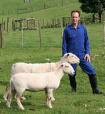
    With rather tatty-looking fleeces, these animals could be forgiven for seeming a little sheepish about their appearance.
    But they are actually one of the most advanced flocks in Britain – being among the country’s first self-shearing sheep.
    The animals have been specially bred to shed their winter coats naturally when spring arrives, saving farmers thousands of pounds a year. 
    A new breed of self-shearing sheep shed their coats naturally in spring
    Wool has fallen so dramatically in value recently that its sale no longer covers the cost of shearing – leaving the task no more than a nuisance for flock owners.
    That led breeders to import rams from foreign varieties such as the Barbados Blackbelly, which sheds wool naturally, to create the new breed called Exlana.
    Without their normal thick coats, the sheep are also more resistant to parasites, and need less medication and costly chemical treatments. 
    Now, instead of spending precious time and money shearing their sheep, farmers simply waits for the light coats to ‘moult’ in the fields.
    West country farmer Peter Baber has come up with a revolutionary way to reduce the costs of sheep farming
    The wool, which is shorter and more sparse than a traditional British sheep, begins shedding around the animal’s neck and legs, often leaving a temporary patch in the middle.
    Where a normal sheep would produce up to 20lb (9kg) of wool, the Exlana – whose newly coined name from the Latin means ‘used to have wool’ – yields just 1lb (500g).
    The new ewes are estimated to save farmers £8 per animal per year in labour costs – which could equal thousands of pounds a year for a full flock.
    Breeder Peter Baber, 54, who runs a farm in Christow, near Exeter, Devon, is spearheading the group of nine farmers who are developing the sheep.
    The winner of Sheep Farmer of the Year 2007, said: ‘It’s totally changed the way we work. It is the most forward-thinking step in British sheep farming for a long time.
    ‘We used to have normal, woolly sheep at the farm and had to spend hours shearing them in the spring. But the value of wool has reduced so much recently that it’s no longer economically viable to produce .
    ‘Shearing has just became a necessity and, quite frankly, a nuisance.’
    ‘I started thinking about alternative solutions about ten years ago, having seen them myself in Bolivia and Brazil.
    ‘There are breeds around the world, particularly in tropical areas, which still shed their sheep naturally, so we imported the genetics to start breeding. Now, we have thousands of wool-shedding sheep on our farms.
    ‘Their bodies recognise when it is spring time and they naturally begin to shed their wool.
    ‘I imagine that the birds on our farms must have the cosiest nests in Britain.’
    The animals will soon be available to buy from Weir Park Farm in Devon, for around £100 per lamb and £150 per ewe.


    WELCOME TO ARVIDSON WILTSHIRES – The Home of Self Shearing Sheep
    • NO SHEARING
    • HIGH QUALITY MEAT AND HIDES
    • EASYCARE HOOFS
    • PERFORMANCE RECORDED
    • FACIAL ECZEMA TESTED
    The Wiltshire Horn from which the polled Wiltshire is derived is an old English breed of sheep. It is listed as a rare breed now due to the small numbers that still survive.
    Main Physical Characteristics
    • Devoid of wool on most parts of the sheep apart from the back and sides of its body.
    • It naturally sheds its fleece during the spring and re-grows it in the autumn.
    • It has only a very short fleece.
    • It produces lean; fine textured meat and a strong skin without shearing cuts.
    • Hoofs tend to be black and very resilient against foot rot under New Zealand farming conditions.
    • Lambs tend to be born with a very fine head and narrow shoulders and the ewes have very few lambing problems.
    • Bearing problems seem to be almost nil in our flock. We have had about four cases in twelve years of farming over 300 mixed age ewes.
    • They are a long legged, slender sheep, which can move rapidly across the hills.
    Ram, age 22 months, neck belly & crutch moult, July 2007 (Below)
    Farm Management Practice
    • Our basic aim is to run our flock harder then you ever will your own while recording performance to always be selecting for the best animals.
    • Ewe replacement level is approximately 50% each year.
    • A low input strategy is followed.
    • Drenches are used as a cure rather then prevention so that we can record those animals that have low natural resistance.
    • Facial Eczema testing was started last year (2006).
    Breeding Objective Targets
    Cover photo from New Zealand Lifestyle Farmer magazine, February 2006, showing David with a ewe and her daughter.(Below)
    Our current breeding aims that we are selecting for are:
    • complete moult by the end of October.
    • target wool length of 10mm.
    • maximum wool length of 30mm.
    • complete moult every year.
    • hoofs that need no attention.
    • no physical faults.
    • facial excema resistance (RAMGUARD TESTING).
    • high lambing percentages (aim 200%)
    • high growth rates (aim for 10kg of live weight for each month of age while on the ewe)
    • high weaned lamb weight as a % of ewe weight.
    We recently had our lamb carcasses assessed by Murray Harwood (former part owner of Supreme Venison). Murray has been selling tons of lamb meat into the top end of the market each week and is a highly skilled butcher himself. His assessment was that these lambs were some of the best he had come across.
    “One of the highest yielding, best tasting lambs I have ever come across. The meat was beautifully marbled to enhance the cooking process and yet low fat overall.”


  • DS homebrew – DSx86 v0.10

    Here’s the latest version of Pate’s DOS emulator for the Nintendo DS, DSx86. The latest update of the brew is another feature-pack release that includes ton’s of new features, more fixes and various other improvements.
     
     
    Download:

  • Infosys Seeks U.S. Patent On Offshoring U.S. Jobs

    theodp writes “It’s interesting to see that famed offshoring firm Infosys is now seeking U.S. patent protection for its Framework for Supporting Transition of One or More Applications of an Organization, which Infosys explains ‘relates generally to the field of outsourcing or offshoring of one or more applications of an organization.’ Prior to this invention, Infosys says it was necessary for a vendor organization to incur hefty visa and travel costs to allow a ‘significant number’ of employees from its offshore location to ‘visit the client’s location to interact with the Subject Matter Experts (SMEs)’ before returning ‘to the offshore location to transfer the knowledge to the offshore team.”

    Funny. Wasn’t it just a year ago that IBM was pressured to abandon its patent application on offshoring?

    Permalink | Comments | Email This Story