Author: Serkadis

  • New Book: Tutankhamun’s Footwear

    Discovery News (Rossella Lorenzi)

    With slideshow.

    When Howard Carter discovered King Tutankhamun’s treasure-packed tomb in 1922 in the Valley of the Kings, he found a large collection of footwear of different sizes and shapes.

    “It is the only evidence of ancient Egyptian royal footwear. It is an amazing collection. Just think — it is 3,300 years old,” Dutch Archaeologist Andre Veldmeijer, the author of “Tutankhamun’s Footwear: Studies of ancient Egyptian Footwear,” told Discovery News.

    Veldmeijer studied 81 specimens, including simple sewn sandals, as well as other elaborately decorated, gold ornamented, brightly colored open shoes.

    Full report on Discovery News

    The first detailed analysis of sandals buried with the boy king suggest the sometimes elaborate footwear was made to accommodate his club foot.

    At least three pairs of shoes found in King Tut’s tomb display a horizontal strap just below the toes, as shown in this illustration. (Click on the photo to find out more about the amazing sandals.)

    King Tutankhamun might have worn some sort of orthopedic shoes specially designed to cope with his club foot condition, an investigation into the pharaoh’s footwear has suggested.

    Published in the book, “Tutankhamun’s Footwear: Studies of Ancient Egyptian Footwear,” the research is the first detailed analysis of the 3,300-year-old footwear since King Tut’s mummy and treasure-packed tomb were discovered by Howard Carter in 1922.

  • Amice Calverley, the EES, and the temple of Sety I at Abydos

    Egypt Exploration Society

    With some gorgeous b&w photos from the 1920s. The Heritage Key article mentioned below dates to early February.

    A fascinating article on Amice Calverley, who worked for the Society in the temple of Sety I at Abydos, has just appeared on the Heritage Key website here (see also the comment by Chris Naunton beneath the main piece).

    The project to record the decoration in the temple remains one the Society’s most significant contributions to Egyptology and its genesis is summarized in the introduction to the first of the published volumes, The Temple of King Sethos I at Abydos. Vol I. The Chapels of Osiris, Isis and Horus (London and Chicago, 1933):

    “In the season of 1925-6 the Egypt Exploration Society, after excavating for some years exclusively at El-Amarna, decided to transfer its activities to Abydos, where the uncovering of the Osireion, interrupted by the war, urgently demanded completion. For this task the Committee engaged the services of Mr. Herbert Felton, who to many years’ experience as a practical engineer added the further qualification of being a photographer of high standing.”

    A selection of photographs taken in 1925 during the final clearance of the Osireion, under the direction of Henri Frankfort. The enigmatic structure had been discovered by Petrie while working for the EEF in 1901-2 but the monument’s situation beneath ground level meant that sliding sand and water seepage had prevented its complete excavation until almost a quarter of a century later, when the problem was finally solved with the aid of a gravity railway pulled by water buffalos, and a steam engine pump.

    “The presence of Mr. Felton at Abydos afforded a welcome opportunity for recording the admirable sculptures of the temple of Sethos I, and his negatives provided the nucleus of what was at that time intended to become merely a photographic survey.’’

  • Egypt forum on looted antiquities calls for unity

    France24

    With photos of the Nefertiti bust, Hawass in his familiar speech-with-mics mode and the Rosetta Stone.

    Egyptian antiquities supremo Zahi Hawass on Wednesday opened an international conference on recovering ancient artefacts from abroad, saying countries must unite to recover their stolen heritage.

    “We need to cooperate, we need a unification between our countries,” Hawass told antiquities officials, deputy culture ministers and museum directors from 21 countries at the two-day Cairo meeting.

    “Every country is fighting alone, every country suffered alone, especially Egypt,” Hawass told the delegates from countries that have seen their national heritage looted over the centuries.

    “We will battle together,” he said, adding that “maybe we will not succeed in a lifetime (but) we have to open the subject.”

    Hawass, who heads Egypt’s Supreme Council of Antiquities (SCA), urged delegates to draw up lists of artefacts missing from their countries and displayed in museums abroad.

  • Lecture notes: Chicago House 2009-2010 season

    Luxor News (Jane Akshar)

    Thanks to Jane for sharing her lecture notes, as usual.

    Chicago House 2009-2010 season Ray Johnson

    It was nice that the last lecture of the season was Ray as I really admire the work they do in Luxor and how accessible they make their publications. Indeed he opened his lecture by announcing that yet another publication was available.

    There are over 100 titles on the Oriental Institute website that available free in low resolution PDF’s and they are pleased that rather than seeing a drop of sales it has actually resulted in an increase. The link is here http://oi.uchicago.edu/research/pubs/catalog/ and if you look you can see a dollar sign or a downward arrow. The downward arrow gives you the free PDF. They are looking to get everything n online and are thankful for donations that have made scanning possible.

    This year they were working at Medinet Habu, TT107, and Khonsu and Luxor temples.

  • Sea Pup die-off as Sea Ice Fails

    We have here the usual anti sealing slant.  The pups are no longer taken, but that has not slowed down the propaganda machine.  It is just too good a photo op for every publicity seeker on Earth.
    There is no ice this year so we are having mass mortality.  What is more, the quota granted the hunters are completely meaningless if there is no ice.  The hunting is done on the ice.


    Yet the adults will survive to pup next year.  Once the numbers for this year are understood, I am sure fisheries will back of the quotas enough to allow a quick rebound next year and the year after.
    This is an unique weather event unlikely to be repeated in our lifetime and generally meaningless.
    Once again, the harp seal population needs to be managed by human harvesting.  I do not think it is optimized as yet and we fortunately have an historic harvest built around it.  Recall a runaway population will collapse the local fishery bringing about a collapse of the harp seal population in a revolving boom and bust cycle.
    Thousands of seal pups die as sea ice fails in Canada
    There may be mass mortality of seal pups as the ice fails in the Gulf of St Lawrence. Credit S Cook/IFAW
    Worst ice year on record leads to harp seals’ demise
    March, 2010. Thousands of harp seal pups are presumed dead in Canada‘s Gulf of St Lawrence and starving pups are being found abandoned on the beaches of Prince Edward Island, tragic victims of the worst ice conditions recorded in eastern Canada.

    With the opening of Canada’s cruel annual commercial seal hunt imminent, the International Fund for Animal Welfare (IFAW) reports that the Gulf of St Lawrence, the annual birthing ground of hundreds of thousands of harp seals, is essentially devoid of both ice and seals. 

    Disastrous for seal pups

    Sheryl Fink, a senior researcher with IFAW, said: “The conditions this year are disastrous for seal pups. I’ve surveyed this region for nine years and have never seen anything like this.

    Thousands of seal pups missing

    “There is wide open water instead of the usual ice floes, and rather than the hundreds of thousands of seal pups that we normally encounter, only a handful of baby harp and hooded seals – animals that are normally found on ice – remain on the beaches.”

    High mortality


    Extremely high pup mortality is expected this year, making this one of several such occurrences in the past decade. In 2007, 99% of harp seal pups born in the Southern Gulf of St Lawrence are thought to have died due to lack of ice. In 2002, 75% of pups are thought to have suffered the same fate. Scientists with IFAW are concerned that the cumulative effects of high pup mortality due to the poor ice conditions, and high numbers of pups killed during Canada‘s commercial seal hunt could be devastating.
    Highly unusual

    Fink added: “Finding these ice-dependent seal species on land is extremely unusual, and should be considered a warning signal. The seal pups we have found on shore are thin and unable to defend themselves or escape from land-based predators. It is highly unlikely that any of these pups will survive long enough for there to be a seal hunt in the Southern Gulf this year.”

    Canada increases seal hunt quota

    Earlier this month, Fisheries Minister Gail Shea increased the total allowable catch of harp seals (TAC) by 50,000, to 330,000 animals. The Minister’s announcement was loudly condemned by animal welfare organisations, conservationists and sealers, in a rare moment of agreement.

    Last year, the European Union voted to ban the commercial trade in seal products from commercial hunts.

    Seal hunt is “reckless and irresponsible

    Robbie Marsland, UK Director of IFAW, said: “It is reckless and irresponsible for the government to allow the hunt to proceed this year, given the high pup mortality that is expected. Under a precautionary approach, we should be protecting the few pups that might escape the devastating effects of climate change this year. 

    “Given the almost complete lack of demand for seal skins, allowing the commercial slaughter of these survivors to proceed is simply adding insult to injury.”
  • Spring edition of KMT (vol 21, no.1)

    KMT Magazine

    Many thanks to John Rauchert for letting me know that the details of the spring edition of KMT have been added to their website.

    Volume 21, Number 1, Spring 2010

    The Burial of Tutankhamen, Part 1 by Marianne Eaton-Krauss
    The Neues Museum, Berlin, Reborn by Aidan Dodson & Dyan Hilton
    The Southern Temple of Buhen by F. Johannes Albers
    Remembrance: T.G.H. James by Donald Ryan & Nicholas Reeves
    Interview: A Chat with T.G.H. James (1991)
    Egypt in Bolton, UK by Lucy Gordan-Rastelli
    Photo Essay: Hues of Medinet Habu by Dennis Forbes

    Plus “Nile Currents” & “For the Record,” as well as reviews of: The Age of Ra by James Lovegrove; Sam Steele’s Adventures: The Treasure of Karnak by L. Frank Baum; The Murder of King Tut by James Patterson & Martin Dugard; Amarna Sunset by Aidan Dodson; Ancient Egypt: An Introduction by Salima Ikram; Mastabas of Nucleus Cemetery G 2100 by Peter Der Manuelian; & Tutankhamen: The Story of Egyptology’s Greatest Discovery by Jaromir Malek

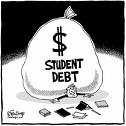
  • Ellen Brown on Student Loan Industry

    I post this item because Ellen Brown has gone to the heart of the reserve banking system and recognized that the student loan market was expensively gamed by the banking industry.
    Also dear reader, it helps the reader understand what makes the banking industry work.  For that reason alone it is worth posting.
    This is a good move that was long overdue. My only concern is that it continues as a single agency.  There is no competition.  Breaking up the system among several regions may be beneficial.
    Curiously, the debate on this was won and lost decades ago and it should never have been given to the banks
    Just as a private medical insurer wants to insure the healthy, a bank wants to lend to the rich.  A community however is best served if the sick are made healthy and the young are educated.  It is also best served if investment capital is supplied to the experienced and ambitious but we have not got there yet.  It is not well served at all if it supplies investment credit to the wealthy already unable to efficiently deploy their own capital.
    Student Loans: The Government is Now Officially in the Banking Business
    By Ellen Brown
    “We say in our platform that we believe that the right to coin money and issue money is a function of government. . . . Those who are opposed to this proposition tell us that the issue of paper money is a function of the bank and that the government ought to go out of the banking business. I stand with Jefferson . . . and tell them, as he did, that the issue of money is a function of the government and that the banks should go out of the governing business.” William Jennings Bryan, Democratic Convention, 1896
    William Jennings Bryan would have been pleased. The government is now officially in the banking business. On March 30, 2010, President Obama signed the reconciliation “fix” to the health care reform bill passed by Congress last week. Slipped into it was student loan legislation the President calls “one of the most significant investments in higher education since the G.I. Bill.” Under the Student Aid and Fiscal Responsibility Act (SAFRA), the federal government will lend directly to students, ending billions of dollars in wasteful subsidies to firms providing student loans. The bill will save an estimated $68 billion over 11 years.
    Money for the program will come from the U.S. Treasury, which will lend it to the Education Department at 2.8% interest. The money will then be lent to students at 6.8% interest. Eliminating the middlemen will allow the Education Department to keep its 4% spread as profit, money that will be used to help impoverished students. If the Education Department were to set up its own bank, on the model of the Green Bank being proposed in the Energy Bill, it could generate even more money for higher education.
    A Failed Experiment in Corporate Socialism
    The student loan bill may look like a sudden, radical plunge into nationalization, but the government was actually funding over 80 percent of student loans already. Complete government takeover of the program was just the logical and predictable end of a failed 45-year experiment in government subsidies for private banking, involving unnecessary giveaways to Sallie Mae (SLM Corp., the nation’s largest student loan provider), Citibank, and other commercial banks exposed in blatantly exploiting the system.
    Under the Federal Family Education Loan Program (FFELP), the U.S. government has been providing subsidies to private companies making student loans ever since 1965. Every independent agency that has calculated the cost of the FFELP, from the Congressional Budget Office to Clinton’s Office of Management and Budget to George W. Bush’s Office of Management and Budget, has found that direct lending could save the government billions of dollars annually. But the mills of Congress grind slowly, and it has taken until now for this reform to work its way through the system.
    In the sixties, when competing with the Soviets was considered a matter of national
    survival, providing the opportunity for higher education was accepted as a necessary public good. But unlike Russia and many other countries, the U.S. was not prepared to provide that education for free. Loans to students were necessary, but students were notoriously bad credit risks. They were too young to have reliable credit histories, and they did not own houses that could be posted as collateral. They had nothing but a very uncertain hope of future gainful employment, and banks were not willing to take them on as credit risks without government guarantees.
    The result was the FFELP, which privatized the banks’ profits while socializing losses by imposing them on the taxpayers. The loans continued to be “originated” by the banks, which meant the banks advanced credit created as accounting entries on their books, the way all banks do. Contrary to popular belief, banks do not lend their own money or their depositors’ money. Commercial bank loans are newmoney, created in the act of lending it. The alleged justification for allowing banks to charge interest although they are not really lending their own money is that the interest is compensation for taking risk. The banks have to balance their books, and if the loans don’t get paid back, the asset side of their balance sheets can shrink, exposing them to bankruptcy. When the risk is underwritten by the taxpayers, however, allowing the banks to keep the interest is simply a giveaway to the banks, an unwarranted form of welfare to a privileged financier class at the expense of struggling students.
    Worse, underwriting these private middlemen with government guarantees has allowed them to game the system. Under the FFELP, banks actually profit more when students default than when they pay back their loans. Delinquent loans are turned over to a guaranty agency in charge of keeping students in repayment. Pre-default, guaranty agencies earn just 1 percent of the loan’s outstanding balance. But if the loan defaults and the agency rehabilitates it, the guarantor earns as much as 38.5% of the loan’s balance.
    Collection efforts are also much more profitable than efforts to avert default, giving guaranty agencies a major incentive to encourage delinquencies. In 2008, 60.5% of federal payments to FFELP came from defaults. An Education Department report issued last year found that only 4.8% of students who borrowed directly from the government had defaulted on their loans in 2007, compared to 7.2 percent for FFELP; and the gap widened when longer periods were taken into account.
    In 1993, students and schools were given the option of choosing between FFELP and the Direct Loan program, which allowed the government to offer better terms to students. The Direct Loan program was the clear winner, growing from just 7% of overall loan volume in 1994-1995 to over 80% today.
    The demise of the FFELP was hastened in early 2007, when New York Attorney General Andrew Cuomo began exposing the corrupt relations between firms lending to students and the colleges they attended. Lenders that had been buying off college loan officials were forced to refund millions of dollars to borrowers.
    Congress responded by cutting the private lenders’ subsidies. But after the 2008 economic crash, the lenders claimed they could no longer afford to lend to low-income (high-risk) borrowers without these subsidies. Congress therefore acquiesced with a May 2008 law requiring the federal government to give banks two-thirds of the funds lent to students. The bill also required the Education and Treasury Departmentsto buy loans from lenders made between May 2008 and July 2009 for the full value of the loans plus interest. To comply with this bill, the Department of Education projects that it will
    eventually have to buy $112 billion in FFELP loans.
    Despite all this government help, lenders have continued to turn their backs on riskier borrowers, driving students to the government’s direct lending program. With the banks enjoying heavy subsidies while failing in their mission, Obama campaigned in 2008 on a promise of eliminating the middleman lenders; and with the new SAFRA, he appears to have fulfilled that goal.
    And thus ends a 45-year experiment in subsidized student lending. In the laboratory of the market, direct lending from the government has proven to be a superior alternative for both taxpayers and borrowers.
    The U.S. is not the only country exploring government-sponsored student loan programs. New Zealand now offers 0% interest loans to New Zealand students, with repayment to be made from their income after they graduate. And for the past twenty years, the Australian government has successfully funded students by giving out what are in effect interest-free loans. They are “contingent loans,” which are repaid if and when the borrower’s income reaches a certain level.
    Where Will the Money Come From?

    The Green Bank Model
    Eliminating the middlemen can reduce the costs of federal lending, but there is still the problem of finding the money for the loans. Won’t funding the entire federal student loan business take a serious bite out of the federal budget?
    The answer is no – not if the program is set up properly. In fact, it could be a significant source of income for the government.
    The SAFRA doesn’t mention setting up a government-owned bank, but the Energy Bill that is now pending before the Senate does. Funding for the energy program is to be through a Green Bank, which can multiply its funds by leveraging its capital base into loans, as all banks are permitted to do. According to an article in American Progress:
    “Funding for the Green Bank should be on the order of an initial $10 billion, with additional capital provided of up to $50 billion over five years. This capital could be leveraged at a conservative 10-to-1 ratio to provide loans, guarantees, and credit enhancement to support up to $500 billion in private-sector investment in clean-energy and energy-efficiency projects.”
    Banks can create all the credit they can find creditworthy borrowers for, limited only by the capital requirement. But when the loan money leaves the bank as cash or checks, banking rules require the bank’s reserves to be replenished either with deposits coming in or with interbank loans. The proposed Green Bank, however, is apparently not going to be a deposit-taking institution. Presumably, then, it will be relying on interbank loans to provide the reserves to clear its checks.
    The federal funds rate – the rate at which banks borrow from each other – has been maintained by the Federal Reserve at between zero and .25% ever since December 2008, when the credit crisis threatened to collapse the economy. A Green Bank qualified to borrow in the interbank market could acquire funds at that very low rate as well, and so could a Student Bank. The spread could give the Education Department more than 6.5% gross profit annually on student loans.
    The Treasury, by contrast, paid an average interest rate for marketable securities in February 2010 of 2.55%, which explains the 2.8% interest at which the Education Department must now borrow from the Treasury. The interbank rate is obviously a better
    deal, but it could go up. The cheapest and most reliable alternative would be for the Treasury itself to become the “lender of last resort,” as William Jennings Bryan urged in 1896.
    The Treasury Department and the Education Department are arms of the same federal government. If the government were to set up a government-owned bank that simply lent “national credit” directly, without borrowing the money first, it could afford to lend to students at much lower rates than 6.8%. In fact, it could afford free higher education for all. Such a program could actually pay for itself, as was demonstrated by the G.I. Bill, considered one of the government’s most successful programs. Under the Servicemen’s Readjustment Act of 1944, the government sent seven million Americans to school for free after World War II. A 1988 Congressional committee found that for every dollar invested in the program, $6.90 came back to the U.S. economy. Better-educated young people got better-paying jobs, resulting in substantially higher tax revenues year after year for the next forty-plus years.
    Taking Back the Credit Power
    Winston Churchill once wryly remarked, “America will always do the right thing, but only after exhausting all other options.” More than a century has passed since William Jennings Bryan insisted that issuing and lending the credit of the nation should be the business of the government rather than of private bankers, but it has taken that long to exhaust all the other options. With student loans, at least, government officials have finally come around to agreeing that underwriting private lenders with public funds doesn’t work.
    We are increasingly seeing that underwriting banks considered “too big to fail” doesn’t work either. Banks are borrowing at near-zero interest rates and speculating with the money, knowing they can’t lose because the government will pick up the losses on any bad bets. This is called “moral hazard,” and it is destroying the economy.
    Issuing the national credit directly, through a federally-owned central bank, may be the only real solution to this dilemma. Today the government borrows the national currency from the privately-owned Federal Reserve, which issues Federal Reserve Notes and lends them to the government and to other banks. These notes, however, are backed by nothing but “the full faith and credit of the United States.” Lending the credit of the United States should be the business of the United States, as William Jennings Bryan maintained. The dollar iscredit (or debt), just as a bond is. Both a dollar bond and a dollar bill represent a claim on a dollar’s worth of goods and services. As Thomas Edison said in the 1920s:
    “If the Nation can issue a dollar bond it can issue a dollar bill. The element that makes the bond good makes the bill good also. The difference between the bond and the bill is that the bond lets the money broker collect twice the amount of the bond and an additional 20%. Whereas the currency, the honest sort provided by the Constitution pays nobody but those who contribute in some useful way. It is absurd to say our Country can issue bonds and cannot issue currency. Both are promises to pay, but one fattens the usurer and the other helps the People.”
    Ellen Brown developed her research skills as an attorney practicing civil litigation in Los Angeles. In Web of Debt, her latest of eleven books, she turns those skills to an analysis of the Federal Reserve and “the money trust.” She shows how this private cartel has usurped the power to create money from the people themselves, and how we the people can get it back. Her websites are
    www.webofdebt.comwww.ellenbrown.comand www.public-banking.com.

    Niko Kyriakou contributed to this article.

  • Art Gallery of Ontario Extends King Tut’s Reign

    Art Daily

    The Art Gallery of Ontario will extend its blockbuster exhibition King Tut: The Golden King and the Great Pharaohs for two additional weeks through May 2 due to high demand for tickets. To date, the Gallery has sold over 300,000 tickets to the exhibition, currently making its only Canadian stop at the AGO.

    The exhibition is already the Gallery’s most attended in over a decade, and AGO Michael and Sonja Koerner Director, and CEO Matthew Teitelbaum is thrilled with its success. “It continues to be a privilege to host these incredible treasures as they make their final journey around the world,” he says. “The response to this exhibition has been remarkable, and we’re glad to give people one final chance to view these extraordinary wonders.”

  • Magnetic Separators (Candle Type)

    We manufacture candle type magnetic separators that are compact and occupy less space keeping the tank free for maintenance. They are more suitable for cellular installations. With excellent collection efficiency they are perfect for viscous liquids. They run only on one drive and also require less power. They are suitable to handle fine ferrous dirt from large flows of coolant. Most useful in rolling, grinding, wire-drawing etc.

    Working

    An endless belt of magnetic candles is dipped in dirty coolant tank such that the dirty coolant enters in the core. Coolant flows slowly over the magnetic candles leaving the ferrous dirt on the candles. The belt is indexed to pull out dirt-laden candles & rotate them at top to remove the dirt. The dirt is then transported to a bin outside the tank.

  • Distortion-free Optics for Line Scan Applications

    MORITEX SCHOTT: High-Resolution Lens for Long Image Sensors of Line Scan Cameras

    Tokyo (Japan) / Mainz (Germany), April 7th, 2010 — MORITEX Corporation has developed a new lens for high-definition line scan cameras. “ML-L00502” offers an exact, high-contrast picture display at a screen diagonal of up to 62mm, today’s maximum applicable CCD sensor length. The illumination drop between the center and the periphery of the field of view is less than 20%. The distortion of the optic is less than 0.1%.

    Machine vision systems that are based on line scan cameras are increasingly being used for quality inspection as well as sorting procedures. Their main area of application is in semiconductor manufacturing, for quality assurance during the production of solar modules and Liquid Crystal Displays (LCD) as well as printed circuit boards for computers, for instance.

    Advanced machine vision systems are also being put to use in telecommunications and information technology, as well as biosciences and laboratory automation. Thereby a high throughput rate can be achieved when line scan cameras with high-resolution image sensors and excellent optics are used.
    The latest generation of CCD sensors in line scan cameras reaches a resolution of 12,000 pixels 5µm in size. In order to capitalize on this, lenses like the “ML-L00502” by MORITEX offers an extremely low distortion. This also makes them attractive for high-resolution Matrix sensors.From the center of the image to the edges, the “ML-L00502” offers an exact, high contrast picture display even with a screen diagonal of up to 62 mm. The diaphragm is adjustable. At an optical magnification of 0,05x the working distance is 1,590 mm, at 0,2x 420 mm.
    The “ML-L00502” allows for a very compact design of the machine vision system. To achieve homogenous illumination of the objects to be inspected, MORITEX and SCHOTT also offer high-performance LED and halogen light sources, including fiber optic light guides upon request.

    About SCHOTT and MORITEX
    The international technology group SCHOTT, based in Mainz, Germany, acquired a majority interest of 70.8% in MORITEX Corporation, Tokyo, in November, 2008 as a result of the tender offer bid. Both companies have been cooperating since June 2007 in order to further extend their position as the world’s leading manufacturers for specific types of imaging and lighting solutions.

    Contact:
    SCHOTT AG
    Andreas Uthmann
    [email protected]

  • Pneumatic manipulator with three points, self centring tilting gripping tool

    Pneumatic arm manipulator with three points self centring gripping tool.
    It allows to catch round shaped parts, also of different diameters, without to have the necessity to change the jaws. Only in case of big difference of the diameters of the components to catch, it is foreseen a quick disconnection to change the terminal parts of the jaws. Particularly indicated to handle barrels, pipes, rolls and round shaped parts in general.
    A device, powered by a pneumatic actuator, allows to tilt 90° the lifted part.
    Max capacity 250 kg.
    Max work radius 4,3 m.
    Max vertical stroke up to 2,4 m.

  • Pneumatic linear balancer with vacuum handling device for panel and metal sheets

    Pneumatic linear balancer with vacuum pads handling attachment for panels and metal sheets.
    The pneumatic linear balancer allows to move the lifted load quickly and with accuracy and with the possibility to control the movement. It is usually used with jib cranes or with crane bridges.
    The vacuum caps are assembled coupled, by movable elements, to arms that can slide on the main rod, to allow to grip panels and metal sheets of different dimensions.
    Vacuum generation is made by compressed air. A safety device maintains the gripped part also in case that the pressure of the air feeding line falls down. Another safety device does not consent to lift a part if the right vacuum level, necessary for a safely gripping, is not achieved.
    It is particularly indicated for quick handling operations, no regulations or adjustment are required and it allows the operator to work ergonomically and with the minimum effort.
    Max capacity 400 kg.
    Max work radius up to 7 m.
    Max vertical stroke up to 2 m.

  • AR’s New “A” Series Amplifiers Are Smaller, More Powerful, And More Economical

    New innovations at AR RF/Microwave Instrumentation are enabling the company to produce smaller, more compact amplifiers with just as much power as the older, larger models.

    The new “A” Series amplifiers, for example, are 25% — 50% smaller than previous models, yet the new size does not mean a reduction in power.

    These newer, smaller models fit easily into a control room; and because of the new design, they are more efficient, using less energy than other amplifiers.

    The smaller, more efficient design also results in an increased performance to price ratio. In other words you get more for your money.

    With the wide frequency range, it’s now possible to test to virtually any standard with the “A” Series amplifiers.

    Each model features the latest FET technology, and can be controlled remotely with IEEE, RS-232, USB and Ethernet interfaces.

  • Match Threaded Detent Pins with Variety of Knobs

    Versatile threaded detent pins can be fit with a wide selection of knob handles for various applications. These solid quick-release pins have a ground shank and a threaded end. Shank diameters are available from 3/16″ to 1/2″, along with metric sizes, and grip lengths from 1/2″ to 4″. Pins come with built-in locking balls, which are held in place by spring force — push to insert, pull to remove. Carr Lane supplies a variety of ball knobs, t handles, fluted knobs and recessed top knobs for use with the threaded pins.

  • NASH vacuum pumps for the PM 7 in Dunaujvaros

    Gardner Denver Nash Germany supplied the complete vacuum system for dewatering in the forming and press sections of the new PM7 paper machine in Dunaujvaros. This technology has already proven itself in every other paper machine within the Hamburger Group, with robustness, efficiency and flexibility that guarantee the highest operational reliability.

    On the new PM7 in Dunaujvaros, nine NASH 2BE3 vacuum pumps are used. Each pump is driven by a motor equipped with a frequency converter, allowing the rotational speed to be set to exactly suit the actual process conditions. This causes the vacuum pressure to adapt to process conditions as well. Additionally, three centrifugal fans for the low-vacuum scavenge points in the forming section have been included. As a result, the vacuum system provides the greatest flexibility at optimum efficiency.

    For the plant operator, the advantages of a NASH liquid ring vacuum system were obvious:
    • An extremely robust system: overload safe and resistant to process failures
    • Very high overall efficiency, particularly in conjunction with optimum control
    • Optimum felt dewatering through the volumetric operating principle of the liquid ring vacuum pump – the scavenge pressure adjusts automatically to suit the felt permeability
    • Scavenge-side liquid carry-over with low fiber content is not a problem for the NASH pumps
    • Rotation speed control offers the potential of high energy savings
    • Low specific power requirements
    • Low noise emissions due to low peripheral speeds of the vacuum pump
    • Future system adaptation, without influencing other scavenge points, is easily done by changing the rotation speed of individual vacuum pumps
    • High operational safety, even if individual vacuum pumps are deactivated
    • Very low service and maintenance costs
    • Confidence in more than 100 years of know-how accumulated by the market leader in the paper industry

    With the decision to use NASH vacuum pumps, the plant operator also made a decision for an innovative, environmentally friendly and economical attractive solution.

  • OMAX® Releases Dual Bridge System for Large-Table JetMachining® Centers

    New system offers dramatic increases in productivity and flexibility

    Kent, Washington, April 5, 2010 – OMAX® Corporation has released its new Dual Bridge System, a configuration option that allows the inclusion of a second Y-bridge to boost efficiency and flexibility. The system can be added to any new or existing 60120, 80X or 120X OMAX JetMachining Centers and is currently the only dual bridge traction drive system available in the waterjet industry.

    With OMAX’s Dual Bridge System, two Y-bridges work independently from each other, significantly increasing machine capacity. The bridges can be programmed to produce separate components or can work in tandem to cut one large part. The system also boosts utilization rates, as cutting can be performed while materials are loaded and unloaded from the machine.

    To maximize user friendliness, the Dual Bridge System makes use of OMAX’s Intelli-MAX® Premium software, which is already installed on all OMAX JetMachining Centers. Operators can easily switch between viewing the programs for either bridge.

    All existing OMAX accessories are fully compatible with the addition of a second Y-bridge. To achieve the fastest possible cutting configuration, the system can also be configured with multiple nozzles and pumps on one machine.

    OMAX believes in manufacturing the best machines and accessories possible with the best software available, and works to continually develop cutting-edge technology and innovative software for its customers. As a result, each OMAX product comes with the OMAX Technology Guarantee, which provides software upgrades for all existing customers at no additional charge.

    About OMAX
    Headquartered in Kent, Washington, OMAX Corporation is the world leader in abrasivejet machining. Each OMAX JetMachining® system is powered by the company’s innovative control software, bringing affordable abrasivejet technology to an expanding and diverse group of industries.

  • Mackenzie River Pleistocene Flood


    Here is some more of the flushing out of the Lake Agassiz melt water lake.  It made sense to look to the Mackenzie flood plane for evidence and this article reports on just that.  The big news though is that there never was any evidence for a St Lawrence route or a Mississippi route.  The Mackenzie is the only route.
    We get to rewrite a lot of textbooks again that accepted the southern tales.  As also mentioned, the crust was thirty degrees further north naturally lowering the elevations.  Of course we also know that the shield centered on Hudson Bay then at the pole was also depressed about a thousand feet by the weight of the ice.  Thus the fresh water buildup was possibly at sea level and unable to tunnel out and escape.  The shift changed all that and the natural escape rout for the first flush would be along the western edge of the crust for most of it.
    I do not trust the presently accepted timeline accuracy. There is too much overlapping uncertainty when it comes to determining the meaning of apparent climate changes.  Besides that, the climatic volatility was several degrees compared to present day volatility of no more than two degrees.  I am arguing for one major event taking place that reconfigured the climatic optimals that then took around two thousand years to fully play out.
    River reveals chilling tracks of ancient flood
    Water from melting ice sheet took unexpected route to the ocean.


    The Younger Dryas flood 13,000 years ago could have emptied into the Arctic Ocean through the Mackenzie River delta.W. LYNCH/PHOTOLIBRARY.COM

    A thousand years after the last ice age ended, the Northern Hemisphere was plunged back into glacial conditions. For 20 years, scientists have blamed a vast flood of meltwater for causing this ‘Younger Dryas’ cooling, 13,000 years ago. Picking through evidence from Canada‘s Mackenzie River, geologists now believe they have found traces of this flood, revealing that cold water from North America’s dwindling ice sheet poured into the Arctic Ocean, from where it ultimately disrupted climate-warming currents in the Atlantic.

    The researchers scoured tumbled boulders and gravel terraces along the Mackenzie River for signs of the meltwater’s passage. The flood “would solve a big problem if it actually happened”, says oceanographer Wally Broecker of Columbia University‘s Lamont-Doherty Earth Observatory in Palisades, New York, who was not part of the team.

    On page 740, the geologists present evidence confirming that the flood occurred (J. B. Murton et al. Nature464, 740–743; 2010). But their findings raise questions about exactly how the flood chilled the planet. Many researchers thought the water would have poured down what is now the St Lawrence River into the North Atlantic Ocean, where the currents form a sensitive climate trigger. Instead, the Mackenzie River route would have funnelled the flood into the Arctic Ocean (see map).

    The Younger Dryas was named after the Arctic wild flower Dryas octopetala that spread across Scandinavia as the big chill set in. At its onset, temperatures in northern Europe suddenly dropped 10 °C or more in decades, and tundra replaced the forest that had been regaining its hold on the land. Broecker suggested in 1989 that the rapid climate shift was caused by a slowdown of surface currents in the Atlantic Ocean, which carry warm water north from the Equator to high latitudes (W. S. Broecker et alNature 341, 318-321; 1989). The currents are part of the ‘thermohaline’ ocean circulation, which is driven as the cold and salty — hence dense — waters of the far North Atlantic sink, drawing warmer surface waters north.

    Broecker proposed that the circulation was disrupted by a surge of fresh water that overflowed from Lake Agassiz, a vast meltwater reservoir that had accumulated behind the retreating Laurentide Ice Sheet in the area of today’s Great Lakes. The fresh water would have reduced the salinity of the surface waters, stopping them from sinking.

    “There’s no way for that water to go out of the Arctic without going into the Atlantic.”

    The theory is widely accepted. However, scientists never found geological evidence of the assumed flood pathway down the St Lawrence River into the North Atlantic; or along a possible alternative route southwards through the Mississippi basin. Now it is clear why: the flood did occur; it just took a different route.

    The team, led by Julian Murton of the University of Sussex in Brighton, UK, dated sand, gravel and boulders from eroded surfaces in the Athabasca Valley and the Mackenzie River delta in northwestern Canada. The shapes of the geological features there suggest that the region had two major glacial outburst floods, the first of which coincides with the onset of the Younger Dryas. If the western margins of the Laurentide Ice Sheet lay just slightly east of their assumed location, several thousand cubic kilometres of water would have been able to flood into the Arctic Ocean.

    “Geomorphic observations and chronology clearly indicate a northwestern flood route down the Mackenzie valley,” says James Teller, a geologist at the University of Manitoba in Winnipeg, Canada, who took part in the study. But he thinks that the route raises questions about the climatic effects of the Lake Agassiz spill. “We’re pretty sure that the water, had it flooded the northern Atlantic, would have been capable of slowing the thermohaline ocean circulation and produce the Younger Dryas cooling,” he says. “The question is whether it could have done the same in the Arctic Ocean.”

    Broecker, however, says that the Arctic flood is just what his theory needed. He says that flood waters heading down the St Lawrence River might not have affected the thermohaline circulation anyway, because the sinking takes place far to the north, near Greenland. A pulse of fresh water into the Arctic, however, would ultimately have flowed into the North Atlantic and pulled the climate trigger there. “There’s no way for that water to go out of the Arctic without going into the Atlantic,” he says. 
    Quirin Schiermeier, with additional rep
  • The rot in US Version of Financial Capitalism


    I always like to read work drawn from another perspective just because flaws often become clearer.  Here we have an article out of China daily dated in the midst of the market breakdown in 2008.
    The presentation is simple and a clear road map for at least elementary reform which almost two years later, we are still waiting for.
    I think no one today disagrees with the argument that the US financial system has been deeply corrupted in ways that brought about the excesses of the past decade and certainly failed to ameliorate them.
    In Canada we had two opportunities to play this game.  In both cases, the government itself intervened and stopped the process.  The first instance we had our six primary banks hustle up to Ottawa to enter into mergers to become competitive and participate fully in the Wall Street subprime casino.  They were told emphatically no.  The government has a longer institutional memory than any individual banker.  The second instance was the expansion of income trust business.  It had a legitimate business role and directed income to retirees.  Only problem, a slew of large companies saw it a great way to lay productive assets off the balance sheet as a premium transaction and the gold rush was on.  It was shut down before we got a flood of pigs with lipstick hitting the market.
    In both cases it took a wide awake government to recognize runaway greed in ordinarily sane individuals and shut it down.
    The result was that Canada entered the 2008 correction with exposure that could be managed and quickly bounced out of it.  The US is still trying to find the bounce part.
    The sooner the USA can improve its regulatory environment to make it more responsible the better.  For the nonce, it may even be smart to have certain specific authority vested very close to the president.  Agencies are simply not given authority or worse are staffed with tame soldiers.
    The rot in US version of financial capitalism
    By Liu Junhong (China Daily)

    Updated: 2008-10-07 07:44
    The world’s financial markets face an uncertain and possibly volatile week as investors await details about how the Treasury will implement the government’s financial rescue package – and watch for any further fallout from the credit crisis around the globe.
    Even though the perfect storm on the New York financial market has come down for the moment, the fact that Washington took such heavy-handed measures regardless of how the market would take it signals the US version of “financial capitalism” is entering an era of undoing its mistakes.
    The US has always prided itself as a cowboy who has lived on financial horsebacks, especially since World War II. It has long been in control of the international monetary and financial system, which has helped it rake in enormous riches, indulge in hegemony and maintain economic prosperity.
    Since the end of the Cold War, however, the US-dominated international financial order has experienced a series of crises as its flaws manifested. And since the “black Monday” in October 1987, the world has seen a financial crisis of widespread impact almost every 10 years. The subprime crisis can be seen as the latest example.
    Alan Greenspan handled a dozen financial emergencies of various descriptions throughout his 19 years as Federal Reserve (Fed) chairman between August 1987 and January 2006, including such significant events as the yen-dollar exchange rate flipping of 1995, the market-rocking effect of the launch of the euro in 1999 and joint intervention of the euro exchange rate by the European Union (EU), the US and Japan in 2000. All these demonstrated the shakiness of the US-dominated international financial order in the post-Cold War era.
    As a matter of fact, the current US financial crisis has once again exposed the flaws of the US version of financial capitalism.
    First, the US-led capital game has reached its own limit. Financial liberalism has gone wild since the Thatcher cabinet of Great Britain and the Reagan administration of the US set off a wave of “neo-liberalism” in the 1980s. In 1999 the US adopted the new banking law to further ease financial regulation. As a result the sector-specific management of financial operations was broken and mixed-service operations became the name of the game. Known as “financial operations by arbitration”, the format allows businesses to gain huge profits by distorting prices so that they can buy low and sell high in the capital game.
    As more players entered the market, the game became less and less profitable as the price system stabilized gradually. In order to expand the room for making profits, major American and European financial institutions threw themselves into “financial technology innovations” to develop financial derivatives and establish a man-made “virtual financial world”.
    Take the subprime mortgage credits for example. They were integrated, split and repackaged into a series of securities-like commodities, which were then sold throughout the world as new virtual financial products after being split and repackaged again and again by downstream retailers. The US lauded this process as the best way to dilute financial risks as well as financial globalization and liberalization.
    The problem is that financial risks, like computer viruses, do not expire as they spread out. As people have found out by now, through repeatedly reselling the debt derivatives, the financial industry spread the “viruses” all over the world. And the whole system would be infected sooner or later once a “virus” developed into a full-blown epidemic. That’s why the subprime crisis has been deepening and spreading since it broke out last year.
    Second, the US market rating system was outdated. Without question the development of financial derivatives can help improve the efficiency of capital utilization and reduce the cost of financing.
    The thing is the valuation and trading of financial derivatives require accurate market rating, but the US‘ financial reform never reached the institutionalized monopoly of market rating firms. The rating agencies brought up by “government orders” early on were still very much in control of the market, where “ethical deficiency” permeated and shielded financial risks, allowing such “viruses” to spread far and wide.
    Third, the US financial system suffered from structural imbalance. The country’s new banking law has only extended financial institutions’ management power, which led to the conglomeration of such businesses, the expansion of the financial industry and fast-growing power it wielded.
    On the other hand, as regulators of the financial industry, the Fed, the US Securities and Exchange Commission and the Department of Treasury were still “doing their own jobs” separately according to the old bureaucratic fixture, leaving the financial industry in a room of no regulation.
    Fourth, the US has learned it the most painful way that believing “scale equals safety” will cost you big time. While proceeding with the financial reform, the US government was somehow convinced that the bigger financial institutions are the safer they become. As a result Washington threw its weight behind a tide of mergers across the financial landscape that turned the industry structure into a domain dominated by giant conglomerates.
    For instance, each of the top three US brokerages boasts assets totaling more than $1 trillion, which is close to the gross domestic product (GDP) of a semi-developed nation. As for Lehman Brothers, the net value of its debts stands at $613 billion. Apparently the subprime crisis has shattered the myth that “bigger is safer” with undeniable facts. It has also made the US government realize, albeit at a tremendous price, the destructiveness of super-sized financial institutions to the whole financial system.
    Currently, to neutralize the fallout of the subprime chain reaction, the EU and the US have begun pushing forward a tide of financial regulation and actively working on a new system for “reining in the financial industry”.
    Meanwhile, Japan, whose financial liberalization has been progressing very slowly, has put forward the idea of building a “market-oriented indirect financial system” in an attempt to break a middle path for “financial capitalism”, correct the “market arbitration-determined finance” of the US through the construction of “value creation-oriented finance” and prevent “financial games”. Faced with different system options from the US, EU and Japan, China‘s financial reform is staring at a set of new challenges and risks.
    The market reform and industrialization of finance is a required subject that China must learn well in the development of market economy. It is key to efficient transformation of individual savings into national productivity and, more importantly, a systematic condition for maintaining the global competitiveness of Chinese enterprises.
    China‘s favorable balance of current account has been growing as the country’s foreign trade expands. The so-called China funds and China capital have been globalizing everyday as financial and opening up have become a key safeguard for the nation’s economic reorientation.
    Taking a look at the history of international financial development it is not hard to notice that the development of the international financial system has always been accompanied by the process of system construction, correction and reconstruction. To proceed with its financial reform and opening-up China needs to consider such new underpinnings as the country’s economic development must not get ahead of itself, its industries and trade are not yet mature, and so are its ways to turn individual savings into investment.
    China does not have to slow the pace of market and industrial reform just because the US messed up its own financial system. Nor does it need to copy Japan‘s model because the neighbor to the east has escaped the subprime tsunami unscathed so far. China still needs to build up its confidence in going ahead with its financial reform along a path best suited to its national condition.
    The author is a researcher with China Institute of Contemporary International Relations
    (China Daily 10/07/2008 page9)
  • Google Voice Desktop Client Said to Be in Testing Internally

    Google is making a big play in the voice-communication market, though you wouldn’t know it from what the company has been saying so far. Google Voice, now with a few million users, is still in a private beta of sorts, but it has the potential to greatly disrupt the entire market. For it to succeed, though, it still needs a couple of t… (read more)

  • MIDA 3DSI TURNS YOUR MACHINING CENTER OR MILLING MACHINE INTO A CMM

    Marposs 3D Shape Inspector (3DSI) is measurement software for PCs with Windows operating systems. It allows both mold makers and mass production machine shops, to turn their own machining center or milling/boring machine into a virtual CMM. This enables in-process measurement and verification of the accuracy of the machined shape without removing it from the machine.