Author: Serkadis

  • What will the liberals make them do next?

    April 19th is just around the corner — a big day for militia groups everywhere, it being their Pearl Harbor/9-11/Remember the Maine Day. The day of the Waco Raid and the Murrah Building Bombing. It’s Whack-Job Mardi Gras. SHOW US YOUR CLIPS!

    But, sadly, some group of Glenn Beck listeners (and Gold-Line investors) had their Tea Party ruined.

    …the target of the raid was a Christian militia group called the Hutaree. The group proclaims on a Web site that it is “preparing for the end time battles to keep the testimony of Jesus Christ alive.”

    Because the Pope is certainly not holding up his end.

    Ah, the Hutaree Militia…and yes, there’s a videotape of their awesome training…just like that Al Qaeda tape we see all the time, except instead of monkey bars there is an old Buick.

    This was naturally, found on MySpace. Rupert Murdoch’s brilliant purchase that continues to exist to serve pornstars, Hannity listeners, and people who cannot be within a 1000 feet of an elementary school. Sorry for being redundant.

    Have fun storming the castle people.


  • ‘Neuroframing’ Global Warming


    I find it marvelous to watch an academic gloss put on the art of successful propaganda.  This spends time chasing the subject of global warming and what might be done better.  He makes the seminal recommendation that it is time to stick to the facts and not rely on the perceived benefits of ‘neuroframing’
    The difficulty with global warming of course is that the facts have been in revolt for fifteen years.  At this point the only creditable strategy is to publish in completely opaque language in utterly obscure climate journals and wait for everyone to forget that the discipline made fools of them.
    After all lying about it all has not worked out so well.
    “Neuroframing” the global warming issue won’t win converts
    Mar 16, 2010
    Last week the Garrison Institute, a retreat center just a few miles down the Hudson River from my home, hosted an impressive symposium on “Climate, Mind and Behavior.” An organizer made the mistake of inviting me to the meeting’s wrap-up session Friday.
    As a brochure put it, the symposium brought together 75 “thought leaders and practitioners from the fields of neuro, behavioral and evolutionary economics, psychology, policy, investing and social media to explore how to integrate emerging knowledge on the key drivers of behavior into solutions for solving the world’s most pressing problem: climate change.”
    Basically, this was a brainstorming session on how to market “solutions” to global warming more effectively. The emphasis on packaging reminded me of the controversial proposal by journalist Chris Mooney and communication professor Matt Nisbet of American University that scientists need to become more adept at “framing” issues such as global warming to win the debate. The Garrison meeting explored whether neuroscience and other fields that probe the physiological underpinnings of human belief and behavior can help environmentalists frame issues more persuasively. Let’s call it “neuroframing.”
    John Gowdy, an economist at Rensselaer Polytechnic Institute, noted that “neuroeconomics” is challenging the conventional economics view of humans as “utility maximizers” who make choices based on self-interest and reason. MRI scans show that we assess risks and rewards with brain regions that underpin fear, suspicion, empathy and other emotions, Gowdy explained, and we make choices very differently depending on how they are framed.
    The psychiatrist Daniel Siegel of UCLA proposed that we all possess two innate, brain-based “maps” for responding to the world. One is a “me-map” that underpins our obsession with our own interests, but we also have a “we-map” corresponding to our concern for others.
    The implications of these presentations were spelled out over lunch for me and other journalists (including Scientific American’s David Biello) by Jonathan Rose, founder of the Garrison Institute and the meeting’s chief sponsor and organizer. Environmentalists must frame issues to appeal to peoples’ “we-maps,” asserted Rose, a green New York real-estate mogul.
    I share the belief of Rose and others at the symposium that global warming is bad and we should do something about it. But I’ve always disliked “framing” as a strategy for influencing the global-warming debate. Framing is just spinning, and neuroframing is spinning plus brain scans.
    First of all, we don’t need MRI studies to tell us that we’re emotional, complicated creatures. Moreover, many people already view environmentalists as self-righteous and manipulative. This is a framing problem that neuroframing may exacerbate. The message is that environmentalists will go to extraordinary lengths—seeking guidance from cutting-edge brain science!–to help the dim-witted public see the world in the same enlightened way that environmentalists do.
    Not all global-warming skeptics are ignorant, irrational idiots. I teach at an engineering school, and about one third of my students identify themselves as global-warming skeptics. They tend to know more about global warming than students who accept it as a fact. Two sources at the Science Times section of the New York Times have told me that a majority of the section’s editorial staff doubts  that human-induced global warming represents a serious threat to humanity.
    As naïve as this may sound, I believe environmentalists should try to influence public opinion by laying out the facts as clearly and honestly as possible and refraining from rhetorical trickery. Inconvenient Truth was a framing masterpiece, but Al Gore’s linkage of global warming to Katrina, however qualified, has made it easier for wackos to claim that single weather events, like the big blizzards that struck Washington, D.C., this winter, contradict global warming. Climategate showed that some climatologists have become so obsessed with framing that they have harmed their credibility.
    Environmentalists should forget about neuroframing. And that’s my we-map talking.
  • Evidence for the Ten Plagues of Egypt at time of Ramesses II

    The Telegraph (Richard Gray)

    Researchers believe they have found evidence of real natural disasters on which the ten plagues of Egypt, which led to Moses freeing the Israelites from slavery in the Book of Exodus in the Bible, were based.

    But rather than explaining them as the wrathful act of a vengeful God, the scientists claim the plagues can be attributed to a chain of natural phenomena triggered by changes in the climate and environmental disasters that happened hundreds of miles away.

    They have compiled compelling evidence that offers new explanations for the Biblical plagues, which will be outlined in a new series to be broadcast on the National Geographical Channel on Easter Sunday.

    Archaeologists now widely believe the plagues occurred at an ancient city of Pi-Rameses on the Nile Delta, which was the capital of Egypt during the reign of Pharaoh Rameses the Second, who ruled between 1279BC and 1213BC.

    The city appears to have been abandoned around 3,000 years ago and scientists claim the plagues could offer an explanation.

    Climatologists studying the ancient climate at the time have discovered a dramatic shift in the climate in the area occurred towards the end of Rameses the Second’s reign.

  • Railroad Dreaming


    Not since the nineteenth century railway boom, has enthusiasm for track run so high.  This gives us a taste of present plans.  I do not think that these in particular are realistic.  What is realistic is the implementation of high speed track along the main corridors throughout the USA.  But even that must begin in small steps and the sooner the better.


    China has a dense population located in a huge number of cities well able to optimize a high speed rail system.  The same holds true for India.


    Yet once you make a high speed trip long enough to require actual sleeping on the train and all that, cost efficiency is impacted and the plane is preferred.


    In the meantime, let us cheer the enthusiasm.  There is a lot of track to be laid just organizing China and India and what has already been done is actually reassuring.  All these reams are possible technically and a young man can anticipate a lifetime career building new lines.


    For a real railway headache, consider laying an effective track system between the Mississippi and the Argentine.  It is painful to think about it even with present day methods.  Yet a proper system would be very useful


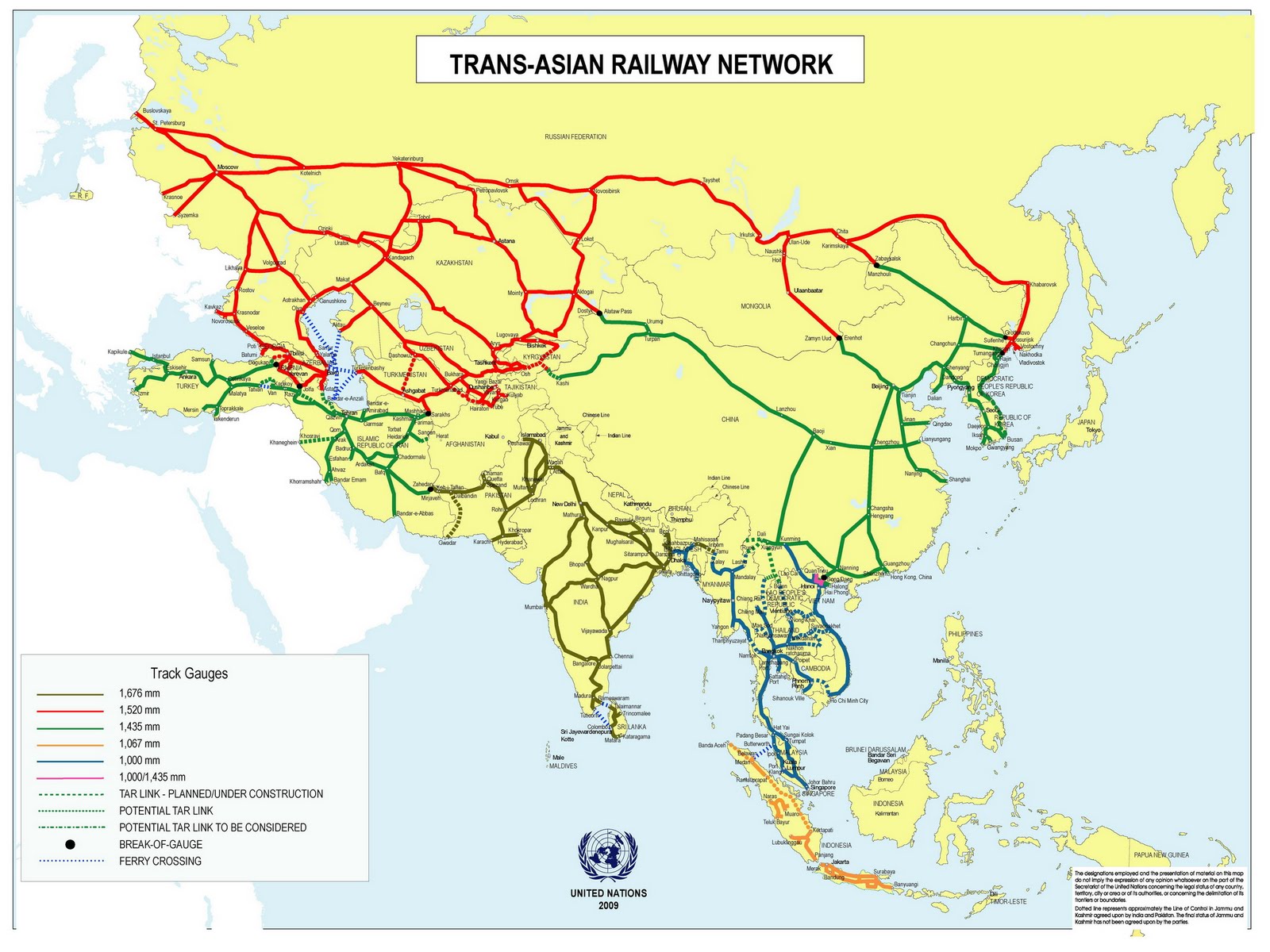
           King’s Cross to Beijing in two days on new high-speed rail network


    Passengers will be able to travel by train from King’s Cross to Beijing in just two days on trains that travel almost as fast as aeroplanes under ambitious new plans from the Chinese.
    By Malcolm Moore, in Shanghai

    Published: 10:00PM GMT 08 Mar 2010
    China is in negotiations to build a high-speed rail network to India and Europe with trains that capable of running at over 200mph within the next ten years Photo: MARTIN POPE
    China is in negotiations to build a high-speed rail network to India and Europe with trains that capable of running at over 200mph within the next ten years.
    The network would eventually carry passengers from London to Beijing and then to Singapore. It would also run to India and Pakistan, according to Wang Mengshu, a member of the Chinese Academy of Engineering and a senior consultant on China‘s domestic high-speed rail project.
    A second project would see trains heading north through Russia to Germany and into the European railway system, and a third line will extend south to connect Vietnam, Thailand, Burma and Malaysia.
    Passengers could board a train in London and step off in Beijing, 5,070 miles away as the crow flies, in just two days. They could go on to Singapore, 6,750 miles away, within three days.
    “We are aiming for the trains to run almost as fast as aeroplanes,” said Mr Wang. “The best case scenario is that the three networks will be completed in a decade,” he added.
    Mr Wang said that China was already in negotiations with 17 countries over the rail lines, which will draw together and open up the whole of Central, East and South East Asia. Mr Wang said the network would also allow China to transport valuable cargoes of raw materials more efficiently.
    “It was not China that pushed the idea to start with,” said Mr Wang. “It was the other countries that came to us, especially India. These countries cannot fully implement the construction of a high-speed rail network and they hoped to draw on our experience and technology,” he said.
    China is in the middle of a £480 billion domestic railway expansion project that aims to build nearly 19,000 miles of new railways in the next five years, connecting up all of its major cities with high-speed lines.
    The world’s fastest train, the Harmony Express which has a top speed of nearly 250mph, was unveiled at the end of last year, between the cities of Wuhan and Guangzhou. Wholly Chinese-built, but using technology from Siemens and Kawasaki, the Harmony Express can cover 660 miles, the equivalent of a journey from London to Edinburgh and back, in just three hours.
    Mr Wang said the route of the three lines had yet to be decided, but that construction for the South East Asian line had already begun in the southern province of Yunnan and that Burma was about to begin building its link. China has offered to bankroll the Burmese line in exchange for the country’s rich reserves of lithium, a metal widely used in batteries.
    Currently, the only rail line that links China to South East Asia is an antiquated track built by the French in Vietnam a century ago. The Asian Development Bank has recently agreed a second £27 million loan as part of the £93 reconstruction of Cambodia‘s network, which should finish by 2013. The cost of the lines from Cambodia to Singapore and then from Vietnam to China could be roughly £400 million.
    “We have also already carried out the prospecting and survey work for the European network, and Central and Eastern European countries are keen for us to start,” Mr Wang said. “The Northern network will be the third one to start, although China and Russia have already agreed on a high-speed line across Siberia, where one million Chinese already live.”
    One stumbling block is China‘s desire for the high-speed tracks to run on the same gauge as China‘s domestic network. Vietnam has agreed to change its standard gauge, but other countries are still in negotiations.
    “From our point of view, the biggest issue is money,” said Mr Wang.
    “We will use government money and bank loans, but the railways may also raise financing from the private sector and also from the host countries. We would actually prefer the other countries to pay in natural resources rather than make their own capital investment.”
    As for passengers, Mr Wang predicted that in a decade’s time, visa restrictions on travel through Asia “will be further lifted”.
  • Luxor governor defends developments

    Al Masry Al Youm (Ayman Hamza)

    With slideshow.

    The Governor of Luxor Samir Farag said the city’s development is a work in progress, and that the government “will remove anything that stands in the face of development, even if it is a mosque or a church.” He added, “we are working according to a development plan which will end in 2030, and no one will threaten me, or force me to leave the track, because I am like a train.”

    Speaking at a symposium hosted by the Heliopolis Lions Club chaired by Safia Metwally, he added, “No one can scare me. No one is more important than the government, and I will not be threatened by the media or the press.”

  • Ocean Disturbance Observed


    This is of course noteworthy, but not necessarily significant at all.  It sounds like it is more than it is yet may be on a percentage basis quite small. 
    It shows how badly we need to develop continuous monitoring of the ocean to actually model what is happening.  Of course we need to develop similar tech for the atmosphere.
    Actually it is an interesting problem that needs to be tackled with radar, lasers and multiple sensing stations and the like in order to get a handle on the problem.  It would be lovely to produce a continuous temperature and salinity curve against depth for any given spot.  What we get instead is effectively random samples at great expense.  It is grossly insufficient and in fact unable to support any inferences whatsoever.
    That is why I find this piece to be so doubtful.  The moment you think through the possible variables it is clear that you need a massive sampling program before you say squat.
    We are way too soon on most of this.
    Waiting to Inhale: Deep-Ocean Low-Oxygen Zones Spreading to Shallower Coastal Waters
    Oxygen-deprived areas in the world’s oceans usually found in deeper water are moving up to offshore areas and threatening coastal marine ecosystems by spurring the die-off of some species and overpopulation of others
     February 23, 2010
    CONTINENTAL CREEP: Hypoxic seawater from the deep ocean is moving into shallower near-shore environments off the Oregon coast, threatening or killing marine species that make their home there.
    A plague of oxygen-deprived waters from the deep ocean is creeping up over the continental shelves off the Pacific Northwest and forcing marine species there to relocate or die. Since 2002 tongues of hypoxic, or low-oxygen, waters from deeper areas offshore have slipped into shallower near-shore environments off the Oregon coast, although not close enough to be oxygenated by the waves. The problem stems from oxygen reduction in deep water, a phenomenon that some scientists are observing in oceans worldwide, and that may be related to climate change. 

    The hypoxic seawater is distinct from the well-known “dead zones” that form at the mouths of the Mississippi and other rivers around the world. Those areas result from agricultural runoff, which lead to algae blooms that consume oxygen. Rather, the Pacific Northwest problem is broader and more mysterious.

    Shelf waters off the Pacific Northwest extend anywhere from 30 to 80 kilometers offshore and lie beneath the California Current, one of the richest marine ecosystems in the world. Francis Chan, a senior research professor at Oregon State University, has been monitoring the area’s low-oxygen events, which normally peak in the late summer months. “Oxygen is just about the most crucial necessity for anything biological,” he says.*

    Chan is one of a number of scientists alarmed at the dramatically reduced oxygen levels showing up in these waters. In fact, the Oregon Department of Fish and Wildlife  put submersible vehicles off Oregon’s coast during a hypoxic event that went anoxic (oxygenless) in 2006, he says, monitoring conditions and recording numerous carcasses of sea stars, sea cucumbers, marine worms and fish.**

    Lothar Stramma, a physical oceanographer at the Christian Albrechts University of Kiel in Germany and his associates describe the hypoxic problem as global in a paper accepted for publication in Deep-Sea Research , stating that tropical low-oxygen zones have expanded horizontally and vertically around the world, and that subsurface oxygen has decreased adjacent to most continental shelves. Low-oxygen zones where large ocean species cannot live have increased by close to 5.2 million square kilometers since the 1960s, the team found. Where this expansion intersects with the coastal shelf, oxygen-deprived waters are slipping up and over shelf floors, killing off creatures such as crabs, mussels and scallops. Such bottom-dwellers normally have a lot to eat in such rich ecosystems, but these species are sensitive to oxygen loss. Similarly, the anoxic ocean at the end of the Permian period (around 250 million years ago) was associated with elevated carbon dioxide and massive terrestrial and oceanic extinctions.
    Lisa Levin of the Scripps Institution of Oceanography in La Jolla, Calif., says that as oxygen-starved layers move upward, large animals such as marlin, tuna and sailfish will be forced into ever-shallower waters. “That may be good for fishermen, but it also makes it a lot easier for fishermen to fish these species out of the ocean,” says Levin, who worked with Stramma on Deep-Sea Research .
    Biodiversity will be the big loser as these low-oxygen zones knock out some species and promote others. Among the big winners is the Humboldt squid, which can tolerate low oxygen; it has expanded its range in the northeastern Pacific in the past 10 years, from the Gulf of California all the way to southeastern Alaska. Biologists worry about the hunting pressure the squid will put on other species.
    Increases in jellyfish blooms also are likely to be part of the process. Levin encountered such blooms recently in low-oxygen environments off India‘s coast, where “the jellyfish were as thick as soup,” she says. Larval fish are especially susceptible to low-oxygen ocean zones. “Larvae are really a ball of cells with a mouth and a gut. There is only so much they can do. They’re not as mobile as fish,” she says. Reproducing female crustaceans and fish may be adversely affected, as well.
    Levin says that the Pacific’s deeper currents keep its waters less oxygenated than those of the Atlantic. “It’s what we call ‘old water,’ since deeper Pacific waters haven’t been at the surface in a long time,” Levin says. Stramma thinks that some of the Pacific’s oxygen problems could also result from El Niño. But climate models predict reductions in dissolved oxygen in all oceans as average global air and sea temperatures rise, and this may be the main driver of what is happening there, she says.
    Chan says that lighter warm water creates a cap over the colder depths, making it less likely that deeper waters—where everything from “plankton to whale poop” sucks up oxygen—will rise to mix with the oxygenated surface. Plus, warmer water simply holds less oxygen. According to Chan, most hypoxia-intolerant species engulfed in low-oxygen waters quickly move away. “But for those whose stress response is to hunker down and wait,” he adds, “they will die.”

    *Erratum (2/24/10): This sentence was changed after publication. It originally stated that Francis Chan is a professor at the University of Oregon.

    **Erratum (2/24/10): This sentence was changed after publication. It originally stated that NOAA put submersibles off the Oregon coast; it was completely rewritten both to correct the error and for clarity.

  • Travel – Luxor to Kharga oasis

    Otherwise Travels (Mickey)

    I stopped posting travel articles a while ago, but every now and again one turns up that looks as though it might be worth sharing and this is one of them. It shows the sort of optimism, sense of untrammeled adventure and willingness to trust that I simply don’t have about travel and people I’ve never met before.

    Once in Asyut, I walk to the bus station and jump on the next bus to Kharga. The bus is extremely dusty and sandy. As we start moving, I feel like someone has thrown a bucket of sand in my face and down my throat. On the bus a gentlemen sits down in the row opposite me an invites me to join him for a chat. I sit down next to him and we begin to talk. Conversation is slow due to his limited English but I can tell he is a kind and genuine fellow. He likes travellers and relishes the opportunity to practice his English. He tells me of his dreams to one-day open a hotel and restaurant for tourists. After getting to know each other, he invites me back to his place and offers to take me around the oasis the next day. I happily accept and look forward to meeting his family and perusing the oasis. Before the three-hour trip is over, he passes me what appear to be tiny apples. They look exactly like mini granny smiths and taste how you would image a little apple would, the same but slightly more sour.

    The landscape along the way is nothing short of amazing. I catch my first real glimpse of the smooth untouched dunes of the Sahara. I feel an immediate peacefulness come over me, it is as if my heart rate just suddenly drops to 30 beats a minute. I only see small tracts like this but I now have a taste for what the next week might be like.

    I am dropped at my near my accommodation in Kharga and after a little aimless wandering around the empty and slightly eerie streets (I don’t have a map of the town) I find the Hamadalla Hotel. It’s an interesting establishment, it reminds me of a dusty, dingy and deserted hospital but with carpet and no patients or doctors. Every toilet in the quiet large hotel seems to be leaking, it’s a little weird. The bathrooms are so grimy I decide not to take a shower as I feel I will be dirtier after. I am pretty sure I am the only one staying in the entire hotel. Hey, for $8 AUD it’s all good.

    See the above page for the full post. If you liked this one have a look at his experiences of the White and Black Deserts (Farafra to Bahariya, with some excellent photographs), Bahariya (with more photographs), Dakhleh (yet more great pics).
  • Tell el-Daba online

    Tell el-Da’ba Homepage (English version)

    I stumbled across this page by accident. Tell el-Da’ba is in the eastern Delta on the Pelusiac branch of the Nile and has now been identified as Avaris, the Hyksos captial. The satellite photograph of the site on the above home page is marked with green areas on which you can click to read details of the excavations at those locations. There are detailed descriptions and photos throughout, and the History page gives an overview of the site’s background and chronology. Also in German.
  • New Book: Gilf Kebir National Park

    American University in Cairo Press

    The first and only guidebook to the Gilf and Uweinat.

    Gilf Kebir National Park
    Egypt Pocket Guide
    Alberto Siliotti
    Feb 2010

    In the far southwestern corner of Egypt lies one of the most fascinating and least known regions of the Sahara Desert, declared a National Park by the Egyptian government in 2007 for its great archaeological and natural-historical heritage. The Gilf Kebir, a broad massif twice the size of Corsica, and Gebel Uweinat, a 2,000-meter inselberg, were discovered only in the 1920s, and explored in the decades following, but today an increasing number of visitors are able to reach this unique area on long desert expeditions and experience for themselves the special geology and ecology of the place and the extraordinary rock paintings from Neolithic times. Now, in lucid text and colorful photographs, drawings, maps, and satellite images, Alberto Siliotti guides the intrepid visitor to the features of the National park, with notes on what to take on such a long desert trip and what not to leave behind.

    Alberto Siliotti is a scientific journalist who specializes in Egyptology. He has written several books including The Discovery of Ancient Egypt (AUC Press, 1998), The Illustrated Guide to the Pyramids of Egypt (AUC Press, 2003), and the popular series of Egypt Pocket Guides.

  • Adopt a Dig

    The Oriental Institute blog
    The Oriental Institute website

    The Get Involved/How To Give section of the OI’s main website offers an opportunity to contribute to Egyptology by donating to the excavations at Tell Edfu. An overview of the site and the work carried out so far is provided.

    Tell Edfu, one of the most well-preserved ancient towns in Egypt, houses the remains of what once had been the capital of the 2nd Upper Egyptian province. Continuous occupation over several millennia led to the constant build-up of settlement layers, creating an artificial mound, or a tell, of considerable height. Tell Edfu is one of the rare places where nearly three thousand years of ancient Egyptian history are preserved in the stratigraphy of a single site – therefore, it provides an enormous potential for increasing our understanding of ancient urbanism in Egypt, a topic that is still poorly understood since it relies almost entirely on archaeological data. Few ancient Egyptian settlement sites are currently accessible and even fewer have been excavated and published.

    The past excavation seasons at Tell Edfu have focused along the eastern part of the tell, which yielded evidence for the early administrative center of the town. The first finds by Dr. Nadine Moeller and her team have already proved to be spectacular, such as the large grain silos that are so far unique in the Egyptian archaeological record. For the first time, it has been possible to discover archaeological settlement remains that complement the already abundant ancient administrative textual sources.

    The budget for each field season at Tell Edfu is spent mostly on airfares and salaries for specialists – such as zoologists, archaeo-botanists, and ceramicists – and workers. Further research and analysis of new data, such as taking samples for radiocarbon dating, and post-excavation work after each field season, like preparing materials for publication, are parts of the project that are currently underfunded. Adopting Tell Edfu as a dig can increase the output possibilities of the project by funding more researchers and providing for efficient and accurate data processing after each season.

  • Exhibition: El enigma del momia

    Diario Informacion

    Thanks to Amigos de la Egiptologia for the link to the above story.

    COMO UNA SUCESIÓN de tesoros se ha organizado la exposición El enigma de la momia. El sarcófago exterior de Seramón, en la vitrina donde se expone. La momia de Seramón, envuelta con las vendas tal y como fue encontrada hace 150 años en Tebas. La comisaria de la muestra, Agathe Mathiaut-Legros; el presidente de la Diputación, José Joaquín Ripoll, y el gerente de la Fundación CajaMurcia, Pascual Martínez, observan algunas piezas.

    Lejos de ser un final, para los egipcios la muerte no era más que el principio de un camino hacia el más allá, el trayecto hacia otro mundo que suponía el reflejo idealizado de su vida terrenal. Esta reflexión da una idea de por qué esta cultura daba tanta importancia a los enterramientos, por qué surgió en esa civilización la técnica de embalsamar los cuerpos y por qué el engalanamiento y el lujo en sus muertos era símbolo de poder.

    Muchas respuestas a estas preguntas son las que ofrece la exposición El enigma de la momia, que se inauguró ayer en el Museo Arqueológico de Alicante (MARQ) para abrir las puertas al mundo egipcio con una muestra única, que incluye 250 piezas, procedentes principalmente del Museo de Louvre y del de Beçanson.

    A line up of treasures make up the new exhibition, The Enigma of the Mummy including the outer sarcophagus and the mummy of Seramon, preserved just as he was when discovered in Luxor. Far from being the final stage in life, for the Egyptians death was just the first step in a journey to a far more distant place which was an idealized version of life as it had been lived. This understanding gives an idea of why this culture gave so much emphasis to the burials, why civilization emerged in the art of the technique of embalming bodies was perfected and why the luxury for their dead was a symbol of power. Many of the answers to these questions are provided by the exhibition which opened yesterday in the Archaeological Museum of Alicante (MAEQ). The unique display includes 250 items loaned principally from the Louvre and the Beçanson in France. Some of the perfumes that were used during the process of mummification have been reproduced and are there to be sampled.
  • Dual-Blast Suicide Bombing Kills At Least 37 On The Moscow Subway

    moscow stretcher russia

    One of a country’s worst-possible domestic nightmares — suicide bombing — has struck Moscow, killing at least 37.

    The attack occurred in two separate blasts.

    According to the Moscow mayor, both attacks were done by females, an odd but interesting detail.

    At least one occurred at a a subway station right beneath headquarters of the country’s leading security agency, the FSB (the successor to the KGB), according to MSNBC.

    No overnight market appears to be moving dramatically (yet) on the news.

    Russian markets are taking the event in stride and are moderately higher.

    table

    Gold does seem to have perked up a little.

    chart

    Here’s a glimpse of the scene underground

    russia blast

    Join the conversation about this story »

  • Book Review: Poems in Context

    Bryn Mawr Classical Review (Review by David Hernández de la Fuente)

    Laura Miguélez Cavero, Poems in Context: Greek Poetry in the Egyptian Thebaid 200-600 AD. Sozomena. Studies in the Recovery of Ancient Texts 2. Berlin/New York: W. De Gruyter, 2008.

    A panoramic study of Greek Epic in Late Antique Egypt, such as this recent book by Dr Laura Miguélez Cavero, published as a result of her 2006 PhD dissertation at the University of Salamanca, was much needed in this field of research. Greek Poetry in the Egyptian Thebaid, as the title goes,–or, rather, epic, since lyric or drama are let aside–is a very valuable piece of scholarship, as we shall point out in the following lines.

    First of all, let us summarize the contents of the present volume. Poems in Context is divided into 5 chapters, the first one providing an analysis of “The so-called school of Nonnus in the literary context of Panopolis (3rd-6th c. AD)” and of some of the main figures of this long period of time (the family of Fl. Horapollon, Cyrus, Olympiodorus, Nonnus and Musaeus). Miguélez Cavero argues for the non-existence of a “School of Nonnus” or something similar explaining this Egyptian “poetic flourishing” (“that would force into a category a certain number of poets whose purpose surely was not to create a group”, p. 5). She also emphasizes the idea that the most important work of this period, the Dionysiaca, “did not emerge in a thematic vacuum” (p.22). Both ideas are important and thoroughly discussed in the book and we shall go back to them.

  • Book Review: Greetings in the Lord

    Bryn Mawr Classical Review (review by Roberta Mazza)

    AnneMarie Luijendijk, Greetings in the Lord: Early Christians and the Oxyrhynchus Papyri. Harvard Theological Studies 60. Cambridge, Mass.: Harvard Divinity School, 2008.

    The city of Oxyrhynchus has attracted the attention of scholars in early Christian studies since the first archaeological season of Grenfell and Hunt on the site (1896-1897), which, amongst others, brought into light the Greek original of what came to be known about fifty years later as the Gospel of Thomas (P. Oxy. I, 1). From that moment onwards the ancient rubbish heaps of the city have given to us a wide range not only of Christian literature, but also of documents — such as letters, lists and contracts — relating to the everyday life of Christians and Christian institutions in that city and its neighbourhood.

    AnneMarie Luijendijk’s “Greetings in the Lord” is an updated and well-structured presentation of the papyrological material relating to early Christianity from the site. The book, mainly addressed to students and scholars in early Christian studies, is divided into three parts (“Meeting Christians at the Marketplace”; “Papa Sotas, Bishop of Oxyrhynchus”; “Legal matters and Government Dealings”), preceded by a general introduction (“Destination Oxyrhynchus: Historical Detective Work in the Footsteps of Monks and Papyrologists”) and ended by a concluding chapter (“Early Christians in the Oxyrhynchus Papyri: New Voices in Ancient History”).

  • Analyst: Twilight as a video game could have raked in millions

    I don’t know if this is serious, but an analyst has apparently called for a video game version of the blood-sucking Twilight franchise, characterizing it as a waste of money-making opportunities. Seven-figures, in particular. How about it

  • Tracking the Colors One Wears Each Single Day

    daily_color_pallette.jpg
    My Daily Color Palette [zago2010rgb.wordpress.com] depicts the colors Jacobo Zanella wears about everyday. Between two and four minutes each single day, he observes the colors of the shoes and clothes he wears and how much skin is exposed, to reproduce a digital translation of this information as a simple pixel graph.

    See also Micro Fashion Network, News Knitter Garments and Wearable Secret Thoughts.

    More detailed views at Flickr.


  • Hennessey Venom GT officially revealed, could be a Veyron-killer

    Hennessey Performance Engineering is out to prove anyone who believes that performance and supercars are dead due to recent strides in automakers struggling to boost their fleet fuel-economy. Meet the new Hennessey Venom GT – based on the Lotus Elise and powered by an American V8, it could possibly be the world’s fastest road going car (pending official figures).

    “This is not the first time that Britain and America have joined forces to produce a weapon of mass propulsion”, said company founder and president, John Hennessey. “Over fifty years ago the American-built P51 Mustang fighter aircraft was flown into history powered by a British Rolls-Royce Merlin engine. Today the Hennessey Venom GT promises to set a new standard of power to weight ratio in the rarified air of today’s supercar market.”

    Weighing in at less than 2,400 lbs, the base Venom GT is powered by a supercharged 6.2L LS9 V8 (same engine used on the Corvette ZR1), tweaked to produce 725-hp. Moving up a notch, the company will also offer 1,000-hp and 1,200-hp twin-turbo V8 engine variants. Mated to a Ricardo 6-speed gearbox, the Venom GT should be capable of hitting 0-60 mph in 2.2 seconds and will keep going until it hits 262 mph.

    To stop the Venom GT, Hennessey added Brembo brakes with 6-piston calipers up front and 4-piston calipers in rear clamping down on 15-inch carbon ceramic rotors.

    Hennessey plans on building 10 units of the Venom GT annually and four have already been sold at around $600,000 a pop. That means there are only six units left from the first allocation.

    Make the jump for the press release and the high-res gallery.

    Hennessey Venom GT:

    Press Release:

    A PICTURE TELLS A THOUSAND HORSEPOWER
    Introducing the Hennessey Venom GT

    SEALY, TEXAS & SILVERSTONE, ENGLAND, March 29, 2010 – Hennessey Performance Engineering (HPE) is pleased to introduce the first official images of its Venom GT supercar. Based upon the Lotus Elise, the Venom GT combines a high-tech, lightweight British chassis with a powerful American V8.

    SOMETIMES LESS EQUALS MORE
    In the case of the Venom GT, less weight means more performance. The Venom GT will have a production curb weight of less than 2,400 lbs (1,071 kilos) aided by its lightweight carbon fiber bodywork and carbon fiber wheels. Stopping power is delivered via Brembo brakes with 6-piston calipers up front and 4-piston calipers in rear clamping down on 15-inch carbon ceramic rotors.

    SOMETIMES MORE EQUALS MORE
    The Venom GT’s base power plant is the supercharged 6.2 liter LS9 V8 (the same as in the Corvette ZR1) tweaked by HPE to 725 bhp. The company will also be offering 1000 bhp and 1200 bhp twin turbo V8 engine variants. The mid-engine V8 will transmit its power to the rear tires via a Ricardo 6-speed gearbox.

    POWER WITH CONTROL
    Hennessey plans to manage power output by using a programmable traction control system. CFD (computational fluid dynamic) tested bodywork and down force will also help keep the Venom stable at speed. An active aero system with adjustable rear wing will deploy under varying conditions on both the road and racetrack. An adjustable suspension system will allow ride height adjustments according to speed and driving conditions. Finally, power will be put to the ground via massive Michelin PS2 tires at all four corners.

    POWERED BY THE USA, BUILT IN THE UK
    Hennessey will be building the power plants at its Texas facility. The engines will then be air freighted to the company’s assembly facility near Silverstone, England where the Venom GT is built and tested. Venom GT buyer will be offered a 1-day driver orientation and instruction program by a Hennessey factory test driver, at a track in the UK or USA prior to delivery.

    LIMITED PRODUCTION
    The company plans to establish a network of Venom GT dealers and distributors in the Middle East, Europe, Russia, Australia and Asia. Production is limited to just 10 vehicles per year and the company already has orders for 4 Venom GT’s.

    About Hennessey Performance Engineering (HPE)
    Hennessey Performance has been making fast cars go faster since 1991. HPE operates at its 30,000 square foot workshop and showroom facility situated on 143 acres near Sealy, Texas (about 45 minutes west of Houston). The company also has a showroom and installation facility located in Lake Forest, California. HPE offers a wide variety of dyno proven, track tested parts and upgrades for a variety of modern performance vehicles. Hennessey Performance is also the only tuner in North America that operates its own test track – Lonestar Motorsports Park.

    – By: Omar Rana


  • Videos: Five replay videos for Gran Turismo 5

    Let’s put all those release rumors to rest for a while now. We’ve got five new and impressive Gran Turismo 5 replay videos, which we’re sure you’ll be more interested to check out than any more chit-chat.

  • 2010 New York Preview: 2010 Cadillac CTS-V Sport Wagon expands V-Series

    We are just two days away from the 2010 New York Auto Show and General Motors today gave us a preview of what is next from its V-Series Cadillac lineup. Joining the Cadillac CTS-V Sedan and the CTS-V Coupe, GM will now expand the V offering with the new 2011 Cadillac CTS-V Sport Wagon.

    “The CTS-V Sport Wagon is a natural extension of both the V-Series and the CTS lineup, offering an uncompromising performance car to enthusiasts who want the extra room of a wagon,” said Don Butler, vice president for Cadillac marketing. “The V-Series Sport Wagon is another hallmark of the dramatic presence and power of Cadillac vehicles.”

    Click here to get prices on the 2010 Cadillac CTS-V Sedan.

    Power for the CTS-V Sport Wagon will come from the same 6.2L supercharged V8 used on the CTS-V Sedan and CTS-V Coupe. The engine is good for making 556-hp with a maximum torque of 551 lb-ft. The engine is available with a Tremec TR6060 six-speed manual with a dual-disc clutch and a Hydra-Matic 6L90 six-speed automatic with steering wheel-mounted shift controls. Of course, Magnetic Ride Control, Brembo brakes and Michelin Pilot Sport PS2 tires will all be part of the game.

    The 2010 Cadillac CTS-V Sport Wagon will hit markets in late 2010, shortly after the CTS-V Coupe.

    Click here to read our review of the 2010 Cadillac CTS-V Sedan.

    Make the jump for the press release.

    2010 Cadillac CTS-V Sport Wagon:

    Press Release:

    Cadillac CTS-V Sport Wagon Show Car Debuts At The New York Auto Show

    o V-Series performance combined with dramatic CTS Sport Wagon design
    o 556-hp (415-kW) supercharged 6.2L V-8
    o Six-speed manual or six-speed automatic with steering wheel shift controls
    o Magnetic Ride Control, Brembo brakes and Michelin Pilot Sport PS2 tires
    o Limited availability beginning in late 2010

    NEW YORK – Cadillac today unveiled the CTS-V Sport Wagon show car, foreshadowing the next addition to its V-Series performance line. It combines the performance and luxury of the landmark CTS-V Sport Sedan with the dramatic design of the CTS Sport Wagon.

    The exterior is finished in Midnight Silver, first seen on the Cadillac Sixteen Concept, and accented by lustrous Liquid Silver-finished wheels and a black chrome finish on the grille’s mesh insert. The rear fascia, upper spoiler and center high-mounted stop lamp are also unique to the show car.

    Inside, the CTS-V Sport Wagon show car is trimmed in exclusive black leather with Alcantara accents. The upper section of the instrument panel and upper door panels are covered in the same premium leather, accented with midnight Sapele wood, while the microfiber material and stitching is applied to the lower door panels, pillars, console lid, headliner and steering wheel center. The show car features fine-grain black leather-trimmed Recaro seats with Alcantara seat inserts. The seat inserts are divided in the center and accented with dark gray stitching, while the V-series logo is laser etched into the seatbacks. Obsidian Black accents grace the center stack, console, steering wheel and door panels.

    The show car’s bespoke color and trim elements hint at the potential direction of color and trim in future Cadillac models. These elements are not yet intended for production, but represent Cadillac’s desire to gauge customer reaction to new color and trim options.

    Production CTS-V Sport Wagon

    The CTS-V Sport Wagon will go into production in late 2010, with initial sales in North America, followed by export markets including Europe and the Middle East. The new model rounds out the V-Series offerings, which include all variants of the CTS family’s sedan, coupe and sport wagon body styles.

    Like its sedan and coupe stable mates, the CTS-V Sport Wagon is powered by a supercharged 6.2L V-8, which delivers 556 horsepower (415 kW) and is backed by either a six-speed manual transmission or a six-speed automatic. A suite of technical and performance elements complement the powertrain, including Magnetic Ride Control, Brembo brakes and Michelin Pilot Sport PS2 performance tires mounted on 19-inch forged aluminum wheels.

    Like the other CTS V-Series models, the Sport Wagon incorporates a unique grille that doubles front-end airflow to help enable its high-performance capabilities. It is also visually identified by an aggressive front fascia and raised center section of the aluminum hood that provides clearance for the supercharger. It rides on 19-inch forged aluminum wheels available in painted or polished finishes.

    The rest of the exterior carries the dramatic design of the new CTS Sport Wagon; the details of which include:

    * Signature V-shaped deck and tailgate motif
    * Large, vertical taillamps with light-pipe technology
    * Power-opening liftgate (via key fob or in-vehicle button)
    * CHMSL-integrated roof spoiler
    * Integrated roof load management system with available cross bars for a seamless appearance
    * Cargo management system with adjustable in-floor containment
    * Available panoramic UltraView sunroof.

    At the rear is a pair of 3-inch (76 mm) chrome exhaust outlets, which caps a performance dual-exhaust system made of high-grade stainless steel that will maintain a lustrous appearance longer than ordinary stainless.

    Of course, cargo capability is a hallmark of wagons and the V-Series Sport Wagon delivers with 25.4 cubic feet (720 liters) of space behind the rear seats and 58 cubic feet (1,644 liters) with the seats folded – virtually doubling the available space of the sedan.

    Supercharged performance

    The 6.2L supercharged V-8 engine powers the CTS-V Sport Wagon – the same acclaimed engine found in the V-Series Sedan and Coupe models. Rated at 556 horsepower (415 kW) and 551 lb.-ft. of torque (747 Nm), it is the most powerful engine offered in Cadillac’s history.

    The engine features an intercooled Eaton Twin Vortices Series™ (TVS™) supercharger. This unique supercharger design employs twin four-lobe rotors, twisted 160 degrees. Typical superchargers feature three lobes twisted 60 degrees. The fourth lobe and added twist, when combined with unique air inlet and outlet ports, create smoother, more efficient airflow into the engine. In addition to improved overall efficiency, this supercharger has superior noise and vibration characteristics compared to more ordinary designs.

    A pair of six-speed transmissions is offered in the CTS-V Sport Wagon – a Tremec TR6060 six-speed manual with a dual-disc clutch and a Hydra-Matic 6L90 six-speed automatic with steering wheel-mounted shift controls. The steering wheel-mounted controls require no shift lever movement and allow immediate tap up/tap down gear selection. Performance Algorithm Shifting provides the automotive transmission with a performance-oriented shift pattern during sustained high-performance driving. As with many Cadillac models, the driver needs only to slide the shifter into the manual “gate” to put the transmission into a performance mode.

    Torque is channeled through the six-speed transmissions to a high-performance rear axle that features a limited-slip rear differential within a cast iron housing for greater thermal management and asymmetrical half-shafts to smoothly manage the supercharged engine’s incredible torque. The unique design includes alternately sized half-shafts that also help dynamically balance the oscillation of torque from side to side, effectively eliminating “power hop.”

    Magnetic Ride Control

    The V-Series achieves exceptional levels of road-holding performance, but also maintains the poise of a luxury car in “regular” driving conditions. The technical enabler of this dual-mode driving character is Cadillac’s landmark Magnetic Ride Control. It is standard on the CTS-V Sport Wagon and is the world’s fastest-reacting suspension technology. It uses shocks controlled by advanced magneto-rheological technology, rather than mechanical valves, to greatly accelerate response time and precision.

    Electronic sensors at all four wheels literally “read the road” every millisecond, making constant adjustments to damping to create virtually instantaneous and extremely precise control of body motions. This is of particular benefit for a high-performance car because it helps keep the car very composed during hard cornering, acceleration, braking and other dynamic maneuvers.

    The Magnetic Ride shocks also enable a broader range of damping control to optimize the ride and handling for all driving conditions. In the CTS-V Sport Wagon, an extra measure of control is offered, with two selectable modes (Tour and Sport), enabling the driver to tailor the suspension for grand touring or more spirited performance driving.

    Cadillac pioneered Magnetic Ride Control, bringing it to production first in 2002, following decades of research on magneto-rheological science. Today, the technology appears only on a short roster of the world’s most elite vehicles, including Cadillac V-Series models, the Escalade luxury SUV and the STS and DTS luxury sedans.

    Brembo brakes and Michelin Pilot Sport PS2 tires

    The CTS-V Sport Wagon incorporates sophisticated braking and tire systems, in partnership with two companies renowned for high-performance technology: Brembo and Michelin. Brembo brakes are at all four corners and include powerful, six-piston calipers in the front and four-piston calipers in the rear.

    Large vented rotors enable strong initial braking force while optimizing heat resistance and eliminating fade. The brake rotors from Brembo are manufactured with “dual-cast” technology that combines cast iron and aluminum, resulting in superior performance and weight reduction.

    The CTS-V Sport Wagon also includes an electric parking brake, which allows for optimal dead pedal placement, which is important for high-performance driving.

    Michelin partnered with Cadillac engineers to develop an exclusive Pilot Sport PS2 tire specifically engineered for the CTS-V. The tires support high levels of grip in track conditions, while also affording excellent performance on the road.

    Comfort, style and technology

    The interior of the CTS-V Sport Wagon is shared with the sedan, including streamlined instrumentation, LED lighting and hand-cut-and-sewn accents.

    The CTS-V Sport Wagon production model will come standard with performance seats featuring perforated sueded microfiber inserts designed to hold the driver and front passenger in place during cornering. Recaro performance driving seats are optional and provide excellent support for spirited driving. These 14-way adjustable performance seats include pneumatic bolster controls in the seat cushions and backrests.

    Complementing the performance seating are a thick steering wheel and a gauge package designed for easy, at-a-glance reference during performance driving. Large instruments have bold readouts, including an LED-lit “tracer” function in the tachometer that flashes as the engine nears the red line. The gauge layout includes a boost gauge and a lateral acceleration display.

    Obsidian Black accents grace the center stack, console, steering wheel and door panels. The production steering wheel and shifter are available in Alcantara, providing the luxurious character of suede. These accents are elegant to the touch and aid the driver during support high-performance driving. Just like every CTS, the V-Series includes a hand-stitched instrument panel, door trim and center console.

    Leading-edge infotainment features extend to the V-Series. Standard features include an advanced navigation system with a deployable screen, Bose 5.1 digital surround audio, factory-installed Bluetooth phone integration and a 40-gigabyte hard drive that allows the customer to store a large library of music files. The system uploads files via a USB port or the in-dash DVD/CD drive and allows stored tracks to be searched and selected through the radio controls.

    2011 CADILLAC CTS-V SPORT WAGON SPECIFICATIONS

    Overview

    Model: 2011 Cadillac CTS-V Sport Wagon
    Body style / driveline: 4-door sport luxury wagon, RWD
    Construction: unitized welded steel body with direct-mounted front cradle and rubber-isolated, multi-link independent rear suspension
    EPA vehicle class: wagon
    Manufacturing location: Lansing Grand River Assembly, Lansing, Mich.


    Engine

    6.2L Supercharged V-8
    Displacement (cu in / cc): 376 / 6162
    Bore & stroke (in / mm): 4.06 / 103.25 x 3.62 / 92 mm
    Block material: cast aluminum
    Cylinder head material: roto-cast aluminum
    Valvetrain: overhead valve, two valves per cylinder
    Fuel delivery: 1.9L supercharger with intercooler; sequential fuel injection
    Ignition: direct-mount ignition coils
    Compression ratio: 9.1:1
    Horsepower (hp / kW @ rpm): 556 / 415 @ 6100*
    Torque (lb-ft / Nm @ rpm): 551 / 747 @ 3800*
    Recommended fuel: premium required
    Maximum engine speed (rpm): 6200
    Estimated fuel economy
    (city / hwy):
    14 / 19


    Transmissions

    Tremec TR6060 Hydra-Matic 6L90
    Type: six-speed manual; fully synchronized with single overdrive six-speed electronically controlled automatic overdrive with torque converter clutch
    Gear ratios (:1):
    First: 2.66 4.03
    Second: 1.78 2.36
    Third: 1.30 1.53
    Fourth: 1.00 1.15
    Fifth: 0.80 0.85
    Sixth: 0.63 0.67
    Reverse: 2.90 3.06
    Final drive ratio: 3.73 3.23


    Chassis / Suspension

    Configuration RWD
    Differential: limited-slip
    Front: independent SLA; 29-mm hollow stabilizer bar; elastomeric handling and ride bushings; 65-N/mm spring rate; Magnetic Ride Control with electro-magnetically controlled shocks
    Rear : independent SLA; 24-mm hollow stabilizer bar; elastomeric trailing arm bushing; 90-N/mm spring rate; Magnetic Ride Control with electro-magnetically controlled shocks
    Steering type: power-assisted rack-and-pinion
    Steering ratio: 16.1:1
    Steering turns, lock-to-lock: 2.7
    Turn circle (ft / m): 37.9 / 11.55
    Chassis control: four-channel StabiliTrak w/ brake assist


    Wheels and tires

    Wheel size and type: front: 19 x 9-inch; forged alloy, 5-lug
    rear: 19 x 9.5-inch, forged alloy, 5-lug
    Tires: Michelin Pilot Sport PS2
    front: 255/40ZR19 (96Y) high-performance summer tire
    rear: 285/35ZR19 (99Y) high-performance summer tire


    Brakes

    Type: four-wheel disc with four-channel ABS, hydraulic brake assist and dynamic rear brake proportioning
    Rotor type and thickness (in / mm)
    Front : 15 x 1.26 / 380 x 32, vented, co-cast
    Rear: 14.7 x 1.1 / 373 x 28, vented


    Dimensions
    Exterior

    Wheelbase (in / mm): 113.4 / 2880
    Length (in / mm): 191.3 / 4859
    Height (in / mm): 59.1 / 1502
    Width (in / mm): 72.6 / 1842
    Track (in / mm): front: 61.8 / 1570
    rear: 62 / 1575
    Curb weight (lb / kg): 4390 / 1995
    Weight distribution (% front / rear): 52 / 48


    Interior

    Headroom (in / mm): front: 38.8 / 986
    rear: 37.2 / 944
    Legroom (in / mm): front: 42.4 / 1078
    rear: 35.9 / 913
    Shoulder room (in / mm): front: 56.7 / 1441
    rear: 57.4 / 1390
    Hip room (in / mm): front: 55.1 / 1400
    rear: 54.1 / 1375


    Capacities

    Seating capacity (front / rear): 2 / 3
    EPA passenger volume (cu ft / L): 96.5 / 2732
    EPA cargo volume (cu ft / L): 25.4 / 720 (behind rear seats)
    58 / 1644 (rear seats folded)
    Trailer towing maximum (lb / kg): TBD
    Fuel tank (gal / L): 18 / 68
    Engine oil (qt / L): 6.3 / 6
    Cooling system (qt / L): 12.42 / 11.75

    – By: Omar Rana


  • Officially Official: 2011 Cadillac CTS-V Sport Wagon unleashed!

    Filed under: , , ,

    Cadillac CTS-V Sport Wagon – Click above for high-res image gallery

    Here in America, drivers who prefer station wagons to crossovers and SUVs are in a distinctly fringe minority. In spite of that, Cadillac has heard the cries from the wilderness and delivered the car we’ve been clamoring for. The CTS-V Sport Wagon is now finally official and production starts later this year.

    Ever since AMG built a handful of Hammer station wagons back in the late 1980s, the idea of a family hauler with ludicrous power and torque has held a strange and twisted appeal for us. The V-wagon takes all the traits we love about the 556-horsepower sedan and adds the expanded cargo body style.

    Aside from the tailgate, everything else is carried over, including the magnetic ride damping system, Brembo brakes, 19-inch wheels shod in Michelin Pilot Sport PS2s, and the asymmetrical half-shaft rear end to avoid axle tramp. Add in 25.4 cubic feet behind the back seats and 58 cubic feet with them folded and we may well have the perfect performance car. Did we mention the 551 pound-feet of torque?

    [Source: General Motors]

    Continue reading Officially Official: 2011 Cadillac CTS-V Sport Wagon unleashed!

    Officially Official: 2011 Cadillac CTS-V Sport Wagon unleashed! originally appeared on Autoblog on Mon, 29 Mar 2010 00:02:00 EST. Please see our terms for use of feeds.

    Permalink | Email this | Comments