Author: Serkadis

  • Bank of America’s FHA flipping policy & principal reduction plan; state ACORN’s shutting down


    pipeline-press

    rob-chrisman-daily

    Yesterday I mentioned the question about whether or not modified loans could still be forced back to the seller for buybacks. Freddie Mac does indeed say that the seller would still need to buy it back after a modification. At the current time, however, there is the belief that sellers continue to be successful in challenging these because most contracts don’t specifically allow the servicers to modify the loans. And in fact several national law firms are making a run at challenging the large servicers, who find themselves caught between not being able to modify a loan and being forced to modify it by the GSE’s and HAMP. Servicers claim that the reps and warrants stay with the seller, and especially if the loan is modified due to fraud or material misrepresentation then the seller may have to indemnify the loan with some deposit of money to the investor.

    Bank of America came out with its official stance on two FHA items. The first, as announced in a HUD Mortgagee Letter, will be the new upfront mortgage insurance premium of 2.25% for both purchases and refinances. BofA will start this April 5. The only FHA programs not impacted by the new UFMIP factors at this time are for loans dealing with Indian Reservations or Hawaiian Homelands. The second addresses BofA’s stand on the FHA flipping waiver, whereby HUD announced a 1-yr waiver to the 2003 90-day restriction. Starting 4/1, BofA’s correspondent lending “will allow the 90-day waiver for all property sellers, including private sale transactions, but prohibits FHA financing for properties owned less than 90 days if the sales price is greater than or equal to a 20% increase over the seller’s acquisition cost. The 90 days is calculated from the seller’s acquisition date to the purchase contract date of the new transaction.” Transactions must meet the usual arm’s length requirements.

    Bank of America will soon begin offering, by invitation only, loan modifications based on a reduction of the mortgage principal to some of its borrowers. Borrowers with principal balances of 120% or more of the home’s market value or who are confronted with endlessly increasing balances on negative amortization loans will be the target (they must meet the basic qualifications of HAMP), and stories reported that BofA will forgive up to 30% of the mortgage loan balance in two stages: the bank will offer an interest-free forbearance of up to 30% of the principal balance for five years, and if the homeowner stays current on mortgage payments for the period of time, then the amount will be forgiven. Urged by the US Government to do more, we may see that other banks are willing to take some losses now to avoid much greater losses later if the housing markets begin to drop again. Industry observers say that it is a variation on the implementation of HAMP, rather than a new alt-HAMP or HAMP-light program. Say what you want, HAMP volumes have been disappointing, especially for Pay-Option ARMs. Bank of America estimates that 45,000 loans will be affected for about $3 billion in principal reductions ($67,000 per loan).

    Urged by the US Government to do more, we may see that other banks are willing to take some losses now to avoid much greater losses later if the housing markets begin to drop again. Industry observers say that it is a variation on the implementation of HAMP, rather than a new alt-HAMP or HAMP-light program. Say what you want, HAMP volumes have been disappointing, especially for Pay-Option ARMs. Bank of America estimates that 45,000 loans will be affected for about $3 billion in principal reductions ($67,000 per loan).

    Come April 1st, ACORN will be closing state chapters across the country. Several chapters across the country have formed similar groups with new names. ACORN began to falter after an alleged embezzlement scandal and cover-up involving the brother of ACORN founder Wade Rathke was revealed in 2008, and then received more bad press when employees were filmed giving advice on how to evade taxes and police. Critics say that they’ve merely changed names; proponents say that things are evolving and that what will remain will be an effective advocate for low- and moderate-income members.

    If you’re not already tired of reading reports in the press about the mortgage and housing crisis, the New York Times has an article titled, “Microcosm of Housing Crisis on an Arizona Street.’

    We have less than a week until the end of the Federal Reserve’s purchase program of mortgage-related debt. Eyes are on the difference between mortgage and Treasury rates – remember that yesterday ALL rates rose. But there appears to be a continued belief that even without the Fed there will be enough investors in mortgage-backed securities that a big jump is very unlikely. A jump of .1-.25% perhaps, but not the .5% or worse that some were forecasting a month ago. Less supply (40% less in 2010 versus 2009 by some estimates), and solid interest in owning mortgages should come into play by mutual funds, pension funds, foreign entities, and private investors. In late 2008, the average 30-year fixed mortgage rate topped 6.30%, and is now around 5.05%. Of course, during that time the Fed has purchased $1.25 trillion in MBS’s, along with $175 billion in agency debt. Besides, are rates really the reason for lower mortgage production? Unemployment, appraisal values, and stricter guidelines obviously are an issue.

    What happened to the entire fixed-income, and stock, markets yesterday? In the middle of the usual weekly auction, the $42 billion 5-yr Treasury sale went poorly (“sloppy”), and suddenly investors realized that yes indeed, our deficit is growing, and demand may drop for our securities. Volatility increased, and the yield on the 10-yr broke through a key level of 3.80% and into the low 3.80’s. Mortgage prices worsened by up to a point, hitting levels that we haven’t seen in a month. In addition, dealers say that they are seeing “money center” banks doing some selling to recognize gains prior to the end of the quarter, and in fact mortgage selling was estimated at three times the average daily volume over the last few weeks. There is continued nervousness about Greece and Portugal impacting the entire credit market. Portugal’s budget deficit is over three times the European’s limit of 3 percent at 9.3 percent of GDP.

    In our country, Durable Goods rose for the third month in a row, but February’s New Home Sales, although the median sales price climbed noticeably, showed a 2.2% decrease – perhaps due to poor weather and unemployment. (Who is going to buy a new house if they don’t have a job, and especially if there are so many existing homes from which to choose…?) Purchases fell 20% in the Northeast, 18% in the Midwest and 4.6% in the South, but demand climbed 21% in the West.

    Today we had Initial Jobless Claims and Continuing Jobless Claims, but still have a $32 billion 7-yr Treasury auction to muddle through. Last week there were 442,000 initial claims, down from 456,000 for the previous week, and the four-week moving average dropped by 11,000. Continuing claims also dropped slightly. After these numbers the 10-yr is sitting around 3.84%, stocks appear to be bouncing, and mortgage prices, depending on coupon, are worse by .125-.250.

    Chutzpah is a Yiddish word meaning gall, brazen nerve, effrontery, sheer guts plus arrogance…

    A little old lady sold pretzels on a street corner for 25 cents each.  Every day a young man would leave his office building at lunch time and as he passed the pretzel stand he would leave her a quarter, but never take a pretzel.
    This went on for more than 3 years. The two of them never spoke. One day as the young man passed the old lady’s stand and left his quarter as usual, the pretzel lady spoke to him.
    Without blinking an eye she said, “They’re 35 cents now.”

    Rob

    (Check out http://www.mortgagenewsdaily.com/channels/pipelinepress/default.aspx. For archived commentaries, check www.robchrisman.com )

  • Recent Google Earth Changes Reverted

    Google continually updates and enhances its products, but, sometimes, the changes don’t go particularly well with the users. While any change is bound to find its critics, and the vocal ones at that, the latest update to Google Earth has been particularly badly received, leading Google to tweak some of the changes or even reverse them.

    The intro… (read more)

  • Mercedes-Benz studying external air bags… but not like you think

    At first when you hear of external air bags you probably think that Mercedes-Benz is looking to provide a massive cushion around the car to reduce impact and protect pedestrians during an accident. Instead, Mercedes-Benz is testing air bags that deploy underneath the car.

    During an impact, these air bags deploy from beneath the car and act like an anchor to slow the car when a collision is inevitable.

    Click here to get prices on the 2010 Mercedes-Benz E-Class.

    The feature is being tested on its new ESF 2009 Engineering Car. Some other safety features of the test car include inflatable seat cushions to push passengers inboard, smart headlights that detect oncoming traffic and redirect the high beams so they don’t blind other drivers, reflective tire sidewalls to make the car visible to cross traffic at night.

    We feel like Volvo should be doing these things.

    Mercedes-Benz ESF 2009 Engineering Car:

    – By: Kap Shah

    Source: Free Press


  • Sucesso do Ford Sync ultrapassa as 2 milhões de unidades vendidas


    Em declaração da Ford na última quarta-feira, foi dito que o sistema de controle de voz Sync, usado para aparelhos celulares e MP3, têm sido um grande sucesso no mercado e já atingiu a marca de 2 milhões de veículos com o sistema instalado, o que mostra que a tendência é que os consumidores queiram realmente ter uma interatividade maior com seus dispositivos de áudio e o carro com maior conforto.

    Esses dados mostram que o Sync está ajudando a companhia a vender seus carros e a melhorar muito a sua imagem. A empresa declara o seguinte a respeito do fato:

    “Após recebermos as demonstrações do Sync, 80% dos clientes potenciais nos informaram que sua opinião sobre a imagem da Ford melhorou e 70% estão mais propensos a comprar. Após um ano em serviço, o modelos equipados com Sync venderam com um valor médio de $240 a mais. Também 87% de nossos clientes estão satisfeitos sobre como o sistema opera e 88% recomendaria a compra de um veículo com o Sync para os outros”.

    Via | Inside Line


  • Local R&D Strategies and Multi-location Firms: The Role of Internal Linkages

    Published: March 25, 2010
    Paper Released: February 2010
    Authors: Juan Alcacer and Minyuan Zhao

    Executive Summary:

    While geographic co-location has obvious benefits for firm innovation, it can also have serious drawbacks. HBS professor Juan Alcácer and Ross School of Business professor Minyuan Zhao explore how firms tap into the rich resources of technology clusters while protecting the value of their innovations. To understand R&D dynamics in a cluster, the scholars argue, we must recognize that a firm located in a particular cluster may also be part of an extended network, with its operations strategically integrated across multiple locations and multiple business lines. Key concepts include:

    • When surrounded by direct competitors, the technology leaders in a cluster favor technologies that can be quickly developed internally, and more of their R&D projects involve researchers from other locations, particularly from primary R&D sites.
    • Internal linkages across a firm protect firm knowledge from appropriation not only in countries where intellectual property rights protection is weak, but also in risky competitive environments in general.

    Abstract

    This study looks at the role of firms’ internal linkages in highly competitive technology clusters, where much of the world’s R&D takes place. The leading players in these clusters are multi-location firms that organize and integrate knowledge across sites worldwide. Strong internal links across locations allow these firms to leverage knowledge for competitive advantage without risking critical knowledge outflow to competitors. We examine whether multi-location firms increase internal ties when they face appropriability risks from direct competitors. Our empirical analysis of the global semiconductor industry shows that when leading firms co-locate with direct market competitors, innovations tend to be quickly internalized, and are more likely to involve collaboration across locations, particularly with inventors from the firm’s primary R & D site. Our results suggest that R&D dynamics in clusters are heavily influenced by multi-location firms with innovative links across locations, and that future research on technology innovation in clusters should account for these links.
    Keywords: technology clusters, knowledge spillover, internalization, appropriability.
    33 pages.

    Paper Information

  • Launch: Highrise for iPhone

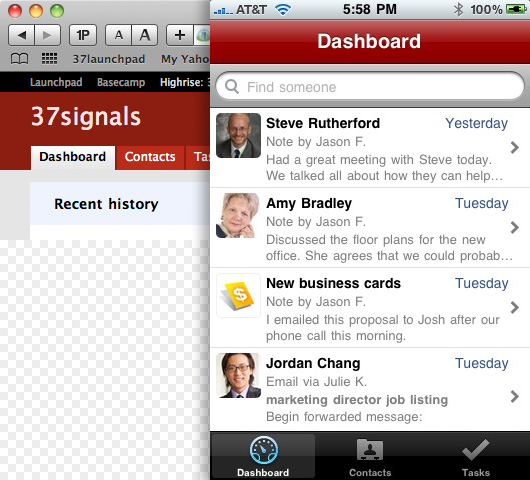
    Last year we decided to embark on designing our own iPhone app for Highrise. We picked Highrise because there were already some good options for Basecamp, and Campfire was well represented by the wonderful Ember. We thought about Backpack and Highrise and decided to go with Highrise.

    Our Highrise customers have been letting us know they weren’t satisfied with the existing iPhone apps for Highrise. We agreed. We wanted the Highrise experience to be great on the desktop and the iPhone.

    We dialed up our friends at Overcommitted — the people behind Ember — and asked them if they’d develop a Highrise app for us. It would be an official 37signals product. They said yes. They set up a Basecamp project, invited us in, and we got started.

    Which features?

    We decided to keep version 1.0 as simple as possible. We focused on contacts and tasks. We left deals and cases out of version 1.0. Those will come later.

    We went through a bunch of iterations, UI ideas, layout experimentations, and functionality explorations. We hope to share some of these in a future post. There are some good lessons in there.

    Fundamentally we wanted 1.0 to be solid, simple, and searchable. A tool to quickly access your business contacts, leads, tasks, and conversations wherever you are. We also wanted it to be fast so we decided to download all your contacts, tasks, and recent notes/emails to your phone so you had a local database. This way we could reduce network usage and make everything pretty snappy.

    Making setup satisfying

    When you launch Highrise for iPhone for the first time it will download all your contacts and tasks to your phone. It doesn’t replace your iPhone address book – it just pulls the contacts down into the Highrise database so everything is local and fast.

    One of the downsides to the initial download is that it can take some time depending on your connection and the number of contacts you have. Waiting for anything sucks, but what sucks more is being bored while waiting.

    So we decided to give you something to do while the initial download is in progress. You can play tic-tac-toe while you wait. Just tap the button and the screen flips to a tic-tac-toe board. The download progress bar remains at the bottom so you see where you are while you tap away your time trying to beat the computer.


    Contact search everywhere

    This is a quick one, but we wanted to make sure that you could get to any contact from just about every screen in the Highrise iPhone app. So you’ll find a search contacts field at the top of all major screens. Sometimes we hide it to maximize screen space, but just scroll up and you’ll find it.

    Color schemes

    There are obviously more important features than this one, but we thought it would be fun to point it out. Highrise lets you pick from a variety of color schemes. We wanted to bring that color into Highrise for iPhone. So every time you launch Highrise for iPhone we pick the color from your Highrise account and color the main bar at the top of Highrise for iPhone. Below you’ll find an example in green and one in red. The image on the left is Highrise the web app, the image on the right is the iPhone app.


    Voice notes

    Since we’re talking about an app for a phone, we might as well take advantage of voice. Highrise for iPhone lets you record voice notes for any of your contacts. Voice notes are uploaded to your Highrise account and playable with an embedded audio player in the Highrise web app. Transcription may be an option down the road.

    File attachments

    Lastly, Highrise for iPhone lets you view any file types that the iPhone natively supports. This means you can view PDF, DOC, XLS, and other file types that are attached to notes or emails right from the app.

    We hope you love it

    We’re thrilled to finally release version 1.0 of the Highrise iPhone app. We hope you love it. Thanks again for using Highrise.

  • Smart Phone Motion Control Patented; Held By Shell Company

    Aubrey Wells was the first of a lot of folks to send over John Paczkowski’s excellent analysis of a highly questionable patent that was issued recently concerning motion control on a smartphone. The patent (7,679,604) is incredibly broad, and appears to cover technology that is in use in many current devices. What’s odd, however, is that the inventors on the patent appear to be Google and Apple engineers, but the patent itself appears to be held by a shell company, of which there is little available information. This suggests (though, it’s not definite) that it’s a typical patent litigation setup. It’s pretty common for patent holders to set up shell companies to sue others with — in part because it allows them to hide who’s really behind the patent, and who’s funding the litigation. No lawsuits have been filed yet, as far as we know, but with a patent so broad, it seems likely that we’ll see something soon.

    Of course, this is the same old story. The idea behind motion sensing in a mobile device is hardly a new or non-obvious idea — the problem was really just that the hardware wasn’t there yet. There were, certainly, other motion sensing technology out there, and there is absolutely nothing in this patent that furthered the art. This sort of interface was coming whether or not it was patented. But that’s what happens with so many patents these days — the focus is on patenting the obvious and then suing everyone who implemented it.

    Update: Hmm. The plot thickens. There’s some evidence that this may be one of Intellectual Ventures 1000+ shell companies. The shell company discussed here, Durham Logistics, is apparently owned by Memscom LLC, according to the Nevada corporations listings. Memscom’s address is the identical address (suite and all) to an Intellectual Ventures office. Could be a coincidence… but… certainly there’s some evidence that this patent is held or controlled by Intellectual Ventures. Why is IV controlling a patent created by Google and Apple inventors?

    Update 2: Thanks to some sleuthing in our comments and various others via email, it looks like the engineers in question both worked at Arraycomm back in the day when this patent was filed, but Arraycomm dumped some of its patent portfolio along the way, and somehow or another, this patent appears to have ended up with this company — almost certainly a part of Intellectual Ventures. Notice how far this patent is from any actual innovation. This is not how the system is supposed to work.

    Permalink | Comments | Email This Story


  • Yahoo Messenger Gets Delicious Bookmarking

    Yahoo is announcing an interesting, new feature in Yahoo Messenger, Delicious bookmarks integration. The feature has been in testing and has now been rolled out to Yahoo Messenger users. It allows them to easily save a link they receive in an IM conversation using Delicious and even share it with the world.

    “This week we launched a new int… (read more)

  • Honda Fit in Europe (Jazz) gets Si package, no power upgrades

    We’re huge fans of the Honda Fit here at egmCarTech and always felt it looked a lot better than the Toyota Yaris or the Nissan Versa. However, we always wished Honda would do a high-performance of the subcompact Fit with aggressive body kit upgrades and a more powerful engine.

    Well, they did… kind of. Meet the European Honda Jazz Si – it comes with enhanced looks, a stylish exterior, a set of hot wheels and an ‘Si’ badge on the back. What it doesn’t come with is engine upgrades.

    Click here to get prices on the 2010 Honda Fit.

    Basically, if buyers want a more spicier looking Honda Fit/Jazz, they can go for the Si appearance package, which is available on the 1.2L or 1.4L model.

    Make the jump for the press release.

    2010 Honda Jazz Si:

    Press Release:

    SPORTY-LOOK HIGH-SPEC JAZZ Si LAUNCHED

    Honda (UK) is introducing a sporty Si grade of its popular British-built supermini – the Jazz. The Jazz Si’s enhanced looks and stylish extra features should appeal to younger drivers who want their car to stand out from the crowd.

    The Si option will be available across the Jazz model range – which first went on sale in 2008. The Si grade tops the 1.2-litre range, with features over and above the SE specification. In 1.4-litre Jazz models, the Si sits mid range, with specification over and above ES models. The Si is only available with a manual transmission.

    The Jazz Si wears 16-inch Chronos alloys which set it apart from standard models. A chrome sports front grille and rear spoiler add to the sporty look. Stylish embroidered carpet mats and Si branding on the boot lid and glove box highlight the car’s high specification.

    Customer feedback showed that younger Jazz owners were keen to stand out from the large number of other Jazz cars on the road. They preferred bigger wheels and enjoyed the additional stylish touches of the first generation Jazz Sport.

    The Si grade has been launched in response to this, and combines sporty good looks with the Jazz’s fuel-sipping engine, low running costs, low emissions, value for money specification and C-sector space and practicality.

    The Jazz is one of the UK’s most celebrated models, winning around 30 industry awards for reliability and customer satisfaction. Now built in Britain, Honda Associates will be ensuring that the Jazz maintains this level and continues to delight customers.

    The Si grade is priced at an additional £870 over the 1.2 SE and 1.4 ES models, but offers nearly £2,000 worth of extra equipment.

    Jazz 1.2-litre Si £12,835 on-the-road
    Jazz 1.4-litre Si £13,510 on-the-road

    The Jazz Si goes on sale from 1 April, 2010 with a choice of really competitive finance offers for customers.

    Both the 1.2 and 1.4 Si models launch with great PCP packages offering an APR of 5.9% over three years with a 25% deposit, or for 7.4% over three years with a 10 per cent deposit.

    Si family
    The Si grade was introduced to the Civic 5 door range in September 2009, providing sportier looks for the futuristic family hatchback. Civic Si variants feature colour-coded bumpers, front fog lights, a Type R-style mesh front grille and dark chrome door handles and fuel cap. 1.4-litre models wear Graphite coloured 16-inch alloy wheels while the higher-powered 1.8-litre petrol and 2.2-litre diesel Si-grade Civics sit on 17-inch Graphite coloured alloy rims. Inside, Si models get half leather upholstery to continue the sports theme, plus a USB port for iPod connectivity.

    The Civic 1.4-litre Si is priced at £16,495 on-the-road (OTR). The 1.8-litre petrol and 2.2-litre diesel are priced at £17,565 (OTR) and £19,070 (OTR), respectively.

    – By: Kap Shah


  • There’s a lot of Mai Shiranui in King of Fighters XIII

    There were rumors (qjnet/playstation-3/rumor-k-mai-shiranui-included-in-king-of-fighters-xii-home-versions.html), there came the console-exclusive characters (qjnet/playstation-3/king-of-fighters-xii-home-console-exclusive-fighters-revealed.html), but Mai Shiranui just didn’t make it to King of Fighters XII. For some reason, SNK had some no-jiggle policy in place. Thankfully though, the jiggling returns

  • What It Looks Like When The Bond Market Vomits

    We noted yesterday the Treasury’s weak auction, but this chart from Waverly Advisors puts yesterday’s sell-off in the 10-year into perspective.

    chart

    Meanwhile, Mike O’Rourke of BTIG has some excellent thoughts on what it means that of late, the US government is now paying more for debt that blue-chip names like Warren Buffett:

    In his note this morning, Gross listed the three criteria necessary for a nation to navigate the “structural headwinds” facing global markets today.  When speaking specifically about the United States, he stated “But remember – my three conditions just suggest that a country can get out of a debt crisis by creating more debt – they don’t assert that the bonds will be a good investment.”  He followed with “U.S. bonds may simply be a ‘less poor’ choice of alternatives.” From an outsider’s perspective, that might be interpreted as bearish a statement on Treasuries as one can expect from the largest bond investor in the world.  We also believe that Gross does not love stocks so much, but just that he is bearish on bonds.  Gross did spell it out, “Rates face a future bear market as central banks eventually normalize QE policies and 0% yields if global reflation is successful.”

    There is heightened investor uncertainty about the inversion of the 10 year swap spread.  Unchartered territory puts investors on edge.  In the near term, it has been attributed to hedgers using treasuries for all of the corporate issuances coming to market.  We have also noted the strong demand for corporate paper has helped to push those yields down.  Longer term, Pimco’s “Unicredit Bond Market” will likely be with us for some time.  The good thing is this is not a total surprise, at least it wasn’t to Gross.

      We interpret these events as one of an increased belief in the recovery.  For over a year, we have argued that Large Cap Corporate America was the healthiest and most liquid area of the economy, superior to the Government or Consumers.  As belief in the recovery increases, the flight to quality bid in Treasuries slowly diminishes and Pimco’s “Unicredit” world emerges. Investors have every reason to have more confidence in a Warren Buffett or a Steve Ballmer.  All of this being said, in order for the bond bear market to emerge and the rise in rates to be sustainable, the economic data needs to be there, or that flight to quality bid will re-emerge.

    Join the conversation about this story »

  • Go Daddy Will No Longer Sell .cn Chinese Domain Names

    It didn’t take long for Google’s decision to drop censorship in China to be followed by others, like Google Co-founder Sergey Brin has been urging. GoDaddy, the world’s biggest domain-name register, has announced that it will no longer be offering .cn domain names. The company is trying to set itself apart from Google’s move, but the timing is… (read more)

  • NASA projects 2010 will (likely) be the hottest year by Andrew Freeman, Washington Post

    Article Tags: 2010 Forecast, NASA

    article image

    Global surface temperature anomalies relative to 1951-1980 mean for (a) annual and 5-year running means through 2009, and (b) 12-month running mean through February 2010. Credit: NASA GISS.

    The headline to this post may surprise many Washingtonians who are still thawing out from the cold and historically snowy winter. However, not only does a new NASA draft analysis predict that 2010 will likely set a new global temperature record, but it also projects that it is “virtually certain” that a new 12-month running mean global temperature record will occur sometime this year.

    Wait a second, you may say. That doesn’t make sense, given the relentless cold thus far in 2010 (at least until the past two weeks), not only in Washington, but also throughout Europe and parts of Asia.

    So, where is this forecast coming from?

    Click source to read FULL report by Andrew Freeman

    Source: voices.washingtonpost.com

    Read in full with comments »   


  • Morre Don Frey, padrinho do Mustang

    Um dos padrinhos do Ford Mustang original, Donald Frey, morreu no dia 5 de março aos 86 anos em Chicago após sofrer um acidente vascular cerebral no qual não resistiu. Frey é considerado padrinho do carro juntamente com Lee Iacocca e estabeleceu uma carreira como CEO da Bell & Howell após sair da Ford em 1968.

    Após conquistar um doutorado em engenharia metalúrgica na Universidade de Michigan, ele entrou na indústria automobilística em 1950. Trabalhando como planejador sênior na década de 60, Frey e seu grupo de trabalho precisavam desenvolver um carro esportivo para a Ford, e para economizar custos, o carro foi construido pela plataforma do Ford Falcon.

    Assim que o Mustang foi criado, o chefe da divisão Lee Iacocca lançou o carro no mercado em abril de 1964 na Feira Mundial de Nova York e até hoje pernamece em produção com muitos fãs ao redor do mundo. Mais uma mente brilhante que se vai, deixando a indústria automobilística com um brilho a menos na história.

    Via | Inside Line


  • 2010 Subaru Tribeca recalled for defective door latches

    Filed under: , , ,

    2010 Subaru Tribeca – Click above for high-res image gallery

    Subaru has issued a recall for 1,585 2010 Subaru Tribecas for mispositioned door latches. Apparently, during production some door latch cables were installed improperly, so that when the window is rolled down the cable might catch in the door glass regulator, and that will open the door. The recall has begun and Subaru dealers will fix both latches for free. If you are one of the affected, you can find the full report from the National Highway Traffic Safety Administration after the jump.

    [Source: NHTSA]

    Continue reading 2010 Subaru Tribeca recalled for defective door latches

    2010 Subaru Tribeca recalled for defective door latches originally appeared on Autoblog on Thu, 25 Mar 2010 07:58:00 EST. Please see our terms for use of feeds.

    Read | Permalink | Email this | Comments

  • Morgan Stanley’s Huge Call On The Interest Rates And The Dollar

    Goldman Sachs (GS) doesn’t see a Fed rate hike for a long time.

    Morgan Stanley (MS) on the other hand stands out for being on the other side of the spectrum.

    Take a look at the firm’s projecitons for EU and US rate hikes, and it should become clear pretty quickly (if they’re correct) why the Euro is in for so much pain.

    chart

    chart

    Join the conversation about this story »

  • Bad Things Happen When Politicians Think They Understand Technology

    With health care reform out of the way, lots of politicians are pushing out new legislative ideas, hoping that Congress can now focus on other issues — so we’re seeing lots of bad legislation proposed. Let’s do a two for one post, highlighting two questionable bills that many of you have been submitting. The first, proposed by Senators Schumer and Graham, is technically about immigration reform, which is needed, but what’s scary is that the plan includes yet another plan for a national ID card. Didn’t we just go through this with Real ID, which was rejected by the states? Jim Harper, who follows this particular issue more than just about anyone, has an excellent breakdown of the proposal, questioning what good a national ID does, while also pointing to the potential harm of such a plan.

    Then we have the big cybercrime bill put forth by Senators Hatch and Gillibrand Senators Rockefeller and Snowe (updated, since there are two separate cybersecurity bills, and its the Rockefeller/Snowe one that has people scared), that tries to deal with the “serious threat of cybercrime.” But, of course, it already has tech companies worried about the unintended consequences, especially when it requires complying with gov’t-issued security practices that likely won’t keep up with what’s actually needed:


    “Despite all [the] best efforts, we do have concerns regarding whether government can rapidly recognize best practices without defaulting to a one-size-fits all approach,” they wrote.

    “The NIST-based requirements framework in the bill, coupled with government procurement requirements, if not clarified, could have the unintended effect of hindering the development and use of cutting-edge technologies, products, and services, even for those that would protect our critical information infrastructure.”

    They added the bill might impose a bureaucratic employee-certification program on companies or give the president the authority to mandate security practices.

    This is one of those bills that sounds good for the headlines (cybercrime is bad, we need to stop it), but has the opposite effect in reality: setting up needless “standards” that actually prevent good security practices. It’s bills like both of these that remind us that technologically illiterate politicians making technology policy will do funky things, assuming that technology works with some sort of magic.

    Permalink | Comments | Email This Story


  • La FIA podría sancionar a USF1

    Podriamos decir que la FIA sigue muy cabreada con el caso de USF1 durante la pasada pretemporada y es que a nadie le gusta que le mientan. Todos recordamos la presentación de USF1, un supuesto equipo ya consolidado y listo para rondar en este campeonato.

    USF1

    Tras esto, la FIA podría estar discutiendo la posibilidad de multar al equipo norteamericano y de esta manera impedir que puedan volver a presentarse en el proceso de selección de nuevas escuderías para el año 2011.

    Por el momento, ni Jean Todt ni los máximos responsables de USF1 se han pronunciado al respecto asi que os mantendremos informados en caso de ocurrir alguna novedad sobre este caso.

    Related posts:

    1. Campos Meta podría fusionarse con USF1
    2. USF1 podría no estar presente en la temporada 2010
    3. Jose María López podría firmar su contrato con USF1 en breve
  • Shutting down computers overnight will save Ford more than $1.2 million

    FoMoCo isn’t only working on making its products go green – the company is also committed to energy efficiency and saving money at the office. Under a new program called PC Power Management, Ford will start asking its users to shutdown their computer systems overnight and on the weekends to further reduce energy.

    “At the same time, the system ensures all computers connected to the Ford Intranet are awake and able to receive software deliveries during off hours, decreasing downtime during working hours due to software loads,” Ford said in a statement.

    Ford says that the savings by powering down the computers not in use will top $1.2 million annually when the system is fully implemented. “By reducing PC power consumption, Ford also stands to reduce its carbon footprint by an estimated 16,000 to 25,000 metric tons annually,” Ford said.

    “In the past, as many as 60 percent of Ford’s PC users haven’t shut their PCs off at the end of the business day, resulting in wasted energy,” said Keith Forte, Ford IT project supervisor. “Going forward, we’ll be able to manage PC power consumption more efficiently while minimizing interruptions during the working day as a result of software updates.”

    PC Power Management will be rolled out to Ford computer systems across the U.S. this month and will be migrated to Ford operations around the world later in the year.

    – By: Omar Rana