Author: Serkadis

  • Four degrees warming in 2050? Oops, you used the wrong dataset, ClimateGate.NL

    Article Tags: ClimateGate

    Image Attachment

    There is an English saying that you have “lies, damned lies and statistics”. Here, I would like to introduce a variation on this expression: “There are lies, damned lies, statistics … and sloppy science”.

    This morning, there was lot of noise in the Dutch media (unfortunately in Dutch only) about new research that was claiming a dramatic warming of 4 degrees in 2050. The news report quoted Dutch econometricians from the University of Tilburg. They had done a statistical analysis of temperature data and the influence of CO2 and solar radiation and concluded that aerosols masked much more of the warming of greenhouse gases than previously thought. This also means there is more warming in the pipeline for the future if the trend of global brightening, that has been detected by researcher Martin Wild of ETH in Zürich, will continue in the coming decades. They also draw policy conclusions from their research stating that in order to avoid more than 2 degree warming more drastic measures are to be taken.

    This news was copied by many Dutch news outlets.

    Click source to read more

    Source: climategate.nl

    Read in full with comments »   


  • Google Dominates Search, Bing and Yahoo Continue to Exchange Market Share

    The search market has been remarkably stable in the US and worldwide for the past few months and the trends are keeping steady. Google dominates and slowly inches forward or manages to maintain its market share, while Microsoft’s Bing nibbles away at Yahoo Search. Nine months after launch, according to comScore’s measureme… (read more)

  • Care and Support Conference report published

    Care and Support Conference

    On the 19 February 2010 the Secretary of State for Health,  the Rt Hon Andy Burnham MP, invited key stakeholders from the Care and Support Alliance and a number of other organisations, including political parties, to attend the Care and Support Conference.

    These key voices in the care and support world discussed the issues facing the care and support system, to give their views to national and local politicians.

    It was a helpful, broad ranging, high level discussion that helped to build consensus towards a White Paper. 

    The Central Office of Information (COI) facilitated the event, and has produced a report on behalf of the Department of Health.

    The report is a summary of the event and summarises views given by attendees.

    You can read the report here.

  • Cisco Unveils New Monster Router

    Cisco’s much-hyped announcement is finally out and it looks like the big words were warranted, this thing will indeed “forever change the Internet.” Or, then again, probably not. It’s just a router, very surprising given that it’s coming from Cisco, granted, but a router nonetheless. Actually a ‘router system’ and a behemoth, at that. The Cisco CRS-3 Carrier Rou… (read more)

  • Passport Cost Increase

    Now that the east coast has finally started to warm up, the sun is shining, birds are chirping…allow me to bring some gloom and doom to passportyour day. It looks like the cost of obtaining / renewing a passport is going to go up.

    The State Department is proposing a fee hike that would raise the cost of applying for a passport from $100 to $135, and renewal cost would increase to $110 from the current $75.

    The reason? The State Department says that the costs of increased security and anti-fraud and terrorism measures aren’t being covered by the current fees.

    Besides this just seeming like yet another rising cost that is annoying to deal with, some lawmakers worry that overall it will hurt the tourism industry- particularly to neighboring countries of Canada and Mexico. They worry that the increased burden will deter Americans from traveling and in turn, continue to hurt the economy.

    While the increase is not yet final, it could be in effect by April. The State Department suggests applying for your passport now if you are planning international travel, as a rush of applications are expected in the wake of this news.

    Do you have an alternative idea to cover security costs? Do you mind paying the higher fee?

  • AutoblogGreen for 03.10.10

    eBay find of the Day: all-electric 1966 Chevrolet Corvair Corsa conversion
    So close to awesome.
    Report: Feds probing Prius’ unintended acceleration incident, no new recall issued
    One car in California is causing a lot of problems.
    Report: Nissan has 56,000 pre-orders for all-electric Leaf
    Or something.
    Other news:

    AutoblogGreen for 03.10.10 originally appeared on Autoblog on Wed, 10 Mar 2010 05:54:00 EST. Please see our terms for use of feeds.

    Read | Permalink | Email this | Comments

  • Former EC President Prodi: The Greece Problem Is “Completely Settled” (Now Help Us Pick What’s Next!)

    We said it Friday, and then reiterated it Monday, and now Former European Commission President Romano Prodi is saying it, so it must be true.

    The Greek crisis is over.

    In addition, according to Bloomberg, Prodi told Italian TV: “I don’t see any other case now in Europe. I don’t think there is any reason to think the euro system will collapse or will suffer greatly because of Greece.

    Now, participate in our poll.

    Join the conversation about this story »

    See Also:

  • UK Manufacturing In Shock Plunge

    The US gets its share of mixed data, leading to furious debates about whether it’s contracting or expanding, but no country it seems as volatile and hard to read right now as the UK. Some think it’s fine; some think it’s the next Iceland.

    The latest bit of data pushes it closer to the latter.

    Bloomberg:

    U.K. factory production unexpectedly fell in January for the first time in five months, a sign manufacturing is struggling to shake off the recession.

    Factory output dropped 0.9 percent from December, the Office for National Statistics said today in London. Economists predicted a 0.2 percent increase, according to the median of 26 forecasts in a Bloomberg News survey. Manufacturing expanded 0.2 percent from a year earlier, the first gain in almost two years.

    We’re certainly not going to give you any bonus points for guessing what the pound is doing today.

    That’s right, it’s puking, as this only ratchets up the great competitive devaluation war, Nothing makes a nation want to print more of its own currency than a drop in factory output.

    chart

    Join the conversation about this story »

    See Also:

  • Twitter Defamation Lawsuit Dismissed, As Tweets Were Considered Too Vague

    Last year, we wrote about how a property management firm in Illinois, Horizon Group Management, had sued a tenant for defamation over a short Twitter message she sent, claiming:


    “Who said sleeping in a moldy apartment was bad for you? Horizon realty thinks it’s okay.”

    The woman had a grand total of 20 followers at the time, so it wasn’t like this was likely to have a huge negative impact on the company. Still, what was impressive was how Horizon defended its decision to sue, saying:


    “We’re a sue first, ask questions later kind of an organization.”

    That seemed rather obvious, given that by filing the lawsuit, the company brought a lot more attention to the fact that some of its tenants were unhappy. And, even worse, the lawsuit has gone nowhere. Dark Helmet alerts us to the news that the lawsuit has been dismissed as the comments were considered “too vague” and didn’t meet the qualifications to be considered libelous. This doesn’t mean that there can’t be defamation via Twitter, so if you’re going to defame someone, at least be vague about it in your 140 characters.

    Permalink | Comments | Email This Story


  • Google Launches Apps Marketplace

    The rumored Google Apps Marketplace is now official and live with more than 50 companies signed as partners at launch. The Marketplace is an online repository and application store for any third-party developer offering a cloud app with some sort of integration with Google Apps. There are apps available in a variety of categories, some free, some paid for, and t… (read more)

  • Economists Slash America’s Post-Stimulus GDP Growth

    barack obama president

    Economist surveyed by Blue Chip Economic Indicators have cut their U.S. 2011 GDP forecasts to 3%, down from 3.1% previously.

    Yet government stimulus is causing them to hike forecasts for this year. Economists from the survey now expect 3.1% GDP growth for 2010.

    Reuters:

    The consensus also expects inventories to continue adding to GDP over the next several quarters but see the size of those contributions become increasingly smaller.

    “By Q1 2011, the contribution to GDP from business inventories is expected to become trivial,” the survey said.

    Thing is, 3% GDP growth isn’t all that bad considering what the U.S. has gone through. If these forecasts prove correct, we’ll take the 3% growth and be happy. We bet markets would be as well. Especially if 2012 can deliver another 3%, since medium term U.S. growth is a key uncertainty right now. Read more here >

    Join the conversation about this story »

    See Also:

  • The World’s Largest Trade Distortion Annihilates Expectations

    china chinese mask

    Chinese trade data annihilated analyst expectations for February. Exports grew by a whopping 46% while imports soared 45%.

    China Daily:

    The export gain in February was more than the 38.3 percent median estimate in a Bloomberg News survey of 28 economists. Imports topped a 38 percent estimate and the trade surplus was in line with forecasts.

    Central bank Governor Zhou Xiaochuan said on March 6 that policy makers must be “very cautious” in timing an exit as a world recovery isn’t yet solid. Commerce Minister Chen Deming said the same day that it was too early to say that exports had recovered from the global financial crisis, and that the trade surplus for the past two months combined had contracted by 50 percent.

    While this will only strengthen the case that China’s economic stimulus might be excessive, it’s important to note that China’s trade surplus contracted substantially recently, thus the nation has some political cover to keep the yuan pegged to the dollar as it is. China could easily hike the yuan at any time, but to us this data doesn’t really increase the urgency to do so.

    Join the conversation about this story »

    See Also:

  • That’s not going to help you get into Costa Rica

    Rush JigglesWell, apparently, Rush Limbaugh is getting ticked off he’s no longer the only worm-filled apple in the right-wing paranoid’s eye. No, it’s time to say some stupid sh*t that at least gets you in the news and allows your greek chorus of listeners to shriek “dittos” through their sheets in glee.

    Not content to threaten (promise) to leave America if it enacts slightly less profitable health care, he threatens to leave for a country with a single-payer system. Well, that’s just stupid and pointless, i.e. par for the restricted-golf course.

    But that’s not stupid enough, nor racist enough, for ol’ Flatulence. He’s determined to crank up the stupidity. And who better to take out his frustrations on than a black guy? Speculating about New York Governor David Patterson…

    David Paterson will become the massa…who gets to appoint whoever gets to take Massa’s place. So, for the first time in his life, Paterson’s gonna be a massa. Interesting, interesting.

    “Massa”? Wow, real subtle. KKKlassy even.

    That tripe won’t play well on your immigration paperwork.

    (Gif from here)

  • Asia Gets Dirt Cheap Financing Thanks To Crisis In The West

    Mao Swimming China

    The spread between dollar-denominated Asian bond yields and U.S. treasury yields has collapsed to 2.44% vs. 7.62% in December 2008, as per J.P. Morgan.

    It appears that trouble in the west is making strong Asian corporates look like relative safe havens. Thus investors can earn yields above treasuries while investing in the perceived safety of companies residing within the world’s most promising economic growth region.

    At the same time, Asian corporates get to cash in on dirt cheap financing thanks to ultra-low U.S. interest rates. It’s another example of Western liquidity overflowing into Asia.

    Bloomberg:

    “It’s one of the cheapest times to borrow in U.S. dollars, and at the same time, there’s a lot of cash floating around,” said Rajeev de Mello, head of Asian investment for Western Asset Management Co., which oversees $506 billion. U.S. and European pension funds “want a slice of the action,” De Mello, who is based in Singapore, said in a phone interview.

    Read more here >

    Join the conversation about this story »

    See Also:

  • Pelosi’s Diaspora…The Scattering – Deadline May Be Dead.

    03.10.10 12:33 AM posted by Skip MacLure

    <div class="entry"><div class="snap_preview">I mentioned growing up on a small ranch. As a child I was able to observe the habits of our animals at length. One of the things that fascinated me was watching the sitting hens (a sitting hen was one who was broody and was allowed to hatch chicks) parade their chicks out into the chicken yard for the first time. The chicks would respond to the mother hen’s incessant clucking, keeping in tight order behind her and ready to flee to safety under her at the first hint of danger.

    Nancy Pelosi has been having her own problems keeping her chicks in line as a fractious membership repeatedly attempts to bolt from the nest. Any reference to the Speaker as an old hen is coincidental.

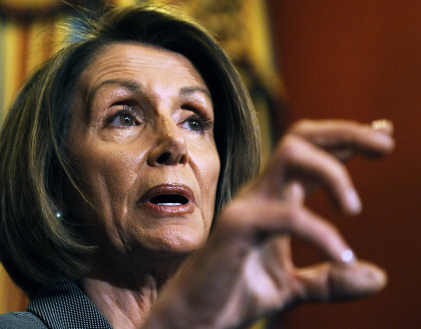
    There is a story out there saying Pelosi is losing her grip, with a picture of a frantic looking Nancy holding up a claw-like hand a la The Wicked Witch Of The West, sans purple skin color. That’s sort of how the whole thing is playing out for the House Madame and the Democrat House right now.

    House members are bolting for good reason. With unremitting pressure from their leadership and the White House on one hand and the growing anger of the country on the other, it’s a thankless position to start with. What is becoming apparent is that despite the calls from the leadership and the proclamations from the White House to sacrifice careers, at this point the votes just aren’t there. read more &raquo;

    http://www.conservativeoutpost.com/p…ne_may_be_dead

  • Romney Declares Obamacare ‘Makes no sense at all”


    Mitt Romney has positioned himself as the de facto leader of the opposition and certainly plans to make another successful run for the presidency.  He always was clearly capable and appears to have a mature agenda and also good instincts.
    I am impressed that he came out and spoke well of Palin.  He did not have to and like most others who call themselves Republicans, could have simply left her hanging out there in the wind.
    Also Romney is the only American politician who has provided his State with universal healthcare.  He is right.  Why is it so difficult for anyone to listen to him on this issue?
    The History of the American presidency has often been strewn with able people unable to attract enough popular support to take the prize.  Sometimes the people are right.  Sometimes it is opportunity lost.  Yet all democratic systems have this feature, however, the parliamentary system has the strength of keeping such individuals close at hand and well occupied.
    I suspect that the next administration will include Mitt Romney in some role and the knowledge exists to put the US economic ship back in order.  My fear today is over the continuing weakness and the total avoidance of the mortgage problem.  It will not be much better in three years without action today.
    The Democrat health care project somehow manages to take the present system that is already gobbling a larger piece of the national economy than any other and make it more expensive in order to make it sort of inclusive.  This is known as the worst possible outcome solution that can only be fathered by direct and indirect bribery.  I look forward to seeing who will stand up in order to refute my assertions.
    That is the problem isn’t it?  The buying of the elected has become so Byzantine as to be opaque to rational scrutiny.  The elected are now powerless to stop it.  Instead we get Obamacare which I am sure bears little resemblance to the president’s intent.
    It is little wonder that the tea party movement has taken off and will bring continuous pressure on the elected to live up to their oath of office.  It is easily done you know.  You simply refuse to meet with any lobbiest whatsoever unless specifically invited and in camera and on the record.  It will not stop back room fixing, but then at least it is clearly a criminal endeavor.
    Romney: Obama’s Healthcare Plan ‘Makes No Sense at All’
    Monday, 08 Mar 2010 07:13 PM

    By: Jim Meyers


    Former Massachusetts governor and 2008 Republican presidential candidate Mitt Romney tells Newsmax that America needs to change course or face the “unthinkable consequences” of its decline.

    He also asserts that President Obama’s policies have extended and deepened the recession, says his healthcare reform plan “makes no sense at all,” and declares that Sarah Palin is definitely qualified to become president.

    Romney has a new book out, “No Apology: The Case for American Greatness,” offering a dramatic new blueprint for the nation to confront our most critical issues. He dropped by Newsmax’s office to discuss a wide range of issues, including the economy, the stimulus package, government bailouts, healthcare, John McCain, and the tea party movement.

    Romney served as governor from 2003 until 2007. A successful businessman, he also was president and CEO of the committee that organized the 2002 Winter Olympics in Salt Lake City, and is considered a front-runner for the GOP presidential nomination in 2012.


    Romney tells Newsmax.TV about “No Apology”:

    “This is a book about what I have seen as a result of my years in the business world, some 25 years, traveling a good deal overseas, and my recognition that what is happening internationally very much threatens America’s economic lead and ultimately threatens our ability to preserve freedom and promote liberty around the world. 

    “So I have described the fact that America needs to remain strong, that we need to stop apologizing for who we are and acknowledge that what we have and what we have done has lifted the world out of poverty and has also provided liberty to million, billions of people.

    “We need to shore up the bases of our strength. If we don’t, we could find ourselves passed by China or by others. And the consequences of America following the same path of decline that other great nations have in the past are really unthinkable.”

    Romney says the economy will recover from the recession, as it always does. But he maintains that the $787 billion stimulus package has not been as effective as it could have been, and Obama’s actions during his first year in office “had the effect of extending the recession and deepening the recession.”

    Romney cites Obama’s claim that, if the stimulus passed, it would hold unemployment at 8 percent, and if not, unemployment would rise to 10 percent. 

    “Well, it got to 10 percent and we still have $787 billion we’ve got to pay back to the people we borrowed it from,” he says, adding that America has become “increasingly vulnerable as a result of our overspending.”

    While Massachusetts governor, Romney put in place healthcare reform that has provided all state residents with healthcare insurance. That plan has some similarities with President Obama’s healthcare plan, “but some very big differences,” he says.

    He points out that Massachusetts did not raise taxes to pay for the plan, while Obama’s plan would. Obama would cut Medicare, while Massachusetts did not. Obama has sought the power to put price controls in place, but Massachusetts did not. 

    “Ours is a state-based plan,” he says.

    “We took responsibility for dealing with an issue and we solved it our own way. States should be allowed to approach their care for the poor in the way they think best, rather than have President Obama and Nancy Pelosi and Harry Reid apply a one-size-fits-all plan for the entire country.

    “The way President Obama has gone about it makes no sense at all.”

    Turning to foreign policy, Romney tells Newsmax.TV that Obama “was simply wrong to go across the world as the new president of the United States establishing who he was by, if you will, distancing himself from the United States of America.

    “He said the United States has been dismissive of other nations, derisive; we don’t listen to the concerns of other nations; we’ve dictated to other nations. He’s wrong. America has freed other nations from dictators.”

    Romney criticizes Obama for canceling plans for a missile defense system in Poland and the Czech Republic, and for speaking out against Israel at the United Nations. 

    But he says he is pleased that Obama reversed course on Iraq.

    “As the candidate who I believe was the most anti-war candidate among the Democratic contenders, and who promised to pull our troops out immediately, he has instead adopted President Bush’s strategy in Iraq. Thank heavens. That’s the right course. 

    “He voted against the surge in Iraq. He said it wouldn’t work. In Afghanistan he’s now applying the surge. I appreciate that as well.
    “So he’s done some things well, some things not so well. But where he’s done well is where he’s adopted the policies and positions of Senator McCain and President Bush.”

    Other highlights of the Newsmax interview:
    ·                     Romney says he’s not sure Sarah Palin will run for president in the future, but asserts that she is qualified for that role and says she “has brought a great deal of energy and passion to our party.”
    ·                     Romney disagrees with Rush Limbaugh’s claim that he erred in backing Sen. John McCain in his re-election campaign in Arizona against a more conservative GOP candidate, citing McCain’s “wisdom and judgment” and adding that McCain has the better chance to win the general election.
    ·                     Obama’s plan of allowing the Bush tax cuts to expire at the beginning of next year is really “a new tax hike, a substantial tax hike on people who pay a lot of taxes,” Romney says. It will encourage Americans to sell assets this year ahead of the hike, he explains, resulting in “a lot of excess revenues this year.” But the year after “will be pretty tough for the government.”
    ·                      Asked about TARP bailouts, Romney says businesses that get in trouble should be allowed to fail, as long as that doesn’t lead to a collapse of the financial system. So Bush’s move to put TARP in place to prevent a collapse was “the right thing to do… At this stage, it has done its job,” he adds. “It should be stopped and the funds that remain in TARP and are paid back to TARP should be used to pay down our debt and to reduce our spending.”
    ·                     The tea party movement will have a serious impact on the November elections, according to Romney.“I’m really pleased that the silent majority is silent no longer,” he declares. But he cautions that if a conservative tea party candidate runs in a general election, that would siphon votes away from a Republican candidate, and “divide and fail is the result. “That would hand over the country to Barack Obama and Nancy Pelosi and Harry Reid, and that would be very sad indeed.” Romney hopes that tea party candidates will instead run in primaries, and if they lose will back the more conservative candidate in the general election.
    ·                     Libertarians such as Ron Paul have an influence on the GOP, and “we welcome his participation in our party,” Romney says. “We’re a big-tent party.”
    ·                     “Liberals like President Obama believe that, if there’s a problem in our country, if some aspect of our economy is having some difficulties, the right course is to have government play a more active role, really to have government take it over and run it,” Romney says. “That’s a course that I think is entirely wrong. If there’s an area in the economy that’s not working well, the right course is typically to say, How do you get government out of it? How do you make it work more like a market?”
    ·                     Discussing the race for the U.S. Senate seat from Florida between Gov. Charlie Crist and former House Speaker Marco Rubio, Romney says: “I like both of those individuals. I haven’t decided whether to endorse one or the other or neither, but I hope whoever wins the primary is able carry on very effectively in the general election.
    “We need more Republican senators in Washington very badly right now.”
  • Warren Buffett Paying Top Dollar To Tap Baby Boomer’s Wine Binge

    warren-buffett-012010

    Looks like Warren Buffett is bullish about U.S. wine. He’s buying a niche wine distribution company and it looks like he payed up to get it:

    Wine and Spirits Daily:

    …a subsidiary of Warren Buffett’s Berkshire Hathaway has struck a deal to purchase Atlanta-based Empire Distributing, which has operations in Georgia and North Carolina. Empire is owned by brothers David and Michael Kahn.

    We told you yesterday that Buffett likely paid top dollar since Georgia is a franchise state.

    This could be the reason:

    Nielsen analyzed the shopping habits of four key generations – greatest generation (aged 64+), boomers (45-63), gen x (33-44) and millennials (15-32) – and gave a rundown on what marketers should expect when targeting these groups. Interestingly, wine is one of the largest spending categories for seniors at $124 per year. Boomers spend $125 per year on wine, while gen x spends $78 and millennials spend $61 annually.

    Read more here >

    Join the conversation about this story »

    See Also:

  • Maringa Water Clarification


    The Maringa tree seed is apparently an excellent water clarifier.  This is rather important since the tree can be grown almost everywhere water potability is a problem.  It is also useful in other ways as I have posted on before.  Google this blog for other material.
    What interests me is that fouled water can be used if the actual charge of biota is fairly low.  We are used to using sterilizers and producing a pure product.  This is all very good but often impossible in practice when the job is to filter out as much as possible and then to rely on the body to sponge up the stragglers. 
    This is not perfect, but it is also how the body actually works in natural conditions. 
    This makes the use of the Maringa seed a huge boon to most of the populations living in regions the tree prospers.
    Chemical tablets typically fail to actually eliminate turbidity, thus this is a much better solution for most surface water that is available.  An obvious trick for the well equipped would be to prepare a tank of river water or whatever is available with the seed to provide a first cleanse and then perhaps put in a small tab of chemical based sterilizer at a lower than indicated level to provided safe and potable water.
    Worlds Most Usefull Tree Provides Low-Cost Water Purification
    by Staff Writers

    Washington DC (SPX) Mar 08, 2010


    Moringa tree seeds, when crushed into powder, can be used as a water-soluble extract in suspension, resulting in an effective natural clarification agent for highly turbid and untreated pathogenic surface water. As well as improving drinkability, this technique reduces water turbidity (cloudiness) making the result aesthetically as well as microbiologically more acceptable for human consumption.
    A low-cost water purification technique published in Current Protocols in Microbiology could help drastically reduce the incidence of waterborne disease in the developing world.

    The procedure, which uses seeds from the Moringa oleifera tree, can produce a 90.00% to 99.99% bacterial reduction in previously untreated water, and has been made free to download as part of access programs under John Wiley and Sons’ Corporate Citizenship Initiative.

    A billion people across Asia, Africa, and Latin America are estimated to rely on untreated surface water sources for their daily water needs. Of these, some two million are thought to die from diseases caught from contaminated water every year, with the majority of these deaths occurring among children under five years of age.

    Michael Lea, a Current Protocols author and a researcher at Clearinghouse, a Canadian organisation dedicated to investigating and implementing low-cost water purification technologies, believes the Moringa oleifera tree could go a long way to providing a solution.

    “Moringa oleifera is a vegetable tree which is grown in Africa, Central and South America, the Indian subcontinent, and South East Asia. It could be considered to be one of the world’s most useful trees,” said Lea.

    “Not only is it drought resistant, it also yields cooking and lighting oil, soil fertilizer, as well as highly nutritious food in the form of its pods, leaves, seeds and flowers. Perhaps most importantly, its seeds can be used to purify drinking water at virtually no cost.”

    Moringa tree seeds, when crushed into powder, can be used as a water-soluble extract in suspension, resulting in an effective natural clarification agent for highly turbid and untreated pathogenic surface water. As well as improving drinkability, this technique reduces water turbidity (cloudiness) making the result aesthetically as well as microbiologically more acceptable for human consumption.

    Despite its live-saving potential, the technique is still not widely known, even in areas where the Moringa is routinely cultivated. It is therefore Lea’s hope that the publication of this technique in a freely available protocol format, a first, will make it easier to disseminate the procedure to the communities that need it.

    “This technique does not represent a total solution to the threat of waterborne disease,” concluded Lea.


    “However, given that the cultivation and use of the Moringa tree can bring benefits in the shape of nutrition and income as well as of far purer water, there is the possibility that thousands of 21st century families could find themselves liberated from what should now be universally seen as19th century causes of death and disease. This is an amazing prospect, and one in which a huge amount of human potential could be released. This is particularly mind-boggling when you think it might all come down to one incredibly useful tree.”
  • Mongolia Micro Finance


    It is always interesting to see a people still able to operate within the confines of their traditional life ways while also finding ways to modernize.  Modernization has now become universal with a few holdouts such as the slave state of North Korea.
    When a nomad has a cell phone, he stops been a nomad.  He is no longer constrained by illiteracy and the limitations of oral traditions.  In practice, the moment a person obtains a cell phone he begins the development of his reading and writing skills naturally.
    This continues to show us that the precepts of micro finance is now reaching into every place on earth.  Combined with the persuasive penetration of the cell phone we have a system that provides modern support for every human being on earth, and it has happened over night in our lifetimes.
    The understanding that all of Africa is now on the rising part of the S curve and also just about every where else that felt left out has allowed us to make a simple prediction.  It is that by 2030 ninety percent of the globe will have a modern developing economy.  Forget about all the problems and lack of infrastructure.  The only thing that matters is communication and access to capital.  The cell and micro finance not only partially solves these problems, it teaches people how to solve these problems.
    It all also provides local organizing ability.  This revolution is now happening from the ground up.
    MAR 2, 2010
    By Beth Ritchey, Kiva Fellows 10th Class, Ulaanbaatar, Mongolia
    Yes, it might be the dead of winter in Mongolia, with temperatures hovering around -30 degrees Fahrenheit, but the loan products here have been turning green. Thanks to the hard work of the Eco Products Team at XacBank in Mongolia, Kiva lenders saw an introduction of 3 new types of personal consumption ‘green loans’ in December 2009:
    • Energy Efficient Stoves
    • Ger (yurt) covers
    • Energy efficient fuel

    Currently around 60% of the population of Ulaanbaatar (the capital of Mongolia) lives in gers (a yurt-like structure heated by a central stove). Pollution is a big problem in Ulaanbaatar, especially in the winter when pollution levels increase substantially due to the extra coal and wood burned in the gers to keep warm. The World Bank estimates that 60% of the pollution in the city during the heating season is attributed to coal burned in the Ger Districts*.

    XacBank recognized this problem and its connection with poverty. Most families spend up to 40% of their incomes, roughly a $140 per month, in the winter time on heating fuel alone. This money most often comes from cuts in nutrition and health budgets*. To address this relationship between pollution and poverty, XacBank started offering new loans to make eco products financially accessible to the residents of the Ger Districts. XacBank currently offers 3 types of green loans for personal consumption: energy efficient stoves, ger covers and energy efficient fuel.

    The energy efficient stoves were developed and tested by GTZ, an international enterprise for sustainable development run by the German Government. The stoves are lined with a type of brick similar to that found in a pottery kiln and are designed to circulate and retain heat for longer periods than traditional stoves. This in turn reduces fuel consumption by more than 60% each month and helps to reduce a family’s air pollution.

    Ger covers are essentially large insulating blankets composed of three separate layers that wrap the entire outside of the ger. The specialized insulation helps to keep heat within the ger and results in a 50% reduction in fuel burned each month. The Ger covering was designed by the United Nations Development Program, but is produced locally in Mongolia. As an additional note, XacBank provided start-up loans to local producers to increase production of both the stove and the ger cover.

    The third XacBank Eco loan is for energy efficient fuel. Borrowers can obtain a loan to buy fuel from producers who create efficient fuels from things like compacted sawdust and gasified coal. The efficient fuels are more expensive than traditional fuels but they have less of a negative impact on the environment by burning longer and producing less carbon output. Overall, the price difference between clean fuels and brown coal is made up through clients using less fuel to achieve the same heating results.

    The majority of XacBank’s green loans are posted in the fall, as Mongolians prepare their gers for winter and stock up on fuel. To date, XacBank has posted 22 green loans on Kiva and plans to do more in the future, so keep an eye out for new eco-loans coming soon! In the meantime you can also check out XacBank’s carbon partnership with yurtcozy which is helping to make the program sustainable.

    *Energy Efficient and Cleaner Heating in Poor, Peri-urban Areas of Ulaanbaatar, World Bank Consultant Summary Report on Activities, October 2008

    This story was originally posted on “Kiva Stories from the Field” on February 23, 2010. Please click here to see the original post.

  • TANZANIA: Weather Changes Turn Farming into Gamble with Nature

    By Denis Gathanju DAR-ES-SALAAM, Mar 10 (IPS) Changes in weather patterns have turned agriculture into a gamble with nature for Tanzanian farmers. Prolonged droughts and floods have made the lives of small-scale farmers, who don’t have access to irrigation, extremely difficult.

    In Tanzania, where the economy is largely driven by agriculture, the largely poor, rural population has become even more vulnerable.

    According to the national Ministry of Agriculture (MoA), agriculture accounts for up to 60 percent of the country’s Gross Domestic Product (GDP). More than 80 percent of the population works in the sector, which makes up 60 percent of the country's exports.

    A 2009 report by the International Institute for Environment and Development (IIED) warns that Tanzania has two decades to adapt its agriculture to climate change or risk major dents in its GDP. Otherwise, GDP loss could amount to one percent within the first 20 years and rise to between 5 and 65 per cent over the next 75 years, says Muyeye Chambwera, who co-authored the report.

    Climate change experts agree that the only way to prevent major economic impact is to change the way agriculture is done.

    "The only way forward is to educate farmers on better farming practices, as most are still using outdated farming methods, while others are practicing farming in areas where rainfall is inadequate," said Marc Baker, executive director of Carbon Tanzania, a non-profit organisation that helps farmers in Arkaria village, 35 kilometres west of Arusha, to adapt to climate change.

    The Tanzanian government has realised it needs to act quickly and initiated a National Adaptation Programme of Action (NAPA) that seeks to reduce green house gas emissions and help small-scale farmers adapt to new agricultural practices and technologies.

    It plans to educate farmers on alternative practices, such as crop rotation, zero grazing and growing of crops that need litlle water, such as millet and sorghum. NAPA also promotes the planting of drought-resistant maize.

    "NAPA’s objective is to enhance the adaptive capacities of vulnerable communities, [s]ince Tanzania’s economy is largely dependent on agriculture […]," confirmed Abubakar Rajabu, permanent secretary in the Office of the Vice President.

    Throughout the country, temperatures are likely to increase between two to four degrees Celsius by 2100, the MoA predicts. This seems a long time away, but it gives an indication that perennial crops, such as maize and beans, will eventually not be able to grow anymore and will have to be replaced with annual crops, such as millet and sorghum.

    The production of maize, Tanzania’s staple food, is expected to drop by a third within the next few decades, because the crop needs lots of water to grow, MoA officials further caution. In the drier, central parts of the country, the maize harvest could even decrease by up to 84 percent.

    Last year’s planting season is a good indicator that the predictions are coming true, perhaps even earlier than expected. Farmers in Iringa province told MoA officials that they harvested between three and five bags of maize per acre of land in 2009. This is a far cry from the average 15 to 18 bags harvested a few years ago.

    Farmers have also observed the effects of changing rainfall patterns. "Maize is no longer doing very well," says Mama Mrema, a small-scale farmer from Arusha. "Now I have turned to growing other crops, such as cassava and sweet potatoes, that do not need a lot of rainfall, to make a living."

    In another village, Mwitikilwa in Iringa province, villagers say there have been drastic changes in weather patterns during the last thirty years.

    Dr. Emma Liwenga, a researcher at the Institute of Resource Assessment at the University of Dar-es-Salaam who has carried out research in the village in the past year, confirms that climate change has prevented farmers in Mwitikilwa from planting beans, coffee, peas and sweet potatoes. Her research also shows an increase in pests due to the increase in temperatures.

    Farmers have been struggling to adjust to changing weather patterns. "The last decade has been really bad in terms of food production, especially in our village where we never used chemical fertilizers to grow our crops. We have been recording fewer harvests, because the dry spells have been longer and more severe while the rains have been irregular," says farmer Maimuna Hamadi.

    The usually short rainfalls that occur between April and July have become sporadic, while temperatures between April and August have become abnormally high, the farmers say.

    "We are no longer sure when to start preparing the land for planting or when to start planting. It is pretty much gambling with nature. The weather is no longer predictable as it was some 10 or 15 years ago," laments Mwanaisha Mwampamba, another farmer from Mwitikilwa.

    "Sometimes the rains are not enough for crop production, while at other times, they are too much. They flood and destroy the crops," she adds. "If the situation persists, then most of us, who have small farms, will sink deeper into poverty, because we depend on agriculture to take care of our families."