 Google is an odd company; it manages to be as nimble as a startup yet has all the advantages of a huge tech corp. It has plenty of experimental projects and small teams working on innovative products but can also tap into its vast technology catalog to create new products without too much hassle. One great example of this is the translation technolog… (read more)
Author: Serkadis
-
Google Goggles to Get Photo Text Translation
-
Peoria’s coffeeshop scene revolves around more than beans
Coffeehouses used to be places of community – think of the 1960s, when beatniks and folk singers used the cafes as a stage for their art and their political views.
Now, go into any Starbucks and it feels more like a library, with patrons sipping on pricey lattes, earphones in place, tapping away on their laptops in solitude.
Try to strike up a conversation and you might be viewed as an intrusive pest.
But the throw-back style coffeehouse is still alive and well in Peoria. There are several places where you can not only get your caffeine buzz but your entertainment fix, too.
Take Copper River Coffee & Tea, 2535 W. War Memorial, for example. The shop, which previously housed Kade’s Coffee up until a year ago, serves up coffee and loose leaf teas to laptop-toting customers during the day.
But in the evenings, they turn the floor over to bands and comedians.
Copper River will host comedian Trey Mowder on Thursday, during a “Laugh A Latte” series.
Manager Ty Paluska says they don’t charge for the entertainment, but they do put a tip bucket out and hope customers support the artists. Paluska plans to host educational seminars, too.
“In the future, I’d like to have nights when we have different professionals come in – people who are passionate about what they do, and talk about it for people who want to learn about a different profession,” he said. “We want to incorporate education and the arts.”
Paluska said coffeehouses provide an escape from both career and domestic stresses.
“It seems like everyone, anymore, goes home after work and locks themselves into their house,” he said. “There’s this idea called the ‘third place’ – it’s not work, it’s not home. It’s a place to get away, sit down and find something else to do.”
Music on the menu
Even though it’s more of a restaurant than a coffeehouse, Rhythm Kitchen has cultivated an atmosphere of community and live music.
Owner Shelley Lenzini this week marks her 11th anniversary at the Water Street location, a venue known just as much for live music as it is for an eclectic menu (and you can order up mochas and other specialty coffee drinks, for what it’s worth).
Lenzini started out with one-man-blues-band Bruce Needham, who would set up in the center of the restaurant with little more than a guitar.
“It was great, and I kind of miss it. It was a little more personal,” Lenzini said. Now, bands set up in the front of the restaurant. There’s an open stage on Wednesday evenings, giving music students and amateurs a place to earn their chops.
“It’s eclectic, comfortable, inviting. We don’t allow computers, we don’t have Wi-Fi; you have to actually talk to the person you’re with. It’s just a place where you have to interact with people. And I don’t charge a cover. The Peoria community, they don’t like to pay a cover.”
Starting this month, Lenzini will begin Soul Food Sunday. She plans to bring in folk and gospel singers on the last Sunday of the month and serve dishes such as pan-fried catfish, homemade macaroni and cheese, spaghetti and meat sauce, collard greens, fried chicken and corn bread. The first Soul Food Sunday will run from 11 a.m. to 4 p.m. Feb. 28.
Taking it outside
James Cross, owner of Leaves ‘N Beans in Peoria Heights since 2008, has paired java with entertainment, too.
In the warmer seasons he has hosted live music every other Saturday outside on the shop’s patio. They plan to start this up again in the spring.
“One thing we’ve noticed is that people love to be seen, especially in the Heights, with people putting out tables on the sidewalks. People love to be outdoors, they love the atmosphere,” he said.
Cross is hoping to attract local jazz bands – preferably ones who aren’t looking to get rich.
“There’s not a lot enough markup in coffee sales to pay for a band, and I think that’s why the bars end up getting the live music instead of coffeeshops,” he said. “So we hope to find bands who want to play for the love of the music.”
Books, music, coffee
John Valentine, who owns Panache at Sheridan Village, seems to have concocted a winning blend.
Panache is a place that just begs customers to settle in. There’s a mess of cafe tables, a fish tank gurgling quietly, packed bookshelves that stretch to the ceiling.
Customers are welcome to contribute to the library, borrow books while they pass the time, or even leave with one.
It’s a diverse collection that includes everything from Michael Moore’s “Dude, Where’s My Country?” to “Condi: The Condoleeza Rice Story” to “Watership Down” and the cliff notes to Jack London’s “Call of the Wild” and “White Fang.”
After the books proved popular, Central Illinois Jazz Society members started leaving their CDs in the shop.
“People can take those, too if they wish,” Valentine said. “We’ve told people that if you want to take books, fine. One lady teaches class and she’ll take 20 of them at a time, she may bring some back, she may not.
“But we’ve got more books than we started with, and the customers like it. I don’t want people to feel like we’re Blockbuster, where if you don’t return it your fine exceeds the value (of the rental).”
Panache’s live music schedule includes an open mike on Thursdays; Dave Hoffman on Fridays; and Tan Nguyen and Suzanne Pavesich on Sundays.
Valentine says any old joe can take the stage on open mike night: random singers and musicians, the occasional poet.
“We get some real dandies. Some of them aren’t that good, but some are. They’ve got to start someplace,” he said.
Valentine, who opened up shop at the current location in 1996, says Panache is basically his living room. He has repeat customers who bring him vacation souvenirs.
He’s had customers ask if they can add their pet fish to the coffee shop tank, which houses a mix of South American cichlids and large Tinfoil barbs.
Children love to watch the fat fish hover lazily. Valentine recently added a large television, where he plans to screen jazz bands, silent movies, musicals and opera.
“I looked at a lot of (coffeeshops) around the country and kind of stole an idea from one and an idea from another. I wanted it to be eclectic. I didn’t want to exclude old people or young people, or singles or married people or any ethnic group. And that’s the spread of people that we do have.”
Danielle Hatch can be reached at [email protected].
Read the original article from Journal Star.
Distributed via Chicago Press Release Services
-
The ol’ reliables, the stupid and hilarious ol’ reliables

Dennis Prager, last known photo
From time-to-time this particular blog has made light of what passes for wit and wisdom from conservative outrage machine Dennis Prager. You never really know just what thing you would never notice has struck his fancy as the worst thing ever. And recently, he’s revealed yet another dumb thing to be angry about in a wholly inappropriate fashion.
A Doritos ad where a male suitor is slapped by a five year old boy:
…a child smacking an adult across the face is not funny. It is, in fact, one of the last things society should tolerate….If a child did that to me, I would grab his offending arm and apply enough force to make it clear that he will never do that again.
Yes, a grown man physically dominating a young child, truly a real man’s man that Dennis Prager.
But with Dennis, there’s always more — and by more I mean worse — in this case that bonus ties a tortilla chip commercial to a justification for bombing third worlders into smithereens.
Immoral violence breeds violence; moral violence (such as just wars, police work, and appropriate parental discipline) reduces violence.
That was a smooth move there you crazy ass, real smooth.
-
Google Acquires iPhone App Maker reMail
 Google is on a roll when it comes to acquisitions, just days after acquiring social search startup Aardvark comes the news of another buy. The company has just bought reMail, creators of an iPhone email app. The announcement came from reMail founder Gabor Cselle himself who said he would be joining Google as Product Manger for Gmail. As for the app i… (read more)
 -
Zero defecte
Se intreba cineva cum a ajuns Japonia sa fie primul creditor al SUA. Iata unul dintre motive :
Managementul calitatii totale (TQM) este o strategie de conducere a unei organizatii:
• concentrat asupra calitatii;
• bazat pe participarea tuturor membrilor acesteia;
• vizeaza un succes pe termen lung prin satisfacerea clientului;
• vizeaza avantaje pentru toţi membrii organizaţiei şi pentru intreprindere.El presupune printre altele si o luptă permanenta pentru a se obţine “0” defecte. Dar oare pana unde se poate ajunge cu rigorile privind calitatea?
“O firma japoneza producatoare de dispozitive electronice in care exista un management al calitatii totale a primit o comanda mai importanta din partea unei firme europene.Contractul stipula printre altele ca produsele livrate sa se incadreze intr-o limita a rebuturilor de 3%. In momentul livrarii, odata cu intreg lotul de produse, firma europeana
a primit si un colet separat pe care scria: “aici sunt cele 3% rebuturi comandate, nu stim la ce o sa va foloseasca dar ne-am straduit sa fie inutilizabile conform dorintei
dumneavoastra!”Mai pe scurt,firma japoneza nu stia ce sunt rebuturile.Produsele fabricate de ei nu aveau defecte si deci,nu existau rebuturi.Pentru ca firma europeana a specificat in contract ca limita rebuturilor sa fie de maxim 3% japonezii nu au avut incotro si s-au conformat.Au fost nevoiti sa faca rebuturi :)).
Trimite si prietenilor:


No related posts.
-
Vote for Your Favorite Firefox 4 Home Tab Design
 There are plenty of reasons why Firefox has become so popular ranging from the technical to the philosophical. One would be that, when Firefox came out, it was the only viable alternative to Internet Explorer but a less cynical view would be that its success had plenty to do with the community involvement in the development process but also in th… (read more)
 -
Is Sony’s XEL-1 OLED TV Inventory Diminishing Worldwide? 3D OLED In 2011?

Several days ago, Reuters (via engadget) reported that Sony is no longer selling the XEL-1 OLED TV in Japan, a product that many consider to be the future of television display. Let’s be realistic though about the XEL-1; the price was astronomical, and the screen was very small at 11″. It offered an extremely stylish appearance and stunning image quality, as well as a HDMI and a cool remote. However, it has been out since 2007 (however it didn’t hit Europe until 2009), and at one time Sony believed it would lead the way to recovery. In the end, perhaps OLED did spark the imagination of consumers. I don’t believe it was a driving force that shattered profit expectations, which is exactly what Sony really needed at the time it launched. This was another classic example of Sony pushing a product out that is way ahead of its time but is limited in practical usage.

“I want this world’s first OLED TV to be the symbol of the revival of Sony’s technological prowess. I want this to be the flag under which we charge forwards to turn the fortunes around,” then president Ryoji Chubachi told a briefing in October 2007.
Things sure are better for Sony these days, but aside from demonstrating a 3D OLED TV at CES 2010, you can’t really say that OLED is relevant in Sony’s product strategy for the rest of the year. I asked President of Sony USA Stan Glasgow during CES 2010 if there would be any more OLED product this year and he said no. So when I read this XEL-1 announcement it was obvious from my understanding of Sony’s upcoming TV strategy that they aren’t just cutting sales in Japan – it is no longer available for sale on SonyStyle USA’s website, nor online through SonyStyle Europe’s website. Only in stores at this time. I will work to confirm what exactly inventory is like but I honestly believe Sony is going to let the product sell itself out.
My easiest prediction to make is that we may see an OLED refresh with 3D integration from Sony as early as the first half of 2011, perhaps even being announced at CES 2011. Sony’s 24.5 inch 3D OLED TV demonstration at CES 2010 was rather impressive, and had a more practical screen size. I could see Sony releasing the same screen size in the market. If you read that and think its too much of a gamble, I would consider that it is not any larger of a gamble than the $4,000+ dollar wireless HD XBR10 series was.
OLED TV solves many of the problems some have had with 3D display, since the combination of active shutter glasses and LCD panels (even those that are LED backlit) may not appear as smooth (in motion), colorful, or bright enough for some people. In my observations, 3D feels truly polished and is much brighter and crisper on an OLED. Even Stan Glasgow admitted that OLED was the best way to do 3D, as OLED was direct transmission and didn’t rely on back lighting and all the other reflective methods.
-
Greenland Ice Loss Attributed to Warming Seas
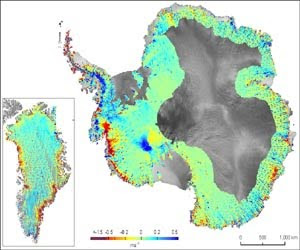 The level of uncertainty in this game is pretty serious, but here we have at least a good indication that the visible losses are driven by warmer waters. At least it conforms to what I am expecting regarding the influx of warmer waters into theThat is my point of course. Warmer sea water is eroding the glaciers and obviously is doing the same for sea ice. That warmer sea water dominates is the important lesson to be drawn by this evidence.Again we can discard atmospheric heat as the principal driver. It is simply not potent enough.So while we have climatic warming of a sort at work, my contention on cause and effect is the complete reverse of what everyone has been accepting. The climate is a bit player in driving the melt rates of ice caps and sea ice. The warm water is been shifted northward at a historically stronger rate than previously true.Each year a larger than normal mass of warmer water is pushed into theAt least I no longer have to waste time trying to fit the weather into this erosion of the sea ice which I did the first two years. If the sea ice was unable to add mass this year of all years then we are surely looking at the wrong horse.by Staff WritersParis (AFP) Feb 14, 2010The icy mass sitting atopAt present, the ocean watermark is rising at around three millimetres (0.12 inches) per year, a figure that compares with 1.8mm (0.07 inches) annually in the early 1960s.ButSome theories point to air temperatures, which are rising faster in far northern latitudes than the global average.A rival idea is that shifting currents and subtropical ocean waters moving north are eroding the foundation of coastal glaciers, accelerating their slide into the sea, especially those insideUntil now, however, these studies have been mainly based on mathematical models rather than observation.A team of scientists led by Fiammetta Straneo of Woods Hole Oceanographic Institution in Massachusetts set out to help fill that data void.Working off of a ship in July and September 2008, the researchers took detailed measurements of the water properties in the Sermilik Fjord connecting Helheim Glacier in easternThey found deep water streaming into the fjord was 3.0-4.0 degrees Celsius (37.4-39.2 degrees Fahrenheit), warm enough to cut into the base of the glaciers and hasten their plunge into the sea.Moored instruments left in the fjord for eight months showed that winds aligned with the coastline played a crucial role in the influx of these warmer waters.“Our findings support increased submarine melting as a trigger for the glacier acceleration, but indicated a combination of atmospheric and oceanic changes as the likely driver,” the researchers say.In a separate field study, Eric Rignot of the Jet Propulsion Laboratory inInvestigating the western side ofOcean melting, they found, accounted for between 20 and 75 percent of ice loss from the glacier face, with calving from the part of the iceberg exposed to air accounting for the rest.Meanwhile, a study also published in the journal Nature Geoscience warned that oceans could become more acidic faster than at any time over the last 65 million years.Andy Ridgwell and Daniella Schmidt of the University of Bristol, westernThey found that the surface of the ocean is set to acidify even faster than it did during a well-documented episode of greenhouse warming 55.5 million years ago.Accelerating acidification has already begun to take a toll on numerous marine animals that play a vital role in ocean food chain and help draw off huge quantities of CO2 from the atmosphere.The calcium carapace of microscopic animals called foraminifera living in the Southern Ocean, for example, have fallen in weight by a third.
 -
Flying Dragons
 I caught this first item and was surprised I had never heard of it. It is far too dramatic an animal to have gone unremarked. A quick query revealed the additional item in Wikipedia.We already knew about extinct flying lizards and this gives us an excellent example of another such animal. It also spells out that the weakness of the pterodactyl and its kin was certainly that they were principally gliders.In this case they are small and arboreal which is a great plan and good for somewhat larger versions.I would like to see someone work out the mechanics for a larger version becoming airborne and gaining altitude. Perhaps these critters can teach us.There have been reports of pterodactyls spotted in remote locales. Those reports may be simple hoaxes, except that I really have no reason to rule out the possibility on the basis of purported class extinction when I am seeing creditable evidence that parts of the class are still about, though scarce.More creditably, wherever strange and dangerous animal came into conflict with humanity over hunting grounds, we solved it. A hunting band with spears will see off many troublesome large animals, particularly if they like to sleep in the sun by themselves.Thus whatever remnant populations exist of obscure critters, they will be in areas normally forever free of human activityby Michael Graham Richard, Ottawa, Canada on 02.16.10Photo: Reddit user Biophilia_curiosusCan’t Wait Until They Find the Full-Sized Species…A Reddit.com user by the name of Biophilia_curiosus posted a few photos that he took inBiophilia_curiosus wrote: “The crazy part is that those lines you see running through the wings like veins are actually its ribs! Evolution did a number on these guys. They can expand and contract their chests at will to glide great distances. We were only able to catch females as they were laying their eggs. All we could do is watch as the males soared overhead.”
Photo: Reddit user Biophilia_curiosusThe photos were taken in\ Draco (genus)
From Wikipedia, the free encyclopedia
Draco is a genus of gliding agamid lizard fromThe only time a flying lizard ventures to the ground is when a female is ready to lay her eggs. She descends the tree she is on and makes a nest hole by forcing her head into the soil. She then lays 2-5 eggs before filling the hole. She guards the eggs for around 24 hours but then leaves and has nothing more to do with her offspring.[1] -
Early Waterway links Atlantic and Pacific
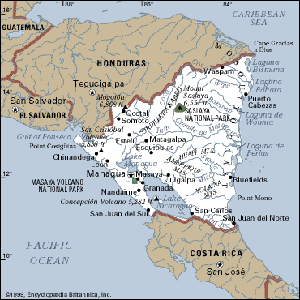 That the Mayan developed an effective route between the Pacific and theBesides,Whether any polity was organized enough to seriously improve it is an interesting question. What goods would justify the effort?I have always thought hydraulic engineering to be largely obvious, but never built unless driven by ample traffic and economic incentives. TheIn any event, this particular connection would obviously require a modest effort to provide easy movement. A few ditches possibly and it becomes easy to traverse. And if anything were to prove difficult, it seems a simple portage will suffice.It is definitely a local proposition though.Explorer finds evidence of early waterway fromValentine LowFebruary 13, 2010Hailed by some as the eighth wonder of the world, theBut was it really the first? An explorer claims to have found evidence of another, more ancient, water route between the oceans — one that existed hundreds of years before theSeveral hundred miles to the north-west, in Nicaragua, the route — which involves rivers, a lake and flood plains — was discovered by Colonel John Blashford-Snell, who has just returned from an expedition there.“It is tremendously exciting,” said the veteran explorer. “With effort it is navigable. But it is going to need more investigation.” He is now planning another expedition to discover whether it is really possible to take a boat from one coast to the other without touching land.If so, it will prove something remarkable: that the ancient maps which show a passage between the two oceans — and which have long been dismissed as fanciful — had a greater claim to accuracy than was realised.A 1774 map by Thomas Kitchin, for example, appears to show a channel that would allow boats to pass between the oceans.Colonel Blashford-Snell’s expedition set out to find evidence that a canal once existed in Nicaragua, part of a wider — and more far-fetched — theory by the writer Gavin Menzies that the Chinese landed in America long before Columbus.No records of such a canal exist, although there were plans for aWhether Colonel Blashford-Snell found evidence of ancient canals is arguable — he does not push the point himself — but the case for a natural water passage is strong, according to the explorer.Parts of the passage are well known, if not obviously navigable. Lake Nicaragua, which is 100ft (32m) above sea level, occupies the central part of the isthmus, and from there the San Juan River runs east to theRapids make the upper parts of the river hard to navigate, although in 1780 a young Horatio Nelson ventured upstream to lead an assault on a Spanish fort on the river.“It is said that the pirate Henry Morgan came up from the“Then they rowed across the lake, sacked the city ofGetting from the lake to the Pacific seemed to be a greater challenge, even though it is a distance of only 12 miles (19km) at its shortest.Colonel Blashford-Snell, who spent two weeks in Nicaragua last month with a team of four, said he found places where the head waters of different river systems — one flowing east into the lake, another flowing west into the Pacific — were only a few hundred yards apart. The seemingly unanswerable question, however, was how to get from one river to the other.Then, by chance, he met a local fisherman who helped him to unlock the puzzle. Mariano Hernandez told them he had made the journey from the centre of the isthmus between Lake Nicaragua and the Pacific down to the lake to go fishing — a journey made possible during the rainy season when the land turns into a lake up to 2m deep.“He said he built a 3m canoe out of cedar wood and did the journey with his brother. They had one nasty capsize and also had a very nasty shock when a bull shark appeared alongside. But they did the journey three times,” said Colonel Blashford-Snell. The fisherman also said he had made the journey west to the Pacific on another river. According to the explorer, other villagers corroborated the fisherman’s story.“It seems likely that even if early cartographers did not see this lake, they were told about it by the indigenous people, and thus drew a channel on their maps,” said Colonel Blashford-Snell. “I’m sure this is how the story of the legendary route between the oceans started.”
 -
boilerPAC: the complete and modular control of industrial boilers
boilerPAC offers a single control system, ideal for manufacturers of boilers and burners and for contractors
boilerPAC is the new control system suitable for all the types and sizes of industrial boilers. The system hardware is standard and expandable. The software is modular and includes all the possible variants; this allows to select only the desired functions on the basis of the boiler model and the application. In practice, only one product covers the complete process: the master, the combustion control, the oxygen trim, the thermal cycle, the analysis, and the blow down
boilerPAC meets the regulations governing the surveillance of unmanned generators thus allowing considerable savings in the management of the plant
boilerPAC offers a simple, intuitive, touch screen operator interface. Finally a graphic interface with icons: no more texts, to be translated in several languages and not always clear for the operators, but guided pages, icons and intuitive symbols which can be easily recognized by everybody. A big advantage, for companies exporting all over the world
With boilerPAC Ascon offers a complete series of sensors, transmitters, control valves and analyzers specifically designed for boilers. Everything for the complete control of boilers and thermal cycles
The heart of the system is the new boilerPAC, a Programmable Automation Controller able to satisfy all the control functions of the plant such as: the control of the burners, the drum level control, the control of the chemical characteristics of the feed water and the continuous blow down. The programming is with the six standard IEC 61131-3 languages. The analogue and digital inputs and outputs are onboard and expandable
The system is completed by the Ethernet port and the standard communication interface MODBUS RTU which guarantee the maximum connectivity for SCADAs and remote control systems with the possibility to send alarms via SMSs
Ascon will exibit at the:
MCE – Expocomfort
From March 23rd to 27th, 2010
Fiera Milano Rho (Milan, Italy)
Ascon SpA
Hall 7 – Booth V47 -
Ministers lavished £9m on climate change stunts… but public opinion is left cold by global warming ‘propaganda’ by Steve Doughty, Daily Mail
Article Tags: CO2 Propaganda
 A disastrous series of failed climate change publicity stunts cost taxpayers £ 9million, it emerged yesterday.
The projects paid for by the Government’s Climate Challenge Fund did next to nothing to change public opinion, a Whitehall report found.
It said the initiatives were almost entirely preaching to the converted and that trying to drum up interest through sensationalism only put people off.
Schemes included a £40,000 DVD in which schoolchildren explained that in ten years everyone will have to wear sunglasses all the time, because the sun will be shining more.
A tent set up in shopping centres and labelled an ‘experiential climate dome’ was subsidised by Whitehall to the tune of nearly £400,000; a computer game cost £47 every time it was played; and a series of ‘ challenging pub quizzes’ about climate change cost more than £85,000.
Large grants went to councils, schools and youth groups for ‘ attitude modification’ programmes and to assure the public that man-made global warming is an established scientific fact.
And £200,000 went to Oxford University to ‘take climate change into the community’.
Source: dailymail.co.uk
-
Mega PSN sale coming
Whip out those wallets, PlayStation Network is gearing up for a massive sale! And you’re gonna get it in spanning the next couple of weeks.
-
Windows Phone 7 development docs leaked


Click for larger versions.
We can always count on XDA-Developers to bring us the news early. In this case it is some snippets of the developer documentation for Windows Phone 7. The above bit confirms the OS is multi-tasking capable, but then we knew this already.
More after the break.

However most developers will be limited to managed code, with even OEM’s and operators having to bed for access to native API’s and being closely audited in their use.

As has leaked earlier also, Visual Studio and Expression Blend for the XAML UI will be the primary development tools.
 Click for larger version.
The above document confirms both Silverlight and XNA development. Silverlight is interesting, as we know it will not be present in the browser yet. XNA is however more interesting, as it is the same language used to program the ZuneHD and more importantly X-Box Live games, suggesting cross compatibility between the 3 platforms.
The software also makes passing references to runtime services that can be used for notifications, including 3rd party notifications, suggesting applications even after suspended can register with a background service to be woken up in response to external data.
Read more from some real developers, who are not too happy, at XDA-Developers here.
Thanks freyberry for the tip.
-
Ryan’s wife, lawyer appeal to Obama
Imprisoned former Gov. George Ryan’s wife and lawyer say they are seeking clemency from President Obama, citing health reasons for seeking Ryan’s early release.
Ryan’s 75-year-old wife, Lura Lynn, has a terminal lung disease and says she now is on oxygen 24 hours a day.
And Ryan’s attorney, former Gov. Jim Thompson, says Ryan himself has health problems, including kidney disease and infected teeth.
Ryan, who was sent to a federal prison in Indiana after his 2006 conviction and 6½-year sentence on corruption charges, turns 76 next Wednesday.
In a telephone interview Wednesday with the Chicago Tribune, Lura Lynn Ryan confirmed she had made a previous plea for clemency for her imprisoned husband in 2008 by calling then-President George W. Bush’s mother, former first lady Barbara Bush. She said she was unsuccessful.
Read the original article from Journal Star.
Distributed via Chicago Press Release Services
-
How is Olympic hockey different?
The biggest difference between international play and North American play has always been the size of the ice sheet.
But in 2010, for the first time ever, the Olympics hockey tournament is being staged on an NHL-sized sheet. That’s a smaller surface, which means less room behind the net and more board play and physicality will be likely.
How will the European teams hold up against USA and Canada?
Rivermen captain Yan Stastny, whose brother, Paul, plays for Team USA:
“I’m not sure how the Russian defensemen will hold up in the smaller rink. That will define their chances. I really don’t want Canada to win. So I’m rooting for USA, that’s where my heart is.”
Rivermen head coach Rick Wamsley:
“Take time to watch these Games, it’s going to be the best hockey. Anytime you get the world’s best players in a tournament for national pride, it’s the game of hockey at its finest.
“Will the NHL-sized rink be an advantage for USA and Canada? Yes and no. I think most of the medal contenders, most of their players are coming from the NHL or have played on North American ice for a long time.
“Now the teams in the bottom part of the draw — those guys are REALLY gonna have some fun. “I think Canada wins the gold in a nail-biter over Russia.”
There are some other differences between Olympic competition and what Rivermen and hockey fans are accustomed to seeing in North America:
BREAKING TIES
In the Olympics, overtime in the group stage will be five minutes of four-on-four play before the contest goes to the shootout. In qualification, quarterfinal and semifinal stages, as well as bronze-medal game, the overtime period will be 10 minutes of sudden-death format. A shootout occurs if game remains tied. In the gold-medal game, the overtime will be 20 minutes, followed by a shootout if game is still tied.THE SHOOTOUT
A three-man roster is named after the conclusion of overtime. In international play, any player can go after the three shooters have gone, including the same player on a repeated basis. In the NHL, all 18 shooters must have a shootout attempt before shooters can be repeated. In the Olympics, a coin toss is used to decide the order in which teams will shoot. In the AHL, the home team chooses which side shoots first, and five shooters are selected. Shootouts are used in the NHL and AHL only in regular-season play. It’s full 20-minute sudden-death OT come playoff time.THE ROSTERS
Olympic teams can dress 20 skaters and two goaltenders. NHL teams can dress 18 skaters and two goaltenders.GOALTENDERS
•In the NHL and AHL, when goaltenders are behind the goal line, they can only handle the puck if within a trapezoid marked on the ice. In international play, goaltenders can handle the puck anywhere.• Masks: USA goaltender Ryan Miller ran into trouble at the Games when IOC officials questioned the phrases on his mask, “Miller Time” and “Matt Man.” North American goaltenders have traditionally decorated their masks with an array of expensive art work. But IOC rule No. 51 prohibits “advertising, demonstrations and propaganda.”
• Crease violations: In the NHL and AHL, players are allowed to stand in the goal crease as long as they don’t interfere with the goaltender. But in international play, referees will whistle play dead and declare a neutral zone faceoff if an attacking player is standing in the crease.
NICE TOUCH
If an NHL or AHL player shoots the puck down ice for an icing infraction, an opposing player must touch the puck first for the infraction to be whistled. But the Olympics include a no-touch icing rule. As soon as the puck crosses the end line down ice, play is whistled dead.DROP THE GLOVES
NHL and AHL players — all North American pro leagues, for that matter — allow fighting and assess a five-minute penalty to combatants. Players who fight in the Olympics receive a match penalty (subject to suspension) and are ejected from the game immediately.OTHER DIFFERENCES
• Helmets are mandatory in Olympic competition, and must remain on whenever a player is on the ice. If a player loses his helmet, he must immediately leave the playing surface or face discipline. In the North American game, players who lose their helmet can continue on until a whistle stops play.• In the NHL, AHL and other North American pro leagues, when a penalty shot is awarded, it must be taken by the player who was fouled. In the Olympics, any player can be selected to take that shot.
— Compiled by Dave Eminian
Read the original article from Journal Star.
Distributed via Chicago Press Release Services
-
Katherine Reutter briefly holds record on short-track oval
VANCOUVER, British Columbia – Champaign native Katherine Reutter held the world record in the short-track 500 meters Wednesday night.
Briefly.
Reutter held the world record for less than five minutes after winning her quarterfinal heat in a record 43.834 seconds.
But the Centennial grad failed to advance out of the semis to set up a showdown with new record-holder Wang Meng of China, who blazed to the gold medal in 43.048. Meng’s semifinal time was 42.985.
“Going into the first race I said to myself ‘I want to set an Olympic record,’ and I did,” Reutter said. “From now on I can say I was an Olympic record-holder.”
In the final, Wang crossed the finish line well ahead, sticking both her arms out. She quickly grabbed a Chinese flag and skated around the rink, shouting, “Woo!”
Reutter, who started slow and was fourth in her semifinal, ended up finishing third in the “B” final in 44.846.
“My goal tonight was to make it to the final and I didn’t, but I could have raced better,” Reutter said.
Reutter next takes to the ice Saturday in the 1,500 in her bid for Olympic glory.
“The 1,500 is my best event anyway, so bring it on,” she said.
Reutter also skates next Wednesday in the 3,000-meter relay finals and Feb. 26 in the 1,000.
Distributed via Chicago Press Release Services
-
Governments Plan for Warming Based On Corrupt IPCC Science by Dr. Tim Ball, CanadaFreePress
Article Tags: Tim Ball

There is no need for any government action on CO2, global warming or climate change. But as usual governments are making the situation worse as they waste billions preparing for warming when cooling is the future. The misdirection is caused by the corrupted science of the Intergovernmental Panel on Climate Change particularly their omission of major solar changes. My last article identified the Milankovitch Effect, a solar mechanism excluded from the Intergovernmental Panel on Climate Change (IPCC).
This article examines the second major solar mechanism ignored and identifies the machinations used to avoid or exclude the research and evidence.
Source: canadafreepress.com
-
Local Marine in Afghanistan ‘I just have to stay alive’
KABUL, Afghanistan – For the U.S. Marines, including Justin Blancas of Mount Prospect, who are deployed to the battlefields of southern Afghanistan, life is fragile and thoughts focus on the day they see their families again. But something about this war is different.
They are now conducting an offensive on Marjah, one of the Taliban’s big urban strongholds in the southern province of Helmand, but progress is slow with the militants preferring fight to flight.
The Marines will soon be joined by tens of thousands more soldiers, the lion’s share of the 30,000-strong troop surge promised by President Barack Obama in December to try to turn around the grinding Afghan war.
Until then, the Marines are on their own. A foot patrol for one platoon of Marines one day ends with a dash under a hail of bullets across a heavily-mined poppy field.
The soldiers have been pinned down in a muddy mound, the thorny weeds cutting through skin. They recover soon enough, however, maneuvering away from the Taliban’s crosshairs and driving them away with heavy machine-gun fire.
“I pray in the morning and at night, hoping that someone up there is looking after me,” says Blancas, a 23-year-old lance corporal serving with the Marines 1st Battalion, 6th Regiment Alpha Company’s 2nd Platoon.
“I have already made my peace with God because this war is different; it’s not conventional.
“These Taliban have learned their lesson. They adapt as fast as we do, but we are bound by our strict rules. They are not,” he says, panting after a 100-yard dash for cover behind an abandoned mud house. “It can be a death run like this every day.”
The U.S. and NATO troop surge will the push the foreign force to 150,000 this year, but Afghan and Western officials are also talking about a political solution to end the Taliban-led insurgency as its enters its ninth year.
To force the Taliban leadership to the negotiating table, however, U.S. military officials have said there needs to be greater success on the battlefield – and this is where the Marines come in.
Yet the challenges on the ground are immense. Fields are littered with improvised explosive devices responsible for most of the deaths of foreign troops in Afghanistan, which hit a record 520 fatalities last year. The area is also filled with opium poppy, which bankrolls the Taliban movement.
The Marines’ mission is to show U.S. strength, assist in installing government control in Helmand province and let the local population know they have arrived.
But Taliban militants harass the villagers at night, warning them of trouble if they help U.S. troops.
Under the cover of darkness, they also plant IEDs in fields the Marines have to cross.
Blancas, a father of a toddler, has armed himself with his assault rifle, two rosaries and prayer cards stuffed in his pockets. It all comes down to one simple thing, he says.
“We do what we have to do, but I plan to be out of the corps soon and be Daddy. I just have to stay alive till then.”
Read the original article on Chicago Press Release Services
-
Climategate: A Defiance of Arrogant Political Power by Ian Plimer, PajamasMedia.com
Article Tags: ClimateGate, Ian Plimer
The average voter has had enough: no more being force-fed scenarios defying that rare commodity called common sense.
The people are speaking. We are seeing a defiance of bureaucrats, officials, government propaganda, and funded climate catastrophe researchers. A scary scientific paradigm of human-induced climate change is collapsing because the cake has been over iced. The average voter has had enough of being talked down to by arrogant scientists with vested interests who present scenarios that defy that rare commodity called common sense.
It was only a short time ago that climate rationalists were told they were factually wrong, that their skepticism was evil, their views were akin to Holocaust denial, and that they should be tried for crimes against humanity. However, Climategate emails show that the coterie of two dozen leading climate comrades shared this skepticism in private — yet denounced skeptics in public. Various cap-and-trade systems have been shown to be an extra tax, which may end up being distributed by the sticky fingers of the UN.
Source: pajamasmedia.com


