Author: ajabogdanoff

  • From communism to the threat of cats: This week’s TED Conversations

    TED-Conversation-generic-imageTED Conversations is a unique space where any member of this community can get feedback on an idea, pose an interesting question, or start a debate with their fellow TEDizens from around the globe. This week, dozens of new conversations were started. Many of them were about issues brought up in our first television special, TED Talks Education, while others were unrelated, spanning topics from the merits of communism to whether cats threaten biodiversity. Here, a sampling of the highlights from this week:

    First, a thought-provoking question from Ye-Jin Ahn:  If communism was working the way its progenitors wanted it to, would it be better than capitalism?

    The main reason why communism was made was people wanted to be equal without getting restricted by their environment, but nowadays communism is abused by some dictators such as North Korean leaders. Besides, capitalism also has its own problem. There are so many people who didn’t have opportunities to try what they really wanted to do due to their poverty or else.

    If communism was working as it was intended, would it be better than capitalism?

    Yubal Masalker responds:

    I think it would. The problem was that there was a huge gap between the theory and its practice. The communism theory was an outcry for change in the reality of severe injustice of those times. It had noble ideals. But as it usually occurs in the mankind’s history, the great ideals fell victim to basic human nature — the human nature of greed and selfishness. This means, whoever gains the power in the name of any ideals, exploit those ideals only for the benefit of himself and his close group. Communism was not exception of this basic human nature, as well as the Capitalism and many countless other man-made systems of diverse ideals.

    So I think that instead of looking for the BIG answers from the failure of Communism (like dictatorships, organizing labor differently, the Chinese interpretation of communism or whatever) it would be much better for the all mankind to look for more seemingly minor answers, which are actually the real true answers. Because these answers are common to perhaps all the mankind’s ideological failures in the history and not just for the failure of the communism — for example, also the latest economic crisis due to the failure of the Capitalism.

    While John Moonstroller reminds us that:

    First we need to find a country that practices communisim without dictators to determine an answer to this question.

    And Heather White adds:

    The current problem capitalism has is the same problem communism had — its utopian ideology was infiltrated by psychopaths. I’m serious.

    People with psychopathic tendencies are attracted to power and prestige — they climb the greasy pole, by whatever means, and when they get power or influence they use it for their own gratification, glorification and empowerment. They lobby for the relaxation of regulation, and once they achieve this they exploit it ruthlessly. You cannot expect a psychopath to have self restraint or feelings of remorse — they are relentless — they want it all.

    Corporation directorships, government departments and politics, are disproportionally represented by psychopaths. In the population as a whole they make up 1%, within the halls of corporate and political power it is estimated that they make up to 4% (source: Jon Ronson’s TED Talk).

    With 221 comments and five days remaining, there’s plenty of time to get involved in the debate!

    Also this week:  The latest in our TEDinClass series, from University of Oregon student Jon Cox:  Cats pose a serious threat to biodiversity: Why do we accept it? What should be done?

    According to the ASPCA, there are around 90 million owned domestic cats (Felis catus) in the U.S., and taking into account strays and feral cats, the total number is estimated to be as high as 160 million (1).Loss et al. (2013) estimates that cats roaming outdoors kill 1.4-­3.7 BILLION birds and 6.9­-20.7 BILLION mammals in the U.S. annually (2). Reptiles and amphibians such as snakes, lizards, frogs, etc., are also frequently killed by cats.

    Cats are even more popular New Zealand, where they are contributing to declines of endemic birds such as the critically endangered kakapo (3), which have evolved in the absence of predators. Businessman/philanthropist Gareth Morgan is trying to gather support for legislation that would aggressively deal with stray and feral cats and potentially eliminate cats from New Zealand to take pressure off of threatened species (4 & 5). With Morgan’s plan, in addition to regulation that would reduce cat populations and increase owner accountability, residents would be encouraged to not replace their cats. As of now the majority of New Zealanders surveyed are in opposition to Morgan’s initiative.

    Would a proposition like Morgan’s meet similar resistance in the U.S.? Probably, but is he on the right track? Would you personally support something like it for your state or country?

    Mario R responded:

    I found an interesting article that highlighted the effects of reducing predatory effects in ecosystems. The article was talking about predatory chains and how the elimination of a top, or superpredator, might open the door for a different predator, or mesopredator, to take the original predator’s place. This would in fact lead to the extinction of the prey. The example they looked at was an endemic bird population, and the superpredator were feral domestic cats.

    This got me to thinking about the effects of suppressing cats’ activities outdoors. If something was done to regulate cats’ outdoor liberties, would there be increases in predatory activity of a different species on the same prey?

    And Erik Parker replied:

    Great point as usual, Mario.

    That was exactly the same line of thought that I was mulling over. For as long as there have been modern urban and suburban areas there have been cats present, really. So I think it makes sense to think about it as though those environments and cats have co-evolved in a way. That means we have no real way of knowing what will happen if cats are eliminated from an area all together. Sure we can speculate that maybe those species preyed upon by the cats in those environments will recover greatly, but what’s to say that some other species wouldn’t come in to fill that niche vacated by the cats? The reality is that we really don’t know what will happen until it does, and this unpredictability is why removal experiments are often so dangerous.

    The article Mario linked to makes the good point that other predators often move in to such situations quickly, and in particular uses the example of rodents coming in to prey on the eggs of birds usually targeted by feral cats. I was able to find some more articles that addressed this phenomena of top predator removal harming an ecosystem overall, and I think they would be valuable to take a look at as it is a really counterintuitive but interesting viewpoint:

    1. http://rspb.royalsocietypublishing.org/content/276/1671/3249.short
    2. http://www.sciencedirect.com/science/article/pii/S0169534701021942

    While Phoebe Cone added:

    I find it pretty ironic to call for the elimination of cats as pets because of their effect on bird biodiversity, when humans are directly causing the loss of so many other species. You could argue that legislation to limit the population of humans in the US should be implemented, because “it is for the greater good and humans are just too destructive to justify”, but of course most people would not support that. Similarly, the majority of people will never support a decision to make cat ownership illegal. There has to be a balance. I do not think it is reasonable to force people to give up pets, a major source of enjoyment and entertainment (a provider of “cultural services”, if you will) to protect other species that the general population, to be honest, probably doesn’t care all that much about.

    I think the focus should be on public education and on feral cat population control. The people who are most likely to want to donate their time and resources to organizations that advocate things such as the protection of bird biodiversity are probably animal lovers, and therefore are likely to keep pets themselves. If we increased public education that let people know that regulating their cats’ outdoor activities could lead to more beautiful birds gracing their feeders and yards, I think people would be much more receptive to the idea that cats harm bird biodiversity. As another person mentioned, putting bells on cat collars is a great idea … It’s not perfect, but it’s a much more balanced and reasonable approach to this issue.

    This conversation has ended, but be sure to check out the rest of the 198 comments here!

  • The future of the U.S. economy: TED fans join in the Robert Gordon/Erik Brynjolfsson debate

    GordonBrynjolfsson-debate

    Robert Gordon and Erik Brynolfsson debated their opposing views of where the economy is headed at TED2013. Last week, they brought the debate to a TED Conversation. Photos: James Duncan Davidson

    Last week, TED speakers Robert Gordon and Erik Brynjolfsson joined us for a live, one-hour debate on the future of the US economy.  It was a furious hour of typing, with both speakers contributing just over 1,500 words in response to a wide variety of user questions.  A few highlights:

    Ryan Zeigler asks:

    Mr. Brynjolfsson, you stated in your talk that you feel that we need to “race with machines” rather than against them. In what manner do you feel that this effects the future of education?

    Erik Brynjolfsson responds:

    We really need to reinvent education. My industry has lagged other industries in digitizing. Far behind music and other media, finance, manufacturing, retailing, etc.  But that’s good news: lots of room to improve.  Digitization of education will do two things:

    1. Much higher quality and lower cost as very best teachers and methods reach larger audiences. Examples: superstars like Sal Khan of Khan Academy or physics lessons from best MIT profs at EdX.
    .
    2. More importantly, gather enormous data about what’s working and not working. Apply big data techniques to improve teaching methods and to personalize how things are taught. Adapt pace and methods, based on students unique situation. Continuous learning by the educators, not just students. My students are already doing this to optimize ad clicks – can soon do it for education.

    Michael Noyes asks:

    Capitalism has created more wealth by far for more people than any other system. However, have we reached a point in our technological history when the pendulum must swing back toward more socialist economics to achieve more prosperity for more people?

    Robert J. Gordon responds:

    You have to distinguish between “socialism” and the capitalist welfare state as exemplified by Sweden, the Netherlands, etc. Socialism involves government ownership of the means of production and was practiced by the postwar UK Labour government which nationalized steel, transport, etc. It was Thatcher’s achievement to reverse all that, and Britain went from being a laggard to one of Europe’s most dynamic economies.

    Yes, we need more of a welfare state, particularly to prepare children in poverty to compete in our educational system. Now they are dropping out of high school and condemning themselves to lives of manual labor and unemployment.

    Theresa Sanker asks:

    When are America’s economic priorities going to shift toward education, saving, and long-term investment, and away from excessive reliance on military power and cheap energy?

    Erik Brynjolfsson responds:

    When more people like you demand it. Simple as that.

    Robert Gordon adds:

    Heckman has shown that the problem is not that we don’t spend enough resources on education. Reducing class sizes has no effect. The problem is that educational resources are not distributed evenly. In an ideal world we would get rid of property taxation as the basis for educational finance, since that gives an advantage to communities with wealthy residents. We should have education funded by a nationwide value-added tax.

    The problem with our military, besides the needless wars in Iraq and Afghanistan, is the endless buckets of cash poured into ridiculous projects like the F-35 fighter which has no known enemy to justify its cost. We built the B-17 in WWII for $250,000 per plane!

    Finally, what’s wrong with cheap energy? Are you in favor of expensive energy?

    With 113 excellent questions and answers, this was a fascinating and informative debate. Don’t miss the rest of the responses, available on TED Conversations »

  • This week’s best questions, ideas and debates from TED Conversations — with a map!

    Location of TED Conversations started in the past 30 days, based on member profiles.

    Location of TED Conversations started in the past 30 days, based on member profiles.

    TED Conversations is a unique space where any member of the TED.com community can get feedback on an idea, pose an interesting question, or start a fascinating debate with fellow TEDizens from around the globe.  We’ve seen participants from Columbia to Palestine, Sudan to Nepal—a total of 114 countries in just the past 30 days.  See just where above. And below, a sampling of the discussions happening in this global community:

    Seigi Karasaki, from Tokyo, Japan, asks: Do people deserve to know the truth, even if it isn’t in their best interest?

    Is truth always the best choice of action? In “On the Decay of the Art of Lying,” Mark Twain argues:

    “Lying is universal–we all do it; we all must do it. Therefore, the wise thing is for us diligently to train ourselves to lie thoughtfully, judiciously; to lie with a good object, and not an evil one; to lie for others’ advantage, and not our own; to lie healingly, charitably, humanely, not cruelly, hurtfully, maliciously; to lie gracefully and graciously, not awkwardly and clumsily; to lie firmly, frankly, squarely, with head erect, not haltingly, tortuously, with pusillanimous mien, as being ashamed of our high calling. Then shall we be rid of the rank and pestilent truth that is rotting the land; then shall we be great and good and beautiful, and worthy dwellers in a world where even benign Nature habitually lies, except when she promises execrable weather.”

    What are your thoughts?

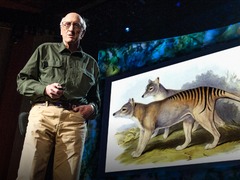
    From Kamloops, Canada, David Johnson responds to Stewart Brand’s provocative de-extinction talk: Science is developing the tools towards de-extinction of species on the planet that have become extinct. The question becomes; Should we?

    Stewart Brand: The dawn of de-extinction. Are you ready?Stewart Brand: The dawn of de-extinction. Are you ready?Stewart Brand and his colleagues are at the biotech precipice of reviving extinct species. The Revive and Restore project plans to not only bring species back but restore them to the wild, as well as protect currently endangered species.

    I don’t think any of us will have a problem with the latter, this discussion is focused on the primary goal; reintroduction of extinct species. We are not talking about dinosaurs, but the Passenger Pigeon, Carolina Parakeet, Heath Hen, Bucardo, the Taz Tiger, etc.

    Up for debate here: Should we?

    And Pabitra Mukhopadhyay, from Kolkata, India, invites us to consider a thought-provoking linguistics question: He, she or s/he? Should languages be made gender neutral or be left on their own to preserve literary integrity?

    Feminists have long argued that sexist language can have real world consequences for gender relations and the relative status of men and women, and recent research suggests that grammatical gender can shape how people interpret the world around them along gender lines.

    But language is as much a communication tool as literature. Some argue that steward and stewardess are distinct but equal terms and dropping one for another takes away the beauty of literary expression.

    Interestingly there are a number of genderless languages—they have no grammatical gender but have specific words to recognize gender. There are also natural gender languages which have evolved through a constant process on conscious neutralization of grammatical genders.

    Things start to get serious when studies of Jennifer L. Prewitt-Freilino, T. Andrew Caswell and Emmi K. Laakso on the gendering of languages come to fore. After investigating 111 languages of the world, their findings suggest that countries where gendered languages are spoken show less gender equality compared to countries with other grammatical gender systems. Furthermore, countries where natural gender languages are spoken demonstrate greater gender equality, which may be due to the ease of creating gender symmetric revisions to instances of sexist language. Norway and Sweden show Global Gender Gap Indices of .82 and .81 (1 being ideally gender equal) and both these countries have natural gender languages. Yemen scores a GGG index of .46 with a gendered language.

    Do you agree with this co-relation?

    With 237 open discussion topics, join us in tackling more big ideas, questions, and debates on TED Conversations»

  • This week’s best questions, ideas and debates from TED Conversations

    TED-Conversation-generic-imageTED Conversations is a unique space where any member of this community can get feedback on an idea, ask a question that they just can’t get out of their mind, or start a respectful debate on an issue they hold near and dear to their heart. This week, dozens of new conversations were started — from “What does the average citizen need maths for?” to “How can overly empathetic people compete in this world?” Here, a sampling of the highlights from this week.

    This week, TEDx Organizer Ellen Feig posed a thought-provoking question:  Can you teach young people to be moral? She wrote:

    Currently I am working on a professional development platform focused on teaching college students ethics and morality. Young people seem to be incredibly disengaged from others, have little sense of what it means  to be moral, gracious or ethical and don’t care. How can we teach morality or is it something  that is innate?

    To which Lejan responded:

    Most of our fairytale culture is based on the idea of teaching moral concepts to young people, yet there is no guarantee that what is taught will be taken. A moral itself is no constant entity and is constantly changing and mixed with religious, political and social ‘belief systems’, it is a task on its own for each generation to do their best in trying to hand over what fells right for them in that moment in time.

    If you, as you describe, deal with young people who already ‘don’t care’, your question is without doubt a good one! When I look at myself, I got all of my ‘moral core values’ exclusively within my family and at a very young age. And this without being directly taught, like, ‘Today my dear we will teach you about ‘lyng’, ‘stealing’ and ‘envying’ .. :o) It was the overall ‘atmosphere.’ … I personally believe that a positive childhood in love and care is the most influential factor for the development of a strong moral compass and that ‘outside’ institutions like childcare, kindergarten and schools are hopelessly over-strained to compensate for that.

    With 70 comments and 12 days to go before the conversation ends, this promises to be an interesting discussion. View the full exchange » 

    Meanwhile, Genevieve Tran shared an inspiring idea: Using the online community to build a collection of personal photos to capture pre-war Afghanistan. Genevieve writes:

    In another TED conversation led by a young person from Afghanistan, he asked the community what we’d like to be able to see in the future. He himself has never seen peace in his country and wished to see this, above all.

    This country has been put on hold for 30 years. And the younger generation in and outside of it has no memory of it, really, of being anything but a warzone, a wasteland. We have such a strong digital culture and digital memory now. Why not “create” an Afghanistan that we want? I created a page that anyone can post on — do you know of anyone who remembers a peaceful Afghanistan in this lifetime? I think it would be nice for young, Internet-connected Afghans to look at 🙂

    Finally, member Domagoj Hackenberger sparked a thought-provoking debate: Is the total eradication of mosquitoes a true solution?  He pointed out:

    Mosquitoes have a massive ecological role in nature. Especially as the main food source for great number freshwater fish and birds.

    To which Kasper Mortensen responded:

    The ecological aspect would seem tricky at first glance, but it really isn’t. Even with this technology available to us, humans are in no way close to becoming the ‘Banes of Mosquitoes’. In fact, our current behavior is the best thing that has ever happened to the mosquitoes; by giving them mobility to spread across the world, we have made them one of the strongest species on this planet. Mosquitoes have no natural capabilities that would allow them to spread in this way. Most mosquitoes have no business being in the Americas at all. So if we are doing anything, we are in fact correcting our previous disturbance of nature.

    And also; since all males die within days, we can actively stop our ‘treatment’ at any given point. We have total control of the development, and can specify the exact number of mosquitoes world wide that we want.

    This technology is literally perfect. It is for these kinds of situations that the word ‘perfect’ exists.

    And check out lots more fascinating discussions and debates over at TED Conversations »