Author: Alan Boyle

  • Tut gets extreme makeover


    Andreas F. Voegelin

    Click for slideshow: A coffinette that contained Tutankhamun’s mummified
    liver is exquisitely crafted, even though the container is only 4 inches (11
    centimeters) wide and 16 inches (39.5 centimeters) long. Click on the picture to
    see the full coffinette and other artifacts from New York’s King Tut exhibition.


    King Tutankhamun’s treasures have been on the road for a long, long time: Over the past five years, precious artifacts have been criss-crossing America, heading over to London, then back to Egypt, then back to America. Everywhere those artifacts have gone, museumgoers have gone crazy over the boy-king, just as they did during a traveling Tut exhibit in the 1970s. (Remember Steve Martin’s classic Tut tribute, circa 1978?)


    Tut mania continues to reigns supreme, especially now that the big tour has reached New York City, its last U.S. stop.


    “A different generation of Tut mania is everywhere,” Zahi Hawass, secretary general of Egypt’s Supreme Council of Antiquities, observed during a walkthrough of the “King Tut NYC” exhibition in midtown Manhattan.


    But the Tut of today – or at least the image that Hawass and other experts have of the “golden boy” from 3,300 years ago – is not the Tut of 30 years ago, or even five years ago. High-tech studies of the mummy have led to an extreme makeover in the story that’s told by the golden treasures.

    …(read more)

  • Biological treasures from Borneo


    Peter Koomen

    Click for slideshow: A newly discovered green and yellow slug has an unusually
    long taiil that it can wrap around its body when resting. Click on the image to see
    more creatures from the “Heart of Borneo.”


    Scientists are showing off some of the 123 new species they’ve found in the remote forests of Borneo, three years after the three nations that own pieces of the island agreed to safeguard 85,000 square miles (220,000 square kilometers) in the “Heart of Borneo.”

    …(read more)

  • See the marvels of the sky


    Carolyn Kaster / AP file

    Click for slideshow: Matthew Hubbard looks at Jim Podpolucha’s homemade
    telescope  during a star party at Cherry Springs State Park in Pennsylvania. Click
    on the picture to see a slideshow of the 10 all-time greatest astronomical images.


    Last year was a big year for astronomy fans – so big that it was formally designated the International Year of Astronomy, in recognition of the 400th anniversary of Galileo Galilei’s groundbreaking telescope observations. But the week ahead is a big week as well, and not just because it’s been designated Astronomy Week. Here’s what you can look forward to, in the skies and on the Web:

    …(read more)

  • Field trips for the week ahead

    I’m going on a series of field trips over the next week, including “Case for Pluto” book signings in the Boston area and New York (plus a little opera indulgence). That means postings to the log will be more sporadic. To tide you over, here are a few virtual field trips you can take on the Web:  

    Seed: Where are the aliens? Maybe playing video games
    Popular Science: How your brain tweaks time’s flow
    Technology Review: Electronic paper … in color! 
    Starry Critters:…(read more)

  • Old vs. new space policies


    Jim Young / Reuters

    President Barack Obama and SpaceX founder Elon Musk tour a launch pad where
    SpaceX’s Falcon 9 rocket is being readied for testing. NASA is paying SpaceX
    to develop the rocket as a means of transport to the International Space Station.


    The backers and the opponents of the White House’s new policy on America’s future space effort largely agree on where they’d like to see NASA going in the 2030s: beyond the moon, to asteroids and Mars. The battle is really over what NASA will be doing (or not doing) in 2012 … which, by the way, is an election year.

    …(read more)

  • Robonaut ready for duty


    NASA / msnbc.com
      Click for video: Engineers
    from NASA and GM discuss
    the Robonaut project.


    When Discovery’s six astronauts take the final space shuttle ride to orbit in September, there’ll be one more rider sitting in the back of the bus: Robonaut 2, the semi-humanoid robot created by NASA and GM.


    The 300-pound (137-kilogram) robot, known as R2 for short, is being outfitted for its first tour of duty on the International Space Station – a tour that marks one small step toward a world where robots and humans work side by side in space.

    …(read more)

  • Rocket racers rise again


    Mike Howard for RRL

    The Rocket Racing League’s Mark III rocket-powered plane fires up during a test
    flight in Oklahoma. Fins have been added to the fuselage for stability’s sake.


    After shifting its business plan, the Rocket Racing League is revving up again for a gee-whiz demonstration of its X-Racer planes next week in Oklahoma. The new-look racing planes will feature crowd-pleasers such as rocket fins and colored flames – as well as an innovative system that will display a virtual “raceway in the sky” on the pilot’s helmet visor.

    …(read more)

  • Greatest hits from Herschel


    ESA / PACS & SPIRE / HOBYS

    An infrared image of the Rosette molecular cloud, obtained by the Herschel space
    telescope, highlights cosmic cocoons of dust that contain massive protostars.


    The European Space Agency’s Herschel space telescope is designed to delve into the old, cold and dusty frontiers of the universe – but there’s nothing old, cold or dusty about the infrared images that the spacecraft is sending back.


    Today’s spectacular view of the Rosette molecular cloud is one of the newest, hottest and brightest additions to ESA’s growing album of Herschel highlights.

    …(read more)

  • Spaceflight’s past and future


    A reveler wears a helmet in the shape of a Sputnik satellite during the 2007 Yuri’s
    Night celebration at NASA’s Ames Research Center in Moffett Field, Calif.


    Space enthusiasts are celebrating nearly five decades of human spaceflight – and anxiously awaiting word on what will happen in the decade ahead.


    The celebration reaches its peak on Monday – which happens to be the 49th anniversary of the first human flight into outer space, made by Soviet cosmonaut Yuri Gagarin, as well as the 29th anniversary of the first space shuttle launch. Back in 2001, spaceflight fans began organizing “Yuri’s Night” parties to mark the occasion.


    For the 10th annual Yuri’s Night, 188 parties (and counting) have been organized in 63 countries on all seven of the world’s continents. Yes, that includes the Amundsen-Scott South Pole Station in Antarctica … and probably someplace close to where you live as well.

    …(read more)

  • Fossils shake up our family tree


    Brett Eloff / Courtesy of Lee Berger, Univ. of the Witwatersrand

    Rock partially encases the cranium of a juvenile male representing the species
    designated Australopithecus sediba. The skull was found in a South African cave.


    Well-preserved fossils found in a South African cave pit mark an important transition between the 3.2 million-year-old pre-human known as Lucy and our own branch of the evolutionary family tree. That much, anthropologists can agree on. But exactly where do they fit in that transition? That’s the subject of a high-profile debate.


    It may be tempting to call these fossils a “missing link,” as some of the leaked news reports did earlier this week. But scientists say that’s too simplistic a term for what the bones signify.


    There are so many elements to the tale that it’s hard to know where to start. Here are the main points relating to the find, announced today by the journal Science:

    …(read more)

  • The planet-hackers are coming


    NOAA
      Click for gallery: This
    map charts the thickness of sulfate aerosols, which may have a cooling effect. Click on the image for more on geoengineering.


    Should we put more pollutants into the air to keep Earth’s temperature down? How about covering polar ice with reflective panels to cut down on melting? Or putting a giant umbrella in space to shade the planet?


    Some of the ideas for easing Earth’s warming trend may sound crazy – but in a newly published book titled “Hack the Planet,” Eli Kintisch says scientists may have no choice but to give them a try.


    “The only thing crazier than geoengineering is what we’re doing now to the atmosphere by continuing to dump carbon dioxide into it,” he told me.

    …(read more)

  • A different breed of planet?


    L. Cook / Gemini Obs. / NASA / ESA / STScI

    An artist’s conception shows the binary system 2M J044144, with a primary brown
    dwarf surrounded by a disk as well as a planet-sized companion.


    If a gas giant forms like a star, but ends up small enough to be a planet, what do you call it? Astronomers are scratching their heads over a planet classification puzzle that is way bigger than Pluto.

    …(read more)

  • The shuttle shuffle


    CollectSpace

    The Enterprise shuttle prototype, currently on exhibit at the Smithsonian’s
    Udvar-Hazy Center, undergoes an inspection to make sure it can be ferried safely
    to a new museum. Enterprise’s departure would make way for Discovery’s arrival.


    Today’s launch of the space shuttle Discovery represents a couple of firsts for the space program – but it also sets the stage for a series of “lasts,” followed by a grand shuffle of space artifacts in museums across the country.

    …(read more)

  • Cars vs. cosmic rays


    Luis Alvarez / AP

    Electrical consultant Antony Anderson holds up an electronic chip from an
    acceleration pedal assembly during a news conference at the National Press Club
    in Washington to discuss Toyota’s sudden acceleration problems.


    Could cosmic rays affect electronics here on Earth? Yes, absolutely. Could cosmic rays be what’s causing the mysterious accelerator problems in Toyota cars? Maybe. That’s one of the reasons why a NASA engineering team has been called in to assist in a federal investigation.

    …(read more)

  • People’s choice from Mars


    NASA / JPL / Univ. of Ariz.

    Click for slideshow: Dust dunes make rippling patterns on the floor of Samara
    Valles, one of the longest ancient valley systems on Mars. Click on the picture to
    see a slideshow of “HiWish” imagery from NASA’s Mars Reconnaissance Orbiter.


    The scientists who control the high-resolution camera on NASA’s Mars Reconnaissance Orbiter have been taking requests, and now they’ve started to deliver Red Planet pictures to follow up on hundreds of suggestions from the public.


    “Some people get into model railroading or Civil War re-enactments. My thing is exploring Mars,” James Secosky, a retired teacher in Manchester, N.Y., said in a NASA advisory. Secosky’s suggestion was among about 1,000 sent in to the “HiWish” imaging program set up in January by the team behind the High Resolution Imaging Science Experiment, or HiRISE.


    The scientists evaluated those suggestions, and this week they released the first eight HiWish selections. The new views take an up-close look at sights such as a boulder-strewn plain, layered ice deposits, the slopes of a volcano and dusty highlands that may hide signs of volcanic activity.


    NASA Administrator Charles Bolden said the people’s choice program was “a prime example of what we call participatory exploration.”

    …(read more)

  • Monster bug? It’s no joke!


    Gwynzer / Reddit

    A 30-inch-long deep-sea bug? This picture purporting to show a
    deep-sea isopod, of the species Bathynomus giganteus, has been
    posted to sites such as Reddit and Cruisers Forum.


    It may look like a creepy-crawly April Fool’s joke – but an expert on deep-sea species says the bizarre giant bug shown in pictures circulating on the Internet is the real deal.

    “I’ve seen the pictures, and they are real, and they really do get that big,” Craig McClain, assistant director of science for the National Evolutionary Synthesis Center in North Carolina, told me today.

    McClain specializes in deep-sea biological systems and covers the subject on his Weblog, Deep-Sea News. So he was the go-to guy when pictures of the bug, reportedly hauled up aboard a remotely operated vehicle operating near an oil rig in the Gulf of Mexico, started turning up on Web sites ranging from Reddit to Cruisers Forum.

    “It’s an isopod,” McClain said. “It’s like the rolypolys or pillbugs that you find in your garden. It’s the same group of animals.”

    …(read more)

  • The face in the Shroud


    History Channel

    A computer graphic shows Jesus’ body underneath the Shroud of Turin, as
    reconstructed for “The Real Face of Jesus,” airing on the History Channel.


    Does the Shroud of Turin show the “real face of Jesus”? That claim is impossible to judge, even though it serves the title of a documentary about the 3-D analysis of the Shroud of Turin premiering tonight on the History Channel. What can be said is that the centuries-old image wasn’t just painted freehand. Computer analysis of the imprint on the shroud suggests that it had to be left behind by someone draped in cloth.


    “Is this the artifact of a real person or not? Definitely it is,” Ray Downing, the digital illustrator at the center of the show, told me today.

    …(read more)

  • Death Star in detail


    NASA / JPL / GSFC / SwRI / SSI

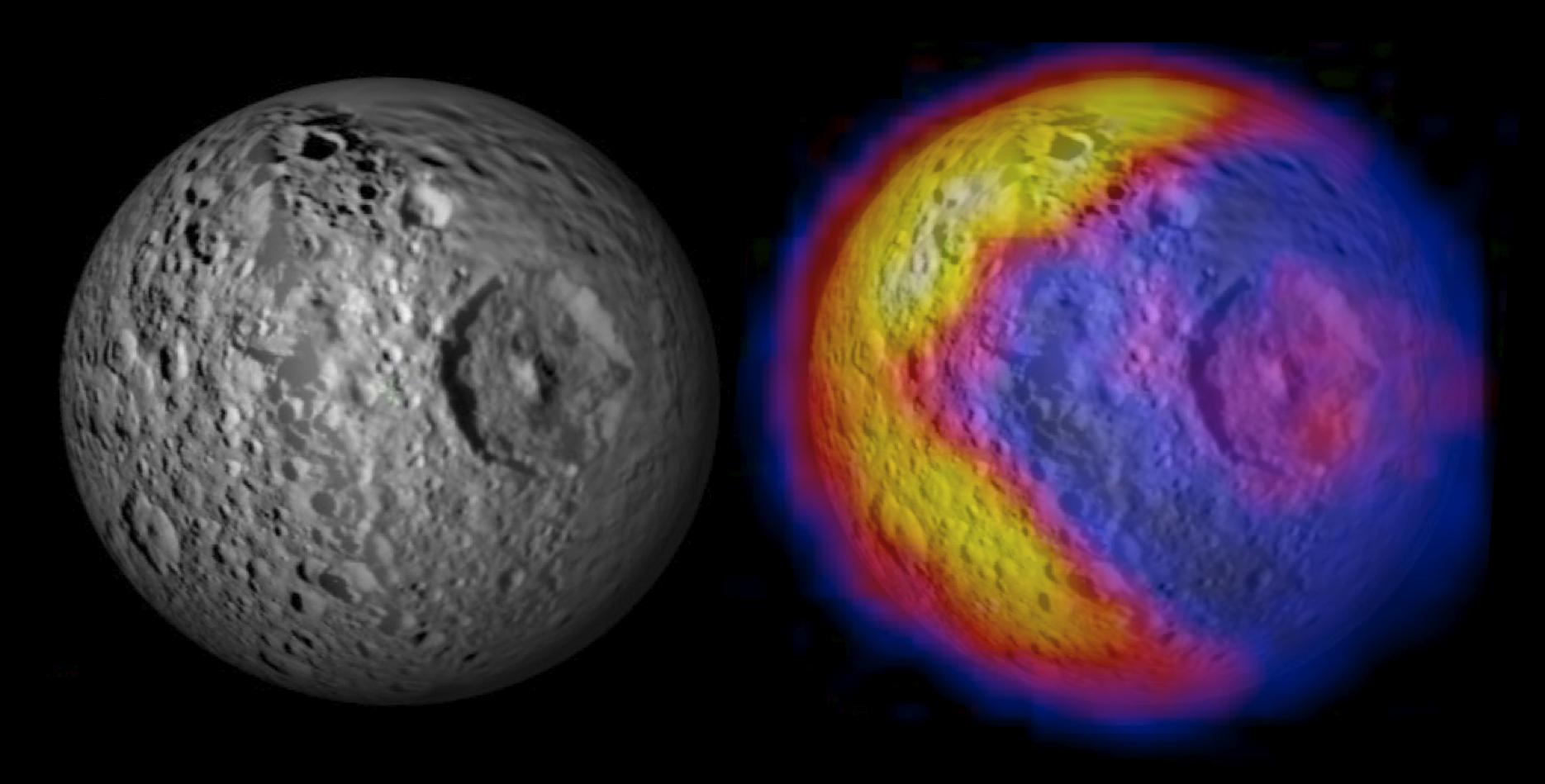
    The left image shows a visible-light image of Mimas, a Saturnian moon that
    has been nicknamed the Death Star because of its “Star Wars” look. The right
    image adds a false-color overlay of temperature data, which makes Mimas look
    more like “Pac-Man” in mid-munch. Click on the picture for a larger version.


    The Cassini orbiter has gotten its closest look yet at Saturn’s moon Mimas, which is nicknamed the “Death Star” because of its curious crater. The fresh imagery has generated new curiosities and yet another nickname for Mimas: the “Pac-Man” moon.


    “After much deliberation, we have concluded: Mimas is not boring. Who knew?!” Cassini imaging team leader Carolyn Porco said in an e-mail announcing today’s image release.


    Linda Spilker, the Cassini project scientist at NASA’s Jet Propulsion Laboratory, agreed: “Other moons usually grab the spotlight, but it turns out Mimas is more bizarre than we thought it was,” she observed in an image advisory. “It has certainly given us some new puzzles.”

    …(read more)

  • Hubble hits new heights


    Imax / NASA

    Click for Imax interactive: The movie “Hubble 3D” and similar efforts bridge
    the gap between cosmic sights and earthly audiences. Click on the image to see
    a Flash interactive model of the Hubble Space Telescope on the Imax Web site.


    As the Hubble Space Telescope nears its 20th birthday, its value for research and the public understanding of science is reaching an unprecedented peak. Few celebrities have been the subject of so many biographies and movies by the time they turn 20.


    The best of the bunch, in print and on the big screen, is arguably hitting the market right now, less than a year after a major upgrade left Hubble in the best shape it’s ever been.

    …(read more)

  • Dark energy in 3-D


    P. Simon (U. of Bonn) and T. Schrabback (Leiden Obs.) / NASA / ESA

    This image shows a smoothed reconstruction of the total matter distribution in the
    COSMOS field based on telescope data. The color coding indicates the distance of
    the foreground mass concentrations, as inferred from gravitational lensing
    distortions. Structures shown in white, blue and green are typically closer to us than
    those indicated in orange and red. Click on the picture for a larger version.


    A 3-D scan of hundreds of thousands of galaxies has confirmed the view that the expansion of the universe is speeding up, due to a mysterious factor called dark energy. The galaxy survey, described in a study set to be published by the journal Astronomy and Astrophysics, serves as one more line of evidence for dark energy’s existence.

    …(read more)