Internet and social networks help Russian prisoners spend their time in prison, says an article at chaskor.ru. Convicts use mobile Internet to access dating sites, search information, and even post their own videos shot on cell phones.
Author: Alexey Sidorenko
-
Russia: Prosecuted Blogger Receives Journalist Award
Mikhail Afanasyev (aka LJ user rukhakasia), blogger from Abakan, Eastern Siberia, received a Journalist Union Award “For Professional Achievement” for a series of articles about the accident at Sayano-Shushenskaya dam, Echo Moskvy reported. The articles led to a criminal case initiated against Afanasyev, which was closed later due to lack of evidence.
-
Russia: Activists Burns Effigy of Policeman
Activists of the movement “Autonomous Action” burnt an effigy a policeman during the “political Maslenitsa“, indymedia reports (photos and footage available). The action was dedicated to Seva Ostapov, a young man violently beaten by policemen and later accused of assaulting them.
-
Russia: Bank Employee Spoils Credit History for $0.26
Blogger logra published the recording of her conversation with a Russian bank employee who called her and in a strikingly impolite manner said he would spoil her credit history for the debt of 26 cents on her account. Logra's post gathered almost 3500 comments, seriously undermining the reputation of the bank.
-
Russia: Actor Calls Against Cooperation with Government
Russian actor Aleksey Devotchenko wrote a desperate post about what professional actors can do to express their protest against current political regime. Among the measures proposed are: not to stage in ‘patriotic' movies, not to participate in concerts organized by police or FSB and so on.
-
Russia: Alpinist Destroys Cars And Blogs About It
Karpovka.ru writes about blogger drunn2007 who works as an industrial alpinist climbing up house walls and breaking excessive ice. On his blog, drunn2007 posts photos of cars damaged by fallen ice adding quite cynical comments.
-
Russia: Protests in 48 Cities Mark “Day of Anger”
Bloggers post photos of mass protests dedicated to the “Day of Anger” held on March 20, 2010. Protests in 48 cities gathered around 20,000 people. Here are the links to pictures and videos from Moscow, Kaliningrad, Vladivostok, Novosibirsk and Irkutsk.
-
Russia: Bloggers Expose Election Fraud Techniques
In 76 regions of Russia people went to voting stations on March 14 to cast their votes for local mayors and regional legislature representatives. The ruling party “United Russia” has won in most of those elections. However, the victory of the party in power wasn't absolute: in Irkutsk people preferred opposition candidate Viktor Kondrashov but this was the only case. Despite the increasing wave of protests (like in Irkutsk [RUS] itself, Kaliningrad, Moscow and others), “United Russia” managed to keep its dominance in all Russian regional legislatures as well as city administration offices.
One of the secrets of such “political stability” (besides state-controlled mass media) is a range of alleged numerous fraud techniques used both by party members and public officials during the elections. These elections were the first to show the power of Web 2.0. in uncovering them. Bloggers gathered evidence of fraud with their cell phone cameras and published them online.
Particularly members of the election observer association “Golos” [EN] (”A Voice”) were quite active in promoting election transparency and exposing fraud. The association installed a fraud hotline website “88003333350.ru” where everyone could post a fraud report. So far, 561 fraud cases have been noted.

Anti-Fraud Hotline, 88003333350.ru
Telephone Voting, Yekaterinburg, Sverdlovsk region
Blogger leonwolf made a capture of the local TV programme where a head of the regional election committee was inviting people to vote by using a phone line and without signing any papers (which is illegal). “You can just call, tell your passport details and if they match those in the database your vote will be counted,” the head of election committee said on TV.Protocol Rewriting, Stanitsa Dinskaya, Krasnodar region.
Russian oppositional newspaper Novaya Gazeta posted a video [RUS], where an employee of the local election committee was allegedly rewriting the election protocol (a document presenting the final result of the election).Vote For Relatives, Yekaterinburg
In the video below two women confess they were brought to the election station to vote for their parents (probably unable to get to the election station by themselves). Such procedure is legal if a person possesses an absentee ballot. But these two women, as well as the whole bus (can be seen on the background) of their “colleagues,” do not have it. And still they're allowed to vote. Not to mention that their transfer was paid by the regional government, as well as a sightseeing excursion after the election.Mass Preliminary Vote, Ivanovo
The most popular fraud technique is a directed at a preliminary vote. It's been practiced among soldiers, policemen and sometimes students. In other words, regional authorities try to mobilize as many people as they can, especially if they have channels of pressure. For students such channel of pressure are various: grades, scholarships, ability to passing an exams, etc.Blogger vitaliy-averin posted this video to illustrate such event:
This video shows a woman checking the absence of students, while these pictures depict a huge crowd at the college hall.
Ballot Insertion, Astrakhan
The video captures two people putting packs of ballots into the ballot box.
All these cases represent current situation with the Russian electoral system. The dominance of the ruling party is based on numerous illegal actions that result in the “expected” election results. At the same time, it shows the weakness of the political system that fails to conduct its political course without such anti-democratic and unlawful measures. But as the bloggers become more and more powerful and as the evidence of the fraud is being more efficiently distributed among Russian netizens, the government's failure to provide free and fair elections can become a real, not virtual, problem.
-
Russia: Authorities Shut Down File Sharing Service
ifolder.ru, Russian file sharing service, has been shut down by police, roem.ru reported. This is the second case of the file sharing site being shut down. The first one was the scandalous case of torrents.ru.
-
Russia: Blogger Criticizes National Post Service
Blogger cyxoupshk published a video (RU with English subs) address criticizing Russian post service. The video is provoked by increasingly bad quality of service as well as recent DHL's shipping suspension.
-
Russia: Photos of Newspaper Office Assault
Regional newspaper Nasha Ryazan (Our Ryazan), published photos of armed men in military outfits (allegedly policemen) blocking the entrance to the newspaper's office. The assault can be connected with the forthcoming regional elections taking place on March 14, 2010.
-
Russia: Mapping Broadband Internet Prices
Russia has experienced an enormous growth of Internet penetration during the last 10 years. But the quality of Internet connection isn't the same for everyone. Quality, price and accessibility of the broadband Internet differ a lot throughout the country with some territories (like Sakhalin [EN]) still being beyond the digital divide. In this article, I'll present the results of the study of broadband prices of the Internet in the Russia's 90 largest cities (with the exception of Moscow and Saint Petersburg). The study was conducted as a part of my Ph.D. thesis for the Moscow State University. More detailed version will be published in the Russian magazine “Internet v Cyfrah” [RUS] in April, 2010.
The analysis focused on unlimited Internet access at the speed of 1 megabit per second (mbs). The original dataset included 810 providers. Then the city median mean was counted. The result of the analysis showed that Russians pay for the same service very different prices. 1mbs unlimited Internet access plan costs from $180 per month in northern Norilsk [EN] to $12 in Yoshkar-Ola [EN] in central Russia. In some cities, there are no 1mb unlimited plans at all and the highest speed people can count on is 256 kbs (if this happened, the special coefficient was used).
Another problem is that in many towns in Siberia and Far East there's no decent broadband and people use satelite Internet which is much more expensive. Below is the table of the cities with the cheapest and the most expensive Internet in the country:
Table 1. Cities with the cheapest broadband prices (November 2009)
# City Broadband price
($ per month)Number of providers 1 Yoshkar-Ola 12 5 2 Kazan 14 13 3 Naberezhnye Chelny 14 6 4 Orsk 14 5 5 Izhevsk 14 14 6 Omsk 15 14 7 Orenburg 15 9 8 Kursk 15 9 9 Kirov 16 9 10 Penza 17 10 Most of the cities in the top-10 are from the Volga region (Yoshkar-Ola, Naberezhnye Chelny [EN], Kazan [EN] and others) where the cheapest prices were found. As a general rule, the cheapest Internet is prevalent in the biggest cities with developed universities (Yekaterinburg, Novosibirsk and others). The railroad connection is also of critical importance due to the technology of the construction of the broadband telecommunications, many of which are constructed along with the railroads.
On the other side, the most expensive broadband can be found in two types of cities: industrial and/or company towns [EN] and in the cities of the North Caucasus. People of the cities with developed oil industry (Surgut and Nizhnevartvosk) do not usually “suffer” from high Internet prices due to higher than average salaries. Both types of cities represent the “risk groups” where the digital divide is present. Poor infrastructure tied with low salaries turns into backwardness on a digital level.
Table 2. Cities with the most expensive broadband prices (November 2009)
# City Broadband price
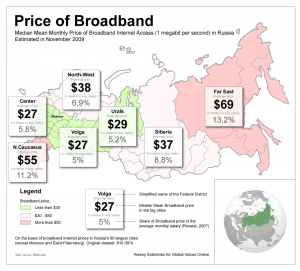
($ per month)Number of providers 79 Syktyvkar 66 2 80 Nizhnevartovsk 67 1 81 Surgut 68 6 82 Komsomolsk-on-Amur 72 3 83 Novorossiysk 76 3 84 Vladikavkaz 91 8 85 Yakutsk 102 5 86 Makhachkala 122 6 87 Nalchik 133 6 88 Norilsk 180 4 Different prices of broadband in the cities lead to a serious differentiation on a regional level. Below is the map of the broadband prices in different Federal Districts [EN] (super-regional administration territorial divisions).
Price of Broadband in Russia, Alexey Sidorenko for GVO
While in the Center, Volga and Urals federal districts the situation with the Internet is rather normal (about $30 for broadband, which is about 5-7 percent of the average income in 2007 and even less in 2009), the situation is much worse in the Far East and North Caucasus where Internet is not only expensive but also less accessible.
Role of government in promoting broadband is positive but not everywhere. Government companies (Center – Domolink, North-West – Avangard, Volga – JDSL, N.Caucasus – Disel, Urals – Utel, Siberia – Web Stream, Far East – Disly) that work in federal districts usually offer the lowest prices and the best conditions. At the same time, in the “problematic” regions like Far East and North Caucasus, government ISP often face monopoly accusations (like it happened with Dal Svyaz). At the same time, government ISPs are expected to be more likely to violate users' rights and less eager to stick to Net Neutrality principles.
Another dimension of digital divide is the size of the city. The analysis shows that the bigger city is the better conditions users have. Internet in smaller cities is usually more expensive and there is less provider competion.
Table 3. Share of broadband price in relation to the average salary
City inhabitants Share of broadband price in the average salary 1,000,000 + 3,6% 500,000 – 1,000,000 5,2% 400,000 – 500,000 5,6% 300,000 – 400,000 7,4% 200,000 – 300,000 8,8% Although Internet penetration rate growth in Russia is impressive, more detailed picture shows there's a lot to be done. As in other parts of the world, there are several factors influencing digital divide: location near main telecommunications arterias, size of the city and it's specialization.
Soviet-era industrial company towns turn out to be less competitive in the post-industrial era. Cities of the unstable and underdeveloped North Caucasus experience the lack of both telecommunications investment and provider competition. Majority of population in smaller cities and towns might have passed the digital divide but still live in the “pre-broadband” world with little or no access to YouTube and other traffic-sensitive online services.
While government officials in the United States and European Union raise the question of the country-wide affordable 30 mbs (or even 100 mbs) in the next decades, Russia's aim should be at least 1 megabit per second.
-
Russia: Video of Directed Voting
Political analyst Alexander Kynev posted a video where students of a local college vote preliminarily in the city of Ivanovo. The video shows one of the most popular fraud techniques in modern Russia: directed preliminary vote that gives 10-15% for the ruling party. The students are either forced or paid to vote.
-
Russia: Photos of Khrapovitskiy Estate
Blogger vadych posted photos of ruins of the magnificent Khrapovitskiy estate, the only Russian estate built to compete with classic French mansions. Under Bolsheviks, the estate experienced nationalization, transformation to public college, then dormitory, fire and now it is close to complete destruction.
-
Russia: Soviet Singer Becomes Internet Meme
A wordless song “I'm Glad I'm Finally Returning Home” performed by Soviet singer Eduard Hill became the recent Internet meme on English-speaking blogosphere. The Youtube video for the song counts about 2 mln. views, 13 thousand comments and 96 video replies.
-
Russia: Two Journalists Kidnapped in Caucasus
Israpil Shovhalov and Abdulla Duduev, two journalists of the “Dosh” online magazine were kidnapped on March 9, 2010 in the Republic of Ingushetia, one of the most unstable regions in Russia, Kavkazky Uzel reported [RUS].
-
Russia: Blogger’s Video Leads to Punishment of Policeman
A blogger posted a video address about a policeman who stopped regular cars on the Moscow belt-road to create a “live barrier” and stop an alleged criminal's car. In less than a day after the blog post, the policeman responsible for this unlawful action got a sever warning, expert.ru reported.
-
Russia: “Postal Cop” Gets Life Imprisonment
Denis Yevsyukov, a 32-year-old Moscow policeman who killed two and injured seven people, was sentenced to life imprisonment on February 20, 2010. The verdict became the hot topic in the Russian blogosphere, igniting discussions about police corruption, modernization challenge and responsibility of the authorities.
Back in April 2009, when the tragedy happened, CCTV video [RUS] of the “postal cop” had a huge effect on the blogosphere. The incredible violence and almost computer-gaming effect of the footage made Yevsyukov a popular culture meme, embodying police irresponsibility and lack of restraint.
Some bloggers like ps_76 celebrated [RUS] the verdict:
Надеюсь что это хоть чуть чуть тормознет охреневшую ментовню.
I hope that this [the verdict] will slow down these crazy cops.LJ user smolyak surrealistically recalled his phobia of policemen that emerged after Yevsyukov's rampage:
В метро я не езжу, но сегодня надо было. И что я увидел. В вагоне рядом со мной стоял настоящий майор Евсюков. Мне стало не по себе. Я представил, как он начнет стрелять. Специально пересел. Все время смотрел на мужика, который должен был первым лечь. Евсюков не стрелял, я вышел на нужной станции.
I don't usually use metro, but today I had to. And this is what I've seen. The real major Yevsyukov was standing in the train cart right next to me. I felt ill at ease. I imagined him starting shooting. I changed my sitting place on purpose. All the time I was staring at some man who should be killed soon. Yevsyukov didn't shoot, I got off on the right station.Blogger smuul called for the reform of the police:
До чего дошли, чтобы в милицейской куртке и стрелять в мирных людей? Это могуть делать только ублюдки. А ведь обыкновенный 32-х летний сопляк… Реформа и только реформа всей системы! А нам меньше болтать и больше работать. Как на Западе. И ЗАКОННОСТЬ во всем, законность, понимаете?
Where did it go to shoot people in police uniform? Only complete bastards can do that. And this was a 32-year-old wimp. Reform and only reform of the whole system! And we should chat less and work more. Like in the West. And Rule of Law everywhere, do you understand?”Four days before the verdict, Yevgeny Chichvarkin [RUS], Russian businessman in exile, suggested [RUS] that the Yevsyukov's rampage was provoked by the corruption in his department and urged “to protect Yevsyukov as the crucial witness of the Moscow police department corruption.” He claimed that the Yevsyukov had become a weak link in the powerful machine of the police corruption, involving raider attacks, drug trafficking and prostitution.
Another blogger samaritatyanin suggested Yevsyukov's rampage was probably much more complicated and doubted the case was [RUS] closed with the verdict:
суд на Евсюковым закончился. осудили, приговорили. вот только так никто и не понял, что произошло то на самом деле. да, он стрелял и убил, ранил. но делал он это явно не в здравом уме, и не пьяный был до белой горячки. я могу сказать только одно – у него съехала крыша, и стрелял он, находясь в мире своих иллюзий – это ведь видно из записи камер магазина.
The Yevsyukov process is over. He's guilty and charged. But no one still understands what really happened. Yes, he was shooting, he killed and injured. But he was clearly insane, he wasn't drunk. I can say only one thing – he was crazy and he was shooting being in the world of his illusions – it can be seen on the CCTVTrying to defend “good policemen,” LJ user severianin made a stand [RUS] against the “campaign against the police,”:
Удивительна и реакция наших сограждан. Они с упоением, как на псовой охоте загонщики, кричат в адрес милиции: “Ату их, ату!” И получается ситуация, когда грехи “евсюковых” висят уже на всех милиционерах, т.е. ты ещё ни в чём не виноват, но уже виноват.
The reaction of our fellow citizens is surprising. Being in raptures, like riding the hounds they cry to police: “tally-ho!, halloo!” And it turns out, that the sins of “yevsyukovs” are hanging on all policement, so you're innocent but at the same time you're already guilty.LJ user defender_faith wondered [EN] who would be the best actor for Yevsyukov's role in a movie. The first answer was “Nicholas Cage,” a reference to the last Werner Herzog's movie with the actor.
Although incidents with violent and corrupt policemen happened before, they have never been that cinematic. A “yevsyukov” became an idiom for the violent cop-criminal, a “bad lieutenant,” person doing everything what he's supposed to fight with. Yevsyukov together with another police Web.2.0 celebrity Aleksei Dymovskiy [EN] developed into the background for the so called “Anti-Police Campaign.” This is a phenomena reported by some media experts who note an increasing number of materials about police crime in all kinds of sources (from independent to Kremlin-affiliated).
-
Russia: Bloggers Outraged About Pedophile Case
Aleksey Sleptsov, a 25-year-old man from St. Petersburg accused of pedophilia, received six years of suspended sentence, fontanka.ru reported [RUS]. Sleptsov was accused of molesting his 5-year-old niece. The court found him guilty of raping the girl 13 (!) times but didn't imprison him. The court justified its decision by presenting good recommendations of Sleptsov from his work and from the members of his family, which was allegedly unaware of the crimes he committed.
Another quite disturbing detail of the case is that police, court and prosecutor's office were silencing the verdict for almost a week. The court's decision would remain unknown if Oksana Homyakova, lawyer of the rape victim, didn't publish the details of the case online. As the matter was publicized, it brought attention of the kid's ombudsman in Russia [EN] Pavel Astakhov [RUS]. After a day of fierce online campaign, he announced [RUS] that he is going to take the case under his personal control and would appeal against the verdict.
The Russian blogosphere was disgusted with the mild verdict. Many bloggers stressed that giving a suspended sentence for pedophilia is an encouragement for further crimes. At the same time, the Governor of St. Petersburg Valentina Matvienko proposed forced sterilization for all persons accused of pedophilia.
Influential blogger radulova was among the first to write about this case [RUS] by copy-pasting the news message. However, a couple of lines provoked a heated discussion with lots of cursing and emotional hate-speech towards pedophiles. Another discussion emerged at fontanka.ru.
Кошмар какой!!! Все с ног на голову перевернули. Насилуют детей – и никто за это не наказывает!А судьи кто?
It's horrible!!! All things are topsy-turned. Kids are being raped – and no one is punished for that! And who are the judges?кастрировать эту тварь…и пусть дальше работает и жену радует, сука!!!
Castrate this beast… and let this bastard work and have a happy life with his wife.Вообще шесть(!) лет условно – это ппц… они бы еще пожизненное условно стали давать… 🙂
Basically, six (!) years of suspended sentence is crazy… They should also give a suspended life sentence, too… 😉Да, было бы хорошо еще татуировку на лоб – педофил. Если после 15 лет в тюряге выживет, то где-то в переулке точно получит “правосудие”…
А судье бы тоже написать “Помогаю педофилам”, как за взятку отсидит (если отсидит) пусть что хочет, то и делает. Никакой гуманной справедливости быть не может.It would be good to make a tatto on a forehead – “a pedophile”. Even if he survives 15 years in prison, in some alley he would definitely get his “justice”… And a judge should get a tattoo “I help pedophiles,” and when he/she survives the jail for bribery (if he/she will) so let him/her do what he/she wants. There can't be a humane justice.Не обсуждаю несоразмерность наказания преступлению – это очевидно.
Но кроме этого я считаю, что родители в таких случаях винованы очень. Невозможно незамечать, что с таким маленьким ребенком (а началось все, когда девочке было пять лет!) происходит что-то ужасное! Кто-нибудь пробовал договориться о чем-то с пятилетним ребенком, да еще и быть уверенным, что ребенок сохранит тайну? Когда вы в последний раз видели пятилетних детей? В этом возрасте они не могут лицемерить (страшно, боятся человека – покажут это, просто не смогут скрыть). Если ребенок испуган, травмирован – это видно невооруженным глазом. Почему не поднимают вопрос виды родителей в таких случаях?I'm not discussing the disproportion of the crime and punishment here – it's obvious. But I think that parents are very guilty in such cases. It's impossible not to notice that with such a small kid (and it all happened when the girl was five!) something horrible is going on. Did anyone try to talk to the kid and be sure that the kid keeps the secret? When did you see 5-year-olds for the last time? In this age they can't be hypocritical (if they're afraid of a person – they will show it, they simply can't hide it). If a kid is frightened, traumatized, it can be noticed with a naked eye. Why no one raises the question of parents' guilt in such cases?Twitter users were active in trying to dig in the case. One Twitter user published the telephone number [RUS] of the judge who gave such verdict. Alex_FG posted [RUS] a call to find his profile on the social networks and find him personally.
The mildness of the verdict made the majority of bloggers almost choke with blood, lust and loathing. Most of the bloggers expressed their sympathy to physical reprisal both with the criminal and the judge who issued such a decision. Very little voices spoke of a legal solution to the problem and almost no one tried to find all the details of the case. At the same time, Sleptsov's case became a good example of online “justice” campaigns, which turned out to be even more effective and mobilizing than “advocacy campaigns.”

