Author: Anthony Clark Arend

  • Opinio Juris’s Online Symposium on Glennon’s “The Blank-Prose Crime of Aggression”

    Professor Michael J. Glennon

    Professor Michael J. Glennon

    As indicated in a previous post, Opinio Juris is hosting the Yale Journal of International Law Online Symposium on Professor Michael Glennon’s article, The Blank-Prose Crime of Aggression.”  Professor Glennon’s initial post has appeared today. The response of Larry Johnson, former UN Assistant-Secretary-General for Legal Affairs, can be found here. And, finally, my response can be found here.

    Be sure to follow Opinio Juris for comments and responses to these posts.

  • Breaking News: Supreme Court sends Uighurs’ case back to the D.C. Circuit Court of Appeals

    SCOTUSblog reports:

    The Supreme Court on Monday ordered the D.C. Circuit Court to take a new look at the case testing federal judges’ powers to order Guantanamo Bay detainees released from custody — a case the Justices had granted and were to hear later this month.  In a brief order, without noted dissent, the Court said the Circuit Court was to decide “what further proceedings in that court or in the District Court are necessary and appropriate for the full and final disposition of the case in light of…new developments.”  The case is Kiyemba, et al., v. Obama, et al. (08-1234).  The “new developments” are offers to resettle the seven Chinese Muslim Uighurs remaining at Guantanamo.

    The Justices’ action has two immediate effects: first, it wipes out the Circuit Court’s earlier ruling that federal judges have no power to order release into the U.S., even temporarily, because that is an immigration matter exclusively for the President and Congress, and, second, it means that the Justices will not have any final ruling this Term on detainee matters, putting the Court on the sidelines while the two other branches of government work out where to go next on policy involving capture and detention of individuals during the government’s “war on terror.”  President Obama wants to close Guantanamo, but there are efforts in Congress to keep it open in order to assure that no detainee reaches the U.S. shores, even for further detention.  There are also efforts on Capitol Hill to block any criminal trial in the U.S. of a Guantanamo prisoner, including those who have been charged with the 9/11 terrorist attacks.

    A third effect of Monday’s order very likely will be that the Court may not act this Term on a second Kiyemba case (same title, docket 09-581) that offered another opportunity to explore the courts’ authority to deal with Guantanamo captives’ fate.  That case involves some of the same individuals who appealed in the case the Court agreed to hear in October.  (The granted case is now informally known as “Kiyemba I.”  The case in 09-581 is known as “Kiyemba II.”)

  • Opinio Juris to host Yale Journal of International Law Online Symposium on Glennon’s “The Blank-Prose Crime of Aggression”

    Professor Michael. J. Glennon

    Professor Michael. J. Glennon

    Julian Ku over at Opinio Juris explains:

    On Monday, Michael J. Glennon of the Fletcher School of Law and Diplomacy will be leading a discussion around his timely Article The Blank-Prose Crime of Aggression. In his Article, Glennon addresses the draft definition of the crime of aggression that was released in early 2009 and is set to be voted upon by the Assembly of States Parties to the International Criminal Court (ICC) this coming May. This crime has remained undefined since being included in the ICC’s underlying Rome Statute, for what Glennon maintains are good reasons. He argues that the crime of aggression is subject to too much disagreement among strong and weak states to reach the level of specificity necessary for imposing individual criminal liability. As a result, the draft definition is ambiguous, overbroad, and inconsistent with the Rome Statute’s own requirement that the court act consistently with internationally recognized human rights. Given these difficulties, Glennon argues that efforts to criminalize aggression along these lines be dropped. Anthony Clark Arend of Georgetown University and Larry Johnson of Columbia Law School will both provide responses.

    It was my honor to be able to comment on my friend Mike Glennon’s post. In a time when international law has come under great criticism, Glennon is one of the far too few international legal scholars that have a realistic and accurate understanding of the nature of international law. I look foward to the comments to his posts and our responses. And I would encourage everyone to read Glennon’s  full article, The Blank-Prose Crime of Aggression. It is outstanding.

  • Transcript of Oral Argument in Holder v. Humanitarian Law Project

    Ralph Fertig, President, Humanitarian Law Project

    Ralph Fertig, President, Humanitarian Law Project

    A previous post noted that oral argument was to be held last Tuesday in Holder v. Humanitarian Law Project. The transcript from the oral argument  can be found here.

    In case you missed it, the New York Times described the oral argument as follows:

    The Supreme Court struggled Tuesday to balance the constitutional rights of humanitarian aid groups with the government’s efforts to combat terrorism.The issue arose in a challenge by aid groups and individuals to parts of a key anti-terror law that bans ”material support” to foreign terrorist organizations, even when that support consists of training and advice about entirely peaceful and legal activities.

    The aid groups involved had trained a group in Turkey on how to bring human rights complaints to the United Nations and assisted them in peace negotiations, but suspended the activities when the U.S. designated the Turkish outfit a terrorist organization in 1997. They also wanted give similar help to a group in Sri Lanka, but it, too, was designated a terrorist organization by the U.S. in 1997.

    Several justices seemed unsure how to resolve a dispute in which they acknowledged legitimate points on both sides. It is the court’s first look at a terrorism-related criminal law since the Sept. 11, 2001, attacks.

    ”This is a difficult case for me,” declared Justice Anthony Kennedy, who often provides the decisive vote that delivers a court majority.

    The humanitarian groups, backed in this case by former President Jimmy Carter, say the law makes a crime out of speech — in violation of the Constitution. ”The government has spent a decade arguing that our clients cannot advocate for peace,” David Cole, the lawyer for the aid groups and individuals, told the court.

    The administration urged the court to reject the challenge. Any aid to terrorist groups ‘’strengthens them in everything they do,” Solicitor General Elena Kagan said. Kagan emphasized the material support law’s importance, calling it a ”vital weapon” in combating terrorism.

    The argument took place a day after 25-year-old Najibullah Zazi pleaded guilty in New York to providing material support to al-Qaida, among other charges, as part of a plan to attack the New York subway.

    Nearly four dozen organizations are on the State Department list, including al-Qaida, Hamas, Hezbollah, Basque separatists in Spain and Maoist rebels in Peru.

    The humanitarian groups, including the Humanitarian Law Project; Ralph Fertig, a civil rights lawyer; and Dr. Nagalingam Jeyalingam, a physician, want to offer assistance to the Kurdistan Workers’ Party in Turkey or the Liberation Tigers of Tamil Eelam in Sri Lanka.

    The government says the Kurdish rebel group, known as the PKK, has been involved in a violent insurgency that has claimed 22,000 lives. The Tamil Tigers waged a civil war for more than 30 years before their defeat last year.

    Justice Sonia Sotomayor was among those who suggested the law could be too broad.

    ”Under the definition of this statute, teaching these members to play the harmonica would be unlawful,” Sotomayor said.

    Kagan replied, ”The first thing I would say is there are not a whole lot of people going around trying to teach al-Qaida how to play harmonicas.”

    Justice Antonin Scalia, who seemed most receptive to the government’s argument, interjected: ”Well, Mohamed Atta and his harmonica quartet might tour the country and make a lot of money. Right?”

    Scalia was referring to the lead Sept. 11 hijacker.

    Supporters of the aid groups have invoked the specter of McCarthyism in a law they say subjects U.S. citizens to prison merely for speech.

    Former President Carter, whose Carter Center seeks to mediate international disputes, said the law threatens the work of groups that share the government’s goal of ending terrorism.

    ”Our work to end violence sometimes requires interacting directly with groups that have engaged in it,” Carter said in a written statement.

    On the other side, the Anti-Defamation League said the law is a reasonable approach to fighting terrorism that does not infringe on constitutional rights.

    The administration, defending a law that has been on the books since 1996 and modified twice since then, said there is no limit on speech because people can say whatever they want in support of terrorist groups and even may, in one example Kagan batted around with Kennedy, call on a group to lay down its arms.

    But that advice crosses the line into illegal activity when it becomes a manual on how to approach the United Nations and lobby for aid, Kagan said.

    The reason for this, she said, is ”you’ve given them an extremely valuable skill that they can use for all kinds of purposes, legal or illegal.”

    The court is expected to issue its decision by late June.

  • Does the Establishment Clause in the US Constitution limit foreign policy?

    Dr. Michael Kessler, Assistant Director of the Berkley Center for Religion, Peace and World Affairs

    Dr. Michael Kessler, Assistant Director of the Berkley Center for Religion, Peace and World Affairs

    Over at Georgetown/On Faith in the Washington Post, my colleague Michael Kessler is beginning a series of articles on that question. He explains:

    Does the Establishment Clause prevent the President from using or aiding religion as part of foreign policy? Absolutely not, so long as it is not action upon U.S. citizens.

    You may not like this result, and you may think that the President should be constrained from rendering aid to foreign religious activities. Please note: I am not making a claim at this point about whether or not the President and the U.S. government ought to be able to give aid or conduct activities in a foreign context that may advance or inhibit religious activity.

    My point is more narrow: if you want to prevent the President from advancing or inhibiting religion in foreign affairs, you will need to find other ways than the Establishment Clause to constrain the President.

    The authors of a major report issued this week by the Chicago Council on Global Affairs state the matter bluntly: “The conduct of U.S. foreign policy is complicated by questions surrounding the relevance and applicability of the Establishment Clause of the First Amendment to the U.S. Constitution.” This is a complicated issue, precisely what I am addressing in a forthcoming, lengthy article. So it is a ripe moment to address the report over the coming weeks and to introduce what I hope are some clarifications about the way to address this issue.

    This confusion about whether the Establishment Clause applies to the foreign actions of the United States arises from doctrinal uncertainty about the scope of the Clause:

    It is unclear…whether and how…domestic nonestablishment constraints apply to U.S. foreign policy. There are reasonable arguments that the clause imposes significant limits on the conduct of foreign policy, and there are equally reasonable arguments that it imposes only relatively narrow limits that have little or no practical effect on the policies recommended in this report.

    The task force authors offer their strongest argument for why the Establishment Clause limits the President’s conduct of foreign policy:

    There is a general assumption that the Constitution and Bill of Rights (including, presumably, the Establishment Clause) apply to most U.S. government action abroad. Moreover, the Supreme Court treats the Establishment Clause, unlike other provisions of the Bill of Rights, as a structural limitation on government that is not subject to a balancing of interests. This conception of the clause, in turn, suggests that it should apply regardless of whether the government acts domestically or overseas.

    A bit thin of an argument, you say? Indeed. “General assumptions” not grounded in principled legal doctrine won’t take us very far when the result may be serious misunderstandings of how Constitutional clauses should and do operate.

    To help clarify this thorny mess, I will sort through these issues in detail over the coming weeks, the most important of which are: 1) the theoretical and historical contours of the Establishment clause (this week), as well as modern Court interpretation (2nd week); 2) whether the Establishment Clause could be used in a lawsuit to attack the President’s conduct of foreign affairs (3rd week); 3) whether Presidential power in foreign affairs more generally can be constrained about the choice of means to achieve a foreign policy goal (4th week)?

    I will conclude (5th week) with some application of these ideas to an actual foreign policy program the United States conducted after 9/11 and at the start of the global war on terror, in which significant funding was provided to advance the cause of democracy promotion and to assist the infrastructure capacity of liberal and moderate Islamic leaders.

    This look fascinating! Go read the rest of today’s column and check out coming articles.

  • The UN’s approval ratings– better than Congress

    My friend and colleague, Erik Voeten posts over at The Monkey Cage:

    A new Gallup World Affairs Poll shows that thirty-one percent of Americans say the United Nations is doing a good job of solving the problems it has had to face. This is a slight improvement over last year’s numbers but still low. Over at Opinio Juris, there is a debate on whether these low approval numbers reflect the ignorance of Americans about what the UN actually does. Perhaps, although it is important to put these numbers in some context. For example, only 18% of Americans gives Congress a favorable approval rating. More importantly, the temporal fluctuations in approval ratings are quite sensible.

    GallupUN.gif

    Approval first dipped in the 1970s when the Cold War produced a stalemate that led to what legendary political scientist Erns Haas labeled “regime decay” at the UN. Just to give some numbers: between 1977 and the start of the Gulf War, the UN Security Council adopted only two resolutions under Chapter VII (resolutions that are binding and used to authorize sanctions and force).

    This changed rather dramatically after the success of the first Persian Gulf War. Between 1990 and 1998, the Council approved 145 Chapter VII resolutions. Yet, some of those authorized missions didn’t turn out so well. One can hardly blame Americans for lowering their faith in the ability of the UN to solve problems after what happened in Srebrenica and Rwanda in the mid 1990s. Richard Holbrooke likes to say that:

    blaming the U.N. for Rwanda is like blaming Madison Square Garden when the Knicks play badly

    Yet, this is not very persuasive as the UN itself acknowledged in the Brahimi report and its Srebrenica report. Surely, the UN bureaucrats can’t stop genocide by themselves but bureaucratic dysfunctionality didn’t help matters either, as Michael Barnett points out in Eyewitness to a Genocide.Approval then went up again around September 11, when the UN did act decisively, and dropped during the Iraq war controversy. We don’t know, of course, whether Americans lost their faith in the UN because it failed to authorize the war in Iraq or because it failed to prevent the U.S. from launching the invasion. There is probably some of each going on and both seem reasonable inferences depending on ones ideological starting point. In the aggregate, then, these data don’t give much reason to believe that the “public” is any more or less unreasonable in its judgments of UN job approval rates than it is in evaluating Congress or other institutions.

    I think Erik’s analysis makes a lot of sense. But I do think that many Americans don’t really understand the actual nature and role of the United Nations. Of course, I am not sure the ratings would be any higher if they did. The UN does so many different things– Dr. Jose Sorzano, who was Deputy Permanent Representative to the UN from the US in the 1980s, used to say, there were several “UN’s”– the UN of the Security Council, the UN of the Specialized Agencies, the UN of the General Assembly, etc.  How somebody would rate “the UN,” would depend upon which of these “UN’s” that person had in mind.

  • ORAL ARGUMENT TODAY: Holder v. Humanitarian Law Project

    As SCOTUSblog reports, the oral argument is scheduled for

    ~10 a.m. -In Holder v. Humanitarian Law Project (08-1498; 09-89), the Court will consider whether a federal statute prohibiting the knowing provision of “any service, training, [or] expert advice or assistance” to a designated foreign terrorist organization is unconstitutionally vague.  Lyle Denniston’s discussion of the case is here.

    My Georgetown University Law Center colleague, David Cole, will be arguing for the Humanitarian Law Project.

  • NATO Secretary-General Anders Fogh Rasmussen’s Georgetown Speech

    Anders Fogh Rasmussen

    Mrs. Albright,
    Dr. Arend,
    Ladies and Gentlemen,

    First of all, let me thank Georgetown University and the Center for New American Studies for this opportunity to meet with you all.

    And let me also take this opportunity to pay tribute to you, Secretary Albright. You have paid exceptional service to the United States for many years and last summer, though still busy, you accepted to take on the task of leading the Group of Experts to develop the draft for NATO’s new Strategic concept. For that I am extremely grateful. NATO will benefit from your unique experience. Thank you.

    Georgetown has an excellent and international reputation. I’m quite sure that many of you will be in key positions a few years from now, dealing with important issues of national and international security.

    That’s why I am keen to share with you my views on the security challenges of today and tomorrow, and in particular on the role of NATO — the security Alliance that connects North America and Europe — in meeting those challenges. Because, in a nutshell, I believe NATO doesn’t fully get the visibility it should, in the US, for what it does to preserve security today.
    And because I am sure that it will be, and should be, an essential part of this country’s security for a long time to come.

    Thomas Jefferson once said, “The most valuable of all talents is that of never using two words when one will do.” In that spirit, I will try to be brief – even though being too brief can be counterproductive. Former Russian President Boris Yeltsin once was asked to describe the situation in his country in just one word. He said: “Good”. “And – he was asked -if you had two words?” ”Not good!”

    So you see: Being too brief can distort the message. And my message to you is, in fact, quite straightforward: if we want to be secure in a world of global risks and threats, likeminded and democratic nations need to cooperate. The problems of the 21st century can only be solved multilaterally. And there is no stronger, more effective framework for that cooperation than NATO.

    Now, I realise that this is probably what you would expect the Secretary General of NATO to say. You might even think that I am paid to say it. But you don’t have to take my words at face value. Let me give you three concrete examples that demonstrate my point.

    First, terrorism. On September 11, 2001, the United States suffered a devastating terrorist attack. And of course, the United States was powerful enough to strike back and deal a heavy blow to Al Qaeda and the Taliban.

    But did you know that, on September 12th, all of America’s Allies in NATO declared that they considered this attack on America as an attack on them as well? Did you know that NATO sent aircraft to patrol the skies here in the United States? Did you know that all NATO countries put their ports and airfields at US disposal for the operation into Afghanistan? Or that most of them sent Special Forces, alongside US soldiers, in the initial military response?

    That was true solidarity, at a critical time. But that solidarity is just as important in Afghanistan today. Making Afghanistan inhospitable to terrorism is a huge challenge. It is complicated, and expensive, and often painful. No one country – not even the United States – could do this alone. But because of NATO, you are not alone.

    44 countries have soldiers in Afghanistan, under NATO command. Sharing the risks, the costs and the burdens with the United States. The non-US members make up 40% of the total number of forces. They also take 40% of the casualties. That is an enormous demonstration of solidarity in fighting terrorism together.

    Second, cyber attacks. You all know the upside of the Net. You can chat with people you would have never met. You can turn on the heating in your house from another country. You can even get someone else’s text for your university paper with one Google search – though I’m sure no one at Georgetown would dream of doing that.

    But like with anything, there is a dark side. Interconnectedness also means vulnerability. A well-orchestrated cyber attack can shut down air traffic control. It can turn off the power in your house, your city, your country. It can shut down banks – which means no money for anyone.

    This isn’t fiction. It has happened. Our NATO-Ally Estonia suffered a few years ago from a sustained, directed cyber attack that shut down a lot of essential services.

    Luckily, Estonia was able to withstand the attack. but NATO was called upon to provide advice and assistance, and we’ve set up a team that can deploy wherever needed, to support any Ally in case they come under this kind of attack.

    Cyber attacks can’t be stopped at the border. You need sustained international cooperation, between countries that trust each other. And that certainly includes NATO.

    My third example: nuclear proliferation and missile defence. President Obama’s vision of a nuclear-free world has received a lot of attention, and for good reason. But it is a long-term vision. Right now, Iran and North Korea are looking in quite the opposite direction. And more and more countries are looking to acquire missiles. In the coming years, we might well see more fingers on more triggers. And so missile defence has become a strategic imperative.

    To my mind, missile defence makes the most sense in an Alliance context. That way, you get forward-based sensors and infrastructure. Allied defence systems can fill the gaps in the US system’s coverage. And doing it through NATO can help to share the cost.

    In short, doing missile defence together is the better deal, in terms of effectiveness and price. It is also a concrete manifestation of shared security – one roof that we build together, that we support together, and that offers protection to us all. Including, I hope, to Russia.

    These are just three examples. I could easily extend that list – protecting our energy supplies; combating piracy; coping with the security implications of climate change. But I hope my first point is clear — that we can only cope with these challenges if we work together.

    My second point is that NATO is, and will remain, the gold standard for security cooperation, for this country and for all the Allies.

    Why? First, because NATO brings together the United States, Canada, and Europe – in short, the transatlantic community. This community remains the strongest and most likeminded group of democracies. We are nations that share the same values: freedom, individual liberty, religious tolerance, and the rule of law.

    But we are also a unique economic community. As a matter of fact, the European and American economies have never been as intertwined as they are today. Even in the current economic crisis, with less than one eighth of the global population, America and Europe generate more than half of the world’s Gross Domestic Product. Of course, China is growing, and so is India. But when it comes to open, rules-based trade between like-minded democracies, Europe and North America are unique.

    Now, like-mindedness, shared values and economic interdependence are certainly good things. But do they also translate into common security policies? I believe that they do. And Afghanistan is the best demonstration. All 28 Allies are in this mission together. Many have taken serious casualties. In fact the five Allied nations with the highest casualty figures per capita are Denmark, Estonia, UK, Canada and the United States. In that order. Still, in spite of the heavy costs in blood and treasure, none of those countries has quit.

    In fact, when President Obama announced a major increase in US troop levels, 35 other countries announced increases of their own.

    And I believe that these new forces, and our new approach, is already having an effect on the ground. There is new momentum. I am confident that this year, we will be able to start transferring security responsibilities to the Afghans themselves – district by district, province by province. And eventually, we will be able to concentrate more on support and training of the Afghan armed forces and police.

    Of course, there will be bad days, included when we cause unintended civilian casualties.

    I just spoke to President Karzai and expressed my deep regrets and condolences for the latest incidents where Afghan civilians have lost their lives.

    As I just said, all 28 NATO Allies are in Afghanistan. But the total number of nations working together in the International Security Assistance Force is 44. And that points to another reason why NATO is unique: it provides a tried-and-tested framework that generates cooperation far beyond its member states.

    NATO is a permanent Alliance, with a multinational political and military structure, and with over 60 years of experience in security cooperation. Put another way, we are no ad-hoc coalition of the willing. And this gives NATO a degree of competence, credibility and legitimacy that encourages even non-NATO countries to put their forces under NATO command.

    We have those partners because, after the end of the Cold War, NATO adapted. We reached out. And we will have to do more of it. A key priority for me is to enhance NATO’s “connectivity” with the broader international community, by building new ties to civilian actors – the United Nations, the European Union, the World Bank, all the way to the NGO community.

    We are also deepening our partnerships with countries from across the globe, from Australia to Japan. I believe we should also reach out to the rising stars of this century, such as China and India, where we have common security interests. And we are pushing ahead with the transformation of our military forces, to make them more flexible and useable.

    In order to bring these different strands of NATO’s adaptation together, we are currently working on a new Strategic Concept. This is a guiding document for NATO. We revise it about every ten years. The new one will describe how NATO will handle future security challenges, and allow us to set the right political and military priorities.

    I have asked a group of independent experts, chaired by Madeleine Albright, to come up with recommendations for our new Strategy by the end of April. Their report will provide the baseline for NATO’s internal deliberations. At our next Summit in Lisbon in November, we will publish the new Strategic Concept.

    The development of our new Strategy is the most open and inclusive process ever in the history of the Alliance. We’ve gotten input from experts and the broader public – not just in our own member countries but all over the world. And I would encourage you to take a moment to go the NATO webmodule on the Strategic Concept, have a look, and let us know what you think. And let me assure you – we really do read it.

    Ladies and Gentlemen,

    NATO was founded 61 years ago – before almost anyone in this room was born. Yes, including me, in case you were wondering. It cut its teeth in the Cold War – which yes, I remember, but for many of you is just history. So you have every right to ask: “What is in it for me today? What will be in it for me tomorrow??”

    Well, NATO is doing a lot for you – and for all the 900 million people in NATO countries. It defends our values and our interests. It embodies security cooperation amongst democracies who can trust each other. It provides solidarity and legitimacy where it matters – including in difficult operations. And it draws an ever larger group of countries into a common multilateral approach.

    In sum, the Atlantic Alliance squares the circle of multilateralism and effectiveness. That is not easy to do. But today, more than ever – when we are looking for security, in an age of uncertainty – it is precious. You can find it in NATO today. And you will be able to rely on NATO tomorrow as well.

    Anders Fogh Rasmussen with Madeleine Albright before the speech

    Anders Fogh Rasmussen with Madeleine Albright before the speech

    Speech courtesy Anders Fog Rasmussen’s Facebook page.

  • LIVE-STREAMING TODAY at 1PM: Anders Fogh Rasmussen, NATO Secretary General, speaking on- “NATO: Delivering Real Security in an Age of Uncertainty”

    Anders Fogh Rasmussen

    Anders Fogh Rasmussen

    Georgetown University
    and
    The Center for a New American Security
    (CNAS)

    will live-stream a lecture by

    His Excellency Anders Fogh Rasmussen
    North Atlantic Treaty Organization (NATO) Secretary General

    with

    The Honorable Madeleine Albright
    Former Secretary of State and
    Chair of the Group of Experts on the new NATO Strategic Concept

    ‘NATO – Delivering Real Security in an Age of Uncertainty’

    Monday, February 22, 2010
    1:00 p.m. – Gaston Hall

    The Lecture will be available for viewing on http://webcast.georgetown.edu/live and on campus cable Channel 2.

    Secretary General Anders Fogh Rasmussen

    Mr. Rasmussen – who has been called “NATO’s reformer” by TIME Magazine – is responsible for steering the decision-making and implementation process within the Alliance. His public service career has spanned decades and has included top leadership and foreign policy positions within the Danish government, including Prime Minister, which he served from 2005 to 2009. Read Secretary General Rasmussen’s full biography here.

  • What is “material support” for terrorism?

    An editorial in Saturday’s Los Angeles Times notes:

    When most Americans hear that it’s illegal to supply “material support” to foreign terrorist groups, they probably assume that the prohibition involves financial or technical support — sending money to pay for hijackers’ air fares or providing wiring for a bomb (or advice about how to use it).

    In fact, the law also seems to prohibit residents of this country from trying to talk political movements out of terrorism or counseling them on how to bring their grievances before international bodies. On Tuesday, the Supreme Court will be asked to invalidate those sections of the law. It can and should do so without undermining the primary purpose of the law.

    At issue in the case is language in the law, which was revised in 2004, that makes it a crime to aid a group on the secretary of State’s list of terrorist organizations. It’s not only illegal to furnish such groups with money and tangible assets like explosives and communications technology but also with “expert advice” — defined as “advice or assistance derived from scientific, technical or other specialized knowledge.” The law also forbids supplying terrorist groups with “personnel” — defined as persons working under the group’s “organization, direction or control” to further its policies.

    These provisions may seem reasonable, but they extend beyond the common-sense definition of “material support” for terrorism. For example, USC professor Ralph Fertig, a Kurdish rights activist who is challenging the law, wants to counsel a Kurdish nationalist organization in Turkey — a group that undoubtedly has engaged in acts of terrorism — to abandon violence and take its political grievances to the United Nations. He argues that the law’s reference to “expert advice” bars him from engaging in such speech.

    Another problem with the law is that it could make it a crime for U.S. supporters of a cause to help groups that have engaged in terrorism to explain themselves. Would an intermediary who worked with a Hamas official to publish an Op-Ed article about the Israeli-Palestinian conflict be subject to imprisonment? Those challenging the law argue that its language is vague enough to cover such a possibility, yet that hardly seems a case of giving material support to terrorism.

    The Obama administration, defending the law, scoffs at the notion that its provisions are unconstitutionally vague or overly broad. And it notes that the law only applies when U.S. residents have direct contacts with terrorist groups; it does not limit a citizen’s right to speak or write on their own in support of such groups (or to counsel them in print to forswear violence).

    The government also makes a more general case: that preventing even benign contact and conversation with foreign groups that engage in terrorism isolates them — or, as a Justice Department lawyer put it: “Congress wants these organizations to be radioactive.” The assumption is that a group so stigmatized and starved of resources will have an incentive to abandon terrorism. But anyone who has followed the legitimization of the Palestine Liberation Organization or Sinn Fein, the political wing of the Irish Republican Army, knows that such movements can be open to persuasion even as some of their adherents are engaging in violence.

    The point was well put in a brief filed by the Carter Center and other groups that seek to resolve international conflicts. They noted that “peacemaking, conflict resolution, human rights advocacy and the provision of aid to needy civilians sometimes requires direct engagement with groups and individuals that resort to or support violence, including some that are, or have been, designated” foreign terrorist organizations.

    Lawyers challenging these provisions offer the court a simple way to resolve this case. It should interpret the law to require “proof of intent to further the designated organization’s illegal activities.” That way the court can protect the 1st Amendment without undermining the war against terrorism.

    It will be interesting to see what the Court will do.

  • Former CIA and NSA Director, Gen. Michael Hayden, joins Georgetown University’s cybersecurity team

    Georgetown University has just announced that Michael Hayden has been brought on as a senior advisor to work on cybersecurity issues. Rob Mathis of Georgetown’s Office of Communication writes:

    Gen. Michael Hayden, former director of the National Security Agency has joined Georgetown University as a senior advisor to its new project that integrates law, policy and technology to tackle the issue of cybersecurity.While at Georgetown, Hayden will work alongside faculty and researchers to create viable proposals for policymakers in defending the digital domain.

    “General Hayden is one of the most respected experts in national security and intelligence,” said Chester Gillis, dean of Georgetown College. “As a senior advisor to Georgetown’s cyberproject he will provide invaluable guidance and experience as we work to understand and tackle some of the most pressing issues around cybersecurity.”

    “With a new set of global challenges, the realm of cybersecurity is one that must be taken up by the global community with a focus on promotion of information, preservation of civil liberties and protection of national security interests,” Hayden said.

    Hayden, who retired from the Air Force after 39 years of active service and stepped down from his position as director of the CIA in February 2009, has overseen many changes within the government’s cybersecurity. In addition to his role as NSA director, he has served as commander of the Air Intel Agency, director of the Joint Command and Control Warfare Center and as a senior member of the National Security Council.

    The university, a National Security Agency Center of Excellence in Information Assurance, will draw expertise from multiple areas on campus for the cybersecurity project, including the Walsh School of Foreign Service, the McDonough School of Business, the Center for Peace and Security Studies, the computer science department and other a programs within Georgetown College such as the Institute for Law, Science and Global Security.

    “I am honored to have General Hayden join the Institute’s efforts at Georgetown University to confront cybersecurity challenges,” said Catherine Lotrionte, Institute for Law, Science and Global Security. “He is a highly-regarded player in this area and his contributions will be essential in moving forward with the cyberproject.”

    Georgetown’s new project has led to collaborations with entities committed to securing cyberspace and protecting civil liberties — such as the Lawrence Livermore National Laboratory, Raytheon Company, Oak Ridge National Laboratory and others.

    Additionally, the university sponsored Cyber ShockWave, an exercise that brings together a bipartisan group of former senior administration and national security officials playing the roles of Cabinet members responding to a simulated cyberspace attack. Hayden developed the Feb. 16 exercise, which was held at the Mandarin Oriental Hotel in Washington, D.C., in collaboration with the Bipartisan Policy Center and other sponsor partners.

    “It is a privilege to be working on this important endeavor in protecting America’s cyberdomain while defending personal liberties,” Hayden said. “I am looking forward to the partnership between academics, scientists and private enterprises in order to develop practical solutions to the national security challenges facing the United States now and in the future.”

    I think this is an excellent development. I have had occasion to work a bit with General Hayden on aspects of this project and believe that he will make an important contribution to the work of the University.

  • The United States, Robert Gibbs and Torture

    Does this bother anyone? Jonathan Turley posts:

    With Dick Cheney boasting on national television of his support for waterboarding and torture (here), the Obama White House is continuing its policy of ignoring the credible claims of war crimes to avoid the politically difficult decision to prosecute Bush, Cheney and others for the U.S. torture program. This was evident this week when White House spokesman Robert Gibbs refused to answer a basic question on the torture of a recently captured Taliban leader– offering only to discuss the matter off the record.
    Just a couple days after the Cheney interview, it was made public that the Administration had captured Mullah Abduh Ghani Baradar. The question was whether the Administration would use waterboarding though its allies:

    CHIP REID: Back on the topic of waterboarding and torture. The president having, as you said, outlawed waterboarding, what is the responsibility of his administration to make sure that this latest alleged captive from the Afghan Taliban is not waterboarded or tortured? Is it — is it the president’s and the administration’s responsibility, not talking about him in particular but is it their responsibility to make sure waterboarding doesn’t happen by Pakistan security forces.

    ROBERT GIBBS: I, Chip, I for a number of reasons, as I said, I’m just not going to get into the details surrounding any of these events right now.
    REID: It is a question of policy, not a question of this particular case.
    GIBBS: And I’ll be happy to talk about it off camera.

    .  .  .

    Reid was correct. This should be an easy question of policy. It is the very crux of the controversy over extraordinary renditions and the use of allies to torture suspects. The United States neither tortures nor hands over suspects to others for torture. It should be a policy that is stated openly and clearly. Yet, Gibbs was clearly unwilling or uncomfortable in making such assurances.

    Instead, the Administration’s blocking of any prosecution has reinforced the view of many that waterboarding is not unlawful and clearly emboldened people like Cheney. Now, we have leading columnists arguing not only for the torture of detainees but their wives and children. It is an example of the slippery slope of torture — once you accept torture, there are no limitations in the absence of principle.

    I hope Gibbs goes on the record and reiterates our obligation not to turn any person over to a state that is likely to torture.  As will be recalled, Article 3 of the Convention Against Torture states:

    1. No State Party shall expel, return (”refouler”) or extradite a person to another State where there are substantial grounds for believing that he would be in danger of being subjected to torture.

    2. For the purpose of determining whether there are such grounds, the competent authorities shall take into account all relevant considerations including, where applicable, the existence in the State concerned of a consistent pattern of gross, flagrant or mass violations of human rights.

  • Video: We Are The World 25 for Haiti

    Recorded on February 1st, 2010, in the same studio as the original 25 years earlier (Henson Recording Studios, formerly A&M Recording Studios) “We Are The World 25 For Haiti”, in which Jones and Richie serve as executive producers and producers, was created in collaboration with executive producers Wyclef Jean, Randy Phillips and Peter Tortorici; producers Humberto Gattica and RedOne; and co-producers Rickey Minor, Mervyn Warren and Patti Austin to benefit the Haitian earthquake relief efforts and the rebuilding of Haiti.

    Academy Award-winning writer-director Paul Haggis (Crash, Million Dollar Baby), whose own personal efforts as well as those of Artists for Peace and Justice have already saved countless lives in Haiti, filmed the private recording session to create the accompanying video and behind-the-scenes production, and serves as Film Director and as an Executive Producer with Jones, Richie, Jean, Phillips and Tortorici.

    The 25th Anniversary recording features over 80 artists and performers. The recording of We Are The World 25 For Haiti embodied the same enthusiasm, sense of purpose and generosity as the original recording 25 years ago. Every one of the artists who participated, regardless of genre or generation, walked into the room with their hearts and souls completely open to coming together to help the people of Haiti.

    Text from the YouTube site. Visit World25.org for more information.

  • The UN’s new temporary headquarters: Bantanamo?

    Photo courtesy Turtle Bay

    Photo: Turtle Bay

    A few weeks ago, I had the pleasure of accompanying about 7o MSFS students and other graduate students from Georgetown’s Walsh School of Foreign Service on our annual career trip to New York City. Much of the trip was live-Tweeted here under the hashtag #msfsnyc. During the trip we had a series of panels on different types of careers in international affairs– everything from international banking to consulting to the media. We also spent a morning at the United Nations exploring careers in the UN system. It was a surprise to me– and everyone else– when instead of entering the Secretariat Building, we walked into a very different structure. Over at Turtle Bay, Colum Lynch explains:

    For the next four years, the United Nations’ nerve center, including Secretary-General Ban Ki-moon’s office, will be situated in a squat, three-story, corrugated steel building on the U.N.’s north lawn that looks like a cross between a suburban big-box store and a high-security lockup facility.

    Bantánamo, a nickname embraced by U.N. staffers, has taken much of the grandeur out of diplomacy at the United Nations. It’s a serious comedown for U.N. civil servants and delegates who have been grinding away in the cause of peace in one of New York City’s architectural landmarks, the glass and marble U.N. headquarters tower and the U.N. General Assembly hall — now undergoing a $1.87 billion renovation.

    “The morale among the people in the secretary general’s office has never been lower,” a U.N. official who works in the new building told Turtle Bay. “Everybody is profoundly depressed and demoralized because they are put into windowless, airless cubicles that are completely inhumane.”

    Some diplomats say the scaled-down, no-frills quarters send just the right message for an organization that has been struggling to shake off a reputation as wasteful. “It’s stern and pragmatic but it’s by no means ostentatious,” said Heraldo Muñoz, Chile’s U.N. ambassador, adding that governments, principally the United States, have unfairly criticized the organization in the past and starved it of cash. “Being in this temporary shelter reflects the state of the U.N. I feel we should be able to put it up with it for a few years.”

    The original U.N. headquarters compound was built in the early 1950s by a committee of internationally renowned architects, including the Swiss-French modernist Le Corbusier and Brazilian Oscar Niemeyer, who intended it to serve as a temple to international peacemaking, elevating the role of U.N. civil servants and delegates to a kind of diplomatic priesthood.

    “Every time I come into that building I feel a sense of awe,” said Stephen Schlesinger, author of The Act of Creation, which chronicles the founding of the United Nations. “It’s now been reduced to a pile of shipping crates. This will diminish the United Nations.”

    Georgetown graduate students chat with a UN official inside the new HQ

    Georgetown graduate students chat with a UN official inside the new HQ

    There is little debate about the need for a full-fledged renovation of the U.N. headquarters compound, which has been showing its age. The elegant corridors linking the Security Council to the General Assembly chamber are riddled with leaks that let in rainwater. The heating and air conditioning systems are wildly inefficient, requiring a sweater to ward off the cold at the height of summer. The walls are filled with asbestos. Last year, New York Mayor Michael Bloomberg’s sister, Marjorie Tiven, who heads the city’s liaison officer with the U.N., threatened to shut down public tours of the U.N. because of rampant violations of local fire safety codes.

    The new headquarters’ airy industrial interior, with exposed air conditioning ducts on the ceiling and poured concrete floors, bears more of a resemblance to Wal-Mart or Ikea — two other popular nicknames for the temporary space — than to the U.N.’s original buildings.

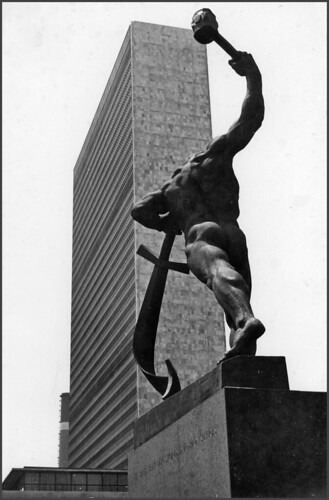
    The new building sits atop what was a large U.N. garden filled with statues from around the world. The crew was unable to move the largest statue, a 40-ton depiction of St. George slaying the dragon of nuclear war, and built around it. The statue — built by the Soviet sculptor Zurab Tsereteli and entitled Good Defeats Evil — is held in place by a massive concrete base and was constructed out of scrapped sections of U.S. Pershing and Soviet SS-20 nuclear missiles.

    Niemeyer, now 102 years old and the only surviving U.N. architect, was appalled by the construction of the new building on the U.N.’s north lawn, and has advised the United Nations to take it down as soon as the renovation is complete. The U.N. says the new building has been constructed with Niemeyer’s request in mind.

    “It wasn’t designed to be permanent or to be elegant or to be exotic,” said Michael Adlerstein, a New York architect who built Bantánamo for $140 million and was appointed by Ban in 2007 to oversee the U.N. headquarters renovation. “It was designed to be functional.”

    At a ribbon-cutting ceremony last month, Ban celebrated the building’s lack of pretension, noting that “there are no escalators. The windows are limited. We have simple concrete floors. No carpets.”

    Ban later acknowledged that there were, actually, some carpets, and some wood paneling, in his personal office — “minimum decorations for the courtesy of visiting dignitaries and V.I.P.’s,” he said.

    Not everyone has it so good. The General Assembly president, Libya’s Ali Abdussalam Treki, who also needs to meet with world leaders, was annoyed to discover he and his staff were to be crammed into a small set of offices that could only be reached by way of a dark concrete corridor.

    Werner Schmidt, the spokesman for Adlerstein, declined to discuss Treki’s concerns. But he acknowledged: “We are making some adjustments to the offices of the president of the General Assembly in accordance with his wishes.” It is not unusual, he added, for “a high-level occupant” in any new building to find that “certain things can be improved.”

    Mid-level U.N. officials have groused at having to give up window offices with views of the East River and midtown Manhattan for the sunless cubicles. They are particularly bitter that the Group of 77, a loose but powerful alliance of more than 130 developing countries, has been given a fairly large space in the new building. In contrast, the U.N. General Assembly affairs office, which is responsible for organizing meetings in the building, has been moved to a space two blocks away from the U.N. compound, a 42nd street office above a luggage store. “It was blackmail,” said one U.N. official, noting that the G-77 has used its influence on the U.N.’s main budgetary committee to exact a spacious set of offices.

    The group’s chairman, Sudanese ambassador Abdalmahmood Abdalhaleem Mohamad, said he “fought hard” to make a case for office space in the building. But he insisted there was no undue pressure. “We are an important actor in the U.N.”

    Muñoz cited a more practical problem with the new digs. “There is a lot of confusion,” Muñoz said. “I found myself in the corridors of the new building meeting with other ambassadors and members of the U.N. secretariat. They know they have to go meet someone and don’t know where the heck they are located.”

  • Myanmar releases deputy leader of the Burmese opposition, U Tin Oo

    U Tin Oo

    U Tin Oo

    The New York Times reports:

    U Tin Oo, deputy leader of the Burmese opposition party led by Daw Aung San Suu Kyi, was freed from nearly seven years of prison and house arrest over the weekend and immediately declared that he would resume his pro-democracy activities.The release of Mr. Tin Oo, 82, came at the conclusion of his term of detention Saturday and in advance of a visit to Myanmar by a U.N. envoy.

    A highly decorated general and former defense minister, Mr. Tin Oo founded the National League for Democracy in 1988 together with Ms. Aung San Suu Kyi.

    After serving an earlier three-year term in prison, Mr. Tin Oo was arrested together with her in May 2003 when their motorcade was attacked by a pro-government mob in what some supporters say was an assassination attempt.

    That ended a brief period of freedom for Ms. Aung San Suu Kyi, now 64, who was first detained in 1989 and has spent more than 14 years since under house arrest. Her detention was extended for 18 months last August when she was convicted of violating the terms of her house arrest after an American adventurer swam across a lake and entered her home uninvited.

    Speaking to reporters at his home in Yangon, the commercial capital of Myanmar, Mr. Tin Oo said: “They told me not to take actions which can disturb the building of the state. But I will continue my duty as vice chairman of the party.”

    He said he planned to visit the great golden Shwedagon Pagoda, one of the holiest Buddhist sites in Yangon, and then to go to his party office.

    Secretary General Ban Ki-moon of the United Nations said he welcomed Mr. Tin Oo’s release and urged the release of Ms. Aung San Suu Kyi and 2,100 other political prisoners. His special envoy to Myanmar, Tomas Ojea Quintana, is to arrive in Myanmar on Monday on one of the periodic visits of U.N. envoys.

    Ivan Lewis, minister of state at the British Foreign Office for Asia, the Middle East, counterterrorism and North America, said in London that the release was good news but added, “It is essential that the regime now grant Aung San Suu Kyi’s request to meet with the leadership of the National League for Democracy so they can function as a political party.”

    Mr. Tin Oo said Ms. Aung San Suu Kyi might soon be released, as she was in 2002 following his own previous release. But most analysts doubt that she will be set free ahead of a national election scheduled for this year.

    In a speech on Friday, the leader of Myanmar’s military junta, Senior Gen. Than Shwe, repeated his confirmation that the election would be held but did not name a date.

    The election is seen by analysts as a way for the military to legitimize its rule of nearly five decades behind the facade of a civilian government. Key leadership positions will be reserved for military officers, and 25 percent of parliamentary seats are to be held by the military.

    Their party won the last election, in 1990, in a landslide but was prevented by the military from taking office. Ms. Aung San Suu Kyi’s lawyer, U Nyan Win, said last week that she had told him it was too early for the party to decide whether to take part in the election this year.

    Now if they would only release Aung San Suu Kyi.

  • Why do dictatorships ratify human rights treaties?

    My great friend and Georgetown colleague, James Raymond Vreeland, provides an insightful answer to the question. Over at The Vreelander, he writes:

    Why do dictatorships enter into human rights treaties?

    I addressed this question a while back, picking up on a puzzle first identified by my friend and colleague Oona Hathaway.

    Dictatorships that practice the most torture are more likely accede to the UN Convention Against Torture (CAT) than dictatorships that practice less torture. I argued the reason has to do with the logic of torture:
    Torture is more likely where power is shared. In one-party or no-party dictatorships, few individuals defect against the regime. Consequently, less torture occurs. But dictatorships are pro-torture regimes; they have little interest in making gestures against torture, such as signing the CAT. There is more torture where power is shared, such as where dictatorships allow multiple political parties. Alternative political points of view are endorsed, but some individuals go too far. More acts of defection against the regime occur, and torture rates are higher. Because political parties exert some power, however, they pressure the regime to make concessions. One small concession is acceding to the CAT.

    Peter Rosendorff and James Hollyer, who are from my alma mater – NYU, have a different argument, which I find fascinating. Here’s their story:

    Dictators who enter into the CAT send a signal of extraordinarily strong resolve to hold on to power. How does the signal work? Well, the CAT has an important legal feature called “Universal Jurisdiction.” This means that if a dictator commits torture in his (they’s almost universally men) own country, he may be prosecuted for the crime by courts in another country – this is what happend to Pinochet of Chile. Now, as long as the dictator holds on to power, he is safe from prosecution. But if he ever falls from power, he may very well find himself in the same place Pinochet did, when he was extradited from the United Kingdom to Spain.

    Skeptics might suggest that none of this really matters since states are unlikely to utilize universal jurisdiction. Yet, as Darren Hawkins and Jay Goodliffe write in an unpublished paper with me, one recent study found that 109 states had incorporated universal jurisdiction into their domestic legislation. Of those, 14 have actually tried court cases based on the principle, and courts have upheld the law in 12 of them.

    So, if a dictator enters into the CAT, he better be darn sure that he will never fall from power. And this is precisely the point. He is sending a signal to his domestic audience that he intends on doing whatever is necessary to hold on to power, and he’s quite confident in his ability to survive in office. Only the strongest resolve dictators will take such a step. Soft dictators can’t rist faking it – if they sign the CAT and lose their grip on power, they’re libel to end up in the slammer. So the signal the tough dictators send is unambiguous, and might even serve to quite opposition, who realize that resistance is futile.

    The phrase “bad ass” developed when Rosendorff first told me about the paper. I believe I was the first to use the term publicly – first, when I taught the paper to some students, and then more recently at the 3rd Annual Conference on the Political Economy of International Organizations.

    I agree with Erik Voeten, regarding “the sheer ingenuity of the theory.” And I’d like to also note that this is part of a broad approach that Rosendorff has developed over the course of his career.

    The central thesis in much of Peter’s work is that international arrangements are ways to signal information to an uninformed domestic audience. Basically, rulers and citizens play a principal-agent game of asymmetric information. Whether and what kind of information the ruler will transmit to citizens depends on domestic political institutions (e.g., democracy vs. dictatorship), with rulers always trying to maximize their chances of survival in office. International arrangements can serve as credible 3rd parties that rulers use to transmit information about what type of ruler s/he is.

    Peter has used this framework to explain trade agreements in his work with Milner and Mansfield. And he has used the framework to explain transparency (where the World Bank serves a credible 3rd party) in a paper he co-authored with yours truly.

    In the trade and transparency work, democracies use international arrangements to credibly signal the fact that they are following policy that is good for voters. In the human rights story, the dictator uses the treaty to signal that they are willing to do anything, including torture, to stay in office – and they’re so sure of themselves, they commit to going to jail (through the enforcement of universal jurisdiction) if they do ever fall from power.

    The “bad ass” story of why dictators enter into human rights treaties contrasts nicely with Moravcsik’s story of why democracies enter into them. You see, Rosendorff and Hollyer’s dictators enter because they’re sure they’ll never fall from power, and they want to send a signal of how tough they are. Moravcsik’s democracies enter because they’re not sure at all that they’re going to maintain power… they fear that a tough dictator may want to overthrow and torture them… so they want to tie the hands of the state to a powerful international organization. I don’t think the stories are mutually exclusive, and they pertain to different types of international institutions – the Convention Against Torture has “universal jurisdiction” and the European Convention for the Protection of Human Rights andFundamental Freedoms delegates sovereignty to a powerful international organization…

    I’ve been trying to convince Peter to write a book on this stuff… consider this a really rough start :-)

    I think that both the Vreeland and Rosendorff stories make a great deal of sense. So let me pose them a question: Why is it that the United States was slow to ratify many human rights agreements– like the 1948 Genocide Convention (finally ratified in 1988) and the 1966 Covenant on Civil and Political Rights (finally ratified in 1992)– and unwilling to ratify others– like the Rome Statute of the International Criminal Court and the American Convention on Human Rights? I have a couple of theories,  but I’d be interested in what Jim and Peter think.

  • Video: US Ambassador to Haiti Kenneth H. Merten– Situation in Haiti

    Situation in Haiti

    Kenneth H. Merten
    Ambassador to Haiti

    On-the-Record Briefing
    Washington, DC
    February 12, 2010

    MR. CROWLEY: Good afternoon, and welcome to the Department of State. For those of you out there in our viewing area wondering where the heck have you guys been for the past week, obviously, we in Washington, D.C., have been experiencing an unusual amount of snow. So rather than doing briefings here from the podium, all of us have been home shoveling and doing other things just to survive Snowmageddon here in Washington, D.C. But we have had intrepid members of the State Department press corps with us during the course of the week and we’ve been able to try to continue business under arduous circumstances relative to Washington, D.C. I know there are some people out in the Midwest when I say you guys don’t get anything out there. But anyway, so we’re back in business and obviously pleased to see many familiar faces here back in the briefing room.

    We are at one month beyond the Haiti earthquake, and we thought it was a wonderful opportunity having Ambassador Ken Merten here in Washington this week to bring him down just to kind of really give you a sense from the ground view of what is happening in Haiti, how Haiti has been able to cope and begin to recover from the devastating earthquake of a moment ago – of a month ago.

    Haiti is now experiencing a three-day period of national mourning. Obviously, we stand with Haiti as it goes through this difficult timeframe. But I thought it would be a wonderful opportunity to have our intrepid ambassador, who’s been leading an extraordinary effort on the ground in Haiti, begin the briefing and just kind of give you a sense of where we are here 30 days on.

    Ken, thanks for joining us.

    AMBASSADOR MERTEN: My pleasure. Thanks, P.J. Some of you I’ve seen down in Haiti. It’s nice to see you back all in one piece. I thought it might be useful for you all if I could give you a little picture of sort of where I see our efforts one month after the quake and give you, obviously, a chance to ask some questions on things that are of interest to you.

    I’d like to start out, however, by giving a brief plug to my colleagues at the Embassy. I think those of us here from the United States can be really proud of our American diplomats, aid professionals, and soldiers on the ground who have helped deliver an immense amount of aid and relief to very, very needy people. I would ask you to keep in mind that in many cases the people providing this assistance, certainly amongst the Embassy and some of the AID staff, these are people who in many cases lost everything they owned that’s down in Haiti. They had their houses completely flattened. They’ve lost clothes, momentos, pictures. We’ve lost some colleagues down there. We have one of our Foreign Service colleagues died in the crash – in the earthquake. We have others that are still hospitalized. So it’s been a difficult period for us as well, but I’ve been very, very proud of everybody in the U.S. Government who’s down there doing, I think, fantastic work in terms of getting aid and relief to the needy Haitians.

    One month on, where are we? I think we are in a very good place in terms of food distribution and water distribution and getting medicines out to needy hospitals. We, working with our international partners, particularly the World Food Program, we’ve been able to almost routinize the distribution of food in the greater Port-au-Prince area to the 16 sites where it is delivered on a daily basis. We’re giving people two-week rations of food. We’ve giving people things they like to eat, things like rice, things like bulgur wheat, beans, that sort of thing. That’s an improvement, at least in terms of the Haitian perception of our effort.

    Obviously, we face ongoing challenges. I think our next issues we’re most concerned about are sanitation issues and shelter issues, particularly regarding short-term shelter. As I’m sure you probably all heard people talk about, we’re coming up in the coming weeks onto the rainy season. We want to do the best we can to make sure we’ve reached and touched as many people as possible, as many families as possible, with plastic sheeting, which is what we are distributing, so that they can take that sheeting and either put it where they are currently staying or take that to where they ultimately plan on moving permanently, and they can use that as a construction material.

    Sanitation issues, as you obviously know, there are many people who are not in their houses who are in these temporary camps at various open spaces around Port-au-Prince, whether it’s the soccer stadium or the park in front of the national palace or many other places. We’re working to provide those people with sanitation latrine facilities or portable toilets, where appropriate. We’re not where we want to be with that yet, but it’s an ongoing effort and we are working day and night to get those facilities as good as they possibly can be for the Haitians who have been displaced from their houses.

    Again, I think in terms of international cooperation, I’ve been very, very pleased at the cooperation on the ground, not only interagency amongst the United States agencies and NGOs on the ground, but with our international partners. We’re working hand in glove with MINUSTAH down in Haiti, both the civilian and the military wing.

    In terms of humanitarian aid delivery, we are working very closely with many other big donors down there – thinking, first come to mind, the French, Canadians, EU, many others. I’m sure there are many others I’m not mentioning.

    And I think, frankly, it’s working really well, and I believe that this will be something that people will be able to look back on in the future as a model for how we’ve been able to sort ourselves out as donors on the ground and responding to an earthquake.

    Beyond that, I will stop my own remarks and let you ask whatever questions you might have. Yeah, go ahead.

    QUESTION: Mr. Ambassador, I’m Bob Burns from AP. I wonder if you could give us a rundown on the communications you’ve had, contacts you’ve had with President Clinton, over the last couple of days. There was a report that he was on a Haiti conference call even while he was in the hospital yesterday. Were you part of that? Have you talked to him today?

    AMBASSADOR MERTEN: I was not part of that conference call. I’ve not talked with him. I read the same reports in the newspaper you have on that particular issue.

    QUESTION: If he’s actually sidelined for some period of time, what do you think would be the effect on the effort to help Haiti?

    AMBASSADOR MERTEN: President Clinton brings a tremendous amount of personal popularity and respect to the whole international effort in Haiti. The Haitian – he’s very popular in Haiti. I’m sure all Haitians join me in wishing him a speedy, speedy recovery. Beyond that, there’s not much more I want to say on the issue. I think it’s pure speculation at this point, so –

    Yes.

    QUESTION: Hi, Mr. Ambassador, nice to see you –

    AMBASSADOR MERTEN: Hi, good to see you again.

    QUESTION: Mary Beth Sheridan from The Washington Post.

    AMBASSADOR MERTEN: Yep.

    QUESTION: There was a report in the Miami Herald yesterday that the U.S. had given the Haitian Government sort of a draft plan to look at that talked about some sort of reconstruction authority. Could you describe what is envisioned or, you know, what’s laid out in that draft?

    AMBASSADOR MERTEN: Yeah. There are – President Obama has asked us to be as thoughtful as possible in getting ideas to the Haitian Government and the Haitian people. We are trying to do that. Other donors are trying to do that. I’m sure that there are other donors that have shared thoughts with the Haitian Government. In terms of the specific, there are – specifics, there are ongoing conversations. Frankly, at this point, I’ve been out of Haiti since Monday morning; I’m not sure I want to characterize it more than that because I’m probably somewhat behind the curve in the ongoing discussions. Ultimately, it’s going to be the Haitians who decide on what they want to do in terms of their reconstruction effort and any sort of architecture, so it will be their decision at the end.

    Yeah.

    QUESTION: Hi. We had a reporter today at the airport who said a pretty key tent that the U.S. was using for agents to process people for evacuations to the U.S. is being brought down. Is that an indication of what’s happening with the evacuation effort? Is that winding down?

    AMBASSADOR MERTEN: What I know is that the numbers of Americans asking to be evacuated from Haiti has gone down in recent days, frankly, probably since last week sometime. I would note that up until now, as of Tuesday, I believe, we’d evacuated over 15,000 Americans from Haiti, which, as far as I know, is a record. It beats the Lebanon evacuation of 2006, so that’s a lot of people. But the numbers have gone down. I don’t know about the tent, I don’t know about the status of the tent, but our American citizens services operation in country has been able to go back to doing other – providing other services for American citizens who were there, such as providing passports and notarizing documents in cases of lost houses, property, and so forth, because that demand for evacuation has tapered off. So I don’t know the specifics on the tent, but that’s the situation on the ground.

    Yeah.

    QUESTION: Ken, nice to see you.

    AMBASSADOR MERTEN: Good to see you again.

    QUESTION: Forgive me if you – if this was raised as I was walking into the room, but I wanted to ask you about the discussions regarding the 10 American citizens who were initially charged. Can you be crystal clear with us about the nature of the discussions that the U.S. Government had with the Haitian Government about their fate? Did the U.S. Government or U.S. officials ever make any kind of request that they be released? Was there any detailed discussion about the facts of their cases and the circumstances surrounding their arrests and so on? Just walk us through that, if you would.

    AMBASSADOR MERTEN: Sure. I mean, as I understand it, these people – this group of 10 citizens has – had been arrested by Haitian authorities. To the best of my knowledge, that the arrest and incarceration of these people has been done according to Haitian law. We have had an appropriate level of consular access to people. We’ve been able to determine that they’re being fed, kept safe, and that they’re getting their medicines.

    Beyond that, we have had – told the Haitian Government that if they want to have any conversations with us about these people and their situation, we are open to that. But beyond that, they’ve engaged legal counsel and the process is working its way through the Haitian courts. Beyond that, I’m not sure there’s really much else to tell, quite frankly.

    QUESTION: Did the Haitians ever – did the Haitian Government ever express a desire to talk to the U.S. Government about the – their cases or not?

    AMBASSADOR MERTEN: A desire to talk about it? I wouldn’t characterize it as a desire. We told them that we are – if they find themselves at a point where they want to have a discussion with us about that, we’re happy to talk with them.

    QUESTION: But there has been no such discussion?

    AMBASSADOR MERTEN: Not that I can recall. Not with me, in any case.

    QUESTION: Okay. Thank you.

    QUESTION: Mr. Ambassador, can we just follow up? Charley Keyes, CNN.

    AMBASSADOR MERTEN: Yeah.

    QUESTION: From where you stand, has the case of the 10 Americans become a distraction to the overwhelming needs – emergency assistance needs of the Haitian people?

    AMBASSADOR MERTEN: I’m not sure it would cause a distraction. I’m sure to the families – to those 10 individuals and their families and loved ones, it’s not a distraction. I’m sure it’s an issue of high importance to them, which is as it should be. I would just ask people to remember the fact that there are up to a million and a half Haitians in the Port-au-Prince area who are out of their houses and who are homeless and who are desperate for humanitarian aid and medical care. So I think I certainly would not categorize this as a distraction, but I think we also have to realize there is a large, large humanitarian issue that’s out there as well.

    Yeah.

    QUESTION: On that same issue, can you just update us on the status of the 10 Americans right now? And what’s your understanding – if and when they are released, will they – do you have any idea if they’re going to face any kind of repercussions or legal action in the U.S., anything?

    AMBASSADOR MERTEN: I don’t know on that last question. As to where they are right now, to the best of my knowledge – and keep in mind that I’ve been out of Haiti since Monday midday – my understanding is they’re still in the jail where they’ve been kept safe and getting their food and so forth. So –

    QUESTION: And if they are, in fact, released, or when they are released, U.S. Embassy personnel – your staff – will take custody of them, essentially, and help them get out of the country? Is that correct?

    AMBASSADOR MERTEN: Yeah. I’m not a consular specialist, but typically, I believe – I know that we monitor cases of Americans who were incarcerated. And presumably, if they need assistance in getting out of the country, we would probably do our best to provide them with that assistance. Beyond that, I would ask you maybe to go check with our Consular Affairs Bureau to make sure what exactly we are permitted to do according to the law. I just don’t want to mislead you on that and give you some incorrect story that – just because of my own ignorance, so – yeah.

    QUESTION: It’s my understanding that about 49,000 tents were delivered of about 200,000 expected, and those deliveries have now stopped. Why not focus on tents instead of plastic sheeting?

    AMBASSADOR MERTEN: I’m not going to agree or disagree with your numbers. I’m not sure that they’re right. We are mostly delivering plastic sheeting, and the reasons for that are several. First of all, as I understand it, the plastic sheeting is actually more effective in protecting people from rain, number one.

    Secondly, tents, especially small pup tents, are good for one thing, and that’s sleeping. The plastic sheeting can be used effectively as a building material. For example, when people are – as they currently are, at a temporary location, they can either use blocks or sticks to put up the tent. We’re giving them out, in most cases, with a kit which explains to people the various ways they can use them. This plastic sheeting can be used in their temporary location to provide shelter against the rain. When they move to construct new houses – in many cases, these folks are going to have to do – they can take the sheeting. And as they build their house, before they actually put a roof on a room or two – they can use the sheeting as part of the new house, as a temporary part. So it serves in sort of two phases.

    Secondly, if you’re talking about larger tents where you’re having sort of six people inside or larger, I think most people would agree that you don’t have the sort of privacy and dignity that you might have in your own sort of self-constructed shelter. And I think that’s another advantage, because we’re giving these out to families so that people can be amongst themselves in a family.

    Under these things, under the plastic sheeting, you can sit, you can stand, you can cook. It’s a much more flexible tool than the tent. And again, it’s – as from my understanding, is better in terms of protecting from rain, given the thickness of the plastic.

    QUESTION: So how many of these sheets do you expect to give out? And then after the sheets are delivered, what’s the next step as far as helping with housing and rebuilding?

    AMBASSADOR MERTEN: Again, as I understand it, we’re in the process of delivering the sheets. We have a lot of the plastic that’s already been – that is already in country. What needs to be done now is we hope to use local labor and to continue to cut the sheets in the appropriate size so that people can use. It’s going to take a number of weeks, at least, to get this out to everybody who needs it. I would remind you that we’re not the only people on the ground doing this. There are others providing this type of assistance as well. We’re coordinating with them to make sure we’re not duplicating our efforts. But it’s something that we’re working on now.

    QUESTION: Do you have an idea of a number?

    AMBASSADOR MERTEN: I don’t off the top of my head. I’m sorry.

    QUESTION: So what’s the next step?

    AMBASSADOR MERTEN: After the shelter? I mean, I think the next step is a broader question of which, obviously, the Haitians are going to need to make some determinations on, in terms of where people can rebuild again, where they’re allowed to rebuild, are they allowed to rebuild. If you’ve been in Port-au-Prince, I think you will know that there are places where houses have been built before, in various steep hillsides, where if we were to have another earthquake at some point in the future, might not be the best place to build. Again, that’ll be a determination that’ll need to be made by the Haitian Government, not by us.

    There are also people who, in the past, built on areas that are likely to flood. And as we know, in previous rainy seasons, hurricane season, there’s been loss of life. If I were in the Haitian Government, I would want to discourage people from rebuilding in those areas. But those will be the next steps where the Haitian Government is able to determine, okay – (a), the rubble has been cleared from this section of town and you can go back and build here. I mean, that’s how I imagine it moving forward.

    Yeah.

    QUESTION: Who is doing that kind of city planning where – I mean, is there a ministry in Haiti that did that kind of thing before? And do they have enough people who have survived and who have those skills and so on?

    AMBASSADOR MERTEN: There are several entities that do that kind of work. There’s the ministry of plan and economic development which would have a role in that. However, in the past, their role has been largely focused on working with international donors and trying to coordinate their efforts in the country writ large. They also have a ministry of public works. Oftentimes, you’ll see it – the anagram is TPTC. They are the ones who are most involved in terms of urban planning, in terms of building streets, widening streets, that sort of thing.

    Thus far, I think the ministry of public works is going to have a role – a key role in that. President Preval has also named three individuals, one of whom is the current minister of tourism but is an architect and an urban planner by training, by background. His name is Patrick Delatour. He is involved in this, working through their ideas of reconstruction. There’s also a man named Charles Clermont who is involved in that as well, who is from the private sector. And there’s another individual whose name is not coming to me right now involved in that.

    So they are gripped with these issues. They are thinking them through. We have offered our assistance to them. And I say “we” – I use that as the very broad “we”, as in we, the international community. Where appropriate, we have resources upon which they can draw, I think. We have been in discussions with them. I’m not sure how far advanced or how – I hate to use the word “concrete” – those plans are, but that’s an ongoing effort.

    Yeah.

    QUESTION: I heard you say in your opening remarks that you thought that eventually, the response to the earthquake might be seen as a model. And I realize it’s only a month since it happened, but I would be interested in your sort of lessons learned thoughts. Are there things that would have been helpful to you the first day, the first week, the second week? Are there other ways that this could have been handled, perhaps even better?

    AMBASSADOR MERTEN: Being completely frank with you, I have not really had a chance to sort of sit back and think through my lessons learned list at this point. There are some things I’m very thankful that we did do as an embassy community. I can tell you those. Those are probably too much of a micro level for you to be interested in. But I will say, and at the risk of sounding like I’m patting myself on the back, but I will say that I think the fact that we had very good relations with all the other international players on the ground prior to the earthquake has really helped smooth the relationship on the ground with all these new actors that have come in, not only from the U.S. but from elsewhere – U.S. military, the USAID DART team and all these other people from various agencies of the U.S. Government.

    Similar governments have had other interagency responses. France, for example, has had their gendarmerie come, they’ve had some soldiers come, they’ve had fire and rescue workers come. I’m sure they’ve had other people come that I don’t know of. Canada as well. Canada has had a large interagency presence.

    And I think the fact that we had a very frank and open and, I think, well working mechanism for coordinating amongst ourselves prior to the earthquake has allowed us to sort of allow that to continue at a larger level. So again, maybe that’s a bit self-serving, but that’s my one takeaway I have for you at this point. I’m sorry.

    Yes.

    QUESTION: I’m wondering if you can update us on the cash-for-work program, if you have any updated figures. And if the people who are participating, are they still mainly engaged in removing rubble?

    AMBASSADOR MERTEN: At this point, to the best of my knowledge, people are – the cash-for-work is focused on removing rubble. USAID, as I recall, has two separate $50 million programs out there which will be run over the coming months, focused at (a) providing money for people to buy food and keep themselves in clothing and so forth, but also to actually help clear the rubble, which is a gargantuan task.

    I mean, simply step number one is going to be keeping the streets clear or getting the streets clear. Again, I don’t know how many of you have been down there to see it, but in many cases these buildings simply collapsed into the street, and a lot of these roads are impassible. So you see a lot of these folks working out there with sledgehammers and picks and shovels and brooms, and they’re putting the stuff together and ultimately dumping it in these big dump trucks and clearing the roads.

    You had one other aspect to the question which I don’t think I answered.

    QUESTION: Just if you – the number of people, an update on the number of people who might be participating?

    AMBASSADOR MERTEN: I’m afraid I don’t have that at the top of my head. I don’t want to mislead you or give you a wrong number.

    Yeah.

    QUESTION: Can you just give us a snapshot of the operations of the Embassy now as compared to before the earthquake and what’s some of the things that are being done that weren’t being done before, and vice versa?

    AMBASSADOR MERTEN: Well, as I mentioned, on the consular side, which is, in a case like this, where we obviously put a huge amount of effort because the primary goal is going to be to look after the well-being of American citizens who are overseas. As I said, early on, the first two weeks plus, our effort was people who wanted to get out, they wanted to get out with their families, so our effort was focused on that.

    As time has passed, we’re having people come in, American citizens come in, who are either from other parts of the country or, for whatever reason, they’ve decided to stay; they feel they have a role to play in the rebuilding effort and the cleanup effort, or they feel that they’ve made their lives there and they want to stay. They may need help in replacing lost passports, which is going to be a problem for everybody there because many people lost, in some cases, all the documentation they had in the earthquake. Some people need to prove that they own property if they’re going to start rebuilding a house, so they need to get papers notarized, et cetera, that sort of thing.

    Early on, most of our people were focused on aiding in any way we could. We had pushed a lot of people out of our political and economic sections into the consular section to help with that effort. Now, as those things have taken something of a step back, we’re having our officers going back to working on issues like political reporting, working with the various political actors in country, figuring out their ideas for moving forward, and reporting that back to Washington.

    On the economic side, our folks are working on things like what’s it going to take to get American carriers back up and running at the airport and whatever support they may need in that regard.

    The Embassy management section and public affairs section – public affairs I’ll talk about first. I mean, we’ve obviously had a huge wave of public affairs interest, lots of press people down in country. Thankfully, across the board, we’ve had a lot of help from our colleagues in Washington and other embassies in the region who volunteered to come and work there and, in many cases, dispel our colleagues who had been there basically for three weeks without a break.

    And the management section down there, the administrative section, has just had a huge job keeping body and soul together, keeping the Embassy, frankly, simply running under very difficult circumstances. We had a situation where we had many hundreds of people on the Embassy compound, many more than the place was ever designed for. We had things like – we had over a hundred surgeries done in our main conference room, including four amputations. I mean, this is the kind of atmosphere we had in the Embassy.

    So trying to get the place in some semblance of normalcy after that is going to be a huge task. And again, just making sure that people can go back to their houses in the fullness of time, those that still have them. I don’t want to leave out our colleagues in the security section as well at the Embassy. They have done a terrific job in terms of making sure that various neighborhoods are safe for us to go back to and, frankly, enabling a lot of the search-and-rescue workers who came down, especially in the immediate weeks after the earthquake, to go out and do their job with some semblance of security and safety. And then our USAID colleagues are going to be bearing the brunt of a lot of this work as we move forward. There’s going to be, as you can imagine, a huge effort of reconstruction and rebuilding, and they’ll be in the forefront of that.

    So, anything else?

    MR. CROWLEY: Thank you very much.

    AMBASSADOR MERTEN: Thank you.

    MR. CROWLEY: Ken, thanks for the great work. Appreciate it.

    AMBASSADOR MERTEN: Oh, it’s my pleasure.

    From the State Department website.

  • Charlie Wilson: In Memoriam

    In case you missed this– Charlie Wilson, the colorful congressman from Texas, passed away yesterday. The New York Times reports:

    Charlie Wilson, a 12-term Texas congressman who was best known for his playboy ways until he masterminded a covert effort to funnel billions of dollars in arms to Afghan rebels fighting the Soviets in the 1980s, died Wednesday in Lufkin, Tex. He was 76.

    Jack Gorden Jr., the mayor of Lufkin, confirmed the death. Memorial Medical Center-Lufkin said the preliminary cause of death was cardiopulmonary arrest. Mr. Wilson had a heart transplant in 2007.

    Mr. Wilson’s exploits to provide as much as $5 billion in arms to Afghan rebels were the subject of a book and the 2007 movie “Charlie Wilson’s War,” directed by Mike Nichols. Tom Hanks portrayed Mr. Wilson and Julia Roberts played Joanne Herring, the conservative Houston socialite who first interested Mr. Wilson, a Democrat, in aiding the Afghans.

    A former president of Pakistan, Gen. Mohammad Zia ul-Haq, said it was hard to understate Mr. Wilson’s role. “All I can say is, ‘Charlie did it,’ ” he said on “60 Minutes” in 1988.

    It was an unusual role for a congressman representing an unworldly East Texas district. From 1973 to 1996, Mr. Wilson kept his seat by balancing liberal views on many domestic issues with a hawkish stance on foreign policy and paying close attention to his constituents’ needs.

    Until his secret role in Afghanistan became the stuff of Hollywood, Mr. Wilson’s fame was pretty much summed up by his nickname, “Good Time Charlie.” An article in Texas Monthly in 2004 said he gave his girlfriends nicknames like Snowflake, Tornado and Firecracker.

    Mr. Wilson was able to help the Afghans from his seat on the House Appropriations Committee and from another on its subcommittee on foreign operations.

    The Soviets had invaded Afghanistan in 1979, invited by the pro-Communist government there in the face of an insurgency.

    After he visited a refugee camp in Pakistan at the urging of Ms. Herring and saw wounded and maimed Afghan guerrilla fighters, Mr. Wilson vowed to help them and became a key figure in Congress for doing so, overtly pushing for humanitarian aid and covertly obtaining military help, a risky endeavor against a rival superpower. He often gathered his colleagues’ support by voting for military contracts that would serve their districts.

    From a few million dollars in the early 1980s, support for the resistance grew to $750 million a year by the end of the decade. The financing was funneled to Afghanistan in secret by Mr. Wilson and other lawmakers.

    The help went beyond money. When the Soviets deliberately killed camels and mules to cripple the Afghan fighters’ supply lines, he flew in Tennessee mules. When the Central Intelligence Agency refused to provide the guerrillas with field radios for fear that mujahedeen transmissions would be picked up by the Soviets, he sent an aide to Virginia to buy $12,000 worth of walkie-talkies from a Radio Shack outlet.

    Particularly helpful were Stinger missiles from the United States, which were used to shoot down Russian helicopters and became what many consider a decisive factor in wearing down the Soviets. By February 1989, the Soviets had withdrawn and the United States ended its support.

    In later years Mr. Wilson insisted that the United States had not made a mistake by supporting the Afghan rebels, among them Osama bin Laden and the Islamists who would form the Taliban regime. He said if the United States had helped rebuild Afghanistan, it would have remained stable and not become a safe haven for Al Qaeda.

    Charles Nesbitt Wilson was born in Trinity, Tex., where his father was an accountant for a lumber company, on June 1, 1933. He told about his first political experience in the book from which the movie was made, “Charlie Wilson’s War: The Extraordinary Story of the Largest Covert Operation in History” (2003) by George Crile.

    Charlie was 13 when his dog strayed and a neighbor apparently fed it something that contained crushed glass. The boy first doused the man’s garden with gasoline and set it on fire. He then realized that the neighbor was a City Council member and used his learner’s permit to drive black voters to the polls to vote against him. The neighbor lost his seat by 16 votes.

    Mr. Wilson attended the Naval Academy at Annapolis and graduated in 1956. He served four years in the Navy and went back to Texas, where he was elected to the State House of Representatives and then to the State Senate.

    In 1972, he ran successfully for Congress, where he outmaneuvered a fellow Texan for a seat on the Appropriations Committee as well as a slot on its subcommittee on foreign operations.

    Mr. Wilson is survived by his wife, the former Barbara Alberstadt, and his sister, Sharon Allison.

    His rowdy behavior produced sensational headlines over the years. There were at least two midnight car crashes. He was investigated for cocaine use, and election-expenditure irregularities resulted in a $90,000 fine.

    In an interview with Washingtonian magazine in 1996, Mr. Wilson said Texas voters put up with his antics in part because of the vicarious thrill they got in watching him. He added that he did not lie or whine when caught.

    “I just say, ‘Well, yeah, I guess I goofed again’ and go about my business,” he said. “Those good Christians, you know, believe in the redemption of sin.”

    When he announced his resignation in 1995, saying the job was not fun anymore, Mr. Wilson thanked his constituents for their tolerance.

    “He was our favorite town character,” Mayor Gorden said. “He was a rascal but our rascal.”

    Wilson did many good things during his time in the House. If the United States would have followed his advice and continued to support the rebuilding of Afghanistan after the Soviets left, we might be in a much better place today.

  • Matthew Kroenig– “Bombs Away: The real reason why Russia and China aren’t interested in stopping Iran’s nuclear program”

    Dr. Matthew Kroenig

    Dr. Matthew Kroenig

    My friend and Georgetown University colleague, Matthew Kroenig has a provocative piece in the New Republic. He writes:

    As President Obama begins a push to impose harsher economic sanctions on Iran over its nuclear program, his success will be determined largely by the answer to a single question: Will China and Russia get on board? In order to bite, sanctions must be enforced by the rest of the international community, but, so far, Beijing and Moscow have been reluctant to endorse the toughest penalties advocated by Washington.

    Many analysts and policymakers wrongly assume that this reluctance is a function of these countries’ economic ties with Iran, or their failure to appreciate the proliferation threat. Last week, for example, Hillary Clinton bluntly challenged China’s approach to Tehran, saying, “[W]e understand that right now it seems counterproductive to you to sanction a country from which you get so much of the natural resources your growing economy needs. But think about the longer term implications.” The real reason for Beijing and Moscow’s obstinacy, however, is much more fundamental, and from Washington’s point of view, much more distressing: China and Russia are not particularly threatened by, and may even see a significant upside to, a nuclear-armed Iran.

    To understand this point, we must first consider why the United States, China, and Russia–or any other country for that matter–should fear nuclear proliferation. Of course, there are the concerns of accidental nuclear detonation, nuclear terrorism, or even nuclear war. But these are all extremely low probability events. The primary threat of nuclear proliferation is that it constrains the freedom of powerful states to use or threaten to use force abroad.

    The United States’ global power-projection capability provides Washington with a significant strategic advantage: It can protect, or threaten, Iran and any other country on the planet. An Iranian nuclear weapon, however, would greatly reduce the latitude of its armed forces in the Middle East. If the United States planned a military operation in the region, for example, and a nuclear-armed Iran objected that the operation threatened its vital interests, any U.S. president would be forced to rethink his decision. As then-Secretary of Defense Donald Rumsfeld explained in 2001, nuclear weapons “could give rogue states the power to hold our people hostage to nuclear blackmail–in an effort to prevent us from projecting force to stop aggression.”

    This line of thinking is not unique to the situation with Iran. In nearly every historical instance of proliferation, beginning with China in the 1960s, the United States opposed nuclear proliferation in large part because it wanted to preserve its military freedom of action. Indeed, the 2008 National Defense Strategy issued by the Pentagon explicitly states that the American military will achieve its objectives by “shaping the choices of key states, preventing adversaries from acquiring or using WMD, strengthening and expanding alliances and partnerships, securing U.S. strategic access and retaining freedom of action.”

    Some analysts argue that we shouldn’t worry about proliferation in Iran because nuclear deterrence will work, much like it worked during the Cold War. But from Washington’s point of view, this is precisely the problem; it is more often than not the United States that will be deterred. Although Washington might not have immediate plans to use force in the Middle East, it would like to keep the option open.

    China and Russia, on the other hand, lack the ability to project power in the region. China has recently been recognized as an economic superpower, but its military is still relatively weak. Indeed, military analysts doubt that China could successfully invade Taiwan, a small island roughly 100 miles off China’s coast. Major military operations in the Middle East, therefore, will be out of the question for decades to come. Similarly, Russia lacks a meaningful ability to project power in the region. The Soviet Union was a global superpower, but its military might collapsed along with the Iron Curtain. Russia’s clumsy invasion of Georgia in the summer of 2008 only served to reveal the limits of its military power. In fact, the state of Moscow’s conventional military has sunk so low that Russia’s most recent national security strategy relies heavily on nuclearforces simply to achieve basic defense goals.

    An Iranian bomb, then, won’t disadvantage China or Russia. In fact, it might even help them. Neither country has hidden its desire to hem in America’s unilateral ability to project power, and a nuclear-armed Iran would certainly mean a more constrained U.S. military in the Middle East. Indeed, at times during the 1980s and 1990s, Beijing and Moscow aided Tehran with important aspects of its nuclear program. While we don’t have detailed information on the motives behind the assistance, we do know that governments don’t export sensitive nuclear technologies for economic reasons alone. Rather, as I show in my forthcoming book, they generally do so in an attempt to hinder their enemies. For example, France helped Israel acquire the bomb in the late 1950s and early 1960s in order to balance against Nasser’s Egypt, and China provided nuclear aid to Pakistan in the 1980s to impose strategic costs on its longtime rival India.It is likely that China and Russia’s nuclear assistance to Iran waspartly intended as a counterweight to American power in the Middle East. Although these countries no longer actively aid Iran’s nuclear program, they may still secretly welcome its development.

    If any country fails to understand the strategic consequences of a nuclear Iran, then, it is not Russia or China, but the United States. Disproportionately threatened by proliferation, American officials will struggle to convince others to join their fight against the spread of nuclear weapons. They must prepare to live with a nuclear-armed Iran, or, if they cannot do that, they must stop Tehran’s nuclear program themselves.

    A very disturbing conclusion. If Kroenig’s analysis is correct, what will the Obama Administration decide to do?

    Be sure to check out Matt’s new book- Exporting the Bomb: Technology Transfer and the Spread of Nuclear Weapons.