![World Day Against Cyber Censorship [640x480]](http://globalvoicesonline.org/wp-content/uploads/2010/03/World-Day-Against-Cyber-Censorship-640x480.jpg "World Day Against Cyber Censorship [640x480]")
On the occasion of the World Day Against Cyber Censorship being celebrated by the Paris-based Reporters without Borders (RSF) on the 12th of March, netizens across the world are realizing that even in this age internet is not free from restrictions on freedom of expression – a basic human right, which in many parts of the world is being encroached upon by those in power. RSF intends to “rally everyone in support of a single Internet that is unrestricted and accessible to all”.
Internet-surveillance trends around the world are both interesting and surprising. According to the Reporters without Borders, Saudi Arabia is definitely a high internet-surveillance zone. This is one of the few issues on which Saudi Arabia stands together with Iran and Tunisia! The 13 countries that control and block the Internet, including North Korea which entirely controls ownership of the internet-connected computers to a selected few, are – Burma, China, Cuba, Egypt, Iran, North Korea, Saudi Arabia, Syria, Tunisia, Turkmenistan, Uzbekistan and Vietnam. The RSF call these countries Internet's Black-Holes.
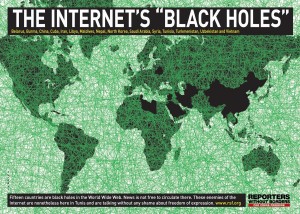
Image Courtesy – Reporters Without Borders/Internet's Black-Holes
The Reporters without Borders not only identify the countries that block Internet, they have devised a rating of the degree of censorship And the trends are surprising:
- Where do you think the Internet access has no censorship?
No, it’s not in the North America and the Europe, but in large parts of Africa, parts of South America, Mexico and the Caribbean and in Mongolia! - Is Australia a free Internet-access zone?
No, it’s under heavy surveillance – the same degree as in Algeria, Tunisia, Yemen and parts of South-East Asia! - What about the rest of the world, including the democracies of North America, Europe and India? They are under some censorship, but largely people have a free Internet-access.
India doesn't fall in the category of “Internet Black-Holes,” hence Hindi web-writers haven't written much on it because they haven't faced this problem. However, there are some Hindi bloggers who have reflected on press-freedom from different angles. I reproduce some of their thoughts below:
Mr. Mysterious from Jeddah writes on his Hindi blog about bloggers being imprisoned in Saudi Arabia for talking about human rights violation:
समाचार एजेंसी डीपीए ने 32 वर्षीय फौद अल-फरहान के हवाले से बताया कि पेशे से तकनीकी विशेषज्ञ और मानवाधिकार कार्यकर्ता फौद ब्लाग लिखने के जुर्म में पिछले तीन महीने से कारावास में है।
फौद के अनुसार बिना किसी पुख्ता सबूत के और बिना कारण बताए उन्हे गिरफ्तार कर लिया गया। गिरफ्तारी से ठीक पहले अपने ब्लाग पर उन्होंने सऊदी अरब के उन दबंग व्यक्तित्वों के बारे में लिखा था जो उन्हे बेहद नापसंद है। इनमें अरबपति राजकुमार वालिद बिन तलाल और कई नामी मौलवियों के नाम शामिल थे।
सऊदी अरब में ब्लागर्स की इस गिरफ्तारी के खिलाफ बहुत सी आवाजें उठ रही है। ब्लागर्स पर चलाए जा रहे न्यायिक मामलों के बावजूद उनके परिवार वाले और मानवाधिकार संगठन इस मनमानी का डट कर मुकाबला कर रहे है।
Rachna Verma has commented in her Hindi blog on the freedom of expressions and the behaviour of the mediapersons in India, who misuse their freedom of expression to keep themselves in powerful position:
दुनिया का सबसे बड़ा लोकतंत्र हमारा देश और उससे भी बढ़कर उसके नागरिकों को प्राप्त अभिव्यक्ति की स्वतंत्रता का अधिकार और इसके साथ ही कार्यपालिका, व्यवस्थापिका और न्यायपालिका पर नजर रखने के लिए बना चौथा स्तम्भ यानि मीडिया॥ अभिव्यक्ति का सशक्त माध्यम , लेकिन अभिव्यक्ति की स्वतंत्रता का पुरजोर बना यह चौथा स्तम्भ ही इस अधिकार पर पक्षपातपूर्ण रवैया अपना रहा है॥ यहां ये साफ कर देना जरूरी है कि यह केवल मेरा अनुभव और व्यक्तिगत राय है॥ हो सकता है कई लोग मेरी इस बात से इत्तेफाक न रखते हो, लेकिन वहीं है ना अभिव्यक्ति है, इसलिए इस अधिकार का प्रयोग करना एक जागरूक नागरिक होने के नाते मैं जरूरी समझती हूं॥
Another Hindi blog bhadas4media celebrates the lesson taught by the reporters in Gujarat to the Chief Minister Modi's government's attempt to curb the freedom of the press by restricting their entry into government hospitals – a move which was strongly opposed by the reporters and it had to be retracted by the government:
गुजरात के सरकारी अस्पतालों में पत्रकारों के प्रवेश पर लगी पाबंदी जबरदस्त विरोध के बाद सोमवार को हटा ली गई। पत्रकारों ने सरकार के इस आदेश के खिलाफ विधानसभा की कार्यवाही का बहिष्कार किया और सचिवालय में भी हंगामा मचाया। इसके बाद स्वास्थ्य मंत्री जयनारायण व्यास ने इस आदेश को वापस ले लिया और बुधवार को पत्रकारों से चर्चा के बाद ही इस पर कोई फैसला लेने की घोषणा की।
स्वास्थ्य विभाग के उपसचिव आई.एम. कुरैशी ने 2 फरवरी 2010 को एक परिपत्र जारी कर गुजरात के सरकारी अस्पतालों में पत्रकारों के प्रवेश पर प्रतिबंध लगा दिया था। उन्होंने बताया कि मीडिया में कई बार तथ्यविहीन व गलत समाचार दिखाए और प्रकाशित किए जाते है जिससे प्रशासन की छवि धूमिल होती है। अहमदाबाद में नाराज पत्रकारों ने सिविल अस्पताल परिसर में धरना दिया और सरकारी आदेश की होली जलाकर अपना विरोध जताया।
This blog-post supports the protest of the press which resulted in the order being taken back by the Gujarat government by titling the post as “Mediapersons Teach a Lesson to the Autocratic Officials of Modi.”
BBC Hindi News service had also reported the Google Debate in China early this year –
इंटरनेट सर्च कंपनी गूगल ने कहा है कि वो चीन में अपना कामकाज समेट सकती है क्योंकि चीनी मानवाधिकार कार्यकर्ताओं के ईमेल कथित तौर पर हैक किये जा रहे हैं…
हैकिंग
वेबसाइट पर हमला करने वालों का प्रमुख लक्ष्य था मानवाधिकार कर्मियों के जीमेल अकाउंट को हैक करना
डेविड ड्रमोंड, गूगल के अधिकारी…
कंपनी की तरफ से जारी किये बयान में डेविड ड्रमोंड ने कहा, “वेबसाईट पर हमला करने वालों का प्रमुख लक्ष्य था मानवाधिकार कार्यकर्ताओं के जीमेल एकाउंट को हैक करना.”…
कंपनी को जांच के बाद इस बात की जानकारी मिली है कि कम से कम दो जीमेल एकाउंट को हैक किया गया.
गूगल ने कहा है कि अमरीका, चीन और यूरोपीय देशों के उन लोगों के दर्जनों जीमेल एकाउंट को किसी तीसरी पार्टी ने खोलकर देखा, जो ‘चीन में मानवाधिकार' के हिमायती थे…
गूगल का ये भी कहना है कि इस तरह कि हैकिंग कि घटनाएं कम से कम 20 और कंपनियों के साथ भी हुईं हैं.
For a profile of Tunisia and its comparison with Saudi Arabia, please see my blog-post, where I have discussed the issue, apart from its interesting social profile.
The sharp contrast between these two countries does not make them see eye to eye with each other. They are not on the best of terms. However, freedom of expression is one arena where they seem to stand together, though not by design.
As information like these are emerging, people are raising their voice against the censorship and it is important to support these voices. We need to inform, connect and empower these people to defend an Internet without restrictions and make it accessible to everyone.
