Author: Becky Chung

  • 25 songs to celebrate innovators: A Spotify playlist inspired by TEDWomen

    The Ahn Trio plays during TEDWomen 2010. Photo: James Duncan Davidson

    The Ahn Trio plays during TEDWomen 2010. Photo: James Duncan Davidson

    Inspired by the theme of TEDWomen 2013, “Invented Here,” we’ve created a killer playlist with songs about women who’ve innovated, made a difference, taken a stand and changed history in the process.

    Our mixtape of tunes include: a Swedish dance-pop tribute to Marie Curie’s research on radioactivity, Jane Birkin’s ode to the work and ideals of Burmese political prisoner Aung San Suu Kyi, an emotional love song dedicated to Georgia O’Keefe and a tongue-in-cheek punk rock commentary on Margaret Thatcher.

    Sit back, turn up the volume and have a listen!

    TEDWomen 2013 will be held in San Francisco, December 4-6, 2013, at the new SFJAZZ Center. Registration for the event opens today. Head to the TEDWomen site to find out how to apply »

    Sign up to get news and updates on TEDWomen »

    Unable to listen to the Spotify playlist? Here is a list of all of the songs we’ve included:

    Clara Barton – Country Joe McDonald
    Abigail Adams – The City and Horses
    When Frida Kahlo Lost Her Halo – Greg Douglass
    The Ballad of Marie Curie – Army Of Lovers
    Florence Nightingale’s House – Katie Malco
    Nelly Bly – Dirty Bourbon River Show
    Ada Lovelace – Madam Monom
    Sojourner Truth – Jeanne Humphries
    Amelia Earhart vs. the Dancing Bear – The Handsome Family
    Cleopatra – Miniature Tigers
    Mother Theresa Can’t Dive – Jose Vanders
    Georgia O’Keefe – Duke Special
    Benazir Bhutto’s Hands Are Clean – Muslimgauze
    Aung San Suu Kyi – Jane Birkin
    Susan B. Anthony Dollar – Sherman & Larsen
    The Ballad of Isadora Duncan – Mike Elliott
    Hypatia – Tomi Leppanen
    I’m In Love With Margaret Thatcher – NotSensibles
    Maria Montessori – With An Orange
    A Freestyle Kiss To Hedy Lamarr – Botanica
    Madeleine Albright – Dave Lowensohn
    Harriet Tubman’s Ballad – Woody Guthrie
    Joan Of Arc – Leonard Cohen
    Speeches Of Indira Gandhi – Indira Gandhi
    Jane Goodall – Adam Kautz
    Virginia Woolf – Indigo Girls
    Annie Get Your Gun – Squeeze

    Hailey Reissman, on the TEDx editorial team, contributed to this playlist.

  • 10 fascinating facts about woolly mammoths

    Hendrick Poinar shares how his team is sequencing the woolly mammoth genome. Photo: courtesy of TEDxDeExtinction

    Hendrick Poinar shares how his team is sequencing the woolly mammoth genome. Photo: courtesy of TEDxDeExtinction

    Sequencing an extinct genome is no longer a pipe dream, says evolutionary biologist and ancient DNA specialist Hendrik Poinar in today’s talk. It’s a modern reality, and we’re not too far from seeing a revived extinct species walking the Earth again — maybe even a woolly mammoth. In this talk from TEDxDeExtinction, Poinar talks about how he and fellow scientists are getting closer to completing a woolly mammoth genome, an intricate puzzle that consists of discovering, entangling and connecting over 5 billion base pairs.

    Hendrik Poinar: Bring back the woolly mammoth!Hendrik Poinar: Bring back the woolly mammoth! So, why do we, humans, have such a fascination with woolly mammoths?

    “Woollys are a quintessential image of the Ice Age … We seem to have a deep connection with them as we do with elephants,” says Poinar in this sci-fi worthy talk. “I have to admit there’s a part of the child in me that wants to see these majestic creatures walk across the permafrost of the North.”

    It may be even more of a possibility now, thanks to a new development in the quest to resurrect the woolly mammoth. Earlier this week, an incredible discovery on the permafrost of the Novosibirsk archipelago in the Arctic Ocean propelled the conversation of de-extincting mammoths forward: Blood, in liquid form, and muscle tissue was discovered inside the well-preserved body of a 10,000 to 15,000 year old female woolly mammoth.

    Thanks to frozen carcasses with skeletons, stomach contents, tusks and now liquid blood left intact — as well as cave painting depictions by our human ancestors — scientists know more about the woolly mammoth than any other prehistoric animal. Here are ten facts about the magnificent woolly mammoth, Mammuthus primigenius, to help ignite your imagination.

    1. Contrary to common belief, the woolly mammoth was hardly mammoth in size. They were roughly about the size of modern African elephants. A male woolly mammoth’s shoulder height was 9 to 11 feet tall and weighed around 6 tons. Its cousin the Steppe mammoth (M. trogontherii) was perhaps the largest one in the family — growing up to 13 to 15 feet tall.
      .
    2. The ears of a woolly mammoth were shorter than the modern elephant’s ears.  Like their thick coat of fur, their shortened ears were an important cold-weather adaptation because it minimized frostbite and heatloss.
      .
    3. Scientists can discern a woolly mammoth’s age from the rings of its tusk, like looking at the rings of a tree. The tusk yields more finite detail than a tree trunk, revealing a major line for each year and a line for the weeks and days in between. Scientists can even tell the season when a woolly mammoth died as the darker increments correspond to summers. The thickness or thinness of the rings indicate the health of the mammoth during that time; the tusk would grow more during favorable conditions.
      .
    4. The woolly mammoth was not the only “woolly” type of animal. The woolly rhinoceros, also known as the Coelodonta, co-existed with the woolly mammoth, walking the Earth during the Pleistocene epoch. Like the woolly mammoth, the woolly rhino adapted to the cold with a furry coat, was depicted by human ancestors in cave paintings and became extinct around the same time.
      .
    5. Cave paintings drawn by ice age humans show the important relationship they had with the woolly mammoths. The Rouffignac cave in France has 158 depictions of mammoths, making up about 70% of the represented animals that date back to the Upper Paleolithic period. There is also evidence of the use of bones and tusks by humans to create portable art objects, shelters, tools, furniture and even burials.
      .
    6. Today, the hunt is on for woolly mammoth tusks in the Arctic Siberia. Due to global warming, the melting permafrost has begun revealing these hidden ivory treasures for a group of local tusk-hunters to find and sell. A tusk can range from 10-13 foot in length and a top-grade mammoth tusk is worth around $400 per pound. Mammoth ivory, unlike elephant ivory, is legal.
      .
    7. The first fully documented woolly mammoth skeleton was discovered in 1799. It was brought to the Zoological Museum of the Zoological Institute of the Russian Academy of Science in 1806 where Wilhelm Gottlieb Tilesius put the pieces together. Basing his task off of an Indian elephant skeleton, Tilesius was successful in reconstructing the first skeleton of an extinct animal except for one error. He put the tusks in the wrong sockets, so that they curved outward instead of inward.
      .
    8. The coat of a woolly mammoth consisted of a “guard” of foot long hairs, and an undercoat of shorter hairs. Preserved mammoth hair looks orange in color, however researchers believe the pigment was changed because of prolonged burial in the ground.
      .
    9. Even a kid can discover a preserved mammoth.  In September 2012 in Russia, an 11-year-old boy named Yevgeny “Zhenya” Salinder happened upon an extremely well-preserved woolly mammoth carcass while walking his dogs.  The remains were of a 16-year-old male woolly mammoth that died about 30,000 years ago. The discovery helped scientists conclude that the large “lumps” on a mammoth’s back were extra stores of fat to help it survive winters. The mammoth was nicknamed “Zhenya.”
      .
    10. The final resting place of woolly mammoths was Wrangel Island in the Arctic. Although, most of the woolly mammoth population died out by 10,000 years ago, a small population of 500-1000 woolly mammoths lived on Wrangel Island until 1650 BC. That’s only about 4,000 years ago! For context, Egyptian pharoahs were midway through their empire and it was about 1000 years after the Giza pyramids were built. The reason for the demise of these woolly mammoths are unknown.

  • What I learned at TEDxDeExtinction

    James Tate

    James Tate, an urban biologist, talks about the public policy of de-extinction and what laws affect bringing back a wooly mammoth and releasing it into the wild.

    How amazing would it be to see a wooly mammoth, raised from the dead, walking the permafrost of the North again? Or to look up at the sky and see a flock of passenger pigeons fly by? Or to witness a gastric-brooding frog hiccup tadpoles out the mouth from an embryo located in its stomach? These incredible animals, as well as others beyond our wildest imaginations, existed — walking whales, marsupial lions, carnivorous kangaroos and even crocodiles that climbed trees.Stewart Brand: The dawn of de-extinction. Are you ready?Stewart Brand: The dawn of de-extinction. Are you ready?
    TEDxDeExtinction, held on March 15 in Washington, D.C., explored the fascinating possibility of bringing back extinct species. Organized by Stewart Brand and Ryan Phelan’s nonprofit Revive & Restore in conjunction with the National Geographic Society, the event was an all-day exploration of the biology, technology and ethics involved in de-extinction.

    So what was it like? TEDxDeExtinction felt like stepping into a time machine that whipped me from the past to the future, and then back again, at high speeds. We leapt from the Pleistocene epoch (about 2,588,000 to 11,700 years ago) to the year 2080, then from1936 (when we killed off the last of the Tasmanian tigers) to tomorrow, when we’ll work towards completing the wooly mammoth genome.

    Illustration by Mauricio Anton

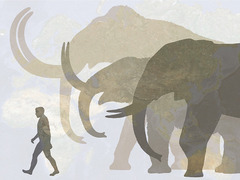
    An illustration of wooly mammoths.

    As I watched the speakers in this strange bubble of mashed-up time, I became fascinated by the very human themes emerging in the narrative of de-extinction: the nature of wonder, which binds us not only to our ecosystem but to our hubris and hope. Wonder is both the catalyst and the goal of scientific progress, and asking questions about the things that amaze us opens new conversations that lead to innovation. When paleontogist Michael Archer peered at a baby thylacine, pickled in a jar of alcohol, he marveled at its potential. The alcohol was a DNA preservative and could be used to create a viable embryo. Ben Novak, the passenger pigeon expert, admired the passenger pigeon’s beauty and unique social behavior: “No book, no museum can give you the majesty of what this bird was.” And forensic paleontologist Hendrik Poinar’s childhood appreciation of the mammoth became a lifelong quest to figure out how to bring it back.

    But asking the questions is the easy part. The most difficult task is answering them. A few of the speakers brought up valid criticisms of de-extinction and the costs it could have, especially on conservation. Stanley Temple described the future of species as a well-balanced three-legged stool; the legs are “protect,” “conserve” and “restore.” Now, we’re adding another leg, “revive,” so the balance needs to shift. David Ehrenfeld, a conservation biologist, believed we need to lose our arrogance and ease up on the hype of de-extinction because, in the end, it’s only “recreational conservation,” that negatively detracts from current conservation efforts. Plus, animal welfare might be an issue — revived species could negatively impact human health or became invasive to other species. And what happens when extinction is not forever?

    Hank Greely also touched on the idea of whether this is something God (or even Darwin) would have wanted us messing around with. And Kate Jones, a conservation biologist who spent years creating an evolutionary tree of mammals, lamented the loss of evolutionary history that would occur with the resurrection of extinct species.

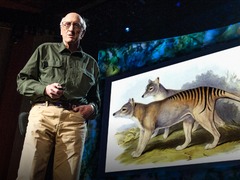
    The last thylacine; a pickled thylacine pup preserved in alcohol; and the passenger pigeon.

    The last thylacine; a pickled thylacine pup preserved in alcohol; and the passenger pigeon.

    Our role in the story of extinction has not exactly been heroic. We hunted the thylacine to death. The baiji, a freshwater dolphin living in the Yangtze River became extinct as its habitat grew increasingly polluted. Farmers thought Carolina parakeets were ruining their crops, so shot them to death. Would de-extinction be our way of righting a wrong? Or should we learn from our mistakes in trying to intervene and focus our efforts on conserving the endangered species that need our attention now?

    One speaker who helped resolve these questions for me: evolutionary biologist Beth Shapiro, who explained that we still haven’t completed the first step of bringing back a wooly mammoth. We only know 3.8 billion base pairs of the genome, which is about 50% of the entire puzzle. She thinks de-extinction is a pipe dream, but a pipe dream worth pursuing. “This is going to stimulate a lot of research,” she said on-stage. “It’s going to bring together the conservationists, ethicists, molecular biologists, and people, like me, digging up bones in the permafrost to converse at the same table. We’ll learn about cloning, about genomes. We’ll learn about where genes are and how they interact with other genes. We’ll learn about what happens when genes from two different species come together.”

    The speakers at TEDxDeExtinction take a bow.

    By the end of the day, I found that the question, “Should we de-extinct?” was answered with a resounding: “We have no choice.” The trajectory of scientific innovation, in the end, is unstoppable. But dizzied from my time travels, I worried that it was all happening too fast.

    Ryan Phelan, co-host of TEDxDeExtinction, assured me that there will be enough time for discussion. “Things are moving slowly, right now. But, at some point, change is going to be exponential, just like the first computer,” she said. “Now, we have time to think: How do we shape the future that we want? How do we do it in a responsible way? There’s time for citizen participation.”

    And that set my feet back down in the present.

  • Secret Voices: Speakers in Session 10 at TED2013

    Session10_SecretVoicesShhh … it’s time for Secret Voices, the 10th session of TED2013. Get ready to hear stories of the forgotten, marginalized, stigmatized and hidden. Our first speaker while make quite an entrance while the last will give a stirring finish, describing the voices in her head. In between, thoughts on inter-species communication.

    In this session:

    Beijing-based artist Liu Bolin silently comments on modern sociopolitical conditions by dissolving into his art.

    Diana Reiss studies cognition in animals and the evolution of intelligence. She and her colleagues demonstrated that bottlenose dolphins (and Asian elephants) can recognize themselves in the mirror.

    Musician Peter Gabriel is the co-founder of WITNESS, which distributes digital cameras to empower people to document human-rights abuses. A founder of the band Genesis, Gabriel is now a solo artist and record mogul, championing world music and innovation.

    As Director of MIT’s Center for Bits and Atoms, Neil Gershenfeld explores the boundaries between the digital and physical worlds.

    Computer scientist Vint Cerf helped lay the foundations for the internet as we know it.

    Shane Koyczan makes spoken-word poetry and music. His poem “To This Day” is a powerful story of bullying and survival, illustrated by animators from around the world.

    Lakshmi Pratury is the host of The INK Conference and was the co-host of TEDIndia 2009.

    Born in North Korea, Hyeonseo Lee left for China in 1997. Now living in South Korea, she has become an activist for fellow refugees.

    Eleanor Longden overcame her misdiagnosis of schizophrenia to earn a master’s in psychology and demonstrate that the voices in her head were “a sane reaction to insane circumstances.”