Author: Ben Lillie

  • A choir live and online: Eric Whitacre at TED2013

    Photo: James Duncan Davidson

    Photo: James Duncan Davidson

    In an extraordinary finale for TED2013, Eric Whitacre stages a type of performance that has never been seen before, with a choir assembled to sing his composition, “Cloudburst.” It’s not just any choir. He’s joined on stage by 100 live singers formed from choirs from California State University, Long Beach Campus, California State University, Fullerton Campus, and Riverside City College. That’s been done before. He is also joined, via Skype, by 32 singers from 32 different countries connecting from their homes.

    Photo: James Duncan Davidson

    Photo: James Duncan Davidson

    Whitacre is famous for his Virtual Choir, and the follow-up, shown first on stage at TED. But no one has ever attempted to put a live choir together with a virtual one. In part this is because of the latency issues of the connection. It’s less than a second, but in singing that is still a potentially huge problem. So, he adapted “Cloudburst,” one of his earliest pieces, to embrace that latency.

    The effect is stunning. We listen to this amazing piece, aware of the vast connection enabled by the Internet.

    Photo: Ryan Lash

    Photo: Ryan Lash

    TED2013_0074933_D41_5472

    Photo: James Duncan Davidson


  • How societies grow old: Jared Diamond at TED2013

    Photos: James Duncan Davidson

    Photos: James Duncan Davidson

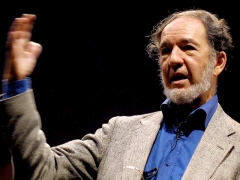
    Jared Diamond on why societies collapseJared Diamond on why societies collapse

    Growing old in traditional societies

    Jared Diamond is the author of Guns, Germs, and Steel, which was a provocative answer to the question of why Europe dominated the world for much of recent history. More recently, he has written The World Before Yesterday, an investigation of traditional societies, and what the modern world might learn from them.

    For this talk, he’s focusing on one chapter of that book and ask the question: what can we learn about how to treat elderly people from traditional societies? There are many, many traditional societies, and they are very different from modern societies. “Tribes,” says Diamond, “constitute thousands of natural experiments in how to run a society.” He is quick to add that they shouldn’t scorned as primitive, nor romanticized as happy and peaceful.

    Now in our society, most old people end up living separately from their children, and away from the friends they grew up with. In traditional societies everyone lives out their lives among their children and friends. That says, their treatment varies wildly.

    At the worst extreme, many get rid of elderly by one of several methods:

    • Neglect and not feeding them.
    • Abandoning them when the group moves.
    • Encouraging suicide.
    • Killing them.

    This happens, says Diamond, mainly under two conditions: Nomads that are incapable of physically carrying them, or people living in marginal or fluctuating environments, such as the arctic or deserts. To us it sounds horrible, “But what could those traditional societies do differently?”

    On the opposite extreme are the New Guinea farming societies he has been studying recently and most other sedentary farming societies. There the elderly are fed, remain and live in the same hut or a nearby hut to their children.

    Elizabeth Lindsey: Curating humanity's heritageElizabeth Lindsey: Curating humanity's heritage

    What does this mean?

    There are two reasons for this variation, the usefulness of old people and the society’s values. There are many things that elderly people contribute to their societies: They may be effective in producing food. They can babysitting grandchildren, freeing their children to hunt and gather. They can craft things. And often they are the leaders and the most knowledgeable. The last point has a huge significance that would never occur to us in literate societies, “It’s their knowledge that spells the difference between survival and death.” In other cases, the society places an emphasis on respect for the elderly, as in East Asia. That contrasts strongly with the United States. Here, the elderly are at a huge disadvantage. For example in job applications, or in hospitals — in that case there is an explicit policy to treat younger people first.

    TED2013_0071148_DSC_9312There are several reasons for that low status: The Protestant work ethic, the emphasis on self-reliance and indepenence, and the cult of youth. Clearly, there have been many changes for the better, but there have also been changes for the worse:

    • There are more old people and fewer young people than at any time. This makes each elderly person more of a burden.
    • The breaking of social ties with age. Americans move on average every 5 years, and are likely to end up away from their children and friends.
    • Formal retirement from the workforce, and the loss of self-esteem which accompanies that.
    • They are, “Objectively less useful than in traditional societies.” The slow pace of change there means what you learn as a child is still useful. Not in ours. (For example, the TV set Diamond grew up with in 1948 had three knobs, today he has a remote with 41 buttons.)

    What can we do?

    Cynthia Kenyon: Experiments that hint of longer livesCynthia Kenyon: Experiments that hint of longer lives

    The lessons

    This is clearly a huge problem, but Diamond thinks there are a few good takeaways from traditional societies about the value of our elders:

    • Elderly people are increasingly useful for high-quality child care, particularly as women enter workforce. Compared to alternative of paid child-care, superior motivated child-care.
    • They have gained in value because of the experience in living condition that are gone, but might come back. None of the young people, including most voters and politicians, have lived through a depression, or a World War.
    • While there are many things they can’t do as well, there are many things they can do better. Some skills increase with age, like understanding of people and human relationships, the ability to help others without ego, and understanding and making connections between large, interdisciplinary data sets. That makes them better at supervising, administrating, advising, and simliar roles.

    It’s a lot of food for thought. He reminds us that we should consider, without romanticizing, that, “Traditional society elders have traditionally more rich lives. They think of dangers far less than we do, and they don’t die of heart disease and diabetes.”

  • “I was watching like no one was dancing”: Allison Hunt at TED2013

    Photo: James Duncan Davidson

    Photo: James Duncan Davidson

    Brené Brown: The power of vulnerabilityBrené Brown: The power of vulnerability

    “If you’re middle-aged and North American, you probably learned to dance when you were in a gymnasium in junior high.” Allison Hunt didn’t get that training, because her mother was always chaperoning the dances, and worse than that: dancing. What could be more embarrassing to a teenager? She says: “You know the expression, dance like no one is watching? I was at the back of the gym watching like no one was dancing.”

    In this short audience talk, Hunt talks about what happened after her recent hip replacement. She was recovering, and saw Brené Brown’s talk on vulnerability. Deciding that she needed to get past the embarrassment of the past, she took private hip-hop lessons. One on one. “I take my vulnerability very seriously.”

    The good news: You don’t need to move your feet. It’s all upper-body. As her instructor said, “When you’re in a club on the dance floor, no one can see your feet.”

    So she learned, and she shares four rules of hip-hop that helped her relax.

    1. No smiling in hip-hop.
    2. Remember you have hands. If you don’t, you will default into jazz-hands or the dreaded finger guns. Use fists, that’s more badass. That’s more, “I think ‘mother’ is half a word.”
    3. Music is vital. Don’t be caught dancing without it.
    4. The louder the music, the better you dance.

  • The vastness of human sexuality: Christopher Ryan at TED2013

    Photos: James Duncan Davidson

    Photos: James Duncan Davidson

    Helen Fisher: Why we love, why we cheatHelen Fisher: Why we love, why we cheat

    Humans have sex like apes

    Christopher Ryan begins his talk with a strong reminder, “We didn’t descend from apes. We are apes.” A special kind, but we are one. We’re closer to chimps and bonobos than they are to any other primate. But he wants to know, “What kind of ape are we? Particularly in terms of our sexuality.”

    That’s a subject he’s been investigating as the co-author, with Cacilda Jethá, of Sex at Dawn. He says that there has been a standard narrative — that men and women are locked in an eternal struggle. That throughout history men have “leased” women’s sexuality in return for security.

    This narrative is mistaken. It turns out that in many societies those things were shared in what he calls a “fierce egalitarianism.” Ryan makes it clear that he is not saying they were noble savages. But he notes that that social structure did exist, and is further saying this extends to sexuality. That “human sexuality has essentially evolved, until agriculture, as a way of maintaining and establishing the complex social networks that our ancestors were very good at.” He is also quick to note he is saying ancestors were promiscuous, but is not saying they were having sex with strangers, because, “There were no strangers.”

    This is also not to criticize monogamy. “To argue that our ancestors were sexual omnivores,” says Ryan, “is no more a criticism of monogamy than arguing that our ancestors were dietary omnivores is a criticism of vegetarianism.”

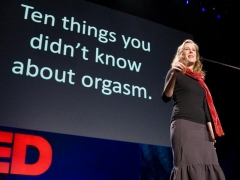
    Mary Roach: 10 things you didn't know about orgasmMary Roach: 10 things you didn't know about orgasm

    Evidence from anatomy and anthropology

    Where did our misconceptions about sex come from? Well, Darwin, as it turns out, was a world-class Victorian prude. He was fascinated by the colorful genital swelling in bonobos, but what he didn’t know is that female chimps have sex 1-4 times an hour with up to a dozen partners. Furthermore, Ryan notes that female chimps are sexually available for 40% of their menstrual cycles, but bonobos for 90% — almost as much as humans, who are capable of engaging in sex at any point in their cycle. That is a trait that is vanishingly rare among mammals.

    For Ryan, a key question to understanding the origin of human sexuality is, “Are human beings a species that evolved in the context of sperm competition?” Are they competing against each other or with the sperm of other men as well? It doesn’t seem to be the case. For example, the average human has sex about a thousand times per birth. “If that seems high to you,” laughs Ryan, “don’t worry, it seems low to other people in the audience.” A more typical number among apes is to have sex about a dozen times per birth. Additionally, Ryan notes, humans and bonobos are among the only animals that have sex face to face. They also have external testicles. Says Ryan, ”External testicles are like having an extra fridge in the garage for beer. If you’re the kind of guy that has a beer fridge, you expect a party to happen at any moment.”

    The evidence that the standard model isn’t correct extends beyond anatomy to anthropology. When one looks, they find all kinds of societies which have sexual practices that should not exist if the standard model is correct. In one culture, they found no shame about sex, and women with many lovers — some with well over 100. Who takes care of the children of those unions? The responsibility falls to the mother, her sisters and brothers. The biological father has no role.

    TED2013_0062674_DSC_8129In the Amazon basin, there are a few societies where a child can have many fathers. Those cultures believe that a fetus is made of accumulated semen. A woman who wants a child who is smart, funny and strong will have sex with one man who is smart, one who is funny and one who is strong. When the child is born, each of these men will come forward. Paternity is a team endeavor.

    Esther Perel: The secret to desire in a long-term relationshipEsther Perel: The secret to desire in a long-term relationship

    What does this mean?

    Why is this important? Ryan is worried: “Our evolved nature is in conflict with many aspects of the modern world…. There is a conflict between what we feel and what we’re told we should feel.”

    He hopes that thinking about the origin of sex will make us become more tolerant of alternative arrangements than the Victorian models. And most importantly, to “finally put to rest the notion that men have an innate right or instinctive need to control women’s sexual behavior.” He says our real fight is not between the genders, but with “an outdated Victorian notion of morality, that conflates desire with property rights.”

    In other words: Forget about “men are from Mars and women are from Venus. Men are from Africa, and women are from Africa.”

  • Fighting the growing deserts, with livestock: Allan Savory at TED2013

    Photos: James Duncan Davidson

    Photos: James Duncan Davidson

    The growing desert

    Allan Savory has dedicated his life to studying management of grasslands. And if that doesn’t sound exciting, just wait, because it touches on the deepest roots of climate change and the future of the planet.

    “The most massive, tsunami, perfect storm is bearing down on us,” is the grim beginning to Savory’s talk. This storm is the result of rising population, of land that is turning to desert, and, of course, climate change. Savory is also unsure of the belief that new technology will solve all of the problems. He agrees that only tech will create alternatives to fossil fuels, but that’s not the only thing causing climate change.

    “Desertification is a fancy word for land that is turning to desert,” he says. It’s a process that happens if we leave ground bare, allowing water to evaporate. Even heavy rainfalls will quickly vanish. Terrifyingly, about two-thirds of the world’s land is desertifying. This is huge, because ”the fate of water and carbon are tied to soil and organic matter. When we damage soils, we give off carbon.”

    Even worse, we might think that only arid and semi-arid land is becoming desert, but tall grasslands are in danger as well. They can have a cancer “that we don’t recognize until it’s terminal form.”

    This is mostly caused by livestock. Everyone knows this, says Savory. Scientists have known it for decades. Livestock damage the land, leading to dry ground, leading to desert. This makes sense, and turns out to be quite wrong.

    TED2013_0052584_D31_3851A terrible mistake

    In the 1950s, Savory helped to set aside large areas of Africa for national parks. As soon as they removed the people (to protect the animals), the land deteriorated. His theory, backed up by data, was that it was because there were too many elephants. That was “political dynamite,” he said, but a panel agreed with his assessment.

    So they shot 40,000 elephants.

    But the deterioration only got worse. The elephants were not the problem after all. Says Savory, “That was the saddest and greatest blunder of my life. I will carry that to my grave.” It did give Savory one thing: “I was absolutely determined to find solutions.”

    Later, in California he was shocked to find similar problems in national parks, but there was no livestock nearby. So he looked at research stations where cattle had been removed, to prove that that would stop desertification. It didn’t. ”Clearly,” he says, “we have never understood what is causing desertification.”

    If it wasn’t livestock, as had been assumed for centuries, what was it? “What we had failed to understand was that … the soil and vegetation developed with large numbers of grazing animals.” They also had predators, and so defended themselves by making herds, which are forced to move. This movement prevented over-grazing, while periodic trampling produced good soil. It wasn’t the livestock, but the way the livestock were kept by farmers.

    The problems spiral out from this failure to understand. If grass dies on it’s own, at the end of a season, it must decay biologically before the next growing season. If it doesn’t, will stifle next growth. The typical method used to deal with that is to burn the grassland. That does remove the dead grass, allowing a new crop to grow, but it is very damaging, releasing an amount of carbon equivalent to 6,000 cars/second.

    Holistic management

    So what can they do? “There is only one option left to climatologists and scientists. That is to do the unthinkable: to use livestock, bunched and moving, as a proxy for the herds.” Those herds mulch it down, leaving both the trampled grass and their dung. The grass is then free to grow without having damaged with fire.

    Now, how do you actually do that? Herders had 10,000 years of experience moving animals, “but they had created the great man-made desserts of the world.” And then 100 years of modern science that accelerated that process. Clearly more was needed.

    He studied other professions — and found new management techniques. With this, he was able to develop what he calls Holistic Management — a way of moving livestock around to mimic the patterns of nature.

    The results are stunning. For location after location he shows two comparison photos, one using his technique, one not. The difference is, “a profound change,” and he’s not kidding — in some cases the locations are unrecognizable (in one case the audience gasped). Not only is the land greener, crop yields are increasing. For example, in Patagonia, an expanding desert, they put 25,000 sheep into one flock. They found an extraordinary 50% improvement in production of land in the first year.

    “What we are doing globally is causing climate change, as much or more than by fossil fuels,” says Savory. It is also causing poverty, suffering, and war. “If this continues, we are unlikely to be able to stop climate change even after we have eliminated the use of fossil fuels.”

    He is currently using this on 15 million hectares on five continents. He estimated that if we do it on half the available land, the growth with take in enough carbon to go back to pre-industrial levles, while feeding people.

    “I can think of almost nothing that offers more hope for our planet, for our children, for their children, and for all of humanity.”

  • A local bacteria to solve a local problem: Miranda Wang and Jeanny Yao at TED2013

    Photo: James Duncan Davidson

    Photo: James Duncan Davidson

    Miranda Wang and Jeanny Yao were the winners in British Columbia of the 2012 Sanofi BioGENEius Challenge Canada. After a visit to a Vancouver waste station, Wang and Yao were blown away by the enormous amount of waste in plastic. Plastic is very hard to sort for recycling — all types have a similar density. Says Wang, “Plastics are useful, but the downside of this convenience is that plastics cause serious problems like the destruction of ecosystems.”

    So Wang and Yao decided to see if there was a way to break them down … with bacteria! It’s a cool idea, but difficult. They made a proposal in grade 12: Find a bacteria from local river to metabolize phthalates. Phthalates are a component of plastic, but they’re not well bonded, so they easily pollute and are found in products like babies’ toys, cosmetics, food wraps. In fact, the EPA has classified them as a top-priority pollutant.

    Wang and Yao figured that if there were places along the local river that were contaminated, then maybe bacteria have evolved to degrade them. So they met a professor who gave them lab space and set to work. They collected samples from three sites, and enriched cultures with phthalates as the only food source. And they discovered that “bacteria can do it” — several local species had indeed evolved to metabolize phthalates. They DNA-sequenced the bacteria, and found several that were not previously associated with phthalate degradation. That’s a real discovery.

    Most interestingly, Wang says, “We found the most efficient degraders came from the local landfill.” Nature was indeed evolving ways of dealing with the problem, one that we could someday use. Yao finishes by noting, ”We weren’t the first ones to break down phthalates, but we were the first ones to look into our local river and find a possible solution to a local problem.”

  • Create!: The speakers in Session 6 at TED2013

    Session6_CreateOnce you dream, you have to do. The speakers in Session 6 have spent their careers giving form to ideas. They are makers, builders, artists and implementers — all with fascinating ideas about what it means to be a creative person.

    In this session:

    In his film “Mars et Avril,” Martin Villeneuve brings his sci-fi romance graphic novel to glorious life.

    Andrew McAfee studies how information technology affects businesses and society.

    Dong Woo Jang turns an unusual stick of bamboo into an archer’s bow — an exploration of his cultural heritage and a metaphor for his perfect world.

    Jinsop Lee is an industrial designer who believes that great design appeals to all five senses.

    Barb Stuckey makes food for a living — and wants to help you taste things better.

    Yu “Jordy” Fu‘s dream is to make this world a better place through art, design and architecture.

    Jacky Myint designed the boundary-breaking news feature “Snow Fall” for NYTimes.com.

    At Novalia, Kate Stone and her team use ordinary printing presses to manufacture interactive electronics, which combine touch-sensitive ink technology and printed circuits into unique and cost-effective products.

    A paper on carbon nanotubes, a biology lecture on antibodies and a flash of insight led 15-year-old Jack Andraka to design a cheaper, more sensitive pancreatic cancer test.

  • Reading minds with a brain scanner — it’s happening: Mary Lou Jepsen at TED2013

    Photos: James Duncan Davidson

    Photos: James Duncan Davidson

    “Let’s talk about what’s in our heads and how to get it out,” says Mary Lou Jepsen as she begins her talk at TED2013.

    Jepsen, a display engineer, recently had brain surgery. Afterward she faced a stigma: “Are you still smart? If not, can you make yourself smart again?” Well, her surgery gave her a chance to experiment in an extraordinary way. Because of nature of the surgery, she had to decide what amounts of over a dozen chemicals to take to stay alive, and to thrive.

    As an experimentalist, she was amazed by how tiny changes in dose changed her sense of self, her thinking, and her behavior. Over several years she tried many combinations. For a while she took a combination typical of a male in his early 20s, and “I was angry all the time, I thought about sex constantly, and I thought I was the smartest person in the world.” That gave new appreciation of men and what they might go through.

    For her, though, the tuning was really about getting herself back. In particular, getting her idea flow back. As a visual thinker, she uses images in her head for rapid prototyping. There is a thought that ideas are images and images are ideas. That’s disputed, but for her images are central.

    It worked, and now she has lots of them. And that brings her to the next bottleneck, and one she thinks she can solve: how to get those images out of her head and onto the screen. Directly. “Can you imagine,” she asks, “a movie director using her imagination alone to direct the world in front of her?”

    Amazingly, the biggest roadblock to that is just increasing the resolution of brain-scan systems. Just this week, the White House announced support of a new project to do exactly this. It’s aimed at treating disease, but will have an impact in many, many areas, including this kind of thought reading. ”Could you imagine,” she asks, “if we could communicate directly with our thoughts? What would we be capable of? And how will we deal with that?”

    TED2013_0044800_D41_7396How is this possible? Jepsen shows two recent experiments.

    • One group used fMRI to scan an individual looking at a picture. Then they scanned the same same individual imagining the picture. Those images are almost identical. That means that imagining an image has the same brain pattern as seeing it.
    • Another group at the University of California, Berkeley has been able to decode a brain-wave into a recognizable shape. They showed people in a brain scanner a set of YouTube videos and scanned them to build a library. Then they were shown a new video. After scanning their brains, the computer could decode the image. The resolution is bad, but it’s clearly right, and it’s stunning. (Read about it here.)

    So, as Jepsen says, they just need to up the resolution. All they need is a thousand-fold increase. How do they get that? Traditionally, better resolution comes from bigger magnets in the MRI machine. Jepsen, however, is looking at techniques to arrange the magnets more cleverly. If successful, they could build a device to do an instant read-out 1000x times better than today. “That’s the dream.”

    And Jepsen says it’s not a matter of if this happens. “It’s coming. We’re going to be able to dump our ideas directly to digital media.” It might take 5 or 15 years, but it’s coming. That, of course, leads to very real concerns about privacy.

    In the near term, this will be a personal tool — someone driving by your house won’t be able to scan your brain and download your thoughts. It will be used for personal enhancement, or to possibly treat Alzheimers and related diseases.

    But Jepsen emphasizes, if we want to understand ourselves better, we need to do this.  And if we do that, “We need to learn how to take this step together.”

  • Dream!: The speakers in Session 5 at TED2013

    Session5_DreamBefore you can create a new world, you have to imagine new possibilities. The speakers in this session are the visionaries who propose that which couldn’t be seen before, and suggest new paths that not only haven’t been traveled yet — but haven’t been thought of.

    Here are the speakers in this session. Click their name to read a recap of their talk:

    The explosive creative direction and choreography of Rich + Tone Talauega has been featured in tours and music videos of pop icons like Michael Jackson, Madonna and Jennifer Lopez.

    Elon Musk is the CEO and product architect of Tesla Motors and the CEO/CTO of Space Exploration Technologies (SpaceX).

    Mary Lou Jepsen discovers astonishing ways to integrate digital screens into daily life.

    At 14, Taylor Wilson became the youngest person to achieve fusion — with a reactor made in his garage. Now he wants to save our seaports from nuclear terror.

    Violinist Ji-Hae Park shares the joy of music.

    Since the counterculture peak of the 1960s, Stewart Brand has been reframing our view. Now, with biotech accelerating four times faster than digital technology, Stewart Brand has a bold new plan to share.

  • A 12 year old learns to scare lions: Richard Turere at TED2013

    TED2013_0034998_D31_0331

    Richard Turere is 12 years old, and he lives in Kenya, in Nairobi National Park. It’s a park with lots of animals that roam freely, including lions. The lions kill livestock. So he say, “I grew up hating lions.”

    Turere, who took part in the Global Talent Search last year, tried to solve the problem. First, he used fire. But that didn’t work, and actually, “It was helping the lions see through the cowshed.”

    So he went to a second idea: a scarecrow. “I was trying to trick the lions. But lions are clever.” On the first day, the lions came, saw the scarecrow and left. The second day, they came and realized it wasn’t moving, and killed the cows.

    But one day Turere discovered that lions are afraid of moving lights. So he got a bunch of lights and an old car battery, and the thing from a motor car that makes the blinkers blink. He set up a circuit that made lights flash. It worked: “The lights flash and trick the lions that I’m walking around the cowshed when I’m sleeping in my bed.”

    Since then, no problems with lions. Other people nearby heard about it and had similar problems, so they asked him to install lights for them. Now it’s used all across Kenya to scare various predators. Because of this, he received a scholarship to the best college in Kenya, where he now studies.

    “A year ago,” says Turere, “I was a boy in a savannah grassland. I saw planes fly over and I said I’d be inside one day. I had a chance to come by plane for the first time for TED. I got to come by plane to come to TED. My dream is to become an aircraft engineer and pilot when I grow up.”

    And for now, he lives with the lions without conflict. It’s a wonderful sentiment to end an extraordinary talk, and the audience responds with a full, enthusiastic standing ovation.

  • Set high expectations for all students: Freeman Hrabowski at TED2013

    TED2013_0035022_D41_3924

    Freeman Hrabowski is president of the University of Maryland, Baltimore County (UMBC), which has made an extraordinary name for itself educating students of all types in science and engineering. “What makes our story especially important,” says Hrabowski, “is that we have learned so much from students who are typically not at the top of the academic ladder.” And they have graduated a tremendous number who go on to PhDs and faculty positions at top universities.

    Hrabowski himself participated in Martin Luther King Jr.’s “Children’s Crusade.” He marched and was arrested in support of his right to a good education. As he waited in the prison, at 12 years old, Dr. King came over and said to them, ”What you children do this day will impact children not yet born.” The lesson Hrabowski learned? “Children can be empowered to take ownership of their education.”

    UMBC was founded that very year. What made it especially important to Hrabowski is: “It was the first university founded at a time when students of all races could go there.” For him it was an experiment. Is it possible to have institutions where people of all backgrounds can come and learn to work together? They found they could do a lot in the arts, humanities, and social sciences. The problem was the same problem America continues to face: in science & engineering. African American students were not succeeding. Furthermore, ”It’s not just minorities that don’t do well in science and engineering.” Twenty percent of African American students who start a science degree will complete it. But the number for white students is 32%, and 42% for Asian Americans. This is a problem for all of America. He thought, ”So many students are smart and can do it. We need to find ways of making it happen.”

    So here are the things they did:

    1. Set high expectations. It takes both a drive, and an understanding that it’s going to be hard work. They had one student who made a C in a core course. They made him re-take it, and he went on to be the first black student to earn a Ph.D. from the University of Pennsylvania. He now works at Harvard.
    2. Building community among the students. We tend to think cutthroat when it comes to excellence. But, as Hrabowski notes, “It’s one thing to earn an A yourself, it’s another thing to help someone else do well.”
    3. It takes researchers to produce researchers. He says they need scientists to pull the students into the work, and the students at UMBC are actively involved in the research in the labs.
    4. Faculty need to be willing to get involved with the students, even in the classroom. Observing every student to see what was wrong with them. One professor wrote, “I have this young black guy in class; he’s not excited about it, he’s not taking notes.” Hrabowski notes that the important part is that the faculty member was observing every student, and, “That young man is now a faculty member, at Duke.”

    So many students, says Hrabowski, are bored in class. That’s why UMBC puts emphasis on collaboration, on using technology. Not just teaching theories, but letting students struggle with those theories. And it’s needed. For example, there has been a 79% decline in women majoring in computer science since 2000. He believes that what will work to combat that is building community, and faculty pulling students into the work.

    Most important, says Hrabowski, “If a student has a sense of self, it’s amazing how their dreams and values can make all the difference in the world.”

  • Fun, interesting science? 11 amazing online sources

    In today’s TED Talk, Tyler DeWitt makes a fantastic case for a simple idea: make science fun. Educators and writers get caught up in the idea that science needs to be taken seriously, and forget that the best way to get kids interested is to… make it interesting. Too much emphasis on being accurate can lead to lessons that are incomprehensible, or just flat-out boring. The money quote from DeWitt:

    “If a young learner thinks that all viruses have DNA, that’s not going to ruin their chances of success in science. But if a young learner can’t understand anything in science and learns to hate it because it all sounds like this, that will ruin their chances of success.”

    Now to the good news. There are a lot of people doing very fun, very engaging, very non-stuffy science work. If you’re a teacher looking for ways to engage your students, or if you just want to see some science yourself, take a look at these great resources:

    Minute Physics. Short videos explaining a physics concept. Sounds simple? It is, and that’s why it’s great. They’re clean, easy to understand, and discuss some of the most fascinating ideas in physics.

    Vi Hart. Another series of videos, this time about math. She uses hand drawings and her own amazing way of talking to make math incredibly fun and relevant.

    It’s OK to be Smart. A Tumblr with a great idea: post interesting science, and be excited about it. Joe Hanson figured that he could make use of the powerful sharing tools on Tumblr to get fascinating science content out there. And he was right.

    Comics! There are a surprising number of amazing web-comics about science. Of course there are the well-loved XKCD and Saturday Morning Breakfast Cereal, which frequently explain, dissect, and have fun with science. There are many, many others, such as sci-ence, where top-notch comic artist Maki Naro illustrates science comics, with a more in-depth explanation below.

    I F***ing love science. One of the most successful Facebook fan pages in existence — it has 3 million likes! Curator Elise Andrew finds funny, awe-inspiring, or otherwise amazing pictures. It’s like LOLcats, but with science.

    There are lots of wonderful places to find science news. Two of our favorites that consistently post high-quality ideas in a playful way are io9, and the inimitable BoingBoing.

    Of course, there is our very own TED-Ed. Short, beautifully animated lessons for high school students.

    There’s also The Story Collider, the story-telling event dedicated to how science makes a difference in lives and changes people. I highly recommend it, but I’m biased because I happen to run it. We have a podcast full of alternately funny and touching science stories.