
Author: Bhumika Ghimire

  • Nepal: Tibet Uprising Anniversary Exposes Growing Rift

    M10_heart_webTibet Uprising Day, observed on March 10 every year, marks the violent crackdown in 1959 by Chinese authorities after Tibetan protesters launched protest against their presence in Tibet.

    This year's anniversary observation in Nepal is already under tremendous scrutiny from the authorities. EverestJournal, a blog on Nepal tourism and environment, says that Nepalese government is ready to stop any anti-China demonstrations in the country.

    “Determined to prevent anti-China demonstrations in Tibet Wednesday, the 51st anniversary of a failed Tibetan uprising against Chinese annexation, Beijing has snapped most links between the former Buddhist kingdom and its neighbor Nepal.

    The bridge connecting northern Nepal with Tibet – the Friendship Bridge – has been effectively closed by the Chinese authorities, rights body International Campaign for Tibet (ICT) said in a statement, while flights between Kathmandu and Lhasa, the Tibetan capital, have been grounded since Friday.”

    Tibetan Protest in kathmandu. Image by Flickr user Buddha's Breakfast. Used under a Creative Commons License

    Tibetan Protest in kathmandu. Image by Flickr user Buddha's Breakfast. Used under a Creative Commons License

    Nepal's forceful approach towards the Tibet Uprising Anniversary and any public program that may be organized by Tibetan refugees in the country is attracting criticism from Tibetan & Nepali blogs.

    TibetCustom says that Nepal is falling “into the arms of China over Tibet “issue””:

    “The Nepalese government has adopted a hard line against expressions of Tibetan identity in Nepal, despite strong cultural and religious ties among the Himalayan peoples that have existed for centuries. Long-staying Tibetan refugees in Kathmandu and in settlements close to the Tibet-Nepal border are increasingly fearful as the Nepalese government relinquishes its historic and sovereign interests in response to incentivized political pressure from Beijing and its Nepalese sympathizers.

    Mary Beth Markey, Vice President of Advocacy of the International Campaign for Tibet, said: “These disturbing developments deserve an immediate response by the international community…..”

    Lathi charge on Tibetan protest in Kathmandu. Image by Flickr user Buddha's Breakfast. Used under a Creative Commons License

    Lathi charge on Tibetan protest in Kathmandu. Image by Flickr user Buddha's Breakfast. Used under a Creative Commons License

    At influential Tibetan blog Phayul, Kalsang Rinchen reported on Nepalese government's decision to detain Tibetan government's representative. Rinchen describes the government's decision as a deliberate move to “appease” the Chinese.

    “The Nepal government has recently launched hunt for “trouble makers” through surprise raids of hotels, restaurants and homes earlier last week reportedly under pressure from China that rewards the crisis stricken country with financial aid and military assistance. Several Tibetans have been reportedly taken under “preventive custody” ahead of Wednesday's commemoration. Unlike protests against China by exiles in other parts of the world, the Tibetans in Nepal do not organize protests under any of the Tibetan exile groups like the Tibetan Youth Congress, Tibetan Women’s Association or Students for a Free Tibet making it hard for the Nepalese police to pin down on any particular group.

    Nepal has intensified its control on the Tibetan refugee community that numbers around 20000 ahead of Wednesday’s Tibetan uprising day commemoration. The Himalayan Kingdom that was struck by a series of domestic turmoil and political revamp in the last decade has been preventing the Tibetans from engaging in anti China activities on its soil. “

    Over The Top, the Blog of Himal Magazine from Nepal informs:

    A letter dated 8 March from the Tibetan Refugee Welfare Committee of Kathmandu, currently making its rounds in the community, makes the ominous allegation that the Nepali police have been going so far as to threaten some extremely dire consequences to the kinds of protests Kathmandu has seen in the past. In a stark warning to the community, the letter states that, in the areas deemed off limits to demonstrators, “the police may even resort to shoot[ing].” As news of arrests of Tibetan activists continue to trickle in, the accompanying photographs taken today around the valley indicate that the Nepali government will continue to channel the paranoia of Beijing.

    This is not the first time Tibetan community in Nepal has come under government's ire. There was a large scale violent crackdown in 2008 when protest against China broke out in Kathmandu before the Summer Olympics in Beijing.

    Protest in Pokhara before summer olympics in Beijing. Image by Flickr user Tboothhk. Used under a Creative Commons License

    Protest in Pokhara before summer olympics in Beijing. Image by Flickr user Tboothhk. Used under a Creative Commons License.

    A recent report in Al Jazeera English characterized the incident as Nepal curtailing Tibetan community's free speech rights, under pressure from China.

    Focus on the Tibetan community in Nepal and neighboring India has however failed to include growing division within the community on a very serious issue-religious freedom. The Dalai Lama has imposed a ban on worship of deity Shugden. This has divided the community as Shugden's believers face hostility and suspicion.

    As Nepal continues to put emphasis in building closer relationship with China, its relationship with hundreds of Tibetan refugees scattered around the country is bound get more strained in coming days. Anniversaries commemorating events like 1959 uprising juts add extra pressure to the already difficult situation.
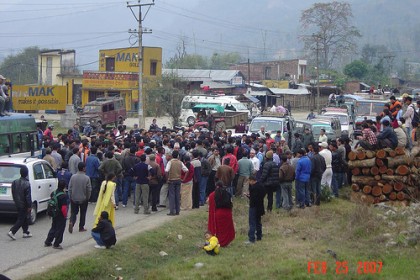
  • Nepal: Monarchists Shut Down Capital Kathmandu

    Strike in Nepal. Image by Flickr user Nepaliaashish. Used under a Creative Commons License

    Strike in Nepal. Image by Flickr user Nepaliaashish. Used under a Creative Commons License

    Pro monarchy groups demanding restoration of constitutional monarchy, and establishment of a Hindu state in Nepal forced its capital to shut down. The streets of Kathmandu, usually a bustling city of about a million people, wore a deserted look on Monday as businesses and schools were closed. Nepali language blog Mysansar has pictures of the city's major thoroughfare during the protest.

    Called by pro-monarchy party Rashtriya Prajatantra Party (RPP) and lead by former Home Minister Kamal Thapa, the protest has once again posed the question – “is there future for monarchy in Nepal?”

    After nearly three hundred years of monarchy, Nepal was declared a republic following a peace agreement between the government and Maoist rebels. King Gynandra was a pretty unpopular figure when he was deposed in 2008; but the relative success of RPP called protest and the way people received the King during a recent religious festival indicates that some people are willing to give the King a second chance.

    United we blog for democratic Nepal, a blog maintained by a group of journalists, reported on the religious festival:

    “A lot of ex-royalists and general people out of curiosity had lined up this time on the roadside to get glimpse of the ex-monarch. Some people cheered as king passed by. There was a group of people who sang bhajan to welcome Shah. Some people screamed slogan Raja Aaau Desh Bachau “Come King and Save the Country” The same slogan chanted by staunch royalists. Gyanendra Shah tried to mingle with the people…he sometime shook his head, waived his hand and joined his palms to honor the elders, according to Kantipur. A woman who was standing by the street complained “Hajur…there is no peace in the country.” Gyanendra Shah who stayed in Panauti for one and half hour prior he returned to the capital only said, “I wish there is justice and no one faced difficulties.”

    Some loyal royalists have also been doing rounds of international publications to turn the border perception on their side. Dirgha Raj Prasai-former member of parliament, writing for Sri Lanka Guardian, argues that Maoists and various political parties are destroying Nepal and only monarchy can save the country.

    The debate over Nepal's status as a secular state has also been pushed to the spotlight. Prasai in his aforementioned article, calling for monarchy to be restored, injects religion into the debate; saying that a secular Republic will destroy Nepal's character as a unique blend of Hindu and Buddhist traditions.

    Blogger Maila Baje speculates that Nepal may quietly drop off its present secular state status:

    “….It was not politically correct to defend Hinduism lest it imply support for the discredited monarchy. The Maoists, the storyline went, had to be brought into the mainstream at all costs. (The rebels, for their part, had long recognized that international funding was most copious for restructuring the religious character of the state.)

    Nearly four years after that simulated peace, it has become fashionable to break the silence. A republican Nepal might be better able to anchor its unique identity as a Hindu state, after all. President Ram Baran Yadav and Maoist leader Pushpa Kamal Dahal have purportedly conceded that the secularization of the state was a mistake. Granted, they made the admission during private meetings with Hindu men of robes. But that goaded Deputy Prime Minister Sujata Koirala toward pushing the envelope. She wants a referendum on whether Nepal should return to state Hinduism.”

    The relative success of RPP called protest in largely liberal progressive Kathmandu is no doubt an indication that nearly two years after the country was declared a secular Republic. There is a section of society who still are not satisfied and convinced about the change. It is up to the leaders and the public to decide how they are going to address the unsatisfied mass.

  • US Bloggers On The Case Of Kidnapping Haitian Orphans

    haiti orphans

    Children from Maison Des Enfants de Dieu orphanage fill the jump seats in a Travis Air Force Base, Calif., C-17, Jan. 23, preparing to head the United States to meet with their adoptive families. Image from Flickr by DVIDSHUB. Used under a Creative Commons License

    As Haiti slowly treads on the path to recovery and rebuilding, there is a sense of renewed concern for the countries children-especially the orphans. Various news agencies have been reporting on child traffickers targeting vulnerable children in the country, including this report at CNN.

    The orphan debate has a lot of US connections because the arrested church group was American and a lot of the orphans were destined for USA if adoptions continued. On the US blogosphere, the opinion on the missionaries seems to be divided, and the attitude of the US Department of State is also being questioned.

    At the legal blog Right Juris, blogger Ryan questions the State Department's handling of the situation. In the light of facts that have emerged-that 22 out of 33 “orphans” the missionaries were trying to get to an orphanage in the Dominican Republic have living parents, and the group did not have necessary permission and documentation to take the children out of country; the State Department has decided to take the “hands off” approach.

    “No matter what happens the US Missionaries Charged with kidnapping Haitian orphans appear to be stuck in Haiti for quite some time. They will be there even longer if the State Department doesn’t help try and secure their release, or a transfer of the case to The United States. The question though is should the State Department intervene? What do you think? Should this group be tried and convicted of kidnapping? Should the U.S. government press for their release? Did the group really have only good intentions when they attempted to flee the country with 33 Haitian children? I would love to hear your thoughts.”

    Brazen attempt of the missionaries to go through their mission, without ever seeking necessary permission in the United States or in Haiti has raised doubts.

    Paul Shepard at the blog Black Spin says that the missionaries have a tough road ahead.

    “While their hearts might have been in the right place, their heads were clearly out of commission in trying to pull off such a dangerous stunt without informing government officials in the United States or Haiti about what they were doing.

    No one doubts some orphans in Haiti today would be better served by moving to loving families in other countries, but that kind of effort takes time and coordination with local officials.”

    Te-Ping Chen at Change.org, questions the children focused relief effort in Haiti. In her thought provoking post titled “When ‘Charity' in Haiti Kills Children”, Chen examines the effect the missionaries' arrest is having on volunteers who want to travel to Haiti to help.

    “…Since the missionaries were arrested last month, the misbegotten travails of ringleader Laura Silsby & co. have had a chilling effect on doctors, aid workers and government officials (you know, the people who have a legitimate mission in helping Haiti with the recovery process) trying to save the lives of critically injured Haitian kids.

    Now, the New York Times is reporting that 10 children have died or become worse while waiting for authorization from newly skittish authorities to get on flights out of the country for treatment.

    Prior to the Americans' arrest, every day, an average of 15 injured Haitian children were getting airlifted out of Haiti onto U.S.-bound flights. Since Silsby & co. bobbed onto the scene, though, only three children have been evacuated for treatment in the U.S. on private flights….”

    Chen joins a growing list of people, including some very well known names, who are asking whether is it an act of kindness to remove Haiti's children from the country in search of better life. Washington Post columnist Eugene Robinson has criticized the missionaries for the brash attempt, saying that “True charity would have been to help those families care for their children — not to put them in a bus and drive them away. “

    Marc Herman at a previous post in Global Voices noted that surprisingly the voice of Haitian themselves has been muted on the orphans issue. He also highlights a sudden rise of interest on Haitian children after the earthquake.

    Late Wednesday evening, a Haitian judge ruled that 8 of the 10 missionaries be release immediately. They will soon be flown back to the United States, leaving behind Laura Silsby and Charisa Coulter. Sisby is the group's leader.

    The already fractured public opinion in the blogosphere is sure to get more intense over the surprise release of the 8 missionaries. There will also be speculation over why 2 missionaries-Laura Silsby and Charisa Coulter are still being held, beyond the official explanation that the judge wants to investigate why the pair had traveled to Haiti before the devastating earthquake last month. It seems that Haiti's children will once again be on the spotlight.

  • Nepal: Renewed Focus On Indo-Nepal Relations

    Following two high profile visits from New Delhi-Foreign Minister S.M Krishna and Army Chief Deepak Kapoor, the India Nepal relation is being discussed with renewed vigor in both Indian and Nepali blogs.

    Pragoti, a left leaning Indian blog, talks about “the right scientific vision for Indo-Nepal relations”, asserting that bilateral relations could improve if India strives for a progressive foreign policy.

    “As long as the Nepali Maoists continue to rely on the Nepali people to democratically stake their claim to power and also to implement their stated programme, the Indian ruling establishment can not offer the logic that the Nepali Maoists are in cahoots with the insurgent Indian Maoists. And as long as there is enough pressure on the Indian ruling establishment by progressive, left and democratic forces to address the grievances and concerns, the prospects of a progressive foreign policy are very much alive. That would require that the democratic-minded people in the country should be strengthened in their fight against the violent and murderous insurgency spearheaded by the Indian Maoists in places like West Bengal, ….”

    India's suspicions regarding the Maoist aside, another issue that has been casting negative shadows over Indo-Nepal relations is the border issue. Allegations have been leveled against India for encroaching Nepali land. United we blog for democratic Nepal features an interview with Buddhi Narayan Shrestha, the former Director General of Survey Department (Nepal) on the very issue, where he presents some specifics regarding dispute:

    “The pillars, which were erected as per the Survey Map of British India, were not found in their location. For example, pillar no 708 at Kauwakhera of Lalboji VDC of Kailali district was found to be 30 metres inside Nepal. But both the local residents and the visiting CA committee concluded that this could have happened because of the change of course of the Mohana river. Secondly, we found some subsidiary (minor) pillars missing. For example, new pillars numbered 407/1, 2 and 3 between Bhajani and Lalbhoji VDC of Kailali district were not found. In other cases, the minor pillars have been broken. Similarly, the 182 maps show half-km no-man’s land on either side of the border. But no-man’s land was not found in places like the Pyaranala area of the Parasan VDC in Kanchanpur district. At some places the Indian side had encroached upon Nepali territories. In other places, Nepal had encroached upon the border. ….”

    Mr. Shrestha says that in some cases Nepal has also encroached upon Indian land, but so far that side of the dispute has not received much attention. Maoists are leading the charge against India on the border issue, they are also calling for renegotiation of 1950 Friendship Treaty between the two countries.

    Maoist leader Prachanda, Image via Wikipedia

    Maoist leader Prachanda

    In 2008, an interview with Maoist leader Pushpa Kamal Dahal (Prachanda) was published in The Hindu, where the treaty was discussed. Bloggers at Chennai-Based Chinese National Newspaper (CBCNN) Blog analyzed the interview and commented on Prachand'a assertions that India has nothing to fear from growing Nepal-China friendship:

    “The idea that Chinese penetration of Nepal ought not to be of much concern because China does not need that country to create problems for India is laughable. Political and military strategists look at advantage, not bare necessity – China does not need Burma either but it has nevertheless established military bases in that country and is said to be actively monitoring Indian Naval activities from there. The U.S. sought transit facilities from Turkey to launch its invasion into Iraq again not because it was required – they achieved their objectives without it anyway – but because it would shorten the campaign and would have potentially made it easier. The same is equally true in case of Chinese interest in Nepal – it would be the height of folly for India to plan its own strategy based on whether China needs Nepali support to confront India.”

    It is obvious that political turmoil in Nepal is affecting its relationship with India. At present, various political parties are using disputes with India to further their agenda; hopefully once the rough waters smooth, Indo-Nepal relations will be guided by mutual interest and trust.