Author: Circle of Blue

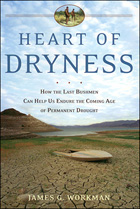
  • Heart of Dryness: Reversing the Politics of Water Scarcity from the Kalahari to Suburbia

    The final installment of our seven-part series of excerpts from James G. Workman’s Heart of Dryness examines how we define water rights for the Bushmen in Botswana as well as suburbanites in the U.S. Workman stresses that the Bushmen’s incredible survival is a warning call for other populations that have yet to endure such water-scarce conditions. As water becomes more scarce, and consequently more political, Workman asks us to question how we’ve “surrendered both our right and our responsibility to water to state-run or-regulated institutions.”

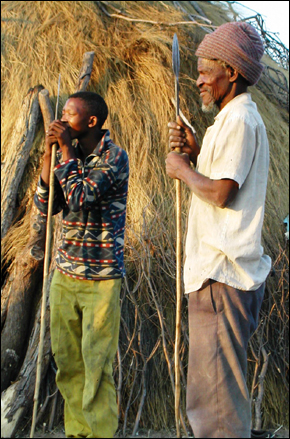
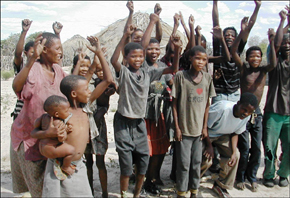
    Botswana Bushmen

    Photo by James G. Workman
    In this final excerpt from Workman’s Heart of Dryness, the author weaves several segments together to understand the political battles that often accompany water scarcity, and the problem of complacency when water is in abundance.

    By James G. Workman
    Special to Circle of Blue

    The dark side of drought and water scarcity isn’t economic stagnation; it is political implosion.[1] Scarce water fragmented society and curtailed liberty. It eroded trust. When drought-struck, the local governments from Atlanta to Los Angeles rationed individual water consumption to one-tenth of what people normally consume each day. [2] It cracked down on private well pumps, claimed and regulated waters for public consumption.

    Outside the Kalahari, these political responses are almost universal. Conflict is inevitable, as most recently witnessed in Boston supermarkets as families brawled over the last bottled water. “Other hazards tend to pull people together,” said Michael Hayes, director of the National Drought Mitigation Center, speaking of water’s power. “With a drought, because it’s a limited resource, it tends to drive people apart.” [3]

    Divide us it did. Southeastern states have sued one another for remnant water, and even Maryland challenged Virginia over control of Potomac River currents for the first time since the Civil War. [4] As citizens appealed to government, governors appealed to God. In July 2007 Alabama Governor Bob Riley declared a week in July “Days of Prayer for Rain.” In November, Georgia Governor Sonny Perdue gathered people together on the capitol steps, bowed his head, and appealed to a higher power for relief. “We’ve come together here simply for one reason and one reason only,” he told the gathering, “to very reverently and respectfully pray up a storm.”[5]

    Irreversibly rising heat, migrating jet stream, booming industry, thirsty populations, helpless leaders driven to their knees: The Perfect Drought.

    “El Nino anomalies aside, it doesn’t appear on the horizon to be getting any cooler or damper; both the World Meteorological Organisation and the British Meteorological Office confirm that last decade was the hottest on record, and reputable observers maintain that our current mega-droughts represent the overture of what will follow for centuries.”

    El Nino anomalies aside, it doesn’t appear on the horizon to be getting any cooler or damper; both the World Meteorological Organisation and the British Meteorological Office confirm that last decade was the hottest on record,[6] and reputable observers maintain that our current mega-droughts represent the overture of what will follow for centuries. Based on new evidence that the Global Warming Era was dawning sooner than expected, even Nobel laureate Al Gore changed his mind: prevention alone was not enough, and too late. Now, he said, we must rapidly learn to adapt to less water.

    If that’s the case, who will teach us?

    For the last seven years as the U.S. broke records for high temperatures and low reservoirs and prepared for what could become the worst hot Dry Age in 30,000 years, the remnants of the world’s oldest civilization—the only people with the survival savvy, strategies, tactics, and values to guide us through the extremes of our once and future drought—were embattled in the heart of the Kalahari Desert, surrounded by armed men who were urging these last free Bushmen to surrender their way of life forever…

    For more than a decade even the wildest drylands in Africa no longer held autonomous bands who might share their self-sufficient experience. Then Botswana’s convoy destroyed the last government water supplies and deliveries inside the Reserve, triggering their crisis—and my opportunity.

    I saw America’s fate inextricably linked to the predicament of a thousand indigenous people suddenly forced to submit, die or adapt once again to The Great Thirstland. The survivors had to tap into the deep reservoir of indigenous wisdom, and I hoped to grasp the essence of their unwritten code. For centuries Bushmen had been shot and infected, poked and prodded, and now, facing the onset of permanent droughts, I set out to exploit them one last time.

    The ‘Last of the First’ welcomed me to their fire. I listened to what often seemed serious debate but was later translated as spectacularly lewd banter. During a lull one evening, as it grew cooler, I moved with tape recorder and camera from one Bushmen to the next until coming to an unspoken matriarch. In exchange for smuggling contraband water and other supplies, I sought to extract from her and others a few Important Answers to Big Questions, namely, “What will you do without government supplied water?”

    She kept scooping flesh out of a tsama melon, trading gossip with another.

    “How are you going to manage water during the drought?”

    The old woman shrugged without looking up and shifted back on her heels. Next to her a small fire burned. It was more smoke than flame, but never seemed to go out.

    I persisted. “Do you think you could manage enough water for your family and your band to last until the rainy season?”

    “Back then, her caginess didn’t make sense. Years later it began to. It wasn’t that Bushmen didn’t want to answer; they just couldn’t.”

    Like others before her, she grew evasive. Repeating the question through my translator met with awkward silence. Back then, her caginess didn’t make sense. Years later it began to. It wasn’t that Bushmen didn’t want to answer; they just couldn’t. As an ‘international water expert’ my grilling Qoroxloo about how humans must manage water was like a Vatican cleric interrogating Galileo about how the sun must orbit the earth.

    To be sure, we will not soon abandon eBay or Wal-Mart to hunt and gather in foraging bands. Nor should we feel the need to. Yet the Bushmen code of conduct may help us escape a Hobbesian or neo-Malthusian nightmare. Prepared for extreme deprivation, Kalahari Bushmen chose the hard responsibility of a dry reality over a government-dependent fantasy of water abundance. Outside of their Reserve the so-called civilized world found that for all our military might and internet bandwidth, certain things still lie beyond our grasp. We discover we cannot ‘regulate’ barren rivers and depleted aquifers any more than we can ‘regulate’ our climate, clouds, or rain. Out here, while elected leaders kneel and ask us all to pray for a thundershower that will provide temporary relief, the increasingly dry hot wind whistles through the thorn trees in the central Kalahari and whispers the ancient secret those last defiant Bushmen never forgot.

    “We don’t govern water.

    Water governs us.”

    We don’t govern water.

    Water governs us.

    If our competitive demand for scarce water drives us apart and escalates political tensions, this same finite supply of freshwater is also itself what ultimately drags us back and binds us together. We may not like the rule of increasingly scarce water, but at the same time we cannot escape it. And Qoroxloo’s band demonstrated how to embrace that reality. Her fundamental rule of adaptation was not to organize and mobilize physical resources to meet expanding human wants, but rather to organize human behavior and society around constraints imposed by diminishing physical resources.

    Whether it pulses between a competing heart and brain, sinks down in the shared aquifer beneath our fenced-off private property, or flows in the common currents that runs along or across our walled-off borders, water is quite literally the connective tissue that links and rules our fates. Only this magical glue makes us collaborate to endure scarcity. If we are to prevent dehydration, domestic strife, or degeneration into the ruthless Hobbesian/Darwinian scenario and if we are to avoid testing the nightmare hypothesis of a trans-national water war, then we need to derive a system like that which for millennia sustained people in the Kalahari.

    Given the scale and complexity of our current political economy, what might this system look like? How do we obey water’s rule? If Qoroxloo’s band ran America’s waterworks: what would Bushmen do?

    Based on my reading of the evidence, they’d organize us politically around the measurable contours of the hydrological unit where we live: water known to exist within an aquifer or river basin. Then, within that unit their code would secure the fundamental and minimal amount of fresh water required to keep each human healthy and alive. Some researchers peg this quantity at thirteen potable gallons per day, for drinking, cooking, and basic hygiene; others ratchet the amount up to one hundred gallons per person per day. Let’s conservatively assume the upper limit, which still lies below America’s comfortable average, and secure it as a fundamental human right, the kind Bushmen owned, recognized and respected in others. The flip side of this individual right is that it demands we also own water as an individual responsibility.

    Human nature takes over from there. Confronted with finite limits imposed by drought and siege, the Bushmen code of conduct allows people to negotiate informally over the water resources they required, reaching out to partners with whom to exchange if and when they need more or less. People increased supply by efficiently reducing demands, and the benevolent result of their integrated informal right to water brought Bushmen into a relative state of social abundance.

    This informal right may seem on the surface like what liberals vehemently demand from the UN, in which under a binding convention governments collectively hold federal water on behalf of the public, safe from the clutches of commerce.[7] If anything, Bushmen sought the opposite. It was not trade itself they feared, but the lack of secure access to the water resources they needed to trade in the first place. Government’s primary role would then be to uphold their individual or band’s right to access water—water that they already inherently owned and traded in reciprocal, lateral, and mutually beneficial exchanges. Defense of this kind of individually defined and divestible water right is a far cry from the enlightened paternalistic eco-socialism espoused by the so-called global water movement. It more accurately reinforces Justice Unity’s Dow’s assertion that water does not belong to the government: It belongs to each of us.

    Or it would if we had not already given it away. All of us growing up in cities and suburbs have surrendered both our right and our responsibility to water to state-run or -regulated institutions. Many of these command-and-control structures are now teetering on the brink of physical failure or institutional collapse. The left wants trillions borrowed and invested to improve all creaky public waterworks. The right wants to privatize them.

    Yet ideology aside, it matters little whether our taps and pipes and sewers can be traced back to a government utility or a corporate venture if both operate as absolute top-down centralized monopolies that impose involuntary and uncompetitive rates and quality with which we cannot, by definition, negotiate. Public or private utilities are neither good nor evil; but right now they still remove all real incentives and accountability to conserve water efficiently, while making us dependent on aging infrastructure, political fecklessness, wasteful approaches, and unreliable supply in a radically changing climate.

    “In an era of permanent droughts, that is not a desirable place to be.”

    In an era of permanent droughts, that is not a desirable place to be.

    Like Qoroxloo’s band, however, we can use our will and our cunning to reclaim what has always been rightfully ours. Government must ensure equitable delivery of water, but it need not be the institution that delivers it. In a free democratic society we can demand that water agencies restore and protect our inherent human right to water—say, the first one hundred gallons per day, owned by each of us—in return for our once again taking responsibility for using it wisely, free to truck, barter and exchange any surplus water within that right that we manage each day to conserve.

    In the spirit of Bushmen, we could demand water exchanges within aridity’s authoritarian rule, in other words: unlimited markets within natural monopolies.[8]

    Rather than pressure politicians to keep water rates low, build more dams, drain more wetlands, pump more deltas, expand storm drains and sewers, and plunder more aquifers, we would all be pulled in the opposite direction. We would nudge governments to raise rates higher and across the board, to reward our efficiency, make the water we conserved worth more, drive us to more efficient exchanges, and restore substantially more leftover wild water back to all those endangered aquatic species.[9]

    However small, local, and interpersonal in its origins, this translation of the Bushmen code of conduct could be replicated and scaled from the bottom up, from urban utilities to irrigation districts to international transboundary waters. By redefining water as an owned and tradable right that turns costly conflict into symbiotic cooperation, security analysts suggest that exchanges like those among Bushmen could alleviate national security tensions over border-crossing aquifers and streams from the Rio Grande and Colorado to the Great Lakes and Columbia, perhaps even in the Middle East.[10] In other words, landlocked Botswana could learn from the Bushmen living within its dry heart how to break the siege imposed by rival neighboring African states.

    My interpretation may or may not accurately convey what the late Qoroxloo would have outlined, either for her resilient and humble band or for our far more rigid and profligate civilizations growing thirsty outside the Kalahari. Then again, even while living she never was one to lay down rules or dictate advice to friends and family, let alone foreign strangers like us. She didn’t write a code of conduct. She lived it. As drought dragged on, she danced against the armed and unthinking political forces closing in on her, until finally, and on her own terms, she broke free.

    When I think of the permanent drought we face in the years ahead, I like to picture her as last seen by her band of foragers: calm, defiant and aware, striding purposefully across the hot dry Kalahari sands while singing an ancient song quietly to herself…and to anyone else who might care to listen.

    Read more of Workman’s Heart of Dryness on Circle of Blue.
    ________
    * Footnotes

    [1] Michael Dudley, “Cities Abandoned? Mass Migrations? The Questions No One is Asking about Drought.” World Environment, PlanetCitizen.com, November 18, 2007.

    [2] Leonard Doyle, “The big thirst: The great American water crisis; the US drought is now so acute that, in some southern communities, the water supply is cut off for 21 hours a day,” The (UK) Independent, November 15, 2007.

    [3] Lynn Waddell and Arian Campo-Flores, “Dry—And Getting Drier: The severe drought has Georgians praying for rain—and battling with their neighbors,” Newsweek, Nov 16, 2007.

    [4] Linda Greenhouse, “Justices Consider Dispute on Use of Potomac River,” New York Times, October 8, 2003.

    [5] Jenny Jarvie, “Gov. to God: Send Rain!” Los Angeles Times, November 14, 2007.

    [6] Matthew Jones, “All 11 hottest years were in last 13: UK Met Office,” Reuters,
    December 14, 2007.

    [7] See Maude Barlow’s Blue Covenant: The Global Water Crisis and the Coming Battle for the Right to Water. As a tireless activist leader Barlow deserves credit for putting the right to water on the global radar screen, but her anti-privatization ideology blinds her to the practical fallacy of what she seeks. An inalienable right to water, held as a public trust by the government, which no one can trade, is the equivalent of a right to vote, held in trust by the state, which no one can cast. It confines individual liberty and diminishes social opportunity. Barlow seeks to disenfranchise in the name of empowerment.

    [8] As Saltzman, in Thirst: A Short History of Drinking Water observed, there is ample precedent for this combination: A rights-based water management regime is clearly not a new idea. The Right to Thirst in Jewish and Islamic Law, sharing norms in Africa and India, and the “always ask” custom among aborigines all depend on a universal norm of access to drinking water by right in times of need. The Aqua Nomine Caesar practice in ancient Rome of free water was rights-based, as well – a right of provision guaranteed by the Emperor. Treating drinking water supply as a priced resource is by no means a new idea, either. The vectigal, a tax on the private consumption of water, funded operation of the Roman water system for centuries. Private water vendors underpinned much of New York and London’s water supply through the 19th century, and now supplies London once more. Nor, finally, are these two identities mutually exclusive.

    [9] The Bushmen survival strategies have also shown why we might be suspicious of the current top-down environmental flow regimes, requirements and regulations. Experts have their place, and I by no means consider myself anti-intellectual or anti-elitist. But anyone who has tried to set aside a certain amount of water “for nature” faces the same lack of political clout as another who tries to set aside water “for extractive industries” or “for agriculture.” Each indirectly represents a vague constituency; my particular special interests may or may not diverge from your own, but in any case we each seek bigger slices from what we assume to be an expanding pie. We want it all.

    [10] Franklin Fisher and Annette Huber-Lee, “Liquid Assets: An economic approach for water management and conflict resolution in the Middle East and beyond,” Resources for the Future, 2005.

  • Q&A: Chris Groves–Exploring Underground Water Systems in Mammoth Cave

    Chris Groves takes Circle of Blue’s creative director, J. Carl Ganter, on an exploration of one of the world’s most iconic karst regions.

    Chris Groves a world renown cave and limestone karst expert

    Photo © J. Carl Ganter / Circle of Blue
    Chris Groves, director of the Hoffman Environmental Research Institute at Western Kentucky University, explores Mammoth Cave, the longest known cave system in the world, in early May as two-day floods damage nearby Nashville, Tennessee.

    Welcome to Circle of Blue Radio’s Series 5 in 15, where we’re asking global thought leaders five questions in 15 minutes, more or less. These are experts working in journalism, science, communication design, and water. I’m J. Carl Ganter. Today’s program is underwritten by Traverse Internet Law: tech savvy lawyers, representing internet and technology companies. In early May 2010, Nashville, Tennessee, was drowning. The Grand Ole Opry and the entire downtown was under water following torrential rains. But not far away–near Bowling Green, Kentucky–researchers were going underground into caverns carved through solid limestone by eons of water flow. They wanted to get a sense of how an ancient cave system was behaving as the rains fell above. So, deep down, in Mammoth Cave, I joined Dr. Chris Groves, a world renown cave and limestone karst expert who directs the Hoffman Institute at Western Kentucky University. I follow him on a tour of tunnels, water, and a bit of history.

    How far underground are we?
    Chris Groves: Right here, roughly probably 250 feet–something like a 20 or 25 story building of more or less solid rock above us.
    So, we’re underground in Mammoth Cave. While it’s raining up above in water events, we’re deep down in the karst system in Kentucky.
    Chris Groves: Actually, this is the only bathroom we’ll pass. Anybody need to use the restroom: either of you?
    No, I’m good.
    Chris Groves: We’re coming up here to a …. most of the cave’s been very dry, and one of the issues here that surprises people in Mammoth Cave is that you expect to see a lot of stalactites and stalagmites and such, and you just don’t see them here, for the most part. And that’s because the geology is such that there’s a waterproof sandstone layer over top that prevents water from coming down, but we’ll come up to a hole in that pretty soon. It’s more of waterfalls coming up. What’s a little different than normal is that we have gotten quite a bit of rain in the last few days here, and–I think somewhere exceeding ten inches, but I’m not really sure of the exact amount–but this is probably the most rain we’ve had here over a similar period of time since, probably for 25 years.

    Just as we’re coming down here in River Hall at Mammoth Cave is the lowest level that are on the public tours, and you can see how the floor’s kind of dark. There’s actually kind of a bathtub ring right here, so this is the highest that the water’s got just in the last couple days and now apparently is receding. This level here that you can see, this is about 45 feet higher than the normal “low” water condition. You see some of the water’s still pooled up. In fact, those benches are usually lined up along the side. They’ve apparently been floating in a lake, and that’s their position as the lake receded. You can see also these–what look like giant rulers, that are essentially giant rulers–those are kind of an old fashioned version of the methods that they used to look at the water levels during the floods. Now, actually, there’s computers that are measuring with probes back there, but just from looking at those, they saw that it was up to 45 feet.

    The last time it got up here was up to right about here. . . was in 1984, so we’re real close to it. I have some data from a study in a river in another part of the cave, where it flooded in 1997, where it rained a little bit less than this one, and we have data from there that the river rose about 94 feet in 12 hours–including rising about 24 feet per hour at one point. And 1997 was here. That tape up there was from 1984. Then on the point of that rock up, there there’s actually some tags up there from 1937. So it’s definitely a very dynamic system in here.

    So up above, we have a very dynamic water system and we forget about what’s happening down below, often times.
    Chris Groves: Well, water drains downhill, just like in a bathtub. And here, what’s a little different is that downhill is not necessarily down the side of a mountain or in a river, but here–because the ground is so dissolved out–it’s literally going straight down into the ground. So the nice thing here in Mammoth Cave, and other caves in south central Kentucky and other areas, is that we can actually go into the aquifer and just see for ourselves what it looks like and sample water and really kind of learn about it first-hand.
    What are some of the things you learn when you’re down here?
    Chris Groves: Well, the big issue here is that we’re in a National Park–which is pretty much the most highly protected land that the Government has in terms of land use–so you’d think that the water would be pristine, just because it’s mostly forest above the surface here. And the cave is, as we know now, so remarkably vast that the passages extend far beyond the boundaries of the National Park. In some cases, these are the upstream ends of some of the underground rivers that are drained in agricultural land. So there’s septic tanks, animal waste, fertilizers, and what have you.
    Exploring Underground Water Systems in Mammoth Cave

    Photo © J. Carl Ganter / Circle of Blue
    Jason Polk, professor of karst, climate change and environmental policy at Western Kentucky University and Chris Groves discuss the quality of the water that flows inside the cave. A steady stream of scientists from around the world also come each year to visit the famous site, according to Groves.
    So tell me about the water quality: we’ve got a whole flow, we have a whole other world up above us–what’s flowing below us?
    Chris Groves: Well, we can see actually two different sources of water here. There’s the river below us–actually where it’s back flooded–and that’s actually from the Green River outside that’s back flooding into the Cave. Then this waterfall that’s in front of us is draining just the local area above us. And it’s very likely that the water that we’re seeing in this waterfall is probably, really, pretty good quality. That’s because it’s drained in a forested area in the National Park. There may be some impact from the visitors and the roads and such, but it’s pretty minimal here. Unfortunately, the water that we can see at the bottom of this shaft here–because that’s actually coming from a combination of water back flooding from the Green River and also the cave streams that are coming into it, and in some cases areas that are draining outside the National Park and agricultural land–that water at the bottom is probably pretty poor quality with various agricultural chemicals, primarily fecal bacteria from human and animal waste, and that water down there may exceed drinking water standards by tens of thousands of times for fecal bacteria. This time of year, we have an issue with an herbicide, Atrizine, which is widely used for corn production here. That has very, very, very low levels allowable in drinking water. There’s quite a bit of controversy regarding the use of Atrizine, these days. During the spring is when they apply it in the fields here, and so we typically get a pretty big slug of it coming through the ground water here, and in some cases, does exceed the drinking water standards.

    We’ll take a little side trip up here that’s pretty cool. So what happens here is that this is the place where the sandstone over top has been removed by erosion–so this waterproof cover has been removed so that you can hear all the water coming down through waterfalls, especially with the rainfall. Now if you look here, this is a bottomless pit–obviously not quite bottomless, since that’s about 90 feet–in fact, it doesn’t look as deep as it usually is because the water’s so high; it’s actually flooded back. I’m not sure, that water may be 20 feet deep? You can make the trip now; you can dive in there just like in Acapulco? I’ll hold your camera if you want, Carl–if you want to try it.

    Any of these side passages we’re seeing pretty frequently. . . some of these just extend for miles and miles and miles. One thing about this is that the Cave here is not a pretty dangerous or difficult cave to explore.–I mean, it is because it’s so vast; there’s definitely very remote sections of it–but of all the hazards, this idea of flooding is really the most potentially hazardous issue.

    One of the most famous cave explorers was a guy named Stephen Bishop in the 1830’s and 1840’s. He really got very interested in the Cave and made really very significant discoveries. Everything that we’ve just seen from the lower levels that we’ve just been in–Green River Hall and Mammoth Dome–he discovered. One of the stories is that right across here, what we’re seeing is a bottomless pit, he had come to this point from the main entrance up to here in the 1830’s sometime and had gone across the pit to the unexplored passage to our right and apparently had come with either a cedar pole or some kind of ladder, depending on which story you hear, and set it right across here where we are and made the first trip. During the subsequent trip, he discovered Mammoth Dome, where we came down the steps, and River Hall, the actual river that we didn’t get to see because it’s flooded. In fact, there, when he discovered the underground rivers down there, he was the first person to see the eyeless fish that are quite well known for Mammoth Cave. This was a place of great adventure, apparently.

    This waterfall runs continuously, but a lot of times–during drier conditions–it’s just a little drip, drip, drip. Here it’s flowing pretty well because of the rainfall we’ve had.

    So, Mammoth Cave holds a pretty important position in karst research–tell me a little bit about that.
    Chris Groves: Yeah, very much. One thing that’s distinctive is that, by far, it’s the longest known, most extensive known, cave in the world. The length of somewhere close to 370 miles, all of which has been measured foot by foot with measuring tapes and compasses. Here’s some more shafts, just like the big ones we saw. These are little ones that are bringing in water. Those, in fact, form independently of the main cave; this was actually an underground river, forming in these big passages that we’re in. Now that river is down by River Hall, where we were before; it’s down several hundred feet lower than where we are. These shafts are just formed from drips that are coming down through the rock from the surface where some little streams are sinking.
    So when we look at karst regions around the world, this is what they look like down deep.
    Chris Groves: Yeah, this is an example of one. There’s so many different kinds, it really depends on the details of the geology and climate and such. This is certainly one of the quintessential examples. In fact, because it’s the longest cave in the world, there’s a huge amount of interest in it among cave explorers and scientists. I think really since I’ve been working at the University, I’ve probably been in the Cave with people from at least 30 countries. The way I look at it, there’s a list of iconic karst areas–Slovenia, the home of the word “karst,” places in south China–there’s a certain set of really iconic karst places for people that are really into it, that are just on your checklist of must see places. Absolutely, this is one of them. And so we’re really lucky at the University that, because of that, there’s a relatively constant stream of major cave scientists from around the world that are just continually coming through here. It’s really a great resource for us and our students.
    The Center of the Earth?

    Photo © J. Carl Ganter / Circle of Blue
    Mammoth cave is sometimes referred to as a limestone labyrinth because of its numerous passageways and shafts, like this 90-feet-deep pit pictured above. It is a “quintessential” karst region that has helped inform people from similar regions, such as in China, according to Groves.
    So, globally, how does the research here affect how we manage freshwater resources in other parts of the world?
    Chris Groves: We’re obviously studying local phenomenon and collecting our data at this place or that place, but what we’re really trying to achieve is to learn about the way these landscapes and aquifers function in a way that transcends just the local details so that we can learn about things and ideas and ways of thinking that we can apply to karst landscapes more widely. Through the 20th century, and even continuing, there’s a good bit of work that’s been done here by various people that has really helped people understand how karst aquifers and landscapes function–not just here in Mammoth Cave, but how they function generally. There’s a lot of lessons that have been learned here that have really informed people around the world. We’ve done a lot of exchange, where my colleagues and I spend a good amount of China, and Chinese colleagues are coming over here. It’s not just a technology transfer through professional publications and such, but through a lot of just personal interactions. I think there’s a lot of information about methods and understanding about karst that really is informed by work that’s taken place here, relationships that have been established.
    Great. Well, Chris, thank you.
    Chris Groves: My pleasure, Carl.
    We’ve been speaking with Dr. Chris Groves, who is Director of the Hoffman Institute Research Center for Environmental Studies and karst around the world. He’s also Professor of Geography at Western Kentucky University. Thanks for joining us for another broadcast of 5 in 15 at Circle of Blue. I’m J. Carl Ganter.

    Our theme is composed by Nedev Kahn, and Circle of Blue Radio is underwritten by Traverse Legal, PLC, internet attorneys specializing in trademark, copyright, and patent infringement litigation.

  • Remedies for Nitrate-Contaminated Water in California are Anything but Quick, Cheap

    Wells that serve more than two million Californians are contaminated with nitrates at levels that surpass public health standards, California Watch reports. In small towns and rural settings, schools and families often don’t have access to groundwater filtration systems. Tap water spiked with high nitrate levels can lead to illness in infants and some studies have found connections to certain cancers in lab animals.

    John Mataka and his wife Rosenda

    Photo by Roberto Guerra
    John Mataka of Grayson, Calif., and his wife Rosenda drink bottled water although Modesto has invested in a treatment plant.

    By Julia Scott
    California Watch, Special to Circle of Blue

    John and Rosenda Mataka never gave a thought to their tap water until 1995, when the city of Modesto took over the town of Grayson’s water supply wells and informed everyone that they had been drinking nitrate-contaminated water for over a decade.

    Modesto officials began conducting regular tests of Grayson’s two production wells. The state Department of Public Health reacted to the results by requiring the city to install a treatment plant to rid the water of dangerous nitrate levels.

    “I was angry. We just weren’t told. Every year they said the water was fine,” said Rosenda Mataka, who raised her son Emiliano on compromised tap water.

    ABOUT THE PROJECT:
    The California Watch nitrates project was a yearlong reporting effort that found a long legacy of groundwater polluted by nitrates from agricultural runoff and septic tanks..

    Although Emiliano and his parents show no indication that their health has been harmed by the water they drank for years, the Matakas worry about the long-term health impacts of exposure to tainted drinking water. Tap water spiked with high nitrate levels can lead to “blue baby syndrome,” which cuts off an infant’s oxygen supply. Some studies have found connections to certain cancers in lab animals.

    Grayson’s water treatment system provides an oddly incongruous sight: an assortment of gleaming pipes and tanks that tower above apricot orchards and alfalfa fields, with a tall fence wrapped around them and a big warning sign that says “Caution: Chlorine.”

    It’s Grayson’s accidental landmark, a symbol of the hidden legacy that has prevented this rural outpost of 1,200 from becoming the prosperous Modesto suburb it could have been.

    In a way, Grayson is lucky. Most small communities of its size with serious nitrate problems can’t afford expensive water treatment plants. That means these communities, made up largely of low-income families who work the fields, end up drinking whatever comes out of the tap, even if the water violates public health standards for nitrates.

    At least one million Californians rely on private wells that have no public health oversight. These residents are at high risk for nitrate contamination because their wells are shallower than municipal wells. Nitrates are colorless and odorless, making them hard to detect without lab testing.

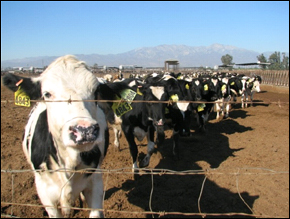
    Cows, of course

    Photo by Sasha Khokha
    Many dairies moved north, to the Central Valley, after Chino water regulators passed strict rules limiting the number of cows.

    At the other end of the spectrum, cities in Southern California have spent millions of dollars on nitrate treatment plants because they have no other choice – dirty or not, the groundwater is crucial to meet population growth while access to imported water shrinks. The Irvine Ranch Water District, for instance, built a $33 million system to remove nitrates in 2007. It costs an additional $2.3 million a year just to operate and maintain. The plant itself serves 50,000 water customers in Orange County.

    Other California communities will be facing the same tough choices in the coming years. California’s population is projected to increase 53 percent by 2050. Of the 50 million people who will one day call this state home, many will settle in the greater Los Angeles area, Inland Empire, and parts of the Central Valley – areas that overlie some of the most nitrate-contaminated groundwater in the state.

    City planners are looking to groundwater to supply one-third of the water needed to accommodate California’s coming population boom, or 1.1 trillion gallons per year – more than any other source, according to the Public Policy Institute of California.

    Looking around Grayson today, it’s hard to believe the town was once in the running to become a major suburb of Modesto. Twenty years ago, a developer was planning to build a 633-unit subdivision at the site of a peach orchard in Grayson.

    Those dreams were dashed shortly after Modesto installed a de-nitrification plant. Although it can barely afford it, the city spends $800 per acre-foot of water to make water drinkable for Grayson’s 1,200 residents – up to $19,440 a month, four times the cost of the treated Tuolomne River water Modesto pipes to half its 210,000 residents.

    Another problem is the leftovers: Grayson’s ion exchange process leaves behind hundreds of tons of saline brine that can’t be recycled or reused, so Modesto pays extra to export four truckloads of it each week to a Bay Area wastewater plant. At those prices, the city quickly concluded it couldn’t afford any new water connections in Grayson and banned them outright. The ban is still in place today, minimizing the area’s population growth.

    “If water wasn’t a problem here, the whole area would be developed in a heartbeat,” said John Mataka, who works for Stanislaus County as a behavioral health specialist. He and Rosenda both advocate for environmental justice issues with a variety of local and state organizations.

    Experts say the slow spread of nitrates underground has already affected millions of Californians, mostly due to a legacy of leaky septic tanks and intensive nitrogen fertilizer-based farming over the last 60 years. Nitrates are the leading cause of well closures in California. Scientists say that if nitrate concentrations don’t taper off, the pollution will eventually sink deep enough to affect the well water that millions of Californians depend upon.

    Studies have shown that although only 3.5 percent of public water supply wells in the Central Valley exceed the public health limit for nitrates today, an additional 13 percent of wells are at substantial risk of contamination.

    That message is somehow getting lost on people, says Karen Burow, a Sacramento-based scientist with the U.S. Geological Survey. Past farming practices have already contributed to tomorrow’s nitrate problems, and today’s contributions are making the problem worse.

    “I think that’s the most important point we can get across – that there is a lot of nitrate in shallow groundwater and it’s moving, and we don’t see it going away very fast. There is some urgency for the policy people to figure out what to do,” Burow said.

    Solving the groundwater problem will take imagination – and a lot more money than the state is spending. California voters have passed two water bonds since 2002, worth more than $8 billion. Roughly $2 billion was allocated for clean, safe drinking water.

    No estimate exists for what it would cost to clean up the nitrates in our groundwater basins, in part because the state has limited knowledge about where the pollutants are and where they go when they reach the water table.

    The Environmental Protection Agency has estimated that the cost of treating all the polluted groundwater in California over the next 20 years, including nitrates, would amount to $7.5 billion.

    Tackling the source

    “The solution isn’t usually to just shut down a dairy. The ones that we found having problems, we’ve worked with them to get more land, improve their cropping practices, in some cases line manure basins.”
    -Ken Landau

    Activists and regulators agree that the best way to solve the nitrate problem is to prevent it. But that is easier said than done. State regulators have started requiring certain operations to limit the nitrogen they apply to land. Records show, however, that in many cases, officials have been aware of ongoing nitrate pollution for years – and took little action to address it.

    One of the best examples of this is the state’s dairies, which grow crops with manure. Many dairies lack enough cropland to absorb all the nitrogen they produce. As a result, they over-apply liquid manure, causing nitrate problems.

    Most dairies began testing their domestic wells for nitrates in 2007 and 65 percent of the dairy wells exceeded the public health limit for nitrates. Forty-two percent of wells had nitrate levels that were twice the drinking water standard.

    Many dairies moved north, to the Central Valley, after Chino water regulators passed strict rules limiting the number of cows.

    Since 2000, the state has mandated that 48 dairies submit groundwater test results – in response to numerous other findings of nitrate contamination on their land. Yet none of the dairies were fined, required to cease operations or asked to clean up a nitrate problem identified by the state.

    Dairies receive violation letters for not monitoring properly, but exceeding the nitrate limits rarely has serious consequences.

    Records show some dairies were even suspected of spreading contamination to adjacent lands, potentially affecting the drinking water of neighbors and farmhands living onsite. But only one dairy, The Bosma Milk Co. in Tipton, received a violation letter specifically for high nitrates in groundwater beneath the property, according to an online database of state enforcement actions.

    The Bosma Milk Co. has reported nitrate concentrations above the public health limit since 2003. Like many other Central Valley dairies with nitrate problems, nitrate concentrations in some of Bosma’s wells spiked as high as five times the pollution limit between 2000 and 2007.

    The dairy received a violation letter in 2008, but no fine. The Central Valley Regional Water Board has asked the dairy to collect more information before it takes action.

    Gary Bosma, co-owner of Bosma Milk Co., said he and his brother Jake have gone out of their way to comply with water quality requirements imposed by the state. He suggested that regulators would have a hard time proving that nitrates were coming from Bosma given that there are other dairies in the area.

    “We have neighbors and the water moves around in the aquifer. Just because one well pops up positive doesn’t mean it’s coming from that dairy,” Bosma said.

    Officials say they have been aware of nitrate issues at dairies for a long time.

    Lettuce growers in Monterey County

    Photo by Sasha Khokha
    Some lettuce growers in Monterey County are participating in a farm program to help them gauge how much nitrogen to apply.

    “The solution isn’t usually to just shut down a dairy. The ones that we found having problems, we’ve worked with them to get more land, improve their cropping practices, in some cases line manure basins,” said Ken Landau, assistant executive officer of the Central Valley Regional Water Quality Control Board.

    In 2007, Central Valley regulators started requiring most dairies to develop plans to manage their manure to reduce water contamination. Another rule, the first of its kind in the country, required dairies to sample their domestic wells for nitrates. If the levels are too high, the dairy needs to pay to install additional monitoring wells to gauge the extent of the contamination.

    The program was welcomed by environmentalists, but Dairy CARES, a statewide dairy-industry coalition, feels the requirements are too burdensome. The group is working on an alternative that calls for installing wells in select regional locations to monitor contamination, an approach that would avoid pointing fingers at individual dairy operators.

    “It’s a much broader scale than holding an individual responsible for their exact actions,” said Darrin Polhemus, deputy director of the State Water Resources Control Board’s division of water quality. “Obviously that’s what we’ll want to get to eventually, but that’s not the focus. It’s not designed to find that one guy out there.”

    An expensive problem

    It’s too late to prevent nitrate contamination in many Southern California groundwater basins, especially in heavily urbanized portions of Los Angeles, Orange, Riverside and San Bernardino counties.

    It’s a problem that harkens back to the region’s agricultural legacy. Land now covered with suburban neighborhoods once sprouted with citrus trees and vegetable fields where farmers used nitrogen fertilizer. Until recently, the Chino Basin was home to more dairies than anywhere in the world.

    Nitrate problems were detected as early as the 1970s in the Chino Basin, one of the largest groundwater basins in the state. The area is at the heart of California’s Inland Empire and home to more than a million people. Nitrate concentrations in the worst-hit parts of the basin were double the EPA threshold in the 1980s and quadruple the limit by 2000, according to records.

    Regulators with the Santa Ana Regional Water Quality Control Board tried with limited success to contain the problem by banning dairies from applying manure to land in the Chino Basin in 1999.

    Today, residents pay high water bills to bankroll multimillion-dollar nitrate treatment plants in places like Pomona and Riverside. The Inland Empire Utilities Agency in western San Bernardino County is in the midst of a $300 million project to expand its nitrate removal plant as part of an aggressive strategy to cope with drought-related limits on imported water.

    “We recognized that imported water was vulnerable and less reliable,” agency General Manager Rich Atwater said. “We’ve literally hit the wall with the Delta. We’re in a huge economic recession and everybody recognizes that we’re going to go from 38 million to 50 million people in the next 25 years, and Southern California is a big part of the demand.”

    Times have changed since the 1970s, when water managers could just shut down a well and dig a new one if nitrates became a serious problem. Atwater says the causes of nitrate contamination were ignored for too long, creating a problem for everyone in the region.

    “All that nitrate contamination that we’re addressing today is literally a legacy of 50 to 100 years ago,” Atwater said. “Prevention is so much more cost effective – 10, 20 times as much. It’s so much more expensive to remove the contaminant from the groundwater basin than to keep it from getting there in the first place.”

    In Modesto, the city has had to shut down 10 of its 140 municipal wells because of nitrate contamination in the past 15 years, and there will likely be more, said Allen Lagarbo, deputy public works director.

    “All cities on wells in this area start developing contamination problems eventually,” he said.

    “We do this crazy thing now and take pristine, beautiful water and put it on our farms, and the minute it soaks into the ground it’s filled with nitrate, and then we ask cities to clean up marginal water and use it as drinking water.”
    -Jean Moran

    The combined population of cities in the Sacramento Metro region and the San Joaquin Valley is projected to top 9 million by 2030. The population in the Central Valley has doubled every 30 years since 1900 as residents move onto former farmlands.

    Meeting those future water demands is not as simple as building a new generation of nitrate treatment plants, as Modesto has discovered. The most common technologies to remove nitrates, ionic exchange and reverse osmosis, can be expensive and cumbersome.

    “We do this crazy thing now and take pristine, beautiful water and put it on our farms, and the minute it soaks into the ground it’s filled with nitrate, and then we ask cities to clean up marginal water and use it as drinking water,” said Jean Moran, professor of earth and environmental science at CSU East Bay and a former groundwater research scientist at Lawrence Livermore National Laboratory.

    A Sacramento solution?

    In the Central Valley, farmers may soon face regulations on their use offertilizer similar to an order imposed on dairies in 2007. The agricultural industry wants those rules to remain voluntary and says it would be unfair for regulators to require farmers to comply with strict statewide water quality standards.

    Nitrogen fertilizer use in California has stabilized at an average 700,000 tons each year, but it’s unclear whether voluntary strategies have made a difference for nitrate levels so far. It took 50 years to detect nitrate problems in many areas and it will take decades to see changes, experts say.

    One option would be to require farmers to limit the amount of fertilizer they apply to their fields. That would require new legislation. The State Water Resources Control Board does not have the authority to impose those limits.

    Lawmakers have directed hundreds of thousands of dollars of aid to small communities struggling with nitrates, and established demonstration projects for good farming practices through the University of California. But when it comes to tackling fertilizer itself, results have been mixed.

    Former Bay Area state Assemblyman Johan Klehs tried to pass a bill in 2006 that would have raised the mill tax on fertilizer. The money would have been used to provide grants to communities affected by nitrate contamination. (In California, fertilizer is exempt from local and state sales taxes). The bill died in the Assembly’s Agriculture Committee.

    “All efforts along those lines automatically go to the ag committee and they die there. Legislators are not friendly to anything that could negatively impact agriculture,” said Debbie Davis, legislative analyst with the Oakland-based Environmental Justice Coalition for Water.

    State Senate Majority Leader Dean Florez, D-Shafter, calls nitrates “a backwater issue in Sacramento.”

    “These are the kinds of things public policy makers need to hear,” he said. “It’s always difficult to get any of these things on the radar screen. … We’ve got to get our farmers to recognize the long-term impact of these materials on water systems. People say it’s the end of a major, multi-billion dollar industry without these fertilizers.”

    Scientists with the U.S. Geological Survey have calculated that even if fertilizer inputs ceased immediately and forever, nitrate levels would continue to climb for many more decades before starting to decline because of the lag time in deeper aquifers.

    All the more reason to take preventative action, says Eli Moore, a research associate with the Oakland-based Pacific Institute.

    “We can deal with nitrate contamination once it’s already reached the tap water, or we can try to prevent nitrate contamination before it becomes a problem,” Moore said. “It’s really a question of whether we as Californians are going to ensure that all Californians have access to clean drinking water.”

    Grayson’s moratorium on new water connections hasn’t kept people from building new homes and simply digging their own backyard wells at the risk of exposing themselves to dangerous levels of nitrates.

    Nitrate concentrations in Grayson’s raw water have tested as high as 65 milligrams per liter over the past 15 years. The public health limit is 45 milligrams per liter. One milligram is equivalent to half a teaspoon in a swimming pool. It may not seem like much, but for vulnerable populations, like infants, the effects can be acute, experts say.

    “If this is an issue now, can you imagine a town three times the size?” asked John Mataka. “It would have been a calamity.”

    This story was produced in collaboration with KQED Central Valley Bureau Chief Sasha Khokha and Christopher Beaver of CB Films. It was edited by Mark Katches. It was copy edited by William Cooley. For the whole story, plus interactive tools, film clips, a photo slideshow and links to a three-part series on nitrates produced by KQED Radio, visit California Watch. Read more of California Watch’s work on Circle of Blue here.

  • Q&A: Paul Saffo on the Future of Media and a New Era of Environmentalism

    Welcome to Circle of Blue Radio’s Series 5 in 15, where we’re asking global thought leaders 5 questions in 15 minutes, more or less. These are experts working in journalism, science, communication design, and water. I’m J. Carl Ganter. Today’s program is underwritten by Traverse Internet Law, tech savvy lawyers, representing internet and technology companies.

    Today we’re talking with Paul Saffo. He’s a man who lives in the future, and he maps and predicts society’s biggest transformations. Paul is a Futurist who teaches at Stanford University, and for the past 20 years has explored the dynamics of large-scale, long-term change. Paul, let’s talk first about the transforming media, how everyone get’s their news and participates in their community. What’s your media forecast?
    Paul Saffo: Well, you know, whenever we have a media shift like this, and you can go back 400 years to movable type: a period from 1450 to movable type’s invention by Herr Gensfleisch Gutenberg, to all this in 1501 for his modern book. We always have this drop in quality and hand ringing over what can we trust, and we forget 100 years ago newspapers were enormously unreliable, so we’re doing that now. We’re getting a mix of new voices, and we’re going to quickly discovery which ones are reliable and, more importantly, create the social indicators of which places you can trust. I’m an optimist about media. I think we’re going to come through this with more voices, more choices, and more reliability. You may not be able to trust specific outlets the way you once did, but it won’t matter because there will be a button where you can chase down authenticity.

    I’m an optimist about media. I think we’re going to come through this with more voices, more choices, and more reliability. You may not be able to trust specific outlets the way you once did, but it won’t matter because there will be a button where you can chase down authenticity.

    You talk a lot about censors, not censorship, but remote sensing capabilities, and we have major global challenges right now, and in a way we’ve lacked those censors. How will censors change our view of responding to these global challenges in both the mechanical sense and in our own personal sense?
    Paul Saffo: Well, this is a world where, at the data level–just a simple data collection–we’re moving from discreet episodic collection. So imagine we’re sampling water, and you check it once a week with an instrument–we’re shifting from discreet episodic measurement to continuous measurement: a continuous data feed on the status of things. Just in health alone, imagine if you’ve got a patient and you send him home, and you can do 7/24 monitoring of bodily vital functions–[it] completely changes how you can do medicine. The same is true for the environment. If we can monitor things 7/24 at fine levels of granularity, it’s going to change the way we think about environmental remediation, about purity water supplies, and the like. The fact is that the Internet, you know, is going to be an Internet of things, just as today once upon a time with the phone system [when] almost all of traffic on a phone system was voice conversations. Even before we went to the internet, voice conversation became less than half a percent of total volume. Today the web, the most visible part is people looking up information, people interacting with information. Hidden behind that are machines using the web. So the web is going to become an environment where maybe a fraction of one percent of the traffic is people interacting with things, and hidden behind that will be machines talking to other machines, sharing data coming off of vast sensor networks, and then occasionally telling us what’s going on.
    Well short term versus long term. We’ve been driven by a lot of short term returns. Now if we can monitor real time and even start to project what some of the long term implications will be of our decisions, that would seem to be a game changer for a lot of industries.
    Paul Saffo: We’re always victims of our own measurements. Part of the reason we got into the environmental crisis that we’ve gotten into is, as Paul Hawken has pointed out, we weren’t measuring the right things. Put it more simply, the problem is that the environment didn’t have its own accountants. Corporations had accountants, and individuals had accountants, but a river didn’t have an accountant. Now we’re talking, maybe a river needs an accountant so we can get that stuff on the balance sheet. All of this vast flood of information coming off of sensors is hopefully a good thing, but it’s not automatically a good thing. It’s going to depend on the sense making tools we build and are we using that data to look at the right measures. I do not doubt the human capability of taking all this wonderful new knowledge and putting it to some stupid disastrous civilization destroying purpose. I don’t think it will happen. I hope it won’t happen, but never underestimate the perversity of human nature to turn the long term into short term advantage.
    We talk a lot about the virtual world, the censors, the data, the measurements of trends and whatnot, but it seems that we get more and more distracted or just stuck behind our computers rather than rolling up our sleeves or our pant legs and wading into the mud to actually find out what’s going on out there. How do we maintain that connection, that human element?
    Paul Saffo: Sure, the question is does the web make us bystanders or engaged activists? Does it make us lean back or lean forward, or more importantly, get out of the chair and into the world? I would say on balance, it’s doing the latter. Conversations with people at a distance, if they go on long enough, lead to a trip to meet face to face. When you see a crisis up close and personally remotely, you want to do something to act on it. In that sense, the plan is becoming a much smaller space that people now really are concerned about things happening half way around because they can see it for themselves. It’s also becoming a much bigger, more rich place because we know all the details that we never imagined in the past. The technology is good, but above all, I would say the most important thing we need is really uncomfortable chairs so that people are not tempted to sit in their chair at a computer and look and watch and comment instead of getting out and acting and doing.
    Looking forward, what trends do you see in either environmental reporting or response in the next five years or so? I mean, we’re at a truly highly agitated point in history.
    Paul Saffo: One issue above all others matters in the environmental space. There’s a debate that’s just beginning around global climate change. We’ve already resolved, global climate change is happening. No question. Global climate change is anthropogenically caused, human caused. No question except for a couple of flatterers who still don’t believe it. Now the debate is what is our approach to solving it, and that’s going to be the single most contentious debate we have, and I see that as a debate between two camps, call one camp the druids, the other camp the engineers. I’m sympathetic to both. I’m a lifetime member of the Sierra Club, third generation. My grandmother knew John Muir, so I’m in favor in the environmental view. Also I teach at an engineering school at Standford. The difference between the two is that the druid position is we need to slow down, we need to lighten our touch on the planet, we need to go back to an earlier time when there was less damage being done to the environment. The engineers are saying no, no, we need to go faster into the future. We need to use this technology to solve the problems we’ve created. I’m kind of skeptical about both camps. We have UN reports that make it clear that’s really hard to be druid these days because we’ve got too many people. We need something like four or six Earths to support the human population on this planet today at its current level of affluence. The engineers, I’m glad they want to solve the problem, but I say, gee, it’s your inventions over the last 150 years that created the problem to begin with. That tension between the people saying go back, go back, and simplify, lighten our touch on the land, and the others saying go forward, go forward, and let’s intervene and let’s build, that’s an argument that makes me very nervous because I don’t think either side has the answer. The right answer is some fusion of the two. We have to go forward, but in my opinion we have to go forward really using deep principles of biomimetics and lessons from nature. The closest analogy I can think of that’s been said by some folks is the metaphor is gardening. It’s the respectful, diffident gardener who’s not creating some stupid exotic wild garden but a sensible, sustainable garden. We’ve screwed this planet up enough that we’re going to have to intervene, and we’re going to have to keep intervening. If we stop intervening, we’ll die, but let’s not create a planet that’s so dependent on our intervening that we have to spend the whole time keeping balls in the air.
    There’s always talk about silver bullets. As humans, we’re looking for that perfect answer, that drug, that cure-all. What’s your take?
    Paul Saffo: Silver bullets. The only term I hate more than silver bullets is the newest one, silver buckshot. This is a long term problem. We are facing deep, long term problems which have been decades in the making. It is moronic to then say, let’s look for the quick fix for something that took a couple of decades. That is just a way to get into deeper trouble. It is my hope that we would remove silver bullet and silver buckshot and all these other stupid short term terms from our vocabulary. What we have to think about is it took a long time to get into this. It’s going to take a long time to get out. It’s a sustained effort. There is no deus ex machina that’s going to drop down from the top of the stage that’s going to save us. This is going to take sustained careful work over many years. It’s a conversation with generations unborn. It’s not a quick fix.
    Thank you, Paul. We’ve been speaking with Paul Saffo, Futurist at Stanford University. To learn more about Paul’s work and other projects, be sure to tune in to Circle of Blue online at CircleofBlue.org.


    Our them is composed by Nadav Kahn, and Circle of Blue Radio is underwritten by Traverse Legal, PLC, internet attorneys specializing in trademark infringement litigation, copyright infringement litigation, patent litigation and patent prosecution. Join us gain for Circle of Blue Radio’s 5 in 15. I’m J. Carl Ganter.

  • Q&A: Peter Gleick Weighs in on the Bottled Water Battle

    Why do people buy billions of gallons of expensive bottled water in the U.S., a country where most of the tap water is cheap and extremely high quality? In his new book “Bottled and Sold,” international water expert Peter Gleick looks for answers in the bigger questions about why we buy bottled water, and defines alternatives for the future.

    Bottled Water Battle

    “Bottled and Sold” available online at Amazon.com

    By Circle of Blue

    J. Carl Ganter: Welcome to Circle of Blue Radio’s Series 5 in 15, where we’re asking global thought leaders five questions in 15 minutes, more or less. These are experts working in journalism, science, communication design, and water. I’m J. Carl Ganter. Today’s program is underwritten by Traverse Internet Law, tech savvy lawyers, representing internet and technology companies.

    There’s a war going on over what kind of water you drink–bottling companies have waged a campaign against tap water and it’s paying off, according to Pacific Institute President and MacArthur Fellow Peter Gleick. Why do people buy billions of gallons of expensive bottled water in the U.S., a country where most of the tap water is cheap and extremely high quality? Some consumers don’t like the taste of their tap water. Bottled water is usually readily available, and some companies have launched fear campaigns against the tap, while others produce misleading advertising. But banning the bottle isn’t the solution, Gleick says. Instead, it’s time to take a hard look at the bigger picture to understand why we buy bottled water so as to define alternatives for the future.

    Q: Dr. Gleick, thanks for joining us today. I wanted to ask, as a scientist, what drew your real interests to bottled water and to writing a book–Bottled & Sold?

    A: I think the whole story about bottled water is a remarkable one. You have to ask yourself, how did we get to this point, how did we get to a situation where billions and billions of gallons of bottle water are sold in a country where tap water is universally available and of incredibly high quality for the most part and remarkably cheap. How did we get to the point where bottled water, where water itself became a commodity to be bottled and sold? That’s what this book tries to deal with. This book tries to address the history of bottled water, the strange stories behind bottled water, the reasons why people drink bottled water or say they buy bottled water, and how we can get out of the situation we’re in.

    Q: You’re pointing out here that there’s a bigger story about how we view and use water–where does bottled water fit in?

    A: Well, here is the big story. The big story is not just bottled water. The big story is the state of the world’s water as a whole and why bottled water has become an important component of that. There are plenty of people who think that we should just get rid of bottled water, that we should ban bottled water, but that’s not what this book argues. I don’t think that’s really the story. What we have to ask ourselves is why do people drink bottled water, when for the most part in a country like the United States and many other parts of the world, tap water is incredibly available and cheap and high quality. Why do we buy bottled water? When we ask that question, we come up with a different set of issues. All of a sudden we understand that there’s a war on tap water by commercial interests. There are places where people don’t like the taste of their tap water or they fear the quality of their tap water. There are places where we just can’t get water conveniently because our water fountains are disappearing one by one. There’s a whole campaign to market and advertise water in a commercial sense to us to make us think, well, you know what, to be sexier, to be skinnier, to be more popular, we have to buy this or that brand of bottled water. What this book says is if we really don’t like the idea of bottled water, we better think about why people buy this bottled water and tackle those problems themselves.

    Q: Tell us some of the secrets–why are people so drawn to buying bottled water?

    A: I think there are four principle reasons why people buy bottled water. I do believe there’s war on tap water, a war being fought by commercial interests who would much rather sell us a very expensive commercial product than have us simply rely on what we’ve always relied on for more than a century now, that is the water coming out of our taps. So people are being made to fear their tap water. That’s one reason why people buy bottled water. A second is people sometimes don’t like the taste of their tap water, and that’s a legitimate concern. In some places, tap water doesn’t taste very good. For that reason, people choose to buy bottled water. A third is that we’re marketed, we’re bombarded with advertising about how this or that brand of bottled water will make us popular or make us more stylish or make us skinnier or sexier or all of the tools of marketing are being used to push bottled water on to consumers. The fourth reasons is it’s increasingly hard to find tap water. Bottled water is really convenient. Think about where you are at any given moment of the day, and you can probably find somebody selling bottled water within a few tens or hundreds of feet, in a vending machine or a 7-11 or some other convenience store. Bottled water has become pretty ubiquitous, and yet our water fountains are disappearing. For all of these reasons, I think sales of bottled water have exploded, and we’ve become increasingly reliant on what used to be a pretty odd thing to think about, that is commercially packaged pieces of plastic holding a little bit of water.

    Q: Are there some larger discussions that play, perhaps around human rights, regulations, even fundamental values, that deserve or demand new attention?

    A: Bottled water is a piece, only a piece, of the world’s water problems. I would be the first to acknowledge, and this book clearly acknowledges, that there are parts of the planet where you don’t want to drink the tap water. Either there is no tap water because governments or communities have failed to meet their basic human needs for water, they’ve failed to provide safe, reliable tap water for people, and bottled water is the only alternative. The problem is that it’s an alternative only for the rich. In places where there is no acceptably clean tap water, the wealthier parts of communities buy bottled water. They spend the money necessary to buy safe water, but that leaves out of the equation billions of people who can’t afford to buy bottled water and who don’t have access to safe tap water. The answer is not to provide bottled water for everybody. The answer is to spend the money and to build the infrastructure to provide safe, clean and affordable tap water for everybody. But in other parts of the world, in developed countries where we have safe tap water, I think we really need to look deeply within ourselves and within our communities about what bottled water really means and whether we ought to be addressing the reasons people buy bottled water.

    Q: There’s a huge complex here built around a largely profitable commodity in a plastic bottle. How can a company shift its earnings away from bottled water and explain that to its shareholders? How could they or would they change?

    A: A number of companies and a number of big companies are making a lot of money selling us bottled water. Bottled water has become a commodity, and I don’t argue in the book that we ought to ban bottled water. I don’t that’s realistic. I think bottle water could be considered a commodity like any other commodity. I do believe, however, that in places where governments have failed to provide safe drinking water from municipal systems, safe tap water, that what we ought to require is that there be universal access to safe tap water, that we provide the alternative to bottled water, and that we marginalize bottled water. Bottled water ought to be a choice that people make, but it shouldn’t be a requirement. That’s something that most parts of the world don’t have the luxury of having at the moment. We don’t have the luxury of safe tap water in many parts of the world, but if we’re not going to ban bottled water, bottled water is going to be a commodity that’s available. I think there are other things that we ought to do to make it a marginalized commodity. If people really want to spend the money to buy bottled water, fine, let them, but let’s remove the reasons that people buy bottled water. Let’s put in place, for example, pretty strict rules about advertising and marketing; about false advertising; [and] about letting companies claim that bottled water is safer than tap water, which for the most part in richer countries, it isn’t. Let’s put in place rules so that they can’t claim it makes you skinnier or sexier without proof that it can do the things its advertisements claim. Let’s make sure that tap water tastes good everywhere. That’s not magic–we know how to make tap water taste good, and in places where it doesn’t taste good municipalities ought to make sure that it does. Let’s remove that as a reason. Let’s rebuild our water fountain infrastructure. There ought to be water fountains everywhere so that people can get safe, inexpensive tap water whenever and wherever they are. Finally, I think there ought to be pretty strict regulations on the quality of bottled water, and there aren’t in most parts of the world.

    Q: Do you have a specific marketing story you can share that really caught your eye during the research for the book?

    A: One of the problems that we face on the marketing side is that we have in place pretty strict rules for false advertising, but what we don’t have in place is enforcement of those rules. You get, especially on the Internet, where people can say almost anything they want without much oversight, [or] without much enforcement of false marketing laws, you get bottled water companies saying things that simply aren’t true. You get bottled water companies advertising oxygenated water, as though magically you could get more oxygen to the human body through bottled water than you can get through breathing–which you can’t. You get marketing of bottled waters that will tell you that you can lose weight, and there is, of course, no shortage of diet scams in any industry, but even the bottled water industry is susceptible to marketing scams for dieting. There’s no magic bottled water that can make you lose weight. There are all sorts of advertisements for magically clustered or magnetically re-arranged or cosmically altered bottled waters that are just crap, and yet there is no adequate control by the Federal Trade Commission, by the Food and Drug Administration, by any federal or international agency to protect the public. I think that makes people spend money on waters that don’t do them any good without much government protection.

    Q: Can you give us some examples?

    A: There are many different kinds of bottled water. There is a small subset of water bottlers that make all sorts of claims for what their magic bottled waters can do. They’re magnetically altered. They’re electrically altered. They’re physically altered. There magic chemicals added to them that give them special properties. Most of this stuff is garbage, and it’s time that our regulatory agencies stepped up and really did their job in protecting the public. There are more traditional bottled waters that come from reliable bottlers, and even many of them hint that their bottled waters are safer than tap water, that they’re more protected than tap water, and for the most part it’s just not true.

    Q: On the bottles we buy, there are different labels–there’s spring water, regular water, what’s the difference?

    A: There’s lots of different kinds of bottled water, and there’s lots of different labels that we see on our bottled water, but the two principle differences are spring water and stuff that doesn’t say spring water. Spring water, in theory, is water that comes from ground water aquifers, either from an actual spring or from a well drilled into or nearby a naturally flowing spring. Then there are the other waters, which are typically in the United States and elsewhere, [that are] simply reprocessed municipal water. More than 40 percent of the bottled water sold in the United States is simply reprocessed municipal water. It comes from municipal taps. It comes from municipal water systems, and it sometimes runs through additional processing, but it’s certainly no safer than our municipal water. Yet, people don’t understand that. People think, well, if it’s bottled, it must be better than our tap water, and it isn’t. Now spring water itself, in some ways I would argue, is even riskier than reprocessed municipal water. At least municipal water we know is supposed to meet federal standards for tap water already. Spring water is, in my opinion, at risk of contamination that municipal water isn’t. The book talks about some of the risks of spring water. I think, for the most part, bottled water is relatively safe, just as for the most part our tap water is safe, but we don’t inspect bottled water as frequently or as carefully as we inspect municipal water. I actually think tap water often is far better monitored and inspected and protected than some of the bottled waters that are sold in the United States.

    Q: And one of the other major questions with spring water particularly is who owns it? Do you touch on that in the book?

    A: I do. One of the controversies about bottled water is where it comes from. Increasingly, because a lot of the bottled water sold in the U.S. is labeled spring and hence has to come from or near natural springs, there’s more and more controversy over where that water is coming from or what the local impacts on local communities are going to be. There are more and more stories, some of which are described in the book, about local communities opposing bigger and bigger bottled water companies coming in and taking their local spring water. In some cases, they’ve dried up local springs or local wetlands. In some cases, there’s concerns about massive amounts of truck traffic driving through local communities as these big water companies come in and build massive bottled water plants. There is this part of the movement against bottled water, a local movement against some of these big bottling companies, and I think there’s going to be more and more pressure on these big companies not to take water from some of these local communities in ways that cause problems. I think that’s part of the movement against bottled water.

    Q: And finally, so what’s your vision for bottled water in the next few years?

    A: I see two possible futures. I see a future in which we fail to protect our tap water and we continue to fail to provide basic water, basic clean and affordable water for all of the world’s people. In that future, bottled water is a bigger and bigger deal. We bottle more of it. We sell it to people who can afford it. The poor continue to suffer from the lack of availability of safe, inexpensive tap water, and water related diseases continue to plague especially the world’s poor. I think that’s a future we could easily see in which bottled water becomes a bigger and bigger story, a bigger and bigger commodity. But I see another possible future, and that is one in which we continue to have bottled water available as a commodity, but it becomes a weird thing. It becomes something that people only buy because they have a lot of money or because they really think that it’s something that they want for reasons of style or glamour. But, for the most part, bottled water becomes once again what it used to be–that is a small and insignificant part of our water story. What we really have is we have extensive, widely available, inexpensive, high quality, good tasting tap water for everybody. As long as we fail to provide good safe tap water for everybody, bottled water has a niche. It has a foothold, but as soon as we provide safe tap water for everybody, then bottled water becomes something that unnecessary. If we can make it unnecessary, then it won’t disappear, but it will once again become a small part of the water story and not a big part.

    Q: J. Carl Ganter: Thanks so much for joining us. We’ve been speaking with Peter Gleick, President of the Pacific Institute and author of the new book, Bottled and Sold. To learn more about global issues and the stories behind them, be sure to tune in to Circle of Blue online at CircleofBlue.org.

    Our theme is composed by Nedev Kahn, and Circle of Blue Radio is underwritten by Traverse Legal, PLC, internet attorneys specializing in trademark infringement litigation, copyright infringement litigation, patent litigation and patent prosecution. Join us gain for Circle of Blue Radio’s 5 in 15. I’m J. Carl Ganter.

  • Heart of Dryness: How the Last Bushmen Can Help Us Endure the Coming Age of Permanent Drought

    In the sixth installment of Heart of Dryness, author James G. Workman explores the traditional wisdom that has kept the Bushmen alive despite incredibly water-scarce conditions and how the national government threatened their existence. And as recent news indicates, the indigenous peoples continue to struggle for their land rights as Botswana’s government allows safari lodges to be built on the Central Kalahari Game Reserve.

    Baobab by Makgadikgadi Pans

    Photos © James G. Workman
    In the sixth installment of James G. Workman’s book, we see the legacy of the legal battle between the Bushmen and Botswana’s national government unfold. Baobab image courtesy of Makgadikgadi Pans.

    By James G. Workman
    Special to Circle of Blue

    Within weeks of the court ruling, forty evicted Bushmen sneaked back into the Kalahari, ignoring President Mogae’s attempts to make them stay out. By April 2006, two hundred had returned. Despite dual pressures mounting against them—an increasingly hot sun and vehemently hostile officials—they reinhabited the core of a waterless Reserve at the center of a landlocked country within an increasingly arid subcontinent. For every Bushman caught, accused, arrested and roughed up, several others sneaked in to gather or hunt, prefering to live freely without official help, without water that had strings attached.

    Two of Qoroxloo’s grandsons were the first ones back home inside, where they remain to this day. “As usual the government is doing everything it can to see to it that we resist from going home,” Galmomphete recently wrote me, in a note about life in the Kalahari that understandably took some time to reach the outside world, “but that’s not a surprise. We will keep fighting.”

    “The old,” said Moloreng. “They know.” He fell silent for so long I wasn’t sure he would continue. Then he added in a quiet voice, “They know how to live without the water.”

    In the note he described a recent hunt with his brothers. The three young poachers were joined by Mongwegi, Kalakala and Tshokodiso—the men who tracked down and recovered Qoroxloo’s body and who dug her grave—and by Mohame Belesa, her husband. “As it is our custom,” he wrote, “we went hunting thinking of the people in Metsiamenong because we felt we had to do something for them.”

    The hunters chased down and killed two gemsboks and distributed the meat. Bushmen ate the flesh from one of the Kalahari’s most desert-adapted antelope, a beast that survived by digging up the moisture embedded in roots and tubers and leaves. The feast and reunion and dance in the night helped close the circle once more, reconnecting those returning home with those who never left. It re-knit the complex ties of a society that had been interrupted for five years. It felt good to be back home, wrote Galomphete, “after such long time having been denied the opportunity by the government. We really enjoyed that moment.”

    Portrait of Nxwaxebe Sakuu, returning to Kikao

    Photos © James G. Workman
    Portrait of Nxwaxebe Sakuu, returning to Kikao. In August 2009 Bushmen who reside on the Kikao settlement filed a case with the country’s High Court requesting the government supply them with potable water.

    I had been invited, and would have very much liked to join them. Over seven years in southern Africa I had grown fond both of the Kalahari and of Botswana’s predominantly decent people. To Botswana I had dragged my girlfriend, where we conceived a child, become engaged and raised our daughter. When work ended and my family moved home to America, I left an off-road vehicle and camping equipment behind, with plans to visit again and again. Then, one day, return became impossible.

    After four decades as the exceptional shining example of African democracy, citizens became anxious their country was “heading for a dictatorship.” Even the jovial best-selling writer Alexander McCall Smith, creator of Precious Ramotswe, spoke up against Botswana’s policies in the Kalahari. In response the government began to label its critics as “enemies of the state.” Church leaders grew “afraid of making public comments for fear of being accused of being members of opposition parties.” President Mogae expelled a University lecturer as “a rogue” because he questioned the Bushmen evictions. Eventually, Mogae targeted 17 critical academics, human rights activists, and journalists from the UK, the U.S., Australia and Canada, and on that blacklist I found my own misspelled name. Until that list is revoked, I am left with the last memories of these defiant people.*

    One evening at dusk several of us walked a quarter mile to pay respects before three unmarked piles of sand. The sky blazed orange and purple against thin distant clouds. Moving from one to another in turn, Mongwegi pointed out where Moeti, Gaoberekwe, and Qoroxloo lay buried. No animals had disturbed her grave over the last twelve months. The elements had smoothed the sand surface, but thorn branches still arced across it as a barrier to scavengers.

    Jumanda shook his head. “In here are these three graves from five years,” he said. “And during that time, how many dozens of young men and women have we buried outside the Reserve? How many died out there and were unable to come home?”

    ABOUT THE BOOK:
    Heart of Dryness
    Heart of Dryness available at Amazon.com

    Suddenly Mongwegi closed his eyes, threw back his head and cried out “to the spirits of these ancestors” to “continue to guide the living. To give strength to us. To show us the way when we become confused and have doubts.”

    We turned in the silence and walked slowly back toward the fires and the laughter of Metsiamenong.

    On that same trip, I spent a night in the eviction camp, Kaudwane, outside the Reserve. Hundreds still lingered there in purgatory, hating the place but too fearful of government threats to leave. I arrived there with Roy Sesana and the FPK legal team, who reassured the Bushmen that the High Court had ruled on five counts that they had been wrongfully, illegally, and unconstitutionally forced from the Kalahari and deprived of their livelihoods and homeland. They were free to return to the place they still called home. At this news the Bushmen jumped up and danced and clapped excitedly, and their wide eyes shone in disbelief.

    Later, as the initial joy subsided and reality set in, a few asked if the government would again provide them water inside.

    The Bushmen attorney, Gordon Bennett, slowly shook his head and looked down. On that count, he conceded, the High Court had ruled termination and destruction of water was legal and constitutional. Botswana would not restore it. But he planned to negotiate a compromise with them.

    Upon translation, the Bushmen fell silent.

    An hour after hearing the legal decision, two dozen Bushmen gathered beneath a shade tree, squatting on their haunches. As each spoke, the others listened. Some gestured, shook their heads, or drew in the sand with sticks.

    I sat near a young Bushman named Kelejetseeing Moloreng. His family raised him in Mothomelo, but he left the Reserve as a teenager after officials destroyed the borehole. He now had a wife and child, and wanted to bring them to what he still considered to be home in the heart of the Kalahari. I pointed to the discussion and made a questioning face.

    “The men, they are talking,” he said in the halting English he had picked up outside the Kalahari, “about water, how to get the water.”

    ABOUT THE AUTHOR:
    James G. Workman
    James G. Workman is an award-winning journalist and has served as an environmental consultant to U.S.-cabinet members.

    Two of his friends elaborated. Men were debating distances, the limits of mobility into the Reserve, how much water they could carry and what the government might allow. Women worried about the status and distribution of the wild food growing inside.

    “Some we eat,” explained Moloreng, “others we drink. They are divided. The food has water inside it.” I asked the men if they planned to return home. They vigorously nodded their heads, but their eyes left room for doubt. Some had previously been beaten for hunting. Most had been dependent on government services all their lives. “When it doesn’t rain, it is a problem,” said one.

    “We grew up with it provided,” added another, “and here was always a tap.”

    “But some of your people have never left the Reserve,” I observed.

    “Yes,” said Moloreng, looking away for a moment, and then back at me. “They are strong. We are young. We go in during the wet season, when it is green. But during the dry season –” his voice trailed off.

    I scribbled his words down into a yellow pad. He watched my chicken-scratch, smiled, and asked what I was doing. For decades out in the Kalahari, Bushmen had grown accustomed to anthropologists and wildlife researchers working on dissertations, but in recent years the foreigners with cameras, recorders and notepads grew increasingly rare. Perhaps the romantic mystique and novelty was wearing off, and evicted Bushmen were becoming just like 40 million other deracinated people. I explained that I wrote about drought and the struggle over water, and how what unfolded here may foretell what occurs in nations beyond Botswana’s borders.

    The connection to people far away seemed to cheer him. “Yes,” he said. “Put this into a book, so the world can know about us and what was done to us. And we can tell the story to our children.”

    “Where will you tell it to them? Here in Kaudwane?”

    “No,” he answered. “Inside. In the Reserve. In our home.”

    “How will you live there?”

    “The old,” said Moloreng. “They know.” He fell silent for so long I wasn’t sure he would continue. Then he added in a quiet voice, “They know how to live without the water.”*

    The old may know but they are dying faster than the vast wild places that forged their existence, taking with them strategies about how to adapt to a hot, dry, and unforgiving world.

    Kgaga bringing supplies to her hut.

    Photos © James G. Workman
    A picture of Kgaga bringing supplies to her hut–the Bushmen continue their way of life despite the extremely limited water resources.

    The rarity of the last free and autonomous Kalahari Bushmen can make them seem precious; it can lead us to romanticize them as Rousseau’s ‘noble savage.’ Yet that, I think, would diminish Qoroxloo’s life and death. She was neither savage nor superwoman but rather a pragmatist who knew exactly where she was and thus who she was. She knew how to live and when to die. She successfully resisted eviction armed with nothing more than the intimate knowledge of her community and her place. And her nobility emerged when the stress from nature’s finite limits was compounded by official force, whereupon she did what any mother would do in such circumstances. Cut off from water, confined to a small perimeter, she denied herself week after week so that her family could endure. During her defiant existence Qoroxloo left a legacy as rich and potent as the rock art of her ancestors. Through perpetual drought and a protracted siege she revealed glimpses of a pragmatic Bushmen code of conduct.

    Every society lives by a social contract, from religious authoritarian “thou shalt not” laws of the Ten Commandments or the Koran, to the secular democratic “government shalt not” protection of liberties under America’s Bill of Rights. Perhaps because theirs remained unwritten, the Bushmen’s code of conduct had the distinct advantage of being simple, durable, flexible and adaptable to aridity. Then again, it had to be. Without any hierarchical police enforcement, their lives were governed by voluntary and egalitarian interactions and by the authority vested by in the Kalahari itself.

    In seeking out Bushmen to unlock a secure path through the age of permanent drought, I first had to get past barriers of lingering mythology and ideology. I am not immune to romantic sentiment. I want to believe, like Rousseau, that dissidents like Qoroxloo and indigenous people on every continent are innately one with nature, that they are more ethical than the rest of us, that they have a built-in tendency toward restraint which somehow made Bushmen, as one colleague put it “the original conservationists.” By this reasoning the Kalahari Bushmen would not squander opportunity or trust. They would avoid the stupid, selfish, reckless, destructive, wasteful, divisive, and shortsighted mistakes that the rest make outside the reserve, especially regarding something so fragile and magical as water.

    My inner skeptic has persuaded me otherwise. I hope my lost naïveté reveals less a cynical pessimism than realistic hope based on universal egalitarianism. In any case the unvarnished anthropological record of human nature shows our species’ behavior does not vary by race or ethnicity, only by externally imposed social, ethical, political, and physical constraints. With no such limitations, each of us looks out for his or her personal interest—using others or exploiting the environment—until power corrupts us absolutely.

    Nyare Bapalo and his grandnephew Moagi sharpening spears before a hunt

    Photos © James G. Workman
    Nyare Bapalo and his grandnephew Moagi sharpening spears before a hunt.

    By now it should be all too clear that in a dry, hot world, water equals power.

    So, given unlimited access to borehole technology and unlimited fuel to pump and deliver water, Bushmen would likely invite upon themselves levels of trouble, depletion, and exploitation from which they would most likely never recover. Just like us.

    If our competitive demand for scarce water drives us apart and escalates tensions, this same finite supply of freshwater is also itself what ultimately drags us back and binds us together. We may not like the rule of increasingly scarce water, but at the same time we cannot escape it. And Qoroxloo’s band demonstrated how to embrace that reality. Her fundamental rule of adaptation was not to organize and mobilize physical resources to meet expanding human wants, but rather to organize human behavior and society around constraints imposed by diminishing physical resources.

    To restate the reality of mitigation: We don’t govern water; water governs us. *

    What did that mean in practice, for Qoroxloo’s band, and for us? We have seen how the scarcity of water governed all vital decisions: who and why to trust; where and when to disperse; what to eat; how much to consume; which plants were burned for fuel, used for construction, or gathered to drink. A water-secure diet emphasized diversified, nutritious, drought-resistant, and moisture-rich permaculture over tastier, storable, transportable bulk food, and was harvested nearby at peak water-ripeness. Since tastier feedlot cattle could not survive droughts, hunting favored desert-adapted game species whose juicy meat concentrated metabolic water. Health, sanitation, and medical decisions adroitly embraced aridity to convert waste into fertilizer, establish a buffer zone from disease vectors, and provide treatments from the concentrated oils of plants.

    Unrestricted liberty allowed dispersal to more abundant water resources, reducing ecological pressure and political stress; and rewarded each individual for drawing on his or her unique knowledge of water extraction from a diversified portfolio of strategies.

    Creation was not vertically ranked or segregated by species but rather shared the increasingly arid landscape while competing for its water resources. Manufacture of luxurious vanity items encouraged competition and reserved water for more urgent needs. Trained from childhood to avoid evaporation and leaks, Qoroxloo’s band developed their technology in the service of water, sealing it from the hungry sand and sheltering it from the thirsty sun. Rivalry over scarce water resources has always existed, but against primal instincts toward zero-sum violence our interdependence encouraged voluntary exchanges among networks that efficiently spread out risks while rewarding conservation both within and between bands. Conservatives call these informal markets while liberals see a reciprocal system of egalitarian barter.

    Celebration is upon hearing the court verdict from the attorneys.

    Photos © James G. Workman
    The Bushmen celebrate upon hearing from attorney’s that the court ruled in favor of their land rights.

    Regardless of ideology, such exchanges emerge only when a society collaboratively agrees to define and defend a water resource that could be divested. Rain belongs to everyone and everything, but Bushmen honored long-standing individual and group rights to water resources: a sip-well, a pan, a buried and labeled water canteen, a field of tsama melons, a grassy hunting territory favored by eland or gemsbok, a wild cluster of fruit or water-filled trees growing along a seep line. Extending rights beyond kin to strangers not only reduced short-term hostility and resentment, but also helped expand an informal safety net of grateful recipients — a reliable form of drought insurance.

    The principles or collective code that worked for Bushmen can be adapted outside their reserve. After all, whether it pulses between a competing heart and brain, sinks down in the shared aquifer beneath our fenced-off private property, or flows in the common currents that run along or across our walled-off borders, water is quite literally the connective tissue that links and rules our fates. Only this magical glue makes us collaborate to endure drought conditions at every level.

    If we are to prevent dehydration, domestic strife, or degeneration into the ruthless Hobbesian/Darwinian scenario—recall those baboons around a waterhole or those first colonists at Roanoke or Jamestown—and if we are to avoid testing the nightmare hypothesis of a trans-national water war, then we need to derive a system like that which for millennia sustained people in the Kalahari.

    Two-minute video “preview/trailer” of Heart of Dryness

    Read more excerpts from Workman’s book featured on Circle of Blue here.

    _____

    * Footnotes

    Dikarabo Ramadubu, “Professor Good Gone for Good,” Botswana Guardian, July 29, 2005.
    Keto Sewai, “Government Slaps Visa Restrictions on Critics,” Mmegi, March 29, 2007; “The 17 affected individuals are: Steven Corry, Mirriam Ross, Fiona Watson, Jonathan Mazower, Janie Workman, Jonathan Reed, David White, John Walsh, Oliver Duff, Karin Goodwin, Carol Midgley, and Jonathan Simpson – all from the UK. The listed Americans are: Rupert Isaacson, Eric Grossberg and Tom Price; while Ian Taylor is an Australian and Daniella Stor is Canadian. At press time, Mmegi had been able to establish that four of the Britons – Corry, Ross, Watson and Mazower are all from Survival International (SI), government’s well-known nemesis in the CKGR saga.

    Seven of the people in the list are journalists. They include Simpson, the respected world affairs editor with the British Broadcasting Corporation (BBC); Financial Times of London’s South African correspondent, Reed and its African editor, White; Price, a highly respected American freelance journalist who often contributes to major publications such as the Los Angeles Times. Other journalists are: Duff (Independent – UK), Goodwin (Sunday Times – Scotland), and Midgley (The Times – UK).

    Taylor is an Australian academic who previously worked as a lecturer on African Affairs at the University of Botswana. He co-authored a critical paper entitled “Presidential Succession in Botswana: No model for Africa” with Professor Kenneth Good. Speculation is rife that that paper, which Good was unable to present, led to his unceremonious deportation from Botswana. American Isaacson is known to be with the Indigenous Land Rights Fund, while Grossberg is suspected to be associated with an organisation that deals with conflict-free diamond issues. At the time of going to press, Mmegi had not yet established what Stor, Workman and Walsh do.

    EPILOGUE: WHAT WOULD BUSHMEN DO?

    In a seminal chapter of A Sand County Almanac called ‘The Land Ethic,’ Aldo Leopold eloquently argued how the “extension of ethics is actually a process in ecological evolution.” The evolving process or “ethical sequence” rippled outward, more inclusively with time, from: 1) personal conduct codes like the Ten Commandments, which guide relationships between individuals; to 2) social conduct codes like the Golden Rule or US Constitution which guide and govern the relationships between people and society; to 3) natural conduct codes, still emerging and undefined, which integrate humans with our complex life support system. Leopold focused his analysis toward this third category: An ethic, ecologically, is a limitation on freedom of action in the struggle for existence. An ethic, philosophically, is a differentiation of social from anti-social conduct. These are two definitions of one thing. The thing has its origin in the tendency of interdependent individuals or groups to evolve modes of co-operation. The ecologist calls these symbioses. Politics and economics are advanced symbioses in which the original free-for-all competition has been replaced, in part, by co-operative mechanisms with an ethical content.

    Matt Ridley, “Ecology as Religion” in The Origins of Virture.

    Sometimes ownership rights bore marks as obvious as a notched arrow or a labeled water canteen; more often than not, the ownership information was conveyed orally among those who asked permission.

  • Q&A: SustainAbility Survey Reveals Clean Water Shortages As Most Urgent Issue

    For 15 years SustainAbility and GlobeScan have polled global thought leaders about the planet’s greatest sustainability challenges. The collaborating firms also release three “pulse” surveys based on three critical sustainability issues that most concern companies and their shareholders.

    | For full coverage of public, business and expert opinion on water issues globally, including a list of the top 20 solutions, see Circle of Blue WaterViews water opinion project here.

    In 2009, the international poll determined that clean water shortages top the world’s most urgent issues. Experts surveyed believe that water challenges will have a “profound effect” across all sectors of society. For Circle of Blue Radio, J. Carl Ganter spoke with two of the report’s authors about water’s brightening spotlight and how this attention could translate into tangible reforms in the business world and beyond.

    J. Carl Ganter: Welcome to Circle of Blue Radio’s Series 5 in 15 where we’re asking global thought leaders 5 questions in 15 minutes, more or less. These are experts working in journalism, science, communication design, and water. I’m J. Carl Ganter. Today’s program is underwritten by Traverse Internet Law, tech savvy lawyers, representing internet and technology companies. (more…)

  • Peter Gleick: The Best Argument Against Global Warming

    Climate deniers have yet to produce an alternative, scientific argument that come close to explaining the evidence around the world that the climate is changing. Here’s how science works.

    ABOUT THE AUTHOR:
    Peter Gleick
    Dr. Peter Gleick is president of the Pacific Institute, an internationally recognized water expert and a MacArthur Fellow.

    Here is the best argument against global warming:

    . . . .

    Oh, right. There isn’t one.

    There is no good argument against global warming. In all the brouhaha about tiny errors recently found in the massive IPCC report, the posturing by global climate deniers, including some elected officials, leaked emails, and media reports, here is one fact that seems to have been overlooked:

    Those who deny that humans are causing unprecedented climate change have never, ever produced an alternative scientific argument that comes close to explaining the evidence we see around the world that the climate is changing.

    Deniers don’t like the idea of climate change, they don’t believe it is possible for humans to change the climate, they don’t like the implications of climate change, they don’t like the things we might have to do to address it, or they just don’t like government or science. But they have no alternative scientific explanation that works.

    Here is the way scientists think science works: Ideas and theories are proposed to explain the scientific principles we understand, the evidence we see all around us, and the mathematical models we use to test theories. Alternative theories compete. The ones that best explain reality are accepted, and any new idea must do a better job than the current one. And in this world, no alternative explanation for climate change has ever come close to doing a better job than the science produced by the climate community and represented by the IPCC and thousands of other reports. Indeed, the evidence that man-made climate change is already happening is compelling and overwhelming. And our water resources are especially vulnerable (see, for just one example, this previous blog post).

    But the world of policy often doesn’t give a hoot for the world of science. That, of course, permits climate deniers to simply say “no, no, no” without having to come up with an idea that actually works better to explain what we see and know. That’s not science. It’s ideology.

    And in the world of media, it makes some kind of sense to put a marginal, discredited climate denier up against world-leading climate scientists, as though that’s some kind of fair balance. Scientists don’t understand that — and it certainly confuses the public.

    Here is the second best argument used by deniers against global warming, (but edited for children) from a message received by a colleague of mine:

    “Mr. xxx, this is John Q. Public out here. Perhaps you don’t understand there’s no such thing as man-made global warming. I don’t care if you call it f!@%$#%@ing climate change, I don’t f!@%$#%@ing care what you call it. The same thing you communists tried in the 1970s. I’ve got a f!@%$#%@ing 75 articles from Newsweek Magazine stating we were making the earth freeze to death and we would have to melt the f!@%$#%@ing ice caps to save the earth. You, sir, and your colleagues, are progressive communists attempting to destroy America…Your f!@%$#%@ing agenda-driven, money-f!@%$#%@ing grabbing paws and understand there’s no such thing as global warming, you f!@%$#%@ing idiot and your f!@%$#%@ing colleagues.”

    Nice, eh? Unfortunately, lots of climate scientists get emails and other messages like this. Note the careful reasoning? The persuasive and logical nature of the debate? The reference to the best scientific evidence from 1970 Newsweek magazines? Very compelling arguments, yes?

    Scientists are used to debating facts with each other, with the best evidence and theory winning. Well, this is a bar fight, where the facts are irrelevant, and apparently, the rules and tools of science are too. But who wins bar fights? As the Simpsons cartoon so brilliantly showed, bullies. Not always the guy who is right.

    Peter Gleick


    Dr. Gleick’s blog posts are provided in cooperation with the SFGate. Previous posts can be found here.

  • Divining Destiny: Water Challenges in Mexico’s Tehuacán Valley

    On March 20, 2006 during the Fourth World Water Forum in Mexico City, Circle of Blue premiered “Tehuacán: Divining Destiny,” a pivotal, comprehensive multimedia report that focused the world’s attention on one community’s struggle with water scarcity, pollution and climate change. It was reported in multiple dimensions by Newsweek’s Latin America bureau chief Joe Contreras, World Press-winning Getty photojournalist Brent Stirton, and Circle of Blue’s multimedia team. Circle of Blue continues its reports with updates from the region as the country faces an historic drought.

    It’s a one-mile walk to the stream where this mother bathes her children twice a week.

    Photos ©2009 Brent Stirton/Reportage by Getty Images
    It’s a one-mile walk to the stream where this mother bathes her children twice a week.

    By Joe Contreras
    Special to Circle of Blue

    By the standards of rural Mexico, Francisca Rosas Valencia cuts an unlikely figure as community leaders go. The 46-year-old mother of nine has spent her entire life in San Marcos Tlacoyalco, a dusty town of 10,000 people located in the heart of the Tehuacán Valley southeast of Mexico City, and decision-making is not among the roles generally assigned to women in her indigenous Popoloca ethnic group.

    Demand for Mexico’s finite supply of water will rise steadily for the foreseeable future. Demographers predict that the country’s population will surpass 120 million by the year 2025, yet as of 2001 the nation’s Environment Minister reported that 12 million Mexicans had no access to safe drinking water. As in many other nations, Mexico’s existing supplies of water are unevenly distributed. The arid northern third of the country is home to only nine per cent of Mexico’s total volume of river water, whereas the southern states that account for about 20 per cent of the national territory boast the best aquifers, have fully half of the river water supply and receive most of the rainfall nationwide.

    The traditional admonishment to foreigners freshly arrived in Mexico against drinking the water is no glib cliché. Only two per cent of the nation’s surface water is classified as being of high quality, and a United Nations survey that evaluated water quality in 122 countries placed Mexico near the bottom of the list at number 106, behind the likes of Guatemala, Egypt and China. Contaminated water ranks second among causes of infant mortality nationwide, and untreated wastewater from homes and industries ranks as the main culprit.

    Polluted water is a grim fact of life for both city dwellers and rural villagers.

    Polluted water is a grim fact of life for both city dwellers and rural villagers. In 1996 the government-run National Water Commission reported high concentrations of toxic chemicals in wells used by the industrial city of León for drinking water. An estimated 150,000 residents of Mexico City imbibe water with dangerously high levels of arsenic. The public health hazards associated with contaminated water supplies aren’t confined to any single region of the country: so-called “black waters” have been used to grow vegetables near the southern city of San Cristóbal de las Casas and alfalfa and other forage crops in the central Mexican state of Querétaro.

    The country’s agribusiness sector is a leading source of water pollution. About 6,000 residents of the Mexican capital consume water containing harmful amounts of pesticide. According to the National Water Commission, wastewater from 61 sugar mills generated 6.2 tons of biochemical oxygen demand in 2000, a reliable yardstick of the amount of fecal and other organic material in water. Pig farms in particular generate massive quantities of excrement that foul rural water supplies. The risks arising from polluted water in the countryside threaten wildlife as well as human beings: over 8,000 migratory birds died near the town of Tequisquiapan after drinking from contaminated ponds and streams.

    Aging infrastructure is aggravating the country’s shortage of safe water. The amount of water lost daily from ruptured pipes in Mexico City is large enough to supply a metropolis the size of Rome. The rapid pace of urbanization throughout the country further taxes the nation’s water supply. Over 20 million people live in the Mexican capital and its outlying suburbs, and the prohibitively high cost of building new water treatment plants has led municipal officials to draw an ever-growing percentage of the capital’s water supply from surrounding rural areas.

    A lone Mexican woman skirts a jaguey near San Marcos Tlacoyalco. These man-made, earth-bermed basins collect rainwater for livestock and also supply water for domestic needs.

    Photos ©2009 Brent Stirton/Reportage by Getty Images
    A lone Mexican woman skirts a jaguey near San Marcos Tlacoyalco. These man-made, earth-bermed basins collect rainwater for livestock and also supply water for domestic needs.

    Successive governments at the national level have recognized the urgent issues at stake with water. Mexico became the first Western country to create a cabinet-level ministry charged with managing water supply when it established the Ministry of Hydraulic Resources in 1947. President Vicente Fox has identified water as a national security issue for Mexico and supported reforms that were incorporated in a major amendment to the National Water Law in 2004. Those reforms were designed to attract private investment in new and existing infrastructure and promote the privatization of drinking water systems in major cities.

    At times, Mexican officials have tackled water-related health emergencies with impressive results. An outbreak of cholera in 1995 made headlines and elicited a concerted response from government health authorities: from a peak of 16,430 cases and 142 deaths reported in that year, the incidence of the disease fell sharply over the next five years until Mexico had become cholera-free by 2002. The country has also made impressive strides in recent years in expanding its potable water system and improving the quality of water furnished to millions of its citizens.

    But more often than not, Mexico’s elected leaders have lacked the political will to enforce the existing body of laws designed to protect the environment. The federal government agency in charge of enforcing those laws slaps hundreds of companies with fines each month for assorted violations. But few of those firms pay much heed to the toothless agency: during the first six months of 2003, only 737 of the nearly 5,000 companies that were cited for environmental violations actually paid their fines.

    …some experts caution, the availability of water to Mexicans by the year 2025 could fall to levels regarded as dangerously low by the World Bank.

    The magnitude of the task at hand is daunting and will require a massive outlay of money and resources from the Mexican government. In 2001 the National Water Commission called for $77 billion in new federal government funding over the ensuing two decades to build new treatment plants to increase the supply of water suitable for human consumption and agricultural irrigation. Otherwise, some experts caution, the availability of water to Mexicans by the year 2025 could fall to levels regarded as dangerously low by the World Bank.

    The national water crisis facing Mexico acquires a special poignancy in the context of the Tehuacán Valley. In modern times, the city of 250,000 that bears its name is best known for the mineral water drawn from local springs. To this day, a Mexican diner who wants to order a bottle of effervescent mineral water with his meal will ask a waiter for “un Tehuacán.” But the 775-square mile (2,000-square kilometer) valley that occupies the southeastern corner of Puebla state and a northern tip of Oaxaca state also holds a special place in the pre-Columbian history of Mexico. It marks the site where indigenous peoples domesticated corn as an agricultural crop for the first time in the history of mankind between the years 5000 and 3400 B.C. These farming pioneers also learned to cultivate beans, chilies, amaranth and marmalade trees, but the valley retains its fame as the worldwide cradle of maize.

    Equally important, the Tehuacán Valley also witnessed another revolutionary development in the agricultural history of Mexico. In 750 B.C. the first dam in the region encompassing Mexico and Central America was built at a site near the present-day town of Coxcatlan by some of Francisca Rosas’ Popoloca ancestors. Estimated to have been 18 meters high, 400 meters long and 100 meters wide, the earthen dam enabled those early farmers to capture and store rainwater for subsequent irrigation of their crops. That momentous breakthrough marked a crucial contribution to what the scholars Scott Whiteford and Roberto Melville have called “the rich treasury of indigenous knowledge about the environment, food, plants and water management techniques.” From then onwards, native farmers could save up rainfall for use during the dry season to water their animals, irrigate their fields and slake their own thirst.

    But nearly three millennia later, the descendants of those enterprising indigenous communities find their traditional way of life under siege. When President Carlos Salinas de Gortari embraced globalization and joined the North American Free Trade Agreement (NAFTA) in 1994, the Mexican government set about dismantling the elaborate system of agricultural subsidies that had been established over the preceding 60 years to protect the nation’s farmers against foreign competition. Among the programs earmarked for reduction or elimination were subsidies for irrigation water–and as control over water resources was progressively decentralized, Mexico’s small farmers were left largely to fend for themselves.

    A lone Mexican woman skirts a jaguey near San Marcos Tlacoyalco. These man-made, earth-bermed basins collect rainwater for livestock and also supply water for domestic needs.

    Photos ©2009 Brent Stirton/Reportage by Getty Images
    Rosalino Carrasco Luna, 74, of Atecoxco is a corn farmer who says he has developed a water divining method using nothing but a rock dangling from a thin rope. He attributes the faltering rains of recent years to the alignment of certain planets.

    The gradual lowering of tariff barriers to cheap U.S. food imports under NAFTA has devastated the nation’s agricultural sector, where nearly one-fifth of the country’s labor force was employed at the time the trade treaty took effect. Between 1994 and 2003, an estimated 1.3 million jobs in Mexican agriculture were eliminated, according to a report issued by the Washington-based Carnegie Endowment for International Peace. The fallout from NAFTA has been especially harsh on corn farmers, whose crops account for roughly 60 per cent of the nation’s arable land. During the three years prior to the dawn of the NAFTA era, Mexico was importing about a million tons of maize annually. By 2001, that figure had soared to over six million tons as Mexican corn flour producers increasingly preferred to buy their maize supply from Iowa instead of local sources.

    The direct impact of NAFTA on the subsistence farmers of the Tehuacán Valley has been somewhat mitigated by the fact that they almost never raise enough corn to sell as a cash crop. In a good year, the campesinos of Santa Ana Teloxtoc will only produce enough maize to meet their own nutritional needs for six months, and some of them actually look forward to the day when a flood of U.S. corn imports might drive down the price of maize they must buy to supplement their own harvests. But the havoc wrought by NAFTA on the Mexican countryside in general has cast a pall on the economic prospects of the country’s small farmers and their families. For a young Mexican like Gregorio Juárez Gordillo, it is easier to find work on the farms of Virginia, where he once harvested tomatoes for a year, than it is in his hometown of San José Buenavista. Sitting astride his bicycle on a scorching weekday afternoon, the 32-year-old Juárez said he had also ventured to the southern state of Chiapas and Ciudad Juárez on the Mexican border across from El Paso in search of employment. He would soon be leaving the valley that gave birth to Mexican agriculture to meet up with an older brother already living in Mexico City. “It’s hard on my parents when I’m not with them, but we don’t have wells to irrigate the crops,” he shrugged. “There’s very little work here, and what there is pays poorly.”

    The view from the hilltop hamlet of Paredones is especially bleak. Most of its 70 inhabitants are related to each other in one form or another, and the community’s lone source of water is a tiny reservoir at the foot of a rugged, cactus-covered hillside where groundwater collects year Ôround. Residents must trudge down to the reservoir each morning and fill up a pair of 20-liter plastic containers that are hauled back up to the village by mule. There is no water left over to irrigate the cornfields of Paredones, and the unusually low amounts of rainfall in 2005 made it one of the worst harvests in living memory. The plight of Paredones is particularly galling to Eloy Hernández Llanos, a 36-year-old father of three who worked in a car wash in Stamford, Connecticut for two years until he returned home in 2004. He can only shake his head when he recalls how a resource in such desperately short supply in Paredones could be used in profligate volumes to hose down luxury sedans and sport utility vehicles. “More than anything, it makes me angry that here there is so little water and there is so much over there,” says Hernández. “Many people [in the U.S.] waste water, they throw it away without recycling it to produce something or irrigate something. It could be put to so much better use here.”

    “Government officials just believe in drilling, piping and pumping. We recycle ancient techniques but we can do that with modern engineering and materials.”

    –General Raœl Hernández Garciadiego

    The conditions in Paredones are about as bad as they get in the Tehuacán Valley. Other towns and villages in the region are devising innovative ways to alleviate their chronic scarcity of water. Dozens of rural communities have received funding and technical assistance from Alternativas, the locally-based NGO that helped Francisca Rosas organize many of her neighbors into an amaranth farming cooperative. Since its inception in 1980, the organization has implemented over 1,500 water resource projects in the valley, ranging from the construction of stone terraces and dams to retain rainwater and halt land erosion to the installation of household waste treatment plants.

    Alternativas has placed a special emphasis on using customs, technology and agricultural know-how that predate the modern era to better manage the region’s limited water resources. “Government officials just believe in drilling, piping and pumping,” notes the Alternativas Director General Raœl Hernández Garciadiego. “ We recycle ancient techniques but we can do that with modern engineering and materials.” Under the auspices of a program called Water Forever, the NGO has encouraged the use of underground horizontal wells known as galerias filtrantes that were introduced by Spanish authorities during the colonial era. The wells are upwardly inclined tunnels that use gravity to tap into groundwater located at higher elevations and bring it to the surface at a lower point in the valley. Believed to have originated in Persia around 1500 B.C., the galerias have proliferated in the Tehuacán Valley in recent decades and currently number around 500. “When our grandfathers passed away, this galeria was abandoned for about thirty years,” explains Pedro Hernández Martinez, an elderly campesino in the town of San Pedro Tetitlan, an indigenous term meaning “the place where stones abound.” “There was a substantial rainfall about four or five years ago and the community came together to discuss how they needed to clean out the galeria so that it would function again. This water equals life for our people, and for this reason we are working to maintain it.” Hydrological engineers also urge farming communities to ensure proper upkeep of jagueyes, ponds used to water livestock that often occupy a central location in the villages of the valley.

    Alternativas also promotes the merchandising of snacks, candies and cookies made from amaranth, the small, protein-rich grain which was cultivated in the valley long before the arrival of the Conquistadores. Spanish authorities prohibited the cultivation of amaranth because it was blended with the blood of human and animal victims during indigenous sacrifice rituals. Anyone caught defying the ban risked amputation of his right hand. Despite such grisly antecedents, however, amaranth has been embraced by hundreds of peasant families who have reaped financial benefit from the marketing of amaranth products under the brand name Quali.

    Rural residents of the mountain range known as the Mixteca are experimenting with new uses of water to improve the quality of their lives. The water used by Victoria Salas Ortiz to wash her family’s clothing is recycled to irrigate a lush flower garden in the front yard of her thatch-roofed hut. Like Francisca Rosas, Victoria is a Popoloca woman who wears her gray-streaked black hair in a braided ponytail and has endured more than her fair share of adversity. The father of Victoria’s 11 children died from cancer at the age of 53, and a teenaged son was killed by a passing motorist as he rode his bike to school. Salas inherited her love of flowers from her mother, and the white lilies and the pink blossoms of Victoria’s regina trees serve to brighten her otherwise humdrum existence as a hat weaver in the village of Estanzuela. “When I used to visit the town of San Pedro Atzumba I would see the gardens of the women living there and say to myself, ÔOh, how I would like to have my own garden,’” recalls Salas. “In past years we never had enough water but now, thank God, we get water pumped to the house every eight days and it lasts us for five.”

    Farmers in the town of Santa Ana Teloxtoc are seeing for themselves the tangible benefits that drip irrigation can bring to their crops. A small parcel of land measuring 25 meters by 25 meters in the middle of town has been fitted with rubber hoses that water neatly arranged rows of plants for 30-minute periods two or three times a week. The demonstration plot was planted with corn, beans, peas, cantaloupe, wheat and squash in December of last year, and many of Santa Ana’s 3,000 residents have been favorably impressed by how well the crops are responding to the drip irrigation technology.“ One young guy with a small tomato garden is using this system,” noted Valent’n Carrillo Hernández, one of the town elders in his mid-70s. “He’s already beginning to see results.”

    San Marcos Tlacoyalco. This couple has been fetching water from the same place for 50 years. This takes such a significant portion of their day that they have time for little else.

    Photos ©2009 Brent Stirton/Reportage by Getty Images
    San Marcos Tlacoyalco. This couple has been fetching water from the same place for 50 years. This takes such a significant portion of their day that they have time for little else.

    Yet for all the good works being carried out under the supervision of Alternativas in the Tehuacán Valley and its environs, there is a nagging sense of a losing battle that is being waged. The human exodus shows no signs of slowing any time soon: more than 100 residents of Santa Ana have voted with their feet in recent years, and three of Valent’n Carrillo’s nephews have started new lives in New York. “We have created sounder bases of livelihood for people who have chosen to stay behind,” says Alternativas chief Raul Hernández Garciadiego. “But we have not stopped immigration.” He characterizes the region’s lack of water as the “axis problem” around which all of the local economy’s deficiencies revolve.

    There is widespread agreement that rainfall patterns in the area have been on the decline for some time. Good rains have not graced the region since 2003, and theories abound among local farmers as to the causes behind the phenomenon. Valent’n Carrillo’s son Edilberto asked me with a straight face whether I had heard rumors that the wealthy owner of a large chicken farm in the vicinity of Santa Ana had hired crop duster planes to spray clouds with a rain-inhibiting gas.

    A grizzled corn farmer in the town of Atecoxco named Rosalino Carrasco Luna volunteered the most outlandish explanation of all. Over the course of his 75 years, Carrasco said he had developed a water divining technique involving the use of a stone tied with a piece of rope that he dangled above the surface of his farmland. If the stone moved at any time, he explained, there was bound to be water below the spot where he was standing. He attributed the faltering rains of recent years to the positioning of certain planets in the solar system. “It has to do with the stars and Jupiter and Venus,” the balding peasant said with conviction. “When one of those planets is in front of the sun and the other is behind it, outer space heats up and the rain falls only on the coastal plains.”

    Whatever the real causes behind the vanishing rains, the meteorological trend poses a serious threat to the Tehuacán Valley’s future water supply. The northern portion of the valley relies on the Tecamachalco aquifer for its groundwater, and in 2004 the volume of water registered a net drop of 93 million cubic meters as the rate of extraction outstripped the rate at which the aquifer was replenished by precipitation. The proliferation of deep wells in the area has placed a heavy burden on the aquifer, and a large number of these wells service major agribusiness operations at the expense of small farmers.

    Uncertainty about future supplies of safe water is not limited to the indigent small farmers of the valley. It is also a source of growing concern for the residents of the city of Tehuacán. The second largest city in the central state of Puebla has seen its population nearly double in the past 15 years, and as with so many other cities in Mexico and elsewhere in Latin America, the urban sprawl has largely occurred in the absence of proper zoning and infrastructure improvements to keep pace with a mushrooming population. A recent article in the local newspaper El Mundo reported that municipal officials needed to provide an additional 17.2 million liters of water per day to meet the expanding needs of its inhabitants. The head of the city’s potable water and sewage services said a new well would be drilled in the coming weeks to compensate for the current shortfall in water supply, a band-aid solution that will place yet more demands on the region’s already declining aquifer. There was a time in the city’s not so distant past when groundwater could be found at a depth of 15 meters. By 2002, however, wells had to be dug at least as deep as 200 meters.

    In the early 1990s, Tehuacán city acquired the dubious distinction of ranking among the ten most polluted metropolitan centers in the country. Some Tehuacáneros walk the streets of the city’s bustling downtown with blue surgical masks to ward off the dust and fecal matter floating in the air. And in recent years, the city’s environmental woes have been compounded by the pollution from industrial-scale laundries that wash jeans for garment assembly plants known as maquiladoras.

    “It costs 15,000 pesos a day to operate those water treatment plants, so they are only turned on when a government inspector or a representative from Levi’s or The Gap is planning a visit.”

    –Martin Barrios Hernández

    With the active support of the Mexican government, U.S. companies began establishing maquiladoras on the Mexican side of the border in the 1960s to produce apparel, electronic appliances, auto parts and other manufactured goods fashioned from raw materials and components that had been imported from the U.S. The incentives were pretty straightforward: take advantage of the low wages, generous tax incentives and weak labor and environmental regulations prevailing in Mexico to produce finished products at a fraction of the cost incurred at a manufacturing facility north of the border. Spurred by the signing of the NAFTA treaty, new maquiladoras dedicated to the production of blue jeans began opening their doors in Tehuacán in the mid-1990s. Before long, many of the best-known jeans companies like Guess, Levi’s and Gap were getting large numbers of their trousers from plants located in Tehuacán, and the city’s booming maquiladora sector created thousands of new jobs for the region.

    The rise of jeans-producing maquiladoras has exacted a significant toll on the surrounding environment. The dyes used in the manufacturing process contain significant amounts of toxic chemicals, and the popularity of the “stone-washed” look requires the application of enzymes in the laundries to give the trousers a faded appearance and a softer feel. In the process, says the Toronto-based Maquila Solidarity Network organization, the maquiladoras’ low-paid Mexican workers are exposed to a variety of harmful substances ranging from caustic soda and chlorine to peroxide and oxalic acid. And that’s not all. “Chemicals used in the laundries often end up polluting local waters,” charges the group at its website. “Mexico’s lax enforcement of environmental laws allows companies to dump dyes into surrounding bodies of water, polluting the groundwater that feeds nearby farms. The deep blue [color] of the creeks surrounding factories in Tehuacán is the dangerous result of such unregulated dumping.”

    Stung by news media coverage of unfair labor practices on the assembly floor and pollution caused by the laundries, leading U.S. jeans companies pressured some of their larger Mexican suppliers to take remedial action at their maquiladoras. The Grupo Navarra firm installed water treatment plants at its jeans factories in Tehuacán six years ago and publicized the development at its website. The maquiladora boom in Tehuacán ended six years ago as some companies decided to move their foreign manufacturing operations to countries like China and Honduras with even lower wage scales than Mexico. As a result, the number of major laundries shrank from a peak of 25 in 2003 to just eight today.

    But the pollution from the town’s remaining maquiladoras and associated laundries continues unabated, say community activists. Some of the bluish water is discharged into a large, open-air drain on the outskirts of the city and is eventually recycled to irrigate farmland downstream in the town of San Diego Chalma. “Everything is the same or even worse,” says Martin Barrios Hernández of the Tehuacán Valley Human and Labor Rights Commission. “It costs 15,000 pesos a day to operate those water treatment plants, so they are only turned on when a government inspector or a representative from Levi’s or The Gap is planning a visit. The city government does absolutely nothing to punish these maquiladoras, and the laundries are destroying the environment and exhausting the water supply.”

    Barrios’ claims are corroborated by a prominent physician in the city. Rodolfo Celio Murillo is a pediatrician, specializing in the treatment of allergies, who grew up in Tehuacán when it was a mid-sized town of 40,000 people. In recent months, he has seen with his own eyes the telltale puddles of blue water that collect on the streets he drives down on his way home from work. “All of the laundries that are still here are discharging [dyes and chemicals],” says Celio. “Part of the problem has to do with the shortage of government inspectors to monitor the industry, part of it is corruption.” The 45-year-old doctor blames contaminated water in part for the unusually high incidence of diarrhea and certain skin diseases among city residents.

    The Carrillo family constructed this water collection reservoir with the help of Alternativas, a regional nonprofit organization. Using a system of pipes and terraces, they are able to deliver precious water to their fields in the valley.

    Photos ©2009 Brent Stirton/Reportage by Getty Images
    The Carrillo family constructed this water collection reservoir with the help of Alternativas, a regional nonprofit organization. Using a system of pipes and terraces, they are able to deliver precious water to their fields in the valley.

    Health risks are one of the many water-related difficulties confronting Francisca Rosas. The steady exodus of young men and women like her son Florentino from the town of San Marcos Tlacoyalco raises troubling questions about the well-being of her grandchildren and the survival of Francisca’s Popoloca culture and language. “My life is on loan from God, and I wonder about the future that lies in store,” she admits.“ That is my uneasiness both as a person and as the mother of a family. At times we don’t have water for bathing, and that brings with it many health problems. I’m worried that in the long term we won’t have enough water.”

    Her words are a warning that other societies ignore at their peril. Yet at the same time, Francisca’s efforts to help conserve the limited water supply in her hometown offer an example that governments should emulate if the world is to avert a catastrophe of biblical proportions. President Vicente Fox underscored the gravity of the many issues tied to mankind’s most indispensable resource in announcing that Mexico would be hosting the fourth World Water Forum in March 2006. “Water is the great theme of the 21st century,” declared Fox at a ceremony held at the presidential residence of Los Pinos. “It is our common future, [and] together the societies and governments of the world should take decisive action that will preserve and guarantee this natural treasure.” As Fox rightly noted, Mexico is not alone in facing tough policy decisions over the management of its water. Over a third of the world’s population face extreme water scarcity on a daily basis, and experts predict that chronic shortages will afflict significant portions of Africa, India, the Middle East and the western United States within the next decade.

    As the personal accounts of farmers in the Tehuacán Valley have demonstrated, there is much to be learned from the successes and failures of Mexico in coping with the most pressing challenge facing the planet in the foreseeable future. “Our goal is to increase our water resources,” explains Armando Castillo Osorio, a diminutive farmer from San Pedro Tetitlan who often donates his own time to help maintain the galeria filtrante originally excavated by the town’s forefathers. “We have very little, but we work in the hope of providing more water for our people. I still feel proud that I am from San Pedro and that my people, our ancestors, have left us with something.”

    Produced with support from the Ford Foundation.

  • Divining Destiny – Tehuacán, Mexico Field Team

    Brent Stirton

    Brent Stirton

    Brent Stirton is the senior staff photojournalist for Getty Images and his work from the front lines of the world’s conflicts and crises is seen regularly in major international magazines. He has a rare gift for expressing compassion through his lens. His drive to tell the critical yet complex global story of water has led to some of the most powerful imagery to date.

    Joseph Contreras

    Joseph Contreras

    Joseph Contreras was Newsweek’s Latin America regional editor. Joseph lends his comprehensive reporting experience, personal insight and keen grasp of Mexico’s culture and challenges. His forthcoming book on modernization in Mexico provides additional depth for his reportage.

    J. Carl Ganter

    J. Carl Ganter

    J. Carl Ganter is director and co-founder of Circle of Blue. He has extensive international journalistic credits in broadcast, print, photography and new-media. He serves on the Woodrow Wilson International Center for Scholars working group, “Navigating Peace.”

    Brian Robertshaw

    Brian Robertshaw

    Brian Robertshaw is a filmmaker with numerous BBC, PBS and CBC credits and production bylines in more than 30 feature films. Brian brings to the Mexico project team his honed sense of visual drama and his eye for the human perspective.

    Scott Whiteford

    Scott Whiteford

    Scott Whiteford is director of Latin American Studies at the University of Arizona. He has conducted major research projects in eight Latin American countries on agrarian transformation, social movements and power, land/water reform, migration, political ecology and resource management. Scott unites his vast expertise in the region with an ability to transpose community-level situations into a broader context.

  • Images from the Tehuacán Valley

    On March 20, 2006 during the Fourth World Water Forum in Mexico City, Circle of Blue premiered “Tehuacán: Divining Destiny,” a pivotal, comprehensive multimedia report that focused the world’s attention on one community’s struggle with water scarcity, pollution and climate change. It was reported in multiple dimensions by Newsweek’s Latin America bureau chief Joseph Contreras and World Press-winning Getty photojournalist Brent Stirton.

    Images from the Tehuacán Valley
  • Map and Statistics – Divining Destiny: Water Challenges in Mexico’s Tehuacán Valley

    “A Place of Stones” – About Mexico’s Tehuacán Valley

    Tehuacán, meaning ‘Place of Stones’ in the native language of Nahuatl, is a centuries old city that lies in the Mexican state of Puebla, roughly 150 miles southeast of Mexico City. As much as 9,000 years ago nomadic people settled in the valley of Tehuacán, due in large part to the fertile soil and abundant supply of water. Around 4000 BC, the people of Tehuacán began cultivating many staple crops and, according to Paleo-botanist Richard Mcneish, were the very first to cultivate corn (maize).

    THE TEHUACAN VALLEY
    LOCATION
    150km (90 miles) southeast of Mexico City
    SIZE
    9000 sq km (3500 sq mi)
    PRECIPITATION
    8-19 inches average annual rainfall
    FIRST POPULATED
    7000 BC
    NAME ORIGIN
    “Tehuacán” translates to “Place of the Gods” or “Place of Stones”

    This wide, cactus covered valley is bordered to the west by the mountains of the Sierra de Zapotitlán and to the east by the Sierra Negra. In contrast to many other regions of Mexico, the climate of the Tehuacán valley is semiarid. Scott Whiteford in his book entitled The Keepers of Water and Earth, writes that creative methods of water collection, as a result, have been devised to keep up with agricultural demands. In this climate, ‘where evapotranspiration exceeds precipitation throughout the entire year and the rainfall is limited and unpredictable, agriculture has to be supported by irrigation.’ As a result a complex system of canals and reservoirs have been created over thousands of years to provide sufficient water for year-round irrigation and to define borders between individual properties.

    Some of the irrigation water, Whiteford explains, has come from springs, known as manantiales, which flow out to the valley floor. The second source of irrigation water comes from a series of streams, called barrancas, which come to life after a rain. Gene Wilken, a resource management surveyor, concludes that the Tehuacán valley has ‘undoubtedly the most extensive and complex runoff management system in Middle America.’

    The third and most important source of water comes from underground tunnels known as galerias filtrantes, which use gravity to guide water from higher elevations to the valley floor. The fourth and most controversial source of water comes from deep wells, called pozos profundos, have been created through modern technology. They are extremely expensive and beyond the means of most farmers. There is great concern, too, that these wells will lower the water table and render many of the galerias less productive.

    Though the Tehuacán valley supports numerous types of commerce, agriculture still dominates the economy. Much of the agriculture still utilizes centuries old techniques, but over the last four decades the number of large and sophisticated agribusinesses specializing in raising vast numbers of chickens, pigs, cattle and other produce, has increased substantially. These businesses, not surprisingly, have put further stress on the underground water reserves.

    Additionally, high quality mineral springs have been tapped for decades for large scale bottling. These mineral springs are so well known that people throughout Mexico still ask for a ‘Tehuacán’ when ordering a bottle of water. There are those who believe, too, that these waters possess curative qualities.

    In the nineties, hundreds of Maquiladoras, or textile factories, were created principally for the manufacture of blue Jeans for the world market. At its height, according to Mart’n Amaru Barrios Hernández, a member of the Comision de Derechos Humanos y Laborales del Valle de Tehuacán, the city and surrounding areas were home to over 700 maquiladoras, which together, created an environmental nightmare. Each factory required huge amounts of underground water, dyes and chemicals to treat these jeans. Though many of these factories have since closed and moved to other countries where labor and taxes are even cheaper, the water that passes though parts of the town has a bluish tint and is full of chemicals such as potassium used for ‘stone-washing’ the jeans. Combined with deforestation and overgrazing, today Tehuacán is one of the driest regions of Mexico.

  • Tehuacán: Divining Destiny (En español)

    It’s a one-mile walk to the stream where this mother bathes her children twice a week.

    Photos ©2009 Brent Stirton/Reportage by Getty Images for Circle of Blue
    Esta madre tiene que caminar un kilómetro y medio para llegar al arroyo donde baña a sus hijos dos veces por semana.

    Conforme a los estándares del México rural, Francisca Rosas Valencia no tiene el aspecto de los líderes de la comunidad. La mujer de 46 años, madre de nueve hijos, ha pasado toda su ida en San Marcos Tlacoyalco, un pueblo polvoriento de 10,000 habitantes localizado en el corazón del valle de Tehuacán al sureste de la ciudad de México, y tomar decisiones no forma parte de las funciones que suelen asignarse a las mujeres dentro de su etnia indígena popoloca.

    La demanda de suministro finito de agua de México se incrementará de manera uniforme en el futuro previsible. Los demógrafos predicen que la población del país sobrepasará los 120 millones para el año 2025; sin embargo, en el año 2001 el secretario del medio ambiente del país informó que 12 millones de mexicanos no tenían acceso a agua potable segura. Al igual que en muchas otras naciones, los abastecimientos existentes de agua de México están distribuidos de manera desigual. El tercio norte del país es una zona árida que alberga apenas el nueve porciento del volumen total de agua de río de México, en tanto los estados del sur que comprenden cerca del 20 porciento del territorio nacional ostentan los mejores acuíferos, tienen prácticamente la mitad del suministro de agua de río y reciben la mayoría de la lluvia de todo el país.

    La tradicional advertencia que se hace a los extranjeros recién llegados a México de no beber agua no es una frase gastada. Sólo dos porciento del agua superficial del país se considera de alta calidad, y un estudio de las Naciones Unidas que evaluó la calidad de agua en 122 países colocó a México cerca del final de la lista en el número 106, detrás de países como Guatemala, Egipto y China. El agua contaminada constituye la segunda causa de mortalidad infantil a nivel nacional, y el agua de desecho no tratada proveniente de los hogares y las industrias es la principal causante.

    El agua contaminada es una sombría verdad de la vida tanto para los habitantes de la ciudad como para aquellos que viven en las zonas rurales.

    El agua contaminada es una sombría verdad de la vida tanto para los habitantes de la ciudad como para aquellos que viven en las zonas rurales. En 1996 la Comisión Nacional del Agua, organismo estatal, informó de altas concentraciones de sustancias químicas tóxicas en pozos utilizados por la ciudad industrial de León para obtener agua potable. Se calcula que unos 150,000 habitantes de la ciudad de México beben agua con concentraciones peligrosamente altas de arsénico. Los riesgos de salud pública relacionados con el suministro de agua contaminada no se limitan a una sola región del país: las llamadas “aguas negras” se han utilizado para cultivar verduras cerca de San Cristóbal de las Casas, ciudad al sur del país, así como alfalfa y otros forrajes en el estado de Querétaro, en el centro de México.

    El sector de la agroindustria del país es una fuente importante de contaminación de agua. Cerca de 6,000 habitantes de la capital mexicana consumen agua que contiene cantidades nocivas de pesticida. De acuerdo con la Comisión Nacional del Agua, el agua residual de 61 ingenios azucareros generó una demanda de 6.2 toneladas de oxígeno bioquímico en 2000, una medida confiable de la cantidad de materia fecal y orgánica de otro tipo que hay en el agua. Las granjas de cerdos en particular generan inmensas cantidades de excremento que contamina los abastecimientos rurales de agua. Los riesgos que entraña el agua contaminada en el campo amenazan la flora y la fauna, así como a los seres humanos: más de 8,000 aves migratorias murieron cerca del pueblo de Tequisquiapan después de beber de los estanques y arroyos.

    El deterioro de la infraestructura está agravando la escasez de agua potable del país. La cantidad de agua que se pierde diariamente por tuberías rotas en la ciudad de México es lo suficientemente grande como para abastecer una metrópoli del tamaño de Roma. El rápido ritmo de urbanización en todo el país plantea un riesgo todavía mayor al suministro de agua de la nación. Más de 20 millones de personas viven en la capital mexicana y su zona conurbada, y el costo prohibitivamente alto de construir nuevas plantas de tratamiento de agua ha llevado a los funcionarios del gobierno capitalino a conseguir un porcentaje cada vez más alto del agua para la capital de las zonas rurales que hay en los alrededores.

    A lone Mexican woman skirts a jaguey near San Marcos Tlacoyalco. These man-made, earth-bermed basins collect rainwater for livestock and also supply water for domestic needs.

    Photos ©2009 Brent Stirton/Reportage by Getty Images for Circle of Blue
    Una Mexicana Solitaria a la orilla de un jagüey cerca de San Marcos Tlacoyalco. Estas pilas fabricadas por el hombre, con un reborde de tierra, almacenan el agua de lluvia para que la beba el ganado y también proporcionan agua para necesidades domésticas.

    Gobiernos federales sucesivos han reconocido los apremiantes problemas que están en juego con el agua. México fue el primer país de occidente en crear una secretaría al nivel del gabinete encargada de administrar el suministro de agua cuando estableció la Secretaría de Recursos Hidráulicos en 1947. El presidente Vicente Fox identificó al agua como un problema de seguridad nacional para México y respaldó reformas que fueron incorporadas en una importante enmienda a la Ley Nacional de Agua en 2004. Dichas reformas fueron concebidas con el fin de atraer inversión privada para infraestructura nueva y para la ya existente y promover la privatización de los sistemas de agua potable en las principales ciudades.

    En ocasiones, los funcionarios mexicanos han abordado las emergencias de salud relacionadas con el agua con resultados impresionantes. Un brote de cólera en 1995 motivó encabezados en los periódicos y propició una respuesta concertada de las autoridades de salud del gobierno: de un máximo de 16,430 casos y 142 muertes registradas ese año, la incidencia de la enfermedad se redujo drásticamente durante los siguientes cinco años hasta que México se deshizo por completo del cólera para el año 2002. El país también ha registrado avances impresionantes en años recientes en lo que se refiere a la expansión del sistema de agua potable y el mejoramiento de la calidad del agua suministrada a millones de sus ciudadanos.

    Sin embargo, son más las veces en que los líderes electos de México han carecido de la voluntad política para hacer cumplir las leyes actuales creadas para proteger el ambiente. El organismo público encargado de asegurar el cumplimiento de dichas leyes castiga a cientos de empresas con multas cada mes por diversas infracciones. Pero son pocas las empresas que le prestan atención al ineficaz organismo: durante los primeros seis meses de 2003, sólo 737 de las casi 5,000 empresas que fueron citadas por violaciones ambientales pagaron sus multas.

    …advierten algunos expertos, la disponibilidad de agua para los mexicanos para el año 2025 podría caer a niveles considerados como peligrosamente bajos por el Banco Mundial.

    La magnitud de la tarea es abrumadora y exigirá un desembolso cuantioso de dinero y de recursos por parte del gobierno mexicano. En 2001 la Comisión Nacional del Agua solicitó $77 mil millones de fondos del gobierno federal durante las siguientes dos décadas para construir nuevas plantas de tratamiento e incrementar el abastecimiento de agua adecuada para el consumo humano y el riego agrícola. De otro modo, advierten algunos expertos, la disponibilidad de agua para los mexicanos para el año 2025 podría caer a niveles considerados como peligrosamente bajos por el Banco Mundial.

    La crisis nacional del agua que enfrenta México adquiere un matiz especial en el contexto del valle de Tehuacán. En los tiempos modernos, a la ciudad de 250,000 habitantes que lleva su nombre se le conoce mejor por el agua mineral extraída de manantiales de la localidad. A la fecha, cuando un comensal mexicano quiere ordenar una botella de agua mineral efervescente con sus alimentos, le pedirá al mesero “un Tehuacán”. Pero el valle de 2,000 kilómetros cuadrados que ocupa un rincón del sureste del estado de Puebla y una punta norte del estado de Oaxaca también tiene un lugar especial en la historia precolombina de México. Marca el sitio en el que pueblos indígenas domesticaron al maíz y lo convirtieron en un cultivo agrícola por primera vez en la historia de la humanidad, entre los años 5000 y 3400 a. de C. Estos campesinos pioneros también aprendieron a cultivar frijoles, chiles, amaranto y zapotes, pero el valle conserva su fama de ser la cuna mundial del maíz.

    De igual importancia es el hecho de que el valle de Tehuacán también fue testigo de otro revolucionario avance de la historia agrícola de México. En el año 750 a. de C., fue construida la primera presa de la región que comprende a México y Centroamérica en un lugar cercano al pueblo actual de Coxcatlán, por algunos de los ancestros popoloca de Francisca Rosas. Se calcula que la presa de tierra tenía 18 metros de alto, 400 metros de largo y 100 metros de ancho, y le permitió a esos primeros campesinos contener y almacenar el agua de lluvia para luego regar sus cultivos. Ese adelanto trascendental constituyó una aportación crucial a lo que los eruditos Scott Whiteford y Roberto Melvilla llamaron “el rico tesoro del conocimiento indígena sobre el ambiente, la comida, las plantas y las técnicas de manejo del agua.” De ahí en adelante, los campesinos del lugar pudieron ahorrar el agua de lluvia para usarla durante la estación de sequía y dar de beber a sus animales, regar sus tierras y saciar su propia sed.

    Pero casi tres milenios después, los descendientes de aquellas emprendedoras comunidades indígenas tienen sitiado su modo de vida tradicional. Cuando el presidente Carlos Salinas de Gortari abrazó la globalización y se unió al Tratado de Libre Comercio de América del Norte (TLCAN) en 1994, el gobierno mexicano emprendió el desmantelamiento del elaborado sistema de subsidios agrícolas que se habían establecido en los 60 años anteriores para proteger a los campesinos del país en contra de la competencia extranjera. Entre los programas destinados a reducirse o eliminarse estaban los subsidios para el agua de riegoÑy a medida que el control de los recursos hidráulicos se descentralizaba progresivamente, los campesinos de México tuvieron que valerse por sí solos.

    A lone Mexican woman skirts a jaguey near San Marcos Tlacoyalco. These man-made, earth-bermed basins collect rainwater for livestock and also supply water for domestic needs.

    Photos ©2009 Brent Stirton/Reportage by Getty Images for Circle of Blue
    Rosalino carrasco Luna, de 74 años, es un campesino de Atecoxco que cosecha maíz y dice que ha creado un método para adivinar la presencia de agua utilizando nada más que una piedra que cuelga de una delgada soga. Le atribuye la falta de lluvia de los últimos años a la alineación de determinados planetas.

    La reducción gradual de las barreras arancelarias que abaratan las importaciones de alimentos provenientes de Estados Unidos conforme al TLCAN ha devastado al sector agrícola del país, en donde casi una quinta parte de la fuerza laboral de la nación estaba empleada en el momento en que el tratado comercial entró en vigor. Entre 1994 y 2003, alrededor de 1.3 millones de empleos en la agricultura mexicana fueron eliminados, según un informe preparado por el Carnegie Endowment for International Peace, con sede en Washington. El deterioro a partir del TLCAN ha sido especialmente severo para los campesinos dedicados al maíz, cuyos cultivos ocupan alrededor del 60 porciento de la tierra cultivable del país. Durante los tres años previos a los albores de la era del TLCAN, México estaba importando cerca de un millón de toneladas de maíz anualmente. Para 2001, esa cifra se había incrementado a más de seis millones de toneladas, al tiempo que los productores de harina de maíz mexicanos preferían cada vez más comprar sus abastecimientos de maíz a Iowa en vez de hacerlo a las fuentes locales.

    El impacto directo del TLCAN en los campesinos del valle de Tehuacán se suavizó de algún modo por el hecho de que casi nunca cultivan suficiente maíz como para venderlo y obtener una fuente de ingresos. En un buen año, los campesinos de Santa Ana Teloxtoc sólo producen el maíz necesario para satisfacer sus propias necesidades alimenticias durante seis meses, y algunos de ellos de hecho esperan ansiosamente el día en que un diluvio de importaciones de maíz estadounidense pudiera reducir el precio del maíz que tienen que comprar para completar sus propias cosechas. Pero los estragos provocados por el TLCAN en el campo mexicano en general han tendido un manto sobre las perspectivas económicas de los pequeños campesinos del país y sus familias. Para un joven mexicano como Gregorio Juárez Gordillo, es más fácil encontrar trabajo en el campo de Virginia, donde alguna vez cosechó tomates durante un año, que en su pueblo natal de San José Buenavista. Sentado a horcajadas sobre su bicicleta una calurosa tarde entre semana, Juárez, de 32 años, dijo que también se había aventurado por el estado de Chiapas, al sur de México, y Ciudad Juárez en la frontera mexicana al otro lado de El Paso en busca de empleo. Pronto abandonaría el valle que dio origen a la agricultura mexicana para reunirse con un hermano mayor que ya vivía en la ciudad de México. “Es duro para mis padres cuando no estoy con ellos, pero no tenemos pozos para regar los cultivos”, afirma encogiendo los hombros. “Hay muy poco trabajo aquí, y el que hay se paga muy mal.”

    El panorama desde el caserío en la cima de la colina de Paredones es especialmente sombrío. La mayoría de sus 70 habitantes están relacionados entre sí de un modo o de otro, y la única fuente de agua de la comunidad es una diminuta reserva al pie de una ladera escarpada cubierta de cactos donde el agua subterránea se acumula durante todo el año. Los habitantes tienen que caminar con dificultades hasta la reserva cada mañana y llenar un par de recipientes de plástico con capacidad de 20 litros que son acarreados en mula hasta el pueblo. No queda agua para regar los maizales de Paredones, y la poquísima lluvia que cayó en 2005 hizo que fuera una de las peores cosechas que se recuerde. La difícil situación de Paredones es particularmente exasperante para Eloy Hernández Llanos, de 36 años y padre de tres hijos que trabajó en un establecimiento para lavado de autos en Stamford, Connecticut durante dos años, hasta que regresó a casa en 2004. Sólo mueve la cabeza cuando recuerda cómo un recurso tan desesperadamente escaso en Paredones podía derrocharse de tal manera para lavar con manguera sedanes de lujo y vehículos deportivos. “Más que nada, me enoja que aquí haya tan poca agua y que haya tanta por allá”, dice Hernández. “Mucha gente [en Estados Unidos] desperdicia el agua, la tiran sin reciclarla para producir algo o regar algo. Aquí podría dársele mucho mejor uso.”

    La situación en Paredones es casi tan mala como en el valle de Tehuacán. Otras ciudades y pueblos de la región están ideando formas innovadoras de aliviar su escasez crónica de agua. Docenas de comunidades rurales han recibido fondos y asistencia técnica de Alternativas, la ONG con sede en la localidad que ayudó a Francisca Rosas a organizar a muchos de sus vecinos para formar una cooperativa de cultivo de amaranto. Desde sus inicios en 1980, la organización ha puesto en marcha más de 1500 proyectos de recursos hidráulicos en el valle, que van desde la construcción de terrazas de piedra y presas para conservar el agua de lluvia y detener la erosión de la tierra, hasta la instalación de plantas de tratamiento de aguas residuales provenientes de los hogares.

    “Los funcionarios de gobierno simplemente creen en excavar, entubar y bombear. Recuperamos técnicas antiguas pero podemos hacerlo con ingeniería y materiales modernos.”

    –El director general de Alternativas Raúl Hernández Garciadiego.

    Alternativas ha puesto especial énfasis en utilizar prácticas, tecnología y conocimientos agrícolas que anteceden a la era moderna para manejar mejor los limitados recursos hidráulicos de la región. “Los funcionarios de gobierno simplemente creen en excavar, entubar y bombear”, observa el director general de Alternativas Raúl Hernández Garciadiego. “Recuperamos técnicas antiguas pero podemos hacerlo con ingeniería y materiales modernos.” Bajo los auspicios de un programa llamado Water Forever, la ONG ha estimulado el uso de pozos subterráneos horizontales conocidos como galerías filtrantes que introdujeron las autoridades españolas durante la época colonial. Los pozos son túneles inclinados de modo ascendente que utilizan la gravedad para sacar el agua freática ubicada en elevaciones más altas y traerla a la superficie en un lugar más bajo del valle. Las galerías, que se cree que se originaron en Persia alrededor del año 1500 a. de C., han proliferado en el valle de Tehuacán en décadas recientes y en la actualidad suman alrededor de 500. “Cuando nuestros abuelos murieron, esta galería quedó abandonada durante casi 30 años”, explica Pedro Hernández Martínez, un campesino anciano del pueblo de San Pedro Tetitlán, palabra indígena que significa “lugar donde abundan las piedras”. “Hubo muchas lluvias hace unos cuatro o cinco años y la comunidad se reunió para ver cómo necesitaban limpiar la galería de modo que volviera a funcionar. Esta agua significa la vida para nuestro pueblo, y por esta razón estamos trabajando para mantenerla.” Los ingenieros hidrólogos también exhortan a las comunidades de campesinos para que se aseguren de dar un mantenimiento apropiado a los jagŸeyes, estanques utilizados para dar de beber al ganado y que a menudo ocupa una ubicación central en los poblados del valle.

    Alternativas también promueve la comercialización de botanas, dulces y galletas hechos de amaranto, el pequeño grano con abundante contenido de proteína que se cultivaba en el valle mucho antes de la llegada de los conquistadores. Las autoridades españolas prohibieron el cultivo de amaranto porque lo mezclaban con la sangre de las víctimas humanas y animales durante los rituales de sacrificio indígenas. Cualquiera que fuera descubierto contraviniendo la prohibición se arriesgaba a que se le amputara la mano derecha. Sin embargo, a pesar de estos antecedentes tan espantosos, el amaranto ha sido aceptado por cientos de familias campesinas que han obtenido beneficios financieros de la venta de productos de amaranto con la marca Quali.

    Los habitantes de la sierra conocida como la Mixteca Alta están experimentando con nuevos usos del agua para mejorar su calidad de vida. El agua utilizada por Victoria Salas Ortiz para lavar la ropa de su familia se recicla para regar un jardín de flores en el frente de su choza con techo de paja. Al igual que Francisca Rosas, Victoria es una mujer popoloca que lleva sujeto su cabello negro, ya con algunas canas, en una cola de caballo trenzada y que ha sufrido demasiadas adversidades. El padre de los 11 hijos de Victoria murió de cáncer a la edad de 53 años y uno de sus hijos murió en plena adolescencia atropellado por un vehículo cuando se dirigía en bicicleta a la escuela. Salas heredó de su madre el gusto por las flores, y las azucenas blancas y los botones color rosa de sus árboles regina sirven para iluminar la que de otro modo sería una pesada existencia como tejedora de sombreros en el poblado de Estanzuela. “Cuando visitaba la ciudad de San Pedro Atzumba veía los jardines de las mujeres que vivían ahí y me decía, Ôoh, cómo me gustaría tener mi propio jardínÕ”, recuerda Salas. “En años pasados nunca teníamos suficiente agua, pero ahora, gracias a Dios, el agua nos llega a la casa entubada cada ocho días y nos dura cinco.”

    Los campesinos del pueblo de Santa Ana Teloxtoc están comprobando por sí mismos los beneficios tangibles que el riego por goteo puede llevar a sus cosechas. Una pequeña parcela de tierra que mide 25 por 25 metros en medio de la ciudad ha sido acondicionada con mangueras de caucho que humedecen hileras cuidadosamente dispuestas de plantas durante periodos de 30 minutos dos o tres veces a la semana. A la parcela de demostración se le sembró maíz, frijoles, guisantes, melón, trigo y calabaza en diciembre del año pasado, y muchos de los 3000 habitantes de Santa Ana se han quedado con una impresión favorable de lo bien que están respondiendo los cultivos a la tecnología de riego por goteo.” Un joven con una pequeña huerta de tomates está utilizando este sistema”, indicó Valentín Carrillo Hernández, uno de los ancianos de la ciudad de unos 75 años de edad. “Ya está empezando a ver resultados.”

    A pesar de todas las obras eficaces que se están llevando a cabo con la supervisión de Alternativas en el valle de Tehuacán y sus alrededores, hay la molesta sensación de que se está perdiendo la batalla que se está librando. El éxodo de sus habitantes no muestra señales de reducirse en un plazo cercano: más de 100 residentes de Santa Ana decidieron irse en años recientes, y tres sobrinos de Valentín Carrillo han iniciado una nueva vida en Nueva York. “Hemos creado bases más sólidas de subsistencia para la gente que prefirió quedarse”, dice el director de Alternativas, Raúl Hernández Garciadiego. “Pero no hemos detenido la inmigración.” Considera la falta de agua de la región como “el problema central” en torno al cual giran todas las deficiencias de la economía local.

    San Marcos Tlacoyalco. This couple has been fetching water from the same place for 50 years. This takes such a significant portion of their day that they have time for little else.

    Photos ©2009 Brent Stirton/Reportage by Getty Images for Circle of Blue
    San Marcos Tlacoyalco: Esta pareja ha ido a traer agua al mismo lugar durante 50 años. Les toma una parte tan importante de su día que lesqueda poco tiempo para hacer algo más.

    Se acepta de manera generalizada que los patrones de lluvia en la región han descendido durante un tiempo. Las precipitaciones no han favorecido a la región desde 2003, y abundan las teorías entre los campesinos locales de las causas de este fenómeno. El hijo de Valentín Carrillo, Edilberto, me preguntó con un rostro serio si había yo escuchado los rumores de que el acaudalado propietario de una granja muy grande de pollos en las cercanías de Santa Ana había alquilado aviones fumigadores para rociar las nubes con un gas que inhibe la lluvia.

    Un campesino entrecano del pueblo de Atecoxco, de nombre Rosalino Carrasco Luna, ofreció voluntariamente la explicación más extravagante de todas. A lo largo de sus 75 años, Carrasco dijo que había creado una técnica para presagiar el agua y que consistía en usar una piedra atada con una soga que él colgaba sobre la superficie de su terreno para cultivo. Si la piedra se mueve en cualquier momento, explicó, era seguro que había agua por debajo del lugar donde él estaba parado. Le atribuía la escasez de lluvias de los años recientes a la ubicación de ciertos planetas en el sistema solar. “Tiene que ver con las estrellas y Júpiter y Venus”, dijo con convicción el campesino casi calvo. “Cuando uno de esos planetas está frente al sol y el otro está detrás, el espacio exterior se calienta y la lluvia cae sólo en la planicie costera.”

    Cualquiera que sea la verdadera causa de la desaparición de las lluvias, la tendencia meteorológica plantea una grave amenaza para el futuro suministro de agua del valle de Tehuacán. La parte norte del valle depende del acuífero de Tecamachalco para obtener el agua subterránea, y en 2004 el volumen de agua registró un descenso neto de 93 millones de metros cúbicos debido a que el ritmo de extracción superó el ritmo al que el acuífero volvió a llenarse con las lluvias. La proliferación de pozos profundos en la región ha colocado una pesada carga al acuífero, y una gran cantidad de estos pozos atienden las importantes actividades de la agroindustria a expensas de los pequeños campesinos.

    La incertidumbre sobre el suministro futuro de agua potable no se limita a los campesinos indígenas en pequeña escala del valle. También es un motivo de preocupación cada vez mayor para los habitantes de la ciudad de Tehuacán. La segunda ciudad más grande del estado central de Puebla ha visto casi duplicarse su población en los últimos 15 años, y al igual que con muchas otras ciudades de México y otros países de Latinoamérica, la mancha urbana se ha extendido sin una planeación de zonas apropiada ni el mejoramiento de infraestructura que vaya a la par del rápido crecimiento de la población. Un artículo reciente del periódico local El Mundo señaló que los funcionarios municipales necesitaban proporcionar unos 17.2 millones más de litros de agua por día para satisfacer las necesidades cada vez más grandes de sus habitantes. El director de servicios hidráulicos y de drenaje de la ciudad dijo que se excavaría un nuevo pozo en las próximas semanas para compensar el actual déficit en el suministro de agua, una solución insuficiente que demandará todavía más del acuífero de la región, ya en disminución. Hubo una vez en el pasado no tan lejano de la ciudad en que el agua del subsuelo podía encontrarse a una profundidad de 15 metros. No obstante, para el año 2002, los pozos tenían que perforarse por lo menos hasta 200 metros.

    A principios de los noventa, la ciudad de Tehuacán adquirió la dudosa distinción de estar entre los 10 centros metropolitanos más contaminados del país. Algunos tehuacaneros caminan por las calles del bullicioso centro de la ciudad con cubrebocas azules para resguardarse del polvo y la materia fecal que flota en el aire. Y en años recientes, las calamidades ambientales se han combinado con la contaminación proveniente de las lavanderías industriales que deslavan pantalones de mezclilla para las plantas de confección de prendas de vestir conocidas como maquiladoras.

    Con el apoyo firme del gobierno mexicano, las empresas estadounidenses empezaron a establecer maquiladoras en el lado mexicano de la frontera en la década de los sesenta para fabricar ropa, productos electrónicos, autopartes y otros bienes manufacturados creados con materias primas y componentes que habían sido importados de Estados Unidos. Los incentivos eran muy evidentes: aprovechar los bajos sueldos, los generosos incentivos fiscales y las débiles regulaciones laborales y ambientales que prevalecen en México para fabricar productos terminados a una fracción del costo que tendría en una planta industrial al norte de la frontera. Estimuladas por la firma del TLCAN, nuevas maquiladoras dedicadas a la producción de pantalones de mezclilla empezaron a abrir sus puertas en Tehuacán a mediados de los noventa. En poco tiempo muchas de las más conocidas empresas de pantalones de mezclilla, como Guess, LeviÕs y Gap, estaban fabricando enormes cantidades de pantalones en plantas ubicadas en Tehuacán, y el floreciente sector de la maquiladora de la ciudad creó miles de nuevos empleos para la región.

    El surgimiento de las maquiladoras fabricantes de pantalones de mezclilla ha deteriorado de un modo significativo el medio ambiente que las rodea. Los tintes utilizados en el proceso de fabricación contienen importantes cantidades de sustancias químicas tóxicas, y la popularidad de la apariencia “deslavada” exige la aplicación de enzimas en las lavanderías para darle a los pantalones una apariencia decolorada y una textura más suave. En el proceso, dice la organización Maquila Solidarity Network, con sede en Toronto, los mal pagados obreros mexicanos de las maquiladoras se exponen a una variedad de sustancias dañinas que van desde soda cáustica y cloro hasta peróxido y ácido oxálico. Y eso no es todo. “Las sustancias químicas utilizadas en las lavanderías a menudo terminan contaminado el agua local”, acusa el grupo en su sitio de Internet. “La laxa aplicación de las leyes ambientales de México les permite a las empresas arrojar los tintes en los cuerpos de agua circundantes, contaminando el agua del subsuelo que alimenta las granjas cercanas. El profundo [color] azul de los arroyos que rodean las fábricas de Tehuacán es el peligroso resultado de dicha descarga no regulada de agua.”

    Presionadas por los artículos periodísticos sobre las injustas prácticas laborales en las plantas y la contaminación ocasionada por las lavanderías, las principales empresas estadounidenses fabricantes de pantalones de mezclilla presionaron a algunos de sus proveedores mexicanos más grandes para que emprendieran acciones que ayudaran reparar el daño. La empresa Grupo Navarra instaló plantas de tratamiento de agua en sus fábricas de pantalones de mezclilla en Tehuacán hace seis años y dio a conocer esta obra en su sito de Internet. El auge de las maquiladoras en Tehuacán terminó hace seis años cuando algunas empresas decidieron trasladar sus operaciones de manufactura en el extranjero a países como China y Honduras con niveles de salario todavía más bajos que los de México. Como resultado, el número de lavanderías importantes se redujo de un máximo de 25 en 2003 a apenas ocho en la actualidad.

    “Cuesta 15,000 pesos diarios hacer funcionar esas plantas de tratamiento, así que sólo se encienden cuando un inspector del gobierno o un representante de Levis o The Gap planea una visita.”

    –Martín Barrios Hernández

    Pero la contaminación de las maquiladoras que todavía quedan en la ciudad y de las lavanderías relacionadas con ellas sigue sin disminuirse, dicen los activistas de la comunidad. Parte del agua azulada se descarga en un gran desagye al aire libre en las afueras de la ciudad y más adelante se recicla para regar tierras de cultivo río abajo en el pueblo de San Diego Chalma. “Todo sigue igual o incluso peor”, afirma Martín Barrios Hernández de la Comisión de Derechos Humanos y Laborales del Valle de Tehuacan. “Cuesta 15,000 pesos diarios hacer funcionar esas plantas de tratamiento, así que sólo se encienden cuando un inspector del gobierno o un representante de Levis o The Gap planea una visita. El gobierno de la ciudad no hace absolutamente nada para castigar a estas maquiladoras, y las lavanderías están destruyendo el ambiente y agotando el suministro de agua.”

    Las afirmaciones de Barrios son confirmadas por un destacado médico de la ciudad. Rodolfo Celio Murillo es un pediatra especializado en el tratamiento de alergias, que creció en Tehuacán cuando era una ciudad de tamaño medio de 40,000 habitantes. En meses recientes, ha visto con sus propios ojos los reveladores charcos de agua azul que se acumula en las calles que él recorre cuando regresa a casa del trabajo. “Todas las lavanderías que todavía están aquí están arrojando [tintes y sustancias químicas]”, afirma Celio. “Parte del problema tiene que ver con la escasez de inspectores gubernamentales que vigilen la industria, parte tiene que ver con la corrupción.” El médico de 45 años considera que el agua contaminada es en parte la causante de la extraordinariamente alta incidencia de diarrea y algunas enfermedades de la piel entre los habitantes de la ciudad.

    The Carrillo family constructed this water collection reservoir with the help of Alternativas, a regional nonprofit organization. Using a system of pipes and terraces, they are able to deliver precious water to their fields in the valley.

    Photos ©2009 Brent Stirton/Reportage by Getty Images for Circle of Blue
    La familia Carrillo construyó este depósito para recopilar agua con la ayuda de Alternativas, una organización no lucrativa regional. Mediante un sistema de tubería y terrazas, pueden hacer llegar el preciado líquido a sus campos de cultivo en el valle.

    Los riesgos de salud son uno de los muchos problemas relacionados con el agua que enfrenta Francisca Rosas. El permanente éxodo de jóvenes, hombres y mujeres, como su hijo Florentino, del pueblo de San Marcos Tlacoyalco plantea preguntas inquietantes sobre el bienestar de sus nietos y la supervivencia de la cultura popoloca y el dialecto de Francisca. “Mi vida es un préstamo de Dios, y no sé qué me espera en el futuro”, admite. “Esa es mi preocupación como persona y como madre de familia. En ocasiones no tenemos agua para bañarnos, y eso trae consigo muchos problemas de salud. Me preocupa que a la larga no tengamos agua suficiente.”

    Sus palabras son una advertencia que otras sociedades ignoran bajo su riesgo. Sin embargo, al mismo tiempo, los esfuerzos de Francisca por ayudar a conservar las limitadas existencias de agua en su pueblo natal ofrecen un ejemplo que los gobiernos deben emular si el mundo quiere prevenir una catástrofe de proporciones bíblicas. El presidente Vicente Fox subrayó la gravedad de muchos de los problemas vinculados con el recurso más indispensable de la humanidad al anunciar que México sería el anfitrión del cuarto Foro Mundial del Agua en marzo de 2006. “El agua es el gran tema del siglo xxi”, declaró Fox en una ceremonia celebrada en la residencia oficial de Los Pinos. “Es nuestro futuro común, [y] las sociedades y los gobiernos mundiales en conjunto deben emprender acciones decisivas que conserven y garanticen este tesoro natural.” Como señaló Fox correctamente, México no es el único país que enfrenta las difíciles decisiones que deben tomarse respecto a las políticas de manejo del agua. Más de una tercera parte de la población del mundo enfrenta escasez extrema de agua cotidianamente, y los expertos predicen que habrá escasez crónica en importantes zonas de Africa, India, el Medio Oriente y el oeste de Estados Unidos en la próxima década.

    Como lo ilustran los relatos personales de los campesinos del valle de Tehuacán, hay mucho que aprender de los éxitos y fracasos que ha tenido México frente al problema más apremiante que enfrenta el planeta en el futuro previsible. “Nuestra meta es incrementar nuestros recursos acuíferos”, explica Armando Castillo Osorio, un campesino menudo de San Pedro Tetitlán quien con frecuencia invierte su tiempo en ayudar a dar mantenimiento a la galería filtrante que excavaron originalmente los antepasados del pueblo. “Tenemos muy poca, pero trabajamos con la esperanza de proporcionar más agua a nuestra gente. Todavía me siento orgulloso de ser oriundo de San Pedro y de que mi pueblo, nuestros antecesores, nos hayan heredado algo.”

  • Perspective: Waters, Wars, Wheat, Watts, Waste and Wasta Add Up to Syria’s Liquid Worries

    By Dr. Paul J. Sullivan
    Special to Circle of Blue

    Syria’s economics, history, politics, diplomacy, and culture have often been defined in a large part by water. This has been the case since this area was part of the Eblan civilization, or about 2500 BC, onward. But let’s look at some more recent facts and events.

    About 30 percent of Syria’s labor force works in agriculture. About one-third of its land is cultivatable. Only one-fourth of that land is irrigated. Much of the irrigation is done in somewhat wasteful ways that has much of the precious water pouring past the crops. Farmers have subsidized energy and also have a yearly flat rate payment for irrigation water. This rate does not even get near to true costs of the water they use. Hence, water is overused, much more land is becoming saline, and water tables are being drawn down in some places at a fast rate. Wells by law need to be licensed, but the rule of law in Syria is sometimes not the letter of the law.

    Some of the fields are irrigated with wastewater, but not in a way one would hope. Some of this wastewater is untreated. Some of the farmers and others say this reduces the need for fertilizers. By law this wastewater cannot be used for irrigating vegetables that will not be cooked, but it surely must be adding to the health problems in the country in some way. The government has been putting a lot of effort and money into improving wastewater treatment in general, but it does not seem to be keeping up with the growing problems.

    Wastewater infrastructure development seems lacking. Even so, Syrian cities reuse a lot of the treated wastewater. Syria seems to understand the water problems it faces, but it also seems to be slowly getting up to speed to solve them.

    The government has been putting some efforts into diffusing new irrigation technologies and starting a group of water management departments and organizations. It is also putting pressure on the farmer’s unions, which in Syria are government organizations to get people to handle the water better. However, very little progress is really being made compared to the problems the country faces.

    Syria’s agricultural policy aims to achieve self-sufficiency in food and agricultural inputs to industry, such as textiles and food processing. The government often buys agricultural products from the farmers at higher than international prices and it subsidizes many inputs for farmers, including water. This prompts many farmers to grow even more, stressing out land and water systems even more so.

    Syria’s main export crop is cotton, which is a water-intensive crop. Others of its main crops include wheat and barley, also water intensive crops. Syria has a significant trade in fruits and vegetables. This may help the bottom line for Syrian food “self-sufficiency”, but these are far from long term rational decisions.

    It might make a lot more sense to focus on virtual water imports for the water-intensive crops and for the farmers and others to switch their economic decisions toward less water-using crops. But this will not happen until the mostly still socialist, centrally-planned economic and political system of Syria either changes its incentives or starts to open up to the actual resource costs of water.

    Syria’s population growth rate is close to 3 percent. Its population has doubled since the mid-1980s.

    Syria’s population growth rate is close to 3 percent. Its population has doubled since the mid-1980s. Its agricultural needs for water have greatly increased, which has been exacerbated by the import-substitution polices of the country. Water needs for industry, commerce and households have also increased, but close to 85 percent of Syria’s water use is for agriculture.

    Syria’s rapid population growth rate also generates greater electrical needs. Hydropower used to be the dominant source of electricity in the country in the early 1980s. Given the limitations of water resources for energy in the country, mostly from the Euphrates, more thermal power stations, also heavy water “drinkers”, have been and are being built. Many stations have been and are being converted toward using natural gas more than oil, given the declining oil fortunes of the country. However, the thermal power station building has not been keeping up with the declining fortunes of hydropower in the country.

    One of the more delicate reasons for this decline in hydropower has been the change in the flows of the most important external water source for Syria: the great Euphrates River. The Euphrates gets its water initially in the Taurus Mountain in Turkey, and then flows through the massive GAP project in Turkey. The GAP project has been using more and more of the water of the Euphrates to irrigate crops and for the production of electricity to produce jobs and prosperity in the southeastern part of Turkey.

    This part of Turkey, which has mostly Kurdish population, has been one of the poorest and most restive parts of the country. The Kurdish populations of Turkey, Iraq and Syria live within a certain proximity to each other. There may be issues here in the future, particularly when one considers the Iraqi Kurds’ desires to have even greater autonomy. Another difficulty are the lives of the Syrian Kurds, who reside in a state that some in their community say does not given them their due nationality, economic or cultural rights. The Kurds of northeastern Syria could be an increasing source of instability if certain changes are not made to their economy and more.

    The Turks see part of the solution to their Kurdish problem to involve developing a mostly Kurdish region in the southeastern part of the country. The Turks are also the largest investors in the Kurdish regions of Iraq for similar reasons. They want a more prosperous Kurdish part of Iraq, given that prosperity might reduce the chances of these Kurds pushing separatism more and also dragging the Turkish Kurds into their separatist efforts.

    All three of these Kurdish areas will need more water to produce this increased prosperity and peace. But the Euphrates only has so much water and Turkey seems to be holding all of the most important cards on the table at the moment. Turkey also has very different definitions and claims to the water of the Euphrates than the Iraqis and the Syrians are willing to fully accept.

    The water flows from Turkey through Syria and then on to Iraq. Some long term wise agreements on economic, energy and irrigation development and on water sharing and water trade will be needed, but these may not happen any time soon. These are very sensitive issues across these countries and have been for decades. As things stand now, it is not possible, given the water flows of the river, to have all parties satisfied and tensions are building. The improving relations between Syria and Turkey may alleviate these tensions at the national and higher levels, but at the farmer and village levels they are growing in Syria and in Iraq.

    The Tigris River also defines the northeastern tip of the border between Syria and Turkey. The Tigris runs along this border and then flows immediately into Iraq. The Tigris River Basin waters in these border areas are used by Syria, Turkey and Iraq. Underground aquifers are “shared” by these three important countries. No real agreements have been signed regarding these underground waters. There is a Joint Trilateral Committee that is supposed to be looking into better ways of sharing the water.

    The vicious droughts that have ravaged Iraq and Syria in recent years, especially the ones in 2008 and 2009, have further brought to light the importance of water for this region. Hundreds of thousands of people in Syria and Iraq had to leave their lands because there was not enough rain and other sources of water to make living on them even subsistence any more.

    Indeed, Syria has been hit very hard by droughts. These droughts are a devastating issue for many of the farmers and other rural people in the country. The drought and the decreased flows of the Euphrates and other rivers in Syria have also led to severe water shortages in some urban and semi-urban areas. Aleppo, a city in northern Syria, has been facing severe water shortages, for example. There is a project to send the waters from the Euphrates to Aleppo, but, again, there is only so much water in the Euphrates to use and share.

    About 75 percent of the people in Syria are urban or semi-urban dwellers. Out of the 20 million who live in this drying country, eight million can be found in Damascus and Aleppo. These cities may be facing some very serious sustainability issues due to water in the not too distant futures. The Barada River, the main river of Damascus, is hardly what it used to be due to droughts, pollution, and overuse.

    When the Israelis captured the Golan Heights and the Mount Hermon area, they also gained control over the banks and access to the Sea of Galilee as well as much of the headwaters of the Jordan River. The Yarmouk River, which acts as a border with Syria and Jordan in places is also a border of the Golan, hence making this important tributary to the Jordan River a vital source of dispute for Syria and Israel. The Hasbani River flows in from Lebanon to Israel, but also along the edges of the Golan. The Banias River originates at Mount Hermon. The Dan River originates at Mount Hermon. By controlling the Golan Israel controls the tributaries and sources of water for the Jordan River and the Jordan River Basin watershed. Water issues also involve the ownership and resolution of the dispute over Shebaa Farms, which is just opposite to the Golan, and has water underground and flowing over it.

    Negotiations and disputes between Syria and Israel have often been about water. The wars and other conflicts between these two nations has often revolved around water, both above and below ground. Syria’s and Israel’s interests in Lebanon also include interests in Lebanese water and this is much more than just the Shebaa Farms.

    The water flows from Syria and Lebanon south to Israel and the Occupied Territories. However, as is well known, much of that water flow is diverted for Israeli use.

    Some of the water in Lebanon that flows from the Orontes River travels through Syria to Turkey. The place where it flows out into the Mediterranean is called Samandag, which is in the Hatay Province of Turkey. This province has been a source of dispute between Turkey and Syria. Part of the dispute has been over water, not just land. This dispute seems to have taken a back seat to the gradually improving relations between the two countries and the greater source of water-induced political stress, the Euphrates. However, as water tensions mount, especially in the northwestern part of Syria, where this river is important, then these international tensions might come back.

    One of Israel’s main goals is to have hydrological security. The same could be said of Syria as well as Jordan, Lebanon, and Iraq, which also share some of their water sources with Syria. And, of course, we cannot forget the Israeli-Palestinian issues that revolve around water. Much of that water also comes originally from the Golan and from the tributaries and other sources of water for the Jordan River Basin.

    The water flows from Syria and Lebanon south to Israel and the Occupied Territories. However, as is well known, much of that water flow is diverted for Israeli use. This is a huge source of tension in a water-stressed area. The Israeli-Palestinian water disputes are for a later article, but it is important to note here that they are intimately connected to the Syrian-Israeli, Lebanese-Israeli and Jordanian-Israeli water disputes. So, as usual in this critical, but brittle region, many issues are interconnected in many complex and sometimes unpredictable ways.

    As the populations and water needs of these countries grow, tensions will likely rise. Some of the fault lines, which also often can be seen as rivers and aquifers, will become either more of a battle zone of more of negotiation space. Which way these go will determine war and peace, prosperity and poverty, and life and death for many.

    So we have seen waters, wars, wheat, watts, waste part of this story. What about the wasta? Wasta is the Arabic term for connections and clout. The story of water within Syria and between Syria and its neighbors has been about clout. Israel has the clout with its powerful military and intelligence services, and, of course, the support of the U.S. Turkey has the clout with its economic, military and other power. Syria, however, has much less clout than the Israelis and the Turks on water issues. It has more wasta than the Lebanese, but even this seems to be changing. The Palestinians are left in the dry not only because they lack relative wasta, but also because of the upstream disputes, which are also about relative wasta.

    Where will this all lead us? Without more efficient use of water, increased desalinization, better cropping patterns, and better incentives for water use within Syria and within the entire region, we are going to face more wars, more destruction, and more deaths. We could also face more insurgencies and asymmetric violence in Syria and across the Eastern Mediterranean. Water is a key to peace. It is also a weapon and purpose of war. These issues, most particularly those between the Syrians and the Israelis, need to be resolved in a much wiser and quicker way than they have been so far. Otherwise, the region might be boiling once again. This time around the region is much more brittle and this time non-state actors could be a much bigger part of things and things really could spin out of control in many ways.

    Water is a key to peace and prosperity. It is also a key to war and conflict. The Syrians and their neighbors surely understand this better than most.

    Dr. Paul J. Sullivan is a professor of economics at the National Defense University, Adjunct Professor of Security Studies and STIA at Georgetown University, and an adviser to Sudan projects at the United States Institute of Peace. He is an internationally recognized expert on the Middle East, parts of Africa, and international energy, water and other resource security and conflict issues.

  • Heart of Dryness: Botswana’s Bushmen Fight for Human, Water Rights

    The fifth installment of Workman’s book details the Bushmen’s painful legal battle for water access against the Botswana government, which had begun to use “intentional, compulsory thirst” on the indigenous community. Left little choice, the Bushmen pursued court action to make access to water a fundamental human right. The Bushmen teamed up with local activists and a growing international movement to win what is considered a landmark case for indigenous rights as well as one of the national tests of whether humans are endowed with an inherent right to water, according to Workman. Despite the victory, there have still been reports of abuse and land battles by the government against the indigenous peoples.

    Botswana's Bushmen

    © www.survivalinternational.org
    Botswana’s Bushmen have had a longstanding struggle with the government about their land rights on the Central Kalahari Game Reserve. While the Bushmen won a major legal battle against the government in 2006, hundreds of the indigenous peoples still live in resettlement camps, according to the NGO Survival International, which focuses on tribal rights.

    By James G. Workman
    Special to Circle of Blue

    Now that they had been prohibited from negotiating contracts to secure water as a private commodity, Qoroxloo’s band of Kalahari Bushmen was left no choice but to seek it as a fundamental human right.

    This was legal terra incognita, and human rights lawyers initially filed the lawsuit as a last resort, hoping to reverse the evictions, gain leverage, bring all parties to the table, and broker a fair settlement. “The government should not feel boxed into a corner,” one local attorney told me on several occasions. But when the President officials established their siege of the reserve and refused to budge, 243 Bushmen challenged President Mogae head-on in Botswana’s High Court.

    Many expected a swift judgment, but instead the case crawled across 251 weeks like a Kalahari tortoise at midday. Stenographers churned out 19,000 pages of court transcripts. Bushmen plaintiffs and government respondents filed 4,500 pages of legal documents. The legal process was agonizing, and only got underway in 2004, whereupon the first Bushman witness, hunched in the witness stand, spoke softly. Too softly. His voice was nearly inaudible. Within minutes an irritated Chief Justice M. Dibotelo had him stop mumbling. “You must speak up!”

    Amogelang Segootsane explained his voice was naturally low.

    Dibotelo leaned forward, instructed the witness to stand on his feet and project from the abdomen so that everyone could hear.

    Amogelang said he was exhausted, having traveled a long and difficult journey on foot through the desert to get here. The city was disorienting. He had camped out in unfamiliar bush and had not slept well.

    Dibotelo repeated his instructions for the third time.

    Bots-woman-290

    © www.survivalinternational.org

    An awkward silence followed. Here at the country’s defining human rights trial, the court was demanding that a thirsty, destitute, fatigued, and frightened witness stand up for several hours in a hot and airless room under cross examination by a sneering government attorney while officials poured icewater from pitchers in front of the man who for two years had been denied a drop.

    Dibotelo paused to consider the situation.

    The U.S. was already accusing Botswana of gross human rights violations against Bushmen: violence during interrogations; lengthy judicial delays; limits to journalists and academics; activist harassment. Of course America itself faced similar allegations: excessive force during questioning of suspects; holding prisoners indefinitely without trial; press restrictions; and using water to extract information. But if activists challenged the Bush Administration for waterboarding, Mogae’s government was on trial for precisely the opposite reason.

    Amogelang said he found himself standing up, “here in this box,” ordered to project his voice, for two reasons. First, the government cut off his family’s regular supply of drinking water. Then it stopped him from bringing a regular supply of drinking water to his family by himself. He didn’t want to come to court, but he had no choice.

    Dibotelo stressed that this was not an inquisition. “We are not trying to persecute….torment you…you can sit down and rest when you feel the need.”

    Witnesses who were subjected to waterboarding typically gave in within 14 seconds, but water deprivation took longer. Some Bushmen endured months or years thirst before caving in. A few dozen Bushmen lived on indefinitely or died under questionable circumstances. But they never cracked. Still, state-sponsored thirst might eventually accomplish the task at hand, and offered undeniable advantages to those in control: no scars, no direct force, no physical restraints, and no apparent liability.

    The High Court had to decide whether that coercive method—which might be called the intentional use of compulsory thirst—was legal. Judge Dibotelo offered the Bushmen plaintiff a glass of water as a courteous gesture. But did he have to? Or could his government deliberately restrict or prevent Bushmen from access to water? The question was not hypothetical. Repercussions from the High Court’s precedent-setting ruling would resonate beyond borders. On behalf of 6 billion humans, the UN danced around the very same question: were Qoroxloo and all other Bushmen inside the Kalahari Reserve endowed with a human right to water?

    For that matter, was anyone?

    “Basically we see water as an issue of human rights versus corporate rights.”

    Liberals generally held that truth to be self-evident. At the dawn of this century, a loose assembly of anti-globalization protesters, trade unions, religious leaders, public utilities, peasant farmers, American social activists, French intellectuals and human rights groups galvanized into the self-proclaimed Global Water Movement. As the essential element without which no living thing can exist, the group’s leaders like Maude Barlow argued, water must be secured for the people, by the government, against Big Business. And its manifesto demanded: “The Earth’s fresh water belongs to the Earth and all species, and therefore must not be treated as a private commodity to be bought, sold, and traded for profit…the global fresh water supply is a shared legacy, a public trust, and a fundamental human right.” Armed with right against might, the Movement provoked nonviolent confrontations and proceeded to chase “foreign economic imperialists” and “water barons” like Coke, Vivendi, Suez and Bechtel out of town, from Kerala, India to Buenos Aires, Argentina to Sydney, Australia to, most spectacularly, Stockton, California, where citizens rose up to overthrow a $600 million water privatization contract with the foreign-based OMI-Thames.

    ABOUT THE BOOK:
    Heart of Dryness
    Heart of Dryness available at Amazon.com

    Eventually RWE, the German parent conglomerate of a dozen water company subsidiaries from coast to coast, fled the U.S. market altogether. Finally, the Movement called on the United States, World Bank, World Trade Organization and United Nations to insert key phrases their founding charters left out: equal public access to rivers, lakes and aquifers; equal shares of public water to drink, wash and bathe; and the inalienable right to water. “Basically we see water as an issue of human rights versus corporate rights,” said Marlow. Indeed, she asserted, “water is the most important human-rights issue of them all.”

    Prominent conservatives adamantly disagreed. This so-called ‘right’ didn’t hold water, figuratively or literally. America’s Founding Fathers were not socialists. They would no more engrave in the Constitution a right to water than they would a right to land, food, medicine, jobs, housing, transportation or fuel. Doing so might even weaken other human rights by making people increasingly dependent on big government. Certainly, water was a necessity. But nothing good came from calling its economic goods and services a ‘right.’ To secure access to water, people must simply deploy “real” and “classic” political rights like free speech, free assembly, and free press. Indeed, “the trouble with rights like ‘water and sanitation’ is that they often achieve the exact opposite of their aims because they invite state intervention into all kinds of areas. Thus, these rights run the risk of bringing about exactly what human rights are supposed to prevent: an omnipresent state.” What’s more, ran the counterargument, it’s impractical. How would any emerging so-called ‘right to water’ be quantified? Would people get an unlimited supply? Would it flow as unrestricted as speech or religious worship, or would failure to pipe free water to every door, on demand, expose leaders to prosecution for human rights violations? What Thomas Paine said about liberty—“What we obtain too cheap we esteem too lightly”—could equally apply to water. Instead of ensuring conservation for all species, said conservatives, a human right to water would quickly lead a nation to waste, pollution, corruption, biodiversity extinctions and, quite literally, state insolvency.

    ABOUT THE AUTHOR:
    James G. Workman
    James G. Workman is an award-winning journalist and has served as an environmental consultant to U.S.-cabinet members.

    Between Left Bank and Right Bank, billions of non-ideological people like Qoroxloo or Amogelang fell through the cracks. For example, Bushmen did not oppose water as a tradable good, but that conservative option had been closed off, and when denied access to water, the so-called “real rights” to life, liberty and the pursuit of happiness had been consequently infringed. At the same time, Qoroxloo found no liberal written precedent, either. Paine’s The Rights of Man, Jefferson’s Declaration of Independence, and Madison’s Bill of Rights were all silent on the matter; even the post-War UN Declaration of Human Rights failed to mention freedom from thirst. At the time of the siege, no country anywhere recognized, enforced, and clearly defined an explicit human right to water. And against the Global Water Movement, one powerful country fought quietly to keep that issue off all multilateral agendas, out of written charters and banned from binding statements. It wasn’t North Korea, Burma or Cuba that smothered debate about the human right to water; it was the United States of America.

    The U.S. attended multi-lateral UN meetings with the express intent to water down language that elevated water as more than an economic good. The richest, most powerful and most individualistic country in the history of the world did not recognize water as a human right, and wanted nobody else to, either. For years, the legality of thirst remained an ideological abstraction, unprovoked and untested in court until the challenge from Bushmen starting with Qoroxloo’s low-voiced co-plaintiff, Amogelang Segootsane.

    When the convoy came, Amogelang recalled being surprised at “how much water was poured out of the tanks.” He told the Court he “did not know what to think,” but assumed “there was something wrong with the people’s heads, or the tanks.” The intent soon became clear. One truck took the tank away; others carried off his neighbors. Those who remained “were very hurt.” Their provisions dwindled. As husband and father of three, he had to act. If the government could not bring water to his family, he would.

    Only she … could educate her countrymen about the insidious nature of torture used against Bushmen hunters.

    So one day he stored up wild kgengwe, a water-rich plant, for his family, and proceeded to walk south. He crossed tiny salt pans. Well outside the Kalahari Reserve, he filled plastic barrels with water at a tap and brought them back in a borrowed donkey cart. He did this every few months until the day he was blocked. As the guards made him pour all his water out they explained they were only following orders, and if he didn’t like it he could write their bosses, asking permission. Amogelang could not write or count past ten, but he knew who could, and decided to seek her. He walked further out of the reserve to Kaudwane, slept near a fire with people he knew, and told them he sought permission to take water into the Kalahari. When they asked if he could also bring water to their families remaining in Gope and Metsiamenong, he said he did not know, but would try.

    He rode south, sharing a bareback horse until he arrived at Lethlekeng, a town so large it had a gas pump. From there he hitched a ride over smooth asphalt until reaching Gaborone, where drivers killed more people each day than Botswana’s lions killed each century. He could not read signs but searched the disorienting streets. He asked directions, in his low voice, and pronounced a name. People knew it. They pointed him toward her understated office, where he stepped up to the door, and knocked.

    *****************

    Alice Mogwe was a respected, no-nonsense, progressive liberal activist. Since getting her degree she had quietly, and more often not so quietly, made a name for herself, eventually addressing the UN. A decade earlier she founded Ditshwanelo, or ‘human rights:’ the prism through which she saw her homeland, her people, her mission. Any fight for rights invariably embraced the downtrodden underdog. Her ideal client might be an abused rural female HIV-positive Muslim communist gay Zimbabwean refugee, but reaching beneath all these outcasts, she defended Bushmen or, in her language, Basarwa.

    As a local maverick from a royal tribal family, Alice was uniquely positioned to do so. Only she, not a foreigner, could educate her countrymen about the insidious nature of torture used against Bushmen hunters. Through Ditshwanelo she could legitimately investigate and challenge their underclass status as squatters in their own country. Alice knew the language intimately enough to trace origins of ‘Basarwa’ to a corruption of ‘bao ba-ba-sa-ruing dikgomo,’ which is to say, those who do not rear cattle, and then scold her nation for defining Qoroxloo in the negative, and abnormal, in terms of what she lacked.

    Nevertheless her crusading organization could barely stay afloat. As foreign funds dried up, quixotic charities like hers might have to court the favor of government and actively seek out senior political figures for help, the same figures she might later need to challenge. It was a frustrating quandary. She sat at her desk with a back support staring at a wall of posters filled with worthy battles she had no time or money to fight. She firmly believed the Bushmen lawsuit had been inexcusably delayed by the aggravating rhetoric of foreigners, and now those same overseas human rights groups—unburdened by her own financial constraints—had taken the case out of local hands to fight in their typically Western confrontational manner. Alice, by contrast, still believed fervently in quiet diplomacy and one-on-one negotiation and compromise. Then again, she had no choice.

    Bots-Kid-70

    © www.survivalinternational.org

    The receptionist told her she had a visitor. She heard who it was and knew how far he had come to reach her office and she stood to welcome him. He was still dressed in her husband’s hand-me-down clothing that she had provided years earlier.

    Dumela, Rra, she said, greeting him as an equal.

    Dumela, Mma, he replied, smiling back.

    What can I do for you?

    Amogelang wanted to tell her his troubles, but she knew them. He wanted to convey his hopes and fears, but she shared them. So he cleared his low, barely audible throat, hoarse from the dusty journey, and said: We have no water.

    *****************

    Botswana maintained it never used force. When confronted in court with hard evidence of how, acting on orders, the President’s subordinates had most definitely deployed compulsory thirst in its deliberate efforts to make Bushmen move, the government attorney Sidney Pilane vigorously denied that any official had ever deliberately ended, stopped, destroyed, cut off or terminated, Bushmen water. Those words sounded so cruel and brutal, so—terminal. What the government merely had done, he asserted, was merely to “move its water provision” from one place to another.

    It was a farcical legal claim, and a clever one. But before it could be tested, the argument left open a loophole that lawyers like Alice could exploit. She urged Bushmen to accept water in the new place outside, and then bring it back to the old one inside.

    The government hadn’t figured on that. But as part of its siege, Botswana’s attorneys found yet another legal rationale that would try to prevent it. No one could interfere with government policy; policy was based on denying water exchange; so officials halted all trade across the Reserve boundaries. Water, along with anything else, became contraband.

    So Alice found a second loophole. By definition, no individual can trade goods or services alone. So Bushmen women and men inside could go out and haul water back to themselves.

    Officials apparently hadn’t considered this possibility, either. They soon had to. On behalf of all Bushmen, Amogelang requested permission, “for us to enter the [Kalahari Reserve] with water. So that we may have something to drink everyday. The places to which the water will be taken is Kukama, Metsiamenong and Gope. It is really heart breaking when one sees the sick orphans and the pregnant women.”

    The next day, Botswana’s Water and Wildlife Departments passed the buck. “We have come to the conclusion that it is not our responsibility to give permission to people to carry drinking water” and referred the issue to the Ministry of Local Government. Five days later, the Ministry of Local Government’s permanent secretary explained calmly how his ministry did not “implement regulations relating to Parks.” It operated under the fiction that no one remained inside the Reserve; holdouts stayed of their own volition, in No Man’s Land, and “not the responsibility of Local Government.”

    As an exhausted Amogelang sat before her, Alice had to explain how the Wildlife Department would let him bring water to his family once Local Government signed off, except Local Government couldn’t sign off because it had no authority over Bushmen once they entered the Kalahari Reserve; Local Government would quickly sign off on Wildlife and let him carry water inside, if he and Bushmen inside the Kalahari Reserve left; only in that case permission would not be necessary because they would have moved outside the reserve where the water was. This circular logic infuriated Alice. She believed in Botswana, took pride in its peaceful traditions, and strived to improve its governance nationally and its reputation globally. As the water situation deteriorated and options ran out, she tried turn crisis into opportunity and give diplomacy one last chance.

    Kiplangat-Amogolang-K#0010

    © www.survivalinternational.org

    Local Government Minister Margaret Nasha might be described by generous authors as “traditionally built” and by everyone else as fat. Nasha was the official who, along with the military officers, was responsible for cutting off water to Qoroxloo’s band; to Bushmen, she was the face of their rival. Bushmen said Nasha spoke down to them, as helpless children in need of guidance. Nasha compared Bushmen with elephants needing to be culled. Bushmen loathed Margaret Nasha. Alice picked up the phone.

    She requested a few minutes with Nasha for a quick talk about certain unforeseen aspects of the Kalahari Reserve situation, with no direct bearing on the court case. Nasha knew how Alice’s tongue could get started and never stop, so had scoffed, only partly teasing, You? Quick talk? Won’t take long? Huh!

    When Alice showed up with Amogelang at her side, Nasha visibly stiffened, and her eyes narrowed, but she held her anger in check and gestured for Alice to say what she had to, face to face.

    For a change Alice said little, instead turning to Amogelang. Why don’t you tell her what you told me?

    He looked at Nasha and in that low, soft voice said: We have no water.

    Nasha came uncorked. According to two of the three people in the room Nasha proceeded to excoriate Bushmen like him, who remained inside the Reserve, correcting him that there was water, plenty of water, because the government had offered water, more water than anyone needed, schools with water for children and water for everyone who wanted to develop like all citizens all over the country, until, at last, she ran out of steam.

    Then both women turned to Amogelang for his response, and he repeated what was at stake for billons who shared his predicament.

    We have no water.

    When Botswana cut off Bushmen water in 2002, few had heard of a “human right to water.” Three years later much of the outside world, from France to India to Ecuador and South Africa were taking steps to make it explicit. Bowing to “a growing movement to formally adopt” it, the Vatican proclaimed “The right to water is thus an inalienable right.” Even water-intensive industries like Nestle and Coca Cola—which in theory would face restrictions on economic activities, a weakening of demand for their product, and a potential hit to their bottom line—called for recognition of a human right to water for the sake of certainty and preserving their brand name. Finally, in a statement backed by Kofi Annan—and opposed by the United States—the UN Committee on Economic, Social and Cultural Rights called it “indispensable for leading a life in human dignity. It is a prerequisite for the realization of other human rights….The human right to water entitles everyone to sufficient, safe, acceptable, physically accessible and affordable water for personal and domestic uses.”

    The UNspeak would have aided Qoroxloo and her band if the words had been legally binding, and not legally hinting. The UN outlined what state parties like Botswana should, could, might and really ought to do when it could find the time. But the eloquence lacked teeth. There was in principle an implicit human right to water. Explicitly, it did not yet exist.

    Back in Nasha’s office, as citizen, advocate and government official squared off over the one resource they each shared and all needed to survive, it was hard to imagine a more subversive idea. Amogelang embodied the moral imperative, Alice provided the legal context and Nasha, who had to govern, sent them away and pondered what to do. She put her finger to the wind and made a few calls. Days later Ditshwanelo received a letter from Jan. F. Broekhuis on behalf of the Director of Wildlife and National Parks: “We are pleased to be able to grant you permission to carry water into the Central Kalahari Game Reserve for use by yourself and your immediate family…”

    Alice was thrilled, and cited this as a perfect example of how one-on-one compromise trumped the polarizing Western hard-line confrontational approach. Now Amogelang could continue his long donkey cart trips. It seemed a victory, a vindication of quiet diplomacy that affirmed the emerging human right to water, in writing.

    jubilation-290

    © www.survivalinternational.org

    Or did it? The letter ominously concluded “…until further notice. Note that this permission does not permit you to supply water to any other persons that may reside in the Reserve.” Why “until further notice?” What exactly did “immediate family” mean to someone with twenty cousins, in-laws, nephews and nieces? And what if he did supply water to Qoroxloo’s band, in Metsiamenong, as he had promised? The words “grant you permission” were a far cry from “recognize your inherent God-given right.”

    Alice protested that Bushmen should not be required to beg permission to bring water wherever they wanted from officials who were engaging in unlawful conduct. But Nasha’s government decreed otherwise. In demanding the last word, it used variations of ‘permit’ and ‘permission’ five times in three sentences. That signal was loud and clear. Like a driver’s permit, water extended as a temporary license need not be defended as an unconditional right. Accordingly, Botswana’s government could choose to grant what people desired, but it was not obliged to protect a right with which people were endowed.

    The difference was subtle but profound, for the scales could always tip back. At any moment, the privilege that the government bestowed as a courtesy could be temporarily rescinded or permanently repealed. Something given could be taken away.

    Two years later Botswana proceeded to do just that. The government alleged, without evidence, that Amogelang had been hired to bring water into the Kalahari, thus breaking the terms of their generosity. Officials reasserted that Bushmen could either stay inside without water or move outside to get water, but could not traffic back and forth carrying water of their own. A final letter concluded, “the aforementioned permit has been suspended until further notice,” and denied Bushmen freedom to fill up tanks and return home. Permission for water was revoked.

    Amogelang’s extended family was subsequently forced, for the first time in their lives, to depart their ancestral homeland. From the day of the cut-offs they lasted three years, two months and eight days before finally caving in to compulsory thirst and state-sponsored dehydration.

    Alice continued to negotiate legal terms with the government on, but kept hitting her head against arbitrary rules of state officials who claimed to be acting on the larger interest of Botswana. At one level, the UN became even more assertive in its statements about water, but failed to walk the walk. It remained for Botswana’s High Court to rule whether Bushmen deserved access to water as an unequivocal human right, on their own terms, in their own land. Yet even its rulings could be nullified by those with power.

    Perhaps human rights are merely a reflection of grinding down raw power to an uneasy peace and equilibrium, a constant effort. Indeed, some lawyers and scholars trace the birth of human rights to a similarly temporary truce brokered eight centuries ago which in part hinged on who had access to water. In the 13th century, Britain’s King John fenced off streams, blocked river navigation, and sold monopolies to water resources that used to be free for all. He restricted water access until subjects revolted in a medieval asymmetric war. Thirsty serfs put pressure on their feudal lords and barons, who in turn made the king restore access to water for all, until “the rivers that [he] fenced were directed to be laid open.” They forced his hand at Runnymede—an island within a river owned by no individual—to sign the Magna Carta.

    Thus scarcity brought conflict until a powerful equilibrium led all sides to inscribe the foundation of human rights. These came not from God, not through reason and conscience, not jotted down by NGOs to be passed by UN resolution, and not, as Americans were taught, conceived in liberty and born immaculate. All rights—and limitations on the state—emerged through ugly and messy processes, repeatedly and violently clawed and scraped and forced into the light where they could be defended.

    Until that happened, tensions escalated. Qoroxloo’s stubborn band was the last of those who never caved in to the government’s compulsory thirst, who never surrendered to the siege, and who as a consequence brought armed government officials to advance on their camps. As Mogae constricted his line in the sand, death would come even to Bushmen denied access to water as a human right.

    CHAPTER 15: HUMAN RIGHTS, WATER WRONGS

    1. “Country Reports on Human Rights Practices—2005,” Bureau of Democracy, Human Rights, and Labor March 8, 2006. Backed by bipartisan Congressional support, U.S officials were at that moment employing what a former CIA director described as the “professional interrogation technique” known as “waterboarding.” Officials immobilized the hooded witness horizontal or upside down and repeatedly poured water onto his face; convinced he was drowning, a gag reflex kicked in, he choked, sputtered and cracked in 14 seconds. The psychological effects lasted much longer; years later some traumatized victims couldn’t take showers, or panicked when it rained.
    2. “CIA Whitewashing Torture: Statements by Goss Contradict U.S. Law and Practice,” Human Rights Watch, Nov. 21, 2005. Richard Esposito, “CIA’s Harsh Interrogation Techniques Described,” ABC News, May 19, 2006.
    3. Kathleen Dean Moore, “Life, Liberty, and…Water?: In the struggle over water, human rights and environmental ethics flow together,” Orion, Winter 2002.
    4. Maude Barlow and Tony Clarke, Blue Gold; Jeffrey Rothfelder, Every Drop for Sale; Alan Snitow, Thirst.
    5. Gleick, et al, The New Economy of Water.
    6. “The Treaty Initiative to Share and Protect the Global Water Commons.”
    7. Snitow, Thirst. The Treaty Initiative was unanimously endorsed by the 800 delegates from 35 countries to accompany demands on behalf of all the world’s citizens, including you.
    8. Maude Barlow & Tony Clarke, Blue Gold, P. 239
    9. “Stand Up for Your Rights: The Old stuffy ones, that is: newer ones are distractions.” The Economist, March 24, 2007; “Many Rights, Some Wrong: The World’s Biggest Human-Rights Organization Stretches Its Brand,” Economist, March, 24, 2007.
    10. Reinout Wibier, The Economist, Letter to the editor, April 7, 2007. The World Bank’s water guru, John Briscoe, dismissed the Movement’s underlying premise: “What does it mean to say that water is a human right?” he demanded. “Those who proclaim it so would say that it is the obligation of the government X to provide free water to everybody. Well, that’s a fantasy.”
    11. Peter Gleick, “The Human Right to Water.”
    12. distshwanelo’ [pronounced ” di – tsua [silent “h”] – ne – lo” with “di” being the plural prefix and the accent being on the “lo”]
    13. Alice Mogwe, “Who Was (T) Here First?”
    14. Letters of Correspondence Dept Wildlife and National Parks (Jan. F. Broekhuis) and A Segootsane c/o Ditshwanelo, 5th July 2002.
    15. Constitutions of Ethiopia, Gambia, South Africa, Uganda, Zambia and Burkina Faso; Stephen C. Mcaffrey, “The Human Right to Water Revisited,” in Water and International Economic Law, Edith Brown Weiss, Laurence Boisson DeChazournes &
    Nathalie Bernasconi-Osterwalder, eds., Oxford University Press, 2004.
    16. Patricia Dandonoli, “The Human Right to Safe Drinking Water: Business Responsibilities and Opportunities in Managing the Global Water Crisis,” Leading Perspectives, Business for Sustainable Responsibility, Summer 2008
    17. United Nations Economic and Social Council, General Comment No. 15: The Right to Water, Geneve, Nov. 26, 2002: That is: “adopt effective measures to realize, without discrimination, the right to water.” Botswana would “have a constant and continuing duty…to move as expeditiously and effectively as possible toward the realization of the right to water.” Specifically, Botswana was obliged to: respect the right by refraining from unfairly interfering with people’s access to water, for example “disconnecting their water supply;” it had to protect people from interference with their access to water by others, for example price increases no one could afford; and it had to fulfil the right by taking all steps – legislation, implementation, monitoring – with available resources to realise the right to water.
    18. Dandonoli, “The Human Right to Safe Drinking Water”
    19. Letters of Correspondence Dept Wildlife and National Parks (Jan. F. Broekhuis) and A Segootsane c/o Ditshwanelo, 13 Sept. 2005.
    20. The Commentaries on the Laws of England of Sir William Blackstone, 4th ed. (London: J Murrary 1876, 33-34, cited by Robert F. Kennedy, Jr. in foreword to Not a Drop to Drink, Ken Midkiff. Specific text reads: (47) All forests that have been created in our reign shall at once be disafforested. River-banks that have been enclosed in our reign shall be treated similarly. * (48) All evil customs relating to forests and warrens, foresters, warreners, sheriffs and their servants, or river-banks and their wardens, are at once to be investigated in every county by twelve sworn knights of the county, and within forty days of their enquiry the evil customs are to be abolished completely and irrevocably. But we, or our chief justice if we are not in England, are first to be informed.”
    21. Jefferson’s inalienable rights may have been endowed by a Creator, but they were meaningless until enforced with bullets against Redcoats, then soaked in Civil War blood, and subsequently earned through aggressive demands, burned churches, cracked skulls and martyrdom of female suffragettes and black civil rights activists, by two World Wars and countless guerrilla skirmishes.

  • A Reader’s Insight: Tapping Into Young Americans to Stop the Water Crisis

    High school senior Sara Clark shares with Circle of Blue her take on global water scarcity issues, and how American students can change the course of the crisis.

    By Sara Clark,
    Special to Circle of Blue

    Over the past two decades, the global economy has witnessed extraordinary, previously unimaginable technological advances and scientific feats. Money and complicated business propositions change hands virtually. Meanwhile medical science defies death and disease on a daily basis, as the worldwide web enables instant communication across oceans. Despite these tremendous advancements in life and technology, the greatest issue we face is our diminishing water supply.

    ABOUT THE AUTHOR:
    Sara Clark
    Sara Clark is a senior at Council Rock High School North in Newtown, Pennsylvania, located 20 miles north of Philadelphia.

    I believe we are poised to solve the water shortage problem by 2020 if we embrace one of the most abundant resources currently available: our nation’s students.

    Fresh, clean water is a priceless commodity that many people live without. According to United Nations-Water, an inter-agency organization that responds to global water shortage, more than one-sixth of the world’s population cannot access freshwater. Incredibly, over 2.5 billion people do not have proper water sanitation systems, a lack of which can lead to widespread disease and malnutrition. More than one million children die every year because of these dangerously unhealthy conditions.

    Yet I believe we are capable of resolving water supply and sanitation problems, particularly if we do not ignore one of our biggest assets: an especially powerful population of students.

    As a future undergraduate, I view this demographic as a passionate group of young adults that is willing to donate time, effort, and resources to reverse the global water shortage. It is absurd that the value of this active population is overlooked while relief organizations worldwide don’t have sufficient manpower to combat the consequences of water scarcity.

    Admittedly, many schools in the U.S. are already working to assuage the impact of the water shortage. But these efforts are isolated and on a small scale. There is a lack of a collective, organized effort on behalf of universities to encourage ongoing remediation. Princeton University’s Davis Projects for Peace recently sponsored two undergraduate students to travel to the small village in Jorit, Ethiopia where they spent their summer building a clean water system for the town. Bigger, more unified efforts are needed to truly instigate change on an international level.

    Other institutions such as Georgetown University and Tufts University have sponsored lectures to educate individuals on the severity of this crisis. These events have also highlighted the importance of conservation efforts to prevent water shortage from intensifying. These efforts are a solid starting point, but they are not enough to stop the depletion of the precious resource.

    Why can’t universities use their research capabilities to teach students water sanitation methods that they can disseminate across the globe? In turn, as students go abroad to work on these projects, they could receive college credit for their efforts. This idea is not so far-fetched; thousands of college students already assume international internships during the summer. These young adults are eager to explore the world. Let’s exploit their curiosity to find solutions for the global freshwater crisis and foster ongoing commitment to service abroad.

    There is much work to be done before this issue is resolved. There are approximately 18 million college students and 17 million American high school students comprising more than 11 percent of the nation’s population. These often active, zealous participants are just what we need to improve, and eventually resolve the water crisis. We can no longer ignore this dedicated, enthusiastic group when discussing the international water shortage.

    I would like to see more colleges and universities implement scholastic options that would encourage hands-on work from students abroad, supervised by faculty, building water treatment plants and educating local residents on sanitation and conservation methods. The academic content is interdisciplinary, cutting across the humanities departments as well as the sciences. The student population has great potential. It’s only a matter of tapping into it.

    Water is the most vital resource to human life, and the lack of water is the most significant malady currently afflicting the world. If nothing is done to stop this growing disaster entire populations will be forced to survive without the most basic resource that all living things need and deserve: fresh, clean water.

    Sara Clark is a senior at Council Rock High School North in Newtown, Pennsylvania, located 20 miles north of Philadelphia. She has lived in Newtown for 11 years. Next year she plans to attend college in the United States, where she anticipates majoring in international relations. Sara plans to incorporate the freshwater crisis into her undergraduate education as well as her work and experiences beyond college.

  • Perspective: Water, Energy, Economy, Poverty and Haiti

    Circle of Blue’s columnist, Dr. Paul J. Sullivan, returns this week with a look at living conditions in Haiti before the disaster.

    Haiti after the earthquake. Photo United Nations Development Programme

    Haiti after the recent earthquake. Click to enlarge.

    By Dr. Paul J. Sullivan
    Special to Circle of Blue

    The average Haitian has been living the life of a disaster victim even before the earthquake. It is the poorest country in the Western Hemisphere. Its human development and other indices were about what one would find in some of the poorest sub-Saharan countries. Mismanagement, corruption and just plain venality have forever been human-caused security earthquakes in this sad country.

    The average GDP per capita in the country was about $600. However, if one calculates how much is owned by a very small percentage of the country, and how much of the GDP is made from these tightly controlled assets, then the GDP per capita for the average Haitian was much lower than $600. Maybe it was closer to $300-400. About 80 percent of Haitians lived on less than $2 a day while about 60 percent lived on less than $1 a day. Only about 50 percent of Haitians had some form of health care prior to the earthquake and about 3 percent had telephones. The very wealthy, the leaders of the street gangs, and the drugs dealers lived very well amidst this grinding and spirit-crushing impoverishment.

    About 50 percent of Haitians were illiterate, and roughly 50 percent of the school-aged children were enrolled in school prior to the earthquake. Families needed their children to help keep the family from falling even further into the sinkhole that is poverty in Haiti. But, by lacking education, they remained stagnant, falling further. It is all so terribly sad.

    Unemployment prior to the earthquake, and for many years previous to it, was about 50 to 60 percent. Skilled labor is scarce. The opportunities to get skills is even less. Most Haitians are trapped in the stagnant, debilitating addiction called chronic and intense poverty. The country has been on the economic life support of foreign and remittance labor from expatriates for years–now it is in economic cardiac arrest.

    Six of the most important resource insecurities and paucities Haiti faces are energy, clean water, sanitation, deforestation, land degradation and coral reef degradation. These are all intimately interconnected in this land of devastation and destitution.

    “About 70 to 80 percent of Haitians had no access to clean water prior to the earthquake. A very small percentage of people had access to piped water, and this was mostly in the cities.”

    About 70 to 80 percent of Haitians had no access to clean water prior to the earthquake. A very small percentage of people had access to piped water, and this was mostly in the cities. Sewer systems and wastewater treatment were close to non-existent. Only the very rich or the very lucky had access to water treatment from privately-owned systems or from systems donated by well-meaning, but very much stressed NGOs and aid organizations. There was little access to safe water and the rates of water poisoning from bacteria and disease were very high. Many children and others died from water-borne illnesses over the years. Maternal mortality was quite high in part due to the lack of clean water. In the rural areas only about 45 percent of the richest groups had access to safe water. Now think how the poorest live.

    In all of this there is a stunning bit of data that also reminds me of Sub-Saharan Africa. Haiti uses only 8.3 percent of its available renewable freshwater resources (other sources peg this figure at 7.5 percent) even though many children in school and workers on the job often go the entire day with little to drink.

    Only about 13 percent of Haitians had legal access to electricity. When you add in the stolen electricity maybe 25 percent had access to electricity. Electricity was produced by three small and decrepit thermal power plants, which are fueled by imported oil products since Haiti has no refinery, and a feeble hydropower plant in the hills near the Dominican Republic, the Peligre Dam, which took over 20 years to build and much less than that to rot into a shadow of its effective self.

    Haiti had one of the lowest demands for electricity per capita in the world. It had the worst electrical system in the Western Hemisphere. The main port for importing the fuels for the thermal plants is damaged and the plants may also be quite damaged.

    Electricity is needed for development. This has been proven time and time again. It is also needed to move water and to clean water. Safe water is hard to have without electricity or, at least, another reliable source of energy to clean and move the water. (To complete the sad circle of water and energy for Haiti: on a good year the Peligre dam produces about one-third of the electricity produced in Haiti, but it has often been subject to the ravages of drought.)

    Given that Haiti is disaster prone maybe one of the best solutions for Haiti for its energy poverty and insecurity is to set up non-grid electricity. Some options include solar, wind, geothermal and other renewable and off-grid energy sources. Off-grid power is less prone to systematic collapse during and after disasters. It could also be a much less expensive way to improve electricity access to those in the rural areas and poorer areas of the towns and cities who have been outrageously underserved. Large electricity grid connections are very expensive to build and fairly easily subject to damage by natural and other disasters.

    It is clear that Haiti’s thermal and hydro generating stations are in grave need of repair and much better management and maintenance. It is also clear that for Haiti to rebuild it will need energy and lots of it. Right now it has very little financial, skill, management, administration and leadership capacity to make this happen.

    Energy is required to clean and to move water. But, then again, you need the energy, finance and leadership to build the water transport and distribution system to get the clean water to the people first. In most areas of Haiti this does not exist. In many of the hill areas people relied on streams, often polluted and filthy, for their water. Piped water is rare in much of Haiti. And this is a country not far from our coast, and a neighbor in need.

    Energy starvation in Haiti has also been intimately related to deforestation, land degradation, coral reef ruination, and the lowering of fisheries and land agricultural yields. The main source of energy for Haitians has always been biomass. This has usually been in the form of charcoal briquettes and other energy forms developed from chopping down trees and gathering up agricultural and other waste for cooking, etc. The aching drive for energy has massively deforested the country. Attempts to turn this around seem to have had minimal impact relative to the overall problem.

    As the trees were uprooted and destroyed, the best soils washed away. The ability of the land to hold the precious water of Haiti was also uprooted. Some of the soil that washed away went into the sea and damaged some of the coral reefs. This damaged some of the fisheries. There have also been devastating land and mudslides. Expect more of these.

    To be fair, however, if you were desperately poor and had no other way to cook, and you were illiterate and had no knowledge of the effects of your actions and you needed to do what was needed to do for your family’s survival what would you do? Add to all of this that indoor cooking with biomass is a huge source of health problems in Haiti and we have a vicious circle of water, energy, land, and other resource poverty circling about in the midst of economic, educational and knowledge poverty, which is in turn circling about in health poverty.

    Electricity, be it from grid power or from distributed solar, wind, etc. can also make medical clinics more viable. Energy helps keep medicines cool and helps sanitize the water, instruments, operating tables and more that are needed in hospitals and clinics.

    The energy-water connections can help develop jobs and the dignity that goes with them. The negative synergy of interconnections amongst energy, water, land, food, health, jobs, education, leadership and more have lead to devastation and destitution in Haiti so far. Those same synergies can be turned positive by the proper leadership, investments, training and education, for Haitians, and with considerable help from those outside of Haiti. In no way does the average Haitian have the financial capacity to rebuild after this.

    Mismanagement, corruption and just plain venality are not victimless crimes. Poverty is not a victimless existence. Leadership is required to turn this situation around. Sadly, I doubt anybody expects this great and benevolent leadership to move into the crumbled presidential palace anytime soon.

    The next time you leave the tap running and the lights on you might want to think of Haiti. Most people there can do neither and never could.

    Read more on the health conditions in Haiti, and the pre-quake living conditions in the country.

    Dr. Sullivan is a professor of economics at the National Defense University, Adjunct Professor of Security Studies and STIA at Georgetown University, and an adviser to Sudan projects at the United States Institute of Peace. He is an internationally recognized expert on the Middle East, parts of Africa, and international energy, water and other resource security and conflict issues.

  • Video: Following the Hidden Waters of Southwest China’s Karst Region


    The vast yet inaccessible underground waters in southwest Yunnan Province represent the front lines of China’s freshwater crisis. Two openings in the earth, Shi Dong and Nan Dong caves, where the Yang Liu River slips into and out of the shadows, mark the point where a fluvial region rich with surface streams meets an unusual geologic formation of soluble rock layers known as a karst landscape. It is also a fateful human dividing line, a place where China’s challenges with water scarcity, land use, and pollution come into clear focus.

    VIDEO: Hidden Waters, Dragons in the Deep
    [See post to watch Flash video]

    Video by Brian Robertshaw; edited by Aaron Jaffe for Circle of Blue.
    A look at what is commonly considered the home of the greatest Karst landscape on earth, and its secret waters that flow underneath.
  • China Karst | Slideshow

    Circle of Blue captures the life and land in Southwest China — the front lines of the country’s freshwater crisis. While water access is difficult, these images reveal communities pushing forward the best they can to survive. Some of these images are on display at the Woodrow Wilson International Center for Scholars in Washington D.C.

    China Karst: Photo © J. Carl Ganter / Circle of Blue

    Hidden Waters and Dragons in the Deep: The Fresh Water Crisis in China's Karst Regions