Author: ConsumerFreedom.com Headlines

  • Momentum Builds Against Soda Taxes

    Kansas legislators found out yesterday that taxing soda is not the easy, controversy-free way to raise revenue they probably thought it would be. Hundreds of soft-drink bottlers, convenience store owners, and restauranteurs descended on the Statehouse in Topeka to voice their opposition to a measure that would impose a 0.4 cent tax on every teaspoon of sugar in non-diet sodas, sports drinks, and other sugared beverages. That would amount to about 5 cents for every 12-ounce can.

    Lawmakers thought that slapping a $40 million soda tax on consumers would help eliminate a $467 million state budget deficit. Instead, the proposal generated a groundswell of opposition. So many soft drink workers showed up at the Kansas Senate Tax Committee hearing that some bottling plants shut down for the day.

    This protest is just the latest sign of growing discontent against cash-strapped politicians who look to soda taxes to raise money in the name of public health. Industry representatives are increasingly making it clear that soda taxes don’t promote better health and will only cost jobs in a troubled economy. They argue it’s unfair to single out soft drinks when other sources of calories are just as much to blame for rising rates of diabetes and obesity. Kansas restaurant owners are saying the tax would force them to raise soft-drink prices for customers or cut costs elsewhere.

    We reported earlier this week about opposition to a proposed soda tax in Philadelphia. Mayor Michael Nutter wants to add a tax of 2 cents per ounce on sweetened beverages as a way to raise $77 million in revenue. Opposition to that plan appears to be building as well. Local retailers and the Teamsters Union argue that the soda tax would kill at least 1,000 jobs out of the 13,000 food-store jobs in the city. They also predict that some of area’s 2,000 beverage industry jobs will be lost. Danny Grace of Teamsters Local 830 told the Philadelphia Inquirer, “If the mayor was successful in passing this new bill, I believe we will lose about 50 percent of our members in soda today, because less sales equals less volume, and less volume means loss of jobs.”

    It looks like politicians may be getting the message. At a city council hearing yesterday, many council members questioned the wisdom of a soda tax. “I can’t be supportive of any kind of a tax increase until I’m convinced that this government is sized properly and running as efficiently as it can,” said Councilman Frank Rizzo. Other council members predict the Nutter tax will go nowhere. Democratic whip Darrell Clarke told a local Fox TV affiliate, “I’m just not seeing the support for it.”


  • Michigan “Meatout” Declaration Grills Sensibilities

    Michigan Governor Jennifer Granholm has signed an unprecedented, unilateral declaration making this Saturday “Meatout Day” in her state, and encouraging Michiganders to eat vegetarian breakfasts, lunches, and dinners. Granholm peppers her declaration with a variety of claims about the supposed benefits of eating vegetarian meals and “risks” of consuming meat.

    What makes it a special slap in the face? Saturday is also “National Agriculture Day,” which honors the important contributions of America's hard-working farmers. According to the most recent figures from the Bureau of Labor Statistics, Michigan has the highest unemployment rate in the United States at 14.3 percent. It just doesn’t make sense for Gov. Granholm to degrade the $71 billion farming industry in her own state.

    If anything, it’s a microcosm of the larger battle involving animal rights groups like PETA, the radical “Humane Society” of the United States, and the phony-baloney “Physicians Committee” for Responsible Medicine, all of whom are trying to reduce consumption of animal products across the board, often deceptively masked in “health” terms.

    Nobody should argue that it’s a bad thing for people to eat more fruits and vegetables. But what anti-meat activists want is not a balanced diet, but the elimination of meat and dairy foods. There’s a big difference between the two, and Granholm’s meat-free declaration certainly doesn’t mince words about its goal.

    But steak and hot dog lovers in the Wolverine State aren’t taking this lying down. As of this writing, the "Stop Michigan Meatout Day" Facebook group (just begun yesterday) has more than 1,500 members. And the group declaring Saturday to be “Michigan Meat Eaters Day” is also quickly accumulating supporters. One creative participant even spelled out the name “PETA” in cuts of steak.

    In the end, Granholm may have sparked such a blowback that people will eat more meat on Saturday’s “Meatout Day” than they would have if she hadn’t made any declaration at all. Wouldn’t that be delicious?

  • Taxing “Junk Food” Is Trashy Policy

    study released last week provides America’s obesity police with new ammunition by concluding that raising the price of pizza and soda—through taxes, say—would reduce how much of them we consume (and thus our total caloric intake). Co-authored by the notoriously overzealous University of North Carolina professor Barry Popkin, the paper is generating lots of media buzz at a time when many states are considering soft drink taxes. But are Popkin's conclusions sound? Not exactly.

    The study calculates that a 10 percent hike in the price of soda could result in a decrease in soft drink consumption. But here’s the interesting part: A rise in the price of soda decreased consumption by 7 percent but saw an increase in energy coming from pizza of 10 percent. The opposite was also true: An increase in the price of pizza decreased pizza consumption but increased the calories coming from soda. (See Table 3.) And oddly enough, an increase in the price of a burger resulted in an increase in calories coming from burgers.

    This analysis seems simply to show that foods are easily interchangeable. If the cost of one desirable food or drink is is artificially increased through taxation, consumers will simply turn to another food choice that they like. An increase in the price of soft drinks, for instance, spurred an increase in the consumption of whole milk—a beverage with more calories per ounce than soda. How’s that for fighting obesity?

    Los Angeles Times writer Karen Kaplan also notes her own concerns about how realistic the study’s conclusions are:

    But keep in mind – this is only a model, and models don’t necessarily reflect the real world. For instance, it is often said that 3,500 calories equals one pound of fat. But endocrinologists and other scientists understand that if you permanently reduce your daily caloric intake, you won’t keep losing weight – your body will simply adjust to its new energy level. This is why it can be so difficult for dieters to keep pounds off. It’s also a good reason to question the conclusion that an 18% soda tax would make the average American 5 pounds lighter…

    The continuing debate on the merits of soda food taxes will have to proceed without hard scientific evidence.

    Of course, those mythical five pounds could be shed by different means. Losing five pounds is the equivalent of zeroing out 48 calories a day over the course of a year. For an average-sized man, that could be done simply by walking for 8 minutes, according to one calorie counter. That’s certainly a more attractive proposal to us than making people pay more for the lunch they enjoy.

    On one level, there’s nothing new here. A 2007 USDA report determined that “research shows that simply manipulating food prices is not likely to induce significant improvements in American consumers’ diets.” In a 2004 article,  USDA researchers determined that a small tax on snack foods is “unlikely to have much influence on consumer diet quality or health.” A second piece by the same researchers in the Review of Agricultural Economics (in 2005) found that “a small tax on salty snacks would have very small dietary impacts. Even a larger tax would not appreciably affect overall dietary quality of the average consumer.”

    There’s plenty more research that reaches similar conclusions. And as experience shows, politicians can’t even get “junk food taxes” right when they try.

  • Soda Taxes Criticized as Ineffective and Unfair

    Food activist godfather Kelly Brownell reiterated his call for soda taxes this weekend, claiming that decreasing the cost of healthy food and boosting the price of unhealthy food will encourage better eating habits. As usual, Brownell is ignoring compelling scientific evidence that says otherwise.

    A new study from researchers at the University of Buffalo found that making healthy food more affordable had the unintended effect of freeing up more money for junk food. The researchers recruited mothers to shop for groceries in a simulated supermarket and reduced the price of items such as fruits and vegetables. Although the mothers bought more of the discounted produce, they used the extra money to purchase more packaged snacks. “When you put it all together, their shopping baskets didn’t have improved nutrition,” says Leo Epstein, a professor of pediatrics at the University of Buffalo.

    Likewise, a 2008 study by Emory University economists examined the impact of changes in states’ taxation rates on obesity levels. They concluded that soft-drink taxes have only a minimal impact on weight because, even when untaxed, soft drinks represent only seven percent of the average soda drinker’s total caloric intake.

    It’s noteworthy that Arkansas and West Virginia have soda taxes. And those two states have obesity rates among the nation’s highest. West Virginia ranks third while Arkansas is tied for 10th place.

    Despite all this evidence, money-hungry politicians (and ideologues like Kelly Brownell) continue to press for soda taxes. Philadelphia Mayor Michael Nutter is calling for a 2-cents-per-ounce tax on all sugar-sweetened beverages, which would force the city’s residents to pay another $70 million in taxes.

    The measure is drawing considerable criticism. Members of the Teamsters Local 830 held a protest against the Nutter soda tax during the weekend’s Patrick’s Day Parade. “We understand that the city is broke,” said Teamster Dan Grace. “But it can’t just be on the backs of my members.”

    And a Philadelphia Inquirer editorial says a soda tax is unfair to the poor. “Unfortunately, the drink tax is unlikely to improve the health of residents,” the paper’s editorial board notes. “But it will hit those who can least afford it the hardest.”

  • PETA (Still) Kills Animals. Lots of ‘Em.

    In 2009 People for the Ethical Treatment of Animals (PETA) put a few more notches on its belt—2,301, to be exact. That’s how many cats and dogs met their demise at the hands of this radical animal rights group last year, according to PETA’s own “Animal Record” filings with the Virginia Department of Agriculture and Consumer Services. That’s 97 percent of the pets that were in PETA’s care, the vast majority of which would have been happier as someone’s in-home companion than as the latest dog-sicle in PETA’s freezer. PETA’s kill count is now 23,640 since 1998. As we told the media about PETA’s status as a doggy and kitty Grim Reaper:

    PETA hasn’t slowed down its hypocritical killing machine one bit, but it keeps browbeating the rest of society with a phony ‘animal rights’ message. PETA is more concerned about funding its advertising and media antics than finding suitable homes for needy cats and dogs.

    Since killing pets is A-OK with PETA, why should anyone listen to their demands about eating meat, using lab mice for medical research, or taking children to the circus? Virginia regulators should reclassify PETA’s headquarters as a slaughterhouse. This is shockingly unethical behavior.

    On Wednesday CNN host Jack Cafferty asked his blog readers if they agreed that PETA’s death squad is indeed hypocrisy. Here’s some of what they wrote:

    Chris: Perhaps if PETA spent some of the money they currently throw at celebrities posing nude, on the actual health and well-being (read: placement) of the animals they're allegedly "rescuing," this would not be an issue.

    Reynard: PETA is so critical of anyone one [sic] accused of unethical treatment of animals even before due process is granted. For them to have euthanasia rates that are so out-of-sync with other agencies makes me question their ethics. … They should protest outside of their own headquarters.

    Jim: Local animal shelters struggle to raise money to provide a valuable service to people and animals. Does PETA? No, they would rather kill adoptable pets and toss them in a dumpster.

    Rich: PETA cares more about cutting into their advertising budget than finding homes for the six pets they kill on average, every single day. Hypocritical is way to [sic] kind a word for these money hungry people.

    Diane: This is the reason I left PETA 25 years ago. They seem to think dogs and cats have no right to even live. They don't like that we 'use them' as pets. … They would rather kill cats and dogs than to have people have them as pets.

  • Hype Masters Call Out Corn Syrup Falsehoods

    Clearing up the high fructose corn syrup myths appears to be the new rage. Last week USA Today took a crack at denouncing the high-fructose fearmongering. And yesterday CBS News thoroughly took to task the claim that high fructose corn syrup is nutritionally different from table sugar. We were pleased to see that even notorious hype makers were calling shenanigans:

    The food police – the ones who told us Chinese food and theatre popcorn were bad – would also be yelling about high-fructose corn syrup. But instead, they say the controversy is all hype. 

    "The evilness of high-fructose corn syrup has become an urban myth," said Michael Jacobson with the Center for Science in the Public Interest.  Jacobson blames the high-fructose corn syrup controversy on a 2004 study that seemed to link soft drinks sweetened with high-fructose corn syrup to the obesity epidemic. 

    "They didn't have one shred of evidence to back up their theory," Jacobson said. "And they eventually recanted and they realized that HFCS and sugar are essentially the same. But they couldn't put the genie back into the bottle."

    The 2004 study Jacobson refers to was co-authored by UNC professor Barry Popkin, who in 2008 backtracked in a follow-up paper that found high fructose corn syrup is not uniquely responsible for obesity. “We were wrong in our speculations on high fructose corn syrup,” Popkin confessed in September. And alongside Jacobson in calling for a tone-down of the scaremongering was the oft-hysterical Marion Nestle, who told CBS News that high fructose corn syrup is “just sugar.”

    CBS News noted one person's concern that high fructose corn syrup "sounds like a chemical." Despite the scientific-sounding name, however, the process for making it is comparable to that for cane sugar. (Check out our videos of how high fructose corn syrup is made and how cane sugar is produced.)

    It's worth noting that some of the “food police” interviewed by CBS News still have an anti-sugar agenda (whether it’s table sugar or high fructose corn syrup). Former FDA chief David Kessler has dumpster-dived in his quest to prove that sugary foods are “addictive.” And Eric Schlosser co-produced the anti-modern agriculture hit film “Food, Inc.” But when even Michael Jacobsona man who makes a living issuing doomsday proclamations about fettuccine alfredo and nachos—says that certain criticisms of high fructose corn syrup are hyperbole, that’s saying something.

  • Hollywood Serves Up Food Elitism

    Food, Inc. failed to win the best “documentary” Oscar on Sunday, but that likely won’t diminish its influence. If you’ve seen this one-sided hit piece on modern agriculture, you know that it’s a thinly veiled advocacy film for organic and local foods in true Michael Pollan style. That such a film draws so much attention is evidence of Hollywood’s fad fascination with organic foodie-ism.

    As author and professor James McWilliams noted yesterday, though, foodie obsessions with a romantic, 19th century-style agriculture are nothing new or novel—people have had such yearnings for decades. And today we write in the pages of The Detroit News to take Tinseltown celebrities to task for their misguided activism that lacks much flavor:

    For average Americans, bringing home the bacon gets a lot harder when you have to buy $29-per-pound artisanal cured pork belly. But that hasn't stopped Hollywood's out-of-touch food purists from trying to guilt-trip all of us into changing the way we eat.

    Promoting a vegetarian lifestyle by focusing on health benefits may seem intuitive, but it shouldn't be. A 2006 Oxford University study found that vegetarians are just as likely as omnivores to die from strokes, and from colon, breast, and prostate cancer. And research has repeatedly shown that organic fruits and vegetables are no healthier than their conventionally grown counterparts….

    When Food Rules writer Michael Pollan sat in the cushy guest seat on Oprah in January, the darling of the "slow food" scene smugly exhorted viewers: "We all can vote with our forks." I couldn't agree more – but I don't think Pollan will like the results.

    Click here to read the full version. (A shorter version also ran Monday in the South Florida Sun-Sentinel. )

  • New York Considers Legislation to Ban Salt in Restaurants

    Not content with just trying to tax soft drinks, New York’s nanny-state politicians are also considering legislation to prohibit the use of salt in the preparation of restaurant food. Assemblyman Felix Ortiz introduced this absurdist bill on March 5. Ortiz is one of New York’s more strident food cops, having already introduced strict restaurant menu labeling proposals in the past. He is also following in the steps of fellow food nanny Mayor Michael Bloomberg who went so far as to compare salt to carcinogenic asbestos.

    Reality check: Besides representing another attempt to run people’s lives, regulating salt intake would have few to no health benefits. A University of California study published last year found that our bodies naturally regulate sodium intake, ensuring that sodium levels remain within a certain range at all times.

    Here is the statement we put out today:

    New York State Assemblyman Felix Ortiz’s New Bill Rubs Salt in New Yorkers’ Wounds

    Proposed Legislation Not Worth Its Salt

    Today the Center for Consumer Freedom (CCF) called out New York State Assemblyman Felix Ortiz for his proposed legislation, bill number A10129, introduced last Friday that would prohibit the use of salt in the preparation of restaurant foods.

    J. Justin Wilson, Senior Research Analyst at CCF, made the following statement regarding this ludicrous legislation:

    New York Assemblyman Felix Ortiz must be hell-bent on making New Yorkers' diet as costly and bland as possible. Between taxing soda and banning salt, he has single-handedly insulted the intelligence of the entire state – no small task. Calling Ortiz's assault on salt "ill-conceived" doesn't do justice to just how hilariously inappropriate it is. I had to call his office just to make sure it wasn't a joke (it’s not).

    What's next from Assemblyman Ortiz? How about regulators at swimming pools ensuring people don't swim within 30 minutes of eating? Levying a fine on anyone who snacks before dinner? Establishing a squad of "Floss Police"?

    Assemblyman Ortiz must not cook for himself because his bill shows his ignorance of how food is made. Forcing a restaurant to stop using salt is the equivalent of telling a carpenter to stop using nails or a barber to not use scissors. If Ortiz were a competitor on Hell's Kitchen, Gordon Ramsay wouldn't even bother wasting a rant on Ortiz before sending him packing.

  • Opposition Builds Against New York Soda Tax Proposal

    New York Governor David Paterson’s proposal to slap a penny-per-ounce tax on sodas and other sweetened beverages is running into a buzz saw of bipartisan opposition. On March 8, nine Democrats and two Republicans in the state senate announced their opposition to the soda tax. Indeed, senators from both parties are saying the tax is “dead on arrival.”

    Good riddance.

    Paterson argues the tax is necessary to fight obesity, especially in children. But like all the other soda tax advocates, Paterson doesn’t get the science right. As a study published in the October 2009 American Journal of Clinical Nutrition concluded, “We showed no association between sugar-sweetened beverage consumption, juice consumption, and adolescent weight gain over a 5-year period.”

    Yet Paterson continues to ridiculously argue that soda is a “dangerous substance” like cigarettes or firecrackers.

    The real motive behind the Paterson soda tax isn’t a concern for children’s health but a desperate desire to raise revenue. And that doesn’t sit well with many New York legislators who are keenly aware of how such a tax would negatively affect their constituents during a recession. “The soda tax, the beverage tax, the fat tax, whatever you want to call it. I’m calling it a bad tax and we’re doing everything we can to defeat it,” noted Senator David Valesky. Likewise, Senator Joseph Robach said, “This year, my rule is I’m not voting for any new taxes. None at all, at any time.” Senator Andrew Lanza denounced the tax as “absurd” while Senator Diane Savino said it would hurt “average families and local businesses.”

    These lawmakers have legitimate concerns. According to some estimates, the soda tax could kill as many as 6,000 jobs in New York State.

    We weighed in on the New York soda tax debate yesterday, pointing out the unfairness of using the tax code to dictate people’s lifestyle choices. “They’re punishing people for enjoying a little life once in a while,” our senior research analyst told the Agency France-Presse. He added that if “the city or state is out of money, then they should own up to it, rather than trying to hide taxes in a whole slew of new fees.”

    Yesterday, our analyst also commented on Philadelphia’s proposed soda tax. In an interview with WTXF Fox 29 in Philadelphia, he dismissed comparisons between soda and tobacco which are often made by soda tax advocates. “Tobacco causes cancer,” he pointed out. “Soda doesn’t cause anything.” Except for putting dollar signs in the eyes of tax-happy politicians, of course.

  • Critics Sound Off Against Soda Taxes

    The national momentum for soda taxes is unfortunately building as cash-strapped governments desperately search for new sources of revenue. Last week, Philadelphia Mayor Michael Nutter proposed a 2-cent-per-ounce tax on sugary drinks. California’s Democratic Senate Majority Leader, Dean Florez, has introduced a soda tax. And for the second year in a row New York Governor David Paterson is floating his own similar proposal.

    The good news amidst this tax-happy mayhem is that people are starting to speak out against the costs (and unfairness) of such taxes. Former Philadelphia Mayor John Street criticized Mayor Nutter’s soda tax as punitive to the poor. “I just don’t know how you can put a 70 percent tax on a 2-liter bottle of Coke,” said Street. “It’s the poor people who are going to pay the sugar tax.” Mayor Street shares our view of the Nutter soda tax. (We’re denouncing it for “penalizing individuals who make food choices that some people in city government don’t like.”)

    In the state of Washington, Governor Christine Gregoire’s proposal to impose an excise tax of 5 cents for every 12 ounces of carbonated beverages has been met with a lack of enthusiasm usually reserved for castor oil.  State Representative Ross Hunter says he will not support the tax, citing the negative economic impacts in a state already reeling from a 9.5 percent unemployment rate. “There’s a lot of good family-wage jobs that will be lost,” said Hunter. “That obviously factors in. I also just think it’s stupid.”

    Bob Slack, vice president of Coca Cola Bottling Company of Washington, estimates that his company would likely reduce its workforce by 25 to 30 percent if the Gregoire soda tax is imposed. And Carole Dawson, who owns the Bremerton Bottling Company, says she would probably have to eliminate “good-paying jobs.” Dawson adds that “we already operate on a razor thin margin in a highly competitive marketplace.” A soda tax, she says, “will only depress our sales, and the effect will be felt throughout the entire local supply chain.”

    It’s refreshing to see politicians and industry leaders highlight the detrimental economic effects of soda taxes. As we have reported, there is no evidence that soda taxes would even accomplish much in reducing obesity rates anyway. Besides being bad science, soda taxes are also bad business.

  • Every Dog Has Its Day…in Court?

    Ever wonder what it might look like if animals had legal standing to sue people, as White House “regulatory czar” Cass Sunstein has proposed? It could look something like Switzerland, where Ingrid Newkirk’s belief that “a rat is a pig is a dog is a boy” could soon be engraved into law. Swiss citizens will vote on Sunday on a national referendum to give animals the “right” to have an attorney act on their behalf in the same way the courts presently treat human children.

    Currently, this “right” is limited to Zurich. Today, the British newspaper The Guardian interviews Antoine Goetschel, Zurich’s “animal counsel,” who describes the variety of offenses he can litigate on behalf of animals. For example, last year Goetschel represented a dead pike against a fisherman. The “crime”? The fisherman took too long—ten minutes—hauling in his catch. (A judge recently acquitted him.) And if you think that’s extreme, Switzerland has a whole kennel of regulations for pet owners, as The Guardian details:

    In late 2008, a new animal act passed into law in Switzerland. It runs to 150 pages and explains in great detail how dozens of species are to be kept and treated by their owners, be they "companion animals" or livestock on a farm. In November, the law will finally become legally enforceable meaning the owner of, say, a rabbit could be prosecuted for keeping their pet in a hutch that doesn't meet the legal criteria.

    A dwarf rabbit, for example, must be kept in a hutch no smaller than 50cm x 70cm, with 40cm headroom. They must also have a nest box, or the "ability to dig" …The new rules for dogs are even more exacting.

    Once a government creates such specific rules for pet owners (or livestock farmers), it’s easy for animal rights “investigators” to unleash the lawyers on minor violators. In fact, such regulations read like something from a Humane Society of the United States (HSUS) ballot initiative. Goetschel estimates that Switzerland will need between six and 15 lawyers to prosecute animal cases.

    Imagine that kind of industry here in the US. HSUS already has 30 attorneys on staff (a fact well-known to readers of our new HumaneWatch blog), any of whom would probably be happy to sue other humans pro bono. With a $100 million organization backing them, they could effectively cripple small farms with a constant barrage of lawsuits. And that’s not counting other animal rights organizations like PETA and the phony-bologna “Physicians Committee” for Responsible Medicine.

    Who knows? Maybe dogs “marking their territory” will provide Swiss lawyers with a replacement for ambulance-chasing. But hopefully America’s legal system will protect pet owners and farmers by keeping a muzzle on animal rights lawyers.

  • BMI Surveillance: Another Flabby Idea

    Yesterday we detailed some of the heavy-handed cause célèbres of the anti-soda crusader Thomas Frieden. Today, ABC News details yet another intrusive proposal that some anti-fat fanatics are drumming up support for: body mass index (BMI) surveillance.

    On its surface, this proposal has many flaws. BMI is, at best, an oversimplified way to classify weight. Consider that under the BMI system, Tom Cruise is officially “overweight” and Arnold Schwarzenegger is officially “obese.” And the British National Health Service recently labeled an athletic 5-year-old girl “overweight” using BMI.

    Such ridiculous claims arise because BMI doesn’t take into account whether mass is due to muscle or fat. It’s no surprise, then, that some doctors have called for abandoning the use of BMI altogether.

    This kind of monitoring has been tried in enough places for people to know that it has unintended consequences. Arkansas, for example, implemented a “BMI screening” law in 2003 requiring schools to track kids’ masses and send a report card to parents. Reviewing the effectiveness of its implementation in 2006, The Baltimore Sun reported on its utter failure:

    Parents in Arkansas did not take kindly to the fat measurements. In fact, last year state lawmakers tried to have the law repealed. According to the Arkansas Democrat-Gazette, during the first year of the screenings 13 percent of parents said their children had been teased at school because of the program.

    But did it help reduce the number of overweight kids? Nope. It did, however, highlight the idea that weight is all-important, which could lead to unhealthy eating behaviors like bulimia and anorexia.

    And the extra stigma on weight isn’t even necessarily, well…healthy. One study last year in the journal Obesity tracked 11,000 people ages 25 and older and discovered that those who were overweight and obese (but not extremely obese) were at a far lower risk of dying than those of normal weight.

    The case for a federal BMI surveillance program just doesn’t make sense. Is there a nationwide mirror shortage we’re not aware of?

  • Food Cops Prepare for Round 2

    Think the chances of a federal tax on soft drinks are slim? By many accounts, you're right. But that hasn’t stopped our dietary overlords from gearing up for a second push. Yesterday, William Dietz of the Centers for Disease Control and Prevention (CDC) spoke at a forum to present the idea as one of many to combat childhood obesity. Writing this week in Health Affairs (a journal supported by the Robert Wood Johnson Foundation), Dietz and CDC chief Thomas Frieden lay out a smorgasbord of heavy-handed regulations to fight your flab, including:

    Frieden and Dietz call a soft drink tax “the single-most effective measure to reverse the obesity epidemic.” This is no surprise coming from Frieden, who honed his naysaying skills as New York City’s health czar. Frieden hasn't been moved by academic research that rejects the notion that soft drinks are uniquely responsible for weight gain and casts doubt on the effectiveness of such a tax. He's moving forward swiftly and resolutely—in the wrong direction.

    And it’s not just federal government activists leading the way. Soft drink taxes have gained ground in state legislatures too. And this week, Philadelphia's mayor is expected to propose a city-wide tax on sugared beverages.

    We’ll keep track of—and continue to oppose—these renewed efforts by the pop cops. Stay tuned.

  • Even Food Cops Know: High Fructose Corn Syrup = Table Sugar

    Every once in while, we find ourselves agreeing with some of the same dietary scolds and public health activists whose harebrained ideas we often denounce. Such is the case with today’s USA Today article about the clash between sucrose (table sugar) and high fructose corn syrup, a corn-based sweetener.

    We’ve explained before how high fructose corn syrup, which is either 55 or 42 percent fructose, shares a nearly identical composition with table sugar, which is 50 percent fructose. (The remainder in both is glucose.) Even two notorious “food cop” activists agree with us, reports USA Today. Michael Jacobson, the usually unreasonable head scold at the Center for Science in the Public Interest, says:

    The bottom line is there isn't a shred of evidence that high-fructose corn syrup is nutritionally any different from sugar.

    And Barry Popkin, a University of North Carolina scientist, confirms that table sugar and high fructose corn syrup have the same number of calories.

    This is an especially sweet turnaround from Popkin. You might remember that Popkin himself was an original pioneer of the theory that high fructose corn syrup bore unique responsibility for rising obesity rates. To his credit, he corrected himself after conducting further research, and acknowledged that his speculation was wrong.

    No doubt, some will continue to cling to the belief that these two sugars are nutritionally different. But even a broken clock is right twice a day.

  • Brownell: Personal Responsibility Doesn’t Work (Except When it Does)

    In January, “Twinkie tax” grandfather Kelly Brownell appeared in a CBS News report to give the U.S. an “F” grade in its fight against obesity. And in typical Brownell fashion, he downplayed individuals' own accountability for their weight: “The personal responsibility approach is a fine place to start. But we've been doing that for forty years now and we're losing the battle with obesity — that's been an experiment that has failed.” Standard fare from someone who’s been on a crusade to get Big Government involved in our fights with flab.

    Fast forward to a profile in the Philadelphia Inquirer: Columnist Daniel Rubin recounts how a man worked 175 pounds off of his 400-pound frame through “gradual, persistent changes in both his eating and exercise regimen.” In other words, he took responsibility for his health and got the changes he wanted. In response, Brownell has his usual commentary, downplaying this instance of personal responsibility “remarkably rare”:

    Brownell … says Larson has done everything right—and that is remarkably rare. "You have to be vigilant. You have to make a constant series of choices about what you eat in an environment that encourages unhealthy eating in innumerable ways, and you have to be physically active."

    One-third of Americans aren't overweight. It’s hard to see how they all can be "rare." They live in the same food environment as other Americans. The difference is that they make different dietary and physical activity choices—choices Brownell apparently doesn’t seem to want to make for himself. The Associated Press reported a few years ago that Big Brother Brownell said he got a little bigger due to snacking and decreased physical activity while he wrote his book:

    He sports a good-size paunch thanks, he says, to a book project that has kept him relatively sedentary and snack-prone for the last year or so. In photographs taken a few years back, Kelly Brownell looks much trimmer.

    In other words, Brownell admits it was his own lifestyle choices that led him to put on weight. And on CBS News in January, he didn’t exactly look as if he had slimmed down:


    Does Kelly Brownell really think draconian government regulations like taxing cookies, brownies, and soft drinks would slim his own figure down? Sometimes, obesity “gurus” should spare us the academic theories about how we don’t have control over what we choose to eat. Perhaps the best advice we could give Brownell (both policy and dietary) is for him to shut his mouth. It doesn’t require heavy-handed government policies to do, and it works 100 percent of the time.

  • Rebutting the Myth of “Evil” High Fructose Corn Syrup


    There is an old observation that if a lie is repeated enough, no matter how outrageous, it comes to be regarded as a truth. Such is the case with the unfounded claims that high fructose corn syrup is an unnatural sugar that poses novel health risks. Another “expert” jumped on this bogus bandwagon at a Charleston, West Virginia health awareness event on Wednesday. Lisa Lineberg, an exercise physiologist and nutritionist, told an audience at Generation Charleston that high fructose corn syrup is “evil.”


    Lineberg claimed that high fructose corn syrup raises the blood sugar level to the point where the body cannot efficiently process it. She argued that this leads to ailments like diabetes.

    But as we’ve frequently explained, there is no scientific evidence that high fructose corn syrup poses unique risks to human health. Once again, here are the facts:

    High fructose corn syrup is not substantially different from other sugars. The version of high fructose corn syrup used in sodas and other sweetened drinks consists of 55 percent fructose and 45 percent glucose. This is very similar to ordinary table sugar, which is 50 percent fructose and 50 percent glucose. And the form of high fructose corn syrup in foods like breads, jams and yogurt – 42 percent fructose and 58 percent glucose – is actually lower in fructose than table sugar. One study appearing in the American Journal of Clinical Nutrition even showed that high fructose corn syrup affects the body no differently than a wholesome glass of milk.

    So Lineberg’s charge that high fructose corn syrup is linked to diabetes is thus – surprise, surprise – nonsense. Sugar is sugar. Our bodies process all sugars in the same manner. Whether you’re eating a simpler sugar, like fructose, or a more complex carbohydrate like starch, your body treats them all the same. Consuming sugar in moderation is good for the body. But just like with any food, eating too much can make you fat.

  • Still No Evidence That Menu Labeling Works

    You might recall that last summer anti-obesity fanatics Kelly Brownell and David Ludwig wrote a piece in the Journal of the American Medical Association. They were addressing the lack of evidence that government-mandated menu labeling would actually work. “For some of the most important public health problems today,” the duo wrote, “society does not have the luxury to await scientific certainty.” But according to a Los Angeles Times report this week, the media should have done just that: waited.

    The LA Times investigation looks at studies conducted following the first menu labeling law in New York City. The result? There’s no conclusive evidence that calorie labeling has changed diners’ habits. Or as we told the Houston Chronicle yesterday, “The findings so far have been mixed. On paper it seems like a good idea but in practice seems relatively ineffective.”

    Let’s take a look at the evidence:
    • Brownell and others, writing in the American Journal of Public Health, concluded that calorie labels on menus affected food choices. Adding supplementary nutritional information (such as the recommended daily caloric intake) to the labels increased the impact. Diners who were shown just calorie counts, though, made up for the decreased consumption at dinner by eating more later.
    • New York University and Yale professors, writing in Health Affairs, compared diners’ decisions in low-income neighborhoods in New York City (with menu labeling) and New Jersey (without labeling). They concluded: “[W]e did not detect a change in calories purchased after the introduction of calorie labeling.”
    • Writing in Pediatrics, researchers from the University of Washington determined that parents at a fast food restaurant that had menu labeling ordered slightly fewer calories for their children, but not for themselves.
    • Stanford researchers compared data from Starbucks stores and found that labeling decreased the number of calories purchased by about 6 percent, primarily because of fewer or lower-calorie food items purchased.
    • Lastly, the New York City Department of Health and Mental Hygiene (which supported the original labeling law) presented its own data at an Obesity Society meeting in October, finding that 15 percent of customers were influenced by menu labeling, ordering 106 fewer calories. However, 44 percent of customers didn’t even notice the information.

    We warned that labeling advocates didn’t have any conclusive evidence that their master plan would work as promised. In 2008, then-top NYC health nanny Thomas Frieden even acknowledged that “we don’t have 100 percent proof that it’s going to work.” It’s too bad some states and localities have learned this the hard way.

    Of course Brownell is continuing to push labeling, and he probably won’t be happy until calorie counts come on flashing billboards with high-decibel sirens. He’s also peddling social engineering in the form of soda taxes, despite plenty of evidence that it won’t work either. We’re wondering: How much longer are lawmakers going to listen to him?


  • TIME Trawls for Tuna Terror

    In a story that seems like it was pulled from an apocalyptic CSPI press release, TIME published a list this week of what it claims are the top 10 “most dangerous” foods. TIME’s inclusion of coffee, hot dogs, and leafy greens raised some eyebrows. But its addition of tuna struck us as especially rank. Here’s what TIME says:

    A well-publicized 2004 U.S. government advisory warned consumers against eating too much of the fish out of concern that the high mercury levels could damage the nervous system and increase the risk of cardiovascular disease. An incriminating 2008 New York Times investigation also caused waves after uncovering that tuna from some ritzy New York City restaurants contained mercury levels so high that the FDA would be justified in removing the fish from the market.

    What’s the catch? The New York Times investigation has already been resoundingly rejected in TIME magazine itself! In a 2008 article titled “The Dangers of Not Eating Tuna,” TIME reacted to the NYT report by asking Harvard medical professor Dariush Mozzafarian for his opinion:

    TIME: Should we stop eating tuna?

    Mozaffarian: No. Overall, the dangers of not eating fish [including tuna] outweigh the small possible dangers from mercury.

    They are small and hypothetical, indeed. As the Centers for Disease Control and Prevention notes: “Finding a measurable amount of mercury in blood or urine does not mean that levels of mercury cause an adverse health effect.”

    And there are no cases in the entire medical literature of anyone in the U.S. getting mercury poisoning from consuming commercially bought fish. In part, that’s because the advisory levels issued by the FDA and EPA have built-in safety margins. For example, a 180 pound man would have to eat more than 10 pounds of canned light tuna every week to assume a hypothetical health risk from the mercury in fish. Japanese today eat eight times the amount of fish Americans do and suffer no ill effects. On the contrary, there’s a wealth of research showing the positive health effects of consuming “brain food.”

    Mozaffarian wrapped up his reaction by telling TIME: “I really think we are experimenting with people’s lives when we give recommendations or write stories or reports that make people eat less fish.” Too bad TIME stopped following his advice.

  • Yes, Wayne, Let’s Follow the Money

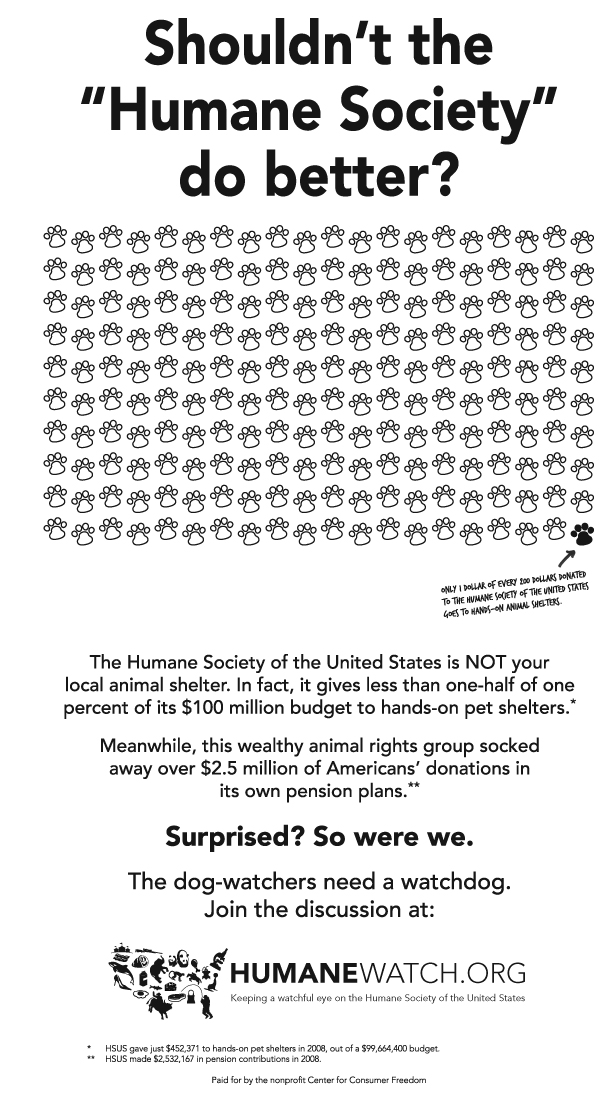
    If you don’t subscribe to the dead-tree edition of The New York Times, you may have missed our full-page ad today asking readers, “Shouldn’t the ‘Humane Society’ do better?” Considering that less than half of one-percent of money spent by the Humane Society of the United States (HSUS) in 2008 went to hands-on pet shelters, lots of people think there’s room for improvement. If you didn’t get the ad, here’s a copy to view:

    It appears we’ve hit close to home at HSUS headquarters. CEO Wayne Pacelle has dialed up his usual issue-dodging response and attacked us for supposedly having a profit motive in airing his dirty laundry. The irony is that Pacelle (as usual) closes his tirade on supposed “money-grubbers” with another appeal for donations. How telling. (Here’s a hint, Wayne: Your own bank account has $162 million in it. Why don’t you look there for loose change?)

    Who has more to lose with a little scrutiny? Our boutique nonprofit whose entire budget is less than what HSUS sticks into its executive pensions, or an animal rights group closely guarding its image and raking in $100 million a year in gifts from unsuspecting Americans?

    We want everyone to “follow the money.” We have, and here’s what we found: Loads and loads of it goes to HSUS lawyers, HSUS campaigns, HSUS lobbying, and HSUS pensions. Very little winds up aiding America’s underfunded hands-on pet shelters. It’s a fact that Wayne doesn’t deny in his response. And more Americans became aware of that fact today.

    Our HumaneWatch project is just getting started. What you’ve seen so far is just the first trickle out of a very, very backed-up faucet. So perhaps we can count on Whiny Wayne having tantrum after tantrum this year. Fine with us. We’ll just keep speaking up for the shelter animals.


  • Federal Racketeering Lawsuit Stuns HSUS

    You may have missed our New Year’s Eve exposé covering the dismissal of a federal lawsuit pushed by a consortium of animal rights groups that included the deceptive Humane Society of the United States (HSUS). The groups alleged that Feld Entertainment (the parent company of the Ringling Bros. and Barnum & Bailey Circus) mistreated elephants in violation of the Endangered Species Act, but in December a judge tossed out the lawsuit. Now the plot thickens: The circus is suing HSUS, two HSUS lawyers, and a number of other animal rights organizations under the Racketeer Influenced and Corrupt Organizations (RICO) Act. (The lawsuit is exclusively available at HumaneWatch.org.)

    The original animal rights lawsuit, filed more than nine years ago, was based on information provided by a former Ringling elephant “barn helper” named Tom Rider. After Rider left his circus job, he was paid by animal rights groups to testify about the supposedly “bad” treatment of elephants there. In all, the original lawsuit’s plaintiffs paid Rider more than $190,000—his sole source of income for years—while the litigation made its way through the court system.

    Sound a bit like pay-for-play? As Judge Emmet Sullivan noted in his December ruling that dismissed the animal rights groups’ lawsuit: “The Court finds that Mr. Rider is essentially a paid plaintiff and fact witness who is not credible, and therefore affords no weight to his testimony…. [T]he primary purpose [for the payments] is to keep Mr. Rider involved with the litigation…”

    Based on Judge Sullivan’s finding, Feld is suing everyone who played a part in this collaborative scheme (hence the “racketeering” aspect). This includes Rider and a nonprofit “Wildlife Advocacy Project” charity that the Washington, DC law firm of Meyer Glitzenstein & Crystal allegedly used to launder money between their plaintiff clients and Rider.

    One of these clients putting up dough to support Rider was the Fund for Animals, which merged with HSUS in 2004.

    Feld is leveling bribery, fraud, obstruction of justice, and money laundering charges against HSUS and two of its corporate attorneys, three other animal rights groups, Meyer Glitzenstein & Crystal, and all three of that firm’s named partners. It’s an earth-shattering lawsuit. Today we’re telling the media:

    America’s farmers, ranchers, hunters, fishermen, research scientists, fashion designers, and restaurateurs have seen for decades how the animal rights movement can behave like a mobbed-up racket. But it’s still shocking to see the evidence laid out on paper. In a treble-damage lawsuit like this, a jury could actually do the humane thing and finally put HSUS out of business completely.

    You can read the full, 135-page lawsuit over at HumaneWatch. It’s worth more than a glance. If these allegations are proven true, HSUS employees might be finding themselves walking the same breadline they’ve tried to put so many others in.