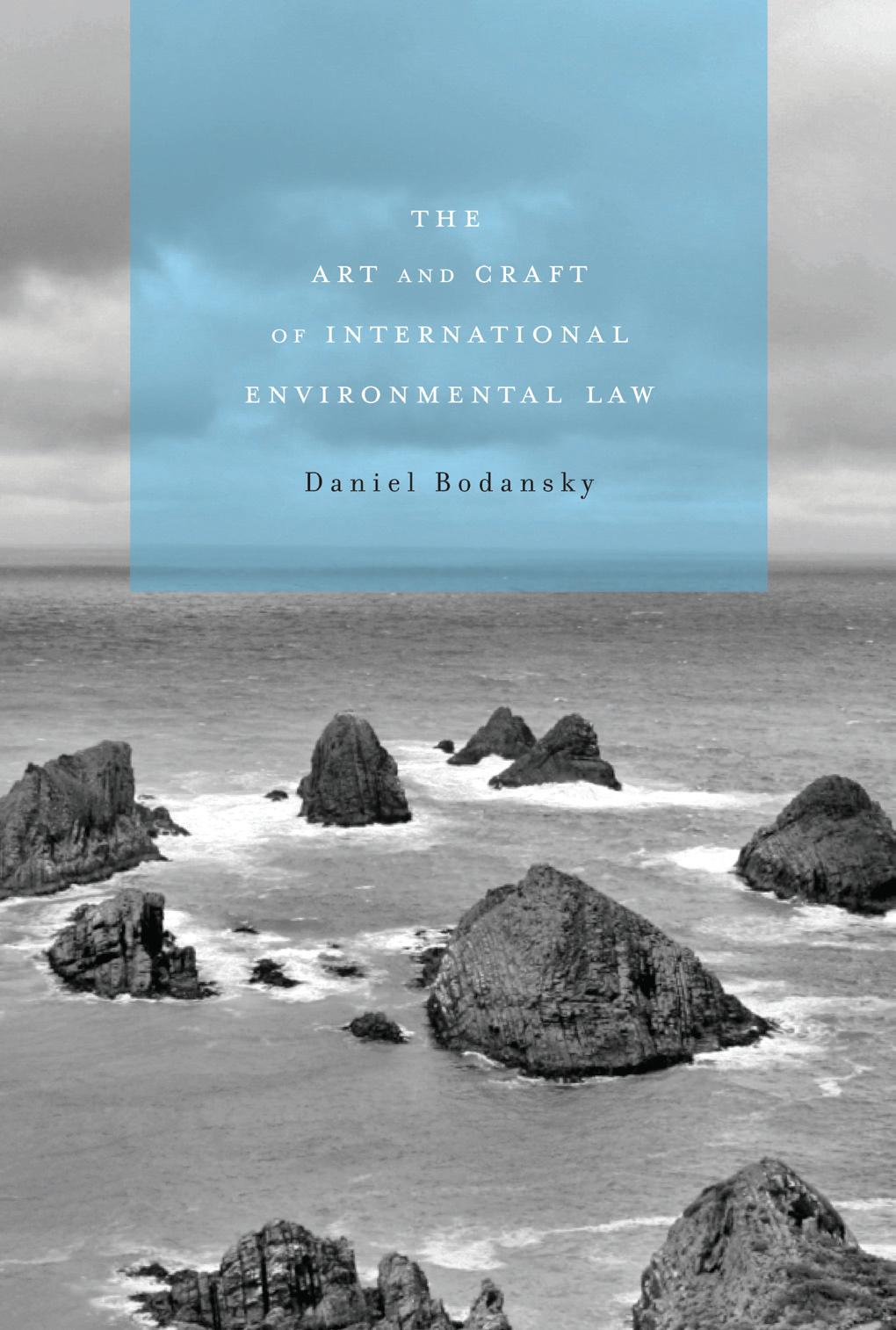
by Dan Bodansky
Many thanks to Peter, Kal and Scott for their very thoughtful comments. As Peter notes, The Art and Craft of International Law focuses more on process and design than on doctrinal issues. Whether or not he is correct that international environmental law lacks common principles or norms that give it substantive coherence, the premise of my book is that it can be studied coherently from a process standpoint.
Peter, Kal and Scott all focus on what makes international environmental law effective. Peter emphasizes the role of social learning, and I agree that this can be an important factor — the acid rain regime in Europe provides a good example. But the climate change regime suggests the limits of epistemic factors. Moreover, to the extent that Peter seems to see coercion, inducements and social learning as alternatives, rather than as potentially complementary strategies, then I disagree. The ozone regime, for example, employs all three techniques. Similarly, as I argue in my book, the managerial and enforcement approaches to compliance are not mutually exclusive. They are what Max Weber called “ideal types” and most regimes contain some admixture of the two.
As Peter suggests, we shouldn’t take a one-size-fits-all approach to regime design; instead, we need to consider carefully which design elements and which approaches to compliance are appropriate for which types of problems or countries. Scott makes a similar point about the climate change regime: the regulatory approach used to address acid rain and ozone depletion — that is, national performance targets — may not work for climate change. The array of tools in the international environmental toolkit are not interchangeable — they are not “mere alternatives,” as Peter notes (and I hope nothing in my book suggests that I think otherwise). In addressing a problem, we need to choose the right tools. And this requires us first to diagnosis the nature of the problem and the obstacles to progress, and then to consider which blend of design elements will be most effective — global vs. regional approaches, hard vs. soft instruments, carrots vs. sticks, and so forth. Systematic study of these questions is certainly helpful. But, in the end, answering them is as much an art and a craft as a science.
Scott asks, what are the obstacles to international progress on the climate change issue? The traditional diagnosis has been that climate change is a collective action problem. On this view, the role of the international climate regime is to create credible, reciprocal commitments that help move states from the uncooperative to the cooperative outcome. In the long run, this analysis may be correct. But it fails to explain much of what we see happening now — on the one hand, an array of national governments, sub-national units (such as California) and businesses taking action unilaterally to reduce their emissions; on the other hand, other countries refusing to assume international commitments, whether or not their commitments are reciprocated by others.
At this stage, the challenge for the climate change regime is less to enforce collective action than to build domestic political will (though the two are, of course, interrelated). Social learning is crucial here, as Peter suggests. But the international climate regime can also help build political will by providing domestic groups with hooks that they can use in the domestic political process. Even though Copenhagen is widely regarded as a failure, to the extent that it helped motivate pledges of domestic action by China, India, Brazil and other major developing countries (and to the extent that the pledged policies will significantly reduce emissions), Copenhagen was a success even before it began. As Kal suggests, the Copenhagen Accord could help reinforce these domestic pledges by recording them internationally and providing at least some measure of international review. To my mind, the Copenhagen Accord epitomizes the characterization of international environmental law with which I conclude my book:
In the end, international environmental law aims to find, not the optimal outcome, but rather the skillful compromise that bridges the gap between competing positions and advances the ball, even if only a little. This view of international environmental law is admittedly more prosaic than heroic. It counsels us to resist the tempting oversimplification. It accepts that international environmental law, like politics, is the art of the possible — and seeks to find the “sweet spot,” which goes as far as possible but not beyond.
Will the system of pledge and review contemplated by Copenhagen be enough? As Kal answers, only time will tell. But, like him, I am doubtful. And, like Scott, I am skeptical that we could improve on Copenhagen and make greater progress through an alternative process. I used to think that process was the problem, and supported addressing climate change in an alternative forum involving fewer countries, such as the G-20. But even if this might have been feasible if we were writing on a clean slate, states have moved so far along the UNFCCC tracks that switching tracks now would be enormously difficult — particularly since the dysfunctionality of the UNFCCC process provides useful cover to countries such as China that are reluctant to assume any international commitments themselves.
What is the solution? Alarmingly, there may be no solution. Perhaps an alternative regulatory approach would be preferable, as Scott has argued elsewhere. But perhaps not. As I argue in my book, international environmental law can play a constructive role, but that is all. It is what I call a thirty percent solution. Solving a problem such as climate change depends on many other factors as well.
Thus, my main thought leaving Copenhagen was exactly along the lines that Kal suggests — namely, to revisit the issue of geoengineering, which I last wrote about more than a decade ago. Geoengineering raises many questions and concerns. But if countries fail to limit their emissions significantly — and if severe climate change occurs as a result — then geoengineering may emerge as a compelling option, as Scott has argued in a very interesting piece entitled the “The Incredible Economics of Geoengineering” (Environmental and Resource Economics, vol. 39 (2008). So, while many may find the prospect of geoengineering unpalatable, we would be well advised to start thinking through its legal and policy implications now ….