Author: David Weigel

  • At CPAC, Tea Party Movement Re-Enters Conservative Fold

    Dick Cheney, with his daughter Liz, made a suprise appearance at CPAC on Thursday. (UPPA/ZUMApress.com)

    Dick Cheney, with his daughter Liz, made a surprise appearance at CPAC on Thursday. (UPPA/ZUMApress.com)

    Mitt Romney has not spoken at any Tea Parties. He has largely avoided the messy debates over the 10th Amendment, nullification, Paul Ryan’s budget proposals, and whether TV stars should be punished for using the “R” word. But at CPAC, at his mid-afternoon address to an overflowing crowd of conservative activists, it was like he’d been waving a Gadsen Flag and a tea kettle from the start.

    “God bless every American who said ‘No!’” said Romney. “It is right and praiseworthy to say no to bad things. It is right to say no to cap-and-trade, no to card check, no to government health care, and no to higher taxes.”

    Image by: Matt Mahurin

    Image by: Matt Mahurin

    The audience at this annual conference — one where he has regularly won the presidential straw poll, but one where he’d never been quite adopted as a true son of the movement — roared with approval. Romney had been introduced by Sen. Scott Brown (R-Mass.), who never mentioned his party affiliation during his insurgent special election bid, but used it twice before the CPAC crowd. Romney, said Brown, was one of the “leading lights” of the GOP.

    Brown had teed up the crowd for a jeremiad against “liberal neo-monarchists,” a “failing” president, and the threat of a “Godzilla-size government bureaucracy.” They cheered even louder when Romney pushed the envelope. He said the rebellion against Obama hinted that “history will judge President Bush far more kindly” than his successor for “pulling us from a deepening recession following the attack of 9/11″ and “[keeping] us safe.”

    In one speech, the year-long journey of conservative activists had come full circle. The last time they gathered for CPAC, George W. Bush had handed the presidency to Barack Obama and Democrats had dramatically expanded their majorities in the House and Senate. Inside the hall, they accepted blame for Bush’s failures; outside the hall, the first Tea Party rallies saw conservative activists declaring independence from Bush’s TARP and Obama’s stimulus package.

    On Thursday, the Tea Party and libertarian factions of the conservative base re-entered the fold and took center stage in packed-to-the-rafters educational panels. And at the same time, those mainstream conservative groups invited these activists to rejoin the Republican Party that had disappointed them. They’d learned their lessons. They’d closed the book on their failure. And in retrospect, didn’t Bush and Cheney seem pretty good?

    “We owe you an apology,” said Rep. Thaddeus McCotter (R-Mich.) in a low-key speech delivered to a room that was quickly emptying out after Romney’s speech. “But more importantly, we owe you what we have been doing since January 2009.” Since Obama’s victory, argued McCotter — and most everyone else at CPAC — the essential goodness of the GOP and the rightness of its policies had been brought into relief.

    “Oh my God!” said David Bossie, the president of Citizens United, who was manning his organization’s booth and accepting constant congratulations for its victory in the “Hillary the Movie” campaign finance reform case. “Barack Obama is the employee of the year for the conservative movement! Every conservative should keep a picture of Barack Obama in his office and — you know how when people go to Notre Dame games, they kiss the sign? Every conservative should kiss that picture.”

    Jerry Doyle, a syndicated conservative radio host, told TWI that the crowd’s outlook for the midterms reminded him of the attitude of fans walking into the Superbowl — “Everybody’s been waiting for the big game, and here it is.” He’d spent years talking to conservative callers who were fed up with Bush, but he wasn’t surprised at the speed with which conservatives and independents turned on Obama, or the speed with which angry activists took another look at what the GOP could offer.

    “I think people had said, ‘You know what, my government’s going to be there for me, take care of me.’ And they found out, no, it’s not.” When Americans grew sick of their government, “Obama just happened to be the figurehead.”

    That was the attitude that united conservatives who’d remained faithful all along and conservatives who were returning to a post-Bush movement. The biggest surprise of Thursday’s schedule was a walk-on appearance by former Vice President Dick Cheney, following a speech by his daughter Liz that re-litigated arguments Republicans had made against Obama for years — at one point, she accused him of “calling small-town Americans ‘bitter.’” The ovation for Liz’s father rolled on for more than a minute; he drew more applause predicting that Obama would be a “one-term president.” And when he headed down to the exhibit hall for a brief radio interview, some members of his entourage sported “Draft Cheney 2012″ stickers handed out by GOProud, a gay Republican group whose booth was doling out reels of Draft Cheney stickers.

    “This grew out of conversations we were having back in November,” said GOProud’s Jimmy LaSilvia, pointing to the group’s chairman of the board Chris Barron. “He kept saying, ‘Cheney’s the guy! Cheney’s the guy!’” As he talked, more activists grabbed stickers, wearing them in proud view of hovering media cameras, and few CPAC attendees that TWI spoke to were completely cold on the idea. Some suggested that a terrorist attack might boost Cheney’s political stock. The cause was popular enough to draw in activists less than 100 percent comfortable with a gay Republican group.

    “I got it from GOProud,” said Colt Ables, a student at the University of Texas-Arlington, shrugging a little with embarrassment. “But I like Cheney, so I’m wearing it.”

    Conservatives who winced at the Bush-Cheney record were out in force, but serious disagreement with the back-to-Bush conservatives was hard to find. Two years ago, Ron Paul’s presidential campaign was lacking a booth in the CPAC exhibit hall until Mitt Romney dramatically quit the presidential race and opened up space for their back-to-1776 brochures. This year, Paul’s Campaign for Liberty occupied a larger section of the exhibit hall than any group except the NRA, with reams of fliers, copies of Young American Revolution magazine (with an illustration of Paul taking the presidential oath on the cover). An intern, Sam Swedberg, donned a sumo suit, a grey wig, a Wal-Mart-bought gingham blouse, and a nametag identifying him as “Big Sis Janet” — Janet Napolitano — challenging passersby to wrestle him. Jeff Frazee, who runs Young Americans for Liberty, told TWI that his libertarian peers were making out just fine with the neoconservatives whom Paul opposed strongly enough to endorse a trio of third party candidates in the 2008 presidential race instead of the McCain-Palin ticket.

    The once-extreme obsessions of Paul’s fans bled into the rest of the convention. They were present in speeches from mainstream figures like Romney, and they were present in lectures that filled large rooms to overflowing. Tom Woods, the author of “The Politically Incorrect History of the United States” and a sometime ghostwriter for Paul, spoke to a packed room on the subject of nullifying federal laws.

    “[Nullification] has only been used by evil people who hate America and hate black people and want to oppress people,” said Woods, sarcastically characterizing  the arguments of critics. “Oh, yeah. Because the federal government would never oppress people!”

    Republican politicians couldn’t really avoid the arguments of Paul acolytes and Tea Partiers. “Senator DeMint, great speech!” said one fan who grabbed the South Carolina Republican on the way to a book signing. “But why didn’t you talk about the Fed?” But the enthusiasm was welcomed. Not even the John Birch Society’s presence in the exhibit hall (their display included a rare CPAC sight, a book attacking Bircher critic William F. Buckley) was very controversial. Republicans argued that the base was speaking for America, that Democrats were really “the party of no” because they didn’t listen to Tea Partiers.

    “The Republican Party should not attempt to co-opt the Tea Parties,” said Rep. John Boehner (R-Ohio), in a speech framed around his potential ascension to the Speaker’s chair if his party wins the House. “I think that’s the dumbest thing in the world. What the Republican Party will do is listen to them, talk to them, and walk among them. The other party can’t say the same.” And he beseeched activists to help the GOP out with a new Contract With America-style statement — it wouldn’t “come from the mountain,” said Boehner, but from the party’s rejuvenated base.

  • Wrestling With Janet Napolitano

    Here’s a video of one of the better scenes from the CPAC exhibit hall: Ron Paul’s Campaign for Liberty hosts sumo wrestling matches that pitted “America” (volunteers) versus “Janet Napolitano” (intern Sam Swedberg).

  • Scenes From CPAC 2010, Round One

    After the jump, a slideshow of photos from the first day of this year’s Conservative Political Action Conference in Washington, D.C.

  • John Boehner’s Interesting Framing of Financial Reform

    In his booster-ish speech about how a Republican Congress would govern, Rep. John Boehner (R-Ohio) deployed a clever frame to make the financial reform bill passed by the House sound absolutely awful.

    “Every Republican voted against [the Democrats’] TARP bailout,” said Boehner, “the permanent slush fund for politicians.”

  • Romney: Bush Nostalgia in Full Bloom

    Mitt Romney’s CPAC experiences since 2007 have been fairly fraught affairs. On the one hand, he always wins the activist straw poll. On the other hand, exhibit halls at past CPACs have been thick with Romney critics — in 2007 one dressed as a dolphin and declared himself “Flip Romney.”

    None of that today. In a surprise, Romney was introduced by Sen. Scott Brown (R-Mass.), who was nearly drowned out by devoted laughter and applause as he gave Romney an incredible plug. “When I started out, the people supporting me could have fit in a phone booth,” said Brown. “Mitt was in that phone booth!”

    The speech that followed was aggressive, and dripping with sarcasm and mockery — a throwback to Romney’s ill-received 2008 Republican National Convention speech. He laid everything wrong with the country at the feet of the Obama presidency and the Democratic majority.

    “The gold medal awarded to Lindsay Vonn has been stripped,” Romney joked. “The judges determined that President Obama was going downhill faster than she was!”

    From there, Romney attacked “liberal neo-monarchists,” accused Obama of “prolonging the recession” with the stimulus package, and charged him with hurting recovery by making it clear that the Bush tax cuts would expire and “pursuing cap and trade.” And this was packaged with a robust defense of the Bush presidency. History, said Romney, would judge Bush favorably. “He pulled us out of a deep recession after 9/11,” said Romney. “And he kept us safe.”

    The crowd stayed glued to this as Romney talked about “our popular, intellectually rigorous conservative agenda” and American exceptionalism. A tirade about the damage liberals wanted to do to America was punctuated with Romney literally pounding the podium with his fist. “We won’t let ‘em do it!”

    Via Politico, here’s the full text of Romney’s speech:

    Thank you to Jay and to Scott for those generous introductions. Both these men have made real contributions to our nation. It’s good to be back at CPAC. I can’t think of an audience I’d rather be addressing today.
    I spent the weekend in Vancouver. As always, the Olympic Games were inspiring. But in case you didn’t hear the late-breaking news, the gold medal in the downhill was taken away from American Lindsey Vonn. It was determined that President Obama is going downhill faster than she is.
    I’m not telling you something you don’t know when I say that our conservative movement took a real hit in the 2008 elections. The victors were not exactly gracious in their big win: Media legs were tingling. Time Magazine’s cover pictured the Republican elephant and declared it an endangered species. The new president himself promised change of biblical proportion. And given his filibuster-proof Senate and lopsided House, he had everything he needed to deliver it.
    They won, we lost. But you know, you learn a lot about people when you see how they react to losing. We didn’t serve up excuses or blame our fellow citizens. Instead, we listened to the American people, we sharpened our thinking and our arguments, we spoke with greater persuasiveness, we took our message to more journals and airwaves, and in the American tradition, some even brought attention to our cause with rallies and Tea parties.
    I know that most of you have watched intently as the conservative comeback began in Virginia and exploded onto the scene in New Jersey. But as a Massachusetts man, who, like my fellow Bay-staters, has over the years, been understandably regarded somewhat suspiciously in gatherings like this, let me take just a moment to exalt in a Scott Brown victory!
    For that victory that stopped Obama–care and turned back the Reid-Pelosi liberal tide, we have something to that you’d never think you’d hear at CPAC, “Thank you Massachusetts!”
    2009 was the President’s turn to suffer losses, and not just at the ballot box, but also in bill after bill in Congress, and most importantly, in his failure to reignite the economy. In how he has responded to these defeats, too, we have learned a great about him and about his team.
    He began by claiming that he had not failed at all. Remember the B+ grade he gave himself for his first year? Tell that to the 4 million Americans who lost their jobs last year, and to the millions more who stopped looking. Explain that to the world’s financial markets who gaped at trillion dollar deficits as far as the eye can see. Square that with the absence of any meaningful sanctions against Iran even as it funds terror and races to become a nuclear nation. President Obama’s self-proclaimed B+ will go down in history as the biggest exaggeration since Al Gore’s invention of the internet!
    Unable to convince us that his failure was a success, he turned to the second dodge of losing teams: try to pin the blame on someone else. Did you see his State of the Union address? First, he took on the one group in the room that was restrained from responding—the Supreme Court. The President found it inexplicable that the first amendment right of free speech should be guaranteed not just to labor union corporations and media corporations, but equally to all corporations, big and small. When it was all over, I think most Americans felt as I did: his noisy critique and bombast did not register as clear and convincingly as Justice Alito’s silent lips forming these words: “Not true!”
    Next he blamed the Republicans in the room, condescending to lecture them on the workings of the budget process, a process many of them had in fact mastered while he was still at Harvard Law School. He blamed Republicans for the gridlock that has blocked his favorite legislation; but he knows as well as we do that he did not need one single solitary Republican vote in either house to pass his legislation. It was Democrats who blocked him, Democrats who said “no” to his liberal agenda after they had been home to their districts and heard from the American people. As Everett Dirksen used to say, “When they felt the heat, they saw the light.” God bless every American who said no!
    Of course, the President accuses us of being the party of “no.” It’s as if he thinks that saying “no” is by definition a bad thing. In fact, it is right and praiseworthy to say no to bad things. It is right to say no to cap and trade, no to card check, no to government healthcare, and no to higher taxes. My party should never be a rubber stamp for rubber check spending.
    But before we move away from this “no” epithet the Democrats are fond of applying to us, let’s ask the Obama folks why they say “no” –no to a balanced budget, no to reforming entitlements, no to malpractice reform, no to missile defense In Eastern Europe, no to prosecuting Khalid Sheikh Mohammed in a military tribunal, and no to tax cuts that create new jobs. You see, we conservatives don’t have a corner on saying no; we’re just the ones who say it when that’s the right thing to do!
    And that leads us to who he has most recently charged with culpability for his failures: the American people. It seems that we have failed to understand his wise plans for us. If he just slows down, he reasons, and makes a concerted effort to explain Obama-care in a way even we can understand, if we just listen better, then we will get it.
    Actually, Americans have been listening quite attentively. And they have been watching. When he barred CSPAN from covering the healthcare deliberations, they saw President Obama break his promise of transparency. When the Democrat leadership was empowered to bribe Nebraska’s Senator Nelson, they saw President Obama break his promise of a new kind of politics in Washington. And when he cut a special and certainly unconstitutional healthcare deal with the unions, they saw him not just break his promise, they saw the most blatant and reprehensible manifestation of political payoff in modern memory. No, Mr. President, the American people didn’t hear and see too little, they saw too much!
    Here again, with all due respect, President Obama fails to understand America. He said: “With all the lobbying and horse-trading, the process left most Americans wondering, ‘What’s in it for me?’” That’s not at all what they were asking. They were asking: “What’s in it for America?”
    America will not endure government run healthcare, a new and expansive entitlement, an inexplicable and surely vanishing cut in Medicare and an even greater burden of taxes. Americans said no because Obama-care is bad care for America!
    When it comes to shifting responsibility for failure, however, no one is a more frequent object of President Obama’s reproach than President Bush. It’s wearing so thin that even the late night shows make fun of it. I am convinced that history will judge President Bush far more kindly—he pulled us from a deepening recession following the attack of 9-11, he overcame teachers unions to test school children and evaluate schools, he took down the Taliban, waged a war against the jihadists and was not afraid to call it what it is—a war, and he kept us safe. I respect his silence even in the face of the assaults on his record that come from this administration. But at the same time, I also respect the loyalty and indefatigable defense of truth that comes from our “I don’t give a damn” Vice President Dick Cheney!
    I’m afraid that after all the finger pointing is finished, it has become clear who is responsible for President Obama’s lost year, the 10% unemployment year—President Obama and his fellow Democrats. So when it comes to pinning blame, pin the tail on the donkeys.
    There’s a good deal of conjecture about the cause of President Obama’s failures. As he frequently reminds us, he assumed the presidency at a difficult time. That’s the reason we argued during the campaign that these were not the times for on the job training. Had he or his advisors spent even a few years in the real economy, they would have learned that the number one cause of failure in the private sector is lack of focus, and that the first rule of turning around any troubled enterprise is focus, focus, focus. And so, when he assumed the presidency, his energy should have been focused on fixing the economy and creating jobs, and to succeeding in our fight against radical violent jihad in Iraq and Afghanistan. Instead, he applied his time and political capital to his ill-conceived healthcare takeover and to building his personal popularity in foreign countries. He failed to focus, and so he failed.
    But there was an even bigger problem than lack of focus. Ronald Reagan used to say this about liberals: “It’s not that they’re ignorant, it’s that what they know is wrong.” Too often, when it came to what President Obama knew, he was wrong.
    He correctly acknowledged that the government doesn’t create jobs, that only the private sector can do that. He said that the government can create the conditions, the environment, which leads the private sector to add employment. But consider not what he said, but what he did last year, and ask whether it helped or hurt the environment for investment, growth, and new jobs.
    Announcing 2011 tax increases for individuals and businesses and for capital gains, hurt.
    Passing cap and trade, hurt.
    Giving trial lawyers a free pass, hurt.
    Proposing card check to eliminate secret ballots in union elections, hurt.
    Holding on to GM stock and insisting on calling the shots there, hurt.
    Making a grab for healthcare, almost 1/5th of our economy, hurt.
    Budgeting government deficits in the trillions, hurt.
    And scapegoating and demonizing businesspeople, hurt.
    President Obama instituted the most anti-growth, anti-investment, anti-jobs measures we’ve seen in our lifetimes. He called his agenda ambitious. I call it reckless. He scared employers, so jobs were scarce. His nearly trillion dollar stimulus created not one net new job in the private sector, but it saved and grew jobs in the government sector– the one place we should have shed jobs. And even today, because he has been unwilling or unable to define the road ahead, uncertainty and lack of predictability permeate the private economy, and prolongs its stall. America is not better off than it was 1.8 trillion dollars ago.

    Will the economy and unemployment recover? Of course. Thanks to a vibrant and innovative citizenry, they always do. But this president will not deserve the credit he will undoubtedly claim. He has prolonged the recession, expanded the pain of unemployment, and added to the burden of debt we will leave future generations. President Obama, Nancy Pelosi, Harry Reid and their team have failed the American people, and that is why their majority will be out the door. Isn’t it fitting that so many of those who have contempt for the private sector will soon find themselves back in it?
    The people of America are looking to conservatives for leadership, and we must not fail them.
    Conservatism has had from its inception a vigorously positive, intellectually rigorous agenda. That agenda should have three pillars: strengthen the economy, strengthen our security, and strengthen our families.
    We will strengthen the economy by simplifying and lowering taxes, by replacing outmoded regulation with modern, dynamic regulation, by opening markets to American goods, by strengthening our currency and our capital markets, and by investing in research and basic science. Instead of leading the world in how much we borrow, we will make sure that we lead the world in how much we build and create and invest.
    We will strengthen our security by building missile defense, restoring our military might, and standing-by and strengthening our intelligence officers. And conservatives believe in providing constitutional rights to our citizens, not to enemy combatants like Khalid Sheikh Mohammed!
    On our watch, the conversation with a would-be suicide bomber will not begin with the words, “You have the right to remain silent!”
    Our conservative agenda strengthens our families in part by putting our schools on track to be the best in the world. Because great schools start with great teachers, we will insist on hiring teachers from the top third of college graduates, and we will give better teachers better pay. School accountability, school choice and cyber schools will be priorities. We will put parents and teachers back in charge of education, not the fat cat CEO’s of the teachers unions!
    Strong families will have excellent healthcare. Getting healthcare coverage for the uninsured should be accomplished at the state level, not a one-size-fits all Pelosi plan. The right way to rein-in healthcare cost is not by making it more like the Post Office, it’s by making it more like a consumer-driven market. The answer for healthcare is market incentives not healthcare by a Godzilla-size government bureaucracy!
    When it comes to our role in the world, our conservative agenda hews to the principles that have defined our nation’s foreign policy for over six decades: we will promote and defend the American ideals of political freedom, free enterprise, and human rights. We will stand with our allies, and confront those who threaten peace and destroy liberty.
    There’s much more on our positive, intellectually rigorous conservative agenda. Not all of it is popular. But the American people have shown that they are ready for truth to trump hope. The truth is that government is not the solution to all our problems.
    This year, I have taken the time to write a book that tells the truth about the challenges our nation faces, and about the conservative solutions needed to overcome them. I have titled it: No Apology: The Case for American Greatness. I’ve set up a booth outside so that you can buy a few hundred copies each. Well, maybe one or two.
    Sometimes I wonder whether Washington’s liberal politicians understand the greatness of America. Let me explain why I say that.
    At Christmas-time, I was in Wal-Mart to buy some toys for my grandkids. As I waited in the check-out line, I took a good look around the store. I thought to myself of the impact Sam Walton had on his company. Sam Walton was all about good value on everything the customer might want. And so is Wal-Mart: rock bottom prices and tens of thousands of items.
    The impact that founders like Sam Walton have on their enterprises is actually quite remarkable. In many ways, Microsoft is a reflection of Bill Gates, just as Apple is of Steve Jobs. Disneyland is a permanent tribute to Walt Disney himself—imaginative and whimsical. Virgin Airlines is as irreverent and edgy as its founder. As you look around you, you see that people shape enterprises, sometimes for many years even after they are gone.
    People shape businesses.
    People shape countries.
    America reflects the values of the people who first landed here, those who founded the nation, those who won our freedom, and those who made America the leader of the world.
    America was discovered and settled by pioneers.
    Later, the founders launched an entirely new concept of nation, one where the people would be sovereign, not the king, not the state. And this would apply not just to government, but also to the American economy: the individual would pursue his or her happiness in freedom, independent from government dictate. Every American was free to be an inventor, an innovator, a founder. America became the land of opportunity and a nation of pioneers.
    We attracted people of pioneering spirit from around the world. They came here for freedom and opportunity, knowing that the cost was incredibly high: leaving behind family and the familiar, learning a new language, often living at first in poverty, sometimes facing prejudice, working long and hard hours.
    All of these pioneers built a nation of incomparable prosperity and unrivaled security.
    After its founding, our national economy grew thanks to more pioneers—people like Alexander Graham Bell and Thomas Edison, Henry Ford, William Procter and Robert Wood Johnson, Bill Hewlett and Dave Packard and Thomas Watson. These are names we know—but the less well known are just as vital American innovators, and they number in the millions.
    That American pioneering spirit is what propelled us to master the industrial age just as today we marshal the information age.
    This course for America, chosen by the founders, has been settled for over 200 years. Ours is the creed of the pioneers, the innovators, the strivers who expect no guarantee of success, but ask only to live and work in freedom. This creed is under assault in Washington today. Liberals are convinced that government knows better than the people how to run our businesses, how to choose winning technologies, how to manage healthcare, how to grow an economy, and how to order our very lives. They want to gain through government takeover what they could never achieve in the competitive economy—power and control over the people of America. If these liberal neo-monarchists succeed, they will kill the very spirit that has built the nation—the innovating, inventing, creating, independent current that runs from coast to coast.
    This is the liberal agenda for government. It does not encourage pioneers, inventors and investors—it suffocates them.
    In a world where others have lost their liberty by trading it away for the false promises of the state, we choose to hold to our founding principles. We will stop these power-seekers where they stand. We will keep America, America, by retaining its character as the land of opportunity. We welcome the entrepreneur, the inventor, the innovator. We will insist on greatness from every one of our citizens, and rather than apologizing for who we are or for what we have accomplished, we will celebrate our nation’s strength and goodness. American patriots have defeated tyrants, liberated the oppressed, and rescued the afflicted. America’s model of innovation, capitalism and free enterprise has lifted literally billons of the world’s people out of poverty. America has been a force for good like no other in this world, and for that we make no apology.

  • Cheney in the House

    While Liz Cheney of Keep America Safe spoke to a mostly-full Marriott Ballroom, a buzz circulated among event organizers: Trust us, you should be there. When Cheney wrapped, the surprise was revealed — her father, the former vice president, was on deck.

    Dick Cheney entered the room to Beatles-on-Ed-Sullivan applause, the longest applause of the day so far. “If I keep hearing applause like that,” he said, “I’m going to have to run!” More applause. The former vice president’s speech was short, mostly platitudes about how much he enjoyed CPAC, and then he was spirited down to the radio booth of 920am with an entourage that included his other daughter, Mary Cheney.

    Photo by David Weigel

    A crowd started to form, although no one not next to the radio mics could hear what Dick and Liz were saying. Members of the media were informed that this was his only interview — he was going to be rushed away immediately — but a group of Citadel cadets were allowed to stand along the path out for a quick photo.

    “We’re all big fans,” said Gerry Ratchford, a junior at the Citadel. “I think it’s ridiculous that the sitting president and vice president feel like they need to engage him.”

    Some members of the Cheney entourage were sporting “Draft Cheney 2012″ stickers, which were being passed out by GOProud, a gay Republican group. When I asked whether they endorsed such an effort: No comment.

  • Commemorate Scott Brown!

    The senator from Massachusetts sends a letter to his supporters — under the bylines of his daughters Ayla and Arianna Brown — offering up, very Obama-esque, commemorative merchandise.

    Pictures and e-mail:

    Friend,

    Tomorrow will mark one month since the election and we just wanted to send you this special email to say thank you for all the support you have given our father, Scott Brown.
    This past election was about real issues and you were a critical part of our operation.  We can’t thank you enough because you were responsible for sending Bold, New,  Leadership to Washington.
    You can commemorate this special election with a seat cushion or a t-shirt.   With a minimum donation of $20 you can get your seat cushion or t-shirt to show others that you were part of this amazing movement.

    Stay tuned for more updates from the campaign!
    Ayla & Arianna Brown

    P.S. If you are on facebook, please become a fan so our dad can connect with you and get your feedback on what you feel is important.

  • Marco Rubio at CPAC: Loving Everything About America Except Charlie Crist

    The annual Conservative Political Action Conference began with a two-man rev-up for Marco Rubio, the former GOP speaker of the House in Florida who has become a cause celebre by running hard for the open Senate seat sought by Gov. Charlie Crist (R-Fla.).

    ACU’s President David Keene briefly reminded the crowd that his group was not one of those conservative groups that had lost its way — it kept score of conservative votes cast by senators and congressman. The only man with a 100 percent score: Sen. Jim DeMint (R-S.C.), who walked onstage to introduce Rubio.

    “I remember being in a room with Republican senators, so pleased that they’d endorsed Charlie Crist,” said DeMint. He went on to talk to Rubio for 15 minutes, he said, and promptly endorsed the man. “The Washington establishment laughed it off. Well, they’re not laughing now!” And with a strange intro line — “George Will says he will win, absolutely” — DeMint cleared the way for a beaming Rubio.

    “A few weeks ago I wasn’t sure I could make it here!” said Rubio, joking about the city’s crippling snowstorms. “Congress couldn’t even meet to work on business. The
    president couldn’t find anywhere to set up his teleprompter to announce new taxes!” Two teleprompter screens stood in front of Rubio, although he didn’t use them.

    The speech that followed from there barely dealt with Rubio’s primary run — he didn’t mention Crist, only saying that “one Arlen Specter is enough” in the Senate, and that high-powered endorsements couldn’t prevent primary challenges. (Rubio has been endorsed, of course, by Jeb Bush.) It only tangentially dealt with the duties of a potential senator — it sounded more like a presidential speech, with salutes to the Tea Parties, bold tax proposals and some re-litigation of the 2008 election.

    “Clever one-line slogans are not going to spare you the need to discuss policy issues in detail,” said Rubio. He accused Obama of “using” the economic crisis “not to fix America, but to change America.” The American people, he said, had “figured it out”: “From Tea Parties to the election in Massachusetts, we are witnessing the single greatest political pushback in American history.”

    All of this got huge applause, as did Rubio’s fairly standard policy proposals: deep tax cuts, the elimination of the capital gains tax and “death tax,” lawsuit reform. He got his biggest ovation when he went after the Obama administration’s war on terror policies. Terrorists, he said, should be killed or “captured and sent to Guantanamo Bay, where they will face a military tribunal, not to Manhattan and a civilian court.”

    That got a standing ovation from a rapturous crowd. One voice yelled out (hard to hear from my seat) “waterboard” or “waterboard them.” Rubio joked it off — “I told you about that Marco-Polo thing!” he said, referring to how he winced when people chanted “Marco.”

    The rest of his speech — about 10 minutes — dealt with his upbringing, with stories of “hearing my father’s keys in the door as he returned home from another 16-hour day at work,” putting it in the context of American exceptionalism — “This is the only place in the world where you can open a small business in a spare bedroom in your home.”

    Rubio ended on another ovation — as he left, around 10 percent of the crowd filed out, skipping Jim DeMint’s speech. The senator didn’t seem to mind.

    “Boy, I could use a man like that in the United States Senate,” said DeMint. “If you didn’t love this country when you got here today, I’m sure you love it now!”

  • The New Conservative Hierarchy

    Ken Vogel previews CPAC by highlighting the new power and prominence of people like Erick Erickson of RedState, Jenny Beth Martin of Tea Party Patriots, and Andrew Breitbart, who don’t share the baggage of the leaders who “flocked to Washington after their efforts culminated in the election of President Ronald Reagan in 1980.”

    It’s worth reading the whole thing for quotes from standby conservative leaders like Grover Norquist and ACU’s David Keene acknowledging — for perhaps the last time — that the conservative movement blew it in the Bush years and the new blood is welcome. (Denying Bush and all his works was a major theme of CPAC 2009.) It’s also worth reading between the lines. For all of the chest-pounding about new leadership, really only Sarah Palin has tried to write the conservative establishment, represented at CPAC, out of the movement. Newt Gingrich, who horrified Tea Partiers in 2009 by endorsing Dede Scozzafava in NY-23, (and also endorsing TARP in 2008) is back at CPAC with a prime speaking slot. And Tea Party leaders are clearly relishing the chance to meet these leaders on new, solid footing — not really pushing them out of the way.

  • Learning to Manage the Fringe

    Texas GOP gubernatorial candidate Debra Medina speaks with the press after an interview with Glenn Beck. (YouTube)

    Texas GOP gubernatorial candidate Debra Medina speaks with the press after her interview with Glenn Beck. (YouTube)

    The annual Conservative Political Action Conference kicks off in Washington today, and one would-be conservative star — Debra Medina — won’t be missed.

    In late January, polls showed Medina’s campaign for governor of Texas surging from single digits — the usual terrain of first-time candidates given to talk of “revolution” and nullifying federal laws — into the low twenties. That was enough support to force a run-off, and enough to turn the media’s attention to the latest story of surprising Tea Party success. Then, on February 11, Glenn Beck booked her on his radio show and asked whether a nasty rumor was true. Did she “believe the government was in any way involved with the bringing down of the World Trade Centers on 9/11?”

    Image by: Matt Mahurin

    Image by: Matt Mahurin

    Medina didn’t say no. “I don’t have all of the evidence, there, Glenn,” she said, stumbling a bit over her words. “And I think the American people have not seen all of the evidence there. So I have not taken a position on that.”

    A groan went up across the conservative blogosphere. When Medina backpedaled by pointing out that Americans also had questions about President Barack Obama’s citizenship, a louder groan went up. Erick Erickson, the influential editor of RedState.com — a website that regularly features guest posts from Republican politicians — announced that the site, which had always banned 9/11 conspiracy theories, was also banning “birthers.”

    “If you think 9/11 was an inside job,” wrote Erickson, “or you really want to debate whether or not Barack Obama is an American citizen eligible to be President, RedState is not a place for you.”

    One Tea Party activist who watched this unfold with dismay was Judson Phillips. Days before the Medina meltdown, he wrapped up the first National Tea Party Convention in front of dozens of TV cameras and 200 reporters. He’d announced the formation of a new Tea Party-driven PAC and introduced the press to Tea Party-affiliated congressional candidates.

    “What Medina did,” Phillips mused this week to TWI, “that might have been the classic self-inflicted wound. It’s clear that she may have been a good candidate someday, and it’s clear that she wasn’t ready for prime time.”

    When he ran the National Tea Party Convention, Phillips got a sense of how fringe beliefs and fringe activists could harm the movement. Handled correctly, they didn’t have to do much damage at all. On its first night, former congressman Tom Tancredo used his time at the podium to call the president “Barack Hussein Obama” and say his election could have been prevented by voter “literacy tests.” On its second night, WorldNetDaily Editor-in-Chief Joseph Farah spent roughly 10 minutes of a 40-minute speech musing about President Obama’s citizenship. Those stories got mainstream media coverage, and Phillips fielded questions on them, but the stories didn’t outlast the showy closing speech by Sarah Palin.

    “For better or worse,” Phillips told TWI, “America’s got a really short attention span. If you go past a few days, people forget about it. Basically, if you don’t want to be taken down, you have to stay on message, and you have to ignore what the media is doing.”

    Phillips’s experience wasn’t unqiue. Conservative activists and Republican politicians have, thus far in the Obama presidency, largely been able to escape the negative attention generated by the movement’s fringes. A February 11 ABC News/Washington Post poll found 35 percent of Americans holding favorable views of the Tea Party movement to 40 percent who hold negative views — negative overall, but better than the ratings for Congress. And that same poll found voters splitting evenly, 46 percent to 46 percent, on whether they wanted the Democrats or the Republicans to win control of Congress in the midterm elections. Despite the increased visibility and power of out-of-the-mainstream activists and rhetoric, the party itself is on steadier footing.

    All of this is on the minds of conservatives and liberals alike today as they arrive for CPAC, the traditional gathering of conservatives that brings presidential hopefuls, young activists, and power players to a D.C. hotel. In the run-up to the convention, CPAC Director Lisa De Pasquale announced that a panel on Obama’s citizenship had been ruled out and took the side of GOProud, a gay Republican group, in a dispute with religious conservatives — the leader of the group, Jimmy LaSalvia, is now slated to appear on a Saturday technology panel.

    At the same time, CPAC has accepted the sponsorship of the John Birch Society — a far-right group famously exiled from the conservative movement by William F. Buckley. And some figures in the “birther” movement will be making appearances at the conference. Gary Kreep, a lawyer who represents fringe presidential candidate Alan Keyes in a suit demanding Obama’s birth certificate, will appear on a panel titled “Saving Freedom and Due Process from An Oppressive Justice Department,” alongside Virginia Attorney General Ken Cuccinelli. Hi-Caliber, a Republican rapper who dropped a verse about Obama’s citizenship at the 9/12 march on Washington, will appear at party hosted by XPAC2010, a series of religious conservative events happening alongside CPAC.

    The toxic fringe issues that convinced activists to distance themselves from Medina won’t be the only controversial elements of the movement coming into the CPAC spotlight. While at past conferences Rep. Ron Paul (R-Tex.)’s brand of anti-Federal Reserve, strict constructionist conservative has gotten a polite reception, this year representatives from his Campaign for Liberty are co-sponsoring multiple panels. The Tea Party movement, blasted by Democratic leaders and liberal activists for the extremism that surfaces at some rallies, is an even greater presence.

    Liberals are primed to find and publicize every CPAC flirtation with fringe politics. TalkingPointsMemo has assigned three reporters to cover the event and Faiz Shakir, the editor of ThinkProgress, told TWI that some number of staffers will attend the convention with video cameras. In the run-up, other liberal-leaning news organizations have run stories on the sensational themes of CPAC panels and a Nancy Pelosi pinata that will be beaten up at an off-site party. But conservatives, who have grown used to having to explain the actions of fringe activists, have seen that coverage of CPAC before. But if the recent past is prologue, making hay out of the fringe elements that will walk the halls, and the event stage, with possible 2012 GOP candidates, won’t do lasting damage.

    “Everybody talks about William F. Buckley repudiating the Birchers,” said J.P. Freire, an editor at the Washington Examiner who was the 2009 CPAC Journalist of the Year. “That’s fine. That’s supposed to happen. But he didn’t spend the rest of his career belaboring the point. When you want to ostracize the fringe, you do not clamp down on it. You ignore it.”

    When Freire received his award last year, he had just come from speaking at one of the first-ever Tea Party protests, a rally of around 100 people in Lafayette Square. One year of aggressive and mocking media coverage of that movement, he said, had revealed that the only people damaged by fringe behavior were the offenders themselves — not the conservative movement.

    “This is out of Saul Alinsky,” said Freire, suggesting that it was a distraction that wasn’t selling given the grievances that mainstream activists had with Democratic policies. “You’re trying to marginalize the critics, but you’re not addressing their concerns.”

    Conservatives have become aware that fringe issues can trip them up. J.D. Hayworth, a former congressman from Arizona who’s challenging Sen. John McCain (R-Ariz.) in the primary, has stumbled in interviews when asked about the president’s citizenship. On Monday, Republican congressional candidate Sean Duffy told TWI that he’s asked “the birther question” from time to time, but he quickly dismisses it and moves on, as he does when asked if he supports plans to nullify or abolish social insurance.

    “There are people on the fringe of everything,” said Terry Jeffrey, the editor of CNSNews.com, who is moderating a panel on “Saving Freedom from The Enemies of Our Values” at CPAC. “I just don’t think that the average person identifies some nut, somewhere, with what conservatism is all about. The bigger problem is that the president needs to answer for some of the people at the White House, and the crazy things they’ve said.”

    Liberal watchdogs and bloggers aren’t changing their plans. Last year, ThinkProgress correspondents got multiple Republicans on video commenting on Rush Limbaugh’s remark that he wanted the president to “fail.” This year, they’re going to be demanding accountability again, even if conservatives figure they can police their own fringes and ignore the blowback.

    “I’m not trying to shoot for the stars,” said Faiz Shakir, the editor of ThinkProgress. “All I want is a record. It shouldn’t be possible for people to duck into a conference, espouse hate-filled rhetoric, and duck out without a trace.”

  • ‘Ladies and Gentlemen, We Have a Country to Save!’

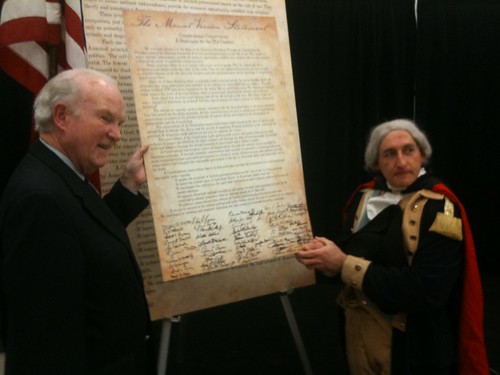
    ALEXANDRIA, VA. — Outside of the Collingwood Library and Museum, a stately home a few miles down the highway from Washington, D.C. — and a few miles north of Mount Vernon — dozens of conservative activists gathered to witness the introduction and signing of the Mount Vernon Statement. On the country road up to the house, cars bearing “Bob McDonnell 2009″ and “Question Al Gore’s Authority” bumper stickers jostled for spaces along grimy snow banks. The cars emptied out and their occupants strolled up to the estate ready to hear some of the movement’s longtime leaders roll out a one-page “statement for the 21st century” of conservative values.

    National Tax Limitation Committee President Lew Uhler Poses with the Mount Vernon Statement and George Washington impersonator James Manship

    National Tax Limitation Committee President Lew Uhler Poses with the Mount Vernon Statement and George Washington impersonator James Manship (Photo by David Weigel)

    The ceremony was moved into a small building set apart from the main house. Inside, a George Washington impersonator, James Manship, made the rounds as conservative activists shook hands and caught up with one another. They included Republican pollster Kellyanne Conway, Curt Levey of the Committee for Justice, Jenny Beth Martin of Tea Party Patriots and Robert Bluey of the Heritage Foundation. In the press section sat R. Emmett Tyrrell, editor of the American Spectator, John Fund, political columnist for The Wall Street Journal, and Mark Tapscott, opinion editor of the Washington Examiner. I asked Tyrrell what, if anything, was new or politically impactful about this statement.

    “We’ve said this for 50 years, and we’re saying it again.” said Tyrrell. “We don’t have to update anything!”

    Shortly after 2:30, the signatories of the statement — including former Attorney General Ed Meese, Americans for Tax Reform’s Grover Norquist, the Media Research Center’s Brent Bozell and the Family Research Council’s Tony Perkins –  lined up on a stage alongside a blown-up version of the statement. Meese rhapsodised about how far the movement had come since the 1960 Sharon Statement crafted by some of the same people in the room today — it now included, he said, “people of various minority groups.”

    “If he were here, Ronald Reagan would be among first to sign the Mount Vernon statement,” said Meese. “Indeed, Ronald Reagan named the framers or the founding fathers more than his nine predecessors combined.”

    Wendy Wright of Concerned Women for America led the audience in a prayer, asking God to “equip us and guide us as we strive to advance constitutional principles.” And the ceremony kept that high level of pomp. Colin Hanna, the honey-voiced president of Let Freedom Ring, lectured the crowd on the history of conservative mission statements, crediting William F. Buckley with the most eloquent ones.

    “Of course,” said Hanna, “William F. Buckley used Latin as a conversational language!”

    Hanna read through the Sharon statement and argued that it remained relevant, if one replaced key words. “Communism — or today we would substitute the word ‘terrorism’ — must be defeated, not simply contained.”

    Kathryn Jean Lopez of National Review Online offered up more links between this “historic” event and the conservatives of the past. “Not just here today, but around the nation, we’re seeing people do what Bill Buckley did in that first issue of National Review.” Lopez waved a facsimile of the issue. “I had to do show and tell. We have them around the office.”

    Heritage Foundation president Ed Fuelner was given the task of reading out the statement, word for word. As he did so, Manship — the George Washington impersonator — nodded at key phrases like “tyrants and despots everywhere.”

    “We must print out the statement’s text on our journals, our magazines and our blog posts,” said Fuelner. “We must distribute the video of today’s ceremony. Ladies and gentlemen, we have a country to save!”

    Before attendees signed the document under Manship/Washington’s watchful eye, they got a special live message from radio host and author Mark Levin, who appeared on a large projection screen over the stage.

    “I want to thank the media,” said Levin. “I see them all against the wall there. We’re saving or creating a nation, here.”

    Levin lectured the room briefly on the importance of fighting “pseudo-conservatives” and the greatness of Ed Meese, whom Levin said respected the Constitution, “unlike the current attorney general, who never mentions the Constitution.” To the “pseudo-conservatives” he issued a warning: “It’s our turn. We’ve had about enough of you. We’re going to take you on and it’s time to defeat you.”

    When Levin wrapped, the attendees lined up to sign the document, then hobnobbed with each other and a small group of reporters. Some hung around to take photos with the blown-up statement — a few grabbed Manship/Washington to pose with them.

    “Whoever did this needs to do some more research,” said Manship/Washington, pointing at the giant paper sharing the photo with him. “The kerning’s too close.”

  • Poll: Five Percent of Americans Have Attended Tea Parties; Movement Is Overwhelmingly White, Male and Conservative

    CNN has a much-needed and revealing poll on the Tea Party movement, with full breakdowns available at their site that reveal — no huge surprise — that it looks like a subsection of the Republican Party. The headline: Eleven percent of Americans have given some kind of support to the movement, with 5 percent attending rallies.

    The demographic breakdowns: Tea Party activists are 60 percent male and 80 percent white, with 77 percent of them self-identifying as “conservatives” and 44 percent identifying as “Republicans.” While 47 percent of Americans report making less than $50,000 a year, only 26 percent of Tea Party activists make that little, while 34 percent make $75,000 or more. The major way in which this movement differs from the Republican Party’s makeup is in geography. Only 31 percent live in the South. Twenty-nine percent live in the Midwest, and 28 percent live in the West. Only in the Northeast, where 13 percent of activists live, are they relatively underrepresented (19 percent of all poll respondents live there).

    Picture 31

    CNN.com

  • The Mount Vernon Statement: ‘Pablum’ That Richard Viguerie Will Sign Anyway

    Ben Smith previewed the latest conservative manifesto-cum-PR-event launching in the run-up to CPAC, and the text is after the jump. RightWingWatch has a good catch that points out just how ephemeral it is: Richard Viguerie, the quotable but vanishingly important direct mail guru, trashed the very idea of a “Mount Vernon Statement,” then signed it anyway. Viguerie, two days ago:

    This is embarrassing. If the people in the leadership of the conservative movement are going to put out pablum like this, the tea party people are going to make them seem irrelevant. And the tea party people are going to march to the forefront. This is almost as if the movements leaders were taken over by Tom DeLay and John Boehner.

    I’ll be at the launch event with, to quote the press details: “Former Attorney General Ed Meese, senior statesman of the conservative movement; Edwin Feulner, president of the Heritage Foundation; Tony Perkins, president of the Family Research Council; Becky Norton Dunlop, president of the Council for National Policy; Brent Bozell, president of the Media Research Center; Alfred Regnery, publisher of the American Spectator; David Keene, president of the American Conservative Union; Wendy Wright, president of Concerned Women for America; David McIntosh, co-founder of the Federalist Society; T. Kenneth Cribb, former domestic policy adviser to President Reagan; Grover Norquist, president of Americans for Tax Reform; William Wilson, president of the Americans for Limited Government; Elaine Donnelly, Center for Military Readiness; Richard Viguerie, chairman of ConservativeHQ.com, Kenneth Blackwell of the Coalition for a Conservative Majority; Colin Hanna, president of Let Freedom Ring; and Kathryn Lopez of National Review.”

    We recommit ourselves to the ideas of the American Founding. Through the Constitution, the Founders created an enduring framework of limited government based on the rule of law. They sought to secure national independence, provide for economic opportunity, establish true religious liberty and maintain a flourishing society of republican self-government.

    These principles define us as a country and inspire us as a people. They are responsible for a prosperous, just nation unlike any other in the world. They are our highest achievements, serving not only as powerful beacons to all who strive for freedom and seek self-government, but as warnings to tyrants and despots everywhere.

    Each one of these founding ideas is presently under sustained attack. In recent decades, America’s principles have been undermined and redefined in our culture, our universities and our politics. The selfevident truths of 1776 have been supplanted by the notion that no such truths exist. The federal government today ignores the limits of the Constitution, which is increasingly dismissed as obsolete and irrelevant.

    Some insist that America must change, cast off the old and put on the new. But where would this lead — forward or backward, up or down? Isn’t this idea of change an empty promise or even a dangerous deception?

    The change we urgently need, a change consistent with the American ideal, is not movement away from but toward our founding principles. At this important time, we need a restatement of Constitutional conservatism grounded in the priceless principle of ordered liberty articulated in the Declaration of Independence and the Constitution.

    The conservatism of the Declaration asserts self-evident truths based on the laws of nature and nature’s God. It defends life, liberty and the pursuit of happiness. It traces authority to the consent of the governed. It recognizes man’s self-interest but also his capacity for virtue.

    The conservatism of the Constitution limits government’s powers but ensures that government performs its proper job effectively. It refines popular will through the filter of representation. It provides checks and balances through the several branches of government and a federal republic.

    A Constitutional conservatism unites all conservatives through the natural fusion provided by American principles. It reminds economic conservatives that morality is essential to limited government, social conservatives that unlimited government is a threat to moral self-government, and national security conservatives that energetic but responsible government is the key to America’s safety and leadership role in the world.
    A Constitutional conservatism based on first principles provides the framework for a consistent and meaningful policy agenda.
    • It applies the principle of limited government based on the
      rule of law to every proposal.
    • It honors the central place of individual liberty in American
      politics and life.
    • It encourages free enterprise, the individual entrepreneur, and
      economic reforms grounded in market solutions.
    • It supports America’s national interest in advancing freedom
      and opposing tyranny in the world and prudently considers what we can and should do to that
      end.
    • It informs conservatism’s firm defense of family, neighborhood,
      community, and faith.

    If we are to succeed in the critical political and policy battles ahead, we must be certain of our purpose.

    We must begin by retaking and resolutely defending the high ground of America’s founding principles.

    Jim DeMint is a fan:

    Picture 29

  • James O’Keefe May Make It to CPAC

    Nikki Schwab and Tara Palmeri talk to the anti-ACORN filmmaker, who’s trying to make it to Washington to join Hannah Giles — who played the prostitute in his sting — and accept the “XPAC Annual Award for Impact” on Friday night. He’s “in the process of petitioning his parole officer to let him cross state lines to make the big event.”

    “We’re having this e-mail exchange right now, actually,” O’Keefe said about his correspondence with his parole officer.

    O’Keefe isn’t on complete lockdown — he did spend Presidents Day on the ski slopes of New Jersey. But for a trip to the District for CPAC to join his cohort Hannah Giles, he’ll have to beg.

    “But hopefully I should be able to make it down to D.C. on Thursday,” he said.

    If he can’t make an appearance, he plans to do a prerecorded or satellite interview with Town Hall’s Kevin McCullough that will appear Friday.

    I noted earlier that O’Keefe and the other players in the ACORN sting were not getting official tributes at CPAC; unofficial tributes like this, however, will be enough to make news.

  • Andrew Malcolm’s Embarrassing Palin-Flacking

    Kevin K. catches the Los Angeles Times’s Andrew Malcolm in a head-spinningly strange fit of Sarah Palin-boosting.

    Something to ponder for 2012: Sarah Palin’s ahead of where Obama was 30 months before his nomination

    A recent Washington Post/ABC News Poll found that 30 months out from the 2012 party presidential nominations, only 71% of Americans believe that Sarah Palin is not qualified to be president.

    This compares with someone named Barack Obama. At the same point in his then unannounced campaign, 0% thought he was qualified for the Oval Office. That’s because he wasn’t even on the polling lists’ radar then.

    I’m sure this is good for the newspaper’s traffic, but it’s deeply silly. There was a poll on this topic when Obama got into the presidential race in February 2007. And 40 percent of survey subjects gave their reason for not supporting Obama as “lacks experience to be president/not experienced enough.” Even if you merge that with the 7 percent who said Obama was “not qualified,” that’s 24 points lower than the number of people who say, right now, that 2008 GOP vice presidential nominee Sarah Palin is not fit for the Oval Office.

    The fact that Palin fans have to engage in spin like this really says it all about her 2012 chances.

  • Salem Communications Buys HotAir.com

    Colby Hall has the scoop:

    Mediaite has learned that leading center-right web site Hot Air has been acquired by Salem Communications for an undisclosed sum. Sources close to the deal claim that Michelle Malkin, the conservative pundit and sole owner of Hot Air, has been in talks with Salem for some time, but the announcement was timed to coincide with the Conservative Political Action Conference, which opens tomorrow in Washington D.C.

    Salem, which operates Townhall.com, actually gets around 90 percent of its revenue from talk radio, which is mostly Christian radio and political hosts, including: Bill Bennett, Michael Medved, and Hugh Hewitt.

  • CPAC Will Honor Ed Morrissey, Ron Kessler With Journalism Awards; Breitbart and ACORN Sting to Receive Unofficial Tributes

    There was some buzz last year about Andrew Breitbart, Hannah Giles and James O’Keefe receiving some sort of honor at CPAC as a show of gratitude for the ACORN video sting. At the moment, they’re definitely getting honors, but almost certainly not from the American Conservative Union and the conference proper.

    On Thursday, Breitbart and Marc Morano — the latter of ClimateDepot — will accept the Reed Irvine Accuracy in Media Award, sponsored by AIM, at a mid-afternoon reception. On Friday, the religious conservative XPAC — a tangentially related event that’s drawing in some CPAC attendees — will “recognize and award” Giles and O’Keefe.

    Not going to the ACORN stingers: CPAC Blogger and Journalist of the Year Awards, for which online voting was held last month. Of the Breitbart-Giles-O’Keefe trio, only Breitbart was a nominee — for Journalist. But the winners were Ed Morrissey of HotAir.com (Blogger) and Ronald Kessler of Newsmax.com (Journalist). Still up in the air: the actual CPAC awards, including the Ronald Reagan and Defender of the Constitution Awards (not picked yet, awarded at a Friday night banquet).

  • The GOP/Tea Party Meeting

    The much-hyped meeting between RNC Chairman Michael Steele and Tea Party activists ended up lasting four hours, with the activists who participated alternating between assertions of independence and gratitude for being invited.

    Karin Hoffman, founder of a South Florida tea party group called DC Works For Us, organized the meeting and said afterwards that it was “a natural part of this movement that the grassroots leaders be heard as part of the political discussion and we were heard.”

    “It’s the beginnings of a relationship,” Hoffman said, though she was careful to pledge that “the grassroots movement will still be the grassroots movement.”

    “It is an autonomous movement, but part of that relationship is that we are able to communicate with them and they are able to communicate with us,” she said.

    Ken Vogel talks to Robin Stublen and Andrew Ian Dodge, two critics (in Florida and Maine, respectively) of Tea Party leadership’s rush to the Republican banner. Both point out that Hoffman had trouble wrangling supporters to come to this meeting; Dodge argues that it was a PR stunt.

    But my experience at the National Tea Party Convention suggests that the people who engage in this high-profile political meetings become, in the media’s eyes, the leaders of the movement. There’s more interest in what they’ll do in 2010 than what they stand for.

  • The CPAC Presidential Straw Poll

    Matt Lewis has the latest edition of the presidential straw poll to be distributed later this week to paying attendees of the annual CPAC conference. In presidential years, candidates often buy tickets for supporters in order to help them win these polls. Not coincidentally, the 2007, 2008, and 2009 winner of the CPAC poll was Mitt Romney.

    New to the poll this year: Gov. Haley Barbour (R-Miss.), Gov. Mitch Daniels (R-Ind.), Sen. John Thune (R-S.D.), and Rick Santorum.

    People who appeared on last year’s ballot but have been cut this year: Gov. Bobby Jindal (R-La.), Gov. Charlie Crist (R-Fla.), and — for obvious reasons — Gov. Mark Sanford (R-S.C.).

    CPAC straw poll ballot:

    Haley Barbour

    Mitch Daniels

    Newt Gingrich

    Mike Huckabee

    Sarah Palin

    Ron Paul

    Tim Pawlenty

    Mike Pence

    Mitt Romney

    Rick Santorum

    John Thune

    Other (write in)

    Undecided

  • The Power of Sarah Palin’s Hand

    There’s a little humor here, but overall I’d say this ad by Tennessee congressional candidate Donn Janes (”I will vehemently oppose any measure giving another country, the United Nations or any other entity power over U.S. citizens”) demonstrates how, among conservative activists, Sarah Palin can do no wrong.