… you should check out Giles, Giles & Fripp


… you should check out Giles, Giles & Fripp
A bit of a problem for the soon-to-be-released tech device.
From the link:
Apple’s iPad $99 battery replacement service is a bit of a misnomer; Apple will replace the entire iPad, not the battery.
Already, the iPad battery has come under fire. The iPad’s 10-inch LCD display requires a battery that’s more than five times the capacity and size of the iPhone 3GS battery. The screen alone consumes roughly 2 watts per hour, Vronko says, and will drain the large battery in 12 hours by itself.
Apple, which claims the iPad has a 10-hour battery life, doesn’t want the iPad to face the kind of vitriolic complaints regarding battery life that the iPhone has endured since its debut.


Just one more reason to go with Google Chrome.
From the first link:
Microsoft Releases Security Advisory to Address VBScript Vulnerability
added March 2, 2010 at 08:36 am
Microsoft has released a security advisory to address a vulnerability in VBScript. The advisory indicates that this vulnerability exists in the way that VBScript interacts with Windows Help files when using Internet Explorer. By convincing a user to view a specially crafted HTML document (web page, HTML email, or email attachment) with Internet Explorer and to press the F1 key, an attacker could run arbitrary code with the privileges of the user running the application.US-CERT encourages users and administrators to do the following to help mitigate the risks:
- Review Microsoft Security Advisory 981169.
- Review the Microsoft Security Research & Defense blog entry regarding this issue.
- Review US-CERT Vulnerability Note VU#612021.
- Refrain from pressing the F1 key when prompted by a website.
- Restrict access to the Windows Help System.
US-CERT will provide additional information as it becomes available.


I’m going to go way out on a limb here and recommend John Woo’s “Red Cliff


There’s been a lot of blog-worthy news on cancer research and nanotech lately, particularly on heating nanoparticles with low-intensity lasers to zap cancer cells. I first blogged on this tech a couple of years ago, but lately a number of institutions have released different research results on the process so I’m guessing it is really getting somewhere. This amount of news release activity makes me wonder if this is getting close to actually treating people. This latest release — the third this month — is from the University of Florida. This particular laser-excited nanoparticle tech does go beyond medical usage
The release:
Engineers: Weak laser can ignite nanoparticles, with exciting possibilities
GAINESVILLE, Fla. — University of Florida engineering researchers have found they can ignite certain nanoparticles using a low-power laser, a development they say opens the door to a wave of new technologies in health care, computing and automotive design.
A paper about the research appears in this week’s advance online edition of Nature Nanotechnology.
Vijay Krishna, Nathanael Stevens, Ben Koopman and Brij Moudgil say they used lasers not much more intense than those found in laser pointers to light up, heat or ignite manufactured carbon molecules, known as fullerenes, whose soccer-ball-like shapes had been distorted in certain ways. They said the discovery suggests a score of important new applications for these so-called “functionalized fullerenes” molecules already being developed for a broad range of industries and commercial and medical products.
“The beauty of this is that it only requires a very low intensity laser,” said Moudgil, professor of materials science and engineering and director of the engineering college’s Particle Engineering Research Center, where the research was conducted.
The researchers used lasers with power in the range of 500 milliwatts. Though weak by laser standards, the researchers believe the lasers have enough energy to initiate the uncoiling or unraveling of the modified or functionalized fullerenes. That process, they believe, rapidly releases the energy stored when the molecules are formed into their unusual shapes, causing light, heat or burning under different conditions.
The Nature Nanotechnology paper says the researchers tested the technique in three possible applications.
In the first, they infused cancer cells in a laboratory with a variety of functionalized fullerenes known to be biologically safe called polyhydroxy fullerenes. They then used the laser to heat the fullerenes, destroying the cancer cells from within.
“It caused stress in the cells, and then after 10 seconds we just see the cells pop,” said Krishna, a postdoctoral associate in the Particle Engineering Research Center.
He said the finding suggests doctors could dose patients with the polyhdroxy fullerenes, identify the location of cancers, then treat them using low-power lasers, leaving other tissues unharmed. Another application would be to image the locations of tumors or other areas of interest in the body using the fullerenes’ capability to light up.
The paper also reports the researchers used fullerenes to ignite a small explosive charge. The weak laser contained far less energy than standard electrical explosive initiators, the researchers said, yet still ignited a type of functionalized fullerenes called carboxy fullerenes. That event in turn ignited comparatively powerful explosives used in traditional blasting caps.
Mining, tunneling or demolition crews currently run electrical lines to explosives, a time-consuming and expensive process for distant explosives. The experiment suggests crews could use blasting caps armed with the fullerenes and simply point a laser to set them off.
“Traditional bursting caps require a lot of energy to ignite — they use a hot tungsten filament,” said Nathanael Stevens, a postdoctoral associate in the Particle Engineering Research Center. “So, it is interesting that we can do it with just a low-powered laser.”
The researchers coated paper with polyhyroxy fullerenes, then used an ultrahigh resolution laser to write a miniature version of the letters “UF.” The demonstration suggests the technique could be used for many applications that require extremely minute, precise, lithography. Moudgil said the researchers had developed one promising application involving creating the intricate patterns on computer chips.
Although not discussed in the paper, other potential applications include infusing the fullerenes in gasoline, then igniting them with lasers rather than traditional sparkplugs in car engines, Moudgil said. Because the process is likely to burn more of the gasoline entering the cylinders, it could make cars more efficient and less polluting.
The researchers have identified more than a dozen potential applications and applied for several patents. This week’s Nature Nanotechnology paper is the first scientific publication on the discovery and the new technique.
-30-


It’s been a while since I’ve had the opportunity to blog about invisibility cloak tech (seven months on the dot, to be exact), but here’s the latest from Germany’s Karlsruhe Institute of Technology.
From the second link:
Researchers at Germany’s Karlsruhe Institute of Technology report they were able to cloak a tiny bump in a layer of gold, preventing its detection at nearly visible infrared frequencies.
Their cloaking device also worked in three dimensions, while previously developed cloaks worked in two dimensions, lead researcher Tolga Ergin said.
The cloak is a structure of crystals with air spaces in between, sort of like a woodpile, that bends light, hiding the bump in the gold later beneath, the researchers reported in Thursday’s online edition of the journal Science.
In this case, the bump was tiny, a mere 0.00004 inch high and 0.0005 inch across (100 microns x 30 microns), so that a magnifying lens was needed to see it.
“In principle, the cloak design is completely scalable; there is no limit to it,” Ergin said. But, he added, developing a cloak to hide something takes a long time, “so cloaking larger items with that technology is not really feasible.”
“Other fabrication techniques, though, might lead to larger cloaks,” he added in an interview via e-mail.


Sounds like this would make a trip to the grocery store a snap. These tags are based on a carbon-nanotube-infused ink for ink-jet printers.
Rice researchers, in collaboration with a team led by Gyou-jin Cho at Sunchon National University in Korea, have come up with an inexpensive, printable transmitter that can be invisibly embedded in packaging. It would allow a customer to walk a cart full of groceries or other goods past a scanner on the way to the car; the scanner would read all items in the cart at once, total them up and charge the customer’s account while adjusting the store’s inventory.
More advanced versions could collect all the information about the contents of a store in an instant, letting a retailer know where every package is at any time.
RFID tags printed through a new roll-to-roll process could replace bar codes and make checking out of a store a snap. Credit: Gyou-Jin Cho/Sunchon National University


… is becoming one of my favorite spots for brain-feeding online games.
This is from the site’s “about” page:
Lumos Labs
Lumos Labs is a cognitive neuroscience research and development company that builds software tools for improving brain health and performance. Lumosity is the first general brain fitness program from Lumos Labs. We specialize in creating innovative applications of the latest developments in brain science in order to help people lead better lives. Since its formation in the spring of 2005, Lumos Labs has been consistently focused on researching and developing the most effective cognitive training applications.


It’s a terrible idea for a lot of reasons, but this bit from the link pretty much sums up why individual states forcing out-of-state e-tailers to cough up taxes just is not feasible:
Mary Osako, a spokeswoman for Amazon.com Inc., the largest online retailer by revenue, said state-by-state laws are creating a “very complex sales tax regime,” and that the company would only support a “simplified system, fairly applied to all business models.” Amazon is in favor a national streamlined sale-tax effort that would mandate sales tax collection by out-of-state retailers in 23 states that have voluntarily signed on to the program. “We aren’t opposed to collecting sales tax within a constitutionally permissible system applied even-handedly,” Ms. Osako said.
A 1992 Supreme Court ruling prohibits states from forcing retailers without a physical presence in the state to collect sales tax on their behalf. Many states technically require local residents to pay so-called use tax on such purchases, but most taxpayers ignore those rules.


This blog hasn’t been shying away from the controversial the last couple of days, so why not a bit on prostitution and web 2.0 …
From the link:
“Over the past decade, the Internet has become an increasingly important vehicle for sharing information about prostitution,” say Luis Rocha at Umea University in Sweden and a couple of buddies. That makes it possible to study the network of links between buyers and sellers at a level of detail that has never been possible before. Today, Rocha and co reveal the results one such study of prostitute-related activity in Brazil.
The community they look at is a public online forum with free registration, financed by advertisements, in which men grade and categorise their sexual encounters with female escorts. The community appears large with over 10,000 buyers and more than 6000 sellers all of whom use anonymous nicknames. The study covers a period of 6 years from when the community was set up in 2002 until 2008.


It’s now been fully exposed as a criminal organization that systemically damages children everywhere it operates and uses its power, influence and secrecy to protect its leadership beyond any other ideal. Take children out of that equation and I’ve just provided a blanket description of every other international organized crime cabal. It’s high time for the international court system to dig into, and dig into hard, the Vatican, and criminally charge and punish the pedophiles — and their protectors in the church, including the Pope — to the fullest extent of the law.
This statement from Monsignor Maurice Dooley in Ireland could be “exhibit A” for the prosecution on why to pursue this matter criminally. Catholic omerta, the pedophilic priest’s best friend (emphasis mine in the blockquote):
Mgr Dooley was asked what action he would take if a paedophile priest approached him now to confide his crimes.
“I would not tell anyone,” he said. “That is his responsibility. I am considering only my responsibility. My responsibility is to maintain the confidentiality of information which I had been given under the contract of confidentiality.
“There must be somebody else aware of what he is up to, and he could be stopped. It is not my function.
“I would tell (the priest) to stop abusing children,” he added.
“But I am not going to go to the police or social services in order to betray the trust he has put in me,” said Mgr Dooley who was speaking on BBC Radio Ulster.
(Hat tip: the Daily Dish)


This post is the second in an ongoing series highlighting the artists behind the SculptCAD Rapid Artists Project. (Hit this link for all posts related to the project.)
Heather Gorham is a Dallas-based artist represented by the Craighead Green Gallery and shows her work across the United States. Unlike many of the project participants, Heather has previous experience with the haptics device and 3D technologies although this is her first use of those technologies in artwork.
How did you get involved with the RAPID Artists project?
I’ve known Nancy Hairston (project founder) and worked with Sculptcad for several years now. When she first had the idea for fine artists to create work using digital sculpting and asked me if I’d like to participate, I jumped at the chance.
Is this your first experience with 3D/digital sculpting technology and tools?
I have been working with 3D digital sculpting for several years now with Sculptcad, working on all sorts of different projects. This is my first real experience with creating my own vision using digital technology.
How have these technologies changed the way you approach your process?
Surprisingly, not so much. Despite the high tech nature I’m approaching this work much like I would in a more traditional medium. For me, it has become another tool in my toolbox. Albeit, a really, really cool one.
Are these digital tools having an effect on the work you are creating? Are the tools aiding/adding to/hindering the process?
So far, working digitally has mostly positive qualities. I think the only frustrating thing is the inability to actually touch, with your own hands, what you are creating. Feeling for imperfections or the perfect curve, getting that tactile feedback from your work.
The positives are the ability to try out different ideas and possibilities with a piece without having to permanently commit. You can test drive so many different ways to solve a problem and see all of your possible outcomes first.
What are your thoughts on the SculptCAD Rapid Artists Project?
I love the SRCA project, after working on projects other than my own, getting to create my own work digitally has been a real pleasure. I can feel that my own relationship to this process has grown and become more personal through working on my own art. I’ve really embraced it.
Also, seeing other artists being introduced to this whole process and their excitement about it and what they can create. Their excitement has been contagious.
Looking beyond the project, what do you have coming up in the near future art-wise? Do you have any shows or projects planned?
I’m working on a large scale installation piece with about 150 rats, should be fun.
I always have work at the Craighead Green Gallery (in Dallas) with a big group show coming up on March 27th.
How can people interested in your work get in touch with you?
You can see more work or contact me at HeatherGorham.com.
Do you have any final thoughts on the Rapid Artists Project?
Can’t wait to see what everyone comes up with.
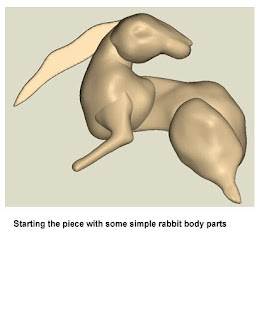
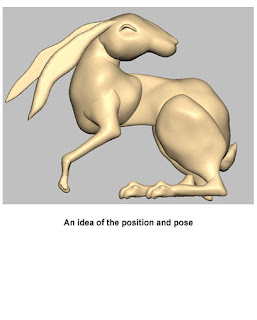
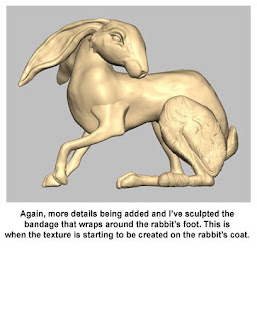
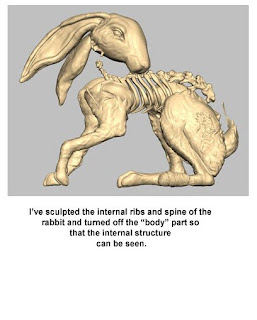
Here is Heather’s prelimary sketch for the project piece:
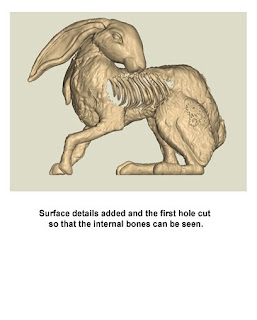
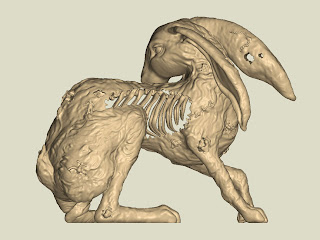
Technical Specs My piece will be created combining stainless steel and bronze alloy for the body of the hare with the possibility of using a separate material, resin for the exposed internal bone structure. The size is approximately 25” x 15” x 12”.
Statement I wanted to use animal imagery for my sculpture, for me it was a way to insure the relatability of my work while using the digital process. I chose the hare because of the old world, romantic idea of beauty and nature it represents, juxtaposed with this new world, digital way of creation. I’m challenged by the innate sense of conflict this presents. The rabbit’s coat is intertwined and layered with sculptural shapes and text creating an extra layer of narrative within the animal’s fur. I’ve created negative cutouts around the body allowing the viewer to see some of the animal’s internal workings. This study of contrasts, old vs. new, metal to fur, nature and technology, exterior and interior are some of the paradoxes most enticing to me in creating this work.
Head below the fold for images of Heather’s digital work in process:
(All images property of Heather Gorham and are used by permission)
“My process involved treating the digital medium much like I would a traditional media such as clay or wax in bronze casting. Digital clay, once you get used to it, responds and has many of the same sensibilities as real clay, allowing for an interesting juxtaposition between the visceral and the virtual.”
Heather Gorham


Needless to say this will have a major impact on using hydrogen as a power source in fuel cells or other applications.
The release:
Layered graphene sheets could solve hydrogen storage issues
IMAGE: A graphene-oxide framework (GOF) is formed of layers of graphene connected by boron-carboxylic “pillars.” GOFs such as this one are just beginning to be explored as a potential storage medium…
Graphene—carbon formed into sheets a single atom thick—now appears to be a promising base material for capturing hydrogen, according to recent research* at the National Institute of Standards and Technology (NIST) and the University of Pennsylvania. The findings suggest stacks of graphene layers could potentially store hydrogen safely for use in fuel cells and other applications.
Graphene has become something of a celebrity material in recent years due to its conductive, thermal and optical properties, which could make it useful in a range of sensors and semiconductor devices. The material does not store hydrogen well in its original form, according to a team of scientists studying it at the NIST Center for Neutron Research. But if oxidized graphene sheets are stacked atop one another like the decks of a multilevel parking lot, connected by molecules that both link the layers to one another and maintain space between them, the resulting graphene-oxide framework (GOF) can accumulate hydrogen in greater quantities.
Inspired to create GOFs by the metal-organic frameworks that are also under scrutiny for hydrogen storage, the team is just beginning to uncover the new structures’ properties. “No one else has ever made GOFs, to the best of our knowledge,” says NIST theorist Taner Yildirim. “What we have found so far, though, indicates GOFs can hold at least a hundred times more hydrogen molecules than ordinary graphene oxide does. The easy synthesis, low cost and non-toxicity of graphene make this material a promising candidate for gas storage applications.”
The GOFs can retain 1 percent of their weight in hydrogen at a temperature of 77 degrees Kelvin and ordinary atmospheric pressure—roughly comparable to the 1.2 percent that some well-studied metal-organic frameworks can hold, Yildirim says.
Another of the team’s potentially useful discoveries is the unusual relationship that GOFs exhibit between temperature and hydrogen absorption. In most storage materials, the lower the temperature, the more hydrogen uptake normally occurs. However, the team discovered that GOFs behave quite differently. Although a GOF can absorb hydrogen, it does not take in significant amounts at below 50 Kelvin (-223 degrees Celsius). Moreover, it does not release any hydrogen below this “blocking temperature”—suggesting that, with further research, GOFs might be used both to store hydrogen and to release it when it is needed, a fundamental requirement in fuel cell applications.
Some of the GOFs’ capabilities are due to the linking molecules themselves. The molecules the team used are all benzene-boronic acids that interact strongly with hydrogen in their own right. But by keeping several angstroms of space between the graphene layers—akin to the way pillars hold up a ceiling—they also increase the available surface area of each layer, giving it more spots for the hydrogen to latch on.
According to the team, GOFs will likely perform even better once the team explores their parameters in more detail. “We are going to try to optimize the performance of the GOFs and explore other linking molecules as well,” says Jacob Burress, also of NIST. “We want to explore the unusual temperature dependence of absorption kinetics, as well as whether they might be useful for capturing greenhouse gases such as carbon dioxide and toxins like ammonia.”
###
The research is funded in part by the Department of Energy.
* J. Burress, J. Simmons, J. Ford and T.Yildirim. “Gas adsorption properties of graphene-oxide-frameworks and nanoporous benzene-boronic acid polymers.” To be presented at the March meeting of the American Physical Society (APS) in Portland, Ore., March 18, 2010. An abstract is available at http://meetings.aps.org/Meeting/MAR10/Event/122133


Very nice. And yes, I’ve been posting more space and nanotech images than usual of late.
The image spans about 50° of the sky. It is a three-colour combination constructed from Planck’s two highest frequency channels (557 and 857 GHz, corresponding to wavelengths of 540 and 350 micrometres), and an image at the shorter wavelength of 100 micrometres made by the IRAS satellite. This combination visualises dust temperature very effectively: red corresponds to temperatures as cold as 10° above absolute zero, and white to those of a few tens of degrees. Overall, the image shows local dust structures within 500 light-years of the Sun.
Credits: ESA/HFI Consortium/IRAS
Hit the link up there for the full release on this image


Truly amazing finding to go along with a very cool image:
After 72 hours of exposure to ambient light, strands of nanoparticles twisted and bunched together. Credit: Nicholas Kotov
Be sure and hit the link up there for the full release on this news, and for a very, very large version of this image.


Medical nanotech news from McGill University.
The release:
DNA nanotechnology breakthrough offers promising applications in medicine
McGill researchers create DNA nanotubes able to carry and selectively release materials
This release is available in French.
A team of McGill Chemistry Department researchers led by Dr. Hanadi Sleiman has achieved a major breakthrough in the development of nanotubes – tiny “magic bullets” that could one day deliver drugs to specific diseased cells. Sleiman explains that the research involves taking DNA out of its biological context. So rather than being used as the genetic code for life, it becomes a kind of building block for tiny nanometre-scale objects.
Using this method, the team created the first examples of DNA nanotubes that encapsulate and load cargo, and then release it rapidly and completely when a specific external DNA strand is added. One of these DNA structures is only a few nanometres wide but can be extremely long, about 20,000 nanometres. (A nanometre is one-10,000th the diameter of a human hair.)
Until now, DNA nanotubes could only be constructed by rolling a two-dimensional sheet of DNA into a cylinder. Sleiman’s method allows nanotubes of any shape to be formed and they can either be closed to hold materials or porous to release them. Materials such as drugs could then be released when a particular molecule is present.
One of the possible future applications for this discovery is cancer treatment. However, Sleiman cautions, “we are still far from being able to treat diseases using this technology; this is only a step in that direction. Researchers need to learn how to take these DNA nanostructures, such as the nanotubes here, and bring them back to biology to solve problems in nanomedicine, from drug delivery, to tissue engineering to sensors,” she said.
The team’s discovery was published on March 14, 2010 in Nature Chemistry. The research was made possible with funding from the National Science and Engineering Research Council and the Canadian Institute for Advanced Research.
###
On the Web: http://www.hanadisleiman.com
Video link: http://snurl.com/uw2q1


News you can, and should, use from the IRS.
The release:
Beware of IRS’ 2010 “Dirty Dozen” Tax Scams
IR-2010-32, March 16, 2010
WASHINGTON — The Internal Revenue Service today issued its 2010 “dirty dozen” list of tax scams, including schemes involving return preparer fraud, hiding income offshore and phishing.
“Taxpayers should be wary of anyone peddling scams that seem too good to be true,” IRS Commissioner Doug Shulman said. “The IRS fights fraud by pursuing taxpayers who hide income abroad and by ensuring taxpayers get competent, ethical service from qualified professionals at home in the U.S.”
Tax schemes are illegal and can lead to imprisonment and fines for both scam artists and taxpayers. Taxpayers pulled into these schemes must repay unpaid taxes plus interest and penalties. The IRS pursues and shuts down promoters of these and numerous other scams.
The IRS urges taxpayers to avoid these common schemes:
Return Preparer Fraud
Dishonest return preparers can cause trouble for taxpayers who fall victim to their ploys. Such preparers derive financial gain by skimming a portion of their clients’ refunds, charging inflated fees for return preparation services and attracting new clients by promising refunds that are too good to be true. Taxpayers should choose carefully when hiring a tax preparer. Federal courts have issued injunctions ordering hundreds of individuals to cease preparing returns and promoting fraud, and the Department of Justice has filed complaints against dozens of others, which are pending in court.
To increase confidence in the tax system and improve compliance with the tax law, the IRS is implementing a number of steps for future filing seasons. These include a requirement that all paid tax return preparers register with the IRS and obtain a preparer tax identification number (PTIN), as well as both competency tests and ongoing continuing professional education for all paid tax return preparers except attorneys, certified public accountants (CPAs) and enrolled agents.
Setting higher standards for the tax preparer community will significantly enhance protections and services for taxpayers, increase confidence in the tax system and result in greater compliance with tax laws over the long term. Other measures the IRS anticipates taking are highlighted in the IRS Return Preparer Review issued in December 2009.
Hiding Income Offshore
The IRS aggressively pursues taxpayers involved in abusive offshore transactions as well as the promoters, professionals and others who facilitate or enable these schemes. Taxpayers have tried to avoid or evade U.S. income tax by hiding income in offshore banks, brokerage accounts or through the use of nominee entities. Taxpayers also evade taxes by using offshore debit cards, credit cards, wire transfers, foreign trusts, employee-leasing schemes, private annuities or insurance plans.
IRS agents continue to develop their investigations of these offshore tax avoidance transactions using information gained from over 14,700 voluntary disclosures received last year. While special civil-penalty provisions for those with undisclosed offshore accounts expired in 2009, the IRS continues to urge taxpayers with offshore accounts or entities to voluntarily come forward and resolve their tax matters. By making a voluntary disclosure, taxpayers may mitigate their risk of criminal prosecution.
Phishing
Phishing is a tactic used by scam artists to trick unsuspecting victims into revealing personal or financial information online. IRS impersonation schemes flourish during the filing season and can take the form of e-mails, tweets or phony Web sites. Scammers may also use phones and faxes to reach their victims.
Scam artists will try to mislead consumers by telling them they are entitled to a tax refund from the IRS and that they must reveal personal information to claim it. Criminals use the information they get to steal the victim’s identity, access bank accounts, run up credit card charges or apply for loans in the victim’s name.
Taxpayers who receive suspicious e-mails claiming to come from the IRS should not open any attachments or click on any of the links in the e-mail. Suspicious e-mails claiming to be from the IRS or Web addresses that do not begin with http://www.irs.gov should be forwarded to the IRS mailbox: [email protected].
Filing False or Misleading Forms
The IRS is seeing various instances where scam artists file false or misleading returns to claim refunds that they are not entitled to. Under the scheme, taxpayers fabricate an information return and falsely claim the corresponding amount as withholding as a way to seek a tax refund. Phony information returns, such as a Form 1099 Original Issue Discount (OID), claiming false withholding credits usually are used to legitimize erroneous refund claims. One version of the scheme is based on a false theory that the federal government maintains secret accounts for its citizens, and that taxpayers can gain access to funds in those accounts by issuing 1099-OID forms to their creditors, including the IRS.
Nontaxable Social Security Benefits with Exaggerated Withholding Credit
The IRS has identified returns where taxpayers report nontaxable Social Security Benefits with excessive withholding. This tactic results in no income reported to the IRS on the tax return. Often both the withholding amount and the reported income are incorrect. Taxpayers should avoid making these mistakes. Filings of this type of return may result in a $5,000 penalty.
Abuse of Charitable Organizations and Deductions
The IRS continues to observe the misuse of tax-exempt organizations. Abuse includes arrangements to improperly shield income or assets from taxation and attempts by donors to maintain control over donated assets or income from donated property. The IRS also continues to investigate various schemes involving the donation of non-cash assets including situations where several organizations claim the full value for both the receipt and distribution of the same non-cash contribution. Often these donations are highly overvalued or the organization receiving the donation promises that the donor can repurchase the items later at a price set by the donor. The Pension Protection Act of 2006 imposed increased penalties for inaccurate appraisals and set new definitions of qualified appraisals and qualified appraisers for taxpayers claiming charitable contributions.
Frivolous Arguments
Promoters of frivolous schemes encourage people to make unreasonable and outlandish claims to avoid paying the taxes they owe. If a scheme seems too good to be true, it probably is. The IRS has a list of frivolous legal positions that taxpayers should avoid. These arguments are false and have been thrown out of court. While taxpayers have the right to contest their tax liabilities in court, no one has the right to disobey the law or IRS guidance.
Abusive Retirement Plans
The IRS continues to find abuses in retirement plan arrangements, including Roth Individual Retirement Arrangements (IRAs). The IRS is looking for transactions that taxpayers use to avoid the limits on contributions to IRAs, as well as transactions that are not properly reported as early distributions. Taxpayers should be wary of advisers who encourage them to shift appreciated assets at less than fair market value into IRAs or companies owned by their IRAs to circumvent annual contribution limits. Other variations have included the use of limited liability companies to engage in activity that is considered prohibited.
Disguised Corporate Ownership
Corporations and other entities are formed and operated in certain states for the purpose of disguising the ownership of the business or financial activity by means such as improperly using a third party to request an employer identification number.
Such entities can be used to facilitate underreporting of income, fictitious deductions, non-filing of tax returns, participating in listed transactions, money laundering, financial crimes and even terrorist financing. The IRS is working with state authorities to identify these entities and to bring the owners of these entities into compliance with the law.Zero Wages
Filing a phony wage- or income-related information return to replace a legitimate information return has been used as an illegal method to lower the amount of taxes owed. Typically, a Form 4852 (Substitute Form W-2) or a “corrected” Form 1099 is used as a way to improperly reduce taxable income to zero. The taxpayer also may submit a statement rebutting wages and taxes reported by a payer to the IRS.
Sometimes fraudsters even include an explanation on their Form 4852 that cites statutory language on the definition of wages or may include some reference to a paying company that refuses to issue a corrected Form W-2 for fear of IRS retaliation. Taxpayers should resist any temptation to participate in any of the variations of this scheme. Filings of this type of return may result in a $5,000 penalty.
Misuse of Trusts
For years, unscrupulous promoters have urged taxpayers to transfer assets into trusts. While there are many legitimate, valid uses of trusts in tax and estate planning, some promoted transactions promise reduction of income subject to tax, deductions for personal expenses and reduced estate or gift taxes. Such trusts rarely deliver the tax benefits promised and are used primarily as a means to avoid income tax liability and to hide assets from creditors, including the IRS.
The IRS has recently seen an increase in the improper use of private annuity trusts and foreign trusts to shift income and deduct personal expenses. As with other arrangements, taxpayers should seek the advice of a trusted professional before entering into a trust arrangement.
Fuel Tax Credit Scams
The IRS receives claims for the fuel tax credit that are excessive. Some taxpayers, such as farmers who use fuel for off-highway business purposes, may be eligible for the fuel tax credit. But other individuals are claiming the tax credit for nontaxable uses of fuel when their occupation or income level makes the claim unreasonable. Fraud involving the fuel tax credit is considered a frivolous tax claim and potentially subjects those who improperly claim the credit to a $5,000 penalty.
How to Report Suspected Tax Fraud Activity
Suspected tax fraud can be reported to the IRS using Form 3949-A, Information Referral. The completed form or a letter detailing the alleged fraudulent activity should be addressed to the Internal Revenue Service, Fresno, CA 93888. The mailing should include specific information about who is being reported, the activity being reported, how the activity became known, when the alleged violation took place, the amount of money involved and any other information that might be helpful in an investigation. The person filing the report is not required to self-identify, although it is helpful to do so. The identity of the person filing the report can be kept confidential.
Whistleblowers also may provide allegations of fraud to the IRS and may be eligible for a reward by filing Form 211, Application for Award for Original Information, and following the procedures outlined in Notice 2008-4, Claims Submitted to the IRS Whistleblower Office under Section 7623.


A note from Ray hot from today’s inbox:
I wanted to take a moment to provide you a quick update on the ongoing progress of Singularity University.
I started Singularity University with Peter Diamandis (X Prize) last year and I am happy to report that it is growing, well, exponentially. Last week we concluded our second 9-Day Executive Program at our NASA Ames campus in Silicon Valley. Forty-five entrepreneurs, CEOs, venture capitalists, and government leaders came from over 15 countries and the feedback we are receiving from participants has been remarkably positive. Over 90% of participants rated the program very highly with one third saying it was their “best program ever!”
Our next 9-day program is coming up on April 30 – May 9th. The program concentrates on six exponential growing technologies:
1. Artificial Intelligence and Robotics
2. Nanotechnology
3. Biotechnology and Bioinformatics
4. Medicine and Human-Machine Interfaces
5. Networks & Computing Systems
6. Energy & Environmental Systems
Attending the program provides an understanding of how these accelerating technologies will transform your business and your industry by showing you what is in the lab today and where the technologies will be in 5 and 10 years. If you have an interest in attending, learn more about the program and how to apply by visiting our website at http://singularityu.org/executive-programs/.
With my best wishes,
Ray


And the modus operandi was mostly going to be a propaganda and sabotage effort to attempt to discredit the organization.
From the link:
In an ironic twist, Wikileaks has now published what appears to be an assessment of the site and the danger is poses to US military confidentiality, apparently from the US Army and Counterintelligence center and dated 18 March 2008.
Most of the report is a measured analysis of the site’s activities, modus operandi, funding and history, which then details numerous documents allegedly leaked to Wikileaks relating to US military activities in Iraq, Afghanistan and beyond that it sees as having handed intelligence to agencies hostile to the US.
Not sure if this is illegal, or not, and certainly there are national security issues with any military leak, but this type of covert action sure feel unAmerican.
Also from the link, here’s the lovely company our military was hoping to join:
A justification for following this course of action is considered to be that other countries have attempted to do the same.
“The governments of China, Israel, North Korea, Russia, Thailand, Zimbabwe, and several other countries have blocked access to Wikileaks.org-type Web sites, claimed they have the right to investigate and prosecute Wikileaks.org and associated whistleblowers, or insisted they remove false, sensitive, or classified government information, propaganda, or malicious content from the Internet,” says the report.