Author: Derek Thompson

  • How One Company Helps to Formalize the Gig Economy

    “What if we aren’t talking about a jobless recovery? What if we’re talking about the emergence of a part-time lifestyle?”

    That’s the concern of many Americans forced into part-time work by the downturn. It’s also the question Julie Ruvolo at Solvate wants to answer. Solvate is a basically a work agency for freelancers. It’s a little bit matchmaking (setting up independent workers with companies looking for part-time talent) a little bit agent/middleman (handling payments, guaranteeing quality and skimming a bit off the top of their workers’ hourly wage) and very necessary.

    Long before the Great Recession decimated
    payrolls and forced millions of employees into part-time positions,
    freelancing in America was on the rise. In a 2009 New York Times Magazine
    piece “The Self-Employment Depression,” Emily Bazelon wrote that between 1995 and 2005, the number of self-employed independent contractors
    grew by 27 percent to almost nine million workers.
    This phenomenon is especially prevalent
    in New York City, self-employment accounted for two thirds of the
    job growth between 1975 and 2007, according to the Chicago Fed. The recession has only expedited the frenzy. In June 2009
    a Daily Beast/Penn, Schoen and Berland Associates poll found that “fully
    one-third of Americans in our survey are now working either freelance
    or two jobs.”

    That’s where Solvate comes in. There are two challenges to shopping a freelancer to a company, Ruvolo said. The first is how to connect companies to the right person, and vice versa. This is trickier problem than you might imagine. Let’s say I want to get a payroll job with The Atlantic. I’ll apply by saying I’m a journalist who can blog. But what if I’m a freelancer looking for work at The Atlantic, and Microsoft, and General Motors communications, and Pepsi advertising? That’s a lot of skills to advertise, so Solvate indexes 10-20 skills of each independent worker to help them find the right jobs.

    The second challenge is logistical: how do you formalize the freelancing process? An easy, attractive website helps companies search for talent by price and skills. Solvate sets up the interview, handles the billing and the contract, and provides an interface where workers can log their time so employers can “check in” on their part-timers even if they’re thousands of miles away.

    But Solvate doesn’t just want to make freelancing easier. They also want to make freelancing better. Independent workers live outside the rules that govern payroll jobs. They don’t qualify for unemployment insurance when their gig ends. They don’t get work benefits or COBRA coverage. Wage theft laws don’t apply equally, even though more than 40% of freelancers reported not being paid by at least one employer last year.

    Before freelancers get protection from the public sector, they need help from the private sector. “We’re on a mission to create trusted relationships between talent and companies,” Ruvolo said.


    Email this Article
    Add to digg
    Add to Reddit
    Add to Twitter
    Add to del.icio.us
    Add to StumbleUpon
    Add to Facebook


  • Is the U.S. Economy Really Growing? Here’s Another Look

    The U.S. economy grew by 3.2 percent annualized in the first three months of 2010. It wasn’t terribly strong growth, but it was the right kind of growth. As Dan Indiviglio explains, consumer spending — which generally accounts for about two-thirds of the economy — made up 80 percent of GDP growth in the first quarter of 2010. That’s good. For comparison, consumers made up less than a seventh of the economy’s 5.6% expansion in the last quarter of 2009.

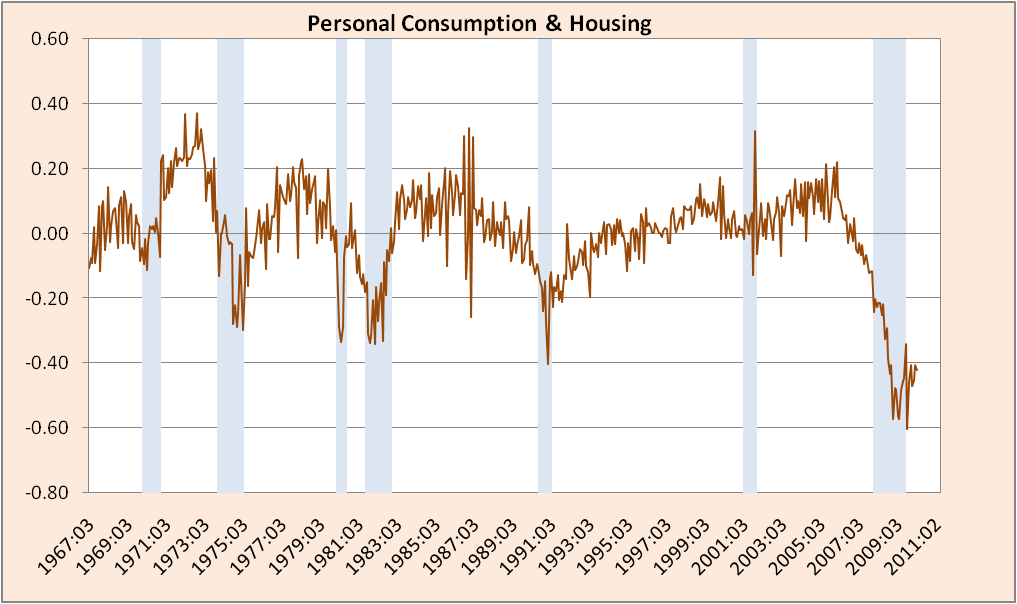
    Here’s another look at the economy, via the Chicago Fed’s National Activity Index:

    Led by improvements in production- and employment-related indicators, the Chicago
    Fed National Activity Index increased to -0.07 in March, up from -0.44
    in February. Three of the four broad categories of indicators that make
    up the index made positive contributions in March, while the
    consumption and housing category made the lone negative contribution.

    And that graph:

    So yes, things are getting better. Inventories were replenished in late 2009, and consumers started spending them down in early 2010. We should expect disposable incomes to start rising in the next few quarters as steady consumer demand encourages businesses to hire again and to full-time their part-timers. Then again, the housing market — which helped drive the last boom — is still in the worst shape in the last 50 years. That’s a heavy anchor.


    Email this Article
    Add to digg
    Add to Reddit
    Add to Twitter
    Add to del.icio.us
    Add to StumbleUpon
    Add to Facebook


  • What Banks Are in Danger in the SAFE Act?

    The SAFE Banking Act proposed by Sens. Brown and Kaufman (which should be introduced soon as an amendment to the Senate financial regulation bill) answers the Too Big to Fail conundrum decisively by capping each bank’s deposits at 10% of total deposits in the country. That doesn’t hit many banks, since the country’s largest commercial bank, Bank of America, has about 12% of total deposits. But here’s the game-changer. The law would also create two ceilings on liabilities: non-deposit liabilities are capped at 2% of GDP for banks and 3% of GDP for non-banks.

    What does that mean? It means banks and non-banks with huge obligations in the repo market and other shadow bank industry deposits would have to dramatically reduce their size. Let’s take a look at how drastic the change would be (this graph below thanks to the invaluable Mike Konczal). Here’s how the graph works. If you’re in the green zone, you’re safe under SAFE. Wells Fargo makes it, barely. The rest would have X amount of time to slim down their liabilities or break apart to avoid whatever punishment mechanism Congress chose to implement.

    Too draconian? Maybe. But Demos points out that Bank of America, which currently has more than 7 percent of GDP in non-deposit
    liabilities, was around 2 percent in 2003.


    Email this Article
    Add to digg
    Add to Reddit
    Add to Twitter
    Add to del.icio.us
    Add to StumbleUpon
    Add to Facebook


  • 62% of Americans: The Stimulus Is Failing

    The Recovery Act cut taxes by more than $100 billion and spent another $150 billion in 2009 on projects like Medicaid, schools and infrastructure projects while raising GDP by an estimated one to three percentage points at the end of the year. So this is not good:

    Nearly two-thirds of Americans do not believe the $787 billion stimulus
    package the president passed last year has helped create jobs,
    according to a new Pew Research Poll.

     Not good, but not surprising. Only 12 percent of Americans know that the administration cut taxes in the Recovery Act. Maybe they don’t know what the stimulus legislation looks like, but they know what the job market looks like. Ten percent unemployed. Another six percent underemployed. They also know what the hiring market looks like: April 2010 hiring is still at April 2009 levels, despite nine months of economic growth.

    If you look at the economy from any corner in New York’s financial district, it looks like the machine is buzzing again. Bank of America and JPMorgan both announced big quarters with billions of dollars in revenue from trading. If you look at the economy from a Main Street corner, you get a different picture. Indeed, BofA and JPM are still dealing with losses in their credit card and real estate sectors.

    This poll isn’t evidence that the stimulus failed. It’s evidence that Americans evaluate the economy by how bad things are, and not by the difference between how bad things are and how bad they could be.

    (graph from Pew).


    Email this Article
    Add to digg
    Add to Reddit
    Add to Twitter
    Add to del.icio.us
    Add to StumbleUpon
    Add to Facebook


  • VAT Would Be Nice, but It’s Not Magical

    The VAT may resolve the debt crisis, but for politicians it’s too soon to be right.

    That’s the headline of this David Ignatius piece in the Washington Post suggesting that the value-added tax is an idea before its time. Perhaps. But he writes:

    By ruling out a VAT when it could keep the federal deficit in check,
    politicians have all but guaranteed that the debt crisis, when it
    comes, will be more damaging. But by then, everyone will be clamoring
    for a VAT, so it will be safe to endorse it.

    The value-added tax could be an effective revenue-generator and tax-code-transformer, but this language is a bit strong. The VAT isn’t some uniquely magical elixir to deficititis. It’s just an efficient tax. Politicians could introduce it at a revenue-neutral level (you could off-set a first-year rate of 5% with reductions to corporate or income taxes) and then scale it up to 10% in the next few years as the economy gained steam, at which point it would start making real money.

    But VAT-or-bust is overstating the case a bit. Repealing the Bush tax cuts for more than the top 5% sometime in the next five years could save more than $100 billion annually. Broadening the tax base by eliminating tax expenditures would save the government a slice out of the $900 billion of cash it passes up each year. Not to mention a carbon tax, defense cuts, Social Security means-testing, PAYGO, Medicare reform … the list goes on. If we focus on one item to the exclusion of all else, we’ll fail to appreciate the unique opportunity of a deficit commission which is to evaluate the entirety of our Rube Goldberg tax system and skewed spending preferences. In the long term, medical inflation matters much more than any other thing. In the short term, all those other things should be on the table.


    Email this Article
    Add to digg
    Add to Reddit
    Add to Twitter
    Add to del.icio.us
    Add to StumbleUpon
    Add to Facebook


  • President Clinton: Immigration Key to Deficit Reduction

    President Bill Clinton spoke at the Peterson Foundation Fiscal Summit in Washington, D.C., about how he would advocate for fiscal responsibility were he running for office in 2010. His big pitch boils down to two ideas: (1) the future and (2) immigrants.

    Here were his self-transcribed (read: rough, but directionally accurate) statements.

    On reducing the deficit

    “The
    end result works. Look what happened to Bill Clinton. America has got
    to get back into the future business.
    We can’t do it if we keep
    mortgaging our future to other countries … to
    our children and grandchildren. Then I’ll tell them I’ll be careful.
    I’ll do everything I can to help the old and the poor and we have to
    change the way we do health care.

    “We need more immigrants. We need to
    reverse the age ratio. I see that
    as part of fiscal responsibility. [Congress] need to pass something. I don’t
    like that Arizona bill, but I get why it happened. It’s horrible what
    happening along the border.”

    “The great virtue of this
    country, the thing we have over China and India is that we have somebody from everywhere here, and they do well. This country still
    works for immigrants. The reason there is anti-immigrant sentiment is white-collar factory workers got killed in the last decade. The burdens
    of the last decade’s economic downturn was basically on white male high
    school grads, or who didn’t graduate from high school or a couple years of college, who got shivered in this
    economy. Their taxes can be lower if we get more taxpayers. The
    changes we make will be less draconian if we get more people into the system. I don’t think there’s any alternative than to increase
    immigration. I don’t see any kinda way out of this unless that’s part
    of the strategy.”
    On Goldman Sachs’ mortgage trades and the SEC suit:
    “I think the timing [of the suit] was
    suspect. I’m not sure they violated the law. But I
    think there was no underlying merit [to those trades].”
    On a value-added tax:
    “You’d
    have to reduce other taxes to keep it progressive. It’s good for
    exports. It doesn’t allow quite so much subsidies for imports. If we
    had the right sort of value-added tax and had the right adjustments to
    keep the progressivity, it’d be really good. I’m not sure the
    commission will wind up recommending it. People in Europe use it its like any
    sales tax. People get used to pay for it. It’s good for exports.”


    Email this Article
    Add to digg
    Add to Reddit
    Add to Twitter
    Add to del.icio.us
    Add to StumbleUpon
    Add to Facebook


  • Are We Smart Enough to Think About the Deficit?

    At the Peterson Foundation Fiscal Summit in Washington DC today, most panelists tried to distingiush between necessary short-term deficits and harmful structural long-term deficits. “I think Americans are smart enough to think about two things at the same time,” former CBO director Alice Rivlin said. 

    Maybe so. But the President himself isn’t always good at distinguishing between short-term and long-term deficits. Instead he’s said things like “Families across the country are tightening their belts and making tough decisions, the federal government should do the same.” That doesn’t make sense. The federal government spends more when American families spend less. That’s why recessions create deficits.

    Later in the event, OMB director Peter Orszag got the short- long-term thing right, but Peter Orszag isn’t the federal government’s top spokesperson on economic policy. That’s the president. And a key part of explaining the motivation behind the deficit commission is explaining that Americans need to look at deficits with bifocals. In the short-term, they’re good. In the long-term, they’re not good. It’s not so hard to say that, but comparing federal shortfalls with families in debt is so ingrained in the way presidents talk about the deficit that we can’t get away from it, even when the president is implicitly asking us to live with red ink for a while.

     
    (Nav Image Credit: mansionwb/flickr)


    Email this Article
    Add to digg
    Add to Reddit
    Add to Twitter
    Add to del.icio.us
    Add to StumbleUpon
    Add to Facebook


  • Deficit Reform Means Breaking Promises

    At the Fiscal Summit in Washington DC, noted deficit scold Peter Peterson made something of a Kinsley gaffe: saying the truth in a way that sounds like a mistake. “We must unencumber ourselves of promises,” he said.

    From a framing perspective, “let’s break promises, together” sounds horrible. But that’s essentially what dramatic fiscal reform amounts to. Americans have been promised lower tax burdens for the last thirty years. Taxes will have to go up. Constituency groups have been promised certain levels of discretionary spending. Spending will have to go down. Seniors have been promised their entitlements, but entitlement reform means changing the level of taxes or spending through Social Security, which means denying some amount of money to people who were told they’d have it.
    So there you have it, the worst, possibly most honest frame imaginable. Fiscal austerity means breaking promises, together.


    Email this Article
    Add to digg
    Add to Reddit
    Add to Twitter
    Add to del.icio.us
    Add to StumbleUpon
    Add to Facebook


  • Are GOP Lies Actually Good for the Public Discourse?

    Public policy is hard. Two-word sound-bites are easy. That’s why they drive the news cycle.

    Remember “death panels”? Remember “you lie”? Remember, most recently, “bailout bill” — Mitch McConnell claim that financial regulation allows endless taxpayer-funded bailouts?

    Of course you do. That’s because the media did our best to keep them alive. After the sound bites hit the news cycle, conservative columnists and TV hosts perused the legislation for language that, seen in a certain light, might corroborate their compatriots’ claims. Liberal columnists and TV hosts countered with explanations that death panels were a myth, Obama wasn’t lying, and resolution authority isn’t an eternal bailout provision. Before long, the entire press seized on these
    two-word half-truths and turned them into political touchstones whose infamy eclipsed the actual legislation.

    This is where we should wring our hands and despair for the fate of the nation … or maybe not. Before “death panels,” managing the cost of end-of-life care was not a headliner item in the health care debate. After “death panels,” it was. Before Joe Wilson’s outburst, most opinion journalists weren’t talking about the intersection of immigration and health care. After “you lie,” we had to. Resolution authority had always been at the heart of the financial regulation debate, but it took a devious frame like “bailout bill” to shine a particularly harsh light on the relationship between the resolution fund and creditors in a failed institution.

    Misleading conservative frames today act as a kind of news peg around which the entire middlebrow, high-traffic media orients its policy coverage. It’s a familiar pattern. Consider the trajectory of “death panels.” Liberals blasted the sound-bite. Then some wonky conservatives defended it. Then thoughtful moderates said we already have death panels because some people can’t afford health care. Then some libertarians said maybe “death panels” are smart, in principle, but not like Palin suggested. Then objective newspapers took up the issue to seriously look into end-of-life care, while everybody else competed to see who could score the authoritative take. Commentators often say “we need a national debate” about important issues. Well, we had a national debate about end-of-life care. Something like it, anyway. Would it have happened without Palin’s Facebook message?

    Nobody knows. What we know is that today, policy debates often enter the mainstream media through an undesirable mechanism: pithy fibs from Republicans. The fibs are wrong. But the debates they start can be real. As Atlantic commentator John Thacker once wrote to me, “It’s sad, but Sarah Palin and Joe Wilson didn’t “kill” the
    healthcare debate. They stimulated it.” I don’t want him to be right. What if he is?


    Email this Article
    Add to digg
    Add to Reddit
    Add to Twitter
    Add to del.icio.us
    Add to StumbleUpon
    Add to Facebook


  • Social Security Reform is Easy

    At the first gathering of the President’s bipartisan fiscal commission, former Congressional Budget Office Director Rudy Penner makes a good point about Social Security reform:

    The other point that I’d make about Social Security, it’s not as
    important as health care, but it’s much more simple to understand. We
    understand the effects of every option. We know what we save. We do not
    know the same sort of things about the various health options. So to me
    that makes a strong argument  … [that modest changes to Social
    Security] would make foreign investors more confident in our finances.

    Here’s another way to make the same point. There is a compelling argument out there that there is no entitlement crisis. The logic goes like this: the entitlement crisis is a Medicare crisis; the Medicare crisis is a medical inflation crisis; medical inflation is national, rather than specific to Medicare; therefore, our fiscal crisis is not specific to our entitlements, but instead a Gordian Knot that entangles the entire medical system. In short, reforming Medicare is really, really complicated. A lot more complicated, at least, than announcing that you’ve raised the taxable income ceiling by a few thousand dollars and indexed it to life expectancies.


    Email this Article
    Add to digg
    Add to Reddit
    Add to Twitter
    Add to del.icio.us
    Add to StumbleUpon
    Add to Facebook


  • Finding Middle Ground on the Deficit

    On Thursday the Peterson Foundation will host a star-studded summit on fiscal responsibility in Washington, DC. To some readers, that might sound as hallow as the Academy Awards and as thrilling as the International Academy on Financial Management, but this is genuinely important stuff. Ruminating on about how the government collects and spends money is a big think, but as public debt approaches record levels.

    Robert Kuttner doesn’t like the thrust of the Peterson summit because, like many liberals, he worries that “fiscal responsibility” is a Trojan horse for gutting Medicare and Social Security. He has a point. There are, without question, some invitees at the summit who see runaway Medicare costs and conclude the quickest solution is to dismantle Medicare. That sort of bluntness would be politically unpalatable and substantively wrongheaded. But Kuttner’s point is incomplete:

    Yes, we will have a national debt problem if we don’t get a return to
    high growth soon. But the more immediate problem is restoration of
    prosperity–and in the near term that will require more public outlay,
    not less. Once a real recovery is on track, we need to increase
    progressive taxation, both to moderate deficits and to pay for
    sustained public spending on things the economy and society need, such
    as 21st century infrastructure, a green economy, good jobs, as well as
    a national health and pension system.

    That’s basically right. But better, perhaps, to say that we will have a national debt problem whether or not we get a return to historically common growth, as the Congressional Budget Office has concluded. Yes, the more immediate problem is the restoration of prosperity. The deficit is probably too low today. But looking at that short-term goal doesn’t preclude acknowledging the long-term challenge. Public debt is in trouble today and it faces remarkable challenges in the 2020s.

    Kuttner says “we need a national debate” between the austerity hawks and the social program defenders. Sounds good! So let’s begin where both sides agree. Many Peterson attendees agree that large deficits are necessary now and dangerous in the future. Many also agree that new taxes will have to pay for ongoing spending, and that it would be unwise to enact regressive taxes that over-burdened lower-income families. The “high road” on the deficit is more crowded that Kuttner thinks.


    Email this Article
    Add to digg
    Add to Reddit
    Add to Twitter
    Add to del.icio.us
    Add to StumbleUpon
    Add to Facebook


  • Does the Web Turn Us Into Partisans?

    The Internet provides an infinity of stuff, but it’s all too easy to siphon off oneself in a cozy, ideologically uniform echo chamber of information — or disinformation. You might expect that the searchable, personalized architecture of the Internet might guarantee that we find the information we’re looking for rather than the information that we need to know. 

    But a fascinating new paper from NBER says that’s not exactly how the Internet works. The authors find that online news consumption is much less ideologically segregating than face-to-face interactions, but more segregating than offline news consumption. Ryan Avent concludes “The internet, if anything, provides a counter to the more ideologically homogeneous circles of friends, families, and colleagues in which we operate daily.”
    There’s a more pessimistic way to interpret the findings. Imagine online news consumption, from newish e-magazines (eg Slate) to blogs like at The Atlantic and Economist, as a halfway mark between offline news consumption and face-to-face interactions. Many of them are, as Andrew Sullivan likes to say, a broadcast of the writer’s opinions rather than an iterative publication. A good broadcast is powerful, but also personal and emotional. In that light, online news takes the offline news model and slow-walks it toward the ideological homogeneity of social circles. Avent’s right. We’re not there yet. But it’s a slow-walk.
    The Web might not be turning us into partisans. But it gives our partisanship the chance to marinate in partisan news — a lot of it, accessible from anywhere. Newspapers have been somewhat partisan for centuries. Magazines even more so. But even if Web readers are merely consuming the news we’ve always read, but pixelated rather than printed, it is a little disappointing that having been offered a universe of content, readers are probably sticking to their ideological solar systems.


    Email this Article
    Add to digg
    Add to Reddit
    Add to Twitter
    Add to del.icio.us
    Add to StumbleUpon
    Add to Facebook


  • Baseball’s Most Bizarre Contract Clauses

    Incentives matter. It’s one reason why bankers’ and ballplayers’ salaries are often loaded onto bonuses. In that vein, Mental Floss has an interesting rundown of the weirdest baseball contract clauses of the last twenty years. Some of them are real incentives. Others aren’t. A $300 bonus to each Oakland A’s player growing a mustache by Father’s Day. A bulldozer for Houston Astros pitcher Roy Oswalt if he made it to the World Series. A $333,333 check for Red Sox pitcher Curt Schilling for each weigh-in that didn’t tip the scales.

    But Ichiro Suzuki’s has got to be the strangest clause:

    The Seattle Mariners star outfielder signed a five-year contract
    extension in July 2007 that included, among other perks, four
    round-trip airline tickets to Japan each year and the services of an
    interpreter and trainer throughout the season. It also included a
    housing allowance for each year of the deal.

    While the numbers
    themselves aren’t eye-popping — the allowance ranges from $32,000 to
    $36,000 a year over the life of the deal — kudos to Ichiro for getting
    someone else to pay his rent.

    Really, a housing allowance? Equal to 0.19% of his yearly salary?


    Email this Article
    Add to digg
    Add to Reddit
    Add to Twitter
    Add to del.icio.us
    Add to StumbleUpon
    Add to Facebook


  • Value-Added Tax: What You Need to Know

    On April 16, the Senate overwhelmingly passed a symbolic measure to reject the idea of a value-added tax. Many people who read the news must have responded: a what?

    Americans like to think of our country as exceptional. Our tax system certainly is. The United States is the world’s only developed nation without a national broad-based consumption tax. As a result, our taxes hit income harder than most countries. Nearly 38 percent of our overall tax take comes from the individual income tax. The OECD average is 25 percent.

    As our gaping deficit commands more attention in Washington, some lawmakers and policy gurus are talking about making America a little less exceptional by creating a national consumption tax. That sounds scary. So let’s back up and explain some things about a value-added tax, or VAT: why we might need it, how it would work, and what liberals and conservatives are saying about it.

    Here’s why we need it: If you think the deficit looks bad now, wait a few years. Rising health care costs for retired baby boomers will push U.S. debt levels past their World War II-levels. But whereas WWII ended and we owed that debt to ourselves, our entitlement system is woven into American life and we owe half the resulting debt to foreign countries. Approaching this challenge will require some combination of robust growth, spending cuts, entitlement reform and more tax revenue.

    Where should this tax revenue come from? There are three reasonable sources. First, some revenue should come from cleaning out the underbrush of special interest deductions and exemptions that hide hundreds of billions of dollars from taxes. But every tax code in the world molds to the interests of the public, and dramatically reducing these carve-outs is unlikely. Second, some revenue should come from higher income taxes on the rich, whose total tax rates have fallen consistently over the last 40 years — while spending grew. But higher taxes on the rich alone won’t close the deficit. That brings us to revenue-source number three: we will have to raise taxes on lower- and middle-class families, and the VAT is probably the most efficient, most equitable, and most non-distortionary way to do it.

    So what is a value-added tax, anyway? What it sounds like: a consumption tax on the “value added” at each stage of production. Here’s how that works: Imagine a $1 loaf of bread you buy from the supermarket with a VAT of 10%. You’ve got a farmer, a baker, and a supermarket in the production chain. The farmer grows the wheat and sells it to the baker. The baker makes a loaf, sells it to the supermarket. The supermarket sells the loaf to me. Each link on the production chain pays the government 10% of the price of its product minus 10% of the price it paid for the goods to make that product. Ultimately, the government collects a total of 10 cents on the $1 loaf. At the supermarket, I pay the bread price plus the VAT: $1.10.

    Maybe that sounds complicated. But it’s actually much easier to collect VAT than a national retail sales tax because there is a counterparty to every transaction. The baker can try to avoid paying her share of VAT. But the government will see that the supermarket reported the purchase of her bread, and it can go to the baker and say “you forgot to report your sales.” With the individual income tax, we ask the IRS to police tax evaders. With a VAT, the production chain helps to police itself.

    For most Americans, this is all happening under the hood. All we would see are higher prices and less overall consumption. Who could want such a thing?

    Maybe all of us. Remember that debt crisis? A VAT could reduce the deficit and its announcement would signal to foreign investors that we’re serious about deficit reduction, reducing our long-term interest rates and making it easier to borrow. What’s more, if a tax on consumption discourages some consumption, it might encourage Americans to save more, which might not be such a bad thing considering an avalanche of consumer debt added to the last recession.

    Finally, the politics. Conservatives and liberals have different objections to the VAT, but many of them are misguided. Conservatives don’t like the VAT because it’s an efficient, invisible tax – a “money machine.” But one look at our deficit projections is enough to tell you that we need a money machine, as Reagan economic adviser Bruce Bartlett wrote. Conservatives also worry that “invisible” taxes like a VAT would enable the government to grow bigger. The evidence does not agree. “Tax visibility is empirically unrelated to the amount of taxation and government spending,” economist Casey Mulligan concluded.

    On the other side, liberals worry that a tax on consumption will hit the poorest the hardest, because lower-income Americans spend more of what they make. But policy makers could solve this regressivity in many ways. Most simply, pairing the VAT with a tax credit for poorer families could actually make the tax progressive. They could also spare some common products from the VAT (indeed, no country’s VAT extends over the entire economy, and realistically an American VAT would probably hit only about a third of GDP). Lawmakers would also probably introduce a VAT in exchange for some combination of cuts to income, payroll, or corporate taxes.

    Of course, a VAT could take years to set up and special interests would carve it up with exemptions, just as they have for the rest of the tax system. But there are reasons for both liberals and conservatives to support the VAT. Conservatives want a tax system with a broader base and lower marginal rates. Liberals want to protect programs like Medicare and education spending with new taxes that don’t overburden lower-income families. A VAT would serve both interests.


    Email this Article
    Add to digg
    Add to Reddit
    Add to Twitter
    Add to del.icio.us
    Add to StumbleUpon
    Add to Facebook


  • Hulu + Subscription Service = Hulu Plus

    Do you like your Hulu free? Then enjoy the next month, because things are about to change.

    The online TV and video streaming site is going ahead with its plan to put old episodes of popular shows behind a $9.95 monthly subscription wall called Hulu Plus. The last five episodes of popular shows will still be free, plus advertising. Everything before that will require subscription.

    Hulu started to turn a profit six months ago, but joint owners News Corp, NBC and Disney are pushing the site to start experimenting with additional pay models. While the journalism and music industries have tried to copy Hulu with digital storefront and Vevo, Hulu has gazed enviously on Netflix, the movie rental service which coaxes a monthly subscription fee in exchange for limitless online viewing.

    Don’t blame Hulu for abandoning the ad-only approach to supporting online media. Newspapers like the Financial Times and Wall Street Journal have the same combo strategy of charging for premium content and supporting the rest with advertising. The New York Times is looking to put up its own internal meter in 2011. Ad supported music sites like Pandora and Grooveshark offer limitless listening and zero ads in exchange for a monthly fee. Large media companies will continue to dip their toes into price differentiation — charging higher levels for “premium” media experiences — because until somebody figures out how to convince advertisers to pay dead-tree rates for pixel ads, publishers will have to soak users for some extra dough.


    Email this Article
    Add to digg
    Add to Reddit
    Add to Twitter
    Add to del.icio.us
    Add to StumbleUpon
    Add to Facebook


  • New York Senator Takes on Facebook

    Facebook wants to ride its new Open Graph protocol past Google on the road to Internet domination. But first, they’re going to have to get past Sen. Chuck Schumer.

    The New York senator wrote a letter to the FTC asking them to look at Facebook’s privacy guidelines. Facebook’s new plug-ins allow users like you and me to see articles, or music, or restaurants our friends have “liked” throughout the Internet. Information that used to live in a news feed on Facebook will now follow us around the Web. What was once merely public is now really, really public.

    In the long run, Facebook’s newest invention is probably a good thing. It will make online shopping better when websites can tell us what kind of jeans our friends liked. It will make online advertising more lucrative when smart phone ads serve up ads for restaurants and shops we support on Facebook. But rather than be asked to opt-in to this brave new world of smart sites and smarter phones, Facebookers’ information is automatically slurped into the matrix. Opt-in is the default; opt-out is the option.

    Schumer wants to flip that around and offer users more upfront control over their accounts. Fine. He can ask, but it’s extremely unlikely that the FTC will decide that the Facebook’s new tool violates privacy any more than their old default opt-in rules. In fact, it’s extremely unlikely that most users even care. An opt-out world — that is a world where control is more important than privacy — is the world we’re living in.

    So ultimately, it’s good that Schumer is asking. Facebook is onto something powerful and potentially revolutionary with Open Graph, but it has a dubious record of loosening privacy rules when it makes architecture changes. The company has changed its privacy settings so often it appears to have once even confused its founder into making public pictures that he later reclaimed behind a privacy wall. If Schumer’s letter accomplishes nothing more than to scare Facebook into freezing its privacy policy and to make more users aware of how they can opt-out of Open Graph, Facebook can continue to innovate while its users understand that ultimately we have the power to turn it off.


    Email this Article
    Add to digg
    Add to Reddit
    Add to Twitter
    Add to del.icio.us
    Add to StumbleUpon
    Add to Facebook


  • What Made the U.S. Government So Big?

    If you’re going to argue that the size of government is the defining
    debate in modern politics, you should probably explain why the
    government is so big. It’s not because of new laws. It’s because of old laws.

    David Brooks latest column argued that “as government
    grew,” moderates and independents recoiled and conservatives revolted.
    Brooks is right that people are angry. Four out of five Americans don’t
    trust the government according to a new Pew poll, the highest level of
    public dissatisfaction in history. But that anger has much more to
    do with the recession — plus a dash of complex conservative angst — than with Obama’s new spending initiatives.

    Let’s look at the numbers: the feds spent $3.5 trillion in 2009, $600 billion more than in fiscal year 2008. What made the US government so big? Jim Horney at the Center on Budget and Policy Priorities explained that some of it was natural growth in government. Discretionary spending tends to increase every year, and defense spending in particular perked up to catch up with war costs.

    But much of the changes came from mandatory increases as a result of the recession. Existing laws to provide aid to the unemployment added $80 billion because more Americans lost their jobs. Another $20 billion went to SNAP assistance because more Americans became eligible for food stamps. Then there are the bailouts: about $250 billion went through TARP and stabilizing payments to Fannie and Freddie initiated in bills passed under President Bush and administered by the Obama administration.

    What about the $800 billion Recovery Act? It didn’t increase the size of government by $800 billion. The CBO estimated that through December 2009, the stimulus raised
    federal spending by $158 billion and cut taxes by $114
    billion. The largest stimulus programs aren’t new services, but support to help states pay for old services: the Medicaid Federal Medical Assistance Percentage (FMAP) and the State Fiscal Stabilization Fund (SFSF).*

    In short, our government is growing because of what past presidents have promised and voters have consistently supported at the polls: Medicare, Medicaid, Social Security, the Federal Unemployment Tax Act. Clive Crook put it nicely: “Big
    Government is no longer a prospect to ward off. That choice has been
    made.”

    That statement is powerful, and it has at least two implications. First, we need to stop pretending that Democrats suddenly “have become the government party.” Every party is the government  party when it controls the government.

    Second, now that we’ve made the Big Government choice, we have to pay for it. The David Brookses of the world need to explain to Americans that this isn’t about Obama. It’s about all of us, collectively, making decades of promises that we haven’t promised to pay for. We will need new taxes, or dramatic and potentially painful reforms to our entitlement programs. That is where this debate should be.

    ________

    *Brooks doesn’t mention health care reform, but if that’s leading the Big Government revolt, then some context is required. The reform bill will indeed increase government’s role in health care by about $100-$200 billion by the middle of the decade and into the 2020s. At that point, Medicare and the employer tax exclusion will cost well over $1 trillion. But the plan would also cut Medicare by $450 billion in the next 10 years and enact an excise tax to eat into the employer subsidy. So while it would be wrong to argue that the health care reform act somehow decreases the role of the government, I would argue that it does not change government’s role in health care as dramatically as its detractors suggest.


    Email this Article
    Add to digg
    Add to Reddit
    Add to Twitter
    Add to del.icio.us
    Add to StumbleUpon
    Add to Facebook


  • What Will Health Care Reform Look Like in 2019?

    Health care costs will raise
    projected spending by about 1 percent over 10 years and Medicare cuts could put 15 percent of hospitals into the red, according to a new report from the Center for Medicaid and Medicare Services. The full estimates are here (warning: PDF).

    The report is generating quite a bit of heat from bloggers, but it’s not exactly new news. The effect of the law is that American health care will cover more (35 million more) and cost more ($311 billion more) over the decade. We knew that.

    If we squeeze Medicare payments, they will grow more slowly than the cost of providers’ services, which could make make some Medicare Part A providers unprofitable. That austerity pressures hospitals’ to either find new efficiencies to absorb the cuts or effectively lobby to limit Medicare cuts. Liberals have long hoped for the former. Conservatives have long expected the latter. Again, we knew that before this report.

    This projection of 2019 doesn’t blow up our expectations, but it’s not the main story, anyway. The key issue for health care reform optimists is what happens after 2019. The excise tax creeps. The exchanges swell. We fire a slew of arrows at the medical inflation monster, from the independent Medicare counsel, to comparative effectiveness research, to the innovation center. Will the arrows hit and stick? We don’t know. We only know that two months ago, we had an empty quiver and 40 million uninsured Americans. And now we have a law.

    PS: Here’s the key graph from the report:

    Effect of Health Care Reform.png


    Email this Article
    Add to digg
    Add to Reddit
    Add to Twitter
    Add to del.icio.us
    Add to StumbleUpon
    Add to Facebook


  • In Defense of Facebook’s Empire of "Like"

    This week, with the announcement of Google’s new plug-ins and Open Graph protocol, the Internet became Mark Zuckerberg’s playground, and his buffet. We the Users aren’t just playing around in the Facebook ecosystem. We’re also feeding it. Every time we click the “like” button by a CNN article, every time we our favorite music on Pandora and restaurants on Yelp, the hive-mind at Facebook HQ grows. Farhad Manjoo does a wonderful job explaining exactly what Facebook’s empire of “like” buttons means for the company, and us:

    It is difficult to underestimate the
    value, to Facebook, of all this activity. Now, very soon, it will also have the largest database
    connecting people to the things they enjoy, whether those things are
    news stories, restaurants, songs, books, movies, jeans, cosmetics, or
    anything else.

    This is going to freak out some folks. After all, there’s public, and then there’s public. You can make a goofy Facebook profile picture accessible to anybody with a Facebook login, but you don’t necessarily want it splashed on a highway billboard. You might be OK with friends checking out your favorite movies and music, but how would you feel about Best Buy, and IMDB, and Target knowing before you even told them because Facebook developed a proprietary information-sharing platform to help companies target consumers? We’ll hear these concerns with increasing frequency.

    But there’s reason to be psyched, not spooked, by the empire of “like.” Imagine the improvement to online shopping “if it made
    consistently good recommendations based on your known likes and
    dislikes,” as Manjoo muses. Imagine the improvements to targeted advertising: you’re
    browsing CNN on your smart phone and a mobile ad pops up with a
    happy hour coupon for a restaurant around the block you liked on Yelp. Imagine a news aggregation site that organized your friends’ favorite opinion pieces by their self-described political persuasion, so that you could break out that news feed into liberal, conservative, and libertarian. A trainable Internet that listens and remembers what we like: that’s not something to be afraid of.


    Email this Article
    Add to digg
    Add to Reddit
    Add to Twitter
    Add to del.icio.us
    Add to StumbleUpon
    Add to Facebook


  • The Tax We Cannot See

    One of the principle conservative objections to a value-added tax is that it is “invisible” to consumers. In other words, we would go about our daily consumer lives, shopping and swiping our debit cards, without knowing that somewhere, deep inside the price tags, lives a phantom tax on various stages of the production cycle. They worry that it is harder to conjure emotional opposition to taxes you can’t see. That will make it easier for the government to raise revenue, which makes it easier for the government to finance its growth.

    Bruce Bartlett has a nice rejoinder to this invisible tax/money machine argument:

    The VAT is a money machine. This is probably the biggest
    problem most conservatives have with the VAT … To keep taxes low, they believe we should raise them in the most
    painful and burdensome manner possible.

    In response, I would make three points. First, we will only enact a
    VAT if we really, really need a lot of new revenue; i.e., a money
    machine.
    If by some miracle Congress enacts massive spending cuts that
    significantly reduce benefits for the largest, most politically
    powerful and fastest-growing voting bloc in the country–the
    elderly–thus preventing the need for higher taxes to avoid a financial
    crisis, then there is no need to consider a VAT. But that’s not going
    to happen except in a libertarian fantasy world.

    Second, it’s not true that VATs always rise once implemented. Of the
    29 members of the Organization for Economic Cooperation and Development
    with a VAT–the U.S. is the only country without one–four have never
    increased their VAT rates and seven others have reduced theirs over
    time. The average VAT rate in the OECD is actually lower today than it
    was in 1984: 17.61% today vs. 17.79% then.

    Third, it is critical to differentiate between those countries
    enacting VATs before the great inflation of the 1970s and those not
    initiating one until after. The first group did raise their VAT rates a
    lot by piggybacking on inflation. But in the era of relative price
    stability since the 1980s, there is little evidence that the VAT is a
    money machine. In the 17 countries enacting VATs since 1977 the average
    rate increase is less than a percentage point.


    Email this Article
    Add to digg
    Add to Reddit
    Add to Twitter
    Add to del.icio.us
    Add to StumbleUpon
    Add to Facebook