Author: Discover Main Feed

  • A Mussel’s Tough “Beard” and a Larva’s Sticky Silk May Inspire New Medical Gear | 80beats

    musselsHarringtonIt’s not easy to find a material that’s both stretchy and hard. Neither is it to find a glue that will stick underwater. But this week researchers said that the solutions aquatic animals have created for those problems could inspire new materials in the lab.

    Mussles have solved the hard-but-still-stretchy problem with their “beards.” The beards are actually made of 50 to 100 so-called byssal threads, and they are what anchor a mussel to a rock or other stable structure. According to study author Matthew Harrington, “they’re not only facing these huge wave forces which are trying to, you know, rip them off the rocks, but also they’re being blasted with debris like small pieces of sand and other debris in the water that are basically acting like sandblasting” [NPR]. If the mussels are blasted off the rocks, they’d likely be eaten or killed.

    To avoid that fate, the mussels developed those byssal threads with dual layers. About 95 percent of the inner layer of these fibers is composed of a smooth, stretchy material, while the outer layer is made up of collagen laced with iron. No other known material on Earth exhibits this kind of soft and stretchy inside, and hard, flexible and protective outside [Discovery News]. Looking at the structure and chemical composition through a microscope, Harrington says that threads look like sandpaper, with the harder “granules” coating a softer surface. While the researchers are far off from developing a synthetic version of the material, the byssal threads could eventually inspire new types of body armor for soldiers and police. Safer, longer-lasting medical implants could also result, since new materials developed from the mussels’ fibers could help to anchor such devices in the human body [Discovery News]. The research team documents its work in Science.

    Also this week, scientists from Utah looked at a species of caddisfly called Brachycentrus echo; its larva depends on its ability to weave sticky silk underwater to create structures for protection and storing food. Studying the silk in depth, bioengineer Russell Stewart found that it was made of fibroin protein and phosphates, which people already use as an adhesive in products like dentures. Stewart hopes that stealing the caddisfly’s secrets could lead to products like a bandage that doctors could use on wet surfaces during surgery. He says, “Gluing things together underwater is not easy. Have you ever tried to put a Band-Aid on in the shower? This insect has been doing this for 150 million to 200 million years”[Salt Lake Tribune].

    Related Content:
    80beats: Dew-Spangled Spider Webs Could Inspire High-Tech Water Collection
    80beats: Metal Injections Make a Spider Silk That Superman Would Envy
    80beats: Spider Ancestor Made Silk—Possibly Using it for Sex—But Couldn’t Spin a Web
    DISCOVER: Unraveling Spider Silk
    DISCOVER: 8 Lessons Medicine Is Learning from Mother Nature (photo gallery)

    Image: Matthew Harrington


  • China’s “Heavenly Palace” Space Station Module Due to Launch in 2011 | 80beats

    tiangong-11China will soon have an outpost in space. The government has announced that its first unmanned space module, the Tiangong-1 (or “The Heavenly Palace”), will be launched next year.

    The module will serve as a docking station for other spacecraft before being transformed into a permanent taikonaut residence and space lab within two years of the launch [Nature blog]. It was originally due to launch this year, but now will see flight only late in 2011, due to technical reasons, Chinese officials said. The Tiangong-1 is expected to be 30 feet long and capable of housing three taikonauts; future missions will add other modules to construct a larger Chinese space station.

    The Tiangong-1 design, unveiled in a nationally televised broadcast on last year’s Chinese New Year, includes a large module with docking system making up the forward half of the vehicle and a service module section with solar arrays and propellant tanks making up the aft [SPACE.com]. The Tiangong-1 is expected to dock the unmanned Shenzhou 8 spacecraft first to test the robotic docking systems before hosting the manned Shenzhou 9 and 10 spacecraft, which are both expected to carry two or three taikonauts into space.

    China’s other space plans include launching a second lunar probe in October in preparation for an unmanned moon landing by the end of 2012. A possible manned lunar mission has also been proposed — with a target date of 2017 — putting China in the forefront of a tightening Asian space race involving India, Japan and South Korea [Associated Press].

    China has insisted that its space programs are for peaceful purposes only. However, the head of the Chinese Air Force, Gen. Xu Qiliang, appeared to have gone off-message when he said in November that international “military competition has shifted towards space” [The New York Times].

    Related Content:
    DISCOVER: #13: China Takes Its First Space Walk
    DISCOVER: China’s Long March to Space
    DISCOVER: One Giant Step for a Small, Crowded Country
    80beats: A Smashing Finale: China’s Lunar Probe Crashes Into the Moon
    80beats: After a Successful Spacewalk, Chinese Astronauts Return Home

    Image: CNSA


  • Creationist McLeroy loses in Texas election | Bad Astronomy

    I am pleased to write that the creationist and generally anti-reality Don McLeroy has lost his bid for re-election to the Texas State Board of Education!

    Yay!

    The man who ousted him is Thomas Ratliff, who is — gasp! — an actual educator who has vowed to try to remove the politicization of the board and also to actually – gasp again! — listen to educators when it comes to, y’know, educational topics. You may remember McLeroy is the goofball who infamously said, “Someone has to stand up to the experts!”

    However, mitigating the good news somewhat are some things to consider:

    1) McLeroy is still on the BoE for the next seven months before his term runs out. He can do a vast amount of damage to Texas schoolchildren’s education in that time.

    2) Ratliff only won by a very narrow margin, meaning a whole lot of Texas citizens either didn’t know about McLeroy’s maniacal attempts at derailing the Lone Star State’s educational system, didn’t care, or actually supported him.

    3) McLeroy and his crew of revisionist creationists have already done so much damage that it cannot be easily repaired. There is a cycle to the way standards and such are reviewed and updated in Texas, so it could be years before things are straightened out, if at all.

    Still, this is good news, and so I won’t use the “Texas: Doomed” graphic. Instead, I’ll remind you not to rest:


    Tip o’ the ten gallon hat to Robert Estes and the many other BABloggees who emailed me about this.


  • Announcing my Next Point of Inquiry Guest: Dot Earth Blogger Andrew Revkin (Ask Your Questions) | The Intersection

    andrew_revkinOver at the Point of Inquiry forums, I’ve just opened a thread to announce my next guest: Andrew Revkin, the prominent author of the New York TimesDot Earth blog, science and environment reporter for the Times from 1995 until last year, and now a Senior Fellow for Environmental Understanding at Pace University’s Academy for Applied Environmental Studies.

    Revkin has covered a multitude of science-related topics during his career, ranging from climate change and energy to politics and science in the Bush administration. But he has also traveled the globe covering numerous natural disasters, including earthquakes, hurricanes, and beyond. At a time when we’ve seen two devastating earthquakes in Haiti and Chile, one thing I want to discuss with Revkin is why human societies, and even wealthy countries, seem to have such a hard time preparing for and protecting against these types of extreme risks. We’ll also inquire about which kinds of natural disasters most threaten the U.S., and why we’re not doing much of anything to increase our resiliency to them.

    You might think of the intended show as a kind of real life version of the movie 2012.

    But the conversation will be much more wide ranging, and I’d be very interested to hear what else you folks think I ought to be asking of Andy Revkin….so please, head over to the forums and pose any questions in the next two days, so that I can read them before the interview is recorded on Sunday. And thanks!


  • Saturday Morning Breakfast pandering | Bad Astronomy

    Zach Weiner is a shrewd, shrewd man. He does stuff like this just because he knows I’ll link to it.

    It's a Weiner joke, be warned.

    Click through to see why (NSFW-ish). But he should know better. I got my revenge years ago by failing all those jocks in my astronomy class*.

    Also: Zach is 28 today, that whippersnapper. Get off my lawn**!


    *Actually, that’s not true. They all got the grades they worked for and deserved. In reality I got my revenge by hacking into their accounts and changing their sports stats.


    **I mean, get off my astroturf!


  • Earth Raised up Its Magnetic Shield Early, Protecting Water and Emerging Life | 80beats

    earthmagfieldHere we are drinking coffee and tweeting and otherwise going about our lives, generally not giving much thought to the protection that the Earth’s magnetic field affords us from the solar wind. But that magnetic field is crucial for our existence. Now, new findings in Science say that this protective shield originated even 200 million years earlier than scientists had previously thought, perhaps protecting the planet’s water from evaporating away and aiding the rise of life on the early Earth.

    To know about the planet’s magnetic field three and a half billion years ago, you need iron, which records not only the direction but also the strength of the magnetic field when it forms. In South Africa, study leader John Tarduno and his team found quartz with iron tucked inside that had remained unchanged in all those years. Using a specially designed magnetometer and improved lab techniques, the team detected a magnetic signal in 3.45-billion-year-old rocks that was between 50 and 70 percent the strength of the present-day field, Tarduno says [Science News]. Three years ago he made a similar find in rocks 3.2 billion years old; thus, this find pushes back the Earth’s magnetic field at least another 200 million years.

    Still, you or I wouldn’t find the Earth of that era to be terribly hospitable. In the sun’s more turbulent youth, it likely spun faster and unleashed a greater barrage of radiation. Not only was the Earth’s magnetic field strength quite a bit less than it is today, but also the magnetopause—the furthest extent of the field, where it meets the incoming solar wind—stretched only half as far out from the planet as it does today. With the magnetopause so close to Earth, the planet would not have been totally shielded from the solar wind and may have lost much of its water early on, the researchers say [Scientific American].

    Pushing the existence of Earth’s magnetic field back further into the planet’s history helps fill in the picture of how life arose, the researchers argue, and it also has implications for those hunting extraterrestrial life. Life as we know it, they say, requires not only liquid water, but also the right magnetic field strength for that water to last over the long term, says Tarduno. Mars may be dry today because it lost its magnetic field early on, he adds [Science News].

    There’s a lot left to learn about the protective layer that makes our lives possible. For a separate study this week in Geophysical Research Letters, another team ran simulations of the activity in the Earth’s core and concluded that they could predict a flip in the field’s polarity—which has happened now and then during the planet’s history—with no more warning than a few decades. Some models suggest that a flip would be completed in a year or two, but if, as others predict, it lasted decades or longer we would be left exposed to space radiation. This could short-circuit satellites, pose a risk to aircraft passengers and play havoc with electrical equipment on the ground [New Scientist].

    Related Content:
    80beats: Dust Collected From Comet Contains a Key Ingredient of Life
    80beats: Chemicals That Evolve in the Lab May Simulate Earth’s Earliest Life
    80beats: Devastating Meteorite Strikes May Have Created Earth’s First Organic Molecules
    80beats: Cutting-Edge Science Reveals: World Won’t End on December 21, 2012
    DISCOVER: The Rigorous Study of the Ancient Mariners, looking into the magnetic field’s history through the logs of sailors

    Image: John Tarduno and Rory Cottrell


  • New Lip-Reading Cell Phone System Can Allow for Silent Conversations | Discoblog

    _47413024_-311The next time you come across a loudmouth yammering away into a cell phone at top volume, be comforted by the fact that researchers are working on a mobile phone that could put an end to “volume-control challenged” people. The lip-reading phone would allow people to silently mouth their words–but the electrode-heavy prototype seems unlikely to catch on anytime soon.

    The BBC reports:

    The device, on show at the Cebit electronics fair in Germany, relies on a technique called electromyography which detects the electrical signals from muscles. It is commonly used to diagnose certain diseases, including those that involve nerve damage.

    Professor Tanja Shultz of the Karlsruhe Institute of Technology, Germany explained that the device requires attaching nine sensors to the face. As the user mouths words, the electrodes capture the electric impulses created by the muscle movement. These impulses are transferred to a device that records and amplifies them, before passing them onto a laptop via wireless. Software in the laptop translates the signals, converting them into words which can then be read out by a synthesizer in handset and sent over the wire to the person on the other end of the phone call.

    The whole process is pretty cumbersome and the creators agree that this phone might not be meant for the mass market. But Shultz says all this tech could one day be packed into a mobile phone. The device could also be a a good option for people who have lost the ability to speak, putting in their hands a device that can allow them communicate clearly. The phone also has a translation option, wherein a person can speak in their mother tongue and have the text communicated in English or any other language.

    The BBC’s report points out that this is not the first time that this technology for silent communication has been used.

    The US space agency Nasa has investigated the technique for communicating in noisy environments such as the Space Station. It has also used the technique to explore advanced flight control systems that do away with joysticks and other interfaces.

    Related Content:
    Discoblog: iPhone Translator App Speaks for You, Using Your Mouth
    Discoblog: Speaking French? Your Computer Can Tell
    Discoblog: Can an iPhone App Decipher Your Baby’s Cries?
    DISCOVER: The Physiology of . . . Facial Expressions

    Image: BBC/ Karlsruhe Institute of Technology


  • The Evolution of The Intersection | The Intersection

    It has been brought to my attention that a number of readers and science bloggers seem to be wondering if Monday’s post means I am retiring from the blogosphere. I’m not, but am glad to see that reflection on the devolving state of science blogs–and their tendency to be more sport and spectacle than science–seems to have resonated broadly with over 400 comments and counting. I will have more to say on science blogging shortly, but first a few words on why I’m posting less frequently…

    Picture 6Foremost, blogging should not be a daily requirement. For me, it began in 2006 when I lost a bet with students–as Cornelia Dean explained in her terrific book. I found I enjoyed the interactive exchange and the way it helped me to make sense of all of the endless ideas spinning around in my head everyday. But a good blog post is the result of inspiration, and over time it started to feel like homework. I’d work a full day at Duke, or edit my book for hours, and scramble for something to get on the blog as an afterthought. Blogging stopped feeling cathartic and became more burdensome while juggling work, travel, talks, some semblance of a social life, and wedding planning. So I’ve decided it’s time to change the way I contribute. From now on, I’ll write only when inspired. This may happen a few times a week or a few times a day. We’ll see how it goes.

    And more importantly, I’m busier than usual this month because David and I are headed to Austin, Texas! I’ll be very sad to leave the incredible Pimm Group at Duke, but I’m also so excited about what’s coming next! While I’ll always stay connected to the marine realm, there’s another crucial area I’ve been growing more and more interested to pursue and there’s no better place to do so than Texas. So here’s the big–related–announcement:

    The Intersection is about to become an energy blog. I’ll have more to say on that soon so keep watching… you ain’t seen nothing yet!


  • Synthetic Biology: Ten Years Old, Ten Years On | The Loom

    mtsitunes220E. coli that can count? In my new podcast, I talk to James Collins, an engineer-turned-biologist who helped usher in the science of synthetic biology ten years ago. We talk about the challenges of getting cells to do what you want them to, and what synthetic biology will look like in 2020. Check it out.


  • Spelunking the lunar landscape | Bad Astronomy

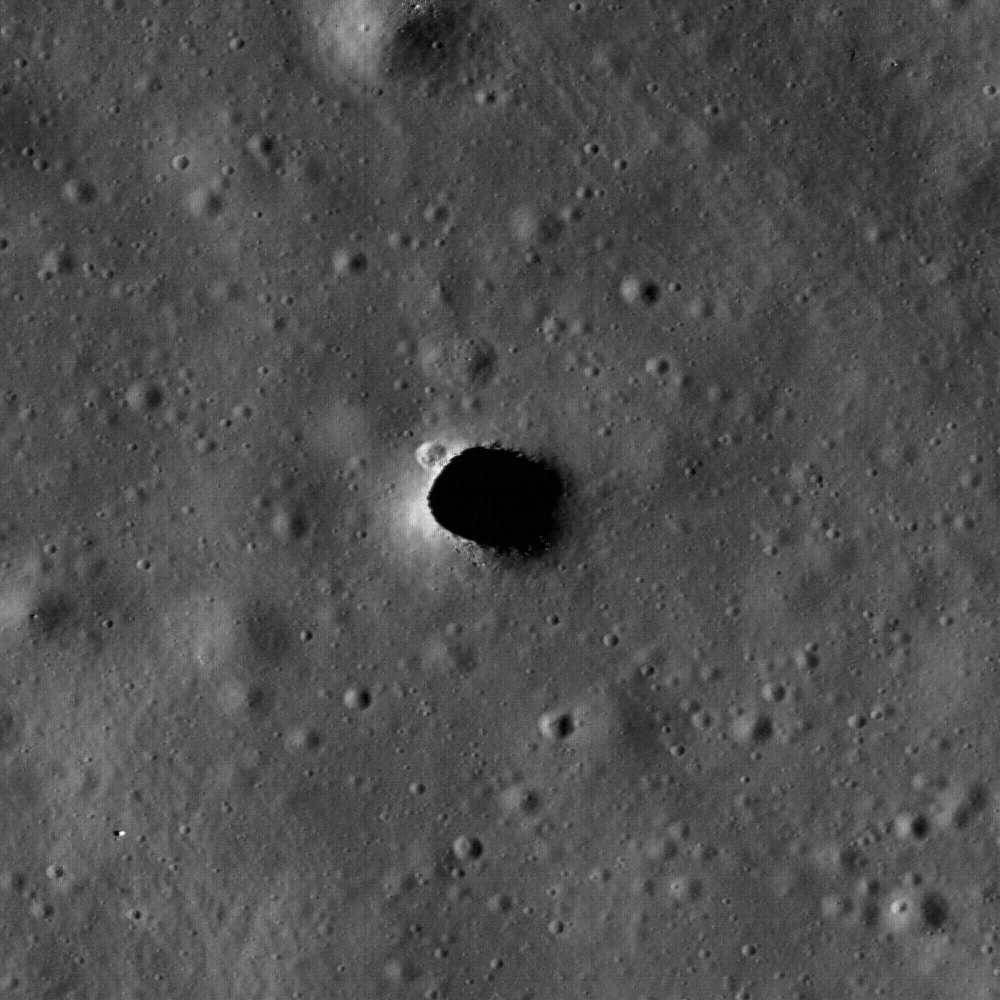
    Need a little bit of jaw-droppiness today? Mwuahahaha. Let me show you something:
    a hole in the Moon.

    lro_skylight

    [Don’t tell anyone, but that’s where they faked the Moon landings!]

    This is an image from the Lunar Reconnaissance Orbiter, one of my favorite spacecraft in existence. It’s been mapping the Moon at an incredible 50 cm/pixel resolution — that’s 19 inches, my pretties — for a while now, and revealing one astonishing thing after another.

    lro_skylight_rilleWhat you’re seeing here is indeed a hole in the Moon: what is almost certainly a skylight, a hole punctured in the roof of a lava tube, an underground tunnel carved by flowing molten material on the Moon. The hole is about 65 meters across — roughly 2/3rd the length of a football field. This region of the Moon is called Marius Hills, and is known to be volcanic in nature. The clincher is that the hole sits in a rille, a sinuous, snaking gully in the lunar surface.

    The picture on the left provides a little context. The hole is the very dark feature near the top, and sunlight is coming from the left. The rille is pretty obvious here, snaking more or less top to bottom, and the hole is smack dab in the middle of it. The place is littered with craters, most of which are soft looking, with no rims and very smooth features, which are possible indicators of very great age (erosion from solar wind, newer impacts, and thermal stress from the large day/night temperature swings wear down sharp features over time), or perhaps the regolith (the ground up rocks making a loose soil-like composite) is just very thick here, softening the sides of craters.

    Let me show you another view, a bit closer in:

    lro_skylight_context

    This section is about 1 km (3000 feet) across; in other words, it might take you about 10 minutes to walk across it (here on Earth, that is; in a spacesuit YMMV). The arrow at the bottom shows you the direction of sunlight; the Sun is coming from the left. That’s important, because our eyes get fooled easily if sunlight is coming from below; it makes craters look like domes and vice-versa. A lot of softer craters look like domes to my eye in this shot, so I marked a nice sharp crater with a 2 (the hole itself is labeled 1). See how the right side of the crater is bright? That makes sense if the Sun is on the left.

    I marked the top of the rille with a 3, and the base of the sloping side with a 4. Think of it as the top and bottom of a riverbank. The other side of the rille is off the picture to the right.

    OK, still with me? Now look at the hole again. The bright crescent around the hole on the right and the dark part on the left must be due to a slope leading into the hole, as if the whole thing is not just a hole punched into the surface, but more like a funnel pushed into it. The hole probably started out somewhat smaller, and the sides collapsed down a bit. Think of digging a hole in dry sand and you’ll get the picture.

    This means there’s a lava tube under the rille, probably carved out by an older lava flow. Observations by the Japanese probe SELENE indicate the hole is about 90 meters deep, and the roof — the top part of the tube — is about 25 meters thick. That explains why it hasn’t collapsed under the eons of meteoric bombardment forming all the craters in it. The hole may be a collapsed section, or it may have been punched by a larger meteorite. Given the size of the hole, the impactor couldn’t have been bigger than a few meters across itself. Had it been much bigger, I’d think more of the roof would’ve collapsed.

    Incredible! And useful, too: radiation from the solar wind may be a problem for future lunar colonists. A good solar flare could sicken or kill them, so they’ll need protection. Building underground is one way to do that, and here we have a pre-fab cave! It’s unfurnished, a bit of a fixer-upper, but ready for occupants, and priced to move.

    You may think a colony on the Moon is fantasy, but I disagree. It’s a matter of realty. And of course, location location location.


  • Buses are bosons, and they condensate | Cosmic Variance

    I did my graduate work at the University of Chicago, and lived in Hyde Park. On occasion I would take the bus (the #6 Jeffery Express) to downtown. Although the buses were scheduled to run every 15 minutes, I would invariably end up waiting a half hour. Sometimes more. Often in the freezing cold, or the sweltering heat. Most infuriatingly, when the bus finally arrived, there was always another one immediately behind it! The buses inevitably came in pairs. Sometimes even in triples or quads.

    Chicago busLet’s assume that the buses are supposed to arrive every 15 minutes. If the buses adhered to their schedule, and I showed up at a random time, I should generally have to wait roughly half the mean bus arrival time: 7.5 minutes. If the buses were totally random, then I would have to wait the average time between bus arrivals: 15 minutes (if you haven’t thought about this before, this statement should sound crazy; perhaps I’ll do a future post on it). So the question is: why did I always end up waiting roughly 30 minutes or more?

    I always assumed that the Universe was conspiring against me. This is a common feeling in graduate school. However….

    I just stumbled across a blog post of a friend of mine from graduate school, Alex Lobkovsky. In it, he discusses precisely this problem, and presents various reasons for the bunching of buses. I have no doubt that he was inspired from similar suffering. Perhaps at the very same bus stop.

    At the end of the day, there’s a fairly straightforward solution. Imagine all of the buses are roughly on time. Now imagine that one bus (call it bus S) happens to fall behind. Because S is running behind, more time has elapsed since the previous bus has passed. This means that more waiting passengers have accumulated, at more bus stops. This in turn means that bus S has to stop more often, and has to pick up more people at each stop. Hence, bus S falls even farther behind. Which means even more people accumulate at each stop. Which means the bus falls even farther behind. And so on. In short: a slow bus gets slower and slower.

    Now let us consider the bus behind bus S; we’ll call it bus F. Bus F starts out roughly on schedule. But because bus S is running late, less time than average has elapsed between when bus S last passed and when bus F arrives. This means fewer people have accumulated, at fewer stops. Which means bus F makes fewer stops, and picks up fewer people. Which means that it starts to run faster than average. Which means even fewer people accumulate. Which means it runs even faster. And so on. In short: a fast bus gets faster and faster.

    Putting this all together: if a random fluctuation creates a slow bus, then it will get slower and slower, and the bus behind it will get faster and faster, until the two buses meet up. At this point, the buses stick together, and are essentially incapable of separating. Thus, in general, buses will bunch up. This will usually happen in pairs, though on occasion triples and even quads may occur. This argument predicts that the arrival of buses will be random, with pairs of buses arriving more often than not, being separated by on average double the mean bus separation. And this is precisely what I discovered, the hard way, shivering at the corner of 55th St. and Hyde Park Boulevard. (N.B. I spent a year in Berlin. There, the buses are fermions, and always arrive exactly on time. It’s the stereotype, but it turns out to be true.)

    After writing this post, I found that wikipedia has already figured it all out. Regardless, it’s nice to know that my suffering was due to statistics, and not because the Universe is out to get me.


  • NCBI ROFL: Women’s bust size and men’s courtship solicitation. | Discoblog

    2175281805_9f87fe28a2“Previous studies have found that women with larger breasts than the average were considered to be more physically attractive. In these studies attractiveness was measured with the help of silhouette figures or photographs and the effect of breast size on men’s behaviour was not considered. In this study two experiments were carried out in order to test the effect of a woman’s breast size on approaches made by males. We hypothesized that an increase in breast size would be associated with an increase in approaches by men. A young female confederate was instructed to wear a bra that permitted her to artificially vary her breast size. In the first experiment the female confederate was instructed to sit in a nightclub for one hour whereas in the second experiment she was instructed to take a seat in a pavement area of a bar. It was found that increasing the breast size of the female confederate was associated with an increasing number of approaches by men.”

    bust

    Photo: flickr/Cane Rosso

    Related content:
    Discoblog: NCBI ROFL: Bust size and hitchhiking: a field study
    Discoblog: NCBI ROFL: Eye Tracking of Men’s Preferences for Female Breast Size and Areola Pigmentation.


  • Globe-Warming Methane Is Gushing From a Russian Ice Shelf | 80beats

    iceshelfBehind the ongoing back-and-forth fights over climate change that usually focus on carbon, there has lingered the threat of the powerful greenhouse gas methane being released into the atmosphere and causing even worse trouble. In August we reported on a study that noted methane bubbling up from the seafloor near islands north of Norway, giving scientists a scare. This week in Science, another team reports seeing the same thing during thousands of observations of the East Siberian Arctic Shelf on Russia’s north coast, which is even more worrisome because it’s a huge methane deposit.

    The shelf, which covers about 800,000 square miles, was exposed during the last ice age. When the region was above sea level, tundra vegetation pulled carbon dioxide from the air as plants grew. That organic material, much of which didn’t decompose in the frigid Arctic, accumulated in the soil and is the source of modern methane [Science News]. Now underwater, it’s covered by a layer of permafrost. But that permafrost seems to be becoming unstable, thanks to the fact that the water on top of it is warmer than the air it was exposed to back when it was on dry land.

    The study said about 8 million tonnes of methane a year, equivalent to the annual total previously estimated from all of the world’s oceans, were seeping from vast stores long trapped under permafrost [Reuters]. Study leader Natalia Shakhova says methane levels in the Arctic haven’t been this high in 400,000 years. While we’re not about to teeter off a cliff—that 8 million tons is a small portion of the global emissions of 440 million tons—we should be concerned, the scientists say. Methane is a far more powerful greenhouse gas than carbon dioxide, absorbing at least 25 times more heat, NOAA says.

    It is possible that climate change could be contributing to the release, with warmer seas causing more methane to come out, creating a feedback loop. But methane has long been leaking, and there’s no record of the previous levels with which to verify how much methane emissions are increasing, or whether people are playing a part. While Shakhova says the warmer runoff into the Arctic ocean is probably contributing, the team can’t say that for sure.

    What they can say for sure is that the methane levels there are extremely high. Most undersea methane oxidizes into CO2 as it enters the atmosphere, but Shakhova says the East Siberian Ice Shelf methane is too close to the surface for that to happen. As a result, she said, atmospheric levels of methane over the Arctic are 1.85 parts per million, almost three times as high as the global average of 0.6 or 0.7 parts per million. Concentrations over the shelf are 2 parts per million or higher [The New York Times].

    Related Content:
    80beats: Methane Seeps from the Arctic Seabed, Spooking Climate Scientists
    80beats: 2 Trillion Tons of Polar Ice Lost in 5 Years, and Melting Is Accelerating
    80beats: Arctic Tundra Surprises Scientists With Autumnal Methane Burps
    80beats: Methane Bubbles in the Arctic Ocean Give Climate Scientists the Willies
    DISCOVER: 10 Ways Methane Could Brake Global Warming–Or Break the Planet
    DISCOVER: If Life Gives You Methane, Make Methane Energy

    Image: University of Alaska Fairbanks


  • Anecdotal Reports: Birth Defects Have Spiked in War-Torn Fallujah, Iraq | 80beats

    FallujahThe Iraq war and its aftermath have left physical and psychic wounds on both local residents who lived through the American invasion and many U.S. soldiers. But anecdotal reports suggest that another demographic may have suffered as well: unborn babies. Doctors in Fallujah, Iraq have reported a high number of children born with birth deformities ever since the massive battle between Iraqi insurgents and U.S. forces that raged there in 2004.

    While no medical studies have been done or official reports have been issued, many Fallujah locals suspect that U.S. weaponry used in the assault has left a lingering effect.

    A debate is expected to come up in the British parliament sometime next week on the subject. The call for debate came up after the latest report by BBC’s John Simpson, in which an Iraqi pediatrician said she was seeing two to three deformed babies each day; most of the children had cardiac complications. The doctor clarified that while she didn’t have any official figures, she had noted an increase in the number of cases since the American invasion. The current level of cardiac birth defects in Fallujah, said the BBC, is 13 times higher than that in Europe.

    In his report, Simpson also encountered children who were missing limbs, who had extra fingers and toes, with six fingers on each hand and six toes on each limb and an other child with spinal cord deformities so severe, he couldn’t bear to have it filmed. Many Iraqis, says Simpson, blame American weapons for increasing birth defects in the area. At a clinic he visited, he was told the worst problems were to be found in the neighborhood of al-Julan, near the river. This was the heart of the resistance to the Americans during the two major offensives of April and September 2004, and was hit constantly by bombs and shells [BBC].

    Local people told the BBC they suspect US forces used white phosphorus and depleted uranium (DU) [in the battle of Fallujah], although this has not been proved [New Scientist]. White phosphorous can be found in incendiary weapons but is more often used as a smokescreen, while depleted uranium, which is toxic and weakly radioactive, can be found in some armor-piercing shells.

    The allegations aren’t new. In a 2009 investigation, The Guardian asked pediatrician Samira Abdul Ghani to keep precise records over a three-week period. Her records reveal that 37 babies with anomalies, many of them neural tube defects, were born during that period at Fallujah general hospital alone [The Guardian]. That report observed that Fallujah’s doctors were hesitant to link the deformities with the war, and suggested that they might be wary of embarrassing the government. Instead, Fallujah general hospital’s director and senior specialist, Dr Ayman Qais, listed other possible causes of the birth defects: “These include air pollution, radiation, chemicals, drug use during pregnancy, malnutrition, or the psychological status of the mother,” said Dr Qais. “We simply don’t have the answers yet” [The Guardian].

    Related Content:
    80beats: Gulf War Syndrome Is a Real Illness, Federal Study Finds
    80beats: Solving a 50-Year Mystery: How Thalidomide Causes Birth Defects
    Discoblog: New Video Game Teaches Soldiers How to Make Nice With the Locals
    DISCOVER: Has Science Found a Way to End All Wars?

    Image:Wikimedia


  • Sand dunes march across Mars | Bad Astronomy

    I’ve said this before, but it bears repeating: when I was a kid, Mars was a dead planet. Dry, frozen, with hardly any atmosphere, I always figured it wasn’t very interesting.

    Heh.

    Mars may or may not be alive in the biological sense, but it’s certainly active geologically! And images from the Mars Reconnaissance Orbiter’s HiRISE camera verify it. It’s spotted migrating ripples across Martian sand dunes:

    hirise_dunemarch

    These before and after images (part of a trio of them) show the motion. The image on the left was taken June 30, 2007, and the one on the right in October of that year. During that time, just a few months, the ripples can clearly be seen to have moved by a few meters (the inset diagram shows the ridges on the dunes schematically). This means that the wind blowing in this part of the planet is not only actively pushing around the sand, but also doing it on a timescale we can measure.

    And on a spatial scale, too. Note the scalebar in the images: it’s 20 meters long, about the size of a house! This strongly suggests that these dunes are loose piles of sand, and not heavily crusted over or cemented (the grains stuck together). That, plus the time and size of the migration, yields yet more clues about the way the surface of Mars is put together.

    Amazingly, this comes at the same time as other news showing that dunes in another region of Mars haven’t moved for at least 100,000 years, and possibly as long as three times that age! So while some regions of Mars are dynamic, active, and changing on a timescale of weeks, other regions are static, unchanging, and rigid for hundreds of millennia.

    I used to think Mars was uninteresting. I was dead wrong. Mars is weird, and in astronomy and space exploration, weird is always interesting.

    Image Credit: NASA/JPL-Caltech/University of Arizona/International Research School of Planetary Sciences

  • The FDA Warns POM: Stop Saying Pomegranate Juice Cures Cancer | Discoblog

    pomtruthThe Web site for POM pomegranate juice makes some pretty extreme claims, strongly implying that the juice can prevent or help treat diseases like cancer, hypertension, diabetes, and even erectile dysfunction. Now, the Food and Drug Administration has said such claims are misleading and are not allowed on food products, according to a report in The New York Times. If POM wants to make such claims, the FDA stated, it will have to be regulated as a drug.

    In a crackdown on companies with misleading labels, the FDA shot off warning letters asking 17 companies to clean up their act.

    POM is not the only company to be chastised by the FDA for misleading labeling. Other offenders included several products whose labels trumpet the fact that they contain no transfats, even though they contain high levels of saturated fat, writes The New York Times:

    The products included Gorton’s Fish Fillets, Spectrum Organic All Vegetable Shortening and two products from Dreyer’s, the Dibs bite-size ice cream snacks and the vanilla-fudge Drumsticks. According to Dreyer’s, the Dibs contain 17 grams of saturated fat per serving. Federal guidelines recommend that a person not consume more than 20 grams in a day.

    The FDA also wagged its finger at some baby foods made by Gerber and Beech-Nut, saying those foods made several unwarranted health claims, because dietary levels for the nutrients cited on their labels haven’t been established for babies.

    Related Content:
    Discoblog:Fast Food Joints Lie About Calories (Denny’s, We’re Looking at You)
    Discoblog: Food Fraud: High Schoolers Use DNA Tests to Expose Fake Caviar
    Discoblog: Fiber-Filled, Antioxidant-Packed Ice Cream—Brilliant? Sacrilegious? Nasty?
    Discoblog: Heart-Stopping Cinematic Excitement: Guess How Much Fat Is in Movie Popcorn?

    Image: POM Juice


  • The Latest Trend in Aircraft: Really, Really Tiny

    Microfliers could search for missing people, detect bombs, and perhaps even deliver drugs inside the human body.

  • I For One Welcome Our Microbial Overlords | The Loom

    Can the bacteria in our bodies control our behavior in the same way a puppetmaster pulls the strings of a marionette? I tremble to report that this wonderfully creepy possibility may be true.

    The human body is, to some extent, just a luxury cruise liner for microbes. They board the SS Homo sapiens when we’re born and settle into their assigned quarters–the skin, the tongue, the nostrils, the throat, the stomach, the genitals, the gut–and then we carry them wherever we go. Some of microbes deboard when we shed our skin or use the restroom; others board at new ports when we shake someone’s hand or down a spoonful of yogurt. Just as on a luxury cruise liner, our passengers eat well. They feed on the food we eat, or on the compounds we produce. While the biggest luxury lines may be able to carry a few thousand people, we can handle many more passengers. Although the total mass of our microbes is just a few pounds, the tiny size of their cells means that we each carry about 100 trillion microbes–outnumbering our own cells by more than ten to one.

    It’s important to bear in mind that you can carry this galaxy of microbes around and enjoy perfect health. These microbes, for reasons that are not entirely clear, behave like well-mannered passengers. They do not barge into the kitchen, take a cleaver to the cooks, and then eat all the food. Aboard the SS Homo sapiens, the crew includes a huge staff of security guards armed with lethal chemical sprays and other deadly weapons, ready to kill any dangerous stowaway (also known as the immune system). For some reason, the immune system does not unleash its deadly fury on the microbes–even when the microbes are fairly close relatives to truly dangerous pathogens.

    In fact, our microbial passengers may actually help out the cruise liner’s crew. They can close up the ecological space in our bodies, so that invading pathogens can’t get a solid foothold. Some species in our guts can break down our food in ways that we can’t, and synthesize certain vitamins and other compounds beyond our biochemistry. The genes that the microbes carry–millions of them–expand our biochemical powers enormously.

    To understand the human microbiome better, scientists have been cataloging the microbes in and on people’s bodies, and they’ve been sequencing their DNA. (Listen to my recent podcast with biologist Rob Knight for more.) Yesterday, Nature published a head-spinningly huge study on the microbiome from a team of European and Chinese researchers. Lurking in the stool of 124 volunteers, the scientists found, were 3.3 million microbial genes. The scientists identified a core of bacteria species carried in most people’s guts, as well as other species that varied from person to person.

    As Ed Yong rightly points out, this study is most impressive as a titanic database. It is not the Theory of Everything for the human microbiome. That will take a lot longer to build, because the microbial ecosystem inside of us is so complex. Individual species don’t just sit in isolation, surviving in their own special way. Microbes cooperate with one another to get the food they need and produce the conditions in which they can thrive. In Microcosm, for example, I write about research suggesting that E. coli–a minor member of the gut ecosystem–may keep oxygen levels low enough for other species to invade and dominate. And it’s not as if there is some Platonic ideal of a microbiome that we all carry around with us from birth to death. The diversity of microbes I carry is different from the one you carry, and they both change over our lifetimes. Every time we take a dose of antibiotics, for example, the balance can change dramatically. And as the diversity of microbes changes, so do its ecological functions.

    Which brings me, at last, to the possibility that the human microbiome can become our puppetmaster.

    First some background. A lot of parasites have evolved the ability to manipulate their hosts for their own benefit. (I get into more detail about this in my book Parasite Rex and in this segment of the show Radio Lab.)

    Very often, the parasites cause hosts to do things that help the parasites, instead of themselves. For example, a protozoan called Toxoplasma needs to get from rats to cats, and to help the process along, it makes rats lose their fear of cats. Parasites can also change the diet of their host as well as the way in which their hosts digest their food. Parasitic wasps living inside caterpillars, for example, cause catepillars to convert the plants they eat into compounds that supply quick energy (good for wasp larvae growing quickly) instead of storing them as fat for their own metamorphosis.

    I was reminded of this sinister manipulation by a paper that was published in Science today by Rob Knight and his colleagues. They built on previous research that revealed that mice genetically engineered to be obese have different kinds of microbial diversity in their guts than normal mice. Scientists have found that if they transfer microbes from an obese mouse to a regular mouse that has had all its own germs stripped out, the recipient mouse will develop extra fat. In the case of these obese mice, it appears that the microbes become less efficient at helping the animals digest food, triggering a series of changes that leads the mice to be fat.

    Knight and his colleagues discovered a different–and more disturbing–way that microbes can make mice fat. They started out by engineering mice so that they didn’t produce a protein normally found on the surface of gut cells, called TLR5. TLR5 can recognize bacteria, and some studies suggest that the cells can then pass along signals to the immune system, possibly sending a stand-down command so that the immune system doesn’t start trying to kill the microbes (and end up killing gut cells too).

    Born without TLR5, mice got 20% fatter than normal. Not only that, but the mice had lots of other familiar symptoms that go along with being overweight, such as high levels of triglyceride, cholesterol, and blood pressure. Without TLR5 exerting its soothing influence, the mice suffered from chronic inflammation, probably thanks to the low-level war they were waging on their microbes. And things got worse for the mutant mice when they had to eat a high-fat diet. They gained more weight on a high-fat diet than regular mice, suffered even more inflammation, and even ended up diabetic.

    The obesity of these TLR5-deficient mice was not the result of inefficiency, as in previous studies. Instead, the mice wanted to eat more–about 10 percent more than regular mice. Knight and his colleagues restricted the diet of the mutant to what the regular mice ate. A lot of their symptoms went away. So the change in their behavior was critical to their weight change.

    The scientists also discovered that the make-up of the microbial diversity changed significantly in the mutant mice. Were the microbes giving the mice their symptoms? To find out, Knight and his colleagues knocked out the microbes with antibiotics. The mice ate less, put on less fat, and showed less diabetes-like symptoms.

    To isolate the effects of the microbes even more, the scientists transferred them from mutant mice into the bodies of ordinary mice that had first had all their own germs stripped out. Remember–these mice have a normal set of TLR5 receptors. The scientists found that the microbes made the recipient mice hungry–and also made them obese, insulin resistant, and so on.

    So here we are. Mice with a genetic make-up that alters the diversity of their gut microbes get hungry, and that hunger makes them eat more. They get obese and suffer lots of other symptoms. Get rid of that particular set of microbes, and the mice lose their hunger and start to recover. And that distinctive diversity of microbes can, on its own, make genetically normal mice hungry–and thus obese, diabetic, and so on.

    When I first learned of this work, I asked Knight–with a mix of dread and delight–whether the microbes were manipulating their hosts, driving them to change their diet for the benefit of the microbes. He said he thinks the answer is yes.

    This discovery doesn’t just have the potential to change the way we think about why we eat what we eat. (Am I really hungry? Or are my microbes making me hungry?) It also provides a new target in the fight against obesity, diabetes, and related disorders. What may be called for is some ecological engineering.

    [Update: Links to papers fixed.]


  • Massive Spanish Botnet Busted, but Hacker Mastermind Remains Unknown | 80beats

    Botnet copySpanish authorities announced this week that they shut down what appears to be the largest botnet ever discovered.

    The Mariposa botnet, which first appeared in 2008, was a network of nearly 13 million virus-infected PCs, remotely operated by thieves stealing private information from computers in half the Fortune 1000 companies and 190 countries. Though three men are now in custody, worries over the bot are far from over.

    Juan Salon at the Spanish Civil Guard was relieved to catch the three men, aged between 25 and 31, whose names have not yet been released. But the guard was troubled to find that none of the three possessed the technical know-how to design something like the Mariposa. “We have not arrested the creator of the botnet. We have arrested the administrators of the botnet, the ones who spread it and were administering and controlling it,” Salon said [San Jose Mercury News]. They are following a fourth suspect, he says.

    Just finding the first three alleged culprits was no easy task, as investigators dealt with international boundaries and the reluctance of service providers housing the command machines, or that have sold the rights to web addresses used in the infection process, to assist in them. In the case of the so-called Mariposa botnet, service providers helped private researchers, Spanish police and the American FBI [Financial Times]. By the time authorities shut down the botnet, it reportedly held 800,000 people’s private information.

    But while Salon worries about not catching the mastermind, he’s happy that the three men apprehended weren’t criminal geniuses. “Thank God, their criminal mentality wasn’t very sophisticated,” said Salon, who said the men apparently tried to offer their botnet to criminal gangs for hire [Reuters]. Despite amassing so much potential for destruction—police say they could have brought down a whole country’s computers systems—the alleged operators lived just a “comfortable” life. Says Civil Guard Captain Cesar Lorenza: “They’re not like these people from the Russian mafia or Eastern European mafia who like to have sports cars and good watches and good suits. The most frightening thing is they are normal people who are earning a lot of money with cybercrime” [The Guardian].

    Of course, there are still thousands of other botnets in operation, but this appears to be the largest ever brought down.

    Related Content:
    80beats: Code Protecting 80 Percent of Cellphone Convos Finally Cracked
    80beats: A Hack of the Drones: Insurgents Spy on Spy Plans with $26 Software
    80beats: Editing Goof Puts TSA Airport Screening Secrets on the Web
    80beats: How to Prevent Heart Hackers from Turning Off Pacemakers
    80beats: Electrical Espionage: Spies Hack Into the U.S. Power Grid

    Image: Wikimedia Commons / Tom B.


  • How big is a BILLION? | Bad Astronomy

    I love numbers. I have a decent grasp of them, including orders-of-magnitude: the idea that 1000 is ten times 100, and so on. This comes from long, long experience, especially in astronomy. Also, writing a book where the last chapter deals in practical terms with numbers like 1092 years kinda gives you a serious feel for big numbers.

    Still, not everyone gets that kind of experience. In everyday life we deal with the number a billion, especially with computers, but honestly, do you have a real grasp of how much bigger a gigabyte is than a megabyte? Sure, it’s 1000x bigger, but that doesn’t really give you the visceral feeling of what kind of number a billion really is.

    Enter Jay Epperhart. He decided to figure out just what a billion means, and put up a pretty cool page describing it.

    milliondotsMy favorite is the graphic depicting a million dots. They’re too small to see in the inline image, and even when I clicked it my browser didn’t display it at full resolution. When I finally displayed it in full res, the idea of just how big a million really is reached through my monitor and flicked my ear.

    That was pretty nifty.

    He goes on to talk about the number of stars in the galaxy and galaxies in the Universe… but I won’t spoil it. Head over there and give it a read. It’s megagigacool.