My dog can fly.
 |
Can yours?
Yeah, I know it’s Caturday, but every dog has her weekend, right? Photo by Chris Setter.
My dog can fly.
|
Can yours?
Yeah, I know it’s Caturday, but every dog has her weekend, right? Photo by Chris Setter.
 “Sexual selection via male mate choice has often been implicated in the evolution of permanently enlarged breasts in women. While questionnaire studies have shown that men find female breasts visually attractive, there is very little information about how they make such visual judgments. In this study, we used eye-tracking technology to test two hypotheses: (1) that larger breasts should receive the greatest number of visual fixations and longest dwell times, as well as being rated as most attractive; (2) that lightly pigmented areolae, indicative of youth and nubility, should receive most visual attention and be rated as most attractive. Results showed that men rated images with medium-sized or large breasts as significantly more attractive than small breasts. Images with dark and medium areolar pigmentation were rated as more attractive than images with light areolae. However, variations in breast size had no significant effect on eye-tracking measures (initial visual fixations, number of fixations, and dwell times). The majority of initial fixations during eye-tracking tests were on the areolae. However, areolar pigmentation did not affect measures of visual attention. While these results demonstrate that cues indicative of female sexual maturity (large breasts and dark areolae) are more attractive to men, patterns of eye movements did not differ based on breast size or areolar pigmentation. We conclude that areolar pigmentation, as well as breast size, plays a significant role in men’s judgments of female attractiveness. However, fine-grained measures of men’s visual attention to these morphological traits do not correlate, in a simplistic way, with their attractiveness judgments.”

Photo: flickr/stevendepolo
Related content:
Discoblog: NCBI ROFL: Bust size and hitchhiking: a field study.
Discoblog: NCBI ROFL: Perceptions of body hair on white women: effects of labeling.
Discoblog: NCBI ROFL: scientist…or perv?
 It’s live here, and here’s part of the show description:
For the scientists who study global warming, now is the winter of their despair.
In the news, it has been climate scandal after alleged climate scandal. First came “ClimateGate,” then “GlacierGate,” “Amazon Gate,” and so on. In public opinion polls, meanwhile, Americans’ acceptance of the science of global warming appears to be declining. Even a freak snowstorm now seems to sow added doubt about this rigorous body of research.
In response to growing public skepticism—and a wave of dramatic attacks on individual researchers—the scientific community is now bucking up to more strongly defend its knowledge. Leading the charge is one of the most frequently attacked researchers of them all—Pennsylvania State University climatologist Michael Mann.
In this interview with host Chris Mooney, Mann pulls no punches. He defends the fundamental scientific consensus on climate change, and explains why those who attack it consistently miss the target. He also answers critics of his “hockey stick” study, and explains why the charges that have arisen in “ClimateGate” seem much more smoke than fire.
Once again, the show is here, and you can subscribe on iTunes for further episodes…
Update: The show airs just in time, apparently; Joe Romm documents yet another unfair and bogus attack on Mann, this time from the Wall Street Journal….
 It sounded like a good idea at the time: You’d had one too many at the pub, one thing led to another, and you ended with someone’s name tattooed on your back. When you rushed out as soon as possible for laser removal of the unfortunate ink, the practitioners were actually using the same techniques that some art restorers employ to remove dirt and grime from masterpieces. And according to a new study in the journal of the American Chemical Society, Accounts of Chemical Research, laser ablation is getting better and more widespread in the art world.
Salvatore Siano at the Applied Physics Institute-CNR in Florence, Italy, tried out the method on a few classic works of art to record the results scientifically. He cleaned parts of a wall painting from a church in Siena, Italy, and also worked on Lorenzo Ghiberti’s gilded bronze panels Porta del Paradiso, or Gate of Paradise, and Donatello’s Renaissance bronze statue of David [BBC News]. While others have experimented like this over the last decade, he says, the Gates of Paradise was the first widely recognized masterwork to receive the treatment. He also notes that treating paintings poses the greatest challenge, but says that the laser cleaning showed great results–in the image above, the angel on the right was cleaned with laser ablation, while the two angels on the left received traditional cleaning.
Art restoration has always been tricky, as conservationists try to remove buildup without damaging original material; it can be tough to separate the original layers from the gunk with a scalpel. Laser ablation, in which dirt and other materials crusting the surface are heated with the laser and vaporized, may avoid some of the problems associated with chemical treatments or other traditional restoration techniques. But Siano notes that a laser in unskilled hands is a dangerous thing. “The pulse duration is really crucial because it determines the time for the localised heating. Sometimes a long heating is harmful and sometimes a short heating is harmful,” explained Dr Siano [BBC News].
While he and his colleagues practice their skills and consider ways to use this method on the delicate pigments of easel paintings, they have stumbled upon an interesting way to clean metals: putting them underwater. “In water you can increase the effect of the laser; it’s a kind of underwater micro-explosion or micro-fragmentation” [BBC News].
Related Content:
80beats: New Imaging Technique Shows Parthenon Was Once Brightly Painted
80beats: Beauty and the Brain: Men And Women Process Art in Different Ways
DISCOVER: The Natural History of Art explores the field of “evolutionary aesthetics”
DISCOVER: The First Masterpieces wonders why our ancestors started painting their caves
DISCOVER: Secret Science in Art finds physics at work in masterpieces
The Loom: Science Tattoo Emporium, the ever growing collection of nerdy ink
Image: Salvatore Siano
Because I love to write about climate change and watch the misinformation and noise fly in the comments, I will direct your attention to two very interesting articles about denialism:
1) My friend and noted skeptic Steve Novella writes about the meaning of scientific consensus and denialism, whether that’s over global warming or vaccines.
2) An article on lies.com likens global warming denialism to the O. J. Simpson trial, saying that when faced with overwhelming evidence, Simpson’s lawyers attacked the court process instead of the actual case. It’s a fascinating analogy and one that strikes me as being very apt.
 I’ll add as a bonus a link to something I wrote a while back: the difference between skepticism and denialism. I wrote it a year or so ago, and don’t see anything I would change today.
 We know that dim lights, a little Marvin Gaye, and a lot of red wine usually do the trick to get humans in the mood for some nookie. But what encourages endangered frogs to get it on?
Apparently, they are a fussy lot, and demand that the temperature be just right and that the humidity and day length be just so; only then will they kick off their slippers for a little bit of action. So, the Bristol Zoo obliged a few endangered frogs by building them a love shack, a specially designed “AmphiPod” with controlled natural conditions that will hopefully encourage the endangered frogs to breed.
Scientific American reports:
In addition to mimicking the frogs’ natural habitat, AmphiPod will also help to protect them against disease, including the deadly chytrid fungus that is rapidly devastating frog populations around the world.
Right now, the AmphiPod is housing the lemur leaf frog (Hylomantis lemur) from Panama and Costa Rica, and Madagascar’s golden mantella frog (Mantella aurantiaca). The leaf frog has already lost almost 80 percent of its population to the deadly chytrid fungus while the golden mantella’s home is being destroyed due to rapid deforestation.
Bristol Zoo authorities will be watching the love shack closely to see if these amphibians get amorous. If the scheme seems to work, other frog couples from different endangered species could be given honeymoons in the love getaway.
 Join Discover Magazine on Facebook
Related Content:
DISCOVER: Frogs Legs Up
80BEATS:A Gentleman Frog That Takes Monogamy & Parenting Seriously
80beats: Frogs Pee Away Scientists’ Attempts To Study Them
Discoblog: Video: How Male Frogs Kick up a Frog Froth to Protect Their Young
80beats: Commitment-Phobic Men Can Blame Their DNA
DISCOVER: Sex and the Female Agenda
DISCOVER: Sex and Control
DISCOVER: Mating Like an Animal: The Real Story
Image: Bristol Zoo
South Dakota, are you kidding me? Astrology in the classroom?
In the fine tradition of creationist legislation that claims that evolution is “just” a theory and that requires the teaching of alternatives, the South Dakota legislature has passed a resolution on the teaching of climate change. Here’s how it starts.
NOW, THEREFORE, BE IT RESOLVED, by the House of Representatives of the Eighty-fifth Legislature of the State of South Dakota, the Senate concurring therein, that the South Dakota Legislature urges that instruction in the public schools relating to global warming include the following: (1) That global warming is a scientific theory rather than a proven fact;
(2) That there are a variety of climatological, meteorological, astrological, thermological, cosmological, and ecological dynamics that can effect [sic] world weather phenomena and that the significance and interrelativity of these factors is largely speculative…
That red color is mine. This resolution was not just offered, folks. It was approved by a majority of the legislature. Astrology and all.
At least I know what astrological means. Someone’s going to have to help me with thermological, though. It’s not even in the dictionary. (Whoops–I found it in the Oxford English Dictionary. Having to do with heat. Still, though–what about cosmological? Is global warming from the Big Bang?)
Wow. That is all.
Update: Thanks to Loree for pointing out that this original language was amended before the vote. Here’s what it ended up as:
A CONCURRENT RESOLUTION, Calling for a balanced approach for instruction in the public schools relating to global climatic change.
NOW, THEREFORE, BE IT RESOLVED, by the House of Representatives of the Eighty-fifth Legislature of the State of South Dakota, the Senate concurring therein, that the South Dakota Legislature urges that all instruction in the public schools relating to global climatic change be presented in a balanced and objective manner and be appropriate to the age and academic development of the student and to the prevailing classroom circumstances.”.
Thankfully, those who don’t know the difference between astrology and astronomy didn’t get their way. But the “balanced” rhetoric that remains is straight out of the creationist playbook. For more, see Science Progress.
[via Think Progress]
 Since NASA’s Stardust mission returned in 2006 from its trip of billions of miles collecting the dust of a comet called Wild2 and dropped it samples down to Earth in the Utah desert, the samples have raised all sorts of questions about how comets formed and what the early solar system was like. In a study this week in Science, there’s a new surprise. Scientists say that the comet sample contains chemicals that must have formed in our home turf, the inner solar system.
Lead researcher Jennifer Matzel studies a tiny particle taken from Stardust’s sample, a piece just five micrometers across. In it her team found the mark of materials that would have formed under high temperatures. Matzel, who specializes in using the decay rates of radioactive chemical elements to assess ancient dates, determined that the Stardust particle must have crystallized just 1.7 million years after the oldest solid rocks in the solar system were forming [San Francisco Chronicle]. After that, the researchers says, the particle must have been flung out to the Kuiper Belt, the region of icy comets revolving around the sun at a distance far past Neptune.
Matzel doesn’t know for sure how this migration would have happened, but she’s excited about it. “The new and interesting thing about this paper is it’s the first time we’ve been able to get some estimate of the timing,” Matzel says. “Even though it’s a very old object and it formed very close to the sun, it had some longer history in the inner solar system before it got flung out to the comet-forming region” [Scientific American]. The trip would not have been easy. NASA’s Joseph Nuth notes that Jupiter would be forming by this time in the early solar system’s history, and that would have been a major obstacle that outwardly-migrating material would have had to overcome.
Once again, Stardust has proven to be great at providing the unexpected. Earlier findings showed that the comet’s cloud unexpectedly contains the same rocky materials as the asteroids that orbit the sun between Mars and Jupiter, as well as molecules of glycine, an organic compound essential for life [San Francisco Chronicle]. More hints about the early solar system probably await in the stardust it brought back.
And while the Stardust “mothership” successfully dropped its sample capsule to Earth in 2006, the spacecraft’s voyage isn’t done. Stardust is now on its way to the comet Tempel 1, the comet impacted by the Deep Impact spacecraft in 2005, where it will take photographs of the crater produced by that impact.
Related Content:
80beats: Dust Collected From Comet Contains a Key Ingredient For Life
80beats: Meteorite, Maybe Older Than The Sun, Shows Chemistry of Ancient Solar System
DISCOVER: NASA Takes a Wild Comet Ride
Image: NASA
Scientific superstars like Carl Sagan and Richard Dawkins are sounding better and better. In the series Symphony of Science, creator John Boswell uses the auto-tune program so beloved by R&B and pop stars to tweak such nerdy delights as Carl Sagan’s monologues from “Cosmos,” and sets them to electro-funk music. The result? Highly watchable videos of Sagan and other guest scientists expounding on the magic of the cosmos and our place in the universe. Boswell has put four videos out previously, but here is his latest offering, “The Poetry of Reality.”
Join Discover Magazine on Facebook
Related Content:
Discoblog: Carl Sagan Sings Again: Symphony of Science, Part 4
Discoblog: Sounds of the Universe: Making Music From the Supernova Cassiopeia A
 A giant iceberg has broken free from Antarctica, and scientists say the massive ice chunk could interfere with ocean circulation and wildlife–particularly Antarctica’s iconic residents, the emperor penguins.
The piece of ice broke free when another huge iceberg struck Antarctica’s Mertz glacier; now the two icebergs, with a combined weight of 700 million tons, are floating along the Antarctic coast. The iceberg collision and break-off is a rare event and occurs naturally every 50 to 100 years, scientists say. The new iceberg, which is 49 miles long and about 24 miles wide, holds enough fresh water to supply all of the earth’s human needs for a year [ABC News].
Scientists are keeping a close eye on the situation, as both icebergs could potentially change the salinity of the water in the area, which could alter the flow of ocean currents.
Since breaking off, both icebergs have moved into an area called a polynya or polynia, where an expanse of open water is surrounded by sea-ice. Distributed across the Southern ocean, polynyas are the zones that produce dense water, super cold and rich in salt that sinks to the bottom of the sea and drives the conveyor-belt like circulation around the globe [Agence France-Presse]. Now, with the icebergs possibly lodged in this area, they could reduce the production of the cold salty water, called bottom water, which feeds oxygen into the deep ocean currents. Mario Hoppema, chemical oceanographer at the Alfred Wegener Institute for Polar and Marine Research in Germany, said that as a result “there may be regions of the world’s oceans that lose oxygen, and then of course most of the life there will die” [Guardian].
In the short-term, scientists say the new iceberg will impact the colonies of emperor penguins and other wildlife that use the area for feeding. Says Antarctic researcher Neal Young: “There are emperor penguin colonies about 200-300km away to the west. They come to this area to feed, and seals in the area also come to get access to the open water.” … He suggested that a change in the availability of open water could affect the rate of food production, which would have an impact on the amount of wildlife it could sustain [BBC News].
While the so-called “calving” of this new iceberg was extremely dramatic, scientists have clarified that it was a natural event, in contrast to recent rapid ice shelf break-off on the Antarctic peninsula where the climate is warming [The Sydney Morning Herald]. Here is Neal Young, a glaciologist at the Antarctic Climate and Ecosystems Research Centre in Tasmania, explaining the significance of the event.
Join Discover Magazine on Facebook
Related Content:
80beats: Is the Once-Stable Part of Antarctica Starting to Melt?
80beats: Fossils of Shrimp-Like Creatures Point to Warmer Antarctica in the Distant Past
80beats: Floods Beneath Antarctica’s Ice Sheet Create a Glacial Slip-and-Slide
80beats: Antarctica is Definitely Feeling the Heat from Global Warming
Image: Australian Antarctic Division
In the United States, about 250,000 amateurs watch the heavens—and many of them have made significant contributions to science.
The Symphony of Science is a wonderful project taking words from famous scientists and using an autotuner to create music. It’s pretty popular; the first one has over 3 million views on YouTube!
The newest version has statements by a dozen different scientists, all talking about what science is and what it does. As Richard Dawkins says, science is the Poetry of Reality:
Pretty cool. I love the sentiment, and it’s fun to see how many friends are in there, too. And you know what? Everything they say in there is true.
Tip o’ the semiquaver to Julia Sherred.
 We know that there’s a whole spectrum of different wavelengths of light beyond the puny band of visible light we humans can see. And we knew that some animals, like certain species of fish and birds, have vision that extended beyond ours into wavelengths like ultraviolet. But a new study in Current Biology demonstrates that not only can damselfish see in UV, but that they can discern specific patterns in UV light, which is much more than we ever gave them credit for.
The findings are the first to show an animal “that is able to discriminate between fine-scale UV patterns using only their short-wavelength receptors (UV cones),” the researchers wrote in their study. These fish seem to use the UV cues to distinguish their own from other similar-looking species [Scientific American]. Prior to this, many researchers thought the fish’s UV vision just allowed them to detect the presence of UV light, and wasn’t refined enough to detect any kind of patterns.
The team, led by Ulrike Siebeck, made the find by studying two species of damselfish, Ambon and lemon, which have different UV sensitive markings on their faces. When the two species were put together, most of the males Ambons would defend their territory by attacking other male Ambons, but wouldn’t pay much attention to their lemon cousins. However, when the experiment was run with UV filters so the fish couldn’t see the UV facial patterns, this same preference for attacking kin wasn’t found [LiveScience]. Without the UV markings, the scientists propose, perhaps the Ambon damselfish couldn’t easily tell the nearly identical lemon damselfish apart from its own species.
While both these species of damselfish see in UV, plenty of their major predators, such as wrasses and cod, typically can’t, Siebeck says. So she argues that damselfish could use their spots to send a covert message [Science News]. UV light also scatters in water more than visible light, so even if predators could see in UV, it wouldn’t do them much good from afar. Thus, these UV face markings could be a clever way for the fish to send bright signals to potential mates or rivals without attracting unwanted attention.
Related Content:
80beats: Male Cleaner Fish Punish Females Who Piss Off the Boss Fish
80beats: DNA Scanner Proves That NYC Sushi Contains Endangered Bluefin Tuna
Discoblog: Was This Fish the Inspiration for Alien?
DISCOVER: The Most Important Fish in the Sea
DISCOVER: 8 Marine Creatures That Light Up the Sea
Image: U. Siebeck et al. / Current Biology 2010
 On Monday, experienced Sea World trainer Dawn Brancheau drowned when a 12,300-pound orca named Tilikum pulled her into a tank after the popular Dine with Shamu show. The tragedy took place in front of dozens of tourists with varying accounts of what exactly occurred.
In the days since, I’ve received many questions about orcas like Tilikum. Several of you want to hear my take on the ethics of captive lifestyles for animals. Some use terms like “compassionate conservation” while others talk about “cruel imprisonment.” Meanwhile, lots of advocacy groups have been speaking out by making lump judgments on all zoos and aquariums–which is not right. To be fair, there is a very broad spectrum in terms of the value of–and responsibility at–each. Further, most handlers I’ve personally met are well-intentioned, and focus on conservation and science. So rather than go into a lengthy discussion on the merits and faults of parks, let’s stick to orcas and this very sad story.
Orcas have evolved to be highly intelligent, social animals, communicating to pod members using sounds that travel underwater. They are also powerful hunters. Tilikum was born wild off the coast of Iceland, where he could travel vast distances until he was captured in 1983. Since then, he’s lived in a comparatively small enclosure, siring offspring, and performing simple tricks for us, over and over and over again.
It’s relatively simple to understand why something might go wrong in this situation.
 My post on birds and dinosaurs yesterday led to a little debate on Facebook, including this, from paleontologist Thomas Holtz:
All living birds share a common ancestor that would also be considered a bird, so they are a monophyletic group. Nevertheless, that group is deeply nested among euornithine ornithothoracine pygostylian avialian eumaniraptoran paravian metornithine maniraptoran maniraptoriform tyrannoraptoran coelurosaurian avetheropodan tetanurine averostran neotheropod theropod saurischian dinosaurs.
…and breathe.
The European Southern Observatory just released a very pretty picture of the nebula NGC 346. Check this out:
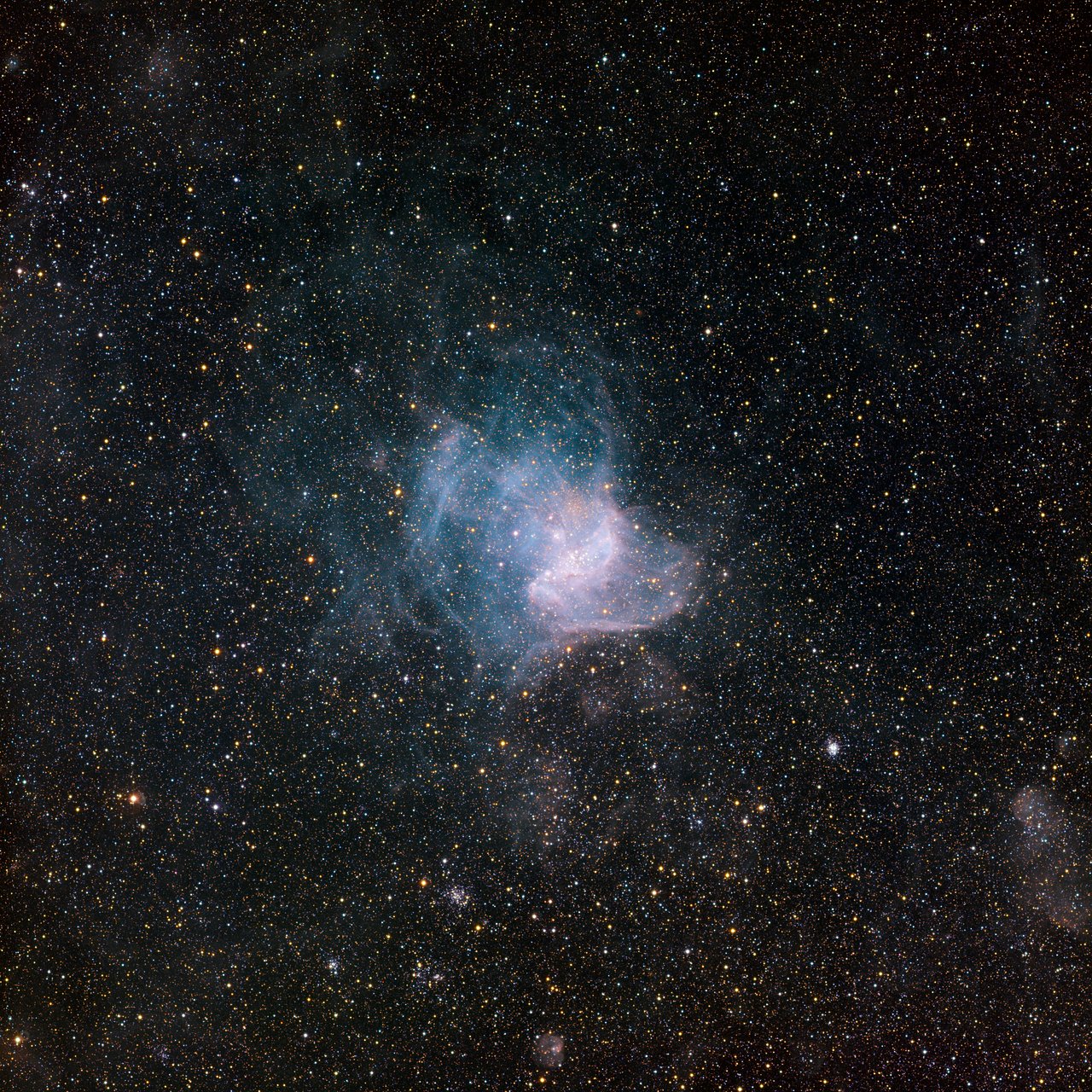
I strongly urge you to click that to ennebulanate to the higher-res version; I had to shrink and compress it quite a bit to fit it here.
The picture is lovely, showing a star-forming region in the Small Magellanic Cloud, a satellite galaxy to our own. The nebula’s about 200 light years across, and 200,000 light years away.
I won’t go into details; you can go to the ESO site for that. But there’s something I want to point out. The sharp wisps you see strewn this way and that inside the gas are due to vast and powerful winds of subatomic particles blowing from the surfaces of massive stars that are newly-born from that very gas. These streams slam into the gas, compressing it across trillions of kilometers, producing storm fronts that are thinner than a laboratory vacuum but are still so voluminous that the mass adds up to many times that of the Sun’s. Added to that is a flood of high-energy ultraviolet light from these massive stars, energy blasting out as they furiously churn out energy in their cores, leading ultimately to their demise in supernovae explosions.
So while you gaze at this nebula and wonder at its beauty, remember that in our Universe, beauty is borne by great violence. If there’s a life lesson in there I’m unaware of it. But it is worth pondering.
I spent last week attending the “Formation and Evolution of Black Holes” conference at the Aspen Center for Physics, organized by Andrea Ghez, Vicky Kalogera, Fred Rasio, and Steinn Sigurdsson (who blogs over at the Dynamics of Cats). It was a great mix of observers and theorists, and we covered the full range, from stellar-mass black holes in our galaxy to supermassive black holes on the far side of the Universe. I was particularly interested in two topics: gravitational-wave recoil and black hole binary inspiral (I’ll blog about both soon enough). And I made another pilgrimage to the Highlands bowl, this time with 15″ of virgin powder.
The Aspen Center runs a public lecture series in conjunction with each conference. So last Wednesday Andrea Ghez gave a lecture on the black hole at the center of our galaxy. It’s our closest big black hole, roughly 25,000 light years (2×10¹⁷ kilometers) away, and four million times the mass of our Sun. Andrea has been leading a team studying the motion of stars orbiting around this black hole. These orbits are one of the best ways (short of the detection of gravitational waves from black hole mergers) of confirming that black holes exist. The orbits tell us the mass of the central object. And the innermost passage of the closest orbit gives us an upper limit on the size of the central object. Combining these numbers gives us a lower limit to the density of the “dark object” at the center of our galaxy. At this point, a black hole is the only viable model for what we see. There is no way to make sense of the orbits using a cluster of (dark) stars at the center, or a massive gas cloud, or anything else we can think of. Gravity tells us that any normal stuff we put there (including “conventional” dark matter) will evaporate or collapse to a black hole. We are not yet probing the horizon of the black hole (in some sense, its surface), but we are getting closer and closer with each passing year.
But, more importantly, Andrea is responsible for one of the coolest movies in all of science:
This shows the orbits of stars around our galactic center. This isn’t an artist’s conception. This isn’t some abstraction of other data. This is a real movie of stars circling the black hole over the last 15 years. In particular, watch S-02. It loops around the black hole, and closes its orbit; we have watched it over one full S-02 “year”. It is an incredible feat of observational astronomy to make these movies. It requires adaptive optics on the largest telescopes in the world (the Keck telescopes on Mauna Kea). We used to think of the heavens as eternal and unchanging. Now we watch movies of stars orbiting black holes.
 Swinging high and low: Why do the testes hang at
different levels? A theory on surface area and
thermoregulation.
“Anatomically, one or the other half of the scrotal sac hangs at a lower level than the other. The testes, housed within the sacs are also situated, suspended, one slightly lower than its other counterpart. While many theories on why and how of the testicular levels have been proposed, including those engendered by vascular, functional, embryological or evolutionary influences, none of the proposed scientific reasons are totally convincing. In our view, one additional, yet overlooked cause for the naturally displaced level could be, simply, to expose more surface area of the active organ to cooler environs. While it is an accepted fact that suspension of the scrotum outside the abdominal cavity is paramount to the functional efficiency of testes in a preferred lower temperature – it still does not address the question – why hang at different levels?… In effect, just by suspension at two levels, nearly one entire extra surface is available for thermoregulation and cooling. That is, the surface area available now becomes two lateral, plus two halves of the two medial. This extra area available to the testes, probably is, yet another a significant but overlooked embryonic factor that dictates differential rates of descent and displacement of anatomical levels of twin reproductive male organs.”

Thanks to Eric for today’s ROFL!
Photo: flickr/brownpau
Related content:
Discoblog: NCBI ROFL: penis friday.
Discoblog: NCBI ROFL: The case of the haunted scrotum.
 Yelp, the popular website that offers reviews of local businesses, has just been bitten by Cats and Dogs, a veterinary hospital that is accusing the site of extortion. In a class-action lawsuit filed in Los Angeles this week, the Long Beach pet hospital claims that Yelp tried to get it to cough up $300 a month for a 12-month advertising commitment in exchange for tweaking possible bad reviews of the clinic.
In its complaint, Cats and Dogs alleges that Yelp carried a negative review of the hospital written by a certain “Chris R” that the hospital’s owner, Gregory Perrault, viewed as false and defamatory. He asked Yelp to remove it because the review was based on an office visit that occurred 18 months before the post was written, and Yelp’s guidelines mandate that reviews must be posted within 12 months of an experience. The site took down Chris R’s review.
However another bad review, this time by “Kay K,” popped up five days later. According to Wired, Kay K wrote:
Dr. Perrault is the rudest vet I’ve ever been to . . . probably one of the rudest people I’ve had the displeasure of meeting. I agree with the previous reviews about making you feel like an unfit mom. My pup had been sick and I had a theory on what the problem may have been and he wouldn’t even entertain the idea, but instead, made me feel bad because my dog got sick. And, my poor dog was terrified of him! He made me feel like I was 2 inches tall and repeatedly looked down his nose at me. Oh, and OVER PRICED! OMG! Who does he think he is??? I did not feel welcomed by him nor his staff. I paid you for a service! No need to treat me so bad!
This is when Perrault alleges Yelp started pestering him; he says sales staff called and pressured him to consider an advertising package that would delete negative reviews, and would keep bad reviews from appearing in Google searches. Wired reports that when the doctor refused to bite, Chris R’s review reappeared on the site, along with a new one from Kay K that read in part:
I ran in to him in a neighborhood store right after he saw my poor sick dog at his clinic and he looked right at me, recognized me, rolled his eyes and looked away!!!! Seriously, someone needs to knock this guy down to the size he really is. He needs to drop his Napolean complex and be a professional. After my horrible experience with him, I took my sick dog to Bixby Animal Clinic and I have never had a more pleasant vet experience! Go there instead! My dog loved everyone there!
On being asked to remove this posting, Yelp declined, stating that they were not in a position to verify if all the reviews had been written by the same person. It added that the reviews reflected the personal opinion of the reviewers and that Yelp, adhering to its review guidelines, couldn’t do anything about them. Perrault’s lawyer called this tactic “high-tech extortion.”
This is not the first time Yelp has found itself in hot water. Last year, the Oakland-based East Bay Express found six business owners who had received calls from Yelp sales reps promising to move or remove negative reviews in exchange for an advertising package.
The report said:
In another six instances, positive reviews disappeared — or negative ones appeared — after owners declined to advertise.
A former Yelp employee reportedly confirmed to the paper that several sales reps promised local businesses that bad reviews would be purged in exchange for advertising on the site. While this is legal, the report pointed out that it raised ethical questions about a site that prides itself on “Real People. Real Reviews.”
The San Francisco-based Web site had more than 26 million visitors in December 2009 and has published more than 9 million reviews.
Related Content:
80beats: Some M.D.s Try to Amputate Online Reviews
80beats: Should Advertisers Be Allowed to Track Your Bedroom Habits?
80beats: How Did “Soupnazi” Allegedly Steal 130 Million Credit Card Numbers?
80beats: Researchers Guess Social Security Numbers From Public Data
Image: Yelp
It’s walking cats that is truly problematic.
Feel free to construct your own similes. (Via Cynical-C.)