Author: Discover Main Feed

  • From Eternity to Book Club: Chapter Seven | Cosmic Variance

    Welcome to this week’s installment of the From Eternity to Here book club. We next take a look at Chapter Seven, “Running Time Backward.” Now we’re getting serious! (Where “serious” means “fun.”)

    Excerpt:

    The important concept isn’t “time reversal” at all, but the similar-sounding notion of reversibility–our ability to reconstruct the past from the present, as Laplace’s Demon is purportedly able to do, even if it’s more complicated than simply reversing time. And the key concept that ensures reversibility is conservation of information–if the information needed to specify the state of the world is preserved as time passes, we will always be able to run the clock backward and recover any previous state. That’s where the real puzzle concerning the arrow of time will arise.

    With this chapter we begin Part Three of the book, which is the most important (and my favorite) of the four parts. Over the course of the next five chapters we’ll be exploring the statistical definition of entropy and its various implications, as well as the puzzles it raises.

    But before getting to entropy, and the arrow of time that depends on it, we first have to understand life without an arrow of time. The only reason the Second Law is puzzling is because the rules of fundamental physics don’t exhibit an arrow of time on their own — they’re perfectly reversible. In this chapter we discuss what “reversible” really means, and contrast it with “time reversal invariance,” which is related by not quite the same. If a theory is both reversible and time-translation invariant (same rules at all times), it’s always possible to define time reversal so that your theory is invariant under it. (E.g. in most quantum field theories, “CPT” does the trick.)

    Reversibility is a very deep idea; it implies that the state of the universe at any one moment in time is sufficient (along with the laws of physics) to precisely determine the state at any other time, past or future. But not many popular physics books spend much time explaining this idea. So we reach all the way back to very simplified models of discrete systems on a lattice (”checkerboard world”). What we’re after is an understanding of what it really means to have “laws of physics” in the first place — rules that the universe obeys as it evolves through time. That lets us explore different kinds of rules, in particular ones that are and are not reversible.

    Along the way we talk about time-reversal invariance in the weak interactions of particle physics, and emphasize how this is not related to the thermodynamic arrow of time that is our concern in this book. Which gives me a good excuse to quote a touching passage from C.S. Wu. This chapter has everything, I tell you.


  • How All-Female Lizards Keep Their Genes Fresh Without Sex | 80beats

    WhiptailLizSure, creatures that reproduce asexually get to avoid some of the hangups that come with sex, but the strategy brings its own problems. First and foremost, how do you prevent genetic deterioration without the fresh infusion of new genes that results from the mixing of male and female DNA? For the all-female whiptail lizard, the solution is to hedge its bets.

    In a study forthcoming in Nature, researcher Peter Baumann found that each whiptail lizard egg cells contains twice the number of chromosomes you’d expect. In the fertilized egg cell of a sexually reproducing lizard species, you’d expect to see much what you see in humans—23 chromosomes from the father and 23 from the mother combining into 46. (Most human cells contain 46 chromosomes, but egg and sperm cells contain only 23, so that they can combine to give an offspring a compete, but genetically new, set of chromosomes.)

    But the whiptail eggs instead begin with two identical copies of each of their mother’s chromosomes, for a total of 92. Those chromosomes then pair with their identical duplicates, and after two cell divisions, a mature egg with 46 chromosomes is produced. Since crossing-over during the cell divisions occurs only between pairs of identical chromosomes, the lizard that develops from the unfertilized egg is identical to its mother [The New York Times].

    Curiously, the whiptail lizards came to be through the fusion of two other lizard species, Baumann says. That gave it a rich genetic diversity, but without sex the lizards needed a new way to maintain that diversity. “There’s an absence of sperm, and genetic information is never provided by another source. Anything that’s lost is lost for good” [Wired.com], Baumann says. This trick he found provides a tidy explanation for how these all-female lizards maintain those rich genetics.

    Still, while the whiptail’s trick allows for generation after generation of identical lizards, that’s not necessarily advantageous for long term survival. Unless an animal can recombine the DNA they already have, they will produce an offspring with an identical set of chromosomes, in which any genetic weakness, such as disease susceptibility or physical mutation, would have no chance to be overridden by outside genetic material from a mate [Scientific American]. Asexual reproduction is beneficial in the short run, and species like Komodo dragons will do it if they have to. But relying on it exclusively might cost the whiptails in the long run, especially if they should need to adapt to a changing habitat.

    There are other creative solutions invented by other asexual species, like the bdelloid rotifers. Unfortunately, though, lizards probably can’t steal the rotifers’ trick of ripping apart their genome and stealing foreign DNA from the surrounding environment.

    Related Content:
    80beats: Sexless Sea Creatures Steal Foreign Genes
    DISCOVER: The Real Dirty Secret About Sex (Life doesn’t need it, so why do we do it?)
    DISCOVER: A Good Reason For Sex
    DISCOVER: 20 Things You Didn’t Know About… Sex

    Image: Peter Baumann


  • Bang! A-boom-a-boomerang | Bad Astronomy

    Sometimes I’m surprised by something I thought I knew, and found out I didn’t, not really.

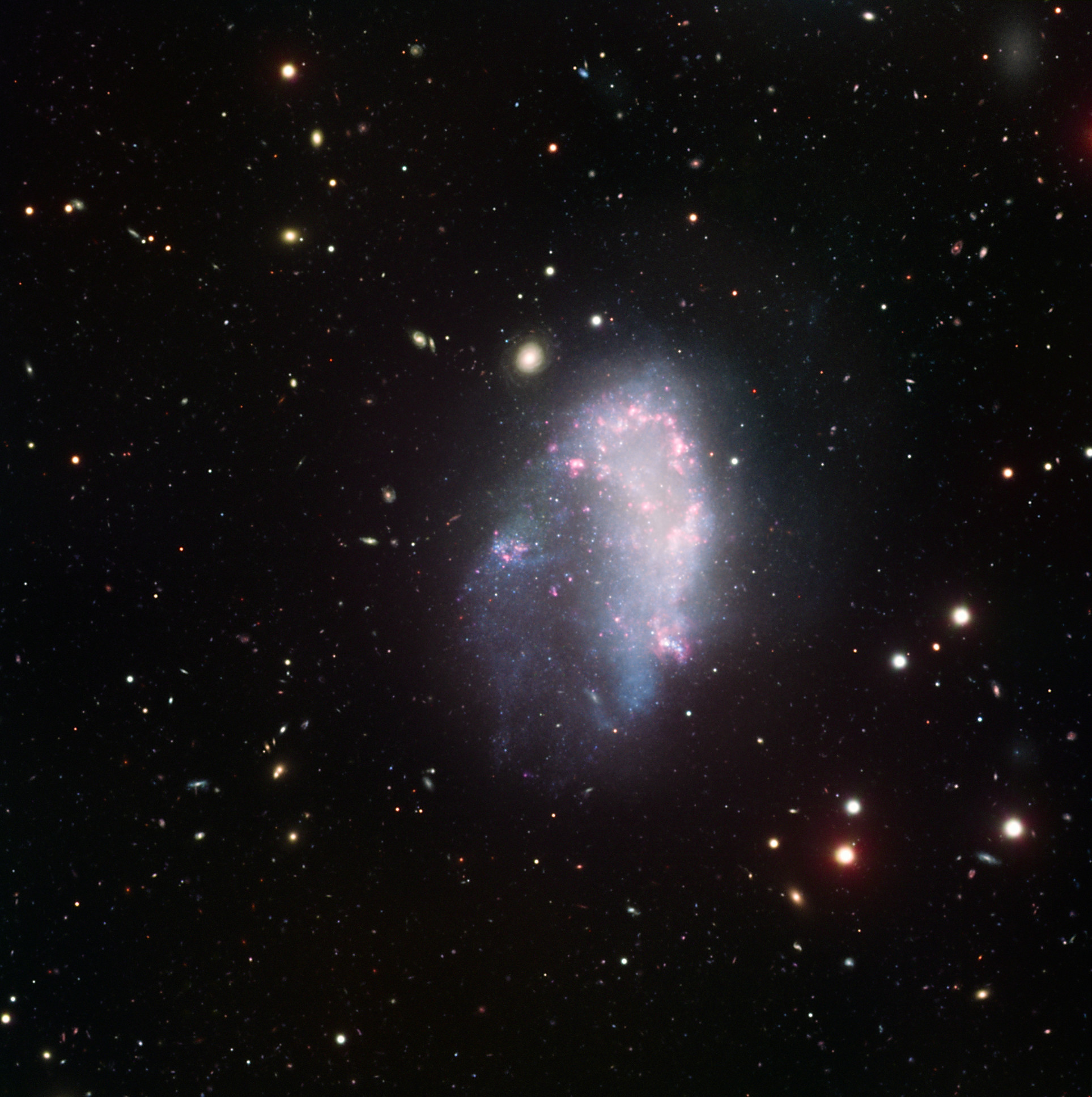
    For your consideration: NGC 1427A, a dwarf galaxy.

    eso_fornaxdwarf

    [Click to unendwarfenate.]

    I’ve seen pictures of this little guy before. It’s a small galaxy, maybe 20,000 light years across (the Milky Way is 5 times that size), and part of the Fornax cluster, a small but rich cluster of galaxies about 60 million light years away. The picture here was taken with the monster 8.2 meter Very Large Telescope in Chile, and uses filters that give a somewhat true-color appearance, though it also accentuates warm hydrogen (the pinkish glow).

    Even though I’ve looked at it before, I don’t think I really saw it, because the boomerang shape is obvious, and to anyone familiar with galaxy dynamics the reason behind it is obvious too. Maybe it’ll help to know that this diminutive galaxy is screaming through the Fornax cluster at 600 kilometers per second, a ridiculously high speed.

    See it now? NGC 1427A looks like it’s got a swept-back shape because it’s being swept back. In between galaxies there is an ethereally-thin fog of gas, but there’s enough there to have an effect on a passing galaxy. The boomerang shape of the galaxy is because that side is facing into the wind, so to speak, and being compressed. The pink curve in the image is due to rigorous star-formation going on there, where the gas clouds are collapsing from the pressure and birthing stars at a prodigious rate.

    Looking at this image, it’s so obvious what’s going on I’m surprised I didn’t notice it before. I guess sometimes you miss stuff right under your nose if you’re not paying attention. If you consider 60 mega-light-years under your nose.

    Tip o’ the Strömgren sphere to the ESO. Image credit: ESO. 10 extra BA points for anyone who knows what the title’s from. Don’t Google it! That’s cheating.


  • Help UK libel reform | Bad Astronomy

    I’ve written about the horrible state of libel laws in the UK before, but there are a couple of new developments:

    1) Simon Singh wrote about the issue for the JREF’s Swift blog. He asks people to sign the online petition for reform, and it helps even if you’re not a UK citizen. In general I don’t support online petitions, but in this case it will have a real and important impact; they can present it personally to people who make the laws and show them this is an important issue. I signed. You should too.

    2) Simon’s libel case goes before the Court of Appeal in London on Tuesday, February 23 (today for most folks reading this). No doubt the major media will be covering it, as it’s a big story. I’ll try to post something here if and when I hear anything.

    You can find out more at the Libel Reform website, including how (if you’re local) you can go downtown to show support for Simon on Tuesday morning at 09:45 (here’s the location).


  • NCBI ROFL: Binge drinking in Jewish and non-Jewish white college students. | Discoblog

    manischewitz“BACKGROUND: In the United States, religious commitment, as measured by service attendance, has an inverse relationship with alcohol consumption, heavy use, and problem use. This association, however, has not been found consistently in Jewish Americans. The present study examined the relationship between religious variables and binge drinking in Jewish and non-Jewish white college students. In addition, the association among genetic, cultural, and religious variables and binge drinking was examined in the Jewish sample alone. …RESULTS: As hypothesized, more frequent religious service attendance related to lower rates of binge drinking in non-Jews but was not related to binge drinking in Jews. Within the Jewish sample, individuals who were religiously affiliated had approximately one third the risk of binge drinking as those who were secularly affiliated, but identification with Jewish culture was not related to binge drinking. In the total sample, individuals who possessed a variant alcohol dehydrogenase allele ADH2*2 were approximately half as likely to binge drink as those who did not possess this allele. CONCLUSIONS: These results are consistent with previous studies that find an inverse relationship between religious service attendance and heavy alcohol use in Christian but not Jewish college students. Findings within the Jewish sample support theories that suggest religious, not just cultural, Jewish affiliation relates to lower levels of alcohol behavior. More research is needed to identify additional factors, including other religious, cultural, genetic, and biological influences, that protect Jewish Americans from heavy drinking.”

    jew

    Photo: flickr/infowidget

    Related content:
    Discoblog: NCBI ROFL: What do Jews do while they poo?
    Discoblog: NCBI ROFL: Binge drinking: also a problem for our teenage rats.
    Discoblog: NCBI ROFL: Science: getting babies drunk since 1997.


  • Discover Interview: Space Is Getting Bigger, and It’s Getting Bigger Faster

    Saul Perlmutter changing our understanding of the entire universe by discovering that its expansion is accelerating.

  • Setting the Record Straight: Belgian Coma Patient Cannot Communicate | 80beats

    brain-3Late last year, a Belgian man in his mid-forties created a media stir when doctors announced that he had been misdiagnosed as being in a coma for 23 years. Rom Houben, the victim of a horrific car-crash in the eighties, was incorrectly diagnosed as being in a “persistently vegetative state.” But by using new diagnostic tests and brain scans that were unavailable in the eighties, scientists revealed that Houben was actually conscious.

    Reports then breathlessly announced that Houben could also finally “communicate,” expressing his thoughts by having his hand supported by his therapist who reportedly helped him tap out his messages on a touch-screen computer. “I shall never forget the day when they discovered what was truly wrong with me,” Houben apparently tapped. “It was my second birth. I want to read, talk with my friends via the computer and enjoy my life now that people know I am not dead” [The Guardian].

    But now one of Houben’s doctors, neuroscientist Steven Laureys, has declared the Belgian hasn’t been communicating after all.

    When the story first broke, DISCOVER and other discerning publications noted that this type of communication, called “facilitated communication,” is very controversial, and has repeatedly failed under conditions of rigorous testing. [Psychology Today]. Skeptics argued that the facilitated communication therapist brought in by Houben’s family was really guiding the man’s hand and choosing which letters to press herself. Skeptics who read Houben’s messages were also amazed that someone who was in a minimally-conscious state for more than two decades was so lucid, articulate, and forgiving of the medical staff. Laureys wanted to study the case further to determine if Houben could indeed communicate.

    He set forth by studying a group of minimally conscious patients, including Houben, and three facilitators. The patients were presented with words and objects while their facilitators were out of the room. When the therapists returned, the patients were asked to type out what they saw. Two out of the three facilitators, included Houbens’, failed–leading Laureys to conclude that the Belgian man wasn’t communicating in the first place.

    Presenting his findings at a neuropsychiatry meeting in London, Laureys said: “To me, it’s enough to say this method (facilitated communication) doesn’t work” [MSNBC]. He added that the new findings don’t change the fact that Houben was misdiagnosed, but noted that Houben’s previous words could not rightly be attributed to him. Said Laureys: “The story of Rom is about the diagnosis of consciousness, not communication” [BBC].

    The findings have vindicated skeptics. “It’s like using an Ouija board,” Arthur Caplan, a professor of bioethics at the University of Pennsylvania, said Friday. “It was too good to be true and we shouldn’t have believed it” [MSNBC]. Other experts have suggested that facilitated communication could be used on some paralyzed patients but not on patients like Houben, who have suffered severe brain injuries.

    However, there may be other methods that Houben could use to communicate; several weeks ago, a fascinating study showed a way to communicate with some vegetative patients by reading their brain scans as they focused their thoughts on different activities or places.

    Related Post:
    80beats: MRI Brain Scans Show Signs of Consciousness in Some “Vegetative” Patients
    80beats: A Silent Hell: For 23 Years, Man Was Misdiagnosed as a Coma Patient
    80beats: Vegetative Coma Patients Can Still Learn–a Tiny Bit

    Image: iStockphoto


  • Pic of the Shuttle reentry… from space! | Bad Astronomy

    The Space Shuttle mission STS-130 ended last night with the Orbiter Endeavour safely landing in Florida at 10:20 p.m. Eastern time yesterday. I live-tweeted the event, and so I was too busy to pay much attention to the Twitter feed from Soichi Noguchi, an astronaut onboard the the International Space Station. I wish I had, because then I could’ve retweeted a picture he took that is simply amazing:

    soichi_shuttle_sturn

    That’s Endeavour as it was over (I believe) the Caribbean Sea. At that point, it was still sloughing off the energy of orbit, dropping in velocity as it dropped through our atmosphere. To do that, it made two wide, curving, banking turns, called S-turns, that slow the Orbiter down. As it’s doing that, it’s ramming the Earth’s air at something like Mach 25, which violently compresses the gas and heats it up. This is what causes the Orbiter (as well as incoming meteors) to glow, not friction.

    The more you know.

    Anyway, the glow is bright enough to be seen in the Space Station, if it happens to be overhead at that time — and that doesn’t have to be the case; it depends on how long it takes after the Orbiter undocks from the ISS before it lands, for example. In this case, though, Soichi was on the ball, and snapped this shot of Endeavour while it was still glowing hotter than the surface of the Sun!

    Like I said, amazing. As far as I know, that’s the first time this has been photographed from space. And we’ll only get four more chances… but after that, maybe it’ll be a Dragon capsule they’ll see.


  • Singing Therapy Can Rewire Brains of Speech-Impaired Stroke Patients | 80beats

    brain-3If you can’t say it, then sing it! Experts researching patients who have lost their ability to speak after a stroke are now suggesting that they could be able to communicate with music using Melodic Intonation Therapy (MIT). Using MIT, the scientists showed that patients who were earlier communicating only in mumbles and grunts could now learn to sing out basic phrases like “I am thirsty.”

    The study was conducted by Harvard Medical School neurologist Gottfried Schlaug on 12 patients whose speech was impaired by strokes, and showed that patients who were taught to essentially sing their words improved their verbal abilities and maintained the improvement for up to a month after the end of the therapy [Wall Street Journal]. Schlaug presented these findings at the meeting of the American Association for the Advancement of Science in San Diego.

    The researchers worked with stroke patients whose speech was incoherent, and who had damage in a region of the left side of the brain that is typically involved in speech. Schlaug’s research suggests that the brain can be essentially rewired. Stroke patients can learn to use a region on the right side of the brain, which is typically involved with music, for sing-songy speech instead. “Singing can give entry into a broken system by engaging the right hemisphere,” says Schlaug [ScienceNOW Daily News].

    Using MIT, therapists taught patients how to sing words and phrases consistent with the underlying melody of speech, while tapping a rhythm with their left hands. After frequent repetition—1.5 hour-long daily sessions with a therapist for 15 weeks—the patients gradually learn to turn the sung words into speech [Wall Street Journal]. When Schlaug compared images of the patients’ brains before and after the therapy, he found that the right side of their brains had changed both structurally and functionally.

    Though it has been known that patients who can’t speak clearly often do better when they sing the words, this is the first time anyone has shown the phenomenon through a clinical trial that combines treatment with brain imaging. Schlaug hopes more patients and caregivers will be enticed to try out Musical Intonation Therapy. However, he points out that MIT is long and expensive; the treatment often lasts for 14 to 16 weeks, with 90-minute sessions five days a week. The results are also dependent on how recently the patient had the stroke and the severity of the attack.

    But the benefits of the therapy are usually permanent, and two thirds of patients who have undergone MIT with Schlaug added more words to their spoken vocabulary after their therapy had ended than the 100 words they were “taught” to say in therapy [AFP]. Each year, about 60,000 to 70,000 people suffer speech defects due to a stroke.

    Related Content:
    DISCOVER:The Genetic Mystery of Music
    DISCOVER:Music Soothes The Savage Brain
    DISCOVER: Musical Scales Mimic the Sound of Language
    DISCOVER:What Do Urban Sounds Do to Your Brain?
    80beats: Found: The First Genetic Mutations That Cause Stuttering
    80beats: Playing a Duet, Guitarists’ Brains Find the Same Grooves
    80beats: Seriously: Frank Sinatra Songs Restored Eyesight to Stroke Patients

    Image: iStockphoto


  • Genetics Study: Will IVF Babies Face Health Problems Later in Life? | 80beats

    infant babyLouise Brown, the first baby conceived through in vitro fertilization, will be turning 32 this year, and most people born through IVF are still younger than 30. While the technique has become commonplace for would-be parents struggling with fertility problems, doctors note that the long-term effects of the procedure still aren’t certain. Now, some scientists are saying they see slight differences in the DNA expression of people born via IVF, and that it’s possible they could be at higher risk for conditions like cancer or diabetes later in life.

    Says lead researcher Carmen Sapienza said “By and large these children are just fine, it’s not like they have extra arms or extra heads, but they have a small risk of undesirable outcomes” [The Guardian]. Rather, the team found a very subtle impact. In 75 IVF babies and 100 naturally conceived ones, they examined 700 genes that particularly interested the researchers because they are linked to fat cell development, insulin signaling, and other functions associated with diseases for which people tend to be at higher risk as they age. The scientists checked DNA methylation, a modification to DNA which affects gene expression, and found that 5 to 10 percent of IVF babies had abnormal patterns of methylation.

    Sapienza’s team published the study in October in Human Molecular Genetics, but his work is picking up attention after he spoke at the American Association of the Advancement of Science meeting in San Diego.

    Studying the health forecast for IVF babies is crucial because they tend to have lower birth weights than traditionally born babies. That could spell trouble ahead, because low-birth-weight babies often have long-term health problems. They’re more likely to be obese, to have diabetes, and to have hypertension when they’re 50, for example [ScienceNOW]. And because no IVF-born person is currently older than 31, there’s no data to predict what health patterns they will have as they age.

    Conscious of a strong reactions by parents of IVF children, Sapienza stressed that the work is neither an attack on IVF nor any kind of proof that IVF babies will be unhealthier than other people as they age. But, he says, one must ask the questions. If it turns out that children who were conceived by IVF had a higher risk of, say, colon cancer, he says, it would be useful to be able to tell them to get screened earlier [ScienceNOW].

    However, one researcher is publicly concerned about the overuse of a specific kind of IVF called Intra-cytoplasmic sperm injection (ICSI). That’s one of its creators, Andre Van Steirteghem. Also speaking at the AAAS meeting, Van Steirteghem warned that his creation was being overused, becoming the dominant IVF method in many hospitals. He says shouldn’t be employed in cases where regular IVF techniques could suffice: “We have to see what will come out in the future, and long term follow up is extremely important, but yes, ICSI has been overused” [The Telegraph]. ICSI makes it possible for men who ordinarily would be sterile to conceive, but carries a slightly higher risk of health problems down the road than regular IVF.

    Related Content:
    DISCOVER: Thirteen Ways of Looking at a Baby
    DISCOVER: IVM: A Fertility Treatment That Could Mean Pregnancy at Half the Cost
    80beats: Vatican’s New Bioethics Rules Grapple With 21st Century Medical Advances
    80beats: Is It Ethical To Pay Women To Donate Eggs For Medical Research?

    Image: iStockphoto


  • Falcon 9 getting ready for maiden voyage | Bad Astronomy

    President Obama’s plan for NASA in the future is to rely heavily on private industry. One of the companies preparing for this is Space X, which has tested its first generation Falcon 1 rocket successfully. The Falcon 9 is a much larger rocket capable of carrying a much heavier payload, but has not yet flown.

    However, the first F9 is at Cape Canaveral, getting ready for launch. It’s been sitting horizontally in a hangar for some time, but is now vertical.

    F9_Vertical_Sunset

    It will undergo a series of ground tests, including a 3.5 second full engine firing (the rocket will be locked down to keep it from going anywhere) before it’ll be cleared for launch. Launch could be as early as March!

    Once it’s flown, the next step will be to carry a test version of the Dragon module — the part that will carry big payloads — on top which could happen as early as July. Once that passes, Space X will be ready to start ferrying material to the space station. They hope to be able to be man-rated by 2013 or 2014, so they can begin to ferry humans into orbit.

    Image credit: Chris Thompson/SpaceX


  • And the Survey Says: Google Is Not Making You Stupid | Discoblog

    is_google_making_us_stupidIn 2008, writer Nicholas Carr worried in The Atlantic that the search engine Google and the easy availability of information on the internet is making our brains lazy–and rendering humans stupid. He wrote that the net was destroying his capacity for concentration and contemplation, adding, “Once I was a scuba diver in the sea of words. Now I zip along the surface like a guy on a Jet Ski.”

    DISCOVER’s own Carl Zimmer responded by taking the opposite stance, and declaring that Google is making us smarter. He argued that humans are “natural born cyborgs” and the internet is our “giant extended mind.” He wrote that there was “nothing unnatural about relying on the internet—Google and all—for information…. Nor is there anything bad about our brains’ being altered by these new technologies, any more than there is something bad about a monkey’s brain changing as it learns how to play with a rake.”

    Now, a new survey from the Pew Internet & American Life Project agrees with Zimmer; it found that Google is indeed making us smarter by allowing us to make better choices. More than 76 percent of the 895 experts polled said Nicholas Carr was wrong in thinking that Google made us stupid.

    PC Magazine reports:

    “Google allows us to be more creative in approaching problems and more integrative in our thinking. We spend less time trying to recall and more time generating solutions,” said Paul Jones of ibiblio.org at the University of North Carolina Chapel Hill.

    “For people who are readers and who are willing to explore new sources and new arguments, we can only be made better by the kinds of searches we will be able to do,” wrote Oscar Gandy, a professor at the University of Pennsylvania. “Of course, the kind of Googled future that I am concerned about is the one in which my every desire is anticipated, and my every fear avoided by my guardian Google. Even then, I might not be stupid, just not terribly interesting.”

    Nicholas Carr meanwhile said he “felt compelled to agree with himself,” telling the Pew Project:

    “What the Net does is shift the emphasis of our intelligence, away from what might be called a meditative or contemplative intelligence and more toward what might be called a utilitarian intelligence. The price of zipping among lots of bits of information is a loss of depth in our thinking.”

    Peter Norvig, Google’s research director, argued in turn that because Google makes so much information available instantly, it’s a good strategy for a knowledge-seeker to skim through many offerings first to get an overview. Then the user can settle down with the best sources for a deeper read. He added that skimming and concentrating can and should coexist.

    Related Content:
    DISCOVER: How Google Is Making Us Smarter
    DISCOVER: Big Picture: 5 Reasons Science [Hearts] Google
    DISCOVER: Google Taught Me How to Cut My Own Hair

    Image: The Atlantic


  • A Viral Indiana Jones | The Loom

    mtsitunes220In my newest podcast, I talk to a kind of viral Indiana Jones. Michael Worobey of the University of Arizona chases down the evolutionary origins of viruses such as HIV and the flu no matter what it takes–including getting dangerously ill in the middle of a civil war. Check it out.


  • Bloom Energy Teases Its Power-Plant-in-a-Box; Many Doubts Remain | 80beats

    bloomenergy_2If you can say one thing about the people behind the Bloom Box, it’s that they know how to generate a buzz. The box is the creation of Silicon Valley Start-up Bloom Energy, and despite the facts that precious few details are know about this hyped fuel cell system, the Internet is all atwitter about it thanks to a 60 Minutes segment featuring CEO K.R. Sridhar that aired on CBS last night.

    Fuel cells are the building blocks of the Bloom Box. They’re made of sand that is baked into diskette-sized ceramic squares and painted with green and black ink [Christian Science Monitor]. The cells are stacked and housed inside the Bloom Box, which is reportedly about the size of a refrigerator. On 60 Minutes, Sridhar promised that each individual cell could power a light bulb, while it would take little more than 60 to power an entire small business, like a coffee shop.

    It’s taken upwards of $400 million in venture capital to advance the Bloom Box, an idea Sridhar got from his days at NASA working on a way to make oxygen on Mars. Sridhar simply turned the concept on its head by pumping oxygen into the box, along with fuel. The oxygen and fuel combine within a new type of fuel cell to create the chemical reaction that makes electricity [Popular Science]. The chemical reaction wouldn’t produce any globe-warming emissions, and the energy for the fuel cells could reportedly come from natural gas, biofuel, or even solar panels. Sridhar wants these individual power sources to replace the electrical grid, and he has some high-profile support, too: Wal-Mart and Google are among the companies currently trying out his box, and Colin Powell is an adviser.

    But if the idea of cheap, clean energy leaves you suspicious, and reminds you of similar promises from experiments like the 1989 Fleischmann-Pons cold fusion “breakthrough,” you’re not alone. Greentech Media CEO Michael Kanellos appeared on the CBS segment to question Bloom’s promises, noting the long and difficult history of fuel cell technology and the lack of great detail about Bloom Box: “You know, they wanna almost make instant energy. But they’re also kind of sprinkled with stardust. You know, Al Gore talks about them. You see the CEO palling around with Tom Friedman at Davos. So there’s a certain whiff of celebrity” [CBS News]. As of this writing, Greentech Media’s own post about the Bloom Box is illustrated with a fanciful unicorn prancing in front of a rainbow.

    Sridhar plans to unveil the machine on Wednesday, and Bloom Box’s own cryptic Web site features little besides a clock counting down to that time. Though the corporate units currently in demo cost hundreds of thousands of dollars, Sridhar says he can eventually bring the cost down to about $2,000, and wants one in every home in the country. We’ll see.

    Related Content:
    80beats: London’s Garbage Will Soon Fuel Some British Airways Flights
    80beats: With $4.5 Million in Pocket Change, Bill Gates Funds Geoengineering Research
    80beats: Self-Assembling Solar Panels Use the Vinaigrette Principle
    80beats: Will These 4 Biofuels Be Bonanzas or Busts?

    Image: Bloom Energy


  • Homeopathy may be diluted out of existence in the UK | Bad Astronomy

    2010 may very well be the best year skeptics have ever had, and we’re only two months in!

    Why, you ask? Because the Ministers of Parliament in the UK have decided that homeopathy is a waste of the National Health Service’s money.

    W

    0

    0

    t

    !!!

    Homeopaths get taxpayer support in the UK to the tune of £4M per year (and probably more), money which goes to prescriptions and four homeopathic hospitals — hospitals which I assume are incredibly tiny, so that their cures are stronger.

    Ha! See what I did there?

    Anyway, the taxpayers’ money is being wasted because homeopathy is pseudoscientific nonsense. It’s water, pure (ha!) and simple, and has no efficacy beyond that of a placebo. Myriads of tests have shown this beyond any reasonable doubt. And, in fact, homeopathy is dangerous because it can divert people away from taking real medicine, which can have very serious repercussions.

    I am thrilled with this news! Now, this does not mean homeopathy will promptly be defunded. It looks like there will be more reports and such, and the NHS will have a response to the MPs in a couple of months. But it’s a major step, and a good one.


  • Energy Is Not Conserved | Cosmic Variance

    I’ve been meaning to link to this post at the arXiv blog, which is a great source of quirky and interesting new papers. In this case they are pointing to a speculative but interesting paper by Martin Perl and Holger Mueller, which suggests an experimental search for gradients in dark energy by way of atom interferometry.

    But I’m unable to get past this part of the blog post:

    The notion of dark energy is peculiar, even by cosmological standards.

    Cosmologists have foisted the idea upon us to explain the apparent accelerating expansion of the Universe. They say that this acceleration is caused by energy that fills space at a density of 10-10 joules per cubic metre.

    What’s strange about this idea is that as space expands, so too does the amount of energy. If you’ve spotted the flaw in this argument, you’re not alone. Forgetting the law of conservation of energy is no small oversight.

    I like to think that, if I were not a professional cosmologist, I would still find it hard to believe that hundreds of cosmologists around the world have latched on to an idea that violates a bedrock principle of physics, simply because they “forgot” it. If the idea of dark energy were in conflict with some other much more fundamental principle, I suspect the theory would be a lot less popular.

    But many people have just this reaction. It’s clear that cosmologists have not done a very good job of spreading the word about something that’s been well-understood since at least the 1920’s: energy is not conserved in general relativity. (With caveats to be explained below.)

    The point is pretty simple: back when you thought energy was conserved, there was a reason why you thought that, namely time-translation invariance. A fancy way of saying “the background on which particles and forces evolve, as well as the dynamical rules governing their motions, are fixed, not changing with time.” But in general relativity that’s simply no longer true. Einstein tells us that space and time are dynamical, and in particular that they can evolve with time. When the space through which particles move is changing, the total energy of those particles is not conserved.

    It’s not that all hell has broken loose; it’s just that we’re considering a more general context than was necessary under Newtonian rules. There is still a single important equation, which is indeed often called “energy-momentum conservation.” It looks like this:

    \nabla_\mu T^{\mu\nu} = 0\,.
    The details aren’t important, but the meaning of this equation is straightforward enough: energy and momentum evolve in a precisely specified way in response to the behavior of spacetime around them. If that spacetime is standing completely still, the total energy is constant; if it’s evolving, the energy changes in a completely unambiguous way.

    In the case of dark energy, that evolution is pretty simple: the density of vacuum energy in empty space is absolute constant, even as the volume of a region of space (comoving along with galaxies and other particles) grows as the universe expands. So the total energy, density times volume, goes up.

    This bothers some people, but it’s nothing newfangled that has been pushed in our face by the idea of dark energy. It’s just as true for “radiation” — particles like photons that move at or near the speed of light. The thing about photons is that they redshift, losing energy as space expands. If we keep track of a certain fixed number of photons, the number stays constant while the energy per photon decreases, so the total energy decreases. A decrease in energy is just as much a “violation of energy conservation” as an increase in energy, but it doesn’t seem to bother people as much. At the end of the day it doesn’t matter how bothersome it is, of course — it’s a crystal-clear prediction of general relativity.

    And one that has been experimentally verified! The success of Big Bang Nucleosynthesis depends on the fact that we understand how fast the universe was expanding in the first three minutes, which in turn depends on how fast the energy density is changing. And that energy density is almost all radiation, so the fact that energy is not conserved in an expanding universe is absolutely central to getting the predictions of primordial nucleosynthesis correct. (Some of us have even explored the very tight constraints on other possibilities.)

    Having said all that, it would be irresponsible of me not to mention that plenty of experts in cosmology or GR would not put it in these terms. We all agree on the science; there are just divergent views on what words to attach to the science. In particular, a lot of folks would want to say “energy is conserved in general relativity, it’s just that you have to include the energy of the gravitational field along with the energy of matter and radiation and so on.” Which seems pretty sensible at face value.

    There’s nothing incorrect about that way of thinking about it; it’s a choice that one can make or not, as long as your clear on what your definitions are. I personally think it’s better to forget about the so-called “energy of the gravitational field” and just admit that energy is not conserved, for two reasons.

    First, unlike with ordinary matter fields, there is no such thing as the density of gravitational energy. The thing you would like to define as the energy associated with the curvature of spacetime is not uniquely defined at every point in space. So the best you can rigorously do is define the energy of the whole universe all at once, rather than talking about the energy of each separate piece. (You can sometimes talk approximately about the energy of different pieces, by imagining that they are isolated from the rest of the universe.) Even if you can define such a quantity, it’s much less useful than the notion of energy we have for matter fields.

    The second reason is that the entire point of this exercise is to explain what’s going on in GR to people who aren’t familiar with the mathematical details of the theory. All of the experts agree on what’s happening; this is an issue of translation, not of physics. And in my experience, saying “there’s energy in the gravitational field, but it’s negative, so it exactly cancels the energy you think is being gained in the matter fields” does not actually increase anyone’s understanding — it just quiets them down. Whereas if you say “in general relativity spacetime can give energy to matter, or absorb it from matter, so that the total energy simply isn’t conserved,” they might be surprised but I think most people do actually gain some understanding thereby.

    Energy isn’t conserved; it changes because spacetime does. See, that wasn’t so hard, was it?


  • NASA iPhone App Lets You Drive a Lunar Rover (Just Try Not to Get Stuck) | Discoblog

    iRoverPresident Obama may have nixed the idea of returning astronauts to the moon anytime soon due to budgetary constraints, but that hasn’t stopped NASA from doling out a gift to its lunar fans.

    The space agency has released its first iPhone game, which is called the “NASA Lunar Electric Rover Simulator.” The free app, available on iTunes, puts you in the driver’s seat of a lunar rover. The release might serve as a kind of homage to Spirit, NASA’s real-life Mars rover that recently became immobilized. (Opportunity continues chugging along.)

    Nasawatch.com describes the idea of the game:

    “Drive your Lunar Electric Rover (LER) over the lunar surface to conduct missions. Rescue stranded crew members, transport crewmembers, and launch and recover other Landers. Avoid being caught on the surface unprotected during Solar Particle Events (SPEs).”

    The game also shows the ascent and descent of the moon lander, and aims to give players a first-hand feel for what the lunar surface looks like and how a rover works. The game is based on NASA data and file footage of actual lunar rovers, and it mimics the approximate conditions of one of the lunar base sites.

    The new game is part of the space agency’s efforts to gin up more interest in its activities via trendy technology like smart phones. And the moon was not its first stop. Earlier this month, NASA released a new iPhone app that allowed users to get live updates from the surface of the sun. NASA says that app lets users “fly around the star, zoom in on active regions, and monitor solar activity.”

    Related Content:
    80beats: Photo Gallery: The Best Views From Spirit’s 6 Years of Mars Roving
    80beats: Obama’s NASA Budget: So Long, Moon Missions; Hello, Private Spaceflight
    80beats: NASA Invites You to “Be a Martian” & Explore the Red Planet’s Terrain
    Bad Astronomy: Give Space A Chance
    Discoblog: Is Apple Taking Sexy Back? Raunchy Apps Vanish From the App Store
    Discoblog: California Lays Claim to Astronaut Garbage Left Behind on the Moon

    Image: Apple


  • School Spying Update: District Used Webcams 42 Times; FBI on the Case | 80beats

    MacBook_Pro_17When we last left the Lower Merion School District, its officials had circled the wagons and refused to openly discuss the lawsuit charging school administrators with remotely accessing the webcams in the laptops loaned out to students, and doing so without the students’ or their parents’ knowledge. The school stayed pretty quiet about it over the weekend, but spokesman Doug Young says that the district has suspended the practice amid the lawsuit and the accompanying protests by students, the community and privacy advocates [The New York Times].

    That might not be enough to quell the swell of anger over Lower Merion’s policy. The district, which loans out Apple laptops to all it students, admits remotely activating the webcams 42 times over the course of the last 14 months, but says all of those instances were attempts to find missing or stolen computers. However, this whole fracas started after school administrators tried to use a photo taken of student Blake Robbins as evidence to corroborate charges that the young man had engaged in some sort of mischief. Robbins told CBS News that the school accused him of selling drugs and tried to back up the charge with images from the webcam.

    Robbins’ parents filed suit in U.S. District Court, but that won’t be the end of Lower Merion’s legal troubles. The FBI has launched a query into the incident. Risa Vetri Ferman, the Montgomery County district attorney, said Friday that she might also investigate [ABC News].

    Related Content:
    80beats: Lawsuit: Webcams in School-Issued Laptops Used to Spy on Students at Home
    80beats: Facebook CEO: People Don’t Really Want Privacy Nowadays, Anyway
    80beats: Should Online Advertisers Be Allowed To Track Your Bedroom Habits?

    Image: Wikimedia Commons / Andrew Plumb


  • Unpeeling the history of water on Mars | Bad Astronomy

    Years ago, I visited the Grand Canyon with my family. The beauty of it was overwhelming, and everything they say about it is true. It’s magnificent.

    That grandeur is only amplified by the obvious scientific significance of it. The layers of sedimentary rock, exposed by the eons-long patient erosion of the Colorado river, are a dramatic open textbook of the geological history of our planet, as if the Earth itself is saying “Look here, and learn of the past!”

    Learn we have. And the Earth, as we have also learned, is not entirely unique. From millions of kilometers away, another canyon beckons us to uncover a planet’s past.

    hirise_gale_oblique

    [Click to engrandcanyonate.]

    What you’re seeing here is a topographical model of a small part of a crater floor on Mars: Gale Crater, to be precise, a monster 150 km (90 miles) wide impact located nearly on the equator of Mars. In its center rises a mountain, a central peak common in large impact craters. Surrounding this central peak is an enormous mound of material, rising kilometers above the crater’s floor (see the topographic image below; the ellipse represents an old potential landing site of the Spirit rover). It’s not entirely clear how this mound formed; however, it’s likely that the entire crater was once filled with material laid down as periodic deposits, and that most of it has eroded away, leaving just that lopsided mound.

    gale_crater_topoIf that sounds familiar, it may be because the Grand Canyon has a similar history (without the crater, of course).

    And like its terrestrial counterpart, the exposed layers tell a history of Mars’s geologic past. Scientists studying those layers using images from the HiRISE camera on the Mars Reconnaissance Orbiter have uncovered a startling feature: while sulfates (deposited by salty water) are seen throughout the layers, clays are only seen lower down, deeper into the past. Clays are only seen where water is abundant, but sulfates alone indicate conditions where water evaporated away.

    What the floor of Gale Crater appears to be telling us is that standing water, at least locally, existed long ago on Mars, but later evaporated away. This is consistent with what we have seen in other parts of Mars, of course. Ever since the rovers landed on Mars we’ve seen one piece of evidence after another of standing water in the Red Planet’s distant past.

    But there’s something about this news that appeals to me, that touches more than the scientist part of my brain. If I hadn’t told you that first image was from Mars, you might very well think that it was from the Grand Canyon or some other Earthly feature. And it really is a canyon, as you can see from this HiRISE image of the same area:

    hirise_gale_crater

    This image shows the very lower left of the oblique view shown above. It’s upside-down, making features difficult to compare (check out the full HiRISE image of the area to see the whole thing), but the crater floor is at the top of this false-color image, and the mound begins to rise toward the bottom. You can see the canyon carved right into the floor, with sand dunes rippling across it.

    Whatever carved this canyon, perhaps hundreds of millions of years ago, perhaps more, tore away the deposited material and revealed all those layers of rock. These layers can be read like a history book written in reverse chronological order, showing us the deep past of Mars, and telling the sad tale of how an entire planet lost its water.

    Mars was once more like the Earth is now, though just how much is anyone’s guess at the moment. I doubt it was exactly like Earth; the evidence of water we see indicates it was incredibly salty, far saltier than we have here at home. But still, Mars is a brilliant ochre cautionary tale in our sky. There but for the grace of water go we…