Author: Discover Main Feed

  • Religious Bill of Rights killed in committee | Bad Astronomy

    I’m happy to say that the Colorado State Judiciary Committee has “indefinitely postponed” the Religious Bill of Rights for public schools.

    Yay!

    They said, and I quote:

    After consideration on the merits, the Committee recommends the following: SB10-089 be postponed indefinitely.

    That is essentially their way of killing the motion. What’s interesting to me is this statement (emphasis mine):

    FINAL VOTE – Moved a substitute motion to postpone Senate Bill 10-089 indefinitely. The motion passed on a 4-3 roll call vote.

    Curious, I looked up the parties of the committee members. Can you guess who voted how? Yup. The Democrats all voted to kill the bill, and the Republicans all voted not to kill it. Shocker, given this was clearly an attempt by the far-right religious groups to once again wedge their foot in the door, trying to make the government a theocracy.

    They lost this time, but by a narrow margin. Had this gone to the floor — and extrapolating from the fact that this was voted on strict party lines in the committee — the bill would have lost anyway, since the party ratio is 21 to 14 Democrat to Republican. Still and all in this country, as we’ve learned we’re always one election away from change.

    I certainly hope that, in this case, change is something we don’t have to believe in.

    Tip o’ the powdered wig to Rachael Acks.


  • Laser-Bearing Jumbo Jet Shoots Down Its First Missile | 80beats

    Success! The video below shows a test the military ran off the California coast last week, in which a modified Boeing 747 carrying a laser used it to shoot down a test missile; it was the first time a laser weapon has destroyed a missile in its booster stage. DISCOVER covered the first flight tests of this system back in 2008.

    The liquid-fueled rocket – thought to be a Scud-B, similar to those being developed by Iran and North Korea – was fired from a ship off the coast California on 11 February [New Scientist]. The plane locked in its tracking lasers, and then unleashed a chemical laser that burned a hole in the side of the missile to blow it up. The Missile Defense Agency ran three total tests, two of which were successful.

    Despite these successes, the news isn’t good for the airborne laser program. Most scientists are pretty sceptical of missile defence. Once fast-moving warheads are in space, they are tough to intercept, and decoys can easily fool even the best systems [Nature]. This system’s approach—targeting the warhead while it’s still attached to the rocket—makes targeting easier, but it means that you must be able to strike within minutes of the missile’s launch.

    As a result, President Obama has pulled back on airborne lasers. There are no other tests scheduled for this year, and the Missile Defense Agency, which manages the program, requested no money for it next year.

    Related Content:
    80beats: Military Tests New Missile Defense System: Lasers Mounted on Jumbo Jets
    80beats: Could a Deep Sea Snail’s Shell Inspire Next-Gen Body Armor?
    80beats: Military Taser Has 200-Foot Range—And Safety Concerns
    80beats: Scientists Predict: The 2010s Will Be Freakin’ Awesome—With Lasers

    Video: Missile Defense Agency


  • Doctor Who series 5 news (and a big spoiler) | Bad Astronomy

    doctorwhologoI have some Doctor Who rumors, kinda, and one big spoiler I have to share. If you want your Doctor Who fanboy/girl squeeishness to remain intact, then go find something else to look at, like this gallery of science in scifi movies.

    OK, so, with that I’ll do the standard SPOILER ALERT and give you some breathing room…

    A
    L
    O
    N
    S

    Y


    All the riffraff gone? Good.

    First, the news: in late January, Billie Piper (like I need to say she played Rose Tyler) did a radio interview where she said that a Doctor Who movie is in the works! Hard to say how reliable this info is, but there you go. I’d like to see a full-length movie where they have the time needed to tell a solid, deep story. And yes, I’ve seen previous movies (including the abominable one with Paul McGann) and know they are not, um, all that great. Still, as a DW fan, I live in eternal hope.

    Second, a spoiler for the upcoming series 5: the Blogtor Who blog has a lot of pictures from the filming, including this one showing the return of an old friend. River Song! Yay! I was wondering if Steven Moffat, the new show runner who wrote the “Silence in the Library” two-parter, would tackle this storyline again. To say he is a great writer is to seriously undercompliment him; he wrote “Blink” and “The Doctor Dances” two-parter, too (as well as the UK comedy “Coupling”, still one of my all-time favorites).

    I just hope that at the end of the episode with her, when she and the Doctor are sharing that last melancholy time together she mentioned last season, he hands her a photo of himself as played by David Tennant. She recognized him, after all.

    Anyway, the photos are fun to go through, if you don’t mind spoilers. I don’t mind mild ones, but I dislike ones that reveal major plot points, so I may just avoid any DW sites for a while now.

    There’s no official word I can find on when the new season will air, but it should be in the next few months. Yay!


  • Another skeptic story hits mainstream: Desiree Jennings | Bad Astronomy

    Via Rebecca I found out that Inside Edition did a rather skeptical story about Desiree Jennings, the woman who claimed a vaccine gave her dystonia, a nervous disorder that caused her to have difficult walking and talking.

    A lot of folks knew right away that this was, um, unlikely, to say the least. Steve Novella from Skeptic’s Guide to the Universe has been very vocal about it, and I was surprised and pleased to see him in the Inside Edition segment!


    So as usual, they have to leave room for the woo — TV has a product to sell in cases like these, more’s the pity — but it’s still nice to see a skeptical viewpoint get more than lip service. Of course, now that the story is getting old, the skeptical viewpoint might sell a little better; the controversy is no longer about the vaccination causing a problem, but whether Ms. Jennings is being honest or not. But the more we get our foot in the door, the more people are shown that there can be a more critical way to think, the better.


  • National Geographic Gets Devoured By Carnivorous Plants | The Loom

    venusI was stunned to learn that National Geographic has never published a story on carnivorous plants. So I wrote one. It’s now out in March issue, as well as on the NG web site. It should come as no surprise that the article is accompanied by dazzling photos that will probably make most readers forget that there’s a story lurking in the shadows, too. You can look at the pictures in the NG slideshow, and see some extra outtakes on the web site of the photographer, Helene Schmitz.


  • New Device Aims to Read Your Dog’s Mind—and Broadcast It on Twitter | Discoblog

    Puppy2There was a time when having a pooch brought simple chores like taking the dog on regular walks, brushing its coat, and occasionally throwing a stick or prying a slipper loose from its clenched jaws. But these days, having a dog can bring strange new responsibilities–like signing the pup up to Twitter.

    A new product by toy giant Mattel called “Puppy Tweets” lets the whole universe get a peek into your dog’s daily activities. The colorful little device hangs from your dog’s collar, and when it detects movement or barking it sends a message via wi-fi to your computer. The messages are translated into pre-programmed tweets and get broadcast directly via Twitter. Your pet’s twitter followers can stay up to date with the latest as he wakes, poops, and woofs.

    As Mattel explains:

    For example, a bark may generate a Tweet of: “I bark because I miss you. There I said it. Now hurry home.” A quick run through the house could produce: “I finally caught that tail I’ve been chasing and…OOUUUCHH!” Invite your friends and family to follow your pet on Twitter and help your dog follow his or her favorite puppy pals or celebrities. Puppy Twitter lets you connect with your pet over the Internet. It’s a great way to brighten your day ‘cause a Tweet from your pooch is a virtual smooch!

    But even if your puppy’s tweets gain popularity, he won’t be the first pet superstar on Twitter; that dubious honor belongs to Sockamillion (Sockington), a feline with a fetish for tweets. He’s already racked up one and half million followers with twitter gems like this: “was my fur always thin over here OH GOD IT’S CAT PATTERN BALDNESS”

    Related Content:
    DISCOVER: Dr. Sigmund Doolittle
    DISCOVER: A Doctor’s Best Friend
    80beats: Dogs Demand Fair Play, or They Won’t Play at All
    Discoblog: Dog Collar Claims to “Translate” Dog Barks; Experts Are Dubious
    Discoblog: Looking to Immortalize Your Pet? Now You Can Turn Muffy’s DNA Into a Diamond

    Image: Mattel


  • Study: The “Love Hormone” Oxytocin Can Improve Autistic People’s Social Skills | 80beats

    baby-hand-parentFor the first time, researchers have found that oxytocin–the hormone at work when breastfeeding mothers bond with their babies and when couples cuddle–can help autistic patients with social interactions. The small but pioneering study showed that when autistic adults inhaled the “love hormone” oxytocin though a nasal spray, they paid more attention to expressions when looking at pictures of faces and were more likely to understand social cues in a game simulation [Reuters].

    The findings will be published this week in the journal Proceedings of the National Academy of Sciences. Although more research is needed to confirm and explore the findings, the results are the latest in a growing body of evidence indicating that the hormone could lead to ways to help people with the often devastating brain disorder function better [Washington Post].

    People with autism or with high-functioning autism spectrum disorders like Asperger’s syndrome have difficulty engaging in social situations [Scientific American]. They normally have trouble making eye contact and are awkward around other people. They also suffer from low levels of oxytocin–a hormone that is found naturally in humans and animals and helps humans understand emotions and social cues better.

    In this study, Angela Sirigu of the Center of Cognitive Neuroscience in Lyon, observed 13 people with high-functioning autism, some of whom were made to inhale oxytocin as part of the experiments. The researchers watched the patients’ responses during a virtual ball tossing game to measure behavioral changes [Reuters]. In the task, Sirigu found that the patients who received the oxytocin nasal spray chose to interact primarily with the most cooperative ball-throwing computer character, while patients who received a placebo spray showed no preference for the cooperative character. In another experiment, the researchers asked the patients to answer questions about pictures of human faces, and recorded the focus of each participant’s gaze. The patients who had inhaled oxytocin showed that they were far more willing, though not quite as willing as controls, to explore faces, focusing longer on eyes [The Seattle Times].

    The researchers are hopeful that because oxytocin proved safe and effective in this study, it could be used to help autistic people function in society. But because the “cuddle hormone” doesn’t last long in the body, some experts said the findings were more likely to encourage drug companies to develop alternative substances that had the same benefits [Washington Post].

    In the past, other studies have shown that oxytocin can reduce typical autistic behaviors, causing autistic subjects to engage in fewer repetitive actions and to have less trouble identifying emotions in voices. Another study being published in the journal Biological Psychiatry found that 16 autistic males in Australia ages 12 to 19 who received the hormone through a nasal spray were better able to recognize other people’s facial expressions [Washington Post].

    Related Content:
    80beats: The Lancet Retracts 1998 Paper That Linked Vaccinations to Autism
    80beats: The “Love Hormone” Oxytocin Helps People Recognize Faces They’ve Seen Before
    DISCOVER: Why Does the Vaccine/Autism Controversy Live on?
    DISCOVER: Autism Gene Located
    DISCOVER: Six Degrees of Autism
    DISCOVER: Autism: It’s Not Just in the Head

    Image: iStockphoto


  • The Brain: The Primitive, Complicated, Essential Emotion Called Fear

    Are you a man or a mouse? No matter how you answer, you experience fear the same way in your brain.

  • Violating Parity with Quarks and Gluons | Cosmic Variance

    Hey, nobody told me that having a blog would involve homework. But here’s Jerry Coyne, nudging me into talking about a story in this morning’s New York Times. Fortunately it’s interesting enough to be worth taking a swipe at.

    The news is an interesting result from RHIC, the Relativistic Heavy Ion Collider at Brookhaven Lab on Long Island. RHIC has been quite the source of surprising new results since it turned on in 2000. It’s not the highest-energy collider in the world, nor did it ever aim to be; instead, it creates novel conditions by smashing together the nuclei of gold atoms. Gold nuclei have lots of particles — 79 protons and 118 neutrons — so the collisions make a soup known as the quark-gluon plasma. (We ordinarily think of a proton or neutron as consisting of three quarks, but those are just the “valence” quarks that are always there. There are also large numbers of quark-antiquark pairs popping in and out of existence, not to mention scads of force-carrying gluons that hold the quarks together. So you are actually create a huge number of quarks and gluons in each collision.)

    qgp

    We think we understand the basic rules of quarks and gluons very well — they’re described by the theory of quantum chromodynamics (QCD), and Nobel prizes have already been handed out. But knowing the basic rules is one thing, and knowing how they play out in reality is something very different. We understand the basic rules of electrons and electromagnetism very well, but chemistry and biology (not to mention atomic physics) are still surprising us. Likewise with quarks and gluons: the results at RHIC have yielded quite a few surprises. Most interestingly, in the aftermath of the collisions the hot plasma of quarks and gluons seems to behave more like a dense fluid than a bunch of freely-moving individual particles. Still much to be learned.

    This latest result has to do with a violation of parity — the symmetry you get by reflecting around one axis, like when you view something in a mirror. (Unfortunately there is a completely different transformation known as mirror symmetry, which this new result has nothing to do with, despite potentially confusing titles.) Quarks and gluons interact in interesting ways, and in the many fluctuations that happen in these high-temperature collisions we can get “bubbles” that pick out a direction in space. In the presence of these bubbles, quarks treat left and right differently, even though they treat both directions exactly the same when they’re in empty space. The phenomenon is known as the chiral magnetic effect — “chiral” means “distinguishing left from right,” and it happens when you put the quark-gluon plasma in a magnetic field.

    It’s worth mentioning that, while this result is interesting and very helpful to our quest to better understand the strong interactions, it does not represent the overthrow of any cherished laws of physics. On the contrary, it was predicted by the laws of physics as we currently understand them — and by human beings such as Dimitri Kharzeev and others. Parity is an important idea in physics, but it’s broken all the time — very famously by the weak interactions. Heck, even biologists know how to break parity — most naturally occurring amino acids are left-handed, not right-handed. (I think the reasons why are still mysterious, but can be traced to accidents of history — hopefully someone will correct me if that’s off base.)

    The interesting thing is that the strong interactions don’t seem to violate parity under ordinary circumstances; it would be very easy for them to do so, but they seem not to in Nature. When things could happen but don’t, physicists are puzzled; this particular puzzle is known as the Strong CP Problem. (”CP” because the strong interactions could easily violate not only parity, but the combined operation of parity and charge conjugation, which switches particles with antiparticles.) This new result from RHIC doesn’t change that state of affairs, but shows how quarks and gluons can violate parity spontaneously if they are in the right environment — namely, a hot plasma with a magnetic field.

    So, okay, no new laws of physics. Just a much better understanding of how the existing ones work! Which is most of what science does, after all.


  • The Ever-Surprising Swine Flu | The Loom

    Last March a new kind of flu came on the scene–the 2009 H1N1 flu, a k a swine flu. Hatched from an eldritch mingling of viruses infecting humans, birds, and pigs, it swept across the world. Here in the United States, the CDC estimates that between 41 and 84 million people came down with swine flu between April and January. Of those infected, between 8,330 and 17,160 are estimated to have died. For more details on the evolution of this new flu strain, here’s a video of a lecture I gave in November.

    This flu strain has been nothing if not surprising. It was lurking around in humans for several months, undetected, before becoming a planetary infection. And before that, the ancestor of the virus was circulating among pigs for a decade, again unknown. And while the new swine flu has killed some 10,000 people in the United States alone and many more abroad, it has proven to be relatively low key–as flu goes. Some 30,000 people die in the United States every year from seasonal flu, the cocktail of flu strains that show up year in and year out.

    Now the swine flu is surprising us once more. It has dwindled away to very low levels and stayed there. Meanwhile, the seasonal flu, which was expected to kick in at some point as well this flu season, is a virtual no-show. The San Francisco Chronicle has the story. In this CDC chart of total reports of flu-like symptoms, you can see that we’re in a deep trough. At this point in previous years, we were fast approaching the peak of the flu. This season, the peak came months ago, at the height of the fall swine flu outbreak.
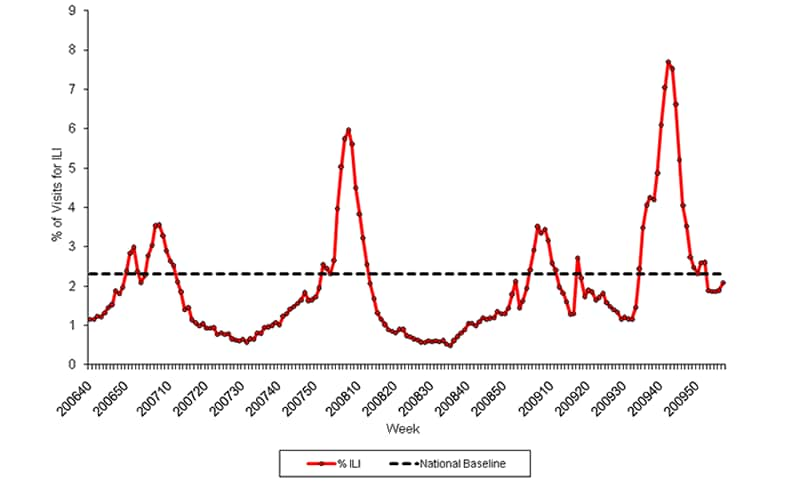
    When swine flu started to crash, some observers expected it to bounce back soon, as other flu strains have in the past. Ian York, at his blog Mystery Rays from Outer Space, offers some interesting ideas about why this hasn’t happened. He suggests that the virus has been stymied by pre-existing immunity in a lot of old people, new immunity from vaccinated children, and the protection that infected survivors now have. In other words, the virus just doesn’t have enough hosts now to sustain a new outbreak.

    It’s possible that the swine flu’s raging success in the fall may have also led to the weird situation we’re in right now, with no seasonal flu at exactly the time you’d expect it. One possibility is that getting sick with swine flu provides some cross-immunity to seasonal flu. Another is ecological: the swine flu outcompeted seasonal flu so effectively at the start of flu season that the seasonal flu hasn’t been able to get a toehold since.

    That, of course, could change. Seasonal flu has been known to peak as late as March. And while flu may be in a lull in the United States, it’s doing just fine in other parts of the world. For example, a nasty kind of flu called influenza B is raging around China right now according to the Chronicle. In normal years B makes up a pretty small fraction of US flu. But this is no normal year.

    Scientists did a better job tracking the 2009 H1N1 outbreak than they have with previous emergent strains. They’ve got new machines to sequence virus genes, online databases to pool information from around the globe, and powerful computers to help figure out where the viruses came from. And yet, with just ten genes, the flu still continues to move enigmatically ahead of our understanding.


  • California’s Fog Is Clearing, and That’s Bad News for Redwoods | 80beats

    redwoodIt’s not easy to survive century after century, through droughts and storms and oscillations of the climate. So California’s majestic coastal redwoods have developed a few tricks, like their great height: The trees can grow to more than 350 feet high, allowing their treetops to pull in moisture from the fog to keep their water levels refreshed. But, according to a new study in the Proceedings of the National Academy of Sciences, the fog is on the decline, which could spell trouble for redwoods and other area species.

    Fog often rolls ashore along the California coast from June through September. The hot, dry inland air rises and creates a vacuum that sucks in the cold, vaporous air from over the ocean [Wired.com]. While the small strip of land about 50 miles inland from the coast where the redwoods live is dry and hot, this influx of moisture keeps the giant trees hydrated.

    To obtain a historical record of coastal fog, the researchers looked at data on ceiling heights recorded hourly at several airports from 1951 to 2008. And they extrapolated back to 1901 using long-term land temperature data [The New York Times]. With the sea becoming warmer, less fog formed in the first place: Coastal fog cover decreased by more than an hour a day since 1951, researchers Todd Dawson and James Johnstone found. Temperature changes affected the fog, too. The coast has heated up faster than the redwood’s inland habitat, lessening the temperature difference between the two, which lowers the force pulling the fog inland. As a result of all this, the scientists propose that the redwoods receive at least three hours less fog per day in the summer than they used to.

    Redwoods are tough enough to survive anyway, the researchers say, but there’s another problem. “As fog decreases, the mature redwoods along the coast are not likely to die outright, but there may be less recruitment of new trees” [Reuters], says Dawson. That means fewer seeds are likely to sprout and take root along the coast, and then to grow to maturity. In addition, climate scientist Phil Duffy tells Wired.com that we shouldn’t focus exclusively on the towering, awe-inspiring sequoias, because lower levels of fog will affect many ecosystems that rely on it for moisture.

    Related Content:
    DISCOVER: The Strange Forests That Drink—And Eat—Fog
    DISCOVER: The Life, Death, And Life of a Tree
    Discoblog: Treehuggers vs. Solar Supporters: Who Cares More About the Environment?
    80beats: Is Google the Guardian Angel of Rainforests?

    Image: flickr / morgenlandfahrer


  • Insights from the Paul Offit Interview, Part II: Blame the Scientific Journal, Not the Media | The Intersection

    (If you haven’t yet heard the first episode of the new Point of Inquiry, you can listen here, and I also strongly encourage you to subscribe via iTunes from the same page.)

    The second insight from my chat with Paul Offit involved who he felt deserved the chief blame for the now notorious 1998 Wakefield paper (which, essentially, presented a claim of correlation between getting the MMR vaccine and getting autism based on a tiny sample of children, with a rather questionable mechanistic hypothesis attached). Offit said, very candidly, that he didn’t blame the media for going gaga over the study when it was published; rather, he blamed the Lancet for publishing it in the first place. As he put it around minute 10:

    I think journals are a public trust, and when that’s published in Britain’s oldest and arguably most respected general medical journal, the media is going to see that as information, they’re not going to see it just as a hypothesis raised, they’re going to see it as a study done. And for them, they’ll jump on it and say, “Here’s at least a cause of autism,” and scare the hell out of people. Which is what happened. I actually don’t blame the media for this. I think that when something is published in the Lancet, I can see where they would jump all over it.

    I agreed with Offit 100 % about this. Journals have a peer review process, and weeks or months to determine which studies to publish, after imposing quality control protocols. Journalists then have less than a day, in many cases, to determine what studies to cover and how to cover them. So by the time a study comes out in a journal, especially a major one, there’s no chance that you can unring the bell by hoping for the media to impose quality control, or call B.S. on this new piece of “science.”

    It just isn’t going to happen.

    For me, that’s another important insight from the Offit interview. Stand by for still more, and in the meantime, you can listen to the podcast and subscribe here. And don’t forget to buy Paul Offit’s book Autism’s False Prophets if you don’t already own it…

    autism-false-prophets-258x400


  • From Eternity to Book Club: Chapter Six | Cosmic Variance

    Welcome to this week’s installment of the From Eternity to Here book club. Chapter Six is entitled “Looping Through Time.” It’s about both the logical paradoxes presented by time travel, and some of the obstacles to actually building a time machine (closed timeline curves) in general relativity.

    Excerpt:

    Everyone knows what a time machine looks like: something like a steampunk sled with a red velvet chair, flashing lights, and a giant spinning wheel on the back. For those of a younger generation, a souped-up stainless-steel sports car is an acceptable substitute; our British readers might think of a 1950s style London police box. Details of operation vary from model to model, but when one actually travels in time, the machine ostentatiously dematerializes, presumably to be re-formed many millennia in the past or future.

    That’s not how it would really work. And not because time travel is impossible and the whole thing is just silly; whether or not time travel is possible is more of an open question than you might suspect. I’ve emphasized that time is kind of like space. It follows that, if you did stumble across a working time machine in the laboratory of some mad inventor, it would simply look like a “space machine”—an ordinary vehicle of some sort, designed to move you from one place to another. If you want to visualize a time machine, think of launching a rocket ship, not disappearing in a puff of smoke.

    There might not be too much new to say about this chapter, as part of it appeared as an excerpt in Discover and we’ve already talked about that. But maybe you weren’t reading that post, in which case, it’s new to you!

    There were three main goals in this chapter. The first was to explain what time travel would and would not be, in the context of general relativity — in particular, it would be just another form of travel through spacetime, not involving any disappearing and rematerializing at some other point in the past. The second was to go through some of the possible ways to make closed timelike curves (with wormholes or cosmic strings) and see how difficult it really was.

    But the third and most interesting goal was to connect time machines to the arrow of time and entropy. At this point in the book we’ve only introduced these concepts somewhat casually — the careful exploration of entropy is in Part Three, which begins next week — so one could argue that a more logical presentation would have delayed this discussion for later. But sometimes there are considerations beyond logic; in particular, once we built up momentum with the entropy discussion, a digression on time travel would have seemed like wandering too far afield. That was my feeling at the time, anyway.

    This is a really interesting aspect of time travel, which I think is dramatically under-emphasized in discussions about it: the real reason why traveling backwards in time makes us nervous is that it becomes impossible to define a consistent arrow of time. The arrow is very ingrained in how we think about the world, including the sense that the past is set in stone while we can still make choices that affect the future. In the presence of a time machine part of our personal “future” is already in the “past,” which seems to compromise our free will.

    So be it! Our free will was always an approximation, if we are good materialists who believe in the laws of physics. But it’s a highly useful approximation. It’s always worth emphasizing, when you start talking about the paradoxes of time travel: the simplest and most plausible way out is to imagine that the universe doesn’t (and won’t ever) actually have any time machines.


  • Wait, how big is NASA’s budget again? | Bad Astronomy

    I have mixed feelings about NASA, as is obvious if you’ve read my posts about it. But I think that they have done a simply fantastic and amazing job given how small their budget is. You might think NASA gets a huge amount of money — a lot of people do — but in fact they get only a tiny fraction of the federal budget.

    The New York Times made this very very clear recently when they posted an interesting graphic depicting the national budget allocations. Take a peek:

    fy2011graphic

    [Click to enporkbarrelate.]

    Can you find NASA on there? It’s actually listed under General Science, near the bottom right. That rectangle’s not very big, is it? And NASA is only a part of that section, so the space agency’s lion’s share is starting to look more like a kitten’s nibble.

    Now, wanna have fun? Close your eyes and click randomly on the graphic. Did you click on NASA? No? Shocker. But this gives you another way to think of the amount of money NASA gets, compared to, say, the military*. Statistically speaking, your chance of randomly picking NASA’s footprint on that graphic are about 1 in 125.

    I’m still working out what I think about Obama’s new plans for NASA. I’m happy about the increase he plans to give them, but we can easily afford to increase NASA’s budget by a lot more. We spend more on pet food every year in the US than we do on NASA. What we spend every year on tobacco products is five times NASA’s annual budget, so I’m thinking the money is out there.

    It’s not a matter of finding the money. It never is, and never has been. It’s a matter of finding the money in a way that isn’t political suicide for a politician. And that, I suspect, is because those of us who support space exploration haven’t made it politically expedient for everyone else to support it, too.

    I don’t have a remedy for that. I’m just a guy with a blog, so I blog about it, trying to show people that space is exciting, interesting, and worth a few more tax dollars a year. The more people who know that, really know that, the better off we are.

    Tip o’ the change purse to Fark.


    * Not to pick on the military, except to say that it gets a lot of money. I actually like to confuse my opponents by telling them truthfully that I support a strong military, since I know there are bad guys out there. Unlike political ideologues, I try to judge things on their merits, and make up my mind on a case-by-case basis. So you can try to peg me as a left-wing liberal on some issue if you want, but you’ll be wrong a lot of the time.


  • Yesterday’s “Morning Joe” Segment With Dr. Nancy Snyderman | The Intersection

    You can watch it here. No “balance”–the guests, Dr. Snyderman and myself, strongly agree that vaccines don’t cause autism. Enjoy!

    Visit msnbc.com for breaking news, world news, and news about the economy

    Once again, link to the segment can be found here.


  • Carl Sagan’s mix tape | Cosmic Variance

    Great Valentine’s appropriate story on NPR the other day via the always awesome Radio Lab, involving Carl Sagan,
    a whirlwind marriage proposal by phone, a 2500 year old Chinese song, and brain waves of new love sent into space on a golden record for future alien civilizations to find.

    This is a love story. And, oddly enough, it starts with an interstellar space mission and a golden record. Toward the end of the summer of ‘77, NASA launched two spacecraft as part of the Voyager Interstellar Mission. On board each craft was a golden record that included, among other things, the sound of a kiss, a mother’s first words to her newborn child, music from all over the world, and greetings in 59 different languages…

    Sagan’s wife Ann Druyan tells the story.

    Orginally broadcast on the “Space” episode of Radio Lab — listen to the whole thing here.


  • NCBI ROFL: Depiction of elderly and disabled people on road traffic signs: international comparison. | Discoblog

    332651213_a0ca6caa80“The traffic sign for elderly or disabled people crossing the road was introduced in the United Kingdom in 1981 after a children’s competition. It portrays a silhouette of a man with a flexed posture using a cane and leading a kyphotic woman… The same sign is also used for frail, disabled, or blind people, even though many of these people are not old. The sign implies that osteopaenic vertebral collapse and the need for mobility aids are to be expected with physical disability as well as with advancing age. Elderly people should not be stigmatised as being impaired or inevitably disabled. We had observed that some countries did not depict these groups in this way and wondered how road signs worldwide illustrate elderly people, as well as people with physical disabilities…We received 119 replies from British missions abroad and seven replies from British embassies, and we found five countries with signs by using an internet search… many countries (for example, Argentina, Brunei, and Macedonia) informed us that their country did not have a road sign warning of elderly, disabled, blind, or deaf people. Of the 118 countries for which we obtained information, 35 (30%) had a road traffic sign featuring one or more of the elderly, blind, deaf, or disabled categories.”

    Read the full article here.

    elderly

    Image: flickr/Daniel Hughes

    Related content:
    Discoblog: NCBI ROFL: BMJ week.


  • Two skeptical podcasts, both new and kinda new | Bad Astronomy

    With my friend D.J. Grothe taking the helm of the JREF, the question came up with what would happen with his old podcast, Point of Inquiry, that he did for the Center for Inquiry. The solution is interesting, and doubles your skeptical outlets: D. J. is doing a new podcast for the JREF, and PoI has been handed over to some new folks… with familiar names.

    First, D. J. is now podcasting for the JREF on For Good Reason, an appropriately-named ‘cast where he interviews, as usual, leading lights in critical thinking. The premier episode was with Randi hisself, the second with Daniel Loxton (who wrote a kid’s book on evolution I really liked), and the latest is a talk with Richard Dawkins. It’s a good podcast, which is no surprise! You can subscribe to it via iTunes too.

    Point of Inquiry is continuing on as well, with new hosts Robert Price and my friends Karen Stollznow and Chris Mooney (who blogs here at the Hive Overmind at The Intersection). The first installment is Chris interviewing Paul Offit on the evils of the antivax movement. I have that one cued up in my iPod and I’m looking forward to listening to it when my schedule allows. I actually don’t have a lot of time to listen to podcasts, but these two are definitely on my subscription list.

    If you’re a skeptic, and especially if you’re not, you should give these shows a listen. They may make you laugh, or make you angry… but they’ll definitely make you think.


  • The raw face of the Death Star moon | Bad Astronomy

    Of all the moons in the solar system, Mimas is one of the most recognizable. And new pictures from Cassini show us again just why.

    On Saturday, February 13, the Saturn probe dipped low over Mimas, sliding past the small moon at a distance of just 15,000 kilometers (9000 miles). For comparison, the Earth is about 13,000 km (8000 miles) across, so Cassini really threaded the needle with this pass.

    On its way out from the encounter, when it was about 70,000 km (44,000 miles) from the moon, it snapped this astonishing shot:

    cassini_mimas

    Yegads. Note that this image is raw and unprocessed — it’s basically straight off the camera (and converted to JPG). But holy cow, there’s a lot to see. The giant crater Herschel is pretty obvious. It’s about 130 km (80 miles) across (compare that to Mimas itself, which is 400 km in diameter!), with a central peak characteristic of large impact basins. I think that’s where the main weapon is located.

    cassini_mimas_herschelMimas has clearly had an interesting past: it’s battered beyond belief, loaded with impact craters. In fact, one thing scientists hope to learn from this pass of the moon is a bit of its timeline. By counting up the number of craters inside Herschel, and comparing that to the crater counts outside of it, they can estimate its age. Fewer craters inside of Herschel means it’s younger than the surrounding surface, for example. But how much younger? Maybe we’ll soon know. And they’ll be able to see craters that are pretty small; the resolution in the image here is about 200 meters (1/8 mile) per pixel. That’s about the same as we can do on our own Moon from Earth!

    Sometimes with raw images like this, the background can be a little screwed up due to artifacts in the camera. But in this case, the glow on the left hand side of the big image is quite real: it’s the face of Saturn itself! The geometry of the shot was just right to capture a bit of the cloudtops of the ringed world. Very cool.

    These are gorgeous pictures, and it’ll be nice to see them once they’re completely processed, too. We’ll learn a lot about the moon from them… and as far as Mimas goes, I just hope it’s not fully armed and operational. I suppose I shouldn’t be too worried though. After all, I used to bullseye womp rats in my T-16 telescope, and they’re not too much bigger than Mimas.

    Image credit: NASA/JPL/Space Science Institute


  • How Many Ways To Interpret “No”? Just One | The Intersection

    So a ‘survey‘ (via online polling) of over 1,000 people in London supposedly reports:

    ‘a majority of women believe some rape victims should take responsibility for what happened.’

    But considering:

    – how frequently we blame the victim rather than taking the time to address the real social and cultural norms that allow this mentality to persist…

    – how many victims of sexual violence already do not report the crime out of shame, fear, or public embarrassment…

    Silence Is The Enemy

    It’s necessary to speak up. And the truth is relatively simple: Regardless of how a person dresses or behaves, there is only one way to interpret No.” Case closed.

    That said, I’m skeptical that the results of this so-called survey reflect reality.